
Thursday, 7 March 2013 : 3rd Week of Lent, Memorial of Saints Perpetua and Felicity, Martyrs (Scripture Reflection)

Brothers and sisters in Christ, today let us stand with God and declare our faith and love in Him, that we would not be like the stiff-necked people in Israel in the past, and those who spurned God’s love and even accused Him of doing evil in His divine ministry in this world. For they were blind, blinded by their human weaknesses, blinded by sin and evil that they have committed.

For they have no true love for the Lord in their hearts. They love not the Lord but the praise of men and worldly honour. For these people failed to see the works of the Holy Spirit in Jesus, in healing the disabled, and casting out demons from the possessed. They instead submitted to their human jealousy and hatred of the good deeds of the Lord. There were also those, as mentioned in the Gospel today, put the Lord to the test, to see if He is really sent by God, to test His powers by sending a sign for them to see.

In fact, the act that Jesus did in casting out demons from the possessed had been the very sign that they have sought, in order for them to believe in Him. But they still failed to see, for their eyes were veiled with a thick layer of worldly sin and filth, that prevented them from seeing the works of God that is good. Jealousy is another thing, that it was indeed possible that in the hearts of some of the people gathered there, there brewed jealousy for the powers that God had, in Christ. It was the same case in the Acts of the Apostles, where Simon the sorceror attempted to bribe the Apostles to have the same authority and power given to them. But the authority of God is not purchaseable, and God gives it only to those whom He deems worthy.

Indeed, brothers and sisters, today God wants to show us that we have to believe in God, and not to be distracted by the evil one, that we begin to accuse God’s works as evil, out of our blindness to see the truth, which eventually will cause divisions between us, and in the end, as Christ had said, we will not be able to stand united, and shall fall down.

Truly, we are One, One in Christ, one as a member of the One Body of Christ, that is the One, Holy, Catholic, and Apostolic Church, that is our Catholic Church. We must all always remember the warning that Christ had given us today, that no house divided against itself will be able to stand and survive. The devil will not survive if he is divided against his servants and his collaborators, and therefore, so does our Church.

Throughout the millenia since the birth of the Church, there had been many dissents and divisions that led to the painful separation and destruction of unity in the Church of Christ, in parallel to the civil war of the nation as mentioned by Christ. We managed to stay together as the Catholic Church, and even managed to welcome some of our separated brethren back into unity with the One and only Church of our Lord. But even within our Church today, there are divisions, that will threaten to destroy the unity and harmony between all the faithful ones in God.

There are those who are blinded to the reason for unity, and chose to separate themselves from the Universal Church to pursue their own goals and ideas, rejecting all other ideas and anything that our Church had come through in the past 50 years since the reforms of the Second Vatican Council. On the other hand, there are many who had succumbed to the world, and buoyed by the evils of the world, begin to demand for worldly changes and innovations to enter the Church.

We must learn to be courageous and say no to all these things that brought disunity and discord into the holy Church of God. We must stand firm despite all the pulls that the world and evil that tried to break up the unity of the Church. How are we to bring back our separated brethren in Christ, those who had been lost in their long journeys in the faith, into the One Church of God, if we ourselves are divided in a civil war against ourselves?

Therefore. brothers and sisters, once again let us pray for unity, both among ourselves, the faithful in Christ already united in His Church, and ourselves and our separated brethren in the myriads of ‘churches’ throughout the world, with our brethren in the Eastern Orthodox and Syriac Orthodox Churches, and that very soon, Christ’s prayer and wish that all of us may be one (That they all may be One) just as He and the Father is one and indivisible, will be fulfilled, and all faithful in God, will be One.

Today, we also commemorate the memorial of Saints Perpetua and Felicity, who were martyrs in the early days of the Church. Saint Perpetua and Saint Felicity were a noble mother and her slave respectively, who were martyred in the height days of the Roman Empire, due to their steadfastness to stand by their faith and their God, and refused all forms of persuasion for them to leave their faith and convert back into paganism. Their faith in God and solid stand had earned them martyrdom and thus eternal life and place in heaven with God who loves them and all of us.

Therefore, brothers and sisters, let us not be divided among ourselves and instead strive for unity, beginning from those near to us, and gradually let us work for unity of all, reach out to our brother Christians who is not yet in full communion with the Holy Church of God. Pray that all will soon return and be united in Christ in the Church He had established on Peter, the Rock.

Pray for us, Saints Perpetua and Felicity, that we also can follow in your footsteps and imitate the strong and unshakeable faith both of you had in the Lord, even to giving up your life for God’s sake, out of love for Him and His children, all of us. Amen.
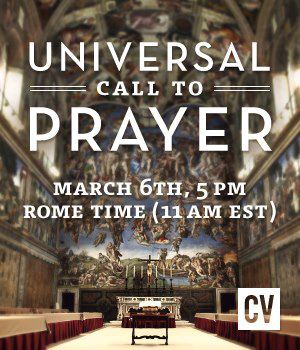
(Live from Rome) Prayer for the Universal Church : Wednesday, 6 March 2013 at 5 pm CET / Rome Time

Dear brothers and sisters in Christ, members of the One, Holy, Catholic, and Apostolic Church throughout the world. Let us all join together with the prayers for the Church that will be held today in Rome at 5 pm, and wherever we are in the world, let us spend the time for prayer for the Church, for the Cardinal-electors, and for the election of our new Pope.

602760_624609867556405_1994490267_n

The event will be live from Rome at Vatican Player, at either http://www.vatican.va/video/ or http://player.rv.va/?language=en&visual=VaticanTic. Do join in the prayers, and if you are unable to do so, and still in the workplace or busy with other commitments, just pray in your hearts, for the sake of our Holy Church.


Timing :

1. Rome : Wednesday, 6 March 2013 at 5 pm (UTC+1)

2. UTC : Wednesday, 6 March 2013 at 4 pm

3. EST : Wednesday, 6 March 2013 at 11 am (UTC-5)

4. PST : Wednesday, 6 March 2013 at 8 am (UTC-8)

5. WIB : Wednesday, 6 March 2013 at 11 pm (UTC+7) (West Indonesian Time, Bangkok, etc.)

6. Singapore : Thursday, 7 March 2013 at 0.00 am (UTC+8) (Singapore, Malaysia, HK, Macau, China, etc.)


The Cardinals, led by the Dean of the College of Cardinals, Cardinal Angelo Sodano, will pray together at St. Peter’s Basilica, and also participate in Eucharistic Adoration, led by the Cardinal Dean of the College. Let us pray for them, and pray that the Conclave will begin soon, and a new Pope, and a good Pope can be soon elected.

Why did Pope Emeritus Benedict XVI relinquished the Papacy? (My personal opinion)

In my personal opinion, why our beloved Pope Benedict XVI, now Pope Emeritus Benedict XVI, had decided to step down from his position and relinquish the Papacy, is because of three main factors and events that potentially play major roles in shaping his decision. All of these factors are tied to the first factor, that is his health.


Here are the three factors and events that in my opinion made our Pope Emeritus did what he had done :


1. Health : The Pope’s failing health due to his old age is likely the main reason why he had decided to relinquish the Papacy. Although indeed, he is now at 85 being much more vigorous as compared to Blessed Pope John Paul II’s last years, but as the Pope has great tasks to be done, for the sake of the Lord, and His people, Pope Benedict chose humility and step aside for someone else to take over the good works he had started.

He realised that his increasing difficulty in walking, most likely due to osteoarthritis and the problems with his vision will eventually impair him and preventing him from exercising his ministry as the Bishop of Rome. It has also been reported that Pope Benedict too suffers from Parkinson’s, although likely a mild one or one that is still at an early stage. This disease is well known for the one that debilitated Blessed Pope John Paul II, and Pope Benedict, being very close to the previous Pope, would really want to avoid another of many years of debilitation, where the Pope instead of leading directly the Church, had to delegate most of his works due to his disabilities. It is a matter of choice of course. Blessed John Paul II chose to persevere to show us how suffering for the sake of the Lord is like, and our beloved Benedict XVI stepped down to show us what humility and virtue is like.


2. WYD (World Youth Day) 2013 : The World Youth Day has been scheduled to occur in July 2013. It would have been in 2014, but because it will be held in Brazil, which will host the World Cup event in 2014, it was decided to hold the World Youth Day a year earlier. As the Pope’s health has made doctors to advise him strongly against transatlantic and difficult journeys, which would have limited him from visiting any countries outside of Europe, or even Italy in the coming years.

In 2012, his visits had been limited to Mexico, Cuba, and Lebanon, with only two major visits as opposed to the usual four or five visits per year, a clear sign that the Pope’s health is increasingly frail to travel far beyond Rome. As the World Youth Day 2013 will be held in Rio de Janeiro, Brazil, it is also possible that our beloved Benedict XVI chose to step aside that a more capable and vigorous new Pope can go instead to the event, that the new Pope can fully lead the event without the disabilities that increasingly had debilitated our beloved Benedict XVI.


3. Asia, the Church in Asia : Although Pope Benedict XVI had been known as someone who is particularly very attentive to the problems that the Church is facing in Europe and the West in general, which resulted in his numerous visits to the countries mostly in Europe, but he has also made several visits to countries in Latin America and Africa. Many would have criticised him for leaving out Asia, as although Middle Eastern countries like Jordan, Lebanon, Turkey and Israel had been visited rather often in his short pontificate, but he had yet to visit South Asia, Southeast Asia, and East Asia, where the Church, just as in Africa, had been growing very, very rapidly.

The Pope in fact, loved the Church in Asia, particularly the Church in China, which he had tirelessly worked at, in order that the believers in Christ there can be fully reintegrated into the One Body of the Universal Church, free from any form of external and governmental interventions.

Azerbaijan in Central Asia, was the last country in Central Asia visited by a Pope in 2002. But to truly look into Asia, we should go deeper into South Asia, that is India, and further east. The last time a Pope visited India and South Asia was in 1999 or 14 years ago, and the last time a Pope visited Southeast Asia was in 1995 (World Youth Day 1995, Manila, Philippines) or 18 years ago; and for East Asia, the last Papal visit was to Korea in 1989 or 24 years ago.

Several countries in Asia such as Singapore, Indonesia, Korea, Philippines, and some other Asian countries had also been graced with Papal visits only once or twice in the entire history of the Church, also owing to the recent expansion of the Church to Asia and that only beginning with Pope Paul VI, that the Pope began to travel again outside Rome and Italy after quite some time. Therefore, due to Pope Benedict XVI’s love for the Church, both in the elder Europe and the younger Church in Asia, and already that his debilitation had made him difficult to make transatlantic visits, including the upcoming World Youth Day in Brazil, but a travel plan to Asia would have made it much more difficult.

A younger and healthier Pope therefore will be able to visit Asia (South, Southeast, East Asia) perhaps as early as this year or next year, 2014. This is however not to say that an Asian Pope will be elected, just yet. The time has not come yet in this election for an Asian Pope. Only in the next election, which hopefully will be held in about a decade from now or more, that the first Asian Pope may be possibly elected.


In the end, it is Pope Benedict XVI’s love for God, and God’s people in the Church that made him to decide to step aside for the good of the Church and the good of God’s mission in this world. However, this is not at all interpreted that it will be permanently so or that such a stepping down will be customary for the Popes. The Papacy is not an office, and not an institution, which for example like the Archbishop of Canterbury of the Anglicans, which is rotated after every number of years in manner akin to the secular and the worldly prime ministers and presidents. No, the Bishop of Rome’s position, as Christ’s only Vicar on this world is far beyond that. Only the Pope himself can decide when and if he will resign at all, and only in extreme cases should this be done.

Let us all pray therefore for our beloved Pope Emeritus, His Holiness Benedict XVI, that God will continue to look after him in his retirement, that through his new life dedicated in prayer, he can lead the Church with the new Pope, his successor, whom we also pray for, to fight against the evils of this world. We also pray for those who attack the Pope, the institution of our Church, and those who attack the faithful in Christ, that first we forgive them, and ask the Lord to enlighten their hearts, that they will learn the truth about His Church and its teachings, that they too will believe and be saved through the One, Holy, Catholic, and Apostolic Church.

May God bless all of us, bless His One and Universal Church, and bless the whole world. Amen!

Friday, 1 March 2013 : 2nd Week of Lent (Scripture Reflection)

We are urged today, not to have evil thoughts on our brothers and sisters today, as illustrated earlier in the story of Joseph in the first reading and the psalm, and how he was sold off in slavery to Egypt due to his brothers’ jealousy, which caused them to initially harbour evil thought of killing him. The same evil intent and plot also happened in the Gospel when the tenants disposed of the servants and the son of the landowner, in the intention of gaining the lands they have been lent with, and disobeying the owner’s wish.

We should not harbour such evil intent, but instead look upon our brothers and sisters with love. Especially, just as Christ has taught us, we should even also look upon our enemies and our persecutors with love! and pray for them too!

And then indeed, the story of the Gospel today, as many of you would know, is a parable on the life of Christ Himself, with the Pharisees and the chief priests being labeled as the evil tenants, as obviously stated in the Scripture. Jesus is the Son of the owner, who is God the Father, who sent Jesus to us, down to earth, just like the owner sent his son in the hope that he will be able to bring the tenants into line and pay up what they are supposed to pay.

But yet, the rejected ones, as we had seen, in both Jesus and Joseph, had become a great instrument of the Lord through their rejection by the people, represented by the brothers of Joseph and the tenants in the Gospel. For Joseph became the regent of Egypt through the gift of prophecy through dreams granted to him by God, which saved thousands if not many more souls from death, by the wise and ample preparation before famine ravaged Egypt for seven years. All these would not have happened without Joseph and his dreams.

Even greater is therefore the role of Christ, for in being rejected by the people, the ‘tenants’ particularly the chief priests, teachers of the Law, and the Pharisees, He has become the very instrument of salvation of all mankind. This rejection was represented by the arrest of Jesus, His trial by the Sanhedrin, leaders of the priests of Israel, and finally His condemnation to death, and His death on the cross. In this He, as the rejected stone by the builder, had become the cornerstone, the very vital part of God’s plan of salvation.

What is a cornerstone? While we do not often use the terms in daily life, architects and those dealing with infrastructure and buildings will know it very well. For cornerstone is named so, since, at the time of the Roman Empire, there is a passion for building commemorative and triumphal arches. Some of these arches can still be seen even today, and some remained in the city of Rome itself. Why are these arches so strong and so solid to be able to stand for centuries and even millenia? It is because of its structure, which is so wonderfully constructed even without modern technology to keep them intact, all just because of one single stone at the peak of the arch, which is called the cornerstone.

This cornerstone is the focal point and the most important point of the arch. For if the cornerstone is removed, the arch will immediately crumble. As long as the cornerstone remained in place, removing other stones from the arch would have minimum impact on the arch’s integrity. Similarly, cornerstone can also be found in other buildings, also known more as the foundation stone. This stone holds up the integrity of the whole building by just being there, and as long as the stone stands, the building will too.

Christ therefore, has become our cornerstone through His death and sacrifice on the cross, and later His glorious resurrection and triumph over death and evil. Why is He our cornerstone? That is because if we keep our anchor on Him, keeping faith in Him, and ensuring that our faith is anchored deeply and securely in Christ, no amount of worldly temptations, and no amount of attacks and persuasions by evil can sway us and make us to fall away from the grace of God.

Through Christ who is our cornerstone, we then can act out His love and compassion on all mankind, for only if we anchor ourselves in Christ, that we can act with love and kindness, out of our faith in God who also loves us dearly that He did not even hold back His Son to be given to us for sacrifice to liberate us from eternal damnation.

Then Christ too established His Church, our Church, as the living and concrete presence that represents Him and His mission in this world, and there was none other than Peter the Apostle, upon whom, as the Rock, Christ chose to build up His Church, making Peter the cornerstone of His Church, the Body of Christ, which is made up of all of us the faithful in Christ.

Now, that our Pope, Benedict XVI, who was the 264th successor of St. Peter, had stepped down from his position as our Pope effective today, our Church, God’s Church, has been left without that cornerstone of faith, which has been passed down since the day of Peter, the first cornerstone of the Universal Church. We still have Christ of course as our Cornerstone, on whom all hearts and minds must be directed to, but it is through the Apostle Peter and his successors, the Popes, that this is made manifest, by them being the cornerstone of God’s living presence in this world, that is the One, Holy, Catholic, and Apostolic Church.

Therefore, today, and through the sede vacante period, and beyond that, let us pray, brothers and sisters in Christ, that first, we all will remain ever faithful, and that our anchor of faith will ever be solidly planted in the cornerstone that is Christ our Lord, always remembering His rejection and sacrifice on the cross that made Him the cornerstone of our life, the cornerstone of salvation, that enabled mankind to return and be reunited with God.

And then, we also pray in particular for our Church, that God will guide the Cardinal-electors who will elect a new Pope to succeed our beloved Pope Benedict XVI, with the guidance of the Holy Spirit sent by God upon all of them. That the world will again have a tangible cornerstone that is the successor of St. Peter, who made the Cornerstone of Christ manifest and real in this world, as the cornerstone of God’s most Holy Church, and as the cornerstone and head of the Body of Christ, the Church, leading all the faithful in Christ in unity with Christ their Saviour.

In the end, the cornerstone, although important, still requires the presence of all of us, the stones surrounding the cornerstone, for the cornerstone by itself will not make a building. Therefore, brothers and sisters in Christ, let us support the new Pope, whoever he will be, as all the people who believe in Christ, that the new Pope, the future cornerstone of the Church, will together build up a solid and strong Church, that is able to project God’s love and work into this world, that more and more people will be saved.

May God bless all of us, bless His Church, bless our retired Pope Emeritus Benedict XVI, and his soon-to-be elected successor. Amen!

Friday, 8 February 2013 : 4th Week of Ordinary Time, Memorial of St. Jerome Emiliani, and St. Josephine Bakhita, Virgin (Scripture Reflection)

We heard today of the tale of how St. John the Baptist was killed by Herod, out of Herod’s adulterous behaviour with his brother’s wife, and that wife’s hatred on John. St. John the Baptist, who had come before Christ to make straight the way for the Lord, met his death at the hands of the corrupt and immoral person who called himself the king of Judea at that time.

Who is John the Baptist? He is the cousin of Jesus, son of Elizabeth, miraculously conceived when Elizabeth was already old and barren, because the Lord desires that through her, a great prophet preceding Christ be born. St. John the Baptist indeed become the last prophet just before the coming of the Messiah, declaring to the world to repent and to be baptised at the River Jordan, in order to prepare themselves for the Messiah, who in fact at that time, had already walked on this world, in the form of Jesus, son of Mary, and Son of the Most High God.

John the Baptist’s call was heeded by many, who came to be baptised by John, and to truly repent from their sins. Nevertheless, the Pharisees and the scribes, just as they will later reject Jesus, they were also skeptical of John’s prophetic mission, and did not repent as many others do. But John managed to lay out the foundation for the later works of Christ and His disciples, just like a farmer plowing the soil preparing for it for the sower, who is Christ, who spreads the seeds on the plowed soil, fertile and ready, and thus are able to produce fruits hundredfold and thousandfold.

After Jesus was baptised by John, He arises in importance, which John in great humility said to his own disciples that just as the Lord for whom he has come to prepare the path for, is rising, he himself has to become lesser. His task in preparing the path for the Lord is complete, and in the last part of his life, which was told in the Gospel today, he was imprisoned for chastising Herod the king and his adultery with Herodias, his brother’s wife.

In ancient Jewish custom, this is actually not unacceptable for a brother to take care of a deceased brother’s wife, and take her as his own wife. Remember another story from the Bible, where the Saducees, who did not believe in the resurrection, asked the Lord about whose wife is the woman who was married to seven brothers, who died one after the other. Clearly, this custom is identified as the norm at that time, as the widow is perceived to be financially incapable of supporting herself, and therefore, it is justified for the brother to come in and take care of his sister-in-law by marrying her himself.

However, in this case, this is different because, just as Jesus later will stress, that marriage is a sacrosanct act, in which a man and woman is joined by God, and through God, this union, when made is eternal and cannot be dissolved by either man or even angels. For what God has made one, no man shall divide. This is the new commandment of the new covenant that Christ brought with His coming, and John, as the messenger of the Lord, did his last service to God by putting forward this teaching, against none other than Herod himself.

It is sad that today, many disregard the sanctity of marriage, and think that marriage is a trivial matter, and that divorce can be so easily contemplated and done. Divorce is something which should be avoided at all costs, as it directly violates what God has told us, that what He had brought together in marriage, which is a Sacrament on its own, no one, not even the husband and the wife themselves should divide back into two. It is sad that in our modern world, many take divorces lightly, and even marry again after the divorce. Many who did this, did so because they claim that they no longer love the wife, or worse that they have been tempted with lust and desire for another woman or man.

In order to maintain the sanctity of marriage, it is paramount that in the family, the faith in the Lord be kept strong, and that all actions should be carried out in love, and in accordance with God’s will. This is why it is important for couples and families, to come together and have meals together as best as they can everyday, so that they will stay close, despite challenges and temptations, and pray together, that the Lord will continue to bless them and strengthen their union, so that the evil one cannot come in between them and made them to decide to split.

Many couples are able to last for decades and many last beyond 50 years, and indeed, until death brought them apart, but not forever, since we know that we eventually will be reunited with the loved ones when we ourselves ascend to heaven at the end of our own lives. Indeed, their secret is no other than ensuring that couples constantly speak to one another from heart to heart, and coming together at all times, with their children, to pray regularly, to share the meal at the table. Remember that when more than two and three gathered in God’s name, He will be there, and will remain there with them, always.

Another story which I will bring to your attention, besides the already told story of John the Baptist, Herod, and Herodias, is the story of the divorces of King Henry VIII, the founder of the Anglican ‘church’ in his vain search for a male heir. King Henry VIII divorced his first wife, Catherine of Aragon, because she was not able to produce a male heir for him, although she did produce a daughter. His appeal to divorce her to the Pope was rejected, and King Henry VIII, displeased at the Papal disapproval went his own way and rebel from the Church, creating his own Anglican ‘church’.

St. Thomas More, King Henry VIII’s chancellor, refused to follow his king into rebellion from Rome, and chastised the king for his immoral behaviour in seeking to marry Anne Boleyn, who was to become the king’s second wife. He was asked to choose between loyalty to his king, and be given great wealth and influence as he always had before that, and thus even greater afterwards, or death if he remains faithful to the true Church. St. Thomas More abandoned all of his worldly wealth and fame, and chose to remain faithful to the Lord, and was therefore martyred.

Ultimately, King Henry VIII would kill Anne Boleyn after she herself failed to produce a male heir, and eventually married no less than four more times, with a total of having six wives and at least two mistresses, and all ultimately in vain, since even when there was a male heir, he died young, and the dynasty died out.

All that futile attempts was most damaging especially if we see how today, 80 million Christians who are in the Anglican Communion, are the direct product of this adulterous behaviour of King Henry VIII. This is an example on how if marriage is not kept as sacrosanct and indivisible in nature, not only it can affect just the two, but especially in King Henry’s case, it caused the destruction of the unity in the Body of Christ, that is the Church. Until today, we still pray and hope that all of them will eventually return soon to the true Faith and Church.

Today we also celebrate the feast of St. Jerome Emiliani, an Italian charitable man who cared deeply for the poor and orphans in early 16th century northern Italy, and died after in his pious work of service to the sick and the poor, he contracted a disease that killed him, and St. Josephine Bakhita, a Canossian nun, who was once a slave from Sudan, who after being freed from slavery, converted to Christianity and committed herself to the Lord by joining the Canossians as a nun. She was noted for her great faith in the Lord, and her dedication to Mary, His mother. She was also very much noted for her great heart and forgiving nature, seeking not revenge against her enemies, and even her former slavemasters, but rather seeking to forgive them and bless them instead.

Therefore, in the footsteps of these great saints, let us all strive, especially for those amongst us who are married, to keep our lives holy and meaningful, by doing what is good for the sake of others, just like St. Jerome Emiliani in service of the poor and the sick, by giving and sharing what we have more to those who need them more, and by our gentle and forgiving nature, following the example of St. Josephine Bakhita, who strive to keep herself pure and holy in the presence of God.

Let us pray also for the unity of all Christians, that especially for the Anglicans today, that their detachment from the Body of Christ that is the Church can soon be reversed, through our constant prayers to God, and through God’s actions, may the unity of the Church be restored. What damages King Henry VIII had done in his adulterous ways parallel to what Herod had done, in direct opposition to the Lord’s will on the sanctity of marriage, may we begin to heal through concrete attempts to reunite back the branches of the Body of Christ back onto its trunk, the Church.

Pray for us, St. Thomas More. And St. Jerome Emiliani, and St. Josephine Bakhita, pray for us all too. Pray for God’s holy Church that it will be one again, and indivisible, just like marriage, as the Lord has made His Church one, just like He and the Father is one and indivisible in the Holy Trinity. Amen.

+Ut Omnes Unum Sint+

(That they all may be One)

Week of Prayer for Christian Unity (beginning 18 January 2013)

The week of Prayer for Christian Unity begins today, 18 January 2013, and will last till 25 January 2013. Let us pray for the Unity of all Christians in the One Church, One Body of Jesus Christ our Lord. That no Christians will ever go astray again, severed from the Root of Jesse, Christ Himself, that is the Church.

+Ut Omnes UNUM Sint, ad Maiorem Dei Gloriam+
(That they all may be ONE, for the greater glory of God)