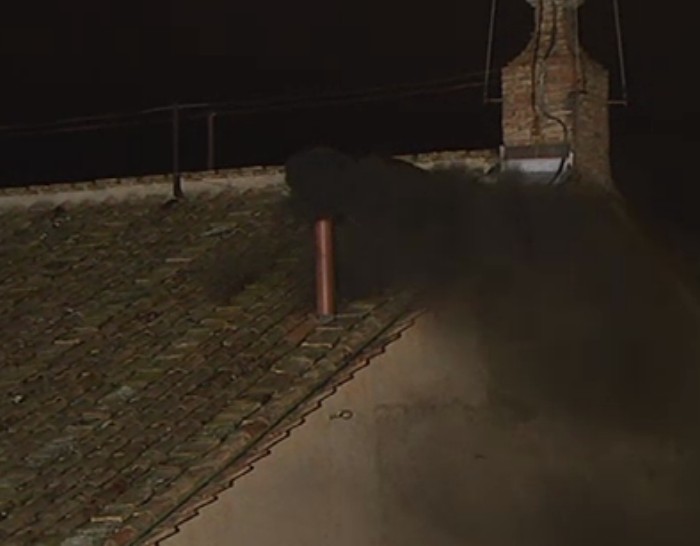
Time to watch for smoke from the Sistine Chapel chimney

Image

These are the times to watch the smoke from the Sistine Chapel’s famous chimney.

As mentioned :

1. First and third ballot of the day will only have smoke if the Pope has been elected. This smoke will always be white.


2. Second and fourth ballot of the day will always have smoke, and can either be black or white.

a. Black smoke : no Pope has been elected

b. White smoke : a new Pope has been elected


3. 45 minutes will pass between the white smoke, and the appearance of the Cardinal Protodeacon, who will announce the Habemus Papam, which will reveal the name of the newly elected Pope, then another 15 minutes will likely pass before the new Pope made his appearance.

First Ballot : Black Smoke, no Pope had been elected yet

http://www.romereports.com/palio/pope-not-yet-elected-black-smoke-comes-out-of-sistine-chapel-english-9378.html

Image

Black smoke from the chimney of the Sistine Chapel for the first ballot, and the only ballot on the first day of Conclave, Tuesday, 12 March 2013.

The next voting rounds will be on Wednesday, 13 March 2013, composed of morning session (2nd and 3rd ballots), and the afternoon session (4th and 5th ballots).

Cardinal Angelo Scola, Archbishop of Milan, the Papabile

http://www.eitb.com/en/news/world/detail/1282802/candidates-new-pope–profile-cardinal-angelo-scola/

From the article (My commentary at the end) :


Election of new pope

Profile of Cardinal Angelo Scola, Archbishop of Milan

APTN

03/11/2013

A conservative, and theologically close to both Pope Benedict and his predecessor John Paul II, Cardinal Scola is regarded as one of the leading European candidates to become Pope.

Cardinal Angelo Scola, the archbishop of Milan.

Cardinal Angelo Scola, the archbishop of Milan, shot to the top of a list of possible successors to Pope Benedict XVI almost immediately the resignation was announced.

A conservative, and theologically close to both Pope Benedict and his predecessor John Paul II, Cardinal Scola is regarded as one of the leading European candidates to become Pope.

Some observers tipped him to succeed after the death of John Paul II in 2005, but the conclave instead chose Cardinal Joseph Ratzinger who became Benedict XVI, the 265th pope.

But if there was rivalry between the candidates in 2005, it had little effect on their close relationship, and Scola remained a favourite of Pope Benedict’s, who appointed the Cardinal archbishop of the Milan Diocese in June 2011.

In the small town of Malgrate on Lake Como in northern Italy, many of the 5,000 residents are backing their hometown boy to become Pope. Scola was born in Malgrate on 7 November 1941 to a truck driver and a homemaker.

He entered the priesthood in 1970, became a Cardinal in 2003, serving first as Patriarch of Milan until he was elevated to his current post of archbishop.

Scola’s cousin, Angelo Colombo, remembers that during World War II he would spend time at his cousin’s home because Scola’s father was a truck driver and could get access to flour and bread.

Colombo said he would go to Scola’s family home, and his aunt and the future Cardinal would always share their food. When he asked if he thought his cousin would make a good Pope, Colombo laughed and responded: “he was a tough boy”.

Scola spent the early years of his life in a small home on Malgrate’s Salita Sant’Antonio. Alfredo Cagliandi was a classmate of Cardinal Scola and lived in the apartment below him.

“We would invite Angelo to come and play and he would repeatedly respond ‘I am sorry, but I don’t have time.’  He was too busy because was already involved in something religious,” said Cagliandi, who still lives in Malgrate.

Scola spent the first two decades after his 1970 ordination in the lecture halls and libraries of renowned Catholic universities and theological training grounds, notably in Fribourg, Switzerland, and the Lateran Pontifical University in Rome.

While pursuing theological studies, Scola was involved in Communion and Liberation, a conservative Italian Catholic group which blends political activism with faith-based fervour as it seeks to make its weight felt in the country’s decision-making.

Back in Scola’s home town, the local priest Father Andrea Lotterio proudly showed off the baptismal font where he says the town’s babies are still baptised today, noting that Scola was baptised there in 1941.

Father Lotterio said Scola has pleased the residents of Malgrate by never losing his strong ties to his hometown. “He has maintained his relationships with many local citizens, with his friends, with his relatives,” Lotterio said. “So much so that in this town he is called Don Angelo, instead of Cardinal or Patriarch of Venice.”

Pope Benedict resigned as leader of the Catholic Church on Thursday, becoming the first pope in 600 years to resign. For the time being, the governance of the Catholic Church shifts to Cardinal Tarcisio Bertone, the camerlengo, or chamberlain. Bertone, along with the College of Cardinals will guide the church and make plans for the conclave to elect the 266th leader within the next few weeks.


Commentary and additions:

Indeed, Cardinal Angelo Scola has many strengths and characteristics that we need as the new Pope to lead the Roman Catholic Church, the one and Universal Church. He does have his weaknesses, but his strengths more than made up for him. After all, it is human to have weaknesses and to make mistakes.

Cardinal Scola is media-savvy, able to reach out into the hearts of many, including youths and those in the world, who are longing for the Lord to come to them. Being media-savvy, and also internet-savvy, Cardinal Scola is not shy of using modern media tools, such as the internet, twitter, YouTube, his own site, and many other means to evangelise to the world, and to reach out, especially to youths.

Cardinal Scola also has a positive outlook and optimism in the Church, and indeed, instead of being pessimistic on the Church, and instead of looking at a Church in trouble, he dismissed all this, and all the lies that the media had brought about the Church, that the Church instead of being in chaos and trouble, is in fact growing, and filled with vibrant and strong faith and love in God, and Cardinal Scola has the capacity to tap into all these energies.

Cardinal Scola also came from a poorer family background, and he understood the plight of the poor and the less fortunate. His hometown people has often remembered him as someone who not only did not forget about where he came from, and where he was born, but also someone who constantly gives them his care and his love, in imitation of Christ and His care for the poor.

Cardinal Scola speaks Italian, English, French, and Spanish, and although his English is not that good, but he has quite a strong command of these languages, which are essential in the Pope’s ministry as the leader of the Universal Church.

Cardinal Scola’s initiatives to reach out to the Christians in the Holy Land and in other areas where Christians are minorities, and his involvement in interreligious dialogue and cooperation, and even with atheists, had been fruitful and crucial in strengthening Christians in the areas where they had been persecuted, and where persecutions are ongoing.

His experience in the Archdiocese of Milan, Patriarchate of Venice, and Diocese of Grosseto clearly showed that he is a pastoral leader with a humble and yet intellectual mind, that matches that of our beloved Pope Emeritus Benedict XVI. Yet, his experiences in the Roman Curia too were many, with works as leader of Pontifical Institute of Marriage and the Family, which he also took a strong stand with the Church in the sanctity of both marriage and the family.

His intellect, knowledge, and publications especially in topics like bioethics, in the midst of the attacks against Church’s stand on bioethics, cloning, and contraceptions will be essential for the future leader of the Church, and his ability to connect and reach out to people, more than Pope Emeritus Benedict XVI, will be valuable asset to have in the new Pope.

Nevertheless, now that the Conclave will begin soon, we continue to pray that God will pour His Holy Spirit on all the Cardinal-electors, that they can make a wise and inspired decision, to elect someone whom the Lord has chosen, as the best possible person to succeed His Apostle, Peter, and lead the whole Universal Church, that God Himself built in this world, to be the manifestation of His love, justice, and presence.

A Timetable of the First Day of Conclave

What will happen today in the first day of the Conclave (Tuesday, 12 March 2013)? All the time noted below are in Rome time (CET, Central European Time, 1 hour ahead of UTC (UTC+1)).

Some event are live from Vatican Player at http://www.vatican.va/video/ and the live recording from Rome Reports : http://www.romereports.com/palio/modules.php?name=Content3&pa=showpage&newlang=english&pid=47#.UT4XGVeJegH


1. (Live) Mass for the Election of the Roman Pontiff / Missa pro Eligendo Pontifice : 10 am. This Mass will officially begin the Conclave and will be offered for prayers for the election of the Pope.

2. Cardinal-electors leave the Domus Sancta Marthae where they stay for the Pauline Chapel : 3.45 pm

3. (Live) Cardinal-electors begin the procession into Sistine Chapel from Pauline Chapel, while singing Veni Creator Spiritus and the Litany of the Saints : 4.30 pm

4. (Live) Oath of secrecy by the Cardinal-electors and the extra omnes order by Monsignor Guido Marini : 4.45 pm, then meditation by Cardinal Prosper Grech of Malta (2nd meditation)

5. Conclave and first ballot : about 5 pm – 7 pm, smoke should appear between 7-8 pm Rome time. If white, means a new Pope has been elected, but this is unlikely to happen. (Smoke and the chimney can be seen live through either Vatican Player or Rome Reports page I mentioned above)

6. Vespers celebrated by the Cardinal-electors : 7.15 pm

7. Cardinal-electors return to Domus Sancta Marthae, their residence during the period of the Conclave : 7.30 pm


These are just rough timing, and as this is the first ballot, the Cardinal-electors may still need time, especially the first-timers, in getting used to the rules and proceedings of the Conclave and thus might be delayed slightly.

My Guide to the Papal Conclave : Part II (From the beginning of the Conclave to the election of the new Pope)

Part I here : https://petercanisiusmichaeldavidkang.com/2013/03/09/my-guide-to-the-papal-conclave-part-i-from-before-to-the-conclave-to-its-beginning/


1. The Conclave begins after selected prayer done by each of the Cardinal-electors, after which then the Cardinal Dean or the senior Cardinal Bishop who is an elector (Cardinal Giovanni Batista Re) who will then ask if there is any need to confirm and re-explain the rules of the Conclave as written in the Apostolic Constitution Universi Dominici Gregis, and the modifications made by the two Motu Proprios released by Pope Benedict XVI, or whether the election can begin immediately without any issue.

If there is no questions raised or no request for reiteration of the rules, then the balloting to elect the new Pope can begin in earnest.


2. According to the Apostolic Constitution, Universi Dominici Gregis, the election of the new Pope can only be done by scrutiny, that is through secret ballot, in which each of the Cardinal-electors write the name of the Cardinal or the person the Cardinal-elector wishes to vote for as his candidate for the Papacy.


3. Pre-Scrutiny period : Three Cardinal-electors are selected as Scrutineers, another three as Infirmarii, and another three as the Revisers. All selections are done by drawing of lots among the Cardinal-electors. Their duties are :


a. Scrutineers : Add up all the votes that the Cardinal-electors have submitted, and if noone obtains two-thirds of the vote, no Pope has been elected, but otherwise, the new Pope had been elected, with a necessary minimum of more than two-thirds of the vote of all the Cardinal-electors (For 2013 conclave, this requires at least 77 votes).

b. Infirmarii : Carry the voting slips for the Cardinal-electors who are sick and therefore unable to attend the voting directly in the Sistine Chapel. Their task is to obtain the votes from the ill Cardinal-electors and then place them in a sealed container and bring the votes back to the Sistine Chapel to be tallied by the Scrutineers with the rest of the votes.

c. Revisers : Revisers act to check the calculation and tallies made by the Scrutineers to ensure that all the calculations are done meticulously, faithfully, and without any modifications or changes.


4. Scrutiny Proper : The Cardinal-electors receive two or three ballot slips each, with a blank line representing the place where they should place the name of the person they wish to vote for (only one name allowed, otherwise that ballot is invalid). They write the name, and then they bring it one by one to the receptacle on the Altar of the Sistine Chapel for the votes, in the presence of the Scrutineers, and before they place the ballot slip, they recite the words :

Testor Christum Dominum, qui me iudicaturus est, me eum eligere, quem secundum Deum iudico eligi debere.

I call as my witness Christ the Lord who will be my judge, that my vote is given to the one who before God I think should be elected.

Then they place the ballot slip into the receptacle, and then return to their respective places.


5. Once the ballot slips are all collected, the first Scrutineer shake the container to mix the votes, and then the last Scrutineer must count the number of votes inside the receptacle. The number of votes must tally with the number of Cardinal-electors (to avoid double-voting). If the number tallies correctly, the counting of the votes can begin. Otherwise, the votes are burned, and a second vote must immediately be taken.


6. For the vote counting, the first Scrutineer take one ballot paper, unfolding it, and taking note the name on the ballot, then pass the ballot to the second Scrutineer, who also takes note the name on the ballot, and then passing the ballot again to the third Scrutineer, who will then read the name on the ballot aloud to all the Cardinal-electors.

Only one ballot paper is allowed in each. If two ballot papers had been folded to make it look like one ballot, then if the name on both papers are the same, they count only as one vote. But if the names are different, they are invalid.


7. Once all the ballots are accounted for, and the names in them had been read out, the ballot papers are then secured together with a string to ensure that all the papers are in order, and the total votes are tallied together in order to get the number of votes that particular candidates receive in that voting session.

If no one receives more than two-thirds of the vote, then there is no new Pope elected.

If someone receives more than two-thirds of the vote, then a new Pope had been elected.


8. On the first day of the conclave, only one afternoon ballot may be held. Then if there is no Pope elected on that day, four ballots are held in the following days, with two ballot sessions in the morning, and two ballot sessions in the afternoon, until a new Pope is elected when someone receives more than two-thirds of the vote.


9. If after three days there had been no Pope elected, the voting session is suspended for maximum of one day to allow time for prayer and reflection among the Cardinal-electors, to allow them to discern carefully on their choices and pray for the inspiration of the Holy Spirit in electing a candidate as the new Pope.

Seven ballots occur afterwards, and if the Conclave has yet been able to elect a new Pope by then, another day is taken for the same break period for prayer, which is then followed by another seven ballots, and then break if the Conclave still yet fails to elect a new Pope, and so on and so forth until the new Pope had been elected.

If until 30 ballots had passed, and no one has been elected as the new Pope, the Cardinal Camerlengo will ask the Cardinal-electors on how to best proceed with the election of the new Pope. With the Motu Proprio released by Pope Benedict XVI in 2007, the provision allowing the Cardinals to go into absolute majority (50% + 1 vote) had been removed, and therefore election will definitely have to be settled with more than two-thirds majority.

After that discussion (after the 30th ballot), the two names with the greatest number of votes will be selected, and if the two names belong to the Cardinal-electors, these two Cardinal-electors lose their right to vote in the next ballot, in which this ballot will only include these two names. The new Pope however has to be still elected by two-thirds majority out of these two names. (This is to avoid a certain group of Cardinal-electors who fail to secure two-thirds majority for their candidate to stall the conclave so that they can elect their candidate by absolute majority as previously allowed by the Apostolic Constitution Universi Dominici Gregis, but such provision was removed by Pope Benedict XVI’s 2007 Motu Proprio).


10. After two ballots (in the morning, and in the afternoon), the votes from both ballot sessions in the morning or in the afternoon, immediately after the second ballot session (morning/afternoon) is burnt at the special stoves prepared for that purpose. Colouring chemicals are then used to make the smoke either black or white depending whether a new Pope had been elected or not.

The smoke will then come out from the chimney linked to the stoves, which is placed on the roof of the Sistine Chapel, and will be the first sign for the outside world whether a new Pope had been elected. The bells of St. Peter’s Basilica and churches around Rome will also be rung when a new Pope had been elected.

Black smoke (la fumata nera) : No new Pope had been elected, more ballots to go.

White smoke (la fumata bianca) : A new Pope had been elected, and the Conclave has ended.


11. When a new Pope had been elected, the Cardinal Dean, or his Vice Dean if the Dean is elected Pope (as the case in 2005 conclave when Cardinal Dean, Joseph Ratzinger was elected Pope), or the senior Cardinal Bishop present in the Conclave as an elector (Cardinal Giovanni Batista Re), will then approach the newly elected Pope, and ask him the formula of the acceptance :

Acceptasne electionem de te canonice factam in Summum Pontificem?

Do you accept your canonical election as Supreme Pontiff?


He will then answer “Accepto or I accept” if he accepts his election as Pope.


Then he will be asked :

Quo nomine vis vocari?

By what name do you wish to be called?


The new Pope will then answer the name he wish to be called (Benedict for Cardinal Joseph Ratzinger, who became Pope Benedict XVI, as there had been 15 other Popes named Benedict before him).


The names that the Popes had used in the past two centuries (from 1800) and what they will be like if the new Pope uses them in parenthesis :

1. John (John XXIV)

2. Benedict (Benedict XVII)

3. John Paul (John Paul III)

4. Paul (Paul VII)

5. Pius (Pius XIII)

6. Leo (Leo XIV)

7. Gregory (Gregory XVII)


12. After the newly elected Pope accepts his election, the Conclave ends, unless the new Pope says otherwise.


Continue to Part III here : https://petercanisiusmichaeldavidkang.com/2013/03/09/my-guide-to-the-papal-conclave-part-iii-from-the-election-of-the-new-pope-to-the-urbi-et-orbi-blessing-by-the-new-pope/