Pope Benedict XVI (16 April 1927 – 31 December 2022)

Pope Benedict XVI, 265th Pope, Vicar of Christ and Supreme Pontiff of the One, Holy, Catholic and Apostolic Church has passed away peacefully at 9.34 am Rome time on the last day of the Year of Our Lord 2022, 31 December 2022.

May he rest in peace. Requeiscat in Pace.

Pope Emeritus Benedict XVI will return to the Vatican on Wednesday, 1 May 2013

http://vaticaninsider.lastampa.it/vaticano/dettaglio-articolo/articolo/papa-el-papa-pope-bergoglio-ratzinger-24332/

Image

According to the original Italian language article of the Vatican Insider/La Stampa above, Pope Emeritus Benedict XVI will return to the Vatican from his stay in Castel Gandolfo, the Papal summer residence on Wednesday, 1 May 2013.

Pope Emeritus Benedict XVI had stayed at Castel Gandolfo since his retirement as reigning Pope of the Church on 28 February 2013, 2 months earlier. He will be staying in the former Mater Ecclesiae monastery which was originally a cloister for nuns, and now vacated to accomodate the Pope Emeritus and his assistants, which include the current Prefect of Papal Household, Archbishop Georg Ganswein, who is also Pope Emeritus Benedict XVI’s private secretary.

This will make the work better for Archbishop Ganswein as in his capacity as both the private secretary to the Pope Emeritus and the Prefect of Papal Household, he had to travel daily between the Vatican and Castel Gandolfo.

Image

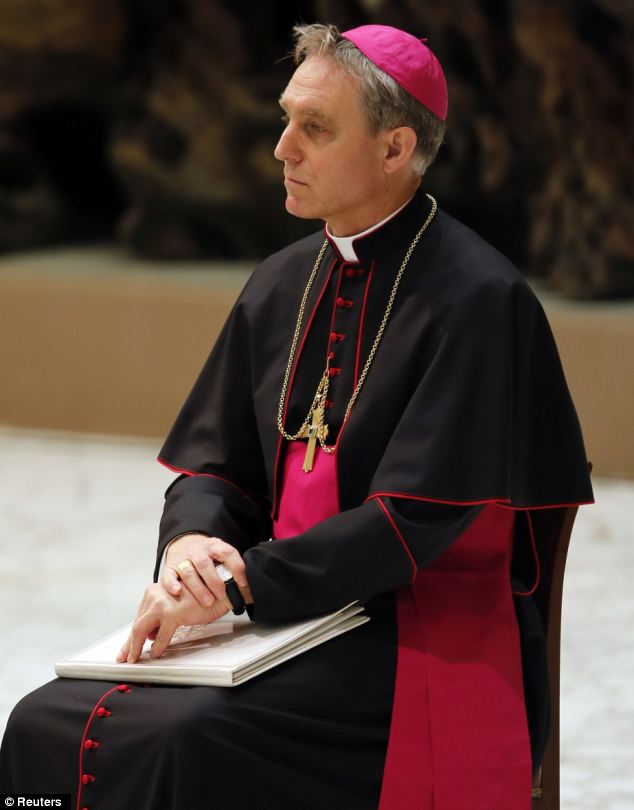
(Above : Archbishop Georg Ganswein, current Prefect of the Papal Household and private secretary to Pope Emeritus Benedict XVI)

May God bless our dear Pope Emeritus, bless him with good health, that he will continue to pray for our Church, and that the reforms that he had begun in the liturgy, worship, and new evangelisation can continue to flourish and grow.

Cardinal Juan Sandoval Iniguez turns 80, ceases to be a Cardinal-elector

Image

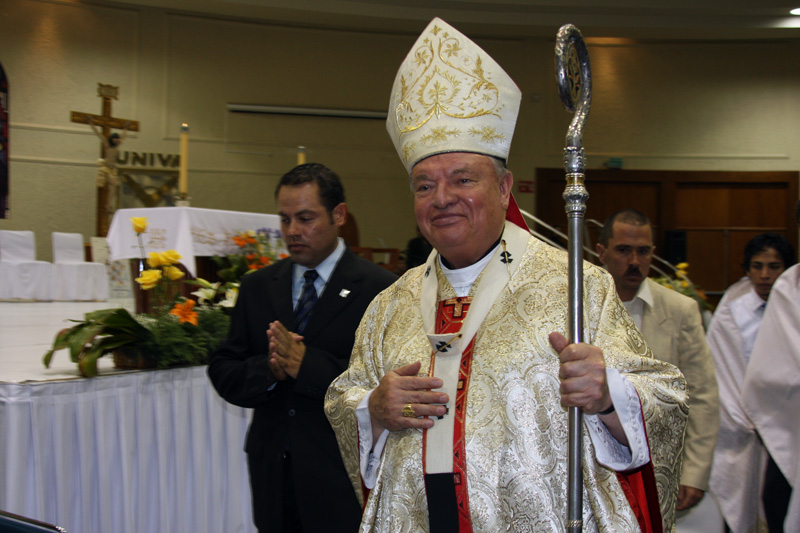
Today, Thursday, 28 March 2013, Cardinal Juan Sandoval Iniguez, Cardinal-Priest of Nostra Signora di Guadalupe e S. Filippo Martire, and Metropolitan Archbishop Emeritus of Guadalajara, Mexico, turns 80, and therefore, according to the rules written in the Apostolic Constitution Universi Dominici Gregis, he loses his right to vote in any future conclave.

http://www.gcatholic.org/hierarchy/data/cardJP2-6.htm#144

May God bless His Eminence Cardinal Sandoval Iniguez, with a blessed old age and health. May he remain strong in the faith and hopefully can perhaps still carry out the mission God had given him.

The College of Cardinals now stands at 206 members in total, with 113 Cardinal-electors and 93 Cardinal non-electors. There are now vacancy of 7 Cardinal-electors as compared to the maximum number of electors allowed in the Conclave of 120, although Popes John Paul II and Benedict XVI had sometimes surpassed this limit.

Next Cardinal-elector to age out (80) will be Cardinal Godfried Danneels on 4 June 2013.

Homily of Pope Francis at the Mass of the Palm Sunday of the Passion of our Lord at St. Peter’s Square, Sunday, 24 March 2013

http://www.vatican.va/holy_father/francesco/homilies/2013/documents/papa-francesco_20130324_palme_en.html

Jesus enters Jerusalem. The crowd of disciples accompanies him in festive mood, their garments are stretched out before him, there is talk of the miracles he has accomplished, and loud praises are heard: “Blessed is the King who comes in the name of the Lord. Peace in heaven and glory in the highest!” (Lk 19:38).

Crowds, celebrating, praise, blessing, peace: joy fills the air. Jesus has awakened great hopes, especially in the hearts of the simple, the humble, the poor, the forgotten, those who do not matter in the eyes of the world. He understands human sufferings, he has shown the face of God’s mercy, and he has bent down to heal body and soul.

This is Jesus. This is his heart which looks to all of us, to our sicknesses, to our sins. The love of Jesus is great. And thus he enters Jerusalem, with this love, and looks at us. It is a beautiful scene, full of light – the light of the love of Jesus, the love of his heart – of joy, of celebration.

At the beginning of Mass, we too repeated it. We waved our palms, our olive branches. We too welcomed Jesus; we too expressed our joy at accompanying him, at knowing him to be close, present in us and among us as a friend, a brother, and also as a King: that is, a shining beacon for our lives. Jesus is God, but he lowered himself to walk with us. He is our friend, our brother. He illumines our path here. And in this way we have welcomed him today. And here the first word that I wish to say to you: joy! Do not be men and women of sadness: a Christian can never be sad! Never give way to discouragement! Ours is not a joy born of having many possessions, but from having encountered a Person: Jesus, in our midst; it is born from knowing that with him we are never alone, even at difficult moments, even when our life’s journey comes up against problems and obstacles that seem insurmountable, and there are so many of them! And in this moment the enemy, the devil, comes, often disguised as an angel, and slyly speaks his word to us. Do not listen to him! Let us follow Jesus! We accompany, we follow Jesus, but above all we know that he accompanies us and carries us on his shoulders. This is our joy, this is the hope that we must bring to this world. Please do not let yourselves be robbed of hope! Do not let hope be stolen! The hope that Jesus gives us.

The second word. Why does Jesus enter Jerusalem? Or better: how does Jesus enter Jerusalem? The crowds acclaim him as King. And he does not deny it, he does not tell them to be silent (cf. Lk 19:39-40). But what kind of a King is Jesus? Let us take a look at him: he is riding on a donkey, he is not accompanied by a court, he is not surrounded by an army as a symbol of power. He is received by humble people, simple folk who have the sense to see something more in Jesus; they have that sense of the faith which says: here is the Saviour. Jesus does not enter the Holy City to receive the honours reserved to earthly kings, to the powerful, to rulers; he enters to be scourged, insulted and abused, as Isaiah foretold in the First Reading (cf. Is 50:6). He enters to receive a crown of thorns, a staff, a purple robe: his kingship becomes an object of derision. He enters to climb Calvary, carrying his burden of wood. And this brings us to the second word: Cross. Jesus enters Jerusalem in order to die on the Cross. And it is precisely here that his kingship shines forth in godly fashion: his royal throne is the wood of the Cross! It reminds me of what Benedict XVI said to the Cardinals: you are princes, but of a king crucified. That is the throne of Jesus. Jesus takes it upon himself… Why the Cross? Because Jesus takes upon himself the evil, the filth, the sin of the world, including the sin of all of us, and he cleanses it, he cleanses it with his blood, with the mercy and the love of God. Let us look around: how many wounds are inflicted upon humanity by evil! Wars, violence, economic conflicts that hit the weakest, greed for money that you can’t take with you and have to leave. When we were small, our grandmother used to say: a shroud has no pocket. Love of power, corruption, divisions, crimes against human life and against creation! And – as each one of us knows and is aware – our personal sins: our failures in love and respect towards God, towards our neighbour and towards the whole of creation. Jesus on the Cross feels the whole weight of the evil, and with the force of God’s love he conquers it, he defeats it with his resurrection. This is the good that Jesus does for us on the throne of the Cross. Christ’s Cross embraced with love never leads to sadness, but to joy, to the joy of having been saved and of doing a little of what he did on the day of his death.

Today in this Square, there are many young people: for twenty-eight years Palm Sunday has been World Youth Day! This is our third word: youth! Dear young people, I saw you in the procession as you were coming in; I think of you celebrating around Jesus, waving your olive branches. I think of you crying out his name and expressing your joy at being with him! You have an important part in the celebration of faith! You bring us the joy of faith and you tell us that we must live the faith with a young heart, always: a young heart, even at the age of seventy or eighty. Dear young people! With Christ, the heart never grows old! Yet all of us, all of you know very well that the King whom we follow and who accompanies us is very special: he is a King who loves even to the Cross and who teaches us to serve and to love. And you are not ashamed of his Cross! On the contrary, you embrace it, because you have understood that it is in giving ourselves, in giving ourselves, in emerging from ourselves that we have true joy and that, with his love, God conquered evil. You carry the pilgrim Cross through all the Continents, along the highways of the world! You carry it in response to Jesus’ call: “Go, make disciples of all nations” (Mt 28:19), which is the theme of World Youth Day this year. You carry it so as to tell everyone that on the Cross Jesus knocked down the wall of enmity that divides people and nations, and he brought reconciliation and peace. Dear friends, I too am setting out on a journey with you, starting today, in the footsteps of Blessed John Paul II and Benedict XVI. We are already close to the next stage of this great pilgrimage of the Cross. I look forward joyfully to next July in Rio de Janeiro! I will see you in that great city in Brazil! Prepare well – prepare spiritually above all – in your communities, so that our gathering in Rio may be a sign of faith for the whole world. Young people must say to the world: to follow Christ is good; to go with Christ is good; the message of Christ is good; emerging from ourselves, to the ends of the earth and of existence, to take Jesus there, is good! Three points, then: joy, Cross, young people.

Let us ask the intercession of the Virgin Mary. She teaches us the joy of meeting Christ, the love with which we must look to the foot of the Cross, the enthusiasm of the young heart with which we must follow him during this Holy Week and throughout our lives. May it be so.

Pope Francis’ schedule between the Papal Inauguration to Palm Sunday

Here is a summary of Pope Francis’ schedule between his Papal Inauguration on Tuesday, 19 March 2013, to the beginning of the Holy Week on Palm Sunday, 24 March 2013 :

1. Tuesday, 19 March 2013 at 9.30 am Rome time : Papal Inauguration Mass at St. Peter’s Square, estimated to be attended by more than 1 million people from all over the world, and many foreign dignitaries, heads of states, and leaders. Mark the full beginning of Pope Francis’ Pontificate with a solemn inauguration with the imposition of both the pallium and the Ring of the Fisherman. First to be attended by the Ecumenical Patriarch of Constantinople, currently Bartholomew I, since the Great Schism in 1054.

2. Wednesday, 20 March 2013 : Reception of the delegations from different Christian churches and representatives at Clementine Hall (Sala Clementina). No General Audience will be held on this day.

3. Friday, 22 March 2013 : Reception of accredited diplomatic representatives to the Holy See in the Regia Hall (Sala Regia).

4. Saturday, 23 March 2013 : Meeting with his predecessor, Pope Emeritus Benedict XVI, at Castel Gandolfo, where the Pope Emeritus is residing.

5. Sunday, 24 March 2013 at 9.30 am Rome time : Palm Sunday Mass at St. Peter’s Square, beginning the Holy Week celebrations.

Pictures of Popes and their predecessors/successors

Image

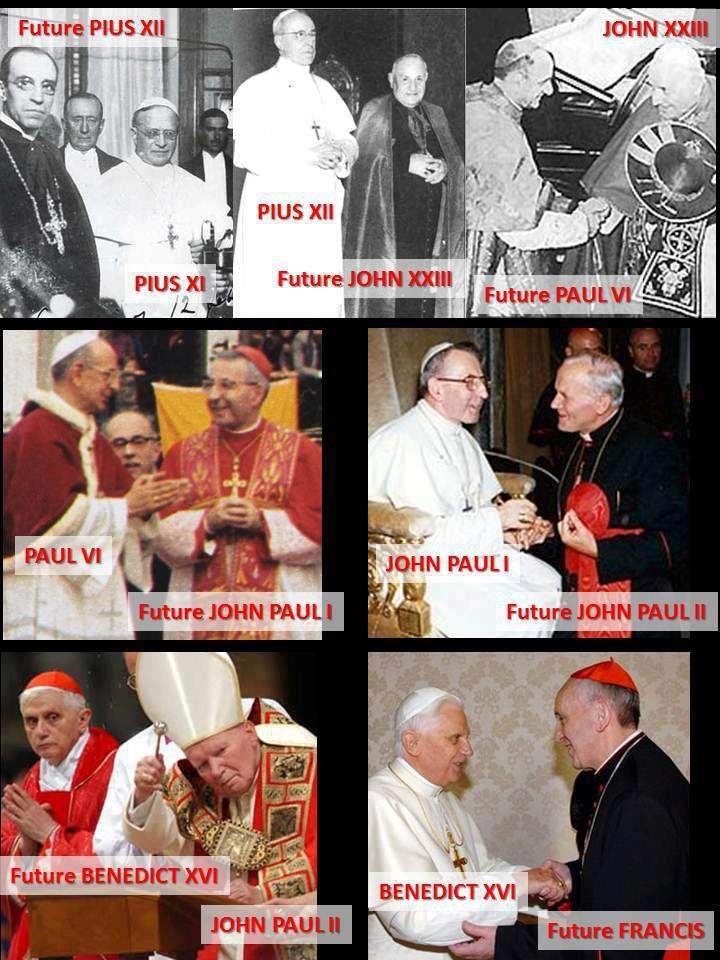
(From UCatholic facebook page)

Depicted here are pictures of the Popes and their successors, or in the other way round, Popes and their predecessors. Most commonly between the reigning Pope and Cardinal who would be elected to succeed him.


List of Popes (and ‘future Popes’) in the depiction in chronological order :

1. Pius XI : 1922 – 1939

2. Pius XII : 1939 – 1958

3. John XXIII : 1958 – 1963

4. Paul VI : 1963 – 1978

5. John Paul I : 1978

6. John Paul II : 1978 – 2005

7. Benedict XVI : 2005 – 2013

8. Francis : 2013 – present (Will be known as Francis I if any of his future successors also pick the name Francis, who will then be Francis II)

Pope Francis to visit Castel Gandolfo to meet Pope Emeritus Benedict XVI on Saturday, 23 March 2013

Newly elected Pope Francis will visit his predecessor, Pope Emeritus Benedict XVI, who is currently still staying at the summer papal residence at Castel Gandolfo. Pope Emeritus Benedict XVI will continue to reside there until the former Mater Ecclesiae monastery at the Vatican completes its renovation.

Second Ballot : No smoke. No Pope had been elected yet

As there was no ‘early’ smoke on Wednesday morning, 13 March 2013 in Rome, it is safe to assume that no Pope had been elected in the second ballot. This is because, instead of the usual 2 ballots per session then burn the ballots of both together at the end (session = morning/afternoon), if a Pope is elected on the first of these two ballots, the second ballot will obviously not take place, and thus, the smoke will be early, and will definitely also be white.

This was also the early sign that a Pope had been elected in 2005, when the afternoon smoke went early (this was after the fourth ballot, first of two afternoon ballots) at near 6 pm Rome time, when the smoke, which should have been later if no Pope was elected.

It may be more likely that the white smoke will appear after the third ballot, or the fourth ballot.

Watch live at : http://www.romereports.com/palio/modules.php?name=Content3&pa=showpage&newlang=english&pid=47#.UUA0qBzLoj7

Cardinal Angelo Scola, Archbishop of Milan, the Papabile

http://www.eitb.com/en/news/world/detail/1282802/candidates-new-pope–profile-cardinal-angelo-scola/

From the article (My commentary at the end) :


Election of new pope

Profile of Cardinal Angelo Scola, Archbishop of Milan

APTN

03/11/2013

A conservative, and theologically close to both Pope Benedict and his predecessor John Paul II, Cardinal Scola is regarded as one of the leading European candidates to become Pope.

Cardinal Angelo Scola, the archbishop of Milan.

Cardinal Angelo Scola, the archbishop of Milan, shot to the top of a list of possible successors to Pope Benedict XVI almost immediately the resignation was announced.

A conservative, and theologically close to both Pope Benedict and his predecessor John Paul II, Cardinal Scola is regarded as one of the leading European candidates to become Pope.

Some observers tipped him to succeed after the death of John Paul II in 2005, but the conclave instead chose Cardinal Joseph Ratzinger who became Benedict XVI, the 265th pope.

But if there was rivalry between the candidates in 2005, it had little effect on their close relationship, and Scola remained a favourite of Pope Benedict’s, who appointed the Cardinal archbishop of the Milan Diocese in June 2011.

In the small town of Malgrate on Lake Como in northern Italy, many of the 5,000 residents are backing their hometown boy to become Pope. Scola was born in Malgrate on 7 November 1941 to a truck driver and a homemaker.

He entered the priesthood in 1970, became a Cardinal in 2003, serving first as Patriarch of Milan until he was elevated to his current post of archbishop.

Scola’s cousin, Angelo Colombo, remembers that during World War II he would spend time at his cousin’s home because Scola’s father was a truck driver and could get access to flour and bread.

Colombo said he would go to Scola’s family home, and his aunt and the future Cardinal would always share their food. When he asked if he thought his cousin would make a good Pope, Colombo laughed and responded: “he was a tough boy”.

Scola spent the early years of his life in a small home on Malgrate’s Salita Sant’Antonio. Alfredo Cagliandi was a classmate of Cardinal Scola and lived in the apartment below him.

“We would invite Angelo to come and play and he would repeatedly respond ‘I am sorry, but I don’t have time.’  He was too busy because was already involved in something religious,” said Cagliandi, who still lives in Malgrate.

Scola spent the first two decades after his 1970 ordination in the lecture halls and libraries of renowned Catholic universities and theological training grounds, notably in Fribourg, Switzerland, and the Lateran Pontifical University in Rome.

While pursuing theological studies, Scola was involved in Communion and Liberation, a conservative Italian Catholic group which blends political activism with faith-based fervour as it seeks to make its weight felt in the country’s decision-making.

Back in Scola’s home town, the local priest Father Andrea Lotterio proudly showed off the baptismal font where he says the town’s babies are still baptised today, noting that Scola was baptised there in 1941.

Father Lotterio said Scola has pleased the residents of Malgrate by never losing his strong ties to his hometown. “He has maintained his relationships with many local citizens, with his friends, with his relatives,” Lotterio said. “So much so that in this town he is called Don Angelo, instead of Cardinal or Patriarch of Venice.”

Pope Benedict resigned as leader of the Catholic Church on Thursday, becoming the first pope in 600 years to resign. For the time being, the governance of the Catholic Church shifts to Cardinal Tarcisio Bertone, the camerlengo, or chamberlain. Bertone, along with the College of Cardinals will guide the church and make plans for the conclave to elect the 266th leader within the next few weeks.


Commentary and additions:

Indeed, Cardinal Angelo Scola has many strengths and characteristics that we need as the new Pope to lead the Roman Catholic Church, the one and Universal Church. He does have his weaknesses, but his strengths more than made up for him. After all, it is human to have weaknesses and to make mistakes.

Cardinal Scola is media-savvy, able to reach out into the hearts of many, including youths and those in the world, who are longing for the Lord to come to them. Being media-savvy, and also internet-savvy, Cardinal Scola is not shy of using modern media tools, such as the internet, twitter, YouTube, his own site, and many other means to evangelise to the world, and to reach out, especially to youths.

Cardinal Scola also has a positive outlook and optimism in the Church, and indeed, instead of being pessimistic on the Church, and instead of looking at a Church in trouble, he dismissed all this, and all the lies that the media had brought about the Church, that the Church instead of being in chaos and trouble, is in fact growing, and filled with vibrant and strong faith and love in God, and Cardinal Scola has the capacity to tap into all these energies.

Cardinal Scola also came from a poorer family background, and he understood the plight of the poor and the less fortunate. His hometown people has often remembered him as someone who not only did not forget about where he came from, and where he was born, but also someone who constantly gives them his care and his love, in imitation of Christ and His care for the poor.

Cardinal Scola speaks Italian, English, French, and Spanish, and although his English is not that good, but he has quite a strong command of these languages, which are essential in the Pope’s ministry as the leader of the Universal Church.

Cardinal Scola’s initiatives to reach out to the Christians in the Holy Land and in other areas where Christians are minorities, and his involvement in interreligious dialogue and cooperation, and even with atheists, had been fruitful and crucial in strengthening Christians in the areas where they had been persecuted, and where persecutions are ongoing.

His experience in the Archdiocese of Milan, Patriarchate of Venice, and Diocese of Grosseto clearly showed that he is a pastoral leader with a humble and yet intellectual mind, that matches that of our beloved Pope Emeritus Benedict XVI. Yet, his experiences in the Roman Curia too were many, with works as leader of Pontifical Institute of Marriage and the Family, which he also took a strong stand with the Church in the sanctity of both marriage and the family.

His intellect, knowledge, and publications especially in topics like bioethics, in the midst of the attacks against Church’s stand on bioethics, cloning, and contraceptions will be essential for the future leader of the Church, and his ability to connect and reach out to people, more than Pope Emeritus Benedict XVI, will be valuable asset to have in the new Pope.

Nevertheless, now that the Conclave will begin soon, we continue to pray that God will pour His Holy Spirit on all the Cardinal-electors, that they can make a wise and inspired decision, to elect someone whom the Lord has chosen, as the best possible person to succeed His Apostle, Peter, and lead the whole Universal Church, that God Himself built in this world, to be the manifestation of His love, justice, and presence.

Summary of the Third General Congregation of the College of Cardinals (Tuesday, 5 March 2013)

http://www.news.va/en/news/general-congregations-5-electors-yet-to-arrive


Here is a rough summary of what was concluded yesterday morning in the Third General Congregation of the College of Cardinals :

1. 110 Cardinal-electors are already in Rome by yesterday morning, only 5 more Cardinal-electors remaining to arrive.

2. No rush to fix the date of the Conclave, but it is still possible to begin by next Monday, 11 March 2013.

3. Sistine Chapel had been closed to public as of yesterday morning, Tuesday, 5 March 2013 to prepare for the Conclave.

4. 33 Cardinals had spoken so far and 11 interventions were made in yesterday’s General Congregation, with issues pertaining to activities of the Holy See and the Church, evangelisation, and many others.

5. Focus on the timeline of the Conclave as specified in the Apostolic Constitution Universi Dominici Gregis and the modifications made by the Motu Proprio Normas Nonnullas.

6. The Cardinals sent a thank-you letter to the Pope Emeritus Benedict XVI, now living in the papal summer residence of Castel Gandolfo.