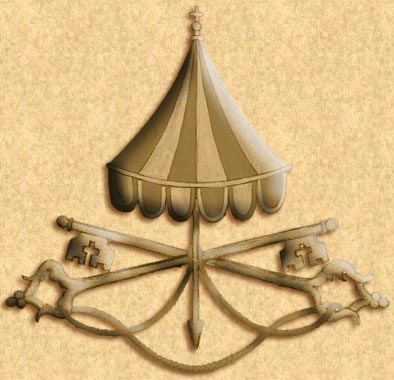
Sealing of the Pope’s Apartment : Not to be opened until the new Pope has been elected

The private residence of the Pope in the Vatican City, that is his apartment in the Apostolic Palace beside the Basilica of St. Peter is left vacant upon the death of the Pope, or in this case, the retirement of the reigning Pope, which began the sede vacante, during which no Pope is present.

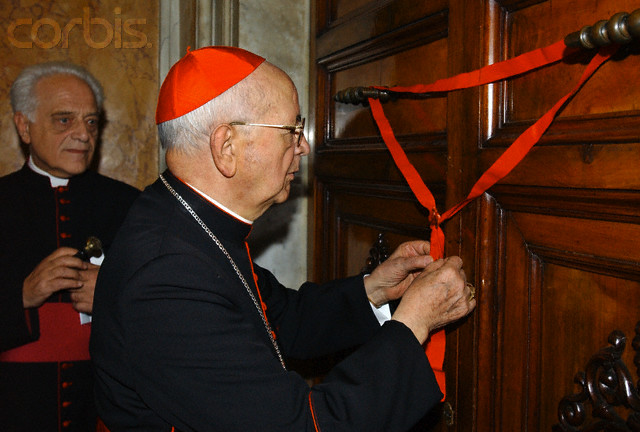
Therefore, in order to avoid fraud and manipulation of papal documents of the previous Pope, and to prevent release of items that can only be done by the new Pope, the Pope’s Apartment is sealed, by a special officer of the Roman Curia, that is the Camerlengo (Chamberlain) of the Holy Roman Church, who is now Cardinal Tarcisio Bertone, who is also the Secretary of State of the Holy See.

The Camerlengo is the leader of the sede vacante transition period, and working in conjunction with the Dean of the College of Cardinals. His duties include sealing the Pope’s apartment and the destruction of the Pope’s Ring of the Fisherman, both of which meant to ensure no fraud documents can be released in absence of the Pope.

The sealing is done as soon as the Pope passed away or stepped down, and done in the presence of the Vice-Camerlengo, who is now Archbishop Pier Luigi Celata, and sealed with a silk string tied and sealed with a wax seal to ensure no one can enter the room, with the unbroken wax seal as evidence.

The room will only be opened again and the seal broken after the conclave is completed and a new Pope is elected.

Image below – from 2005 after the death of Blessed Pope John Paul II, then Camerlengo, Cardinal Eduardo Martinez Somalo sealing the Pope’s apartment

Image

Cardinals summoned to Rome to gather and discuss the start date and details of Conclave

All Cardinals from around the world, from the archdioceses and dioceses have been summoned to Rome as per the decision made in the meeting of the College of Cardinals on Friday, 1 March 2013. Meetings to decide the date of the Conclave, and its details will commence on Monday, 4 March 2013.

Many of the Cardinals would be eager to be able to elect a new Pope before the Holy Week begins, so that if possible, he may even be installed prior to the Holy Week, and therefore the Cardinals will be able to go home and celebrate Holy Week with their respective archdioceses/dioceses.

Friday, 1 March 2013 : 2nd Week of Lent (Scripture Reflection)

We are urged today, not to have evil thoughts on our brothers and sisters today, as illustrated earlier in the story of Joseph in the first reading and the psalm, and how he was sold off in slavery to Egypt due to his brothers’ jealousy, which caused them to initially harbour evil thought of killing him. The same evil intent and plot also happened in the Gospel when the tenants disposed of the servants and the son of the landowner, in the intention of gaining the lands they have been lent with, and disobeying the owner’s wish.

We should not harbour such evil intent, but instead look upon our brothers and sisters with love. Especially, just as Christ has taught us, we should even also look upon our enemies and our persecutors with love! and pray for them too!

And then indeed, the story of the Gospel today, as many of you would know, is a parable on the life of Christ Himself, with the Pharisees and the chief priests being labeled as the evil tenants, as obviously stated in the Scripture. Jesus is the Son of the owner, who is God the Father, who sent Jesus to us, down to earth, just like the owner sent his son in the hope that he will be able to bring the tenants into line and pay up what they are supposed to pay.

But yet, the rejected ones, as we had seen, in both Jesus and Joseph, had become a great instrument of the Lord through their rejection by the people, represented by the brothers of Joseph and the tenants in the Gospel. For Joseph became the regent of Egypt through the gift of prophecy through dreams granted to him by God, which saved thousands if not many more souls from death, by the wise and ample preparation before famine ravaged Egypt for seven years. All these would not have happened without Joseph and his dreams.

Even greater is therefore the role of Christ, for in being rejected by the people, the ‘tenants’ particularly the chief priests, teachers of the Law, and the Pharisees, He has become the very instrument of salvation of all mankind. This rejection was represented by the arrest of Jesus, His trial by the Sanhedrin, leaders of the priests of Israel, and finally His condemnation to death, and His death on the cross. In this He, as the rejected stone by the builder, had become the cornerstone, the very vital part of God’s plan of salvation.

What is a cornerstone? While we do not often use the terms in daily life, architects and those dealing with infrastructure and buildings will know it very well. For cornerstone is named so, since, at the time of the Roman Empire, there is a passion for building commemorative and triumphal arches. Some of these arches can still be seen even today, and some remained in the city of Rome itself. Why are these arches so strong and so solid to be able to stand for centuries and even millenia? It is because of its structure, which is so wonderfully constructed even without modern technology to keep them intact, all just because of one single stone at the peak of the arch, which is called the cornerstone.

This cornerstone is the focal point and the most important point of the arch. For if the cornerstone is removed, the arch will immediately crumble. As long as the cornerstone remained in place, removing other stones from the arch would have minimum impact on the arch’s integrity. Similarly, cornerstone can also be found in other buildings, also known more as the foundation stone. This stone holds up the integrity of the whole building by just being there, and as long as the stone stands, the building will too.

Christ therefore, has become our cornerstone through His death and sacrifice on the cross, and later His glorious resurrection and triumph over death and evil. Why is He our cornerstone? That is because if we keep our anchor on Him, keeping faith in Him, and ensuring that our faith is anchored deeply and securely in Christ, no amount of worldly temptations, and no amount of attacks and persuasions by evil can sway us and make us to fall away from the grace of God.

Through Christ who is our cornerstone, we then can act out His love and compassion on all mankind, for only if we anchor ourselves in Christ, that we can act with love and kindness, out of our faith in God who also loves us dearly that He did not even hold back His Son to be given to us for sacrifice to liberate us from eternal damnation.

Then Christ too established His Church, our Church, as the living and concrete presence that represents Him and His mission in this world, and there was none other than Peter the Apostle, upon whom, as the Rock, Christ chose to build up His Church, making Peter the cornerstone of His Church, the Body of Christ, which is made up of all of us the faithful in Christ.

Now, that our Pope, Benedict XVI, who was the 264th successor of St. Peter, had stepped down from his position as our Pope effective today, our Church, God’s Church, has been left without that cornerstone of faith, which has been passed down since the day of Peter, the first cornerstone of the Universal Church. We still have Christ of course as our Cornerstone, on whom all hearts and minds must be directed to, but it is through the Apostle Peter and his successors, the Popes, that this is made manifest, by them being the cornerstone of God’s living presence in this world, that is the One, Holy, Catholic, and Apostolic Church.

Therefore, today, and through the sede vacante period, and beyond that, let us pray, brothers and sisters in Christ, that first, we all will remain ever faithful, and that our anchor of faith will ever be solidly planted in the cornerstone that is Christ our Lord, always remembering His rejection and sacrifice on the cross that made Him the cornerstone of our life, the cornerstone of salvation, that enabled mankind to return and be reunited with God.

And then, we also pray in particular for our Church, that God will guide the Cardinal-electors who will elect a new Pope to succeed our beloved Pope Benedict XVI, with the guidance of the Holy Spirit sent by God upon all of them. That the world will again have a tangible cornerstone that is the successor of St. Peter, who made the Cornerstone of Christ manifest and real in this world, as the cornerstone of God’s most Holy Church, and as the cornerstone and head of the Body of Christ, the Church, leading all the faithful in Christ in unity with Christ their Saviour.

In the end, the cornerstone, although important, still requires the presence of all of us, the stones surrounding the cornerstone, for the cornerstone by itself will not make a building. Therefore, brothers and sisters in Christ, let us support the new Pope, whoever he will be, as all the people who believe in Christ, that the new Pope, the future cornerstone of the Church, will together build up a solid and strong Church, that is able to project God’s love and work into this world, that more and more people will be saved.

May God bless all of us, bless His Church, bless our retired Pope Emeritus Benedict XVI, and his soon-to-be elected successor. Amen!

Sede Vacante has begun. The See of Rome is Vacant

Therefore, as of now, Thursday, 28 February 2013, at 8 pm CET (UTC+1), Pope Benedict XVI is no longer our Pope, and the See of Rome is vacant.

Image

Let us all pray, first for His Holiness Benedict XVI, Bishop Emeritus of Rome, that God will continue to guide him in his prayerful life as a simple pilgrim, to the end of his journey in this world. We will always remember him as our beloved Pope.

Then, of course, let us pray that God will soon appoint the new shepherd, successor of St. Peter the Apostle, through the Holy Spirit and guidance to the Cardinal-electors who will elect the new Pope in the conclave which will begin likely in about 10 days from now, according to the rules of Apostolic Constitution Universi Dominici Gregis and the corresponding modifications by the Motu Proprio Normas Nonnullas.

Pope Benedict XVI’s message at his last General Audience : St. Peter’s Square, Wednesday, 27 February 2013

“Like the Apostle Paul in the Biblical text that we have heard, I feel in my heart that I have to especially thank God who guides and builds up the Church, who plants His Word and thus nourishes the faith in His People. At this moment my heart expands and embraces the whole Church throughout the world and I thank God for the news that, in these years of my Petrine ministry, I have received about the faith in the Lord Jesus Christ and for the love that truly circulates in the Body of the Church, making it to live in the love and the hope that opens us to and guides us towards the fullness of life, towards our heavenly homeland.”

“I feel that I am carrying everyone with me in prayer in this God-given moment when I am collecting every meeting, every trip, every pastoral visit. I am gathering everyone and everything in prayer to entrust it to the Lord: so that we may be filled with the knowledge of His will through all spiritual wisdom and understanding in order to live in a manner worthy of the Lord and His love, bearing fruit in every good work.”

“At this moment I have great confidence because I know, we all know, that the Gospel’s Word of truth is the strength of the Church; it is her life. The Gospel purifies and renews, bearing fruit, wherever the community of believers hears it and welcomes God’s grace in truth and in love. This is my confidence, this is my joy.”

“When, on 19 April almost eight years ago I accepted to take on the Petrine ministry, I had the firm certainty that has always accompanied me: this certainty for the life of the Church from the Word of God. At that moment, as I have already expressed many times, the words that resounded in my heart were: Lord, what do You ask of me? It is a great weight that You are placing on my shoulders but, if You ask it of me, I will cast my nets at your command, confident that You will guide me, even with all my weaknesses. And eight years later I can say that the Lord has guided me. He has been close to me. I have felt His presence every day. It has been a stretch of the Church’s path that has had moments of joy and light, but also difficult moments. I felt like St. Peter and the Apostles in the boat on the Sea of Galilee.”

“The Lord has given us many days of sunshine and light breezes, days when the fishing was plentiful, but also times when the water was rough and the winds against us, just as throughout the whole history of the Church, when the Lord seemed to be sleeping. But I always knew that the Lord is in that boat and I always knew that the boat of the Church is not mine, not ours, but is His. And the Lord will not let it sink. He is the one who steers her, of course also through those He has chosen because that is how He wanted it. This was and is a certainty that nothing can tarnish. And that is why my heart today is filled with gratitude to God, because He never left—the whole Church or me—without His consolation, His light, or His love.”

“We are in the Year of Faith, which I desired precisely in order to strengthen our faith in God in a context that seems to relegate it more and more to the background. I would like to invite everyone to renew their firm trust in the Lord, to entrust ourselves like children to God’s arms, certain that those arms always hold us up and are what allow us to walk forward each day, even when it is a struggle. I would like everyone to feel beloved of that God who gave His Son for us and who has shown us His boundless love. I would like everyone to feel the joy of being Christian. In a beautiful prayer, which can be recited every morning, say: ‘I adore you, my God and I love you with all my heart. Thank you for having created me, for having made me Christian…’ Yes, we are happy for the gift of faith. It is the most precious thing, which no one can take from us! Let us thank the Lord for this every day, with prayer and with a coherent Christian life. God loves us, but awaits us to also love Him!”

“It is not only God who I wish to thank at this time. A pope is not alone in guiding Peter’s barque, even if it is his primary responsibility. I have never felt alone in bearing the joy and the weight of the Petrine ministry. The Lord has placed at my side so many people who, with generosity and love for God and the Church, have helped me and been close to me. First of all, you, dear Brother Cardinals: your wisdom, your advice, and your friendship have been precious to me. My collaborators, starting with my secretary of state who has accompanied me faithfully over the years; the Secretariat of State and the whole of the Roman Curia, as well as all those who, in their various areas, serve the Holy See. There are many faces that are never seen, remaining in obscurity, but precisely in their silence, in their daily dedication in a spirit of faith and humility, they were a sure and reliable support to me.”
 
“A special thought goes to the Church of Rome, my diocese! I cannot forget my Brothers in the episcopate and in the priesthood, consecrated persons, and the entire People of God. In my pastoral visits, meetings, audiences, and trips I always felt great care and deep affection, but I have also loved each and every one of you, without exception, with that pastoral love that is the heart of every pastor, especially the Bishop of Rome, the Successor of the Apostle Peter. Every day I held each of you in prayer, with a father’s heart.”

“I wish to send my greetings and my thanks to all: a pope’s heart extends to the whole world. And I would like to express my gratitude to the Diplomatic Corps accredited to the Holy See, which makes the great family of Nations present here. Here I am also thinking of all those who work for good communication and I thank them for their important service.”

“At this point I would also like to wholeheartedly thank all of the many people around the world who, in recent weeks, have sent me touching tokens of concern, friendship, and prayer. Yes, the Pope is never alone. I feel this again now in such a great way that it touches my heart. The Pope belongs to everyone and many people feel very close to him. It’s true that I receive letters from the world’s notables—from heads of states, from religious leaders, from representatives of the world of culture, etc.”

“But I also receive many letters from ordinary people who write to me simply from their hearts and make me feel their affection, which is born of our being together with Christ Jesus, in the Church. These people do not write to me the way one would write, for example, to a prince or a dignitary that they don’t know. They write to me as brothers and sisters or as sons and daughters, with the sense of a very affectionate family tie. In this you can touch what the Church is—not an organization, not an association for religious or humanitarian ends, but a living body, a communion of brothers and sisters in the Body of Jesus Christ who unites us all. Experiencing the Church in this way and being able to almost touch with our hands the strength of His truth and His love is a reason for joy at a time when many are speaking of its decline. See how the Church is alive today!”

“In these last months I have felt that my strength had diminished and I asked God earnestly in prayer to enlighten me with His light to make me make the right decision, not for my own good, but for the good of the Church. I have taken this step in full awareness of its seriousness and also its newness, but with a profound peace of mind. Loving the Church also means having the courage to make difficult, agonized choices, always keeping in mind the good of the Church, not of oneself.”

“Allow me here to return once again to 19 April, 2005. The gravity of the decision lay precisely in the fact that, from that moment on, I was always and for always engaged by the Lord. Always—whoever assumes the Petrine ministry no longer has any privacy. He belongs always and entirely to everyone, to the whole Church. His life, so to speak, is totally deprived of its private dimension. I experienced, and I am experiencing it precisely now, that one receives life precisely when they give it. Before I said that many people who love the Lord also love St. Peter’s Successor and are fond of him; that the Pope truly has brothers and sisters, sons and daughters all over the world and that he feels safe in the embrace of their communion; because he no longer belongs to himself but he belongs to all and all belong to him.”

“’Always’ is also ‘forever’–there is no return to private life. My decision to renounce the active exercise of the ministry does not revoke this. I am not returning to private life, to a life of trips, meetings, receptions, conferences, etc. I am not abandoning the cross, but am remaining beside the Crucified Lord in a new way. I no longer bear the power of the office for the governance of the Church, but I remain in the service of prayer, within St. Peter’s paddock, so to speak. St. Benedict, whose name I bear as Pope, will be a great example to me in this. He has shown us the way for a life that, active or passive, belongs wholly to God’s work.”

“I also thank each and every one of you for the respect and understanding with which you have received this important decision. I will continue to accompany the Church’s journey through prayer and reflection, with the dedication to the Lord and His Bride that I have tried to live every day up to now and that I want to always live. I ask you to remember me to God, and above all to pray for the Cardinals who are called to such an important task, and for the new Successor of the Apostle Peter. Many the Lord accompany him with the light and strength of His Spirit.”

“We call upon the maternal intercession of Mary, the Mother of God and of the Church, that she might accompany each of us and the entire ecclesial community. We entrust ourselves to her with deep confidence.”

“Dear friends! God guides His Church, always sustaining her even and especially in difficult times. Let us never lose this vision of faith, which is the only true vision of the path of the Church and of the world. In our hearts, in the heart of each one of you, may there always be the joyous certainty that the Lord is beside us, that He does not abandon us, that He is near and embraces us with His love. Thank you.”

Show our support to the Cardinal-electors by ‘adopting’ them!

http://adoptacardinal.org/

Now you can ‘adopt’ a Cardinal through this site to show our support for them. Let us pray for the Cardinals, and maybe through the Cardinals that the site selected for each one of you, learn more about them, and pray for them.

We pray that our Universal Church will have a new shepherd soon after our beloved shepherd, Pope Benedict XVI steps down at the end of today. May God always bless His Church and His people.

What will happen at the last days of the Pope and the day when he retires (28 February 2013) by Salt and Light TV


Wednesday, 27 February 2013

10.30 am – Pope Benedict XVI’s last General Audience at St. Peter’s Square (Pope’s farewell to the faithful around the world)


Thursday, 28 February 2013

11.00 am – Pope Benedict XVI’s last private meeting with the College of Cardinals in Sala Clementina

5.30 pm – Pope Benedict XVI leaves for Castel Gandolfo by the helicopter

8.00 pm – Pope Benedict XVI’s Papacy ends, sede vacante begins (no Pope present in the Church)


All time listed above are in CET (Central European Time) or UTC+1 hour


Conclave may begin between 9 March 2013 and 11 March 2013 as announced by the Vatican officials.

Explanation on the changes brought by Motu Proprio Normas Nonnullas on the Conclave

http://vaticaninsider.lastampa.it/en/the-vatican/detail/articolo/motu-proprio-benedetto-xvi-benedict-xvi-benedecto-xvi-conclave-22655/

Modifications to the Apostolic Constitution Universi Dominici Gregis that regulates the Papal Conclave, as explained in English by Vatican Insider, with three main changes highlighted :


1. Conclave can begin earlier than 15 days after the vacancy of the See of Rome, but the exact date depends entirely on the College of Cardinals.

2. Cardinal-electors can opt not to attend the Conclave based on health and other valid reasons, but otherwise, all electors should attend, and those with the rights should not be impeded attendance at the Conclave.

3. All people locked inside the Conclave, including even the laity must take the oath of secrecy, the same as that of the Cardinals. More specific latae sententiae excommunication is given immediately to those who broke the oath during and even after the Conclave, unless permission given by the new Pope.

Cardinal Lubomyr Husar reaches age 80 and therefore becomes ineligible to vote in the Papal Conclave

Today, Tuesday, 26 February 2013, Cardinal Lubomyr Husar, Major Archbishop Emeritus of Kyiv-Halic, and thus the former leader of the Ukrainian Catholic Church (Eastern Rite Catholic Church) in full communion with Rome, turns 80, and by the rules laid out in the Apostolic Constitution Universi Dominici Gregis, can no longer participate in the Conclave to elect the new Pope.

The College of Cardinals now stand at 208 members, with 117 electors (2 will not attend the Conclave in March 2013) and 91 non-electors.

We wish His Eminence a happy birthday and pray for him that God will always guide him and strengthen him, that even in his old age and retirement, he will still be able to do great things for the greater glory of God. May God bless Cardinal Husar and the Ukrainian Church. Amen!

Ad multos annos, Your Eminence!

English version of the Pope’s latest Motu Proprio : Normas Nonnullas

http://www.zenit.org/en/articles/motu-propio-apostolic-letter-regarding-the-election-of-the-roman-pontiff

Here is the English version of the Motu Proprio Normas Nonnullas on the election of the Supreme Pontiff (Pope) by Zenit. Happy reading and God bless!