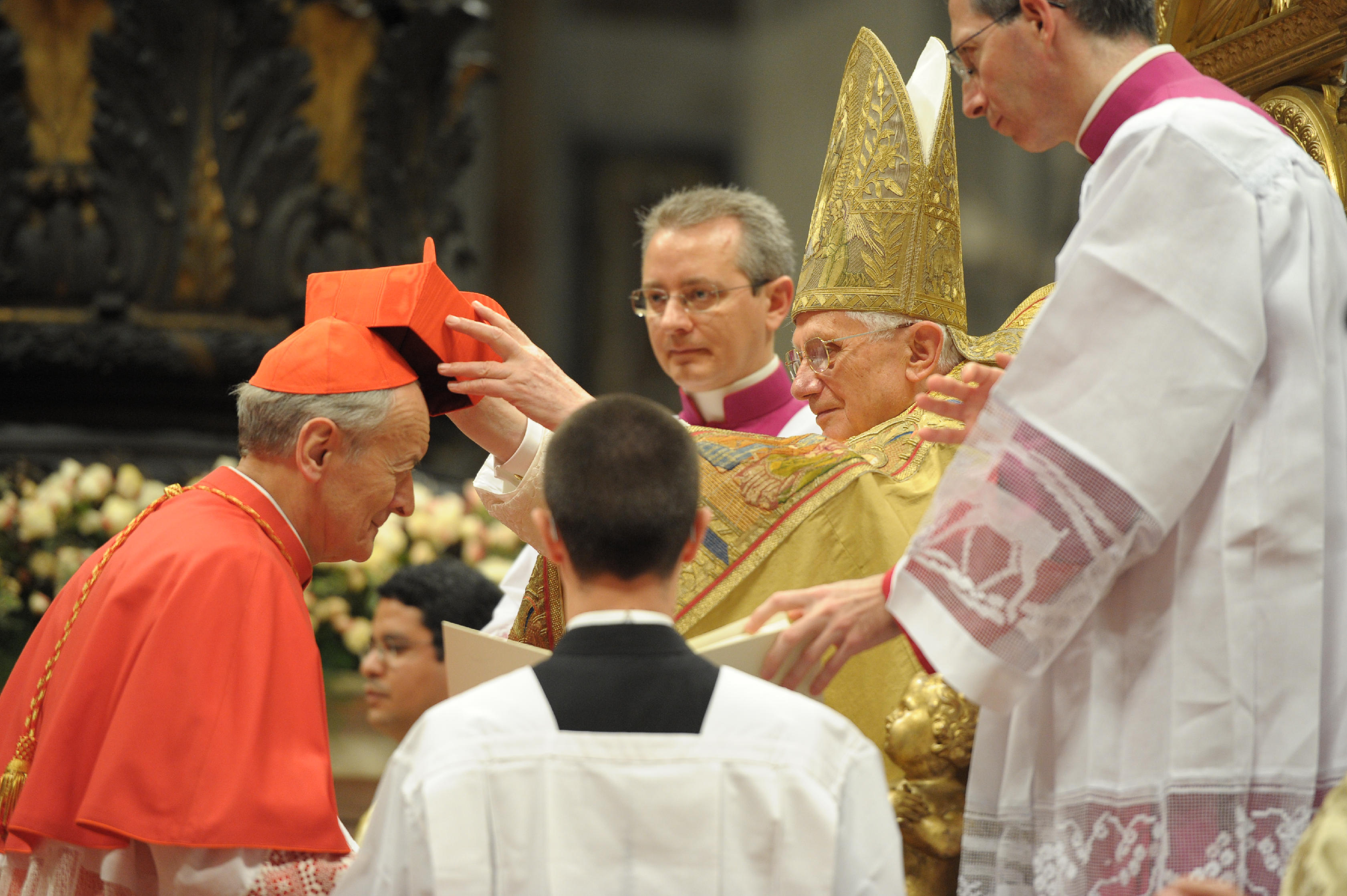
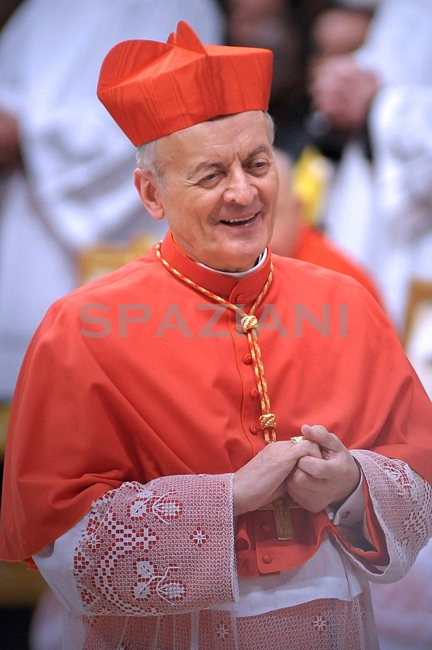
Cardinals Update : Cardinal Paolo Sardi, Patron of the Sovereign Military Hospitaller Order of St. John of Jerusalem of Rhodes and of Malta (Italy), turned 80, ceases to be a Cardinal-elector

On Monday, 1 September 2014, Cardinal Paolo Sardi, Cardinal-Deacon of S. Maria Ausiliatrice in Via Tuscolana, Cardinal-Patron of  the Sovereign Military Hospitaller Order of St. John of Jerusalem of Rhodes and of Malta (Italy), turned 80, and therefore, according to the rules written in the Apostolic Constitution Universi Dominici Gregis, he lost his right to vote in any future conclave.

_MG_3898

Cardinal Paolo Sardi was made Cardinal-Deacon of S. Maria Ausiliatrice in Via Tuscolana by Pope Benedict XVI in the 2010 Consistory of Cardinals on 20 November 2010, the third Consistory of his pontificate. Cardinal Sardi was made a Cardinal in honour of his position as the Patron of  the Sovereign Military Hospitaller Order of St. John of Jerusalem of Rhodes and of Malta, also known as the Sovereign Military Order of Malta, one of the most prominent and important charity and public action arm of the Church, the direct and current successor of the Knights Hospitallers established during the era of the Crusades, a position which he held from 2009 to the present day.

02382_20112010

http://www.gcatholic.org/hierarchy/data/cardB16-3.htm#1368

May God bless His Eminence Cardinal Sardi with a blessed old age and health. May he remain strong in the faith and hopefully can perhaps still continue to work great graces and good works of love and peace as he continues to minister to the people of God through his patronage of the Sovereign Military Order of Malta. We also pray for the success of the actions and the charities of this faithful order of the Church.

cardinale_PAOLO_SARDI

The College of Cardinals now stands at 210 members in total, with 115 Cardinal-electors and 95 Cardinal non-electors. There are now a vacancy of 5 Cardinal-elector as compared to the maximum number of electors allowed in the Conclave of 120.

Next Cardinal-elector to age out (80) will be Cardinal Paul Josef Cordes (Germany), the President Emeritus of the Pontifical Council ‘Cor Unum’ on 5 September 2014.

Monday, 1 September 2014 : 22nd Week of Ordinary Time (Homily and Scripture Reflections)

Liturgical Colour : Green

Brothers and sisters in Christ, today we are reminded yet again on the importance of understanding the will and the nature of God, and how He worked His wonders and good works in our lives, learning to trust more of His love and kindness and casting away from our hearts all forms of prejudice, bias, judgmental attitude and self-righteousness.

We mankind are all prone to all of these, as we have been created with much abilities and gifts given to us. Among all of creations, we are special in that we have such an intellect and ability to discern the right and the wrong, partly because our ancestors committed sin by eating the fruits of the tree of the knowledge of good and evil.

In that, we all are aware of the things around us and we are able to discern, but because our intellect, the human intellect, and our human wisdom are not divine in nature, what we have in us, in our minds are limited and flawed by its nature. That is how we fall into the trap of prejudice, bias and judgmental attitude towards others, thinking that we are righteous over other peoples, and in our selfishness, which is part of our nature, we condemn and judge others based on our own standards.

It is common for us to look at someone and judge them based on their character, on what we observed from them, in terms of what clothes they are wearing, what accessories they are wearing, and what company of friends and background someone has. We judge others based on what we observe from them, and we tend to look at the exterior, on appearances to make our judgments, and once we have judged, it is hard for us to remove that bias and prejudice from our minds.

The same happened to Jesus, who went to His own hometown of Nazareth in Galilee. He went there to continue doing the good works He had done during His ministry in this world to fulfill and accomplish the long promised salvation for the people of God, the Messiah and Saviour who had eventually come to bring all of His people into a new life in harmony with God and His will.

Yet, as we all know, Jesus among men were seen as a mere carpenter’s son, the son of a simple and humble yet hardworking carpenter named Joseph, who married Mary, the mother of Jesus, and through this, became His foster-father. Yet, the people even when presented with the truth, that Jesus was in fact the Messiah and the Son of God, and Joseph was His foster-parent refused to change their bias and prejudice, choosing to reject Him rather than listening to His truth.

Why is this so? Because every men are by nature selfish and they are always concerned about themselves and their own self-preservation. This is our nature, and it is not easy to change unless through a determined effort and understanding of the teachings which Jesus had passed down to us. Those people in Nazareth must be thinking, that how is this Son of a humble and simple carpenter, a noteworthy job and yet one that did not bring about much respect due to its low position in the hierarchy of the society, can be the Messiah.

They thought not in divine terms but in the terms of men and the world. They judged Jesus for His supposed simple and low-rank birth to a carpenter and from there they developed the prejudice that prevented them from truly listening to the words which Jesus had to say. And this did not happen to just Jesus, as many of the prophets as mentioned also suffered the same fate, rejected especially by those who knew them and those who shared their homes with these prophets.

We always like to presume that we know it all, and we know all about those around us by just looking at them and we judge them based on how they look and how they act in the society. And Jesus wanted to tell us that this attitude is wrong. We must never be judgmental to others as we too can be judged if we judge others. And that we should look deeper and not just be focused on the appearances, but also on what are inside a person’s hearts and minds.

Therefore, brothers and sisters in Christ, let us all reflect on our own lives, on whether we have done what the people of Nazareth had done, in prejudicing and in being judgmental against others. Let us all change our ways if we had done so, and become better children and servants of our Lord. Let us stop our selfishness and judgmental attitudes, and from there let us all instead work together with one another, so that we may live in harmony and love together, and love sincerely and love tenderly.

May Almighty God be with us, guide us on our way, and strengthen the love and faith which He had planted in our hearts, awakening in us the desire to love one another and to love our God, our Lord and Creator, He who also loves us so much that He gave us Jesus, His Son to be our Saviour and Redeemer. God bless us all. Amen.

Monday, 1 September 2014 : 22nd Week of Ordinary Time (Gospel Reading)

Liturgical Colour : Green

Luke 4 : 16-30

When Jesus came to Nazareth, where He had been brought up, He entered the synagogue on the sabbath, as He usually did. He stood up to read, and they handed Him the book of the prophet Isaiah.

Jesus then unrolled the scroll and found the place where it is written : “The Spirit of the Lord is upon Me. He has anointed Me to bring good news to the poor, to proclaim liberty to captives and new sight to the blind; to free the oppressed and to announce the Lord’s year of mercy.”

Jesus then rolled up the scroll, gave it to the attendant and sat down; and the eyes of all in the synagogue were fixed on Him. Then He said to them, “Today these prophetic words come true, even as you listen.”

All agreed with Him, and were lost in wonder, while He spoke of the grace of God. Nevertheless they asked, “Who is this but Joseph’s Son?” So He said, “Doubtless you will quote Me the saying : Doctor, heal Yourself! Do here in Your town what they say You did in Capernaum.”

Jesus added, “No prophet is honoured in his own country. Truly, I say to you, there were many widows in Israel in the days of Elijah, when the heavens withheld rain for three years and six months and a great famine came over the whole land. Yet Elijah was not sent to any of them, but to a widow of Zarephath, in the country of Sidon.”

“There were also many lepers in Israel in the time of Elisha, the prophet, and no one was healed except Naaman, the Syrian.”

On hearing these words, the whole assembly became indignant. They rose up and brought Him out of the town, to the edge of the hill on which Nazareth is built, intending to throw Him down the cliff. But He passed through their midst and went His way.

Monday, 1 September 2014 : 22nd Week of Ordinary Time (Psalm)

Liturgical Colour : Green

Psalm 118 : 97, 98, 99, 100, 101, 102

How I love Your law, meditating on it all day!

Your command – mine forever – has made me wiser than my enemy.

I have more insight than my teachers for I meditate on Your decrees.

I have more understanding than the elders for I abide by Your precepts.

I turn my feet from evil paths, that I may keep step with Your word.

I have not departed from Your decrees for You Yourself have instructed me.

Monday, 1 September 2014 : 22nd Week of Ordinary Time (First Reading)

Liturgical Colour : Green

1 Corinthians 2 : 1-5

When I came to reveal to you the mystery of God’s plan I did not count on eloquence or on a show of learning. I was determined not to know anything among you but Jesus, the Messiah, and a crucified Messiah.

I myself came weak, fearful and trembling; my words and preaching were not brilliant or clever to win listeners. It was, rather, a demonstration of spirit and power, so that your faith might be a matter, not of human wisdom, but of God’s power.