Saturday, 2 March 2013 : 2nd Week of Lent (Scripture Reflection)

The parable of the prodigal son is indeed a well-known parable and story, that many have heard, which symbolises God’s eternal love for us and His great mercy. Do not be mistaken however, that God will simply just overlook any kind of error and sin because of His love for us. For God first and foremost is Holy and therefore He hates sin in all its forms. He hates evil and things that marred the holiness of His creations. He does have mercy, and His great and the incomprehensible degree of His love allows Him to forgive us, just like the father of the prodigal son.

But how does this forgiveness come about? It is not by being idle and wait for God’s forgiveness. If we stay idle, or worse if we continue to dwell in the world of sin, God will not forgive us, but rather condemn us for our continued rebellion against His love. Remember, that, in the parable of the prodigal son, it is the son, who in great humility and repentance, decided to turn back home and seek his father.

Instead of being haughty and proud, he lowered himself and even declared his unworthiness before the father. The father forgives him first because the younger son is back after being lost into the world, and then because he so humbly had submitted himself to the father’s judgement and in full humility even declared his unworthiness, which made the loving father to love him even more.

Forgiveness is not easy, but the Lord is willing to forgive as long as His children who have sinned, and thus rebelled against Him just like the prodigal son, are to humbly seek His mercy and love. God is kind as He is just, and He will show us great blessings and graces if we are obedient and try our best to remain in His favour, by first listening to the Word of God, and the commandments of love as brought by Christ, and to make our faith manifest through our good works and service for the good of all mankind, starting from those around us.

But do not forget, that God in His great mercy, do not just forgive us like that, for if we are forgiven but we ourselves continue to accuse others who had made mistakes to us, is it not contradictory? Just as Christ had said, love one another as I have loved you, and do upon others as what you wish to be done to you.

Therefore, brothers and sisters in Christ, let us first forgive one another first, forgive those who had made you hurt, those who had ostracised you, and then let us ourselves not hurt others, not ostracise others, and not made others’ lives to suffer. Only then, let us offer ourselves, our sinful beings in humility at God’s feet. He, who is our Father, will lift us up again, and makes us whole again, and once again worthy of Him.

If only love, kindness, and forgiveness can be ever present in everyone in our world today, that world would have been much nicer, is it not? All of us Christians, are just like the elder son of the father in the parable, as we had been brought closer to God through our baptism, and had been taught the faith and the love of God through our priests and our fellow brethren in faith. However, let us not be like the elder son who in jealousy became angry with the father because he seemed to overlook him due to the return of the prodigal younger son.

Because, we, who are like the elder son, have been saved in Christ, provided that we remain faithful to Him and practice our faith through our works and service for others as the Lord commanded us. However, there are many out there, who have yet to listen and receive the Good News of the Lord, and many still are also former believers in Christ, who had lapsed in their faith along the way, and had fallen into the traps of evil, through worldly pleasures, consumerism, secularism, and many others. They are the younger son, the lost prodigal son.

Rather than be annoyed and be jealous of them, when the Lord welcomes them into His kingdom like what the elder son did, let us instead help the Father, in seeking these lost sheep, these lost children of God, for through us, God can work wonders in our world. Let us help one another, particularly these lost ones, in finding together our way to the Lord, who will welcome all of us with His love and outstretched hands, the hands which had been pierced with nails on the cross to redeem us from death and eternal damnation, and into eternal life and union with Him.

Let us pray, brothers and sisters in Christ, that first we will always remain faithful to God, obey His commandments, and do what we can, and whatever is within our abilities to help one another, to love one another, and to reach out especially to those who hunger for God.

Then, let us also pray for our Holy Church, which is now without a shepherd, that God will appoint soon a new shepherd to guide His holy people, that through the Church, God’s work will be made manifest and real in this world, guiding all peoples back towards the Lord from their sinful past. May God, who is our loving Father, bless us all, and remain with us, and always be ready to welcome us back if we had gone astray and then humbly seek His mercy. May God place into our hearts the heart of mercy, the heart of love, and the heart of compassion for others. Blessed be God, forever and ever! Amen.
Friday, 1 March 2013 : 2nd Week of Lent (Scripture Reflection)

We are urged today, not to have evil thoughts on our brothers and sisters today, as illustrated earlier in the story of Joseph in the first reading and the psalm, and how he was sold off in slavery to Egypt due to his brothers’ jealousy, which caused them to initially harbour evil thought of killing him. The same evil intent and plot also happened in the Gospel when the tenants disposed of the servants and the son of the landowner, in the intention of gaining the lands they have been lent with, and disobeying the owner’s wish.

We should not harbour such evil intent, but instead look upon our brothers and sisters with love. Especially, just as Christ has taught us, we should even also look upon our enemies and our persecutors with love! and pray for them too!

And then indeed, the story of the Gospel today, as many of you would know, is a parable on the life of Christ Himself, with the Pharisees and the chief priests being labeled as the evil tenants, as obviously stated in the Scripture. Jesus is the Son of the owner, who is God the Father, who sent Jesus to us, down to earth, just like the owner sent his son in the hope that he will be able to bring the tenants into line and pay up what they are supposed to pay.

But yet, the rejected ones, as we had seen, in both Jesus and Joseph, had become a great instrument of the Lord through their rejection by the people, represented by the brothers of Joseph and the tenants in the Gospel. For Joseph became the regent of Egypt through the gift of prophecy through dreams granted to him by God, which saved thousands if not many more souls from death, by the wise and ample preparation before famine ravaged Egypt for seven years. All these would not have happened without Joseph and his dreams.

Even greater is therefore the role of Christ, for in being rejected by the people, the ‘tenants’ particularly the chief priests, teachers of the Law, and the Pharisees, He has become the very instrument of salvation of all mankind. This rejection was represented by the arrest of Jesus, His trial by the Sanhedrin, leaders of the priests of Israel, and finally His condemnation to death, and His death on the cross. In this He, as the rejected stone by the builder, had become the cornerstone, the very vital part of God’s plan of salvation.

What is a cornerstone? While we do not often use the terms in daily life, architects and those dealing with infrastructure and buildings will know it very well. For cornerstone is named so, since, at the time of the Roman Empire, there is a passion for building commemorative and triumphal arches. Some of these arches can still be seen even today, and some remained in the city of Rome itself. Why are these arches so strong and so solid to be able to stand for centuries and even millenia? It is because of its structure, which is so wonderfully constructed even without modern technology to keep them intact, all just because of one single stone at the peak of the arch, which is called the cornerstone.

This cornerstone is the focal point and the most important point of the arch. For if the cornerstone is removed, the arch will immediately crumble. As long as the cornerstone remained in place, removing other stones from the arch would have minimum impact on the arch’s integrity. Similarly, cornerstone can also be found in other buildings, also known more as the foundation stone. This stone holds up the integrity of the whole building by just being there, and as long as the stone stands, the building will too.

Christ therefore, has become our cornerstone through His death and sacrifice on the cross, and later His glorious resurrection and triumph over death and evil. Why is He our cornerstone? That is because if we keep our anchor on Him, keeping faith in Him, and ensuring that our faith is anchored deeply and securely in Christ, no amount of worldly temptations, and no amount of attacks and persuasions by evil can sway us and make us to fall away from the grace of God.

Through Christ who is our cornerstone, we then can act out His love and compassion on all mankind, for only if we anchor ourselves in Christ, that we can act with love and kindness, out of our faith in God who also loves us dearly that He did not even hold back His Son to be given to us for sacrifice to liberate us from eternal damnation.

Then Christ too established His Church, our Church, as the living and concrete presence that represents Him and His mission in this world, and there was none other than Peter the Apostle, upon whom, as the Rock, Christ chose to build up His Church, making Peter the cornerstone of His Church, the Body of Christ, which is made up of all of us the faithful in Christ.

Now, that our Pope, Benedict XVI, who was the 264th successor of St. Peter, had stepped down from his position as our Pope effective today, our Church, God’s Church, has been left without that cornerstone of faith, which has been passed down since the day of Peter, the first cornerstone of the Universal Church. We still have Christ of course as our Cornerstone, on whom all hearts and minds must be directed to, but it is through the Apostle Peter and his successors, the Popes, that this is made manifest, by them being the cornerstone of God’s living presence in this world, that is the One, Holy, Catholic, and Apostolic Church.

Therefore, today, and through the sede vacante period, and beyond that, let us pray, brothers and sisters in Christ, that first, we all will remain ever faithful, and that our anchor of faith will ever be solidly planted in the cornerstone that is Christ our Lord, always remembering His rejection and sacrifice on the cross that made Him the cornerstone of our life, the cornerstone of salvation, that enabled mankind to return and be reunited with God.

And then, we also pray in particular for our Church, that God will guide the Cardinal-electors who will elect a new Pope to succeed our beloved Pope Benedict XVI, with the guidance of the Holy Spirit sent by God upon all of them. That the world will again have a tangible cornerstone that is the successor of St. Peter, who made the Cornerstone of Christ manifest and real in this world, as the cornerstone of God’s most Holy Church, and as the cornerstone and head of the Body of Christ, the Church, leading all the faithful in Christ in unity with Christ their Saviour.

In the end, the cornerstone, although important, still requires the presence of all of us, the stones surrounding the cornerstone, for the cornerstone by itself will not make a building. Therefore, brothers and sisters in Christ, let us support the new Pope, whoever he will be, as all the people who believe in Christ, that the new Pope, the future cornerstone of the Church, will together build up a solid and strong Church, that is able to project God’s love and work into this world, that more and more people will be saved.

May God bless all of us, bless His Church, bless our retired Pope Emeritus Benedict XVI, and his soon-to-be elected successor. Amen!

Thursday, 28 February 2013 : 2nd Week of Lent (Scripture Reflection)

We heard today, the well-known story of Lazarus the poor and the rich man. One who suffered in this life and received his reward in the afterlife, while the rich man who enjoyed in this world, suffers  grievously in hell. Do not be confused though. God does not hate the rich, and neither that He hates those who have more. It does not mean that if you are poor then you are guaranteed entry into the kingdom of heaven.

No, indeed, what matters is the state of the soul, and how are we aligned with God in our hearts. Wealth and property can be a hindrance in our path to God, but they can also be an asset that helps us in our path. What matters is how we use them, and to whom we depend on. We have a choice, either to place our trust in the eternal and undying Lord our God, and in His love, or to place our trust in mortal man and temporal wealth.

Wealth though useful, as indeed, we cannot live in this world today without money at all. Money makes the world spinning, and it allows many things to be done. But, as we have seen in many people today, many are ensnared and trapped in the futile thirst for wealth, possessions, affluence, and wanting for more of each of them, that they plough forward thinking only on the best way to get these, and immerse themselves so fully in their career and work, so that they can earn all these. Such is the kind of damage to our soul and our being, that materialism and commercialism in our world has brought us.

Just as in the first reading, in what the Lord said to the prophet Jeremiah, that these men who placed their trust in mortal and temporary things will be cursed and rejected just like the rich man. You can party all you want all day, and have a very enjoyable life in this world, but in too many cases, because of such pleasure, enjoyment, and fulfillment, we became blind to those around us, we became blind to the condition of the world outside our comfort zone, and we ignore the cry of the poor and the less fortunate for help.

We do not need to give all our wealth and possessions to the poor. We do not need to sell our homes and live like a poor ourselves, denying ourselves any property. For what is important is that, to listen. Just as Abraham said to the rich man in hell, that there is a need to listen, to listen to the teachings of God through the Law and the prophets, and listen to the word of God, which today we read and listened to in the readings. But to listen is also to sharpen our minds and our senses, to open our eyes and ears to see and hear the plight of the less fortunate around us.

That beyond all those ceaseless partying, happy life, and all, there is a way to achieve true happiness. Because, happiness that is built on these materials, possessions, and all mortal things will eventually be swept away, and although it is real happiness, but it is not true happiness. What is true happiness is to follow what God has constantly taught us through Christ, to follow His commandments of love.

To love our neighbour as we love ourselves, and to love God Himself with all our strength, and with all our being. In doing so, we will gain true satisfaction, and with the knowledge that God loves what we are doing, if we do so, we can be rest assured that we will not suffer the same way the rich man did. For the rich man had many opportunities in life to help Lazarus in life, who always present at his gate, and therefore must be well known to the rich man. Yet, instead of giving him help, the rich man lifted no finger to help and abandoned him to his death.

Indeed, again we heard about the sin of omission, that is, failing to do what we are supposed to do, and failing to do what is good, when we are able to. To sin is not by just doing what is bad and evil in the eyes of God, but we also have committed sin, if we are fully capable of doing good, and have the power and capacity to lessen the sufferings of others by sharing what good we have, but have chosen to ignore, and do not use what we have, the opportunity that we have. Such is the sin of omission, that the rich man had done, in addition to whatever bad things he might have done in his life, that made him deserve hell.

For in hell, the sufferings that the rich man suffered is in fact not physical fires and torment, as what many would have thought and portrayed as the burning hells. Instead, what is hell? Hell is the ultimate separation between God and man, where man has no hope of eternal life, but eternal death and separation from God who is everything. For God encompass everything and loves all of His creation, that it is incomprehensible to be left out of His love and presence.

Hell is when we have totally rejected God, and have turned our back entirely from Him, and shunned His divine and infinite love. The suffering of the rich man is the suffering of the soul, the internal fire, a fire that is the absence of the love and presence of God, that burns the person so greatly that they suffer. Imagine a world where you cannot reach out to God, and where you have no hope of escaping, and imagine the place where it is too late for you to ask the Lord for forgiveness, because we ourselves have rejected Him. That is the true hell.

We have the privilege today to listen to the Word of God through the Scripture, just as the rich man had the opportunity to listen to the Moses through the Law, and the prophets. Therefore, brothers and sisters in Christ, it is now up to us to choose, whether we want to listen to the Word of God, and begin to change our ways and our life, that we may live in charity and love, or to reject the Word and continue to revel in our own pleasurable life, that is not true happiness.

Let us pray for one another that all of us will grow ever more in faith, hope, and love. That all of us can do in our own ways, charitable acts and acts of love, to help those less fortunate around us, and not limited to just that, but also to comfort the sorrowful and to accompany the lonely, and many others things that we indeed can do, and we have the potential to do. Let us pray for our Church, that it can continue to do its numerous act of charity, which all of us can also participate in, for the good of our brethren throughout the world, suffering from hunger, injustice, prejudice, and even persecution. May God bless us all, always. Amen.

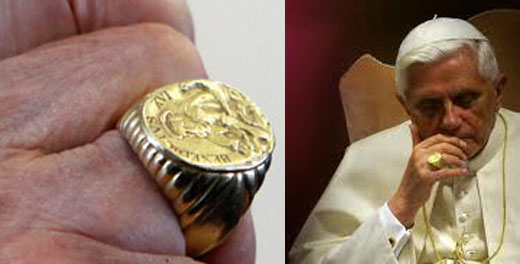
The Ring of the Fisherman or the Fisherman’s Ring (Pope Benedict XVI’s ring as Pope)

Image

What is the Ring of the Fisherman? or also called the Fisherman’s Ring? and why fisherman?

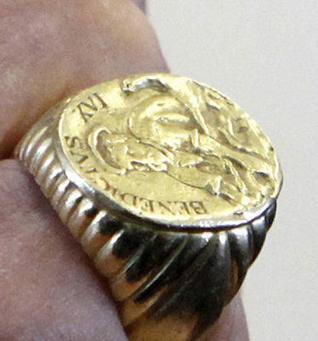
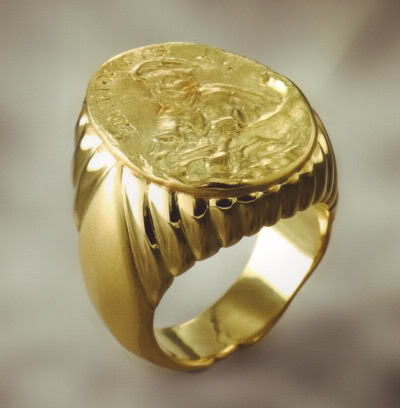
This is because, Peter, the leader of the Apostles, whom our Popes are successors of, including our retiring Pope Benedict XVI, was once a fisherman at Lake Galilee in Israel. Then Jesus, our Lord, came and called him and his brother Andrew, to follow Him, and then He made Peter, a fisher of man, through His Church, which He entrusted to him to lead. This is why, the picture on the Fisherman’s Ring represents Peter as fisherman as seen in the image above. Also engraved is the regnal name of the Pope, Benedictus XVI in Latin.

Image


This ring was used in the past to seal important Papal documents such as letters and most importantly papal bulls. The seal used was wax seal, in which hot wax was poured and the ring is pressed onto the hot wax while it is still hot, and therefore, the image engraved on the ring, will be reflected on the wax seal, signifying the legality of the documents and papal bulls published, with the authority of the Pope, as successor of St. Peter and leader of the Universal Church, one Church of Christ.

Image

This ring, which symbolises the authority of the Pope, given to him at the Installation of the Pope (Papal Installation), is destroyed upon the Pope’s death, and in Pope Benedict XVI’s case, it will be destroyed after the sede vacante starts with a silver hammer in the presence of witnesses, to prevent any misuse of the Ring during the sede vacante to validate documents not released by the Pope.

Pope Benedict XVI’s message at his last General Audience : St. Peter’s Square, Wednesday, 27 February 2013

“Like the Apostle Paul in the Biblical text that we have heard, I feel in my heart that I have to especially thank God who guides and builds up the Church, who plants His Word and thus nourishes the faith in His People. At this moment my heart expands and embraces the whole Church throughout the world and I thank God for the news that, in these years of my Petrine ministry, I have received about the faith in the Lord Jesus Christ and for the love that truly circulates in the Body of the Church, making it to live in the love and the hope that opens us to and guides us towards the fullness of life, towards our heavenly homeland.”

“I feel that I am carrying everyone with me in prayer in this God-given moment when I am collecting every meeting, every trip, every pastoral visit. I am gathering everyone and everything in prayer to entrust it to the Lord: so that we may be filled with the knowledge of His will through all spiritual wisdom and understanding in order to live in a manner worthy of the Lord and His love, bearing fruit in every good work.”

“At this moment I have great confidence because I know, we all know, that the Gospel’s Word of truth is the strength of the Church; it is her life. The Gospel purifies and renews, bearing fruit, wherever the community of believers hears it and welcomes God’s grace in truth and in love. This is my confidence, this is my joy.”

“When, on 19 April almost eight years ago I accepted to take on the Petrine ministry, I had the firm certainty that has always accompanied me: this certainty for the life of the Church from the Word of God. At that moment, as I have already expressed many times, the words that resounded in my heart were: Lord, what do You ask of me? It is a great weight that You are placing on my shoulders but, if You ask it of me, I will cast my nets at your command, confident that You will guide me, even with all my weaknesses. And eight years later I can say that the Lord has guided me. He has been close to me. I have felt His presence every day. It has been a stretch of the Church’s path that has had moments of joy and light, but also difficult moments. I felt like St. Peter and the Apostles in the boat on the Sea of Galilee.”

“The Lord has given us many days of sunshine and light breezes, days when the fishing was plentiful, but also times when the water was rough and the winds against us, just as throughout the whole history of the Church, when the Lord seemed to be sleeping. But I always knew that the Lord is in that boat and I always knew that the boat of the Church is not mine, not ours, but is His. And the Lord will not let it sink. He is the one who steers her, of course also through those He has chosen because that is how He wanted it. This was and is a certainty that nothing can tarnish. And that is why my heart today is filled with gratitude to God, because He never left—the whole Church or me—without His consolation, His light, or His love.”

“We are in the Year of Faith, which I desired precisely in order to strengthen our faith in God in a context that seems to relegate it more and more to the background. I would like to invite everyone to renew their firm trust in the Lord, to entrust ourselves like children to God’s arms, certain that those arms always hold us up and are what allow us to walk forward each day, even when it is a struggle. I would like everyone to feel beloved of that God who gave His Son for us and who has shown us His boundless love. I would like everyone to feel the joy of being Christian. In a beautiful prayer, which can be recited every morning, say: ‘I adore you, my God and I love you with all my heart. Thank you for having created me, for having made me Christian…’ Yes, we are happy for the gift of faith. It is the most precious thing, which no one can take from us! Let us thank the Lord for this every day, with prayer and with a coherent Christian life. God loves us, but awaits us to also love Him!”

“It is not only God who I wish to thank at this time. A pope is not alone in guiding Peter’s barque, even if it is his primary responsibility. I have never felt alone in bearing the joy and the weight of the Petrine ministry. The Lord has placed at my side so many people who, with generosity and love for God and the Church, have helped me and been close to me. First of all, you, dear Brother Cardinals: your wisdom, your advice, and your friendship have been precious to me. My collaborators, starting with my secretary of state who has accompanied me faithfully over the years; the Secretariat of State and the whole of the Roman Curia, as well as all those who, in their various areas, serve the Holy See. There are many faces that are never seen, remaining in obscurity, but precisely in their silence, in their daily dedication in a spirit of faith and humility, they were a sure and reliable support to me.”
 
“A special thought goes to the Church of Rome, my diocese! I cannot forget my Brothers in the episcopate and in the priesthood, consecrated persons, and the entire People of God. In my pastoral visits, meetings, audiences, and trips I always felt great care and deep affection, but I have also loved each and every one of you, without exception, with that pastoral love that is the heart of every pastor, especially the Bishop of Rome, the Successor of the Apostle Peter. Every day I held each of you in prayer, with a father’s heart.”

“I wish to send my greetings and my thanks to all: a pope’s heart extends to the whole world. And I would like to express my gratitude to the Diplomatic Corps accredited to the Holy See, which makes the great family of Nations present here. Here I am also thinking of all those who work for good communication and I thank them for their important service.”

“At this point I would also like to wholeheartedly thank all of the many people around the world who, in recent weeks, have sent me touching tokens of concern, friendship, and prayer. Yes, the Pope is never alone. I feel this again now in such a great way that it touches my heart. The Pope belongs to everyone and many people feel very close to him. It’s true that I receive letters from the world’s notables—from heads of states, from religious leaders, from representatives of the world of culture, etc.”

“But I also receive many letters from ordinary people who write to me simply from their hearts and make me feel their affection, which is born of our being together with Christ Jesus, in the Church. These people do not write to me the way one would write, for example, to a prince or a dignitary that they don’t know. They write to me as brothers and sisters or as sons and daughters, with the sense of a very affectionate family tie. In this you can touch what the Church is—not an organization, not an association for religious or humanitarian ends, but a living body, a communion of brothers and sisters in the Body of Jesus Christ who unites us all. Experiencing the Church in this way and being able to almost touch with our hands the strength of His truth and His love is a reason for joy at a time when many are speaking of its decline. See how the Church is alive today!”

“In these last months I have felt that my strength had diminished and I asked God earnestly in prayer to enlighten me with His light to make me make the right decision, not for my own good, but for the good of the Church. I have taken this step in full awareness of its seriousness and also its newness, but with a profound peace of mind. Loving the Church also means having the courage to make difficult, agonized choices, always keeping in mind the good of the Church, not of oneself.”

“Allow me here to return once again to 19 April, 2005. The gravity of the decision lay precisely in the fact that, from that moment on, I was always and for always engaged by the Lord. Always—whoever assumes the Petrine ministry no longer has any privacy. He belongs always and entirely to everyone, to the whole Church. His life, so to speak, is totally deprived of its private dimension. I experienced, and I am experiencing it precisely now, that one receives life precisely when they give it. Before I said that many people who love the Lord also love St. Peter’s Successor and are fond of him; that the Pope truly has brothers and sisters, sons and daughters all over the world and that he feels safe in the embrace of their communion; because he no longer belongs to himself but he belongs to all and all belong to him.”

“’Always’ is also ‘forever’–there is no return to private life. My decision to renounce the active exercise of the ministry does not revoke this. I am not returning to private life, to a life of trips, meetings, receptions, conferences, etc. I am not abandoning the cross, but am remaining beside the Crucified Lord in a new way. I no longer bear the power of the office for the governance of the Church, but I remain in the service of prayer, within St. Peter’s paddock, so to speak. St. Benedict, whose name I bear as Pope, will be a great example to me in this. He has shown us the way for a life that, active or passive, belongs wholly to God’s work.”

“I also thank each and every one of you for the respect and understanding with which you have received this important decision. I will continue to accompany the Church’s journey through prayer and reflection, with the dedication to the Lord and His Bride that I have tried to live every day up to now and that I want to always live. I ask you to remember me to God, and above all to pray for the Cardinals who are called to such an important task, and for the new Successor of the Apostle Peter. Many the Lord accompany him with the light and strength of His Spirit.”

“We call upon the maternal intercession of Mary, the Mother of God and of the Church, that she might accompany each of us and the entire ecclesial community. We entrust ourselves to her with deep confidence.”

“Dear friends! God guides His Church, always sustaining her even and especially in difficult times. Let us never lose this vision of faith, which is the only true vision of the path of the Church and of the world. In our hearts, in the heart of each one of you, may there always be the joyous certainty that the Lord is beside us, that He does not abandon us, that He is near and embraces us with His love. Thank you.”

Wednesday, 27 February 2013 : 2nd Week of Lent (Gospel Reading)

Matthew 20 : 17-28

When Jesus was going to Jerusalem, He took the twelve disciples aside and said to them, “See, we are going to Jerusalem. There the Son of Man will be betrayed to the chief priests and the teachers of the Law, who will condemn Him to death. They will hand Him over to the foreigners, who will mock Him, scourge Him, and crucify Him. But He will be raised to life on the third day.”

Then the mother of James and John came to Jesus with her sons, and she knelt down, to ask a favour. Jesus said to her, “What do you want?” And she answered, “Here You have my two sons. Grant that they may sit, one at Your right hand and one at Your left, when You are in Your kingdom.”

Jesus said to the brothers, “You do not know what you are asking. Can you drink the cup that I am about to drink?” They answered, “We can.” Jesus replied, “You will indeed drink My cup, but to sit at My right or at My left is not for Me to grant. That will be for those, for whom My Father has prepared it.”

The other ten heard all this, and were angry with the two brothers. Then Jesus called them to Him and said, “You know that the rulers of the nations act as tyrants over them, and the powerful oppress them. It shall not be so among you : whoever wants to be more important in your community shall make himself your servant. And if you want to be the first of all, make yourself the servant of all.”

“Be like the Son of Man who has come, not to be served but to serve, and to give His life to redeem many.”

Tuesday, 26 February 2013 : 2nd Week of Lent (Gospel Reading)

Matthew 23 : 1-12

Then Jesus said to the crowds and to His disciples, “The teachers of the Law and the Pharisees have sat down on the chair of Moses. So you shall do and observe all they say, but do not do as they do, for they do not do what they say. They tie up heavy burdens and load them on the shoulders of the people, but they do not even raise a finger to move them.”

“They do everything in order to be seen by people : they wear very wide bands of the Law around their foreheads, and robes with large tassels. They enjoy the first paces at feasts and reserved seats in the synagogues, and they like being greeted in the marketplace, and being called ‘Master’ by the people.”

“But you, do not let yourselves be called Master, because you have only one Master, and all of you are brothers and sisters. Neither should you call anyone on earth Father, because you have only one Father, He who is in heaven. Nor should you be called Leader, because Christ is the only Leader for you.”

“Let the greatest among you be the servant of all. For whoever makes himself great shall be humbled, and whoever humbles himself shall be made great.”

Sunday, 24 February 2013 : 2nd Sunday of Lent (Scripture Reflection)

The Lord, Jesus Christ, who was transfigured on the mountain, as we heard in the Gospel today, we know to be both fully human and fully divine. He is fully human, having been incarnate into flesh through the Blessed Virgin Mary and the power of the Holy Spirit, and also being fully divine, as He is the Word of God, through whom all things were created by God the Father. Lord Jesus Christ, the Son of God, was sent, by the Father to us, so that all of us can be saved, and can have hope to return to God who loves us, and not be lost to Satan and death.

Elijah and Moses appeared to Jesus on the mountain, because they represented the two aspect of the Old Testament, that Jesus had come to fulfill, and perfect through His new covenant, as told in the New Testament. Elijah represents the prophets, whom had come through the centuries before the coming of Christ, to proclaim His coming, and the prophecies that through Jesus were fulfilled, and all telling of the coming salvation of the people of God from the tyranny of sin, and the end of the separation that had separated God from mankind.

Moses represents the Law, which was given by God Himself at Mount Horeb, the holy mountain, to Moses during his 40 days stay there. This Law includes the Ten Commandments of love, and the other laws of the people of Israel. Christ had come to perfect this Law by explaining the Law, and based them on the very nature of God Himself, which is love. That the Law is made out of God’s love for mankind, and that mankind must not blindly subject themselves to the Law, but rather understand them and carry them out in love for the good of their fellow men.

In today’s transfiguration story, it is indeed noteworthy how, we humans prefer things that are good, and we always hope that things will stay our way, and we like to stay within our comfort zone, that is the sphere that keeps us from the harms and dangers of the outside world. Such was why Peter suggested to Jesus, that they stay there in Christ’s glory, and not come down from the mountain. To come down from the mountain for Jesus, as mentioned that He spoke about that mission to both Elijah and Moses, was to be death for Him, as He would die on the cross, but would rise again on the third day.

He chose to come down, and the Lord too told the disciples to obey Him, through the voice in the cloud, not to be tempted to stay on in glory, but to descend and continue the mission. In this case, Christ lowered Himself such from His glory revealed at the Transfiguration, and in perfect humility and obedience to God, laid down His life for all His sheep, the children of God, for their salvation. It is Christ’s obedience that allow God to exercise the greatest work of all, that is the salvation of all mankind, and the salvation of the world.

Similarly, Abram, who is later to be known as Abraham, was rewarded by God with the promise that his descendants will be numerous as the stars and will receive the Promised Land, all because of Abram’s great faith, obedience, and love to God. Later on, we are told that such is his great faith and obedience, he was willing to sacrifice his own son, Isaac, the son of the promise, to obey the Lord’s will. The Lord saw his faith, and rewards him greatly.

If Abraham was willing to sacrifice his own son, how much more would the Lord therefore then do for our sake? That is to give His own Son, which is part of Him in the Holy Trinity, to be a man and then die so that we can live?

We too, today therefore, brothers and sisters in Christ, should imitate Abram/Abraham and Christ, who do not just stay in their comfort zone, and rather do their best to fulfill the mission entrusted to them by God, no matter how difficult it was. Jesus had to face suffering and death, and Abram had to later to face the fact that the beloved son he was given to by the Lord, he had to sacrifice to the Lord. We do not face such difficult challenges, but we too have our own challenges in accepting and fulfilling the missions God has entrusted us with.

Too many times that we have failed to fulfill these missions simply because, we are content with our comfort zone, with whatever abundance we already have in this world, and in our own circles, either in our own family, with our own friends, or in our own career and workplace, and in the achievements and glory that we have achieved and made. We have to make sure that we step out of this comfort zone, as we ourselves are not Christians and not baptised just to be idle in our faith.

Our Catholic faith teaches us that we have to be proactive and do good for the sake of our brethren. Many people have need for our help and actions, and just as Coadjutor Archbishop William Goh mentioned in his recent ordination speech, our Church cannot be just a ‘maintenance church’, but rather must be a vibrant and powerful Church, that exerts its influence and love into this world.

Just like Abram, who was greatly rewarded by God out of his love and obedience to God, shall we then also obey God’s will, that is to help others around us, spread the Gospel and the Good News of our Lord, especially to those who seek for it, and to give the love of God that flows through us, to all mankind, that everyone too can become the children of God, and just like Abram, to be rewarded eventually with grace from God, which for us, is the promise of life eternal with Him in heavenly glory.

For no glory can come without hard work, and no glory exists without its sufferings and humility. The glorious Christ humbled Himself that all of us have hope through Him, by offering His own Body as the bridge between us and God.

Therefore, brothers and sisters in Christ, today, let us be transfigured, and transformed just like Christ was, but not the way Christ was, rather, let us shed our old, passive, and idle path, our idle and dormant faith. Instead, let us boldly step forward into this world, bringing into it, the message of the Good News of our God, and to serve all peoples humbly with sincerity and love, both love for our fellow men, and for our Father who loves us. May God bless us today in all our works, in all our actions, and in all our dealings, that in all things that we do, we will always bring life and love to others, and to glorify God’s Name at all times. Forever and ever. Amen.

Saturday, 23 February 2013 : 1st Week of Lent (Scripture Reflection)

God loves all, and He loves everyone, without exception. Not even the worst sinners can escape from His love. However, all of us, who truly love God in return, and keep His teachings and commandments, enjoy even greater love, and also He has made us His people, His children, and promise us every graces and blessings in our lives.

It is easy to love your friends, those who also love you, and your family, and those whom you know. It is easy to be with them and also live happily with them. But indeed, if we are all indeed called by God to be His missionaries to all the world, can we just stay content in being within our own sphere of safety? within our own comfort zone?

No! Indeed, as the Lord said to us, “Love our enemies” and “Pray for those who persecutes you”, we have to reach out to those who hate us, and especially to those whom because of the hate in our hearts, have hated too. It is natural for us humans to hate, as since the days of the fall of Adam and Eve, sin has entered the hearts of men, and therefore with it, came hatred, prejudice, and jealousy. It is natural for us to hate someone who hated us first, and it is natural for us to covet the possession of others, especially those who are more fortunate than us. However, remember that through our baptism in God, and through the Sacred Scripture that we read and listened to, we have all become the children of God, and have been made better than what our human natures allow us to be.

For as the children of God, we too should follow in God’s footsteps. No better example at this, that Christ, the Son of God, whose in His death throes on the cross, showed how great God’s love is to all peoples. For Christ Himself had said, “There is no greater love, than that of those who gave their life for their friends. To Christ, all of us are His friends, does not matter whether king or poor, big or small, saints or sinners. Even to those whom had handed Him the death penalty by shouting “Crucify Him!”, Christ also consider them as friends, and He gave His life for them. These were His enemies, but out of His great love, He forgave them, and asked the Father not to punish them, because they do not know what they were doing.

This was one example Christ gave why we should love our enemies. Not to die like Him for our enemies, but because, these enemies of ours are after all, also the children of God, whom God loves, despite of their sins, just like God loves us, despite of our sins. Therefore, we should love one another, even our enemies, that they too, may learn love, and in doing so, shed off their hatred and sinful ways, and join us in salvation. There are many who also persecute us, especially the faithful, as we have often heard happening all over the world. But how do we face this? Do we face them with hatred and more violence, or do we face them with love? with prayer? For if we face them with hatred, and violence, not only would they be condemned, but we too, since in doing so, we let ourselves fall to the snares of evil, and by bringing more hatred and violence, we prevent the works and love of God from being manifest.

Rather, let us indeed do what the Lord told us, to end the cycle of hatred, the cycle of evil, and steadfastly refuse the temptations of the devil. Bring back our separated brethren, who are separated from us by hatred, prejudice, and jealousy, and therefore, bring ourselves together into the Light, and made our world a better place, just as the Lord wishes for us, whom He loves dearly. Let us pray, that all of us will be strong, and will be able to carry out our mission, and in that mission, to reach out to those who hate us, our enemies, to be able to forgive them and the pains and sufferings they have inflicted on us, and to love all who had persecuted us. Let us make this world a better world, based in love, peace, compassion, and harmony, instead of hatred, evil, and death. Amen.

Saturday, 23 February 2013 : 1st Week of Lent (Gospel Reading)

Matthew 5 : 43-48

You have hear that it was said : “Love your neighbour and do not do good to your enemy.” But this I tell you : love your enemies, and pray for those who persecute you, so that you may be children of your Father in Heaven.

For He makes His sun rise on both the wicked and the good, and He gives rain to both the just and the unjust. If you love those who love you, what is special about that? Do not even tax collectors do as much? And if you are friendly only to your friends, what is so exceptional about that? Do not even the pagans do as much?

As for you, be righteous and perfect in the way your heavenly Father is righteous and perfect.