http://www.zenit.org/en/articles/cardinal-angelo-sodano-s-homily-at-the-missa-pro-eligendo-pontifice
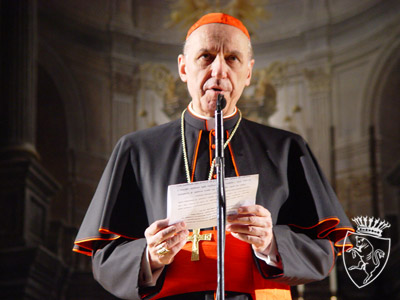
Homily of Cardinal Angelo Sodano
Dean of the College of Cardinals
Vatican Basilica – March 12, 2013
Dear Concelebrants, Distinct Authorities, Brothers and Sisters in Christ,
“Forever I will sing the mercies of the Lord” is the hymn that resounds once again near the tomb of the Apostle Peter in this important hour of the history of the Holy Church of Christ.
These are the words of Psalm 88 that have flowed from our lips to adore, give thanks and beg the Father who is in heaven. “Misericordias Domini in aeternum cantabo”: is the beautiful Latin text that has introduced us into contemplation of the One who always watches over his Church with love, sustaining her on her journey down through the ages, and giving her life through his Holy Spirit.
Such an interior attitude is ours today as we wish to offer ourselves with Christ to the Father who is in heaven, to thank him for the loving assistance that he always reserves for the Holy Church, and in particular for the brilliant Pontificate that he granted to us through the life and work of the 265th Successor of Peter, the beloved and venerable Pontiff Benedict XVI, to whom we renew in this moment all of our gratitude.
At the same time today, we implore the Lord, that through the pastoral sollicitude of the Cardinal Fathers, He may soon grant another Good Shepherd to his Holy Church. In this hour, faith in the promise of Christ sustains us in the indefectible character of the church. Indeed Jesus said to Peter: “You are Peter and on this rock I will build my Church, and the gates of hell shall not prevail against her.” (Mt. 16:18).
My brothers, the readings of the World of God that we have just heard can help us better understand the mission that Christ has entrusted to Peter and to his successors.
1. The Message of Love
The first reading has offered us once again a well-known oracle from the second part of the book of Isaiah that is known as “the book of consolation” (Isaiah 40-66). It is a prophecy addressed to the people of Israel who are in exile in Babylon. Through this prophecy, God announces that he will send a Messiah full of mercy, a Messiah who would say: “The spirit of the Lord God is upon me… he has sent me to bring good news to the poor, to bind up the wounds of broken hearts, to proclaim liberty to captives, freedom to prisoners, and to announce a year of mercy of the Lord” (Isaiah 61:1-3).
The fulfillment of such a prophecy is fully realized in Jesus, who came into the world to make present the love of the Father for all people. It is a love which is especially felt in contact with suffering, injustice, poverty and all human frailty, both physical and moral. It is especially found in the well known encyclical of Pope John Paul II, “Dives in Misericordia” where we read: “It is precisely the mode and sphere in which love manifests itself that in biblical language is called “mercy” (n. 3).
This mission of mercy has been entrusted by Christ to the pastors of his Church. It is a mission that is entrustedd by every priest and bishop, but is especially entrusted to the Bishop of Rome, Shepherd of the universal Church. It is infact to Peter that Jesus said: “Simon son of John, do you love me more than these?… Feed my lambs (John 21:15). In his commentary on these words, St. Augustine wrote: “May it be therefore the task of love to feed the flock of the Lord” (In Iohannis Evangelium, 123, 5; PL 35, 1967).
It is indeed this love that urges the Pastors of the Church to undertake their mission of service of the people of every age, from immediate charitable work even to the highest form of service, that of offering to every person the light of the Gospel and the strength of grace. This is what Benedict XVI wrote in his Lenten Message for this year (n.3). “Sometimes we tend, in fact, to reduce the term “charity” to solidarity or simply humanitarian aid. It is important, however, to remember that the greatest work of charity is evangelization, which is the “ministry of the word”. There is no action more beneficial – and therefore more charitable – towards one’s neighbor than to break the bread of the word of God, to share with him the Good News of the Gospel, to introduce him to a relationship with God: evangelization thus becomes the highest and the most integral promotion of the human person. As the Servant of God Pope Paul VI wrote in the Encyclical Populorum Progressio, the proclamation of Christ is the first and principal contributor to development (cf. n. 16).”
2. The message of unity
The second reading is taken from the letter to the Ephesians., written by the Apostle Paul in this very city of Rome during his first imprisonment (62-63 A.D.)
It is a sublime letter in which Paul presents the mystery of Christ and his Church. While the first part is doctrinal (ch.1-3), the second part, from which today’s reading is taken, has a much more pastoral tone (ch. 4-6). In this part Paul teaches the practical consequences of the doctrine that was previously presented and begins with a strong appeal for church unity: “As a prisoner for the Lord, then, I urge you to live a life worthy of the calling you have received. Be completely humble and gentle; be patient, bearing with one another in love. Make every effort to keep the unity of the Spirit through the bond of peace.(Eph 4,1-3).
St. Paul then explains that in the unity of the Church, there is a diversity of gifts, according to the manifold grace of Christ, but this diversity is in function of the building up of the one body of Christ. “So Christ himself gave the apostles, the prophets, the evangelists, the pastors and teachers, to equip his people for works of service, so that the body of Christ may be built up (Eph 4:11-12).
It is for the very unity of His mystical body that Christ then has sent His Holy Spirit and, at the same time, He has established His apostles and among them Peter, who takes the lead, as the visible foundation of the unity of the Church.
In our text, St. Paul teaches that each of us must work to build up the unity of the Church, so that “From him the whole body, joined and held together by every supporting ligament, grows and builds itself up in love, as each part does its work (Eph 4:16). Each of us is therefore called to cooperate with the Successor of Peter, the visible foundation of such an ecclesial unity.
3. The Mission of the Pope
Brothers and sisters in Christ today’s Gospel takes us back to the Last Supper, when the Lord said to his Apostles: “This is my commandment: that you love one another as I have loved you” (John 15:12). The text is linked to the first reading from the Messiah’s actions in the first reading from the prophet Isaiah, reminding us that the fundamental attitude of the Pastors of the Church is love. It is this love that urges us to offer our own lives for our brothers and sisters. Jesus himself tells us: “There is no greater love than to lay down one’s life for one’s friends” (John 15:12).
The basic attitude of every good Shepherd is therefore to lay down one’s life for his sheep (John 10:15). This also applies to the Successor of Peter, Pastor of the Universal Church. As high and universal the pastoral office, so much greater must be the charity of the Shepherd. In the heart of every Successor of Peter, the words spoken one day by the Divine Master to the humble fisherman of Galilee have resounded: “Diligis me plus his? Pasce agnos meos… pasce oves meas”; “Do you love me more than these? Feed my lambs… feed my sheep!” (John 21:15-17)
In the wake of this service of love toward the Church and towards all of humanity, the last popes have been builders of so many good initiatives for people and for the international community, tirelessly promoting justice and peace. Let us pray that the future Pope may continue this unceasing work on the world level.
Moreover, this service of charity is part of the intimate nature of the Church. Pope Benedict XVI reminded us of this fact when he said: “The service of charity is also a constitutive element of the Church’s mission and an indispensable expression of her very being; (Apostolic Letter in the form of a Motu Proprio Intima Ecclesiae natura, November 11, 2012, introduction; cf. Deus caritas est, n. 25).
It is this mission of charity that is proper to the Church, and in a particular way is proper to the Church of Rome, that in the beautiful expression of St. Ignatius of Antioch, is the Church that “presides in charity” “praesidet caritati” (cf. Ad Romanos (preface).; Lumen Gentium, n. 13).
My brothers, let us pray that the Lord will grant us a Pontiff who will embrace this noble mission with a generous heart. We ask this of the Lord, through the intercession of Mary most holy, Queen of the Apostles and of all the Martyrs and Saints, who through the course of history, made this Church of Rome glorious through the ages. Amen.


 petercanisiusmichaeldavidkang