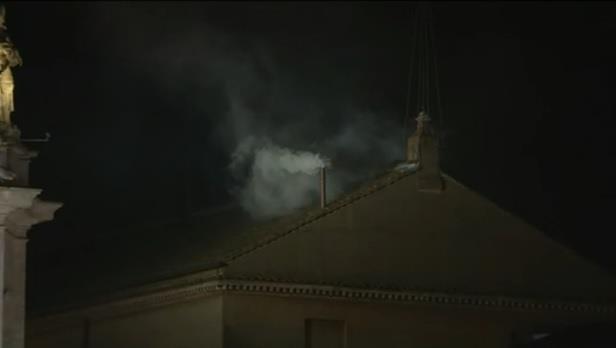
Fifth Ballot : White smoke (Fumata bianca). A new Pope has been elected. Habemus Papam!

Habemus Papam! We have a Pope!

549289_509082082489147_147052586_n

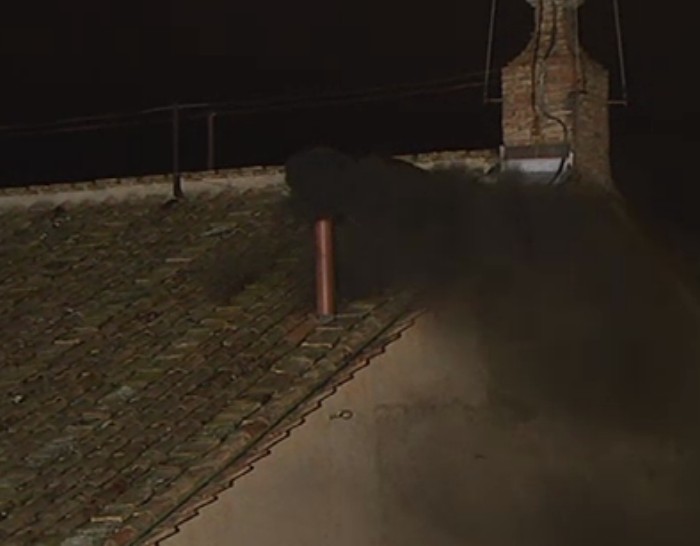
Fourth Ballot : No smoke appeared on chimney. A new Pope has not been elected yet

Yet another wait as the fourth ballot was not successful to elect a new Pope yet. If the fourth ballot had seen a new Pope elected as in 2005, the smoke would have appeared from the chimney above the Sistine Chapel, and it will be white.

Now we are waiting for the fifth and the last ballot of the day. The smoke will be appearing very soon. Keep on praying!

More Concise, Detailed, and Nicer Infographic about the Conclave

Image

Time to watch for smoke from the Sistine Chapel chimney

Image

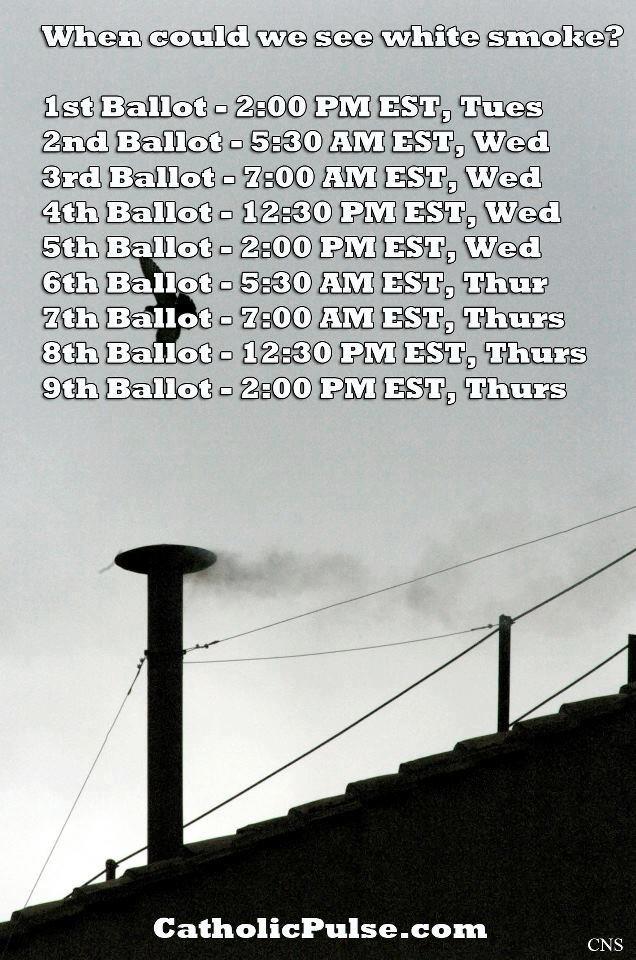
These are the times to watch the smoke from the Sistine Chapel’s famous chimney.

As mentioned :

1. First and third ballot of the day will only have smoke if the Pope has been elected. This smoke will always be white.


2. Second and fourth ballot of the day will always have smoke, and can either be black or white.

a. Black smoke : no Pope has been elected

b. White smoke : a new Pope has been elected


3. 45 minutes will pass between the white smoke, and the appearance of the Cardinal Protodeacon, who will announce the Habemus Papam, which will reveal the name of the newly elected Pope, then another 15 minutes will likely pass before the new Pope made his appearance.

List of possible regnal names for the new Pope, from Benedict to Peter

These are the list of all the possible regnal names (may not be entirely complete, since I may miss some in the way), that the new Pope can and may take as his own regnal name. In parentheses are how the name will look like if the Pope takes the name.

The ones listed below are the names that Popes had been taking since 1775 till today (2013) :

1. Benedict (Benedict XVII) last Benedict still living as Pope Emeritus

2. John Paul (John Paul III) last John Paul died in 2005

3. Paul (Paul VII) last Paul died in 1978

4. John (John XXIV) last John died in 1963, no John before that since 1334

5. Pius (Pius XIII) last Pius died in 1958

6. Leo (Leo XIV) last Leo died in 1903

7. Gregory (Gregory XVII) last Gregory died in 1846


Below are the names that the Popes had taken before 1775, but this does not rule them out from being picked by the new Pope, but chances are remote, with the above 7 names in use for the past 238 years.

8. Clement (Clement XV) last Clement died in1775

9. Innocent (Innocent XIV) last Innocent died in 1724

10. Alexander (Alexander IX) last Alexander died in 1691

11. Urban (Urban IX) last Urban died in 1644

12. Sixtus (Sixtus VI) last Sixtus died in 1590

13. Marcellus (Marcellus III) last Marcellus died in 1555

14. Julius (Julius IV) last Julius died in 1555

15. Adrian (Adrian VII) last Adrian died in 1523, last non-Italian Pope before 1978

16. Callixtus (Callixtus IV) last Callixtus died in 1458

17. Nicholas (Nicholas VI) last Nicholas died in 1455

18. Eugene (Eugene V) last Eugene died in 1447

19. Martin (Martin VI) last Martin died in 1431

20. Boniface (Boniface X) last Boniface died in 1404

21. Celestine (Celestine VI) last Celestine died in 1294, also a Saint, the famous Pope who resigned

22. Honorius (Honorius V) last Honorius died in 1287

23. Lucius (Lucius IV) last Lucius died in 1185

24. Anastasius (Anastasius V) last Anastasius died in 1154

25. Eugene (Eugene IV) last Eugene died in 1153

26. Gelasius (Gelasius III) last Gelasius died in 1119

27. Paschal (Paschal III) last Paschal died in 1118

28. Victor (Victor IV) last Victor died in 1087

29. Stephen (Stephen X) last Stephen died in 1058

30. Damasus (Damasus III) last Damasus died in 1048

31. Sylvester (Sylvester IV) last Sylvester died in 1045

32. Sergius (Sergius V) last Sergius died in 1012

33. Agapetus (Agapetus III) last Agapetus died in 955

34. Marinus (Marinus III) last Marinus died in 946

35. Lando/Landus (Landus II) only used once, died in 914, last Pope whose name is only used once

36. Theodore (Theodore III) last Theodore died in 897

37. Romanus (Romanus II) only used once, died in 897

38. Formosus (Formosus II) only used once, died in 896

39. Valentine (Valentine II) only used once, died in 827

40. Zachary (Zachary II) only used once, died in 752

41. Constantine (Constantine II) only used once, died in 715

42. Sisinnius (Sisinnius II) only used once, died in 708

43. Conon (Conon II) only used once, died in 687

44. Agatho (Agatho II) only used once, last one is Saint, died in 681

45. Donus (Donus II) only used once, last one died in 678

46. Adeodatus (Adeodatus III) last Adeodatus died in 676

47. Vitalian (Vitalian II) only used once, died in 672

48. Severinus (Severinus II) only used once, died in 640

49. Sabinian (Sabinian II) only used once, died in 606

50. Pelagius (Pelagius III) last Pelagius died in 590

51. Vigilius (Vigilius II) only used once, died in 555

52. Silverius (Silverius II) only used once, last one is Saint, died in 537

53. Felix (Felix V) last Felix died in 530


All the names below have been used only once, ever. Most of them are the early Church Fathers and Saints, and therefore, it is rather extremely unlikely any of these names would be picked.

54. Hormisdas (Hormisdas II) only used once, died in 523

55. Symmachus (Symmachus II) only used once, last one is Saint, died in 514

56. Simplicius (Simplicius II) only used once, last one is Saint, died in 483

57. Hilarius (Hilarius II) only used once, last one is Saint, died in 468

58. Zosimus (Zosimus II) only used once, last one is Saint, died in 418

59. Siricius (Siricius II) only used once, last one is Saint, died in 399

60. Liberius (Liberius II) only used once, died in 366

61. Mark (Mark II) only used once, last one is Saint, died in 336

62. Miltiades (Miltiades II) only used once, last one is Saint, died in 314, First Pope after Edict of Milan

63. Eusebius (Eusebius II) only used once, last one is Saint, died in 310

64. Marcellinus (Marcellinus II) only used once, last one is Saint, died in 304

65. Caius (Caius II) only used once, last one is Saint, died in 296

66. Eutychian (Eutychian II) only used once, last one is Saint, died in 283

67. Dionysius (Dionysius II) only used once, last one is Saint, died in 268

68. Cornelius (Cornelius II) only used once, last one is Saint, died in 253

69. Fabian (Fabian II) only used once, last one is Saint, died in 250

70. Anterus (Anterus II) only used once, last one is Saint, died in 236

71. Pontian (Pontian II) only used once, last one is Saint, died in 235

72. Zephyrinus (Zephyrinus II) only used once, last one is Saint, died in 217

73. Eleuterus (Eleuterus II) only used once, last one is Saint, died in 189

74. Soter (Soter II) only used once, last one is Saint, died in 174 or 175

75. Anicetus (Anicetus II) only used once, last one is Saint, died in 166

76. Hyginus (Hyginus II) only used once, last one is Saint, died in 140 or 142

77. Telesphorus (Telesphorus II) only used once, last one is Saint, died in 136 or 138

78. Evaristus (Evaristus II) only used once, last one is Saint, died in 105 or 107

79. Anacletus (Anacletus II) only used once, last one is Saint, died in 88 or 92

80. Linus (Linus II) only used once, last one is Saint, died in 76 or 79

81. Peter (Peter II) only used once, and he is the founder of the Church, Apostle of Jesus Christ, and it is extremely unlikely any future Pope, or any Pope will ever adopt the name of the Prince of the Apostles.

First Ballot : Black Smoke, no Pope had been elected yet

http://www.romereports.com/palio/pope-not-yet-elected-black-smoke-comes-out-of-sistine-chapel-english-9378.html

Image

Black smoke from the chimney of the Sistine Chapel for the first ballot, and the only ballot on the first day of Conclave, Tuesday, 12 March 2013.

The next voting rounds will be on Wednesday, 13 March 2013, composed of morning session (2nd and 3rd ballots), and the afternoon session (4th and 5th ballots).

Cardinal Angelo Scola, Archbishop of Milan, the Papabile

http://www.eitb.com/en/news/world/detail/1282802/candidates-new-pope–profile-cardinal-angelo-scola/

From the article (My commentary at the end) :


Election of new pope

Profile of Cardinal Angelo Scola, Archbishop of Milan

APTN

03/11/2013

A conservative, and theologically close to both Pope Benedict and his predecessor John Paul II, Cardinal Scola is regarded as one of the leading European candidates to become Pope.

Cardinal Angelo Scola, the archbishop of Milan.

Cardinal Angelo Scola, the archbishop of Milan, shot to the top of a list of possible successors to Pope Benedict XVI almost immediately the resignation was announced.

A conservative, and theologically close to both Pope Benedict and his predecessor John Paul II, Cardinal Scola is regarded as one of the leading European candidates to become Pope.

Some observers tipped him to succeed after the death of John Paul II in 2005, but the conclave instead chose Cardinal Joseph Ratzinger who became Benedict XVI, the 265th pope.

But if there was rivalry between the candidates in 2005, it had little effect on their close relationship, and Scola remained a favourite of Pope Benedict’s, who appointed the Cardinal archbishop of the Milan Diocese in June 2011.

In the small town of Malgrate on Lake Como in northern Italy, many of the 5,000 residents are backing their hometown boy to become Pope. Scola was born in Malgrate on 7 November 1941 to a truck driver and a homemaker.

He entered the priesthood in 1970, became a Cardinal in 2003, serving first as Patriarch of Milan until he was elevated to his current post of archbishop.

Scola’s cousin, Angelo Colombo, remembers that during World War II he would spend time at his cousin’s home because Scola’s father was a truck driver and could get access to flour and bread.

Colombo said he would go to Scola’s family home, and his aunt and the future Cardinal would always share their food. When he asked if he thought his cousin would make a good Pope, Colombo laughed and responded: “he was a tough boy”.

Scola spent the early years of his life in a small home on Malgrate’s Salita Sant’Antonio. Alfredo Cagliandi was a classmate of Cardinal Scola and lived in the apartment below him.

“We would invite Angelo to come and play and he would repeatedly respond ‘I am sorry, but I don’t have time.’  He was too busy because was already involved in something religious,” said Cagliandi, who still lives in Malgrate.

Scola spent the first two decades after his 1970 ordination in the lecture halls and libraries of renowned Catholic universities and theological training grounds, notably in Fribourg, Switzerland, and the Lateran Pontifical University in Rome.

While pursuing theological studies, Scola was involved in Communion and Liberation, a conservative Italian Catholic group which blends political activism with faith-based fervour as it seeks to make its weight felt in the country’s decision-making.

Back in Scola’s home town, the local priest Father Andrea Lotterio proudly showed off the baptismal font where he says the town’s babies are still baptised today, noting that Scola was baptised there in 1941.

Father Lotterio said Scola has pleased the residents of Malgrate by never losing his strong ties to his hometown. “He has maintained his relationships with many local citizens, with his friends, with his relatives,” Lotterio said. “So much so that in this town he is called Don Angelo, instead of Cardinal or Patriarch of Venice.”

Pope Benedict resigned as leader of the Catholic Church on Thursday, becoming the first pope in 600 years to resign. For the time being, the governance of the Catholic Church shifts to Cardinal Tarcisio Bertone, the camerlengo, or chamberlain. Bertone, along with the College of Cardinals will guide the church and make plans for the conclave to elect the 266th leader within the next few weeks.


Commentary and additions:

Indeed, Cardinal Angelo Scola has many strengths and characteristics that we need as the new Pope to lead the Roman Catholic Church, the one and Universal Church. He does have his weaknesses, but his strengths more than made up for him. After all, it is human to have weaknesses and to make mistakes.

Cardinal Scola is media-savvy, able to reach out into the hearts of many, including youths and those in the world, who are longing for the Lord to come to them. Being media-savvy, and also internet-savvy, Cardinal Scola is not shy of using modern media tools, such as the internet, twitter, YouTube, his own site, and many other means to evangelise to the world, and to reach out, especially to youths.

Cardinal Scola also has a positive outlook and optimism in the Church, and indeed, instead of being pessimistic on the Church, and instead of looking at a Church in trouble, he dismissed all this, and all the lies that the media had brought about the Church, that the Church instead of being in chaos and trouble, is in fact growing, and filled with vibrant and strong faith and love in God, and Cardinal Scola has the capacity to tap into all these energies.

Cardinal Scola also came from a poorer family background, and he understood the plight of the poor and the less fortunate. His hometown people has often remembered him as someone who not only did not forget about where he came from, and where he was born, but also someone who constantly gives them his care and his love, in imitation of Christ and His care for the poor.

Cardinal Scola speaks Italian, English, French, and Spanish, and although his English is not that good, but he has quite a strong command of these languages, which are essential in the Pope’s ministry as the leader of the Universal Church.

Cardinal Scola’s initiatives to reach out to the Christians in the Holy Land and in other areas where Christians are minorities, and his involvement in interreligious dialogue and cooperation, and even with atheists, had been fruitful and crucial in strengthening Christians in the areas where they had been persecuted, and where persecutions are ongoing.

His experience in the Archdiocese of Milan, Patriarchate of Venice, and Diocese of Grosseto clearly showed that he is a pastoral leader with a humble and yet intellectual mind, that matches that of our beloved Pope Emeritus Benedict XVI. Yet, his experiences in the Roman Curia too were many, with works as leader of Pontifical Institute of Marriage and the Family, which he also took a strong stand with the Church in the sanctity of both marriage and the family.

His intellect, knowledge, and publications especially in topics like bioethics, in the midst of the attacks against Church’s stand on bioethics, cloning, and contraceptions will be essential for the future leader of the Church, and his ability to connect and reach out to people, more than Pope Emeritus Benedict XVI, will be valuable asset to have in the new Pope.

Nevertheless, now that the Conclave will begin soon, we continue to pray that God will pour His Holy Spirit on all the Cardinal-electors, that they can make a wise and inspired decision, to elect someone whom the Lord has chosen, as the best possible person to succeed His Apostle, Peter, and lead the whole Universal Church, that God Himself built in this world, to be the manifestation of His love, justice, and presence.

(Special) Mass for the Election of the Roman Pontiff / Missa pro Eligendo Pontifice (Gospel Reading)

John 15 : 9-17

As the Father has loved Me, so I have loved you. Remain in My love! You will remain in My love if you keep My commandments, just as I have kept My Father’s commandments and remain in His love. I have told you all this, that My own joy may be in you, and your joy may be complete.

This is My commandment : Love one another as I have loved you! There is no greater love than this, to give one’s life for one’s friends; you are My friends, if you do what I commanded you. I shall not call you servants any more, because servants do not know what their master is about. Instead I have called you friends, since I have made known to you everything I learnt from My Father.

You did not choose Me; it was I who chose you and sent you to go and bear fruit, fruit that will last. And everything you ask the Father in My Name, He will give you. This is My command, that you love one another.

A Timetable of the First Day of Conclave

What will happen today in the first day of the Conclave (Tuesday, 12 March 2013)? All the time noted below are in Rome time (CET, Central European Time, 1 hour ahead of UTC (UTC+1)).

Some event are live from Vatican Player at http://www.vatican.va/video/ and the live recording from Rome Reports : http://www.romereports.com/palio/modules.php?name=Content3&pa=showpage&newlang=english&pid=47#.UT4XGVeJegH


1. (Live) Mass for the Election of the Roman Pontiff / Missa pro Eligendo Pontifice : 10 am. This Mass will officially begin the Conclave and will be offered for prayers for the election of the Pope.

2. Cardinal-electors leave the Domus Sancta Marthae where they stay for the Pauline Chapel : 3.45 pm

3. (Live) Cardinal-electors begin the procession into Sistine Chapel from Pauline Chapel, while singing Veni Creator Spiritus and the Litany of the Saints : 4.30 pm

4. (Live) Oath of secrecy by the Cardinal-electors and the extra omnes order by Monsignor Guido Marini : 4.45 pm, then meditation by Cardinal Prosper Grech of Malta (2nd meditation)

5. Conclave and first ballot : about 5 pm – 7 pm, smoke should appear between 7-8 pm Rome time. If white, means a new Pope has been elected, but this is unlikely to happen. (Smoke and the chimney can be seen live through either Vatican Player or Rome Reports page I mentioned above)

6. Vespers celebrated by the Cardinal-electors : 7.15 pm

7. Cardinal-electors return to Domus Sancta Marthae, their residence during the period of the Conclave : 7.30 pm


These are just rough timing, and as this is the first ballot, the Cardinal-electors may still need time, especially the first-timers, in getting used to the rules and proceedings of the Conclave and thus might be delayed slightly.

Times to watch for the smoke signal from the Sistine Chapel

Image

Here are the times when the smoke signals (black or white) will pour out of the chimney and be visible to the public, as the first sign whether the Cardinal-electors had succeeded or failed to elect a new Pope in the previous ballot session.


1. Smoke after 1st ballot (The only Tuesday ballot session, 1st day):

Tuesday, 12 March 2013 at 8 pm Rome time (CET/UTC+1)

Tuesday, 12 March 2013 at 7 pm UTC

Tuesday, 12 March 2013 at 2 pm EST (UTC-5)

Tuesday, 12 March 2013 at 11 am PST (UTC-8)

Wednesday, 13 March 2013 at 2 am WIB (Indonesia, Thailand, etc.) (UTC+7)

Wednesday, 13 March 2013 at 3 am Singapore time (UTC+8)


2. Smoke after 2nd ballot (1st Wednesday morning ballot, 2nd day) : A new Pope is likely to have been elected (if no pope elected after the 2nd ballot, the Cardinal-electors will continue directly to 3rd ballot, and the two ballots will be burned together after the 3rd ballot) :

Wednesday, 13 March 2013 at 11.30 am Rome time (CET/UTC+1)

Wednesday, 13 March 2013 at 10.30 am UTC

Wednesday, 13 March 2013 at 5.30 am EST (UTC-5)

Wednesday, 13 March 2013 at 2.30 am PST (UTC-8)

Wednesday, 13 March 2013 at 5.30 pm WIB (Indonesia, Thailand, etc.) (UTC+7)

Wednesday, 13 March 2013 at 6.30 pm Singapore time (UTC+8)


3. Smoke after 3rd ballot (2nd Wednesday morning ballot, 2nd day) :

Wednesday, 13 March 2013 at 1 pm Rome time (CET/UTC+1)

Wednesday, 13 March 2013 at 12 pm UTC

Wednesday, 13 March 2013 at 7 am EST (UTC-5)

Wednesday, 13 March 2013 at 4 am PST (UTC-8)

Wednesday, 13 March 2013 at 7 pm WIB (Indonesia, Thailand, etc.) (UTC+7)

Wednesday, 13 March 2013 at 8 pm Singapore time (UTC+8)


4. Smoke after 4th ballot (1st Wednesday afternoon ballot, 2nd day) : A new Pope is likely to have been elected

Wednesday, 13 March 2013 at 6.30 pm Rome time (CET/UTC+1)

Wednesday, 13 March 2013 at 5.30 pm UTC

Wednesday, 13 March 2013 at 12.30 pm EST (UTC-5)

Wednesday, 13 March 2013 at 9.30 am PST (UTC-8)

Thursday, 14 March 2013 at 00.30 am WIB (Indonesia, Thailand, etc.) (UTC+7)

Thursday, 14 March 2013 at 1.30 am Singapore time (UTC+8)


5. Smoke after 5th ballot (2nd Wednesday afternoon ballot, 2nd day) :

Wednesday, 13 March 2013 at 8 pm Rome time (CET/UTC+1)

Wednesday, 13 March 2013 at 7 pm UTC

Wednesday, 13 March 2013 at 2 pm EST (UTC-5)

Wednesday, 13 March 2013 at 11 am PST (UTC-8)

Thursday, 14 March 2013 at 2 am WIB (Indonesia, Thailand, etc.) (UTC+7)

Thursday, 14 March 2013 at 3 am Singapore time (UTC+8)


6. Smoke after 6th ballot (1st Thursday morning ballot, 3rd day) : A new Pope is likely to have been elected :

Thursday, 14 March 2013 at 11.30 am Rome time (CET/UTC+1)

Thursday, 14 March 2013 at 10.30 am UTC

Thursday, 14 March 2013 at 5.30 am EST (UTC-5)

Thursday, 14 March 2013 at 2.30 am PST (UTC-8)

Thursday, 14 March 2013 at 5.30 pm WIB (Indonesia, Thailand, etc.) (UTC+7)

Thursday, 14 March 2013 at 6.30 pm Singapore time (UTC+8)


7. Smoke after 7th ballot (2nd Thursday morning ballot, 3rd day) :

Thursday, 14 March 2013 at 1 pm Rome time (CET/UTC+1)

Thursday, 14 March 2013 at 12 pm UTC

Thursday, 14 March 2013 at 7 am EST (UTC-5)

Thursday, 14 March 2013 at 4 am PST (UTC-8)

Thursday, 14 March 2013 at 7 pm WIB (Indonesia, Thailand, etc.) (UTC+7)

Thursday, 14 March 2013 at 8 pm Singapore time (UTC+8)


8. Smoke after 8th ballot (1st Thursday afternoon ballot, 3rd day) : A new Pope is likely to have been elected

Thursday, 14 March 2013 at 6.30 pm Rome time (CET/UTC+1)

Thursday, 14 March 2013 at 5.30 pm UTC

Thursday, 14 March 2013 at 12.30 pm EST (UTC-5)

Thursday, 14 March 2013 at 9.30 am PST (UTC-8)

Friday, 15 March 2013 at 00.30 am WIB (Indonesia, Thailand, etc.) (UTC+7)

Friday, 15 March 2013 at 1.30 am Singapore time (UTC+8)


9. Smoke after 9th ballot (2nd Thursday afternoon ballot, 3rd day) :

Thursday, 14 March 2013 at 8 pm Rome time (CET/UTC+1)

Thursday, 14 March 2013 at 7 pm UTC

Thursday, 14 March 2013 at 2 pm EST (UTC-5)

Thursday, 14 March 2013 at 11 am PST (UTC-8)

Friday, 15 March 2013 at 2 am WIB (Indonesia, Thailand, etc.) (UTC+7)

Friday, 15 March 2013 at 3 am Singapore time (UTC+8)


If until at this point, no one has yet been elected the Pope, they will adjourn for a maximum of one full day for prayer, discernment and consideration. To think and really find out who should be the next Pope. The cycle continues again with the other 3 day ballots, and then break if the Cardinals fail to pick a suitable candidate, and these proceedings will continue until a new Pope had been elected.

If this conclave is fast, as it is expected to be, due to the incoming Holy Week and other mattters, we do not even need to refer to the timing I placed for the later ballots.

Nevertheless, regardless what happens, God is always with us, and He will certainly choose the best one available for the position.