Pictures of the First General Congregation of the College of Cardinals (Monday, 4 March 2013 at 9.30 am)

https://www.facebook.com/media/set/?set=a.505028852894470.1073741832.171224532941572&type=1

The First General Congregation of the College of Cardinals had ended, and the pictures can be found in the Facebook link of Vatican News above. Now they are in the Second General Congregation, likely to discuss the date of the Conclave, which may be revealed by tomorrow. So stay tuned! and pray for our Cardinal-electors!

First General Congregation of the College of Cardinals in ongoing : We pray for the Cardinals and wait for news

The First General Congregation of the College of Cardinals in now ongoing in Rome (since half an hour ago, 9.30 am Rome time today), with most Cardinals having arrived in Rome, to discuss the Conclave, and the qualities needed for the next Pope. Which is also a chance for the Cardinals to discuss among themselves who they think the best candidate is.

The date of the Conclave will also be decided shortly, if not in this meeting, then in the Second General Congregation which will begin at 5 pm Rome time today. We pray for the Cardinal-electors, that the Holy Spirit will guide all of them in this period, and later into the Conclave, that we will soon have a new Pope, a wonderful new Shepherd to lead God’s Church in this world.

We await the press briefing by Fr. Federico Lombardi, head of the Holy See Press Office, which will be at 1 pm Rome time today (CET/UTC+1).

Preliminary News : Conclave to begin on Monday, 11 March 2013 (Confirmation needed from the College of Cardinals)

http://vaticaninsider.lastampa.it/en/the-vatican/detail/articolo/22827/

According to the Vatican Insider, or La Stampa, which is the best source of objective and accurate news on the Vatican, the date of the Conclave has been set on Monday, 11 March 2013, which they posted on Monday, 4 March 2013, today, on their La Stampa edition.

Confirmation from the Holy See Press Office (Fr. Federico Lombardi) is needed however, as the first General Congregation of the College of Cardinals that meets to decide the starting date of the Conclave only began this morning at 9 am CET or Rome time. Therefore, the starting date of the Conclave may still change, but it is highly expected to occur between Saturday, 9 March 2013 and Monday, 11 March 2013.

We hope then to have a Pope by Thursday, 14 March 2013 at the latest, and hope that in that case, the Papal Installation Mass can be held on Sunday, 17 March 2013, the 5th Sunday of Lent. That we can have the new Pope to lead us in the celebration of the Holy Week, and the residential Cardinals too can go home to celebrate the Holy Week in their respective archdioceses/dioceses.

Saturday, 2 March 2013 : 2nd Week of Lent (Scripture Reflection)

The parable of the prodigal son is indeed a well-known parable and story, that many have heard, which symbolises God’s eternal love for us and His great mercy. Do not be mistaken however, that God will simply just overlook any kind of error and sin because of His love for us. For God first and foremost is Holy and therefore He hates sin in all its forms. He hates evil and things that marred the holiness of His creations. He does have mercy, and His great and the incomprehensible degree of His love allows Him to forgive us, just like the father of the prodigal son.

But how does this forgiveness come about? It is not by being idle and wait for God’s forgiveness. If we stay idle, or worse if we continue to dwell in the world of sin, God will not forgive us, but rather condemn us for our continued rebellion against His love. Remember, that, in the parable of the prodigal son, it is the son, who in great humility and repentance, decided to turn back home and seek his father.

Instead of being haughty and proud, he lowered himself and even declared his unworthiness before the father. The father forgives him first because the younger son is back after being lost into the world, and then because he so humbly had submitted himself to the father’s judgement and in full humility even declared his unworthiness, which made the loving father to love him even more.

Forgiveness is not easy, but the Lord is willing to forgive as long as His children who have sinned, and thus rebelled against Him just like the prodigal son, are to humbly seek His mercy and love. God is kind as He is just, and He will show us great blessings and graces if we are obedient and try our best to remain in His favour, by first listening to the Word of God, and the commandments of love as brought by Christ, and to make our faith manifest through our good works and service for the good of all mankind, starting from those around us.

But do not forget, that God in His great mercy, do not just forgive us like that, for if we are forgiven but we ourselves continue to accuse others who had made mistakes to us, is it not contradictory? Just as Christ had said, love one another as I have loved you, and do upon others as what you wish to be done to you.

Therefore, brothers and sisters in Christ, let us first forgive one another first, forgive those who had made you hurt, those who had ostracised you, and then let us ourselves not hurt others, not ostracise others, and not made others’ lives to suffer. Only then, let us offer ourselves, our sinful beings in humility at God’s feet. He, who is our Father, will lift us up again, and makes us whole again, and once again worthy of Him.

If only love, kindness, and forgiveness can be ever present in everyone in our world today, that world would have been much nicer, is it not? All of us Christians, are just like the elder son of the father in the parable, as we had been brought closer to God through our baptism, and had been taught the faith and the love of God through our priests and our fellow brethren in faith. However, let us not be like the elder son who in jealousy became angry with the father because he seemed to overlook him due to the return of the prodigal younger son.

Because, we, who are like the elder son, have been saved in Christ, provided that we remain faithful to Him and practice our faith through our works and service for others as the Lord commanded us. However, there are many out there, who have yet to listen and receive the Good News of the Lord, and many still are also former believers in Christ, who had lapsed in their faith along the way, and had fallen into the traps of evil, through worldly pleasures, consumerism, secularism, and many others. They are the younger son, the lost prodigal son.

Rather than be annoyed and be jealous of them, when the Lord welcomes them into His kingdom like what the elder son did, let us instead help the Father, in seeking these lost sheep, these lost children of God, for through us, God can work wonders in our world. Let us help one another, particularly these lost ones, in finding together our way to the Lord, who will welcome all of us with His love and outstretched hands, the hands which had been pierced with nails on the cross to redeem us from death and eternal damnation, and into eternal life and union with Him.

Let us pray, brothers and sisters in Christ, that first we will always remain faithful to God, obey His commandments, and do what we can, and whatever is within our abilities to help one another, to love one another, and to reach out especially to those who hunger for God.

Then, let us also pray for our Holy Church, which is now without a shepherd, that God will appoint soon a new shepherd to guide His holy people, that through the Church, God’s work will be made manifest and real in this world, guiding all peoples back towards the Lord from their sinful past. May God, who is our loving Father, bless us all, and remain with us, and always be ready to welcome us back if we had gone astray and then humbly seek His mercy. May God place into our hearts the heart of mercy, the heart of love, and the heart of compassion for others. Blessed be God, forever and ever! Amen.

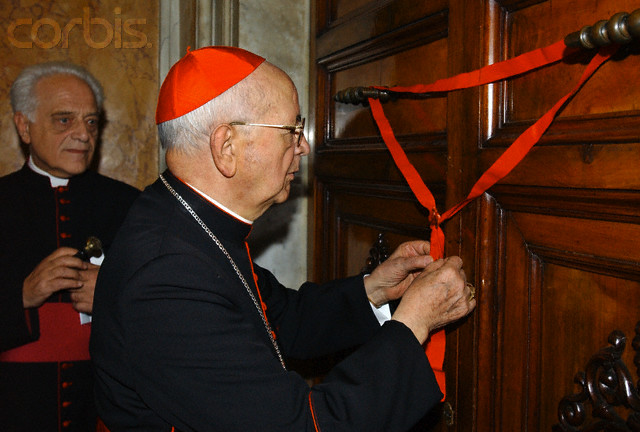
Sealing of the Pope’s Apartment : Not to be opened until the new Pope has been elected

The private residence of the Pope in the Vatican City, that is his apartment in the Apostolic Palace beside the Basilica of St. Peter is left vacant upon the death of the Pope, or in this case, the retirement of the reigning Pope, which began the sede vacante, during which no Pope is present.

Therefore, in order to avoid fraud and manipulation of papal documents of the previous Pope, and to prevent release of items that can only be done by the new Pope, the Pope’s Apartment is sealed, by a special officer of the Roman Curia, that is the Camerlengo (Chamberlain) of the Holy Roman Church, who is now Cardinal Tarcisio Bertone, who is also the Secretary of State of the Holy See.

The Camerlengo is the leader of the sede vacante transition period, and working in conjunction with the Dean of the College of Cardinals. His duties include sealing the Pope’s apartment and the destruction of the Pope’s Ring of the Fisherman, both of which meant to ensure no fraud documents can be released in absence of the Pope.

The sealing is done as soon as the Pope passed away or stepped down, and done in the presence of the Vice-Camerlengo, who is now Archbishop Pier Luigi Celata, and sealed with a silk string tied and sealed with a wax seal to ensure no one can enter the room, with the unbroken wax seal as evidence.

The room will only be opened again and the seal broken after the conclave is completed and a new Pope is elected.

Image below – from 2005 after the death of Blessed Pope John Paul II, then Camerlengo, Cardinal Eduardo Martinez Somalo sealing the Pope’s apartment

Image

Friday, 1 March 2013 : 2nd Week of Lent (Scripture Reflection)

We are urged today, not to have evil thoughts on our brothers and sisters today, as illustrated earlier in the story of Joseph in the first reading and the psalm, and how he was sold off in slavery to Egypt due to his brothers’ jealousy, which caused them to initially harbour evil thought of killing him. The same evil intent and plot also happened in the Gospel when the tenants disposed of the servants and the son of the landowner, in the intention of gaining the lands they have been lent with, and disobeying the owner’s wish.

We should not harbour such evil intent, but instead look upon our brothers and sisters with love. Especially, just as Christ has taught us, we should even also look upon our enemies and our persecutors with love! and pray for them too!

And then indeed, the story of the Gospel today, as many of you would know, is a parable on the life of Christ Himself, with the Pharisees and the chief priests being labeled as the evil tenants, as obviously stated in the Scripture. Jesus is the Son of the owner, who is God the Father, who sent Jesus to us, down to earth, just like the owner sent his son in the hope that he will be able to bring the tenants into line and pay up what they are supposed to pay.

But yet, the rejected ones, as we had seen, in both Jesus and Joseph, had become a great instrument of the Lord through their rejection by the people, represented by the brothers of Joseph and the tenants in the Gospel. For Joseph became the regent of Egypt through the gift of prophecy through dreams granted to him by God, which saved thousands if not many more souls from death, by the wise and ample preparation before famine ravaged Egypt for seven years. All these would not have happened without Joseph and his dreams.

Even greater is therefore the role of Christ, for in being rejected by the people, the ‘tenants’ particularly the chief priests, teachers of the Law, and the Pharisees, He has become the very instrument of salvation of all mankind. This rejection was represented by the arrest of Jesus, His trial by the Sanhedrin, leaders of the priests of Israel, and finally His condemnation to death, and His death on the cross. In this He, as the rejected stone by the builder, had become the cornerstone, the very vital part of God’s plan of salvation.

What is a cornerstone? While we do not often use the terms in daily life, architects and those dealing with infrastructure and buildings will know it very well. For cornerstone is named so, since, at the time of the Roman Empire, there is a passion for building commemorative and triumphal arches. Some of these arches can still be seen even today, and some remained in the city of Rome itself. Why are these arches so strong and so solid to be able to stand for centuries and even millenia? It is because of its structure, which is so wonderfully constructed even without modern technology to keep them intact, all just because of one single stone at the peak of the arch, which is called the cornerstone.

This cornerstone is the focal point and the most important point of the arch. For if the cornerstone is removed, the arch will immediately crumble. As long as the cornerstone remained in place, removing other stones from the arch would have minimum impact on the arch’s integrity. Similarly, cornerstone can also be found in other buildings, also known more as the foundation stone. This stone holds up the integrity of the whole building by just being there, and as long as the stone stands, the building will too.

Christ therefore, has become our cornerstone through His death and sacrifice on the cross, and later His glorious resurrection and triumph over death and evil. Why is He our cornerstone? That is because if we keep our anchor on Him, keeping faith in Him, and ensuring that our faith is anchored deeply and securely in Christ, no amount of worldly temptations, and no amount of attacks and persuasions by evil can sway us and make us to fall away from the grace of God.

Through Christ who is our cornerstone, we then can act out His love and compassion on all mankind, for only if we anchor ourselves in Christ, that we can act with love and kindness, out of our faith in God who also loves us dearly that He did not even hold back His Son to be given to us for sacrifice to liberate us from eternal damnation.

Then Christ too established His Church, our Church, as the living and concrete presence that represents Him and His mission in this world, and there was none other than Peter the Apostle, upon whom, as the Rock, Christ chose to build up His Church, making Peter the cornerstone of His Church, the Body of Christ, which is made up of all of us the faithful in Christ.

Now, that our Pope, Benedict XVI, who was the 264th successor of St. Peter, had stepped down from his position as our Pope effective today, our Church, God’s Church, has been left without that cornerstone of faith, which has been passed down since the day of Peter, the first cornerstone of the Universal Church. We still have Christ of course as our Cornerstone, on whom all hearts and minds must be directed to, but it is through the Apostle Peter and his successors, the Popes, that this is made manifest, by them being the cornerstone of God’s living presence in this world, that is the One, Holy, Catholic, and Apostolic Church.

Therefore, today, and through the sede vacante period, and beyond that, let us pray, brothers and sisters in Christ, that first, we all will remain ever faithful, and that our anchor of faith will ever be solidly planted in the cornerstone that is Christ our Lord, always remembering His rejection and sacrifice on the cross that made Him the cornerstone of our life, the cornerstone of salvation, that enabled mankind to return and be reunited with God.

And then, we also pray in particular for our Church, that God will guide the Cardinal-electors who will elect a new Pope to succeed our beloved Pope Benedict XVI, with the guidance of the Holy Spirit sent by God upon all of them. That the world will again have a tangible cornerstone that is the successor of St. Peter, who made the Cornerstone of Christ manifest and real in this world, as the cornerstone of God’s most Holy Church, and as the cornerstone and head of the Body of Christ, the Church, leading all the faithful in Christ in unity with Christ their Saviour.

In the end, the cornerstone, although important, still requires the presence of all of us, the stones surrounding the cornerstone, for the cornerstone by itself will not make a building. Therefore, brothers and sisters in Christ, let us support the new Pope, whoever he will be, as all the people who believe in Christ, that the new Pope, the future cornerstone of the Church, will together build up a solid and strong Church, that is able to project God’s love and work into this world, that more and more people will be saved.

May God bless all of us, bless His Church, bless our retired Pope Emeritus Benedict XVI, and his soon-to-be elected successor. Amen!
Sede Vacante has begun. The See of Rome is Vacant

Therefore, as of now, Thursday, 28 February 2013, at 8 pm CET (UTC+1), Pope Benedict XVI is no longer our Pope, and the See of Rome is vacant.

Image

Let us all pray, first for His Holiness Benedict XVI, Bishop Emeritus of Rome, that God will continue to guide him in his prayerful life as a simple pilgrim, to the end of his journey in this world. We will always remember him as our beloved Pope.

Then, of course, let us pray that God will soon appoint the new shepherd, successor of St. Peter the Apostle, through the Holy Spirit and guidance to the Cardinal-electors who will elect the new Pope in the conclave which will begin likely in about 10 days from now, according to the rules of Apostolic Constitution Universi Dominici Gregis and the corresponding modifications by the Motu Proprio Normas Nonnullas.

How the Conclave proceeds : A very nice and concise animation!

http://vaticaninsider.lastampa.it/en/the-vatican/come-si-elegge-il-papa/

Go and visit this site, which offers a very good and detailed though simple explanations on the way a Conclave proceeds. Not only that it is easy to follow, step-by-step from the beginning of the Conclave to after a new Pope is elected, I believe it’s quite neat too, with all the animations they did for the occasion. Good job Vatican Insider!

Papabili for the 2013 Papal Conclave (List) : My summary and opinions

Cardinal Angelo Scola : My favourite to be the next Pope. The leading Italian candidate, Archbishop of Milan, and former Patriarch of Venice. He is also a spiritual and intellectual disciple of our beloved Pope Benedict XVI, with similar views on the liturgy. Best person to continue the work that has been started by Pope Benedict XVI on ‘reform of the reform’ and other issues of the faith and the Church.

View his videos, homilies, activities, and Masses at his site : http://angeloscola.it/ and the Youtube page of Archdiocese of Milan at : http://www.youtube.com/user/itleditore

Cardinal Marc Ouellet : Canadian, Prefect of the Congregation for Bishops, former Primate of Canada and Metropolitan Archbishop Emeritus of Quebec. My second favourite and alternative to Cardinal Scola to be the next Bishop of Rome, and also widely regarded as the top non-Italian and non-European candidate. He is also close to our Pope Benedict XVI in his views and intellectually as well, though may be not as close as Cardinal Scola is. He has done a great job at the Congregation, and has seen the appointment of bishops who are not just good administrators, but also good in intellect and faith as well.

Cardinal Gianfranco Ravasi : Italian, President of the Pontifical Council for Culture, well-known for his activity in engaging the media and the new media, particularly through the Internet, via Twitter and other social media in the approach for new evangelisation, and also has done great works among the youth, who are the Church’s future. May have chance if Cardinal Scola’s candidacy does not make it. Drawback is that he has less experience, being only less than 3 years as a Cardinal and about 6 years as a bishop, with little experience outside the Pontifical Council for Culture.

Cardinal Tarcisio Bertone : Italian, Cardinal Secretary of State. The prime Cardinal in the Roman Curia, the second hand of the Pope. He is seen as a strong leader, but many has seen that he is a rather dominating persona, which may be incompatible with the office of the Papacy, and he is also rather too old at 78 going 79 at the end of this year. As Pope Benedict XVI was elected just on his 78th birthday, just like Cardinal Arinze, who is already above 80, the chance of the College of Cardinals to elect someone too old is getting more remote, especially considering the reason for Pope Benedict XVI’s decision to retire and renounce the position as the Bishop of Rome.

Cardinal Timothy Dolan : American, Metropolitan Archbishop of New York. Jovial and lively, reminds me much of Blessed Pope John XXIII. Conservative in issues and outlook. However, being a Cardinal from the world’s only superpower and also the troubles in the American church makes his chances rather slim. However, his youth, his charisma, and his position as the President of the US Catholic Bishops’ Conference may boost his chances to be elected.

Cardinal Raymond Burke : American, Prefect of Supreme Tribunal of Apostolic Signatura (or the Supreme/Chief Justice of the Holy See). Relatively young and traditional, worn the traditional Cardinal dress (galero and cappa magna) and one of the more-traditionally minded Cardinal in the College. Often celebrated the Mass in the Extraordinary Form. May be a good choice for those looking for a more traditional candidate as the next Pope, to continue the ‘reform of the reform’ of Pope Benedict XVI.

Cardinal Christoph Schonborn : Austrian. Metropolitan Archbishop of Vienna. Long seen as the contender for the Papacy, even since the 2005 election. Still rather young at 68 (even younger during the 2005 conclave). However, he is a controversial figure, often recorded with the liturgical abuses (he himself may not mean so, as his funeral Mass for the late Archduke Otto of Austria was done very reverently and liturgically correct), such as the youth Mass with rock concert/party style-Mass and not-so-traditional types of worship, and then with a German currently as the Bishop of Rome, it is less likely that the Cardinals will elect another German as Pope, even though he came from neighbouring Austria.

Cardinal Francis Arinze : Nigerian, Former Prefect of the Congregation for the Divine Worship and the Discipline of the Sacraments. Often touted recently in the media with Cardinal Peter Turkson, another African (Ghana), due to the intense media bias on the possibility of having an African Pope in this Conclave. Not to be biased, but what the media often reported is not what is the actual happening on the ground. Main problem is, according to Universi Dominici Gregis, although it specifically state that he cannot vote as elector because he is already above 80 of age, he may still be elected, but considering that Pope Benedict XVI has resigned at the age of 85 going 86, the Cardinals will likely want to elect someone in their early 70s like Cardinal Scola or late 60s like Cardinal Ouellet.

Cardinal Peter Turkson : Ghana (Africa), President of Pontifical Council for Justice and Peace. Seen by many as a strong contender, but with main issues regarding his frequent gaffes and improper comments regarding Muslim-Christian relations, which is a very important and delicate matter in the Church indeed. He was also censured somewhat for his screening of a clip that showed the rise of Islam in Europe last year, which quite a few Cardinals saw as fearmongering. In addition, his name, Peter, may bring about intense speculation on Petrus Romanus (Peter the Roman) in the Prophecy of St. Malachy on the Popes. Petrus Romanus, being the last Pope, will come at the time near the end of time, heading the Church in the time of persecution (as perhaps told in the Book of Revelations). As this last prophecy is not numbered, it is most likely that St. Malachy purposely did so / the vision given by the Lord purposely did so such that we know what’s going to happen, but not the exact time when the Lord will come again, so that we will always be ready for His coming. So, no, most likely we won’t have a Peter or Pope Peter in this time round. (Addition : Cardinal Turkson has also openly announced that he is ready to be elected if he is. Normally this is frowned, as this is seen as ambition, and incompatible with the will of the Holy Spirit. Remember that the papal conclave is not the same as the US presidential elections or any other secular elections, it is far above that).

Cardinal Luis Antonio Gokim Tagle : Filipino (Asia), Metropolitan Archbishop of Manila. A young and new Cardinal appointed by the Pope at his last consistory last November. This may be seen by some as the Pope appointing his ‘successor’ but it is actually not so. I myself hope that he will be elected Pope, but not this time, maybe after the next one, and he can have the chance to be the 268th Pope instead (we are electing the 267th Bishop of Rome in this conclave). First is his very young age, and his relative lack of experience in both as a Cardinal and the Archbishop of Manila. I have very high opinions on Cardinal Tagle and was very glad when he was named a Cardinal last year, but to me, let Cardinal Tagle do great works first in Manila for many more years, and then, with all those experiences, then he can become an even better Pope next time.

This list is still incomplete, and I will post additions from time to time. In any case, it is not man to decide who’s the next leader of the Universal Church, the Vicar of Christ. It is Christ Himself, through the Holy Spirit, and thus through the Cardinal-electors inspired by the Spirit who decides. Pray for them, and for the entire Universal Church, and for the whole world. Amen.

Conclave for the election of the new Pope : When are the possible dates and why?

http://www.straitstimes.com/breaking-news/world/story/vatican-says-new-pope-be-elected-easter-20130211

As traditionally the Conclave follows the death of the previous Pope, and this requires the traditional 9-days mourning period (Novemdiales) after the funeral (which happens a few days, 6 days in the case of Blessed Pope John Paul II) before the Conclave can begin, this is why it takes about 15 days or so for the Conclave can begin. This period of time is also for Cardinals from all over the world to have the time to come to Rome to elect the new Pope and for preparation of the Conclave.

However, as the announcement of the date of retirement came early, more than two weeks before the actual date, the Cardinals have plenty of time to come to Rome, and without the Novemdiales, in fact, the Conclave can begin as early as 1 March 2013, and we’ll have a new Pope perhaps even by 3 March 2013 or so.