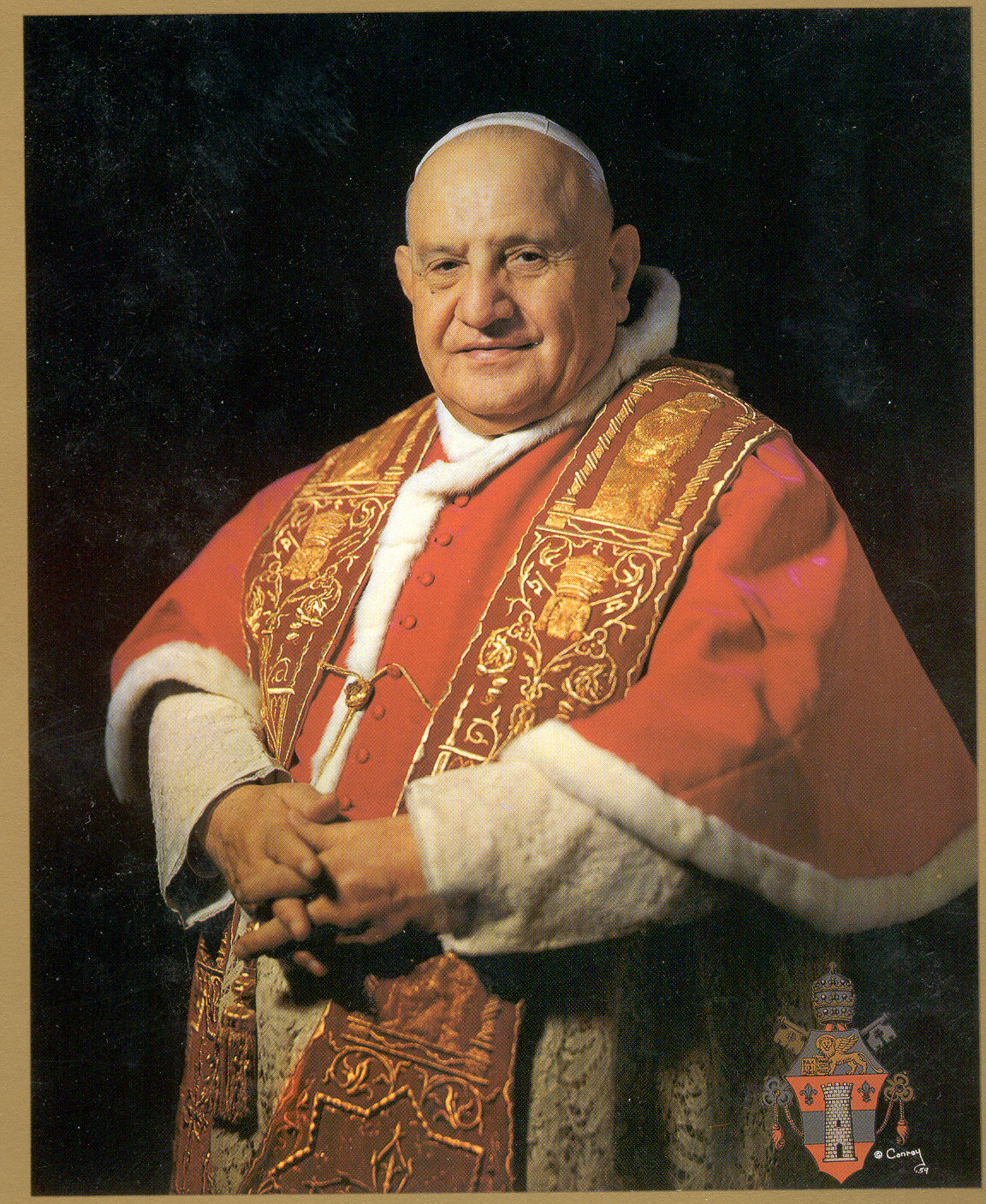
Saturday, 11 October 2014 : 27th Week of Ordinary Time, Memorial of Pope St. John XXIII, Pope (Homily and Scripture Reflections)

Liturgical Colour : Green or White (Saturday Mass of our Lady and Popes)

Brothers and sisters in Christ, today we are presented with the message of the Lord, through the Holy Scriptures and the Gospels, on the nature of our faith and salvation, and how we can attain that salvation through what we are doing in this life, not just based on any race or other passive benefits or factors, but through the commitment of actions that make our faith truly alive in God.

In the first reading today, St. Paul in his letter to the faithful and the Church in Galatia showed how while in the past, God revealed His Law to His people to guide them and prevent them from going astray from the path towards salvation, but the coming of Christ, the Messiah and Saviour of all, gave mankind a new focus of their faith and devotion. For God Himself had come down upon us, in our humble form, to save us from our fate that was death and oblivion.

There was also to be no more division and prejudice, or any difference in treatment between those in the society, based on either race or birth, based no longer on either status or wealth or possessions. What matters is truly whether one believes in the Lord Jesus Christ, and if one believes, and lives according to that faith which they have, then they are guaranteed salvation in Jesus Christ our Lord.

That was because, the Jews, who were descendants of Abraham, the faithful servant of God, with whom He had made His covenant with, were proud and prejudiced against their neighbours, thinking that as the heirs and sons of Abraham, they alone deserved salvation, and the others, the Gentiles, namely the Greeks, the Samaritans, Romans, Arabs, Canaanites, and others whom they considered as pagans and barbarians deserved eternal damnation.

Yet, Jesus made it clear in the Gospel, that blessing is upon those who follow the will of God, who walk in His ways, and who practice their faith in the real life, showing that their faith is truly real, concrete and dynamic. Yes, not the dead and stagnant faith shown by lack of action, by mere lip service of faith, and not by prejudicing against others or condemning others or glorifying oneself thinking that one is worthy of salvation, while others do not.

Therefore, today we are all called to reflect on our own lives, whether in all things we do, we have been truly faithful to the Lord, not just by mere faith or words, but also through actions founded in faith, filled with hope, and blessed and graced by love. This is what is necessary for us to attain our salvation, and blessed we are indeed if we listen to Jesus and what He had said, instead of following our own desires and wants.

Today, we celebrate together with the whole Universal Church, the feast of Pope St. John XXIII, the successor of St. Peter the Apostle, and one of the great and holy Popes of the twentieth century after the birth of Christ. Pope St. John XXIII, who was also called the ‘Good Pope’, was chiefly remembered for his role in convoking and gathering the latest Ecumenical Council of the Holy Roman Church, that is the Second Vatican Council, which lasted from 1962 to 1965, but in fact, his holiness stemmed not just from that act, but also from the actions which he had taken for the entire course of his life.

The life and examples of Pope St. John XXIII, the Good Pope, il Papa Buono, can be an inspiration for us all, as ever since he was born of a poor peasant family in the village and commune of Sotto il Monte, in the province of Bergamo in northern Italy as Angelo Giuseppe Roncalli, he had led a very faithful and devoted life to God. He was poor, just as his family was poor, but together they as a family lovingly devoted themselves to God.

At a certain moment in his youth, the young Angelo encountered experience in faith, by those whom he met, including his uncle, which encouraged him to consider giving himself to the service of God. As his family was poor, and peasant youths were considered important assets to help out in work, his parents were reluctant to let him to go and join the seminary.

Nevertheless, in the end, God had His way, and Angelo managed to join the seminary, studying intently and eventually was ordained a priest of the Diocese of Bergamo. He eventually became the secretary of the local ordinary, Bishop Radini-Tedeschi, who was a relatively obscure individual compared to his later famous protege, but the one who had great influence on Angelo and his later great works.

Bishop Radini-Tedeschi encountered a great workers and union strike in accordance to the poor living conditions and treatment of workers by the government of that era, in the early twentieth century, and Bishop Radini-Tedeschi faithfully and tenderly exercised his works as the shepherd of his flock, calling for restraint and restoration of order while calling for reforms and great improvement in the treatment of workers. He even donated his own personal wealth to help the poor workers made their ends meet.

All these inspired the young Angelo Roncalli, the later Pope St. John XXIII, as he later was made Archbishop and appointed as the Apostolic Delegate to Bulgaria, and later to Greece and Turkey. During his diplomatic missions in the service of the Church, Archbishop Roncalli did many great works, establishing links and friendship with the separated brethren of faith in the Eastern Orthodox Church, and during his mission in Greece and Turkey, even saved many Jews from the actions of the German NAZI who was bent on annihilating them as a race in the holocaust.

In his later mission as the Apostolic Nuncio to France, Archbishop Roncalli continued to do many good works, establishing links and relationship with the French government, including dealing with the difficult leader of France, Charles de Gaulle, who wanted to reduce the influence of the Church of Rome in the affairs of the Church in France.

And eventually, as the Patriarch of Venice and a Cardinal of the Holy Roman Church, Cardinal Angelo Roncalli continued to exercise the good works which he had done earlier in his earlier posts and ministries, and which eventually he continued when he was elected Pope in 1958 to succeed the great Pope Pius XII, the Pastor Angelicus, or the Angelic Pope.

Pope St. John XXIII continued to lead the Church faithfully, and he was particularly concerned with the restoration of relations with the Eastern Church, as he had experienced earlier during his time in Bulgaria, Greece and Turkey, in the relationships he had made with the prelates and faithful of the Eastern Church at the time. And then he was also concerned about the state of the Church, and the need for a continuation of the unfinished works of the First Vatican Council, which was prematurely ended due to the events at that time.

Thus, Pope St. John XXIII convoked the gathering of the Second Vatican Council, which commenced in 1962, and which sessions was started and opened by the Pope himself, which meeting was to continue until 1965, and concluded by Pope Paul VI, his successor as Pope St. John XXIII passed away in 1963, before the conclusion of the Ecumenical Council which he had initiated.

Pope St. John XXIII also was renowned for his role in helping to reduce tension between the superpowers, namely the United States of America and the Soviet Union, which almost ended up in a major war, during the Cuban Missile Crisis in 1962. One of the last major acts of Pope St. John XXIII was the peace which he helped broker between the two sides, and which was the major reason behind the Papal encyclical he released in 1963, the famous Pacem in Terris, or ‘Peace on earth’.

Brothers and sisters in Christ, as I have mentioned, that the actions of Pope St. John XXIII are examples to all of us, and through them, we should also be inspired to follow in his footsteps, that our faith may grow stronger and that in our devotion, we may be found justified in our faith by the Lord our God. Remember, brethren, that we have to have a living faith in us, so that our faith will not be just empty, but be real and concrete.

May Almighty God, who sees the faith and commitment which Pope St. John XXIII, also see the faith that is in us, and therefore may grant us the inheritance and reward which He promised us through Jesus Christ His Son. May we all come ever closer to His loving embrace, seeking His mercy and be made righteous once again. God bless us all. Amen.

Saturday, 11 October 2014 : 27th Week of Ordinary Time, Memorial of Pope St. John XXIII, Pope (Gospel Reading)

Liturgical Colour : Green or White (Saturday Mass of our Lady and Popes)

Luke 11 : 27-28

At that time, as Jesus was speaking, a woman spoke from the crowd and said to Him, “Blessed is the one who gave You birth and nursed You!”

Jesus replied, “Truly blessed are those who hear the word of God, and keep it as well.”

Saturday, 11 October 2014 : 27th Week of Ordinary Time, Memorial of Pope St. John XXIII, Pope (Psalm)

Liturgical Colour : Green or White (Saturday Mass of our Lady and Popes)

Psalm 104 : 2-3, 4-5, 6-7

Sing to the Lord, sing His praise, proclaim all His wondrous deeds. Glory in His Holy Name; let those who seek the Lord rejoice.

Look to the Lord and be strong; seek His face always. Remember His wonderful works, His miracles and His judgments.

You descendants of His servant Abraham, you sons of Jacob, His chosen ones! He is the Lord our God; His judgments reach the whole world.

Saturday, 11 October 2014 : 27th Week of Ordinary Time, Memorial of Pope St. John XXIII, Pope (First Reading)

Liturgical Colour : Green or White (Saturday Mass of our Lady and Popes)

Galatians 3 : 22-29

But the Scriptures have declared that we are all prisoners of sin, so the only way to receive God’s promise is to believe in Jesus Christ.

Before the time of faith had come, the Law confined us and kept us in custody until the time in which faith would show up. The Law then was serving as a slave to look after us until Christ came, so that we might be justified by faith. With the coming of faith, we are no longer submitted to this guidance.

Now, in Christ Jesus, all of you are sons and daughters of God through faith. All of you who were given to Christ through baptism, have put on Christ. Here there is no longer any difference between Jew or Greek, or between slave or freed, or between man and woman : but all of you are one in Christ Jesus.

And because you belong to Christ, you are of Abraham’s race and you are to inherit God’s promise.

Lumen Fidei (Light of Faith) : Encyclical of Two Popes, Pope Benedict XVI and Pope Francis

http://www.vatican.va/holy_father/francesco/encyclicals/documents/papa-francesco_20130629_enciclica-lumen-fidei_en.html

ENCYCLICAL LETTER
LUMEN FIDEI
OF THE SUPREME PONTIFF
FRANCIS
TO THE BISHOPS PRIESTS AND DEACONS
CONSECRATED PERSONS
AND THE LAY FAITHFUL
ON FAITH


1. The light of Faith: this is how the Church’s tradition speaks of the great gift brought by Jesus. In John’s Gospel, Christ says of himself: “I have come as light into the world, that whoever believes in me may not remain in darkness” (Jn 12:46). Saint Paul uses the same image: “God who said ‘Let light shine out of darkness,’ has shone in our hearts” (2 Cor 4:6). The pagan world, which hungered for light, had seen the growth of the cult of the sun god, Sol Invictus, invoked each day at sunrise. Yet though the sun was born anew each morning, it was clearly incapable of casting its light on all of human existence. The sun does not illumine all reality; its rays cannot penetrate to the shadow of death, the place where men’s eyes are closed to its light. “No one — Saint Justin Martyr writes — has ever been ready to die for his faith in the sun”. Conscious of the immense horizon which their faith opened before them, Christians invoked Jesus as the true sun “whose rays bestow life”. To Martha, weeping for the death of her brother Lazarus, Jesus said: “Did I not tell you that if you believed, you would see the glory of God?” (Jn 11:40). Those who believe, see; they see with a light that illumines their entire journey, for it comes from the risen Christ, the morning star which never sets.

An illusory light?

2. Yet in speaking of the light of faith, we can almost hear the objections of many of our contemporaries. In modernity, that light might have been considered sufficient for societies of old, but was felt to be of no use for new times, for a humanity come of age, proud of its rationality and anxious to explore the future in novel ways. Faith thus appeared to some as an illusory light, preventing mankind from boldly setting out in quest of knowledge. The young Nietzsche encouraged his sister Elisabeth to take risks, to tread “new paths… with all the uncertainty of one who must find his own way”, adding that “this is where humanity’s paths part: if you want peace of soul and happiness, then believe, but if you want to be a follower of truth, then seek”. Belief would be incompatible with seeking. From this starting point Nietzsche was to develop his critique of Christianity for diminishing the full meaning of human existence and stripping life of novelty and adventure. Faith would thus be the illusion of light, an illusion which blocks the path of a liberated humanity to its future.

3. In the process, faith came to be associated with darkness. There were those who tried to save faith by making room for it alongside the light of reason. Such room would open up wherever the light of reason could not penetrate, wherever certainty was no longer possible. Faith was thus understood either as a leap in the dark, to be taken in the absence of light, driven by blind emotion, or as a subjective light, capable perhaps of warming the heart and bringing personal consolation, but not something which could be proposed to others as an objective and shared light which points the way. Slowly but surely, however, it would become evident that the light of autonomous reason is not enough to illumine the future; ultimately the future remains shadowy and fraught with fear of the unknown. As a result, humanity renounced the search for a great light, Truth itself, in order to be content with smaller lights which illumine the fleeting moment yet prove incapable of showing the way. Yet in the absence of light everything becomes confused; it is impossible to tell good from evil, or the road to our destination from other roads which take us in endless circles, going nowhere.

A light to be recovered

4. There is an urgent need, then, to see once again that faith is a light, for once the flame of faith dies out, all other lights begin to dim. The light of faith is unique, since it is capable of illuminating every aspect of human existence. A light this powerful cannot come from ourselves but from a more primordial source: in a word, it must come from God. Faith is born of an encounter with the living God who calls us and reveals his love, a love which precedes us and upon which we can lean for security and for building our lives. Transformed by this love, we gain fresh vision, new eyes to see; we realize that it contains a great promise of fulfilment, and that a vision of the future opens up before us. Faith, received from God as a supernatural gift, becomes a light for our way, guiding our journey through time. On the one hand, it is a light coming from the past, the light of the foundational memory of the life of Jesus which revealed his perfectly trustworthy love, a love capable of triumphing over death. Yet since Christ has risen and draws us beyond death, faith is also a light coming from the future and opening before us vast horizons which guide us beyond our isolated selves towards the breadth of communion. We come to see that faith does not dwell in shadow and gloom; it is a light for our darkness. Dante, in the Divine Comedy, after professing his faith to Saint Peter, describes that light as a “spark, which then becomes a burning flame and like a heavenly star within me glimmers”. It is this light of faith that I would now like to consider, so that it can grow and enlighten the present, becoming a star to brighten the horizon of our journey at a time when mankind is particularly in need of light.

5. Christ, on the eve of his passion, assured Peter: “I have prayed for you that your faith may not fail” (Lk 22:32). He then told him to strengthen his brothers and sisters in that same faith. Conscious of the duty entrusted to the Successor of Peter, Benedict XVI proclaimed the present Year of Faith, a time of grace which is helping us to sense the great joy of believing and to renew our wonder at the vast horizons which faith opens up, so as then to profess that faith in its unity and integrity, faithful to the memory of the Lord and sustained by his presence and by the working of the Holy Spirit. The conviction born of a faith which brings grandeur and fulfilment to life, a faith centred on Christ and on the power of his grace, inspired the mission of the first Christians. In the acts of the martyrs, we read the following dialogue between the Roman prefect Rusticus and a Christian named Hierax: “‘Where are your parents?’, the judge asked the martyr. He replied: ‘Our true father is Christ, and our mother is faith in him’”. For those early Christians, faith, as an encounter with the living God revealed in Christ, was indeed a “mother”, for it had brought them to the light and given birth within them to divine life, a new experience and a luminous vision of existence for which they were prepared to bear public witness to the end.

6. The Year of Faith was inaugurated on the fiftieth anniversary of the opening of the Second Vatican Council. This is itself a clear indication that Vatican II was a Council on faith, inasmuch as it asked us to restore the primacy of God in Christ to the centre of our lives, both as a Church and as individuals. The Church never takes faith for granted, but knows that this gift of God needs to be nourished and reinforced so that it can continue to guide her pilgrim way. The Second Vatican Council enabled the light of faith to illumine our human experience from within, accompanying the men and women of our time on their journey. It clearly showed how faith enriches life in all its dimensions.

7. These considerations on faith — in continuity with all that the Church’s magisterium has pronounced on this theological virtue — are meant to supplement what Benedict XVI had written in his encyclical letters on charity and hope. He himself had almost completed a first draft of an encyclical on faith. For this I am deeply grateful to him, and as his brother in Christ I have taken up his fine work and added a few contributions of my own. The Successor of Peter, yesterday, today and tomorrow, is always called to strengthen his brothers and sisters in the priceless treasure of that faith which God has given as a light for humanity’s path.

In God’s gift of faith, a supernatural infused virtue, we realize that a great love has been offered us, a good word has been spoken to us, and that when we welcome that word, Jesus Christ the Word made flesh, the Holy Spirit transforms us, lights up our way to the future and enables us joyfully to advance along that way on wings of hope. Thus wonderfully interwoven, faith, hope and charity are the driving force of the Christian life as it advances towards full communion with God. But what is it like, this road which faith opens up before us? What is the origin of this powerful light which brightens the journey of a successful and fruitful life? 


CHAPTER ONE

WE HAVE BELIEVED IN LOVE
(cf. 1 Jn 4:16)

Abraham, our father in faith

8. Faith opens the way before us and accompanies our steps through time. Hence, if we want to understand what faith is, we need to follow the route it has taken, the path trodden by believers, as witnessed first in the Old Testament. Here a unique place belongs to Abraham, our father in faith. Something disturbing takes place in his life: God speaks to him; he reveals himself as a God who speaks and calls his name. Faith is linked to hearing. Abraham does not see God, but hears his voice. Faith thus takes on a personal aspect. God is not the god of a particular place, or a deity linked to specific sacred time, but the God of a person, the God of Abraham, Isaac and Jacob, capable of interacting with man and establishing a covenant with him. Faith is our response to a word which engages us personally, to a “Thou” who calls us by name.

9. The word spoken to Abraham contains both a call and a promise. First, it is a call to leave his own land, a summons to a new life, the beginning of an exodus which points him towards an unforeseen future. The sight which faith would give to Abraham would always be linked to the need to take this step forward: faith “sees” to the extent that it journeys, to the extent that it chooses to enter into the horizons opened up by God’s word. This word also contains a promise: Your descendants will be great in number, you will be the father of a great nation (cf. Gen 13:16; 15:5; 22:17). As a response to a word which preceded it, Abraham’s faith would always be an act of remembrance. Yet this remembrance is not fixed on past events but, as the memory of a promise, it becomes capable of opening up the future, shedding light on the path to be taken. We see how faith, as remembrance of the future, memoria futuri, is thus closely bound up with hope.

10. Abraham is asked to entrust himself to this word. Faith understands that something so apparently ephemeral and fleeting as a word, when spoken by the God who is fidelity, becomes absolutely certain and unshakable, guaranteeing the continuity of our journey through history. Faith accepts this word as a solid rock upon which we can build, a straight highway on which we can travel. In the Bible, faith is expressed by the Hebrew word ’emûnāh, derived from the verb ’amān whose root means “to uphold”. The term ’emûnāh can signify both God’s fidelity and man’s faith. The man of faith gains strength by putting himself in the hands of the God who is faithful. Playing on this double meaning of the word — also found in the corresponding terms in Greek (pistós) and Latin (fidelis) — Saint Cyril of Jerusalem praised the dignity of the Christian who receives God’s own name: both are called “faithful”. As Saint Augustine explains: “Man is faithful when he believes in God and his promises; God is faithful when he grants to man what he has promised”.

11. A final element of the story of Abraham is important for understanding his faith. God’s word, while bringing newness and surprise, is not at all alien to Abraham’s experience. In the voice which speaks to him, the patriarch recognizes a profound call which was always present at the core of his being. God ties his promise to that aspect of human life which has always appeared most “full of promise”, namely, parenthood, the begetting of new life: “Sarah your wife shall bear you a son, and you shall name him Isaac” (Gen 17:19). The God who asks Abraham for complete trust reveals himself to be the source of all life. Faith is thus linked to God’s fatherhood, which gives rise to all creation; the God who calls Abraham is the Creator, the one who “calls into existence the things that do not exist” (Rom 4:17), the one who “chose us before the foundation of the world… and destined us for adoption as his children” (Eph 1:4-5). For Abraham, faith in God sheds light on the depths of his being, it enables him to acknowledge the wellspring of goodness at the origin of all things and to realize that his life is not the product of non-being or chance, but the fruit of a personal call and a personal love. The mysterious God who called him is no alien deity, but the God who is the origin and mainstay of all that is. The great test of Abraham’s faith, the sacrifice of his son Isaac, would show the extent to which this primordial love is capable of ensuring life even beyond death. The word which could raise up a son to one who was “as good as dead”, in “the barrenness” of Sarah’s womb (cf. Rom 4:19), can also stand by his promise of a future beyond all threat or danger (cf. Heb 11:19; Rom 4:21).

The faith of Israel

12. The history of the people of Israel in the Book of Exodus follows in the wake of Abraham’s faith. Faith once again is born of a primordial gift: Israel trusts in God, who promises to set his people free from their misery. Faith becomes a summons to a lengthy journey leading to worship of the Lord on Sinai and the inheritance of a promised land. God’s love is seen to be like that of a father who carries his child along the way (cf. Dt 1:31). Israel’s confession of faith takes shape as an account of God’s deeds in setting his people free and acting as their guide (cf. Dt 26:5-11), an account passed down from one generation to the next. God’s light shines for Israel through the remembrance of the Lord’s mighty deeds, recalled and celebrated in worship, and passed down from parents to children. Here we see how the light of faith is linked to concrete life-stories, to the grateful remembrance of God’s mighty deeds and the progressive fulfilment of his promises. Gothic architecture gave clear expression to this: in the great cathedrals light comes down from heaven by passing through windows depicting the history of salvation. God’s light comes to us through the account of his self-revelation, and thus becomes capable of illuminating our passage through time by recalling his gifts and demonstrating how he fulfils his promises.

13. The history of Israel also shows us the temptation of unbelief to which the people yielded more than once. Here the opposite of faith is shown to be idolatry. While Moses is speaking to God on Sinai, the people cannot bear the mystery of God’s hiddenness, they cannot endure the time of waiting to see his face. Faith by its very nature demands renouncing the immediate possession which sight would appear to offer; it is an invitation to turn to the source of the light, while respecting the mystery of a countenance which will unveil itself personally in its own good time. Martin Buber once cited a definition of idolatry proposed by the rabbi of Kock: idolatry is “when a face addresses a face which is not a face”. In place of faith in God, it seems better to worship an idol, into whose face we can look directly and whose origin we know, because it is the work of our own hands. Before an idol, there is no risk that we will be called to abandon our security, for idols “have mouths, but they cannot speak” (Ps 115:5). Idols exist, we begin to see, as a pretext for setting ourselves at the centre of reality and worshiping the work of our own hands. Once man has lost the fundamental orientation which unifies his existence, he breaks down into the multiplicity of his desires; in refusing to await the time of promise, his life-story disintegrates into a myriad of unconnected instants. Idolatry, then, is always polytheism, an aimless passing from one lord to another. Idolatry does not offer a journey but rather a plethora of paths leading nowhere and forming a vast labyrinth. Those who choose not to put their trust in God must hear the din of countless idols crying out: “Put your trust in me!” Faith, tied as it is to conversion, is the opposite of idolatry; it breaks with idols to turn to the living God in a personal encounter. Believing means entrusting oneself to a merciful love which always accepts and pardons, which sustains and directs our lives, and which shows its power by its ability to make straight the crooked lines of our history. Faith consists in the willingness to let ourselves be constantly transformed and renewed by God’s call. Herein lies the paradox: by constantly turning towards the Lord, we discover a sure path which liberates us from the dissolution imposed upon us by idols.

14. In the faith of Israel we also encounter the figure of Moses, the mediator. The people may not see the face of God; it is Moses who speaks to YHWH on the mountain and then tells the others of the Lord’s will. With this presence of a mediator in its midst, Israel learns to journey together in unity. The individual’s act of faith finds its place within a community, within the common “we” of the people who, in faith, are like a single person — “my first-born son”, as God would describe all of Israel (cf. Ex 4:22). Here mediation is not an obstacle, but an opening: through our encounter with others, our gaze rises to a truth greater than ourselves. Rousseau once lamented that he could not see God for himself: “How many people stand between God and me!” … “Is it really so simple and natural that God would have sought out Moses in order to speak to Jean Jacques Rousseau?” On the basis of an individualistic and narrow conception of conscience one cannot appreciate the significance of mediation, this capacity to participate in the vision of another, this shared knowledge which is the knowledge proper to love. Faith is God’s free gift, which calls for humility and the courage to trust and to entrust; it enables us to see the luminous path leading to the encounter of God and humanity: the history of salvation.

The fullness of Christian faith

15. “Abraham rejoiced that he would see my day; he saw it and was glad” (Jn 8:56). According to these words of Jesus, Abraham’s faith pointed to him; in some sense it foresaw his mystery. So Saint Augustine understood it when he stated that the patriarchs were saved by faith, not faith in Christ who had come but in Christ who was yet to come, a faith pressing towards the future of Jesus. Christian faith is centred on Christ; it is the confession that Jesus is Lord and that God has raised him from the dead (cf. Rom 10:9). All the threads of the Old Testament converge on Christ; he becomes the definitive “Yes” to all the promises, the ultimate basis of our “Amen” to God (cf. 2 Cor 1:20). The history of Jesus is the complete manifestation of God’s reliability. If Israel continued to recall God’s great acts of love, which formed the core of its confession of faith and broadened its gaze in faith, the life of Jesus now appears as the locus of God’s definitive intervention, the supreme manifestation of his love for us. The word which God speaks to us in Jesus is not simply one word among many, but his eternal Word (cf. Heb 1:1-2). God can give no greater guarantee of his love, as Saint Paul reminds us (cf. Rom 8:31-39). Christian faith is thus faith in a perfect love, in its decisive power, in its ability to transform the world and to unfold its history. “We know and believe the love that God has for us” (1 Jn 4:16). In the love of God revealed in Jesus, faith perceives the foundation on which all reality and its final destiny rest.

16. The clearest proof of the reliability of Christ’s love is to be found in his dying for our sake. If laying down one’s life for one’s friends is the greatest proof of love (cf. Jn 15:13), Jesus offered his own life for all, even for his enemies, to transform their hearts. This explains why the evangelists could see the hour of Christ’s crucifixion as the culmination of the gaze of faith; in that hour the depth and breadth of God’s love shone forth. It was then that Saint John offered his solemn testimony, as together with the Mother of Jesus he gazed upon the pierced one (cf. Jn 19:37): “He who saw this has borne witness, so that you also may believe. His testimony is true, and he knows that he tells the truth” (Jn 19:35). In Dostoevsky’s The Idiot, Prince Myskin sees a painting by Hans Holbein the Younger depicting Christ dead in the tomb and says: “Looking at that painting might cause one to lose his faith”. The painting is a gruesome portrayal of the destructive effects of death on Christ’s body. Yet it is precisely in contemplating Jesus’ death that faith grows stronger and receives a dazzling light; then it is revealed as faith in Christ’s steadfast love for us, a love capable of embracing death to bring us salvation. This love, which did not recoil before death in order to show its depth, is something I can believe in; Christ’s total self-gift overcomes every suspicion and enables me to entrust myself to him completely.

17. Christ’s death discloses the utter reliability of God’s love above all in the light of his resurrection. As the risen one, Christ is the trustworthy witness, deserving of faith (cf. Rev 1:5; Heb 2:17), and a solid support for our faith. “If Christ has not been raised, your faith is futile”, says Saint Paul (1 Cor 15:17). Had the Father’s love not caused Jesus to rise from the dead, had it not been able to restore his body to life, then it would not be a completely reliable love, capable of illuminating also the gloom of death. When Saint Paul describes his new life in Christ, he speaks of “faith in the Son of God, who loved me and gave himself for me” (Gal 2:20). Clearly, this “faith in the Son of God” means Paul’s faith in Jesus, but it also presumes that Jesus himself is worthy of faith, based not only on his having loved us even unto death but also on his divine sonship. Precisely because Jesus is the Son, because he is absolutely grounded in the Father, he was able to conquer death and make the fullness of life shine forth. Our culture has lost its sense of God’s tangible presence and activity in our world. We think that God is to be found in the beyond, on another level of reality, far removed from our everyday relationships. But if this were the case, if God could not act in the world, his love would not be truly powerful, truly real, and thus not even true, a love capable of delivering the bliss that it promises. It would make no difference at all whether we believed in him or not. Christians, on the contrary, profess their faith in God’s tangible and powerful love which really does act in history and determines its final destiny: a love that can be encountered, a love fully revealed in Christ’s passion, death and resurrection.

18. This fullness which Jesus brings to faith has another decisive aspect. In faith, Christ is not simply the one in whom we believe, the supreme manifestation of God’s love; he is also the one with whom we are united precisely in order to believe. Faith does not merely gaze at Jesus, but sees things as Jesus himself sees them, with his own eyes: it is a participation in his way of seeing. In many areas in our lives we trust others who know more than we do. We trust the architect who builds our home, the pharmacist who gives us medicine for healing, the lawyer who defends us in court. We also need someone trustworthy and knowledgeable where God is concerned. Jesus, the Son of God, is the one who makes God known to us (cf. Jn 1:18). Christ’s life, his way of knowing the Father and living in complete and constant relationship with him, opens up new and inviting vistas for human experience. Saint John brings out the importance of a personal relationship with Jesus for our faith by using various forms of the verb “to believe”. In addition to “believing that” what Jesus tells us is true, John also speaks of “believing” Jesus and “believing in” Jesus. We “believe” Jesus when we accept his word, his testimony, because he is truthful. We “believe in” Jesus when we personally welcome him into our lives and journey towards him, clinging to him in love and following in his footsteps along the way.

To enable us to know, accept and follow him, the Son of God took on our flesh. In this way he also saw the Father humanly, within the setting of a journey unfolding in time. Christian faith is faith in the incarnation of the Word and his bodily resurrection; it is faith in a God who is so close to us that he entered our human history. Far from divorcing us from reality, our faith in the Son of God made man in Jesus of Nazareth enables us to grasp reality’s deepest meaning and to see how much God loves this world and is constantly guiding it towards himself. This leads us, as Christians, to live our lives in this world with ever greater commitment and intensity.

Salvation by faith

19. On the basis of this sharing in Jesus’ way of seeing things, Saint Paul has left us a description of the life of faith. In accepting the gift of faith, believers become a new creation; they receive a new being; as God’s children, they are now “sons in the Son”. The phrase “Abba, Father”, so characteristic of Jesus’ own experience, now becomes the core of the Christian experience (cf. Rom 8:15). The life of faith, as a filial existence, is the acknowledgment of a primordial and radical gift which upholds our lives. We see this clearly in Saint Paul’s question to the Corinthians: “What have you that you did not receive?” (1 Cor 4:7). This was at the very heart of Paul’s debate with the Pharisees: the issue of whether salvation is attained by faith or by the works of the law. Paul rejects the attitude of those who would consider themselves justified before God on the basis of their own works. Such people, even when they obey the commandments and do good works, are centred on themselves; they fail to realize that goodness comes from God. Those who live this way, who want to be the source of their own righteousness, find that the latter is soon depleted and that they are unable even to keep the law. They become closed in on themselves and isolated from the Lord and from others; their lives become futile and their works barren, like a tree far from water. Saint Augustine tells us in his usual concise and striking way: “Ab eo qui fecit te, noli deficere nec ad te“, “Do not turn away from the one who made you, even to turn towards yourself”. Once I think that by turning away from God I will find myself, my life begins to fall apart (cf. Lk 15:11-24). The beginning of salvation is openness to something prior to ourselves, to a primordial gift that affirms life and sustains it in being. Only by being open to and acknowledging this gift can we be transformed, experience salvation and bear good fruit. Salvation by faith means recognizing the primacy of God’s gift. As Saint Paul puts it: “By grace you have been saved through faith, and this is not your own doing; it is the gift of God” (Eph 2:8).

20. Faith’s new way of seeing things is centred on Christ. Faith in Christ brings salvation because in him our lives become radically open to a love that precedes us, a love that transforms us from within, acting in us and through us. This is clearly seen in Saint Paul’s exegesis of a text from Deuteronomy, an exegesis consonant with the heart of the Old Testament message. Moses tells the people that God’s command is neither too high nor too far away. There is no need to say: “Who will go up for us to heaven and bring it to us?” or “Who will go over the sea for us, and bring it to us?” (Dt 30:11-14). Paul interprets this nearness of God’s word in terms of Christ’s presence in the Christian. “Do not say in your heart, ‘Who will ascend into heaven?’ (that is, to bring Christ down), or ‘Who will descend into the abyss?’ (that is, to bring Christ up from the dead)” (Rom 10:6-7). Christ came down to earth and rose from the dead; by his incarnation and resurrection, the Son of God embraced the whole of human life and history, and now dwells in our hearts through the Holy Spirit. Faith knows that God has drawn close to us, that Christ has been given to us as a great gift which inwardly transforms us, dwells within us and thus bestows on us the light that illumines the origin and the end of life.

21. We come to see the difference, then, which faith makes for us. Those who believe are transformed by the love to which they have opened their hearts in faith. By their openness to this offer of primordial love, their lives are enlarged and expanded. “It is no longer I who live, but Christ who lives in me” (Gal 2:20). “May Christ dwell in your hearts through faith” (Eph 3:17). The self-awareness of the believer now expands because of the presence of another; it now lives in this other and thus, in love, life takes on a whole new breadth. Here we see the Holy Spirit at work. The Christian can see with the eyes of Jesus and share in his mind, his filial disposition, because he or she shares in his love, which is the Spirit. In the love of Jesus, we receive in a certain way his vision. Without being conformed to him in love, without the presence of the Spirit, it is impossible to confess him as Lord (cf. 1 Cor 12:3).

The ecclesial form of faith

22. In this way, the life of the believer becomes an ecclesial existence, a life lived in the Church. When Saint Paul tells the Christians of Rome that all who believe in Christ make up one body, he urges them not to boast of this; rather, each must think of himself “according to the measure of faith that God has assigned” (Rom 12:3). Those who believe come to see themselves in the light of the faith which they profess: Christ is the mirror in which they find their own image fully realized. And just as Christ gathers to himself all those who believe and makes them his body, so the Christian comes to see himself as a member of this body, in an essential relationship with all other believers. The image of a body does not imply that the believer is simply one part of an anonymous whole, a mere cog in great machine; rather, it brings out the vital union of Christ with believers, and of believers among themselves (cf. Rom 12:4-5) Christians are “one” (cf. Gal 3:28), yet in a way which does not make them lose their individuality; in service to others, they come into their own in the highest degree. This explains why, apart from this body, outside this unity of the Church in Christ, outside this Church which — in the words of Romano Guardini — “is the bearer within history of the plenary gaze of Christ on the world” — faith loses its “measure”; it no longer finds its equilibrium, the space needed to sustain itself. Faith is necessarily ecclesial; it is professed from within the body of Christ as a concrete communion of believers. It is against this ecclesial backdrop that faith opens the individual Christian towards all others. Christ’s word, once heard, by virtue of its inner power at work in the heart of the Christian, becomes a response, a spoken word, a profession of faith. As Saint Paul puts it: “one believes with the heart … and confesses with the lips” (Rom 10:10). Faith is not a private matter, a completely individualistic notion or a personal opinion: it comes from hearing, and it is meant to find expression in words and to be proclaimed. For “how are they to believe in him of whom they have never heard? And how are they to hear without a preacher?” (Rom 10:14). Faith becomes operative in the Christian on the basis of the gift received, the love which attracts our hearts to Christ (cf. Gal 5:6), and enables us to become part of the Church’s great pilgrimage through history until the end of the world. For those who have been transformed in this way, a new way of seeing opens up, faith becomes light for their eyes.


CHAPTER TWO

UNLESS YOU BELIEVE,
YOU WILL NOT UNDERSTAND

(cf. Is 7:9)

Faith and truth

23. Unless you believe, you will not understand (cf. Is 7:9). The Greek version of the Hebrew Bible, the Septuagint translation produced in Alexandria, gives the above rendering of the words spoken by the prophet Isaiah to King Ahaz. In this way, the issue of the knowledge of truth became central to faith. The Hebrew text, though, reads differently; the prophet says to the king: “If you will not believe, you shall not be established”. Here there is a play on words, based on two forms of the verb ’amān: “you will believe” (ta’amînû) and “you shall be established” (tē’āmēnû). Terrified by the might of his enemies, the king seeks the security that an alliance with the great Assyrian empire can offer. The prophet tells him instead to trust completely in the solid and steadfast rock which is the God of Israel. Because God is trustworthy, it is reasonable to have faith in him, to stand fast on his word. He is the same God that Isaiah will later call, twice in one verse, the God who is Amen, “the God of truth” (cf. Is 65:16), the enduring foundation of covenant fidelity. It might seem that the Greek version of the Bible, by translating “be established” as “understand”, profoundly altered the meaning of the text by moving away from the biblical notion of trust in God towards a Greek notion of intellectual understanding. Yet this translation, while certainly reflecting a dialogue with Hellenistic culture, is not alien to the underlying spirit of the Hebrew text. The firm foundation that Isaiah promises to the king is indeed grounded in an understanding of God’s activity and the unity which he gives to human life and to the history of his people. The prophet challenges the king, and us, to understand the Lord’s ways, seeing in God’s faithfulness the wise plan which governs the ages. Saint Augustine took up this synthesis of the ideas of “understanding” and “being established” in his Confessions when he spoke of the truth on which one may rely in order to stand fast: “Then I shall be cast and set firm in the mould of your truth”. From the context we know that Augustine was concerned to show that this trustworthy truth of God is, as the Bible makes clear, his own faithful presence throughout history, his ability to hold together times and ages, and to gather into one the scattered strands of our lives.

24. Read in this light, the prophetic text leads to one conclusion: we need knowledge, we need truth, because without these we cannot stand firm, we cannot move forward. Faith without truth does not save, it does not provide a sure footing. It remains a beautiful story, the projection of our deep yearning for happiness, something capable of satisfying us to the extent that we are willing to deceive ourselves. Either that, or it is reduced to a lofty sentiment which brings consolation and cheer, yet remains prey to the vagaries of our spirit and the changing seasons, incapable of sustaining a steady journey through life. If such were faith, King Ahaz would be right not to stake his life and the security of his kingdom on a feeling. But precisely because of its intrinsic link to truth, faith is instead able to offer a new light, superior to the king’s calculations, for it sees further into the distance and takes into account the hand of God, who remains faithful to his covenant and his promises.

25. Today more than ever, we need to be reminded of this bond between faith and truth, given the crisis of truth in our age. In contemporary culture, we often tend to consider the only real truth to be that of technology: truth is what we succeed in building and measuring by our scientific know-how, truth is what works and what makes life easier and more comfortable. Nowadays this appears as the only truth that is certain, the only truth that can be shared, the only truth that can serve as a basis for discussion or for common undertakings. Yet at the other end of the scale we are willing to allow for subjective truths of the individual, which consist in fidelity to his or her deepest convictions, yet these are truths valid only for that individual and not capable of being proposed to others in an effort to serve the common good. But Truth itself, the truth which would comprehensively explain our life as individuals and in society, is regarded with suspicion. Surely this kind of truth — we hear it said — is what was claimed by the great totalitarian movements of the last century, a truth that imposed its own world view in order to crush the actual lives of individuals. In the end, what we are left with is relativism, in which the question of universal truth — and ultimately this means the question of God — is no longer relevant. It would be logical, from this point of view, to attempt to sever the bond between religion and truth, because it seems to lie at the root of fanaticism, which proves oppressive for anyone who does not share the same beliefs. In this regard, though, we can speak of a massive amnesia in our contemporary world. The question of truth is really a question of memory, deep memory, for it deals with something prior to ourselves and can succeed in uniting us in a way that transcends our petty and limited individual consciousness. It is a question about the origin of all that is, in whose light we can glimpse the goal and thus the meaning of our common path.

Knowledge of the truth and love

26. This being the case, can Christian faith provide a service to the common good with regard to the right way of understanding truth? To answer this question, we need to reflect on the kind of knowledge involved in faith. Here a saying of Saint Paul can help us: “One believes with the heart” (Rom 10:10). In the Bible, the heart is the core of the human person, where all his or her different dimensions intersect: body and spirit, interiority and openness to the world and to others, intellect, will and affectivity. If the heart is capable of holding all these dimensions together, it is because it is where we become open to truth and love, where we let them touch us and deeply transform us. Faith transforms the whole person precisely to the extent that he or she becomes open to love. Through this blending of faith and love we come to see the kind of knowledge which faith entails, its power to convince and its ability to illumine our steps. Faith knows because it is tied to love, because love itself brings enlightenment. Faith’s understanding is born when we receive the immense love of God which transforms us inwardly and enables us to see reality with new eyes.

27. The explanation of the connection between faith and certainty put forward by the philosopher Ludwig Wittgenstein is well known. For Wittgenstein, believing can be compared to the experience of falling in love: it is something subjective which cannot be proposed as a truth valid for everyone. Indeed, most people nowadays would not consider love as related in any way to truth. Love is seen as an experience associated with the world of fleeting emotions, no longer with truth.

But is this an adequate description of love? Love cannot be reduced to an ephemeral emotion. True, it engages our affectivity, but in order to open it to the beloved and thus to blaze a trail leading away from self-centredness and towards another person, in order to build a lasting relationship; love aims at union with the beloved. Here we begin to see how love requires truth. Only to the extent that love is grounded in truth can it endure over time, can it transcend the passing moment and be sufficiently solid to sustain a shared journey. If love is not tied to truth, it falls prey to fickle emotions and cannot stand the test of time. True love, on the other hand, unifies all the elements of our person and becomes a new light pointing the way to a great and fulfilled life. Without truth, love is incapable of establishing a firm bond; it cannot liberate our isolated ego or redeem it from the fleeting moment in order to create life and bear fruit.

If love needs truth, truth also needs love. Love and truth are inseparable. Without love, truth becomes cold, impersonal and oppressive for people’s day-to-day lives. The truth we seek, the truth that gives meaning to our journey through life, enlightens us whenever we are touched by love. One who loves realizes that love is an experience of truth, that it opens our eyes to see reality in a new way, in union with the beloved. In this sense, Saint Gregory the Great could write that “amor ipse notitia est“, love is itself a kind of knowledge possessed of its own logic. It is a relational way of viewing the world, which then becomes a form of shared knowledge, vision through the eyes of another and a shared vision of all that exists. William of Saint-Thierry, in the Middle Ages, follows this tradition when he comments on the verse of the Song of Songs where the lover says to the beloved, “Your eyes are doves” (Song 1:15). The two eyes, says William, are faith-filled reason and love, which then become one in rising to the contemplation of God, when our understanding becomes “an understanding of enlightened love”.

28. This discovery of love as a source of knowledge, which is part of the primordial experience of every man and woman, finds authoritative expression in the biblical understanding of faith. In savouring the love by which God chose them and made them a people, Israel came to understand the overall unity of the divine plan. Faith-knowledge, because it is born of God’s covenantal love, is knowledge which lights up a path in history. That is why, in the Bible, truth and fidelity go together: the true God is the God of fidelity who keeps his promises and makes possible, in time, a deeper understanding of his plan. Through the experience of the prophets, in the pain of exile and in the hope of a definitive return to the holy city, Israel came to see that this divine “truth” extended beyond the confines of its own history, to embrace the entire history of the world, beginning with creation. Faith-knowledge sheds light not only on the destiny of one particular people, but the entire history of the created world, from its origins to its consummation.

Faith as hearing and sight

29. Precisely because faith-knowledge is linked to the covenant with a faithful God who enters into a relationship of love with man and speaks his word to him, the Bible presents it as a form of hearing; it is associated with the sense of hearing. Saint Paul would use a formula which became classic: fides ex auditu, “faith comes from hearing” (Rom 10:17). Knowledge linked to a word is always personal knowledge; it recognizes the voice of the one speaking, opens up to that person in freedom and follows him or her in obedience. Paul could thus speak of the “obedience of faith” (cf. Rom 1:5; 16:26). Faith is also a knowledge bound to the passage of time, for words take time to be pronounced, and it is a knowledge assimilated only along a journey of discipleship. The experience of hearing can thus help to bring out more clearly the bond between knowledge and love.

At times, where knowledge of the truth is concerned, hearing has been opposed to sight; it has been claimed that an emphasis on sight was characteristic of Greek culture. If light makes possible that contemplation of the whole to which humanity has always aspired, it would also seem to leave no space for freedom, since it comes down from heaven directly to the eye, without calling for a response. It would also seem to call for a kind of static contemplation, far removed from the world of history with its joys and sufferings. From this standpoint, the biblical understanding of knowledge would be antithetical to the Greek understanding, inasmuch as the latter linked knowledge to sight in its attempt to attain a comprehensive understanding of reality.

This alleged antithesis does not, however, correspond to the biblical datum. The Old Testament combined both kinds of knowledge, since hearing God’s word is accompanied by the desire to see his face. The ground was thus laid for a dialogue with Hellenistic culture, a dialogue present at the heart of sacred Scripture. Hearing emphasizes personal vocation and obedience, and the fact that truth is revealed in time. Sight provides a vision of the entire journey and allows it to be situated within God’s overall plan; without this vision, we would be left only with unconnected parts of an unknown whole.

30. The bond between seeing and hearing in faith-knowledge is most clearly evident in John’s Gospel. For the Fourth Gospel, to believe is both to hear and to see. Faith’s hearing emerges as a form of knowing proper to love: it is a personal hearing, one which recognizes the voice of the Good Shepherd (cf. Jn 10:3-5); it is a hearing which calls for discipleship, as was the case with the first disciples: “Hearing him say these things, they followed Jesus” (Jn 1:37). But faith is also tied to sight. Seeing the signs which Jesus worked leads at times to faith, as in the case of the Jews who, following the raising of Lazarus, “having seen what he did, believed in him” (Jn 11:45). At other times, faith itself leads to deeper vision: “If you believe, you will see the glory of God” (Jn 11:40). In the end, belief and sight intersect: “Whoever believes in me believes in him who sent me. And whoever sees me sees him who sent me” (Jn 12:44-45). Joined to hearing, seeing then becomes a form of following Christ, and faith appears as a process of gazing, in which our eyes grow accustomed to peering into the depths. Easter morning thus passes from John who, standing in the early morning darkness before the empty tomb, “saw and believed” (Jn 20:8), to Mary Magdalene who, after seeing Jesus (cf. Jn 20:14) and wanting to cling to him, is asked to contemplate him as he ascends to the Father, and finally to her full confession before the disciples: “I have seen the Lord!” (Jn 20:18).

How does one attain this synthesis between hearing and seeing? It becomes possible through the person of Christ himself, who can be seen and heard. He is the Word made flesh, whose glory we have seen (cf. Jn 1:14). The light of faith is the light of a countenance in which the Father is seen. In the Fourth Gospel, the truth which faith attains is the revelation of the Father in the Son, in his flesh and in his earthly deeds, a truth which can be defined as the “light-filled life” of Jesus. This means that faith-knowledge does not direct our gaze to a purely inward truth. The truth which faith discloses to us is a truth centred on an encounter with Christ, on the contemplation of his life and on the awareness of his presence. Saint Thomas Aquinas speaks of the Apostles’ oculata fides — a faith which sees! — in the presence of the body of the Risen Lord. With their own eyes they saw the risen Jesus and they believed; in a word, they were able to peer into the depths of what they were seeing and to confess their faith in the Son of God, seated at the right hand of the Father.

31. It was only in this way, by taking flesh, by sharing our humanity, that the knowledge proper to love could come to full fruition. For the light of love is born when our hearts are touched and we open ourselves to the interior presence of the beloved, who enables us to recognize his mystery. Thus we can understand why, together with hearing and seeing, Saint John can speak of faith as touch, as he says in his First Letter: “What we have heard, what we have seen with our eyes and touched with our hands, concerning the word of life” (1 Jn 1:1). By his taking flesh and coming among us, Jesus has touched us, and through the sacraments he continues to touch us even today; transforming our hearts, he unceasingly enables us to acknowledge and acclaim him as the Son of God. In faith, we can touch him and receive the power of his grace. Saint Augustine, commenting on the account of the woman suffering from haemorrhages who touched Jesus and was cured (cf. Lk 8:45-46), says: “To touch him with our hearts: that is what it means to believe”. The crowd presses in on Jesus, but they do not reach him with the personal touch of faith, which apprehends the mystery that he is the Son who reveals the Father. Only when we are configured to Jesus do we receive the eyes needed to see him.

The dialogue between faith and reason

32. Christian faith, inasmuch as it proclaims the truth of God’s total love and opens us to the power of that love, penetrates to the core of our human experience. Each of us comes to the light because of love, and each of us is called to love in order to remain in the light. Desirous of illumining all reality with the love of God made manifest in Jesus, and seeking to love others with that same love, the first Christians found in the Greek world, with its thirst for truth, an ideal partner in dialogue. The encounter of the Gospel message with the philosophical culture of the ancient world proved a decisive step in the evangelization of all peoples, and stimulated a fruitful interaction between faith and reason which has continued down the centuries to our own times. Blessed John Paul II, in his Encyclical Letter Fides et Ratio, showed how faith and reason each strengthen the other. Once we discover the full light of Christ’s love, we realize that each of the loves in our own lives had always contained a ray of that light, and we understand its ultimate destination. That fact that our human loves contain that ray of light also helps us to see how all love is meant to share in the complete self-gift of the Son of God for our sake. In this circular movement, the light of faith illumines all our human relationships, which can then be lived in union with the gentle love of Christ.

33. In the life of Saint Augustine we find a significant example of this process whereby reason, with its desire for truth and clarity, was integrated into the horizon of faith and thus gained new understanding. Augustine accepted the Greek philosophy of light, with its insistence on the importance of sight. His encounter with Neoplatonism introduced him to the paradigm of the light which, descending from on high to illumine all reality, is a symbol of God. Augustine thus came to appreciate God’s transcendence and discovered that all things have a certain transparency, that they can reflect God’s goodness. This realization liberated him from his earlier Manichaeism, which had led him to think that good and evil were in constant conflict, confused and intertwined. The realization that God is light provided Augustine with a new direction in life and enabled him to acknowledge his sinfulness and to turn towards the good.

All the same, the decisive moment in Augustine’s journey of faith, as he tells us in the Confessions, was not in the vision of a God above and beyond this world, but in an experience of hearing. In the garden, he heard a voice telling him: “Take and read”. He then took up the book containing the epistles of Saint Paul and started to read the thirteenth chapter of the Letter to the Romans. In this way, the personal God of the Bible appeared to him: a God who is able to speak to us, to come down to dwell in our midst and to accompany our journey through history, making himself known in the time of hearing and response.

Yet this encounter with the God who speaks did not lead Augustine to reject light and seeing. He integrated the two perspectives of hearing and seeing, constantly guided by the revelation of God’s love in Jesus. Thus Augustine developed a philosophy of light capable of embracing both the reciprocity proper to the word and the freedom born of looking to the light. Just as the word calls for a free response, so the light finds a response in the image which reflects it. Augustine can therefore associate hearing and seeing, and speak of “the word which shines forth within”. The light becomes, so to speak, the light of a word, because it is the light of a personal countenance, a light which, even as it enlightens us, calls us and seeks to be reflected on our faces and to shine from within us. Yet our longing for the vision of the whole, and not merely of fragments of history, remains and will be fulfilled in the end, when, as Augustine says, we will see and we will love. Not because we will be able to possess all the light, which will always be inexhaustible, but because we will enter wholly into that light.

34. The light of love proper to faith can illumine the questions of our own time about truth. Truth nowadays is often reduced to the subjective authenticity of the individual, valid only for the life of the individual. A common truth intimidates us, for we identify it with the intransigent demands of totalitarian systems. But if truth is a truth of love, if it is a truth disclosed in personal encounter with the Other and with others, then it can be set free from its enclosure in individuals and become part of the common good. As a truth of love, it is not one that can be imposed by force; it is not a truth that stifles the individual. Since it is born of love, it can penetrate to the heart, to the personal core of each man and woman. Clearly, then, faith is not intransigent, but grows in respectful coexistence with others. One who believes may not be presumptuous; on the contrary, truth leads to humility, since believers know that, rather than ourselves possessing truth, it is truth which embraces and possesses us. Far from making us inflexible, the security of faith sets us on a journey; it enables witness and dialogue with all.

Nor is the light of faith, joined to the truth of love, extraneous to the material world, for love is always lived out in body and spirit; the light of faith is an incarnate light radiating from the luminous life of Jesus. It also illumines the material world, trusts its inherent order and knows that it calls us to an ever widening path of harmony and understanding. The gaze of science thus benefits from faith: faith encourages the scientist to remain constantly open to reality in all its inexhaustible richness. Faith awakens the critical sense by preventing research from being satisfied with its own formulae and helps it to realize that nature is always greater. By stimulating wonder before the profound mystery of creation, faith broadens the horizons of reason to shed greater light on the world which discloses itself to scientific investigation.

Faith and the search for God

35. The light of faith in Jesus also illumines the path of all those who seek God, and makes a specifically Christian contribution to dialogue with the followers of the different religions. The Letter to the Hebrews speaks of the witness of those just ones who, before the covenant with Abraham, already sought God in faith. Of Enoch “it was attested that he had pleased God” (Heb 11:5), something impossible apart from faith, for “whoever would approach God must believe that he exists and that he rewards those who seek him” (Heb 11:6). We can see from this that the path of religious man passes through the acknowledgment of a God who cares for us and is not impossible to find. What other reward can God give to those who seek him, if not to let himself be found? Even earlier, we encounter Abel, whose faith was praised and whose gifts, his offering of the firstlings of his flock (cf. Heb 11:4), were therefore pleasing to God. Religious man strives to see signs of God in the daily experiences of life, in the cycle of the seasons, in the fruitfulness of the earth and in the movement of the cosmos. God is light and he can be found also by those who seek him with a sincere heart.

An image of this seeking can be seen in the Magi, who were led to Bethlehem by the star (cf. Mt 2:1-12). For them God’s light appeared as a journey to be undertaken, a star which led them on a path of discovery. The star is a sign of God’s patience with our eyes which need to grow accustomed to his brightness. Religious man is a wayfarer; he must be ready to let himself be led, to come out of himself and to find the God of perpetual surprises. This respect on God’s part for our human eyes shows us that when we draw near to God, our human lights are not dissolved in the immensity of his light, as a star is engulfed by the dawn, but shine all the more brightly the closer they approach the primordial fire, like a mirror which reflects light. Christian faith in Jesus, the one Saviour of the world, proclaims that all God’s light is concentrated in him, in his “luminous life” which discloses the origin and the end of history. There is no human experience, no journey of man to God, which cannot be taken up, illumined and purified by this light. The more Christians immerse themselves in the circle of Christ’s light, the more capable they become of understanding and accompanying the path of every man and woman towards God.

Because faith is a way, it also has to do with the lives of those men and women who, though not believers, nonetheless desire to believe and continue to seek. To the extent that they are sincerely open to love and set out with whatever light they can find, they are already, even without knowing it, on the path leading to faith. They strive to act as if God existed, at times because they realize how important he is for finding a sure compass for our life in common or because they experience a desire for light amid darkness, but also because in perceiving life’s grandeur and beauty they intuit that the presence of God would make it all the more beautiful. Saint Irenaeus of Lyons tells how Abraham, before hearing God’s voice, had already sought him “in the ardent desire of his heart” and “went throughout the whole world, asking himself where God was to be found”, until “God had pity on him who, all alone, had sought him in silence”. Any-one who sets off on the path of doing good to others is already drawing near to God, is already sustained by his help, for it is characteristic of the divine light to brighten our eyes whenever we walk towards the fullness of love.

Faith and theology

36. Since faith is a light, it draws us into itself, inviting us to explore ever more fully the horizon which it illumines, all the better to know the object of our love. Christian theology is born of this desire. Clearly, theology is impossible without faith; it is part of the very process of faith, which seeks an ever deeper understanding of God’s self-disclosure culminating in Christ. It follows that theology is more than simply an effort of human reason to analyze and understand, along the lines of the experimental sciences. God cannot be reduced to an object. He is a subject who makes himself known and perceived in an interpersonal relationship. Right faith orients reason to open itself to the light which comes from God, so that reason, guided by love of the truth, can come to a deeper knowledge of God. The great medieval theologians and teachers rightly held that theology, as a science of faith, is a participation in God’s own knowledge of himself. It is not just our discourse about God, but first and foremost the acceptance and the pursuit of a deeper understanding of the word which God speaks to us, the word which God speaks about himself, for he is an eternal dialogue of communion, and he allows us to enter into this dialogue. Theology thus demands the humility to be “touched” by God, admitting its own limitations before the mystery, while striving to investigate, with the discipline proper to reason, the inexhaustible riches of this mystery.

Theology also shares in the ecclesial form of faith; its light is the light of the believing subject which is the Church. This implies, on the one hand, that theology must be at the service of the faith of Christians, that it must work humbly to protect and deepen the faith of everyone, especially ordinary believers. On the other hand, because it draws its life from faith, theology cannot consider the magisterium of the Pope and the bishops in communion with him as something extrinsic, a limitation of its freedom, but rather as one of its internal, constitutive dimensions, for the magisterium ensures our contact with the primordial source and thus provides the certainty of attaining to the word of Christ in all its integrity.


CHAPTER THREE

I DELIVERED TO YOU
WHAT I ALSO RECEIVED

(cf. 1 Cor 15:3)

The Church, mother of our faith

37. Those who have opened their hearts to God’s love, heard his voice and received his light, cannot keep this gift to themselves. Since faith is hearing and seeing, it is also handed on as word and light. Addressing the Corinthians, Saint Paul used these two very images. On the one hand he says: “But just as we have the same spirit of faith that is in accordance with scripture — ‘I believed, and so I spoke’ — we also believe, and so we speak” (2 Cor 4:13). The word, once accepted, becomes a response, a confession of faith, which spreads to others and invites them to believe. Paul also uses the image of light: “All of us, with unveiled faces, seeing the glory of the Lord as though reflected in a mirror, are being transformed into the same image” (2 Cor 3:18). It is a light reflected from one face to another, even as Moses himself bore a reflection of God’s glory after having spoken with him: “God… has shone in our hearts to give the light of the knowledge of the glory of God in the face of Christ” (2 Cor 4:6). The light of Christ shines, as in a mirror, upon the face of Christians; as it spreads, it comes down to us, so that we too can share in that vision and reflect that light to others, in the same way that, in the Easter liturgy, the light of the paschal candle lights countless other candles. Faith is passed on, we might say, by contact, from one person to another, just as one candle is lighted from another. Christians, in their poverty, plant a seed so rich that it becomes a great tree, capable of filling the world with its fruit.

38. The transmission of the faith not only brings light to men and women in every place; it travels through time, passing from one generation to another. Because faith is born of an encounter which takes place in history and lights up our journey through time, it must be passed on in every age. It is through an unbroken chain of witnesses that we come to see the face of Jesus. But how is this possible? How can we be certain, after all these centuries, that we have encountered the “real Jesus”? Were we merely isolated individuals, were our starting point simply our own individual ego seeking in itself the basis of absolutely sure knowledge, a certainty of this sort would be impossible. I cannot possibly verify for myself something which happened so long ago. But this is not the only way we attain knowledge. Persons always live in relationship. We come from others, we belong to others, and our lives are enlarged by our encounter with others. Even our own knowledge and self-awareness are relational; they are linked to others who have gone before us: in the first place, our parents, who gave us our life and our name. Language itself, the words by which we make sense of our lives and the world around us, comes to us from others, preserved in the living memory of others. Self-knowledge is only possible when we share in a greater memory. The same thing holds true for faith, which brings human understanding to its fullness. Faith’s past, that act of Jesus’ love which brought new life to the world, comes down to us through the memory of others — witnesses — and is kept alive in that one remembering subject which is the Church. The Church is a Mother who teaches us to speak the language of faith. Saint John brings this out in his Gospel by closely uniting faith and memory and associating both with the working of the Holy Spirit, who, as Jesus says, “will remind you of all that I have said to you” (Jn 14:26). The love which is the Holy Spirit and which dwells in the Church unites every age and makes us contemporaries of Jesus, thus guiding us along our pilgrimage of faith.

39. It is impossible to believe on our own. Faith is not simply an individual decision which takes place in the depths of the believer’s heart, nor a completely private relationship between the “I” of the believer and the divine “Thou”, between an autonomous subject and God. By its very nature, faith is open to the “We” of the Church; it always takes place within her communion. We are reminded of this by the dialogical format of the creed used in the baptismal liturgy. Our belief is expressed in response to an invitation, to a word which must be heard and which is not my own; it exists as part of a dialogue and cannot be merely a profession originating in an individual. We can respond in the singular — “I believe” — only because we are part of a greater fellowship, only because we also say “We believe”. This openness to the ecclesial “We” reflects the openness of God’s own love, which is not only a relationship between the Father and the Son, between an “I” and a “Thou”, but is also, in the Spirit, a “We”, a communion of persons. Here we see why those who believe are never alone, and why faith tends to spread, as it invites others to share in its joy. Those who receive faith discover that their horizons expand as new and enriching relationships come to life. Tertullian puts this well when he describes the catechumens who, “after the cleansing which gives new birth” are welcomed into the house of their mother and, as part of a new family, pray the Our Father together with their brothers and sisters.

The sacraments and the transmission of faith

40. The Church, like every family, passes on to her children the whole store of her memories. But how does this come about in a way that nothing is lost, but rather everything in the patrimony of faith comes to be more deeply understood? It is through the apostolic Tradition preserved in the Church with the assistance of the Holy Spirit that we enjoy a living contact with the foundational memory. What was handed down by the apostles — as the Second Vatican Council states — “comprises everything that serves to make the people of God live their lives in holiness and increase their faith. In this way the Church, in her doctrine, life and worship, perpetuates and transmits to every generation all that she herself is, all that she believes”.

Faith, in fact, needs a setting in which it can be witnessed to and communicated, a means which is suitable and proportionate to what is communicated. For transmitting a purely doctrinal content, an idea might suffice, or perhaps a book, or the repetition of a spoken message. But what is communicated in the Church, what is handed down in her living Tradition, is the new light born of an encounter with the true God, a light which touches us at the core of our being and engages our minds, wills and emotions, opening us to relationships lived in communion. There is a special means for passing down this fullness, a means capable of engaging the entire person, body and spirit, interior life and relationships with others. It is the sacraments, celebrated in the Church’s liturgy. The sacraments communicate an incarnate memory, linked to the times and places of our lives, linked to all our senses; in them the whole person is engaged as a member of a living subject and part of a network of communitarian relationships. While the sacraments are indeed sacraments of faith, it can also be said that faith itself possesses a sacramental structure. The awakening of faith is linked to the dawning of a new sacramental sense in our lives as human beings and as Christians, in which visible and material realities are seen to point beyond themselves to the mystery of the eternal.

41. The transmission of faith occurs first and foremost in baptism. Some might think that baptism is merely a way of symbolizing the confession of faith, a pedagogical tool for those who require images and signs, while in itself ultimately unnecessary. An observation of Saint Paul about baptism reminds us that this is not the case. Paul states that “we were buried with him by baptism into death, so that, just as Christ was raised from the dead by the glory of the Father, we too might walk in newness of life” (Rom 6:4). In baptism we become a new creation and God’s adopted children. The Apostle goes on to say that Christians have been entrusted to a “standard of teaching” (týpos didachés), which they now obey from the heart (cf. Rom 6:17). In baptism we receive both a teaching to be professed and a specific way of life which demands the engagement of the whole person and sets us on the path to goodness. Those who are baptized are set in a new context, entrusted to a new environment, a new and shared way of acting, in the Church. Baptism makes us see, then, that faith is not the achievement of isolated individuals; it is not an act which someone can perform on his own, but rather something which must be received by entering into the ecclesial communion which transmits God’s gift. No one baptizes himself, just as no one comes into the world by himself. Baptism is something we receive.

42. What are the elements of baptism which introduce us into this new “standard of teaching”? First, the name of the Trinity — the Father, the Son and the Holy Spirit — is invoked upon the catechumen. Thus, from the outset, a synthesis of the journey of faith is provided. The God who called Abraham and wished to be called his God, the God who revealed his name to Moses, the God who, in giving us his Son, revealed fully the mystery of his Name, now bestows upon the baptized a new filial identity. This is clearly seen in the act of baptism itself: immersion in water. Water is at once a symbol of death, inviting us to pass through self-conversion to a new and greater identity, and a symbol of life, of a womb in which we are reborn by following Christ in his new life. In this way, through immersion in water, baptism speaks to us of the incarnational structure of faith. Christ’s work penetrates the depths of our being and transforms us radically, making us adopted children of God and sharers in the divine nature. It thus modifies all our relationships, our place in this world and in the universe, and opens them to God’s own life of communion. This change which takes place in baptism helps us to appreciate the singular importance of the catechumenate — whereby growing numbers of adults, even in societies with ancient Christian roots, now approach the sacrament of baptism — for the new evangelization. It is the road of preparation for baptism, for the transformation of our whole life in Christ.

To appreciate this link between baptism and faith, we can recall a text of the prophet Isaiah, which was associated with baptism in early Christian literature: “Their refuge will be the fortresses of rocks… their water assured” (Is 33:16). The baptized, rescued from the waters of death, were now set on a “fortress of rock” because they had found a firm and reliable foundation. The waters of death were thus transformed into waters of life. The Greek text, in speaking of that water which is “assured”, uses the word pistós, “faithful”. The waters of baptism are indeed faithful and trustworthy, for they flow with the power of Christ’s love, the source of our assurance in the journey of life.

43. The structure of baptism, its form as a rebirth in which we receive a new name and a new life, helps us to appreciate the meaning and importance of infant baptism. Children are not capable of accepting the faith by a free act, nor are they yet able to profess that faith on their own; therefore the faith is professed by their parents and godparents in their name. Since faith is a reality lived within the community of the Church, part of a common “We”, children can be supported by others, their parents and godparents, and welcomed into their faith, which is the faith of the Church; this is symbolized by the candle which the child’s father lights from the paschal candle. The structure of baptism, then, demonstrates the critical importance of cooperation between Church and family in passing on the faith. Parents are called, as Saint Augustine once said, not only to bring children into the world but also to bring them to God, so that through baptism they can be reborn as children of God and receive the gift of faith. Thus, along with life, children are given a fundamental orientation and assured of a good future; this orientation will be further strengthened in the sacrament of Confirmation with the seal of the Holy Spirit.

44. The sacramental character of faith finds its highest expression in the Eucharist. The Eucharist is a precious nourishment for faith: an encounter with Christ truly present in the supreme act of his love, the life-giving gift of himself. In the Eucharist we find the intersection of faith’s two dimensions. On the one hand, there is the dimension of history: the Eucharist is an act of remembrance, a making present of the mystery in which the past, as an event of death and resurrection, demonstrates its ability to open up a future, to foreshadow ultimate fulfilment. The liturgy reminds us of this by its repetition of the word hodie, the “today” of the mysteries of salvation. On the other hand, we also find the dimension which leads from the visible world to the invisible. In the Eucharist we learn to see the heights and depths of reality. The bread and wine are changed into the body and blood of Christ, who becomes present in his passover to the Father: this movement draws us, body and soul, into the movement of all creation towards its fulfilment in God.

45. In the celebration of the sacraments, the Church hands down her memory especially through the profession of faith. The creed does not only involve giving one’s assent to a body of abstract truths; rather, when it is recited the whole of life is drawn into a journey towards full communion with the living God. We can say that in the creed believers are invited to enter into the mystery which they profess and to be transformed by it. To understand what this means, let us look first at the contents of the creed. It has a trinitarian structure: the Father and the Son are united in the Spirit of love. The believer thus states that the core of all being, the inmost secret of all reality, is the divine communion. The creed also contains a christological confession: it takes us through all the mysteries of Christ’s life up to his death, resurrection and ascension into heaven before his final return in glory. It tells us that this God of communion, reciprocal love between the Father and the Son in the Spirit, is capable of embracing all of human history and drawing it into the dynamic unity of the Godhead, which has its source and fulfillment in the Father. The believer who professes his or her faith is taken up, as it were, into the truth being professed. He or she cannot truthfully recite the words of the creed without being changed, without becoming part of that history of love which embraces us and expands our being, making it part of a great fellowship, the ultimate subject which recites the creed, namely, the Church. All the truths in which we believe point to the mystery of the new life of faith as a journey of communion with the living God.

Faith, prayer and the Decalogue

46. Two other elements are essential in the faithful transmission of the Church’s memory. First, the Lord’s Prayer, the “Our Father”. Here Christians learn to share in Christ’s own spiritual experience and to see all things through his eyes. From him who is light from light, the only-begotten Son of the Father, we come to know God and can thus kindle in others the desire to draw near to him.

Similarly important is the link between faith and the Decalogue. Faith, as we have said, takes the form of a journey, a path to be followed, which begins with an encounter with the living God. It is in the light of faith, of complete entrustment to the God who saves, that the Ten Commandments take on their deepest truth, as seen in the words which introduce them: “I am the Lord your God, who brought you out of the land of Egypt” (Ex 20:2). The Decalogue is not a set of negative commands, but concrete directions for emerging from the desert of the selfish and self-enclosed ego in order to enter into dialogue with God, to be embraced by his mercy and then to bring that mercy to others. Faith thus professes the love of God, origin and upholder of all things, and lets itself be guided by this love in order to journey towards the fullness of communion with God. The Decalogue appears as the path of gratitude, the response of love, made possible because in faith we are receptive to the experience of God’s transforming love for us. And this path receives new light from Jesus’ teaching in the Sermon on the Mount (cf. Mt 5-7).

These, then, are the four elements which comprise the storehouse of memory which the Church hands down: the profession of faith, the celebration of the sacraments, the path of the ten commandments, and prayer. The Church’s catechesis has traditionally been structured around these four elements; this includes the Catechism of the Catholic Church, which is a fundamental aid for that unitary act with which the Church communicates the entire content of her faith: “all that she herself is, and all that she believes”.

The unity and integrity of faith

47. The unity of the Church in time and space is linked to the unity of the faith: “there is one body and one Spirit… one faith” (Eph 4:4-5). These days we can imagine a group of people being united in a common cause, in mutual affection, in sharing the same destiny and a single purpose. But we find it hard to conceive of a unity in one truth. We tend to think that a unity of this sort is incompatible with freedom of thought and personal autonomy. Yet the experience of love shows us that a common vision is possible, for through love we learn how to see reality through the eyes of others, not as something which impoverishes but instead enriches our vision. Genuine love, after the fashion of God’s love, ultimately requires truth, and the shared contemplation of the truth which is Jesus Christ enables love to become deep and enduring. This is also the great joy of faith: a unity of vision in one body and one spirit. Saint Leo the Great could say: “If faith is not one, then it is not faith”.

What is the secret of this unity? Faith is “one”, in the first place, because of the oneness of the God who is known and confessed. All the articles of faith speak of God; they are ways to know him and his works. Consequently, their unity is far superior to any possible construct of human reason. They possess a unity which enriches us because it is given to us and makes us one.

Faith is also one because it is directed to the one Lord, to the life of Jesus, to the concrete history which he shares with us. Saint Irenaeus of Lyons made this clear in his struggle against Gnosticism. The Gnostics held that there are two kinds of faith: a crude, imperfect faith suited to the masses, which remained at the level of Jesus’ flesh and the contemplation of his mysteries; and a deeper, perfect faith reserved to a small circle of initiates who were intellectually capable of rising above the flesh of Jesus towards the mysteries of the unknown divinity. In opposition to this claim, which even today exerts a certain attraction and has its followers, Saint Irenaeus insisted that there is but one faith, for it is grounded in the concrete event of the incarnation and can never transcend the flesh and history of Christ, inasmuch as God willed to reveal himself fully in that flesh. For this reason, he says, there is no difference in the faith of “those able to discourse of it at length” and “those who speak but little”, between the greater and the less: the first cannot increase the faith, nor the second diminish it.

Finally, faith is one because it is shared by the whole Church, which is one body and one Spirit. In the communion of the one subject which is the Church, we receive a common gaze. By professing the same faith, we stand firm on the same rock, we are transformed by the same Spirit of love, we radiate one light and we have a single insight into reality.

48. Since faith is one, it must be professed in all its purity and integrity. Precisely because all the articles of faith are interconnected, to deny one of them, even of those that seem least important, is tantamount to distorting the whole. Each period of history can find this or that point of faith easier or harder to accept: hence the need for vigilance in ensuring that the deposit of faith is passed on in its entirety (cf. 1 Tim 6:20) and that all aspects of the profession of faith are duly emphasized. Indeed, inasmuch as the unity of faith is the unity of the Church, to subtract something from the faith is to subtract something from the veracity of communion. The Fathers described faith as a body, the body of truth composed of various members, by analogy with the body of Christ and its prolongation in the Church. The integrity of the faith was also tied to the image of the Church as a virgin and her fidelity in love for Christ her spouse; harming the faith means harming communion with the Lord. The unity of faith, then, is the unity of a living body; this was clearly brought out by Blessed John Henry Newman when he listed among the characteristic notes for distinguishing the continuity of doctrine over time its power to assimilate everything that it meets in the various settings in which it becomes present and in the diverse cultures which it encounters, purifying all things and bringing them to their finest expression. Faith is thus shown to be universal, catholic, because its light expands in order to illumine the entire cosmos and all of history.

49. As a service to the unity of faith and its integral transmission, the Lord gave his Church the gift of apostolic succession. Through this means, the continuity of the Church’s memory is ensured and certain access can be had to the wellspring from which faith flows. The assurance of continuity with the origins is thus given by living persons, in a way consonant with the living faith which the Church is called to transmit. She depends on the fidelity of witnesses chosen by the Lord for this task. For this reason, the magisterium always speaks in obedience to the prior word on which faith is based; it is reliable because of its trust in the word which it hears, preserves and expounds. In Saint Paul’s farewell discourse to the elders of Ephesus at Miletus, which Saint Luke recounts for us in the Acts of the Apostles, he testifies that he had carried out the task which the Lord had entrusted to him of “declaring the whole counsel of God” (Acts 20:27). Thanks to the Church’s magisterium, this counsel can come to us in its integrity, and with it the joy of being able to follow it fully.


CHAPTER FOUR

GOD PREPARES A CITY FOR THEM
(cf. Heb 11:16)

Faith and the common good

50. In presenting the story of the patriarchs and the righteous men and women of the Old Testament, the Letter to the Hebrews highlights an essential aspect of their faith. That faith is not only presented as a journey, but also as a process of building, the preparing of a place in which human beings can dwell together with one another. The first builder was Noah who saved his family in the ark (Heb 11:7). Then comes Abraham, of whom it is said that by faith he dwelt in tents, as he looked forward to the city with firm foundations (cf. Heb 11:9-10). With faith comes a new reliability, a new firmness, which God alone can give. If the man of faith finds support in the God of fidelity, the God who is Amen (cf. Is 65:16), and thus becomes firm himself, we can now also say that firmness of faith marks the city which God is preparing for mankind. Faith reveals just how firm the bonds between people can be when God is present in their midst. Faith does not merely grant interior firmness, a steadfast conviction on the part of the believer; it also sheds light on every human relationship because it is born of love and reflects God’s own love. The God who is himself reliable gives us a city which is reliable.

51. Precisely because it is linked to love (cf. Gal 5:6), the light of faith is concretely placed at the service of justice, law and peace. Faith is born of an encounter with God’s primordial love, wherein the meaning and goodness of our life become evident; our life is illumined to the extent that it enters into the space opened by that love, to the extent that it becomes, in other words, a path and praxis leading to the fullness of love. The light of faith is capable of enhancing the richness of human relations, their ability to endure, to be trustworthy, to enrich our life together. Faith does not draw us away from the world or prove irrelevant to the concrete concerns of the men and women of our time. Without a love which is trustworthy, nothing could truly keep men and women united. Human unity would be conceivable only on the basis of utility, on a calculus of conflicting interests or on fear, but not on the goodness of living together, not on the joy which the mere presence of others can give. Faith makes us appreciate the architecture of human relationships because it grasps their ultimate foundation and definitive destiny in God, in his love, and thus sheds light on the art of building; as such it becomes a service to the common good. Faith is truly a good for everyone; it is a common good. Its light does not simply brighten the interior of the Church, nor does it serve solely to build an eternal city in the hereafter; it helps us build our societies in such a way that they can journey towards a future of hope. The Letter to the Hebrews offers an example in this regard when it names, among the men and women of faith, Samuel and David, whose faith enabled them to “administer justice” (Heb 11:33). This expression refers to their justice in governance, to that wisdom which brings peace to the people (cf. 1 Sam 12:3-5; 2 Sam 8:15). The hands of faith are raised up to heaven, even as they go about building in charity a city based on relationships in which the love of God is laid as a foundation.

Faith and the family

52. In Abraham’s journey towards the future city, the Letter to the Hebrews mentions the blessing which was passed on from fathers to sons (cf. Heb 11:20-21). The first setting in which faith enlightens the human city is the family. I think first and foremost of the stable union of man and woman in marriage. This union is born of their love, as a sign and presence of God’s own love, and of the acknowledgment and acceptance of the goodness of sexual differentiation, whereby spouses can become one flesh (cf. Gen 2:24) and are enabled to give birth to a new life, a manifestation of the Creator’s goodness, wisdom and loving plan. Grounded in this love, a man and a woman can promise each other mutual love in a gesture which engages their entire lives and mirrors many features of faith. Promising love for ever is possible when we perceive a plan bigger than our own ideas and undertakings, a plan which sustains us and enables us to surrender our future entirely to the one we love. Faith also helps us to grasp in all its depth and richness the begetting of children, as a sign of the love of the Creator who entrusts us with the mystery of a new person. So it was that Sarah, by faith, became a mother, for she trusted in God’s fidelity to his promise (cf. Heb 11:11).

53. In the family, faith accompanies every age of life, beginning with childhood: children learn to trust in the love of their parents. This is why it is so important that within their families parents encourage shared expressions of faith which can help children gradually to mature in their own faith. Young people in particular, who are going through a period in their lives which is so complex, rich and important for their faith, ought to feel the constant closeness and support of their families and the Church in their journey of faith. We have all seen, during World Youth Days, the joy that young people show in their faith and their desire for an ever more solid and generous life of faith. Young people want to live life to the fullest. Encountering Christ, letting themselves be caught up in and guided by his love, enlarges the horizons of existence, gives it a firm hope which will not disappoint. Faith is no refuge for the fainthearted, but something which enhances our lives. It makes us aware of a magnificent calling, the vocation of love. It assures us that this love is trustworthy and worth embracing, for it is based on God’s faithfulness which is stronger than our every weakness.

A light for life in society

54. Absorbed and deepened in the family, faith becomes a light capable of illumining all our relationships in society. As an experience of the mercy of God the Father, it sets us on the path of brotherhood. Modernity sought to build a universal brotherhood based on equality, yet we gradually came to realize that this brotherhood, lacking a reference to a common Father as its ultimate foundation, cannot endure. We need to return to the true basis of brotherhood. The history of faith has been from the beginning a history of brotherhood, albeit not without conflict. God calls Abraham to go forth from his land and promises to make of him a great nation, a great people on whom the divine blessing rests (cf. Gen 12:1-3). As salvation history progresses, it becomes evident that God wants to make everyone share as brothers and sisters in that one blessing, which attains its fullness in Jesus, so that all may be one. The boundless love of our Father also comes to us, in Jesus, through our brothers and sisters. Faith teaches us to see that every man and woman represents a blessing for me, that the light of God’s face shines on me through the faces of my brothers and sisters.

How many benefits has the gaze of Christian faith brought to the city of men for their common life! Thanks to faith we have come to understand the unique dignity of each person, something which was not clearly seen in antiquity. In the second century the pagan Celsus reproached Christians for an idea that he considered foolishness and delusion: namely, that God created the world for man, setting human beings at the pinnacle of the entire cosmos. “Why claim that [grass] grows for the benefit of man, rather than for that of the most savage of the brute beasts?” “If we look down to Earth from the heights of heaven, would there really be any difference between our activities and those of the ants and bees?” At the heart of biblical faith is God’s love, his concrete concern for every person, and his plan of salvation which embraces all of humanity and all creation, culminating in the incarnation, death and resurrection of Jesus Christ. Without insight into these realities, there is no criterion for discerning what makes human life precious and unique. Man loses his place in the universe, he is cast adrift in nature, either renouncing his proper moral responsibility or else presuming to be a sort of absolute judge, endowed with an unlimited power to manipulate the world around him.

55. Faith, on the other hand, by revealing the love of God the Creator, enables us to respect nature all the more, and to discern in it a grammar written by the hand of God and a dwelling place entrusted to our protection and care. Faith also helps us to devise models of development which are based not simply on utility and profit, but consider creation as a gift for which we are all indebted; it teaches us to create just forms of government, in the realization that authority comes from God and is meant for the service of the common good. Faith likewise offers the possibility of forgiveness, which so often demands time and effort, patience and commitment. Forgiveness is possible once we discover that goodness is always prior to and more powerful than evil, and that the word with which God affirms our life is deeper than our every denial. From a purely anthropological standpoint, unity is superior to conflict; rather than avoiding conflict, we need to confront it in an effort to resolve and move beyond it, to make it a link in a chain, as part of a progress towards unity.

When faith is weakened, the foundations of humanity also risk being weakened, as the poet T.S. Eliot warned: “Do you need to be told that even those modest attainments / As you can boast in the way of polite society / Will hardly survive the Faith to which they owe their significance?” If we remove faith in God from our cities, mutual trust would be weakened, we would remain united only by fear and our stability would be threatened. In the Letter to the Hebrews we read that “God is not ashamed to be called their God; indeed, he has prepared a city for them” (Heb 11:16). Here the expression “is not ashamed” is associated with public acknowledgment. The intention is to say that God, by his concrete actions, makes a public avowal that he is present in our midst and that he desires to solidify every human relationship. Could it be the case, instead, that we are the ones who are ashamed to call God our God? That we are the ones who fail to confess him as such in our public life, who fail to propose the grandeur of the life in common which he makes possible? Faith illumines life and society. If it possesses a creative light for each new moment of history, it is because it sets every event in relationship to the origin and destiny of all things in the Father.

Consolation and strength amid suffering

56. Writing to the Christians of Corinth about his sufferings and tribulations, Saint Paul links his faith to his preaching of the Gospel. In himself he sees fulfilled the passage of Scripture which reads: “I believed, and so I spoke” (2 Cor 4:13). The reference is to a verse of Psalm 116, in which the psalmist exclaims: “I kept my faith, even when I said, ‘I am greatly afflicted’” (v. 10). To speak of faith often involves speaking of painful testing, yet it is precisely in such testing that Paul sees the most convincing proclamation of the Gospel, for it is in weakness and suffering that we discover God’s power which triumphs over our weakness and suffering. The apostle himself experienced a dying which would become life for Christians (cf. 2 Cor 4:7-12). In the hour of trial faith brings light, while suffering and weakness make it evident that “we do not proclaim ourselves; we proclaim Jesus Christ as Lord” (2 Cor 4:5). The eleventh chapter of the Letter to the Hebrews concludes with a reference to those who suffered for their faith (cf. Heb 11:35-38); outstanding among these was Moses, who suffered abuse for the Christ (cf. v. 26). Christians know that suffering cannot be eliminated, yet it can have meaning and become an act of love and entrustment into the hands of God who does not abandon us; in this way it can serve as a moment of growth in faith and love. By contemplating Christ’s union with the Father even at the height of his sufferings on the cross (cf. Mk 15:34), Christians learn to share in the same gaze of Jesus. Even death is illumined and can be experienced as the ultimate call to faith, the ultimate “Go forth from your land” (Gen 12:1), the ultimate “Come!” spoken by the Father, to whom we abandon ourselves in the confidence that he will keep us steadfast even in our final passage.

57. Nor does the light of faith make us forget the sufferings of this world. How many men and women of faith have found mediators of light in those who suffer! So it was with Saint Francis of Assisi and the leper, or with Blessed Mother Teresa of Calcutta and her poor. They understood the mystery at work in them. In drawing near to the suffering, they were certainly not able to eliminate all their pain or to explain every evil. Faith is not a light which scatters all our darkness, but a lamp which guides our steps in the night and suffices for the journey. To those who suffer, God does not provide arguments which explain everything; rather, his response is that of an accompanying presence, a history of goodness which touches every story of suffering and opens up a ray of light. In Christ, God himself wishes to share this path with us and to offer us his gaze so that we might see the light within it. Christ is the one who, having endured suffering, is “the pioneer and perfecter of our faith” (Heb 12:2).

Suffering reminds us that faith’s service to the common good is always one of hope — a hope which looks ever ahead in the knowledge that only from God, from the future which comes from the risen Jesus, can our society find solid and lasting foundations. In this sense faith is linked to hope, for even if our dwelling place here below is wasting away, we have an eternal dwelling place which God has already prepared in Christ, in his body (cf. 2 Cor 4:16-5:5). The dynamic of faith, hope and charity (cf. 1 Th 1:3; 1 Cor 13:13) thus leads us to embrace the concerns of all men and women on our journey towards that city “whose architect and builder is God” (Heb 11:10), for “hope does not disappoint” (Rom 5:5).

In union with faith and charity, hope propels us towards a sure future, set against a different horizon with regard to the illusory enticements of the idols of this world yet granting new momentum and strength to our daily lives. Let us refuse to be robbed of hope, or to allow our hope to be dimmed by facile answers and solutions which block our progress, “fragmenting” time and changing it into space. Time is always much greater than space. Space hardens processes, whereas time propels towards the future and encourages us to go forward in hope.

Blessed is she who believed (Lk 1:45)

58. In the parable of the sower, Saint Luke has left us these words of the Lord about the “good soil”: “These are the ones who when they hear the word, hold it fast in an honest and good heart, and bear fruit with patience endurance” (Lk 8:15). In the context of Luke’s Gospel, this mention of an honest and good heart which hears and keeps the word is an implicit portrayal of the faith of the Virgin Mary. The evangelist himself speaks of Mary’s memory, how she treasured in her heart all that she had heard and seen, so that the word could bear fruit in her life. The Mother of the Lord is the perfect icon of faith; as Saint Elizabeth would say: “Blessed is she who believed” (Lk 1:45).

In Mary, the Daughter of Zion, is fulfilled the long history of faith of the Old Testament, with its account of so many faithful women, beginning with Sarah: women who, alongside the patriarchs, were those in whom God’s promise was fulfilled and new life flowered. In the fullness of time, God’s word was spoken to Mary and she received that word into her heart, her entire being, so that in her womb it could take flesh and be born as light for humanity. Saint Justin Martyr, in his dialogue with Trypho, uses a striking expression; he tells us that Mary, receiving the message of the angel, conceived “faith and joy”. In the Mother of Jesus, faith demonstrated its fruitfulness; when our own spiritual lives bear fruit we become filled with joy, which is the clearest sign of faith’s grandeur. In her own life Mary completed the pilgrimage of faith, following in the footsteps of her Son. In her the faith journey of the Old Testament was thus taken up into the following of Christ, transformed by him and entering into the gaze of the incarnate Son of God.

59. We can say that in the Blessed Virgin Mary we find something I mentioned earlier, namely that the believer is completely taken up into his or her confession of faith. Because of her close bond with Jesus, Mary is strictly connected to what we believe. As Virgin and Mother, Mary offers us a clear sign of Christ’s divine sonship. The eternal origin of Christ is in the Father. He is the Son in a total and unique sense, and so he is born in time without the intervention of a man. As the Son, Jesus brings to the world a new beginning and a new light, the fullness of God’s faithful love bestowed on humanity. But Mary’s true motherhood also ensures for the Son of God an authentic human history, true flesh in which he would die on the cross and rise from the dead. Mary would accompany Jesus to the cross (cf. Jn 19:25), whence her motherhood would extend to each of his disciples (cf. Jn 19:26-27). She will also be present in the upper room after Jesus’ resurrection and ascension, joining the apostles in imploring the gift of the Spirit (cf. Acts 1:14). The movement of love between Father, Son and Spirit runs through our history, and Christ draws us to himself in order to save us (cf. Jn 12:32). At the centre of our faith is the confession of Jesus, the Son of God, born of a woman, who brings us, through the gift of the Holy Spirit, to adoption as sons and daughters (cf. Gal 4:4).

60. Let us turn in prayer to Mary, Mother of the Church and Mother of our faith.
Mother, help our faith!
Open our ears to hear God’s word and to recognize his voice and call.
Awaken in us a desire to follow in his footsteps, to go forth from our own land and to receive his promise.
Help us to be touched by his love, that we may touch him in faith.
Help us to entrust ourselves fully to him and to believe in his love, especially at times of trial, beneath the shadow of the cross, when our faith is called to mature.
Sow in our faith the joy of the Risen One.
Remind us that those who believe are never alone.
Teach us to see all things with the eyes of Jesus, that he may be light for our path. And may this light of faith always increase in us, until the dawn of that undying day which is Christ himself, your Son, our Lord!

Given in Rome, at Saint Peter’s, on 29 June, the Solemnity of the Holy Apostles Peter and Paul, in the year 2013, the first of my pontificate.


FRANCISCUS

50 years of Pacem in Terris (11 April 1963 – 11 April 2013)

Last Thursday, 11 April 2013, marked the 50th anniversary since the publication of the encyclical Pacem in Terris by Blessed Pope John XXIII, a landmark event at the time when the world was wrecked with the tensions and conflict of the Cold War, calling all peoples to respect and aim for world peace in particular, which is what the title of the encyclical is all about, that is ‘Peace in earth’ – Pacem in Terris.
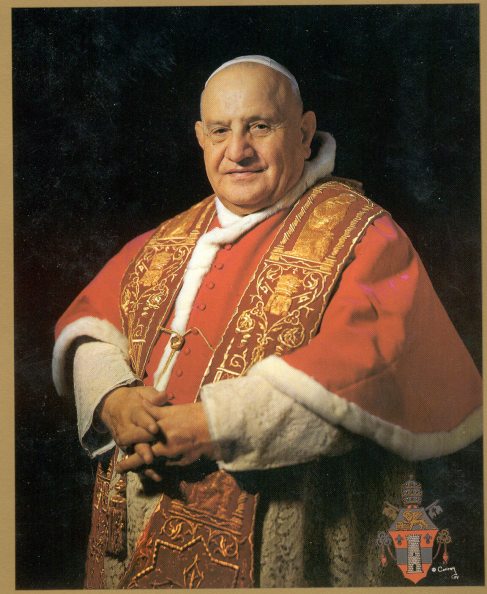
Image

Just less than one year from the release date (11 April 1963), in October 1962 that the world was almost engulfed by a nuclear disaster in the Cuban Missile Crisis, between the USA and the USSR in the most dangerous tension of the Cold War ever since.

Image

Signing of the encyclical Pacem in Terris (image above)
http://www.vatican.va/holy_father/john_xxiii/encyclicals/documents/hf_j-xxiii_enc_11041963_pacem_en.html

Here is the complete text of the encyclical Pacem in Terris – also available in the link above :

PACEM IN TERRIS

ENCYCLICAL OF POPE JOHN XXIII 
ON ESTABLISHING UNIVERSAL PEACE IN TRUTH,
JUSTICE, CHARITY, AND LIBERTY

APRIL 11, 1963


To Our Venerable Brethren the Patriarchs, Primates, Archbishops, Bishops, and all other Local Ordinaries who are at Peace and in Communion with the Apostolic See, and to the Clergy and Faithful of the entire Catholic World, and to all Men of Good Will.

Venerable Brethren and Dearest Sons Health and Apostolic Benediction.

Peace on Earth—which man throughout the ages has so longed for and sought after—can never be established, never guaranteed, except by the diligent observance of the divinely established order.

Order in the Universe

2. That a marvelous order predominates in the world of living beings and in the forces of nature, is the plain lesson which the progress of modern research and the discoveries of technology teach us. And it is part of the greatness of man that he can appreciate that order, and devise the means for harnessing those forces for his own benefit.

3. But what emerges first and foremost from the progress of scientific knowledge and the inventions of technology is the infinite greatness of God Himself, who created both man and the universe. Yes; out of nothing He made all things, and filled them with the fullness of His own wisdom and goodness. Hence, these are the words the holy psalmist used in praise of God: “O Lord, our Lord: how admirable is thy name in the whole earth!” (1) And elsewhere he says: “How great are thy works, O Lord! Thou hast made all things in wisdom.” (2)

Moreover, (2a) God created man “in His own image and likeness,” (3) endowed him with intelligence and freedom, and made him lord of creation. All this the psalmist proclaims when he says: “Thou hast made him a little less than the angels: thou hast crowned him with glory and honor, and hast set him over the works of thy hands. Thou hast subjected all things under his feet.” (4)

Order in Human Beings

4. And yet there is a disunity among individuals and among nations which is in striking contrast to this perfect order in the universe. One would think that the relationships that bind men together could only be governed by force.

5. But the world’s Creator has stamped man’s inmost being with an order revealed to man by his conscience; and his conscience insists on his preserving it. Men “show the work of the law written in their hearts. Their conscience bears witness to them.” (5) And how could it be otherwise? All created being reflects the infinite wisdom of God. It reflects it all the more clearly, the higher it stands in the scale of perfection. (6)

6. But the mischief is often caused by erroneous opinions. Many people think that the laws which govern man’s relations with the State are the same as those which regulate the blind, elemental forces of the universe. But it is not so; the laws which govern men are quite different. The Father of the universe has inscribed them in man’s nature, and that is where we must look for them; there and nowhere else.

7. These laws clearly indicate how a man must behave toward his fellows in society, and how the mutual relationships between the members of a State and its officials are to be conducted. They show too what principles must govern the relations between States; and finally, what should be the relations between individuals or States on the one hand, and the world-wide community of nations on the other. Men’s common interests make it imperative that at long last a world-wide community of nations be established.

I. ORDER BETWEEN MEN

8. We must devote our attention first of all to that order which should prevail among men.

9. Any well-regulated and productive association of men in society demands the acceptance of one fundamental principle: that each individual man is truly a person. His is a nature, that is, endowed with intelligence and free will. As such he has rights and duties, which together flow as a direct consequence from his nature. These rights and duties are universal and inviolable, and therefore altogether inalienable. (7)

10. When, furthermore, we consider man’s personal dignity from the standpoint of divine revelation, inevitably our estimate of it is incomparably increased. Men have been ransomed by the blood of Jesus Christ. Grace has made them sons and friends of God, and heirs to eternal glory.

Rights

11. But first We must speak of man’s rights. Man has the right to live. He has the right to bodily integrity and to the means necessary for the proper development of life, particularly food, clothing, shelter, medical care, rest, and, finally, the necessary social services. In consequence, he has the right to be looked after in the event of illhealth; disability stemming from his work; widowhood; old age; enforced unemployment; or whenever through no fault of his own he is deprived of the means of livelihood. (8)

Rights Pertaining to Moral and Cultural Values

12. Moreover, man has a natural right to be respected. He has a right to his good name. He has a right to freedom in investigating the truth, and—within the limits of the moral order and the common good—to freedom of speech and publication, and to freedom to pursue whatever profession he may choose. He has the right, also, to be accurately informed about public events.

13. He has the natural right to share in the benefits of culture, and hence to receive a good general education, and a technical or professional training consistent with the degree of educational development in his own country. Furthermore, a system must be devised for affording gifted members of society the opportunity of engaging in more advanced studies, with a view to their occupying, as far as possible, positions of responsibility in society in keeping with their natural talent and acquired skill. (9)

The Right to Worship God According to One’s Conscience

14. Also among man’s rights is that of being able to worship God in accordance with the right dictates of his own conscience, and to profess his religion both in private and in public. According to the clear teaching of Lactantius, “this is the very condition of our birth, that we render to the God who made us that just homage which is His due; that we acknowledge Him alone as God, and follow Him. It is from this ligature of piety, which binds us and joins us to God, that religion derives its name.” (l0)

Hence, too, Pope Leo XIII declared that “true freedom, freedom worthy of the sons of God, is that freedom which most truly safeguards the dignity of the human person. It is stronger than any violence or injustice. Such is the freedom which has always been desired by the Church, and which she holds most dear. It is the sort of freedom which the Apostles resolutely claimed for themselves. The apologists defended it in their writings; thousands of martyrs consecrated it with their blood.”(11)

The Right to Choose Freely One’s State in Life

15. Human beings have also the right to choose for themselves the kind of life which appeals to them: whether it is to found a family—in the founding of which both the man and the woman enjoy equal rights and duties—or to embrace the priesthood or the religious life.(12)

16. The family, founded upon marriage freely contracted, one and indissoluble, must be regarded as the natural, primary cell of human society. The interests of the family, therefore, must be taken very specially into consideration in social and economic affairs, as well as in the spheres of faith and morals. For all of these have to do with strengthening the family and assisting it in the fulfilment of its mission.

17. Of course, the support and education of children is a right which belongs primarily to the parents. (13)

Economic Rights

18. In the economic sphere, it is evident that a man has the inherent right not only to be given the opportunity to work, but also to be allowed the exercise of personal initiative in the work he does. (14)

19. The conditions in which a man works form a necessary corollary to these rights. They must not be such as to weaken his physical or moral fibre, or militate against the proper development of adolescents to manhood. Women must be accorded such conditions of work as are consistent with their needs and responsibilities as wives and mothers.(15)

20. A further consequence of man’s personal dignity is his right to engage in economic activities suited to his degree of responsibility.(16) The worker is likewise entitled to a wage that is determined in accordance with the precepts of justice. This needs stressing. The amount a worker receives must be sufficient, in proportion to available funds, to allow him and his family a standard of living consistent with human dignity. Pope Pius XII expressed it in these terms:

“Nature imposes work upon man as a duty, and man has the corresponding natural right to demand that the work he does shall provide him with the means of livelihood for himself and his children. Such is nature’s categorical imperative for the preservation of man.”(17)

21. As a further consequence of man’s nature, he has the right to the private ownership of property, including that of productive goods. This, as We have said elsewhere, is “a right which constitutes so efficacious a means of asserting one’s personality and exercising responsibility in every field, and an element of solidity and security for family life, and of greater peace and prosperity in the State.”(18)

22. Finally, it is opportune to point out that the right to own private property entails a social obligation as well. (19)

The Right of Meeting and Association

23. Men are by nature social, and consequently they have the right to meet together and to form associations with their fellows. They have the right to confer on such associations the type of organization which they consider best calculated to achieve their objectives. They have also the right to exercise their own initiative and act on their own responsibility within these associations for the attainment of the desired results(20).

24. As We insisted in Our encyclical Mater et Magistra, the founding of a great many such intermediate groups or societies for the pursuit of aims which it is not within the competence of the individual to achieve efficiently, is a matter of great urgency. Such groups and societies must be considered absolutely essential for the safeguarding of man’s personal freedom and dignity, while leaving intact a sense of responsibility.(21)

The Right to Emigrate and Immigrate

25. Again, every human being has the right to freedom of movement and of residence within the confines of his own State. When there are just reasons in favor of it, he must be permitted to emigrate to other countries and take up residence there.(22) The fact that he is a citizen of a particular State does not deprive him of membership in the human family, nor of citizenship in that universal society, the common, world-wide fellowship of men.

Political Rights

26. Finally, man’s personal dignity involves his right to take an active part in public life, and to make his own contribution to the common welfare of his fellow citizens. As Pope Pius XII said, “man as such, far from being an object or, as it were, an inert element in society, is rather its subject, its basis and its purpose; and so must he be esteemed.”(23)

27. As a human person he is entitled to the legal protection of his rights, and such protection must be effective, unbiased, and strictly just. To quote again Pope Pius XII: “In consequence of that juridical order willed by God, man has his own inalienable right to juridical security. To him is assigned a certain, well-defined sphere of law, immune from arbitrary attack.”(24)

Duties

8. The natural rights of which We have so far been speaking are inextricably bound up with as many duties, all applying to one and the same person. These rights and duties derive their origin, their sustenance, and their indestructibility from the natural law, which in conferring the one imposes the other.

9. Thus, for example, the right to live involves the duty to preserve one’s life; the right to a decent standard of living, the duty to live in a becoming fashion; the right to be free to seek out the truth, the duty to devote oneself to an ever deeper and wider search for it.

Reciprocity of Rights and Duties Between Persons

30. Once this is admitted, it follows that in human society one man’s natural right gives rise to a corresponding duty in other men; the duty, that is, of recognizing and respecting that right. Every basic human right draws its authoritative force from the natural law, which confers it and attaches to it its respective duty. Hence, to claim one’s rights and ignore one’s duties, or only half fulfill them, is like building a house with one hand and tearing it down with the other.

Mutual Collaboration

31. Since men are social by nature, they must live together and consult each other’s interests. That men should recognize and perform their respective rights and duties is imperative to a well ordered society. But the result will be that each individual will make his whole-hearted contribution to the creation of a civic order in which rights and duties are ever more diligently and more effectively observed.

32. For example, it is useless to admit that a man has a right to the necessities of life, unless we also do all in our power to supply him with means sufficient for his livelihood.

33. Hence society must not only be well ordered, it must also provide men with abundant resources. This postulates not only the mutual recognition and fulfillment of rights and duties, but also the involvement and collaboration of all men in the many enterprises which our present civilization makes possible, encourages or indeed demands.

An Attitude of Responsibility

34. Man’s personal dignity requires besides that he enjoy freedom and be able to make up his own mind when he acts. In his association with his fellows, therefore, there is every reason why his recognition of rights, observance of duties, and many-sided collaboration with other men, should be primarily a matter of his own personal decision. Each man should act on his own initiative, conviction, and sense of responsibility, not under the constant pressure of external coercion or enticement. There is nothing human about a society that is welded together by force. Far from encouraging, as it should, the attainment of man’s progress and perfection, it is merely an obstacle to his freedom.

Social Life in Truth, Justice, Charity and Freedom

35. Hence, before a society can be considered well-ordered, creative, and consonant with human dignity, it must be based on truth. St. Paul expressed this as follows: “Putting away lying, speak ye the truth every man with his neighbor, for we are members one of another.”(25) And so will it be, if each man acknowledges sincerely his own rights and his own duties toward others.

Human society, as We here picture it, demands that men be guided by justice, respect the rights of others and do their duty. It demands, too, that they be animated by such love as will make them feel the needs of others as their own, and induce them to share their goods with others, and to strive in the world to make all men alike heirs to the noblest of intellectual and spiritual values. Nor is this enough; for human society thrives on freedom, namely, on the use of means which are consistent with the dignity of its individual members, who, being endowed with reason, assume responsibility for their own actions .

36. And so, dearest sons and brothers, we must think of human society as being primarily a spiritual reality. By its means enlightened men can share their knowledge of the truth, can claim their rights and fulfill their duties, receive encouragement in their aspirations for the goods of the spirit, share their enjoyment of all the wholesome pleasures of the world, and strive continually to pass on to others all that is best in themselves and to make their own the spiritual riches of others. It is these spiritual values which exert a guiding influence on culture, economics, social institutions, political movements and forms, laws, and all the other components which go to make up the external community of men and its continual development.

God and the Moral Order

37. Now the order which prevails in human society is wholly incorporeal in nature. Its foundation is truth, and it must be brought into effect by justice. It needs to be animated and perfected by men’s love for one another, and, while preserving freedom intact, it must make for an equilibrium in society which is increasingly more human in character.

38. But such an order—universal, absolute and immutable in its principles—finds its source in the true, personal and transcendent God. He is the first truth, the sovereign good, and as such the deepest source from which human society, if it is to be properly constituted, creative, and worthy of man’s dignity, draws its genuine vitality. (26) This is what St. Thomas means when he says: “Human reason is the standard which measures the degree of goodness of the human will, and as such it derives from the eternal law, which is divine reason . . . Hence it is clear that the goodness of the human will depends much more on the eternal law than on human reason.” (27)

Characteristics of the Present Day

39. There are three things which characterize our modern age.

40. In the first place we notice a progressive improvement in the economic and social condition of working men. They began by claiming their rights principally in the economic and social spheres, and then proceeded to lay claim to their political rights as well. Finally, they have turned their attention to acquiring the more cultural benefits of society.

Today, therefore, working men all over the world are loud in their demands that they shall in no circumstances be subjected to arbitrary treatment, as though devoid of intelligence and freedom. They insist on being treated as human beings, with a share in every sector of human society: in the socio-economic sphere, in government, and in the realm of learning and culture.

41. Secondly, the part that women are now playing in political life is everywhere evident. This is a development that is perhaps of swifter growth among Christian nations, but it is also happening extensively, if more slowly, among nations that are heirs to different traditions and imbued with a different culture. Women are gaining an increasing awareness of their natural dignity. Far from being content with a purely passive role or allowing themselves to be regarded as a kind of instrument, they are demanding both in domestic and in public life the rights and duties which belong to them as human persons.

42. Finally, we are confronted in this modern age with a form of society which is evolving on entirely new social and political lines. Since all peoples have either attained political independence or are on the way to attaining it, soon no nation will rule over another and none will be subject to an alien power.

43. Thus all over the world men are either the citizens of an independent State, or are shortly to become so; nor is any nation nowadays content to submit to foreign domination. The longstanding inferiority complex of certain classes because of their economic and social status, sex, or position in the State, and the corresponding superiority complex of other classes, is rapidly becoming a thing of the past.

Equality of Men

44. Today, on the contrary the conviction is widespread that all men are equal in natural dignity; and so, on the doctrinal and theoretical level, at least, no form of approval is being given to racial discrimination. All this is of supreme significance for the formation of a human society animated by the principles We have mentioned above, for man’s awareness of his rights must inevitably lead him to the recognition of his duties. The possession of rights involves the duty of implementing those rights, for they are the expression of a man’s personal dignity. And the possession of rights also involves their recognition and respect by other people.

45. When society is formed on a basis of rights and duties, men have an immediate grasp of spiritual and intellectual values, and have no difficulty in understanding what is meant by truth, justice, charity and freedom. They become, moreover, conscious of being members of such a society. And that is not all. Inspired by such principles, they attain to a better knowledge of the true God—a personal God transcending human nature. They recognize that their relationship with God forms the very foundation of their life—the interior life of the spirit, and the life which they live in the society of their fellows.

II. RELATIONS BETWEEN INDIVIDUALS AND THE PUBLIC AUTHORITIES

46. Human society can be neither well-ordered nor prosperous without the presence of those who, invested with legal authority, preserve its institutions and do all that is necessary to sponsor actively the interests of all its members. And they derive their authority from God, for, as St. Paul teaches, “there is no power but from God”.(28)

In his commentary on this passage, St. John Chrysostom writes: “What are you saying? Is every ruler appointed by God? No, that is not what I mean, he says, for I am not now talking about individual rulers, but about authority as such. My contention is that the existence of a ruling authority—the fact that some should command and others obey, and that all things not come about as the result of blind chance—this is a provision of divine wisdom.”(29)

God has created men social by nature, and a society cannot “hold together unless someone is in command to give effective direction and unity of purpose. Hence every civilized community must have a ruling authority, and this authority, no less than society itself, has its source in nature, and consequently has God for its author.”(30)

47. But it must not be imagined that authority knows no bounds. Since its starting point is the permission to govern in accordance with right reason, there is no escaping the conclusion that it derives its binding force from the moral order, which in turn has God as its origin and end.

Hence, to quote Pope Pius XII, “The absolute order of living beings, and the very purpose of man—an autonomous being, the subject of duties and inviolable rights, and the origin and purpose of human society—have a direct bearing upon the State as a necessary community endowed with authority. Divest it of this authority, and it is nothing, it is lifeless…. But right reason, and above all Christian faith, make it clear that such an order can have no other origin but in God, a personal God, our Creator. Hence it is from Him that State officials derive their dignity, for they share to some extent in the authority of God Himself.”(31)

An Appeal to Conscience

48. Hence, a regime which governs solely or mainly by means of threats and intimidation or promises of reward, provides men with no effective incentive to work for the common good. And even if it did, it would certainly be offensive to the dignity of free and rational human beings. Authority is before all else a moral force. For this reason the appeal of rulers should be to the individual conscience, to the duty which every man has of voluntarily contributing to the common good. But since all men are equal in natural dignity, no man has the capacity to force internal compliance on another. Only God can do that, for He alone scrutinizes and judges the secret counsels of the heart.

49. Hence, representatives of the State have no power to bind men in conscience, unless their own authority is tied to God’s authority, and is a participation in it.(32)

50. The application of this principle likewise safeguards the dignity of citizens. Their obedience to civil authorities is never an obedience paid to them as men. It is in reality an act of homage paid to God, the provident Creator of the universe, who has decreed that men’s dealings with one another be regulated in accordance with that order which He Himself has established. And we men do not demean ourselves in showing due reverence to God. On the contrary, we are lifted up and ennobled in spirit, for to serve God is to reign.(33)

51. Governmental authority, therefore, is a postulate of the moral order and derives from God. Consequently, laws and decrees passed in contravention of the moral order, and hence of the divine will, can have no binding force in conscience, since “it is right to obey God rather than men “(34).

Indeed, the passing of such laws undermines the very nature of authority and results in shameful abuse. As St. Thomas teaches, “In regard to the second proposition, we maintain that human law has the rationale of law in so far as it is in accordance with right reason, and as such it obviously derives from eternal law. A law which is at variance with reason is to that extent unjust and has no longer the rationale of law. It is rather an act of violence.”(35)

52. The fact that authority comes from God does not mean that men have no power to choose those who are to rule the State, or to decide upon the type of government they want, and determine the procedure and limitations of rulers in the exercise of their authority. Hence the above teaching is consonant with any genuinely democratic form of government.(36)

Attainment of the Common Good is the Purpose of the Public Authority

53. Men, both as individuals and as intermediate groups, are required to make their own specific contributions to the general welfare. The main consequence of this is that they must harmonize their own interests with the needs of others, and offer their goods and services as their rulers shall direct—assuming, of course, that justice is maintained and the authorities are acting within the limits of their competence. Those who have authority in the State must exercise that authority in a way which is not only morally irreproachable, but also best calculated to ensure or promote the State’s welfare.

54. The attainment of the common good is the sole reason for the existence of civil authorities. In working for the common good, therefore, the authorities must obviously respect its nature, and at the same time adjust their legislation to meet the requirements of the given situation .(37)

Essentials of the Common Good

55. Among the essential elements of the common good one must certainly include the various characteristics distinctive of each individual people. (38) But these by no means constitute the whole of it. For the common good, since it is intimately bound up with human nature, can never exist fully and completely unless the human person is taken into account at all times. Thus, attention must be paid to the basic nature of the common good and what it is that brings it about. (39)

56. We must add, therefore, that it is in the nature of the common good that every single citizen has the right to share in it—although in different ways, depending on his tasks, merits and circumstances. Hence every civil authority must strive to promote the common good in the interest of all, without favoring any individual citizen or category of citizen. As Pope Leo XIII insisted: “The civil power must not be subservient to the advantage of any one individual, or of some few persons; inasmuch as it was established for the common good of all.” (40)

Nevertheless, considerations of justice and equity can at times demand that those in power pay more attention to the weaker members of society, since these are at a disadvantage when it comes to defending their own rights and asserting their legitimate interests. (41)

The Spiritual, Too

57. In this connection, We would draw the attention of Our own sons to the fact that the common good is something which affects the needs of the whole man, body and soul. That, then, is the sort of good which rulers of States must take suitable measure to ensure. They must respect the hierarchy of values, and aim at achieving the spiritual as well as the material prosperity of their subjects.(42)

58. These principles are clearly contained in that passage in Our encyclical Mater et Magistra where We emphasized that the common good “must take account of all those social conditions which favor the full development of human personality.(43)

59. Consisting, as he does, of body and immortal soul, man cannot in this mortal life satisfy his needs or attain perfect happiness. Thus, the measures that are taken to implement the common good must not jeopardize his eternal salvation; indeed, they must even help him to obtain it.(44)

Responsibilities of the Public Authority, and Rights and Duties of Individuals

60. It is generally accepted today that the common good is best safeguarded when personal rights and duties are guaranteed. The chief concern of civil authorities must therefore be to ensure that these rights are recognized, respected, co-ordinated, defended and promoted, and that each individual is enabled to perform his duties more easily. For “to safeguard the inviolable rights of the human person, and to facilitate the performance of his duties, is the principal duty of every public authority.”(45)

61. Thus any government which refused to recognize human rights or acted in violation of them, would not only fail in its duty; its decrees would be wholly lacking in binding force.(46)

Reconciliation and Protection of Rights and Duties of Individuals

62. One of the principal duties of any government, moreover, is the suitable and adequate superintendence and co-ordination of men’s respective rights in society. This must be done in such a way 1) that the exercise of their rights by certain citizens does not obstruct other citizens in the exercise of theirs; 2) that the individual, standing upon his own rights, does not impede others in the performance of their duties; 3) that the rights of all be effectively safeguarded, and completely restored if they have been violated.(47)

Duty of Promoting the Rights of Individuals

63. In addition, heads of States must make a positive contribution to the creation of an overall climate in which the individual can both safeguard his own rights and fulfill his duties, and can do so readily. For if there is one thing we have learned in the school of experience, it is surely this: that, in the modern world especially, political, economic and cultural inequities among citizens become more and more widespread when public authorities fail to take appropriate action in these spheres. And the consequence is that human rights and duties are thus rendered totally ineffective.

64. The public administration must therefore give considerable care and thought to the question of social as well as economic progress, and to the development of essential services in keeping with the expansion of the productive system. Such services include road-building, transportation, communications, drinking-water, housing, medical care, ample facilities for the practice of religion, and aids to recreation. The government must also see to the provision of insurance facilities, to obviate any likelihood of a citizen’s being unable to maintain a decent standard of living in the event of some misfortune, or greatly in creased family responsibilities.

The government is also required to show no less energy and efficiency in the matter of providing opportunities for suitable employment, graded to the capacity of the workers. It must make sure that working men are paid a just and equitable wage, and are allowed a sense of responsibility in the industrial concerns for which they work. It must facilitate the formation of intermediate groups, so that the social life of the people may become more fruitful and less constrained. And finally, it must ensure that everyone has the means and opportunity of sharing as far as possible in cultural benefits.

Harmonious Relations Between Public Authority’s Two Forms of Intervention

65. The common welfare further demands that in their efforts to co-ordinate and protect, and their efforts to promote, the rights of citizens, the civil authorities preserve a delicate balance. An excessive concern for the rights of any particular individuals or groups might well result in the principal advantages of the State being in effect monopolized by these citizens. Or again, the absurd situation can arise where the civil authorities, while taking measures to protect the rights of citizens, themselves stand in the way of the full exercise of these rights. “For this principle must always be retained: that however extensive and far-reaching the influence of the State on the economy may be, it must never be exerted to the extent of depriving the individual citizen of his freedom of action. It must rather augment his freedom, while effectively guaranteeing the protection of everyone’s essential, personal rights.” (48)

66. And the same principle must be adopted by civil authorities in their various efforts to facilitate the exercise of rights and performance of duties in every department of social life.

Structure and Operation of the Public Authority

67. For the rest, it is not possible to give a general ruling on the most suitable form of government, or the ways in which civil authorities can most effectively fulfill their legislative, administrative, and judicial functions.

68. In determining what form a particular government shall take, and the way in which it shall function, a major consideration will be the prevailing circumstances and the condition of the people; and these are things which vary in different places and at different times.

We think, however, that it is in keeping with human nature for the State to be given a form which embodies a threefold division of public office properly corresponding to the three main functions of public authority. In such a State a precise legal framework is provided, not only for the official functions of government, but also for the mutual relations between citizens and public officials. This will obviously afford sure protection to citizens, both in the safeguarding of their rights and in the fulfilment of their duties.

69. If, however, this juridical and political structure is to realize its potential benefits, it is absolutely essential that public officials do their utmost to solve the problems that arise; and they must do so by using policies and techniques which it is within their competence to implement, and which suit the actual condition of the State. It is also essential that, despite constantly changing conditions, legislators never disregard the moral law or constitutional provision, nor act at variance with the exigencies of the common good. And as justice must be the guiding principle in the administration of the State, and executives must thoroughly understand the law and carefully weigh all attendant circumstances, so too in the courts: justice must be administered impartially, and judges must be wholly incorrupt and uninfluenced by the solicitations of interested parties. The good order of society also requires that individuals and subsidiary groups within the State be effectively protected by law in the affirmation of their rights and the performance of their duties, both in their relations with each other and with government officials.(49)

Law and Conscience

70. There can be no doubt that a State juridical system which conforms to the principles of justice and rightness, and corresponds to the degree of civic maturity evinced by the State in question, is highly conducive to the attainment of the common good.

71. And yet social life is so complex, varied and active in this modern age, that even a juridical system which has been established with great prudence and foresight often seems inadequate to the need.

72. Moreover, the relations of citizens with each other, of citizens and intermediate groups with public authorities, and the relations between public authorities of the same State, are sometimes seen to be of so ambiguous and explosive a nature, that they are not susceptible of being regulated by any hard and fast system of laws.

In such cases, if the authorities want to preserve the State’s juridical system intact—in itself and in its application to specific cases—and if they want to minister to the principal needs of society, adapt the laws to the conditions of modern life and seek solutions to new problems, then it is essential that they have a clear idea of the nature and limits of their own legitimate spheres of action. Their calmness, integrity, clear sightedness and perseverance must be such that they will recognize at once what is needed in a given situation, and act with promptness and efficiency.(50)

Citizens’ Participation in Public Life

73. A natural consequence of men’s dignity is unquestionably their right to take an active part in government, though their degree of participation will necessarily depend on the stage of development reached by the political community of which they are members.

74. For the rest, this right to take part in government opens out to men a new and extensive field of opportunity for service. A situation is created in which civic authorities can, from the greater frequency of their contacts and discussions with the citizens, gain a clearer idea of what policies are in fact effectual for the common good; and in a system which allows for a regular succession of public officials, the authority of these officials, far from growing old and feeble, takes on a new vitality in keeping with the progressive development of human society. (51)

Characteristics of the Present Day

75. There is every indication at the present time that these aims and ideals are giving rise to various demands concerning the juridical organization of States. The first is this: that a clear and precisely worded charter of fundamental human rights be formulated and incorporated into the State’s general constitutions.

76. Secondly, each State must have a public constitution, couched in juridical terms, laying down clear rules relating to the designation of public officials, their reciprocal relations, spheres of competence and prescribed methods of operation.

77. The final demand is that relations between citizens and public authorities be described in terms of rights and duties. It must be clearly laid down that the principal function of public authorities is to recognize, respect, co-ordinate, safeguard and promote citizens’ rights and duties

78. We must, however, reject the view that the will of the individual or the group is the primary and only source of a citizen’s rights and duties, and of the binding force of political constitutions and the government’s authority.(52)

79. But the aspirations We have mentioned are a clear indication of the fact that men, increasingly aware nowadays of their personal dignity, have found the incentive to enter government service and demand constitutional recognition for their own inviolable rights. Not content with this, they are demanding, too, the observance of constitutional procedures in the appointment of public authorities, and are insisting that they exercise their office within this constitutional framework.

III. RELATIONS BETWEEN STATES

80. With respect to States themselves, Our predecessors have constantly taught, and We wish to lend the weight of Our own authority to their teaching, that nations are the subjects of reciprocal rights and duties. Their relationships, therefore, must likewise be harmonized in accordance with the dictates of truth, justice, willing cooperation, and freedom. The same law of nature that governs the life and conduct of individuals must also regulate the relations of political communities with one another.

81. This will be readily understood when one reflects that it is quite impossible for political leaders to lay aside their natural dignity while acting in their country’s name and in its interests They are still bound by the natural law, which is the rule that governs all moral conduct, and they have no authority to depart from its slightest precepts.

82. The idea that men, by the fact of their appointment to public office, are compelled to lay aside their own humanity, is quite inconceivable Their very attainment to this high-ranking office was due to their exceptional gifts and intellectual qualities, which earned for them their reputation as outstanding representatives of the body politic

83. Moreover, a ruling authority is indispensable to civil society. That is a fact which follows from the moral order itself. Such authority, therefore, cannot be misdirected against the moral order. It would immediately cease to exit, being deprived of its whole raison d’être. God Himself warns us of this: “Hear, therefore, ye kings, and understand: learn, ye that are judges of the ends of the earth. Give ear, you that rule the people, and that please yourselves in multitudes of nations. For power is given you by the Lord, and strength by the Most High, who will examine your works, and search out your thoughts.” (53)

84. And lastly one must bear in mind that, even when it regulates the relations between States, authority must be exercised for the promotion of the common good. That is the primary reason for its existence.

An lmperative of the Common Good

85. But one of the principal imperatives of the common good is the recognition of the moral order and the unfailing observance of its precepts. “A firmly established order between political communities must be founded on the unshakable and unmoving rock of the moral law, that law which is revealed in the order of nature by the Creator Himself, and engraved indelibly on men’s hearts . . . Its principles are beacon lights to guide the policies of men and nations. They are also warning lights—providential signs—which men must heed if their laborious efforts to establish a new order are not to encounter perilous storms and shipwreck.” (54)

In Truth

86. The first point to be settled is that mutual ties between States must be governed by truth. Truth calls for the elimination of every trace of racial discrimination, and the consequent recognition of the inviolable principle that all States are by nature equal in dignity.

Each of them accordingly has the right to exist, to develop, and to possess the necessary means and accept a primary responsibility for its own development. Each is also legitimately entitled to its good name and to the respect which is its due.

87. As we know from experience, men frequently differ widely in knowledge, virtue, intelligence and wealth, but that is no valid argument in favor of a system whereby those who are in a position of superiority impose their will arbitrarily on others. On the contrary, such men have a greater share in the common responsibility to help others to reach perfection by their mutual efforts.

88. So, too, on the international level: some nations may have attained to a superior degree of scientific, cultural and economic development. But that does not entitle them to exert unjust political domination over other nations. It means that they have to make a greater contribution to the common cause of social progress.

89. The fact is that no one can be by nature superior to his fellows, since all men are equally noble in natural dignity. And consequently there are no differences at all between political communities from the point of view of natural dignity. Each State is like a body, the members of which are human beings. And, as we know from experience, nations can be highly sensitive in matters in any way touching their dignity and honor; and with good reason.

The Question of Propaganda

90. Truth further demands an attitude of unruffled impartiality in the use of the many aids to the promotion and spread of mutual understanding between nations which modern scientific progress has made available. This does not mean that people should be prevented from drawing particular attention to the virtues of their own way of life, but it does mean the utter rejection of ways of disseminating information which violate the principles of truth and justice, and injure the reputation of another nation. (55)

In Justice

91. Relations between States must furthermore be regulated by justice. This necessitates both the recognition of their mutual rights, and, at the same time, the fulfilment of their respective duties.

92. States have the right to existence, to self development, and to the means necessary to achieve this. They have the right to play the leading part in the process of their own development, and the right to their good name and due honors. Consequently, States are likewise in duty bound to safeguard all such rights effectively, and to avoid any action that could violate them. And just as individual men may not pursue their own private interests in a way that is unfair and detrimental to others, so too it would be criminal in a State to aim at improving itself by the use of methods which involve other nations in injury and unjust oppression. There is a saying of St. Augustine which has particular relevance in this context: “Take away justice, and what are kingdoms but mighty bands of robbers “(56)

93. There may be, and sometimes is, a clash of interests among States, each striving for its own development. When differences of this sort arise, they must be settled in a truly human way, not by armed force nor by deceit or trickery. There must be a mutual assessment of the arguments and feelings on both sides, a mature and objective investigation of the situation, and an equitable reconciliation of opposing views.

The Treatment of Minorities

94. A special instance of this clash of interests is furnished by that political trend (which since the nineteenth century has become widespread throughout the world and has gained in strength) as a result of which men of similar ethnic background are anxious for political autonomy and unification into a single nation. For many reasons this cannot always be effected, and consequently minority peoples are often obliged to live within the territories of a nation of a different ethnic origin. This situation gives rise to serious problems.

95. It is quite clear that any attempt to check the vitality and growth of these ethnic minorities is a flagrant violation of justice; the more so if such perverse efforts are aimed at their very extinction .

96. Indeed, the best interests of justice are served by those public authorities who do all they can to improve the human conditions of the members of these minority groups, especially in what concerns their language, culture, ancient traditions, and their economic activity and enterprise. (57)

A Cautionary Note

97. It is worth noting, however, that these minority groups, in reaction, perhaps, to the enforced hardships of their present situation, or to historical circumstances, frequently tend to magnify unduly characteristics proper to their own people. They even rate them above those human values which are common to all mankind, as though the good of the entire human family should subserve the interests of their own particular groups. A more reasonable attitude for such people to adopt would be to recognize the advantages, too, which accrue to them from their own special situation. They should realize that their constant association with a people steeped in a different civilization from their own has no small part to play in the development of their own particular genius and spirit. Little by little they can absorb into their very being those virtues which characterize the other nation. But for this to happen these minority groups must enter into some kind of association with the people in whose midst they are living, and learn to share their customs and way of life. It will never happen if they sow seeds of disaffection which can only produce a harvest of evils, stifling the political development of nations.

Active Solidarity

98. Since relationships between States must be regulated in accordance with the principles of truth and justice, States must further these relationships by taking positive steps to pool their material and spiritual resources. In many cases this can be achieved by all kinds of mutual collaboration; and this is already happening in our own day in the economic, social, political, educational, health and athletic spheres—and with beneficial results. We must bear in mind that of its very nature civil authority exists, not to confine men within the frontiers of their own nations, but primarily to protect the common good of the State, which certainly cannot be divorced from the common good of the entire human family

99. Thus, in pursuing their own interests, civil societies, far from causing injury to others, must join plans and forces whenever the efforts of particular States cannot achieve the desired goal. But in doing so great care must be taken. What is beneficial to some States may prove detrimental rather than advantageous to others.

Contacts Between Races

100. Furthermore, the universal common good requires the encouragement in all nations of every kind of reciprocation between citizens and their intermediate societies. There are many parts of the world where we find groupings of people of more or less different ethnic origin. Nothing must be allowed to prevent reciprocal relations between them. Indeed such a prohibition would flout the very spirit of an age which has done so much to nullify the distances separating peoples.

Nor must one overlook the fact that whatever their ethnic background, men possess, besides the special characteristics which distinguish them from other men, other very important elements in common with the rest of mankind. And these can form the basis of their progressive development and self-realization especially in regard to spiritual values. They have, therefore, the right and duty to carry on their lives with others in society.

The Proper Balance Between Population, Land and Capital

101. As everyone is well aware, there are some countries where there is an imbalance between the amount of arable land and the number of inhabitants; others where there is an imbalance between the richness of the resources and the instruments of agriculture available. It is imperative, therefore, that nations enter into collaboration with each other, and facilitate the circulation of goods, capital and manpower. (58)

102. We advocate in such cases the policy of bringing the work to the workers, wherever possible, rather than bringing workers to the scene of the work. In this way many people will be afforded an opportunity of increasing their resources without being exposed to the painful necessity of uprooting themselves from their own homes, settling in a strange environment, and forming new social contacts.

The Problem of Political Refugees

103. The deep feelings of paternal love for all mankind which God has implanted in Our heart makes it impossible for Us to view without bitter anguish of spirit the plight of those who for political reasons have been exiled from their own homelands. There are great numbers of such refugees at the present time, and many are the sufferings—the incredible sufferings—to which they are constantly exposed.

104. Here surely is our proof that, in defining the scope of a just freedom within which individual citizens may live lives worthy of their human dignity, the rulers of some nations have been far too restrictive. Sometimes in States of this kind the very right to freedom is called in question, and even flatly denied. We have here a complete reversal of the right order of society, for the whole raison d’etre of public authority is to safeguard the interests of the community. Its sovereign duty is to recognize the noble realm of freedom and protect its rights.

The Refugee’s Rights

105. For this reason, it is not irrelevant to draw the attention of the world to the fact that these refugees are persons and all their rights as persons must be recognized. Refugees cannot lose these rights simply because they are deprived of citizenship of their own States.

106. And among man’s personal rights we must include his right to enter a country in which he hopes to be able to provide more fittingly for himself and his dependents. It is therefore the duty of State officials to accept such immigrants and—so far as the good of their own community, rightly understood, permits—to further the aims of those who may wish to become members of a new society.

Commendable Efforts

107. We therefore take this opportunity of giving Our public approval and commendation to every undertaking, founded on the principles of human solidarity or of Christian charity, which aims at relieving the distress of those who are compelled to emigrate from their own country to another.

108. And We must indeed single out for the praise of all right-minded men those international agencies which devote all their energies to this most important work.

Causes of the Arms Race

109. On the other hand, We are deeply distressed to see the enormous stocks of armaments that have been, and continue to be, manufactured in the economically more developed countries. This policy is involving a vast outlay of intellectual and material resources, with the result that the people of these countries are saddled with a great burden, while other countries lack the help they need for their economic and social development .

110. There is a common belief that under modern conditions peace cannot be assured except on the basis of an equal balance of armaments and that this factor is the probable cause of this stockpiling of armaments. Thus, if one country increases its military strength, others are immediately roused by a competitive spirit to augment their own supply of armaments. And if one country is equipped with atomic weapons, others consider themselves justified in producing such weapons themselves, equal in destructive force.

111. Consequently people are living in the grip of constant fear. They are afraid that at any moment the impending storm may break upon them with horrific violence. And they have good reasons for their fear, for there is certainly no lack of such weapons. While it is difficult to believe that anyone would dare to assume responsibility for initiating the appalling slaughter and destruction that war would bring in its wake, there is no denying that the conflagration could be started by some chance and unforeseen circumstance. Moreover, even though the monstrous power of modern weapons does indeed act as a deterrent, there is reason to fear that the very testing of nuclear devices for war purposes can, if continued, lead to serious danger for various forms of life on earth.

Need for Disarmament

112. Hence justice, right reason, and the recognition of man’s dignity cry out insistently for a cessation to the arms race. The stock-piles of armaments which have been built up in various countries must be reduced all round and simultaneously by the parties concerned. Nuclear weapons must be banned. A general agreement must be reached on a suitable disarmament program, with an effective system of mutual control. In the words of Pope Pius XII: “The calamity of a world war, with the economic and social ruin and the moral excesses and dissolution that accompany it, must not on any account be permitted to engulf the human race for a third time.” (59)

113. Everyone, however, must realize that, unless this process of disarmament be thoroughgoing and complete, and reach men’s very souls, it is impossible to stop the arms race, or to reduce armaments, or—and this is the main thing—ultimately to abolish them entirely. Everyone must sincerely co-operate in the effort to banish fear and the anxious expectation of war from men’s minds. But this requires that the fundamental principles upon which peace is based in today’s world be replaced by an altogether different one, namely, the realization that true and lasting peace among nations cannot consist in the possession of an equal supply of armaments but only in mutual trust. And We are confident that this can be achieved, for it is a thing which not only is dictated by common sense, but is in itself most desirable and most fruitful of good.

Three Motives

114. Here, then, we have an objective dictated first of all by reason. There is general agreement—or at least there should be—that relations between States, as between individuals, must be regulated not by armed force, but in accordance with the principles of right reason: the principles, that is, of truth, justice and vigorous and sincere co-operation.

115. Secondly, it is an objective which We maintain is more earnestly to be desired. For who is there who does not feel the craving to be rid of the threat of war, and to see peace preserved and made daily more secure?

116. And finally it is an objective which is rich with possibilities for good. Its advantages will be felt everywhere, by individuals, by families, by nations, by the whole human race. The warning of Pope Pius XII still rings in our ears: “Nothing is lost by peace; everything may be lost by war.” (60)

A Call to Unsparing Effort

117. We therefore consider it Our duty as the vicar on earth of Jesus Christ—the Saviour of the world, the Author of peace—and as interpreter of the most ardent wishes of the whole human family, in the fatherly love We bear all mankind, to beg and beseech mankind, and above all the rulers of States, to be unsparing of their labor and efforts to ensure that human affairs follow a rational and dignified course.

118. In their deliberations together, let men of outstanding wisdom and influence give serious thought to the problem of achieving a more human adjustment of relations between States throughout the world. It must be an adjustment that is based on mutual trust, sincerity in negotiation, and the faithful fulfilment of obligations assumed. Every aspect of the problem must be examined, so that eventually there may emerge some point of agreement from which to initiate treaties which are sincere, lasting, and beneficial in their effects.

119. We, for Our part, will pray unceasingly that God may bless these labors by His divine assistance, and make them fruitful.

In Liberty

120. Furthermore, relations between States must be regulated by the principle of freedom. This means that no country has the right to take any action that would constitute an unjust oppression of other countries, or an unwarranted interference in their affairs. On the contrary, all should help to develop in others an increasing awareness of their duties, an adventurous and enterprising spirit, and the resolution to take the initiative for their own advancement in every field of endeavor.

The Evolution of Economically Under-developed Countries

121. All men are united by their common origin and fellowship, their redemption by Christ, and their supernatural destiny. They are called to form one Christian family. In Our encyclical Mater et Magistra, therefore, We appealed to the more wealthy nations to render every kind of assistance to those States which are still in the process of economic development. (61)

122. It is no small consolation to Us to be able to testify here to the wide acceptance of Our appeal, and We are confident that in the years that lie ahead it will be accepted even more widely. The result We look for is that the poorer States shall in as short a time as possible attain to a degree of economic development that enables their citizens to live in conditions more in keeping with their human dignity.

123. Again and again We must insist on the need for helping these peoples in a way which guarantees to them the preservation of their own freedom. They must be conscious that they are themselves playing the major role in their economic and social development; that they are themselves to shoulder the main burden of it.

124. Hence the wisdom of Pope Pius XII’s teaching: “A new order founded on moral principles is the surest bulwark against the violation of the freedom, integrity and security of other nations, no matter what may be their territorial extension or their capacity for defense. For although it is almost inevitable that the larger States, in view of their greater power and vaster resources, will themselves decide on the norms governing their economic associations with small States, nevertheless these smaller States cannot be denied their right, in keeping with the common good, to political freedom, and to the adoption of a position of neutrality in the conflicts between nations. No State can be denied this right, for it is a postulate of the natural law itself, as also of international law. These smaller States have also the right of assuring their own economic development. It is only with the effective guaranteeing of these rights that smaller nations can fittingly promote the common good of all mankind, as well as the material welfare and the cultural and spiritual progress of their own people”. (62)

125. The wealthier States, therefore, while providing various forms of assistance to the poorer, must have the highest possible respect for the latter’s national characteristics and timehonored civil institutions. They must also repudiate any policy of domination. If this can be achieved, then “a precious contribution will have been made to the formation of a world community, in which each individual nation, conscious of its rights and duties, can work on terms of equality with the rest for the attainment of universal prosperity.” (63)

Signs of the Times

126. Men nowadays are becoming more and more convinced that any disputes which may arise between nations must be resolved by negotiation and agreement, and not by recourse to arms.

127. We acknowledge that this conviction owes its origin chiefly to the terrifying destructive force of modern weapons. It arises from fear of the ghastly and catastrophic consequences of their use. Thus, in this age which boasts of its atomic power, it no longer makes sense to maintain that war is a fit instrument with which to repair the violation of justice.

128. And yet, unhappily, we often find the law of fear reigning supreme among nations and causing them to spend enormous sums on armaments. Their object is not aggression, so they say—and there is no reason for disbelieving them—but to deter others from aggression.

129. Nevertheless, We are hopeful that, by establishing contact with one another and by a policy of negotiation, nations will come to a better recognition of the natural ties that bind them together as men. We are hopeful, too, that they will come to a fairer realization of one of the cardinal duties deriving from our common nature: namely, that love, not fear, must dominate the relationships between individuals and between nations. It is principally characteristic of love that it draws men together in all sorts of ways, sincerely united in the bonds of mind and matter; and this is a union from which countless blessings can flow.

IV. RELATIONSHIP OF MEN AND OF POLITICAL COMMUNITIES
WITH THE WORLD COMMUNITY

130. Recent progress in science and technology has had a profound influence on man’s way of life. This progress is a spur to men all over the world to extend their collaboration and association with one another in these days when material resources, travel from one country to another, and technical information have so vastly increased. This has led to a phenomenal growth in relationships between individuals, families and intermediate associations belonging to the various nations, and between the public authorities of the various political communities. There is also a growing economic interdependence between States. National economies are gradually becoming so interdependent that a kind of world economy is being born from the simultaneous integration of the economies of individual States. And finally, each country’s social progress, order, security and peace are necessarily linked with the social progress, order, security and peace of every other country.

131. From this it is clear that no State can fittingly pursue its own interests in isolation from the rest, nor, under such circumstances, can it develop itself as it should. The prosperity and progress of any State is in part consequence, and in part cause, of the prosperity and progress of all other States.

Inadequacy of Modern States to Ensure Universal Common Good the

132. No era will ever succeed in destroying the unity of the human family, for it consists of men who are all equal by virtue of their natural dignity. Hence there will always be an imperative need—born of man’s very nature—to promote in sufficient measure the universal common good; the good, that is, of the whole human family.

133. In the past rulers of States seem to have been able to make sufficient provision for the universal common good through the normal diplomatic channels, or by top-level meetings and discussions, treaties and agreements; by using, that is, the ways and means suggested by the natural law, the law of nations, or international law.

134. In our own day, however, mutual relationships between States have undergone a far reaching change. On the one hand, the universal common good gives rise to problems of the utmost gravity, complexity and urgency—especially as regards the preservation of the security and peace of the whole world. On the other hand, the rulers of individual nations, being all on an equal footing, largely fail in their efforts to achieve this, however much they multiply their meetings and their endeavors to discover more fitting instruments of justice. And this is no reflection on their sincerity and enterprise. It is merely that their authority is not sufficiently influential.

135. We are thus driven to the conclusion that the shape and structure of political life in the modern world, and the influence exercised by public authority in all the nations of the world are unequal to the task of promoting the common good of all peoples.

Connection Between the Common Good and Political Authority

136. Now, if one considers carefully the inner significance of the common good on the one hand, and the nature and function of public authority on the other, one cannot fail to see that there is an intrinsic connection between them. Public authority, as the means of promoting the common good in civil society, is a postulate of the moral order. But the moral order likewise requires that this authority be effective in attaining its end. Hence the civil institutions in which such authority resides, becomes operative and promotes its ends, are endowed with a certain kind of structure and efficacy: a structure and efficacy which make such institutions capable of realizing the common good by ways and means adequate to the changing historical conditions.

137. Today the universal common good presents us with problems which are world-wide in their dimensions; problems, therefore, which cannot be solved except by a public authority with power, organization and means co-extensive with these problems, and with a world-wide sphere of activity. Consequently the moral order itself demands the establishment of some such general form of public authority.

Public Authority Instituted by Common Consent and Not Imposed by Force

138. But this general authority equipped with world-wide power and adequate means for achieving the universal common good cannot be imposed by force. It must be set up with the consent of all nations. If its work is to be effective, it must operate with fairness, absolute impartiality, and with dedication to the common good of all peoples. The forcible imposition by the more powerful nations of a universal authority of this kind would inevitably arouse fears of its being used as an instrument to serve the interests of the few or to take the side of a single nation, and thus the influence and effectiveness of its activity would be undermined. For even though nations may differ widely in material progress and military strength, they are very sensitive as regards their juridical equality and the excellence of their own way of life. They are right, therefore, in their reluctance to submit to an authority imposed by force, established without their co-operation, or not accepted of their own accord.

The Universal Common Good and Personal Rights

139. The common good of individual States is something that cannot be determined without reference to the human person, and the same is true of the common good of all States taken together. Hence the public authority of the world community must likewise have as its special aim the recognition, respect, safeguarding and promotion of the rights of the human person. This can be done by direct action, if need be, or by the creation throughout the world of the sort of conditions in which rulers of individual States can more easily carry out their specific functions.

The Principle of Subsidiarity

140. The same principle of subsidiarity which governs the relations between public authorities and individuals, families and intermediate societies in a single State, must also apply to the relations between the public authority of the world community and the public authorities of each political community. The special function of this universal authority must be to evaluate and find a solution to economic, social, political and cultural problems which affect the universal common good. These are problems which, because of their extreme gravity, vastness and urgency, must be considered too difficult for the rulers of individual States to solve with any degree of success.

141. But it is no part of the duty of universal authority to limit the sphere of action of the public authority of individual States, or to arrogate any of their functions to itself. On the contrary, its essential purpose is to create world conditions in which the public authorities of each nation, its citizens and intermediate groups, can carry out their tasks, fullfill their duties and claim their rights with greater security. (64)

Modern Developments

142. The United Nations Organization (U.N.) was established, as is well known, on June 26, 1945. To it were subsequently added lesser organizations consisting of members nominated by the public authority of the various nations and entrusted with highly important international functions in the economics, social, cultural, educational and health fields. The United Nations Organization has the special aim of maintaining and strengthening peace between nations, and of encouraging and assisting friendly relations between them, based on the principles of equality, mutual respect, and extensive cooperation in every field of human endeavor.

143. A clear proof of the farsightedness of this organization is provided by the Universal Declaration of Human Rights passed by the United Nations General Assembly on December 10, 1948. The preamble of this declaration affirms that the genuine recognition and complete observance of all the rights and freedoms outlined in the declaration is a goal to be sought by all peoples and all nations.

144. We are, of course, aware that some of the points in the declaration did not meet with unqualified approval in some quarters; and there was justification for this. Nevertheless, We think the document should be considered a step in the right direction, an approach toward the establishment of a juridical and political ordering of the world community. It is a solemn recognition of the personal dignity of every human being; an assertion of everyone’s right to be free to seek out the truth, to follow moral principles, discharge the duties imposed by justice, and lead a fully human life. It also recognized other rights connected with these.

145. It is therefore Our earnest wish that the United Nations Organization may be able progressively to adapt its structure and methods of operation to the magnitude and nobility of its tasks. May the day be not long delayed when every human being can find in this organization an effective safeguard of his personal rights; those rights, that is, which derive directly from his dignity as a human person, and which are therefore universal, inviolable and inalienable. This is all the more desirable in that men today are taking an ever more active part in the public life of their own nations, and in doing so they are showing an increased interest in the affairs of all peoples. They are becoming more and more conscious of being living members of the universal family of mankind.

V. PASTORAL EXHORTATIONS

146. Here once more We exhort Our sons to take an active part in public life, and to work together for the benefit of the whole human race, as well as for their own political communities. It is vitally necessary for them to endeavor, in the light of Christian faith, and with love as their guide, to ensure that every institution, whether economic, social, cultural or political, be such as not to obstruct but rather to facilitate man’s self betterment, both in the natural and in the supernatural order.

Scientific Competence, Technical Capacity and Professional Experience

147. And yet, if they are to imbue civilization with right ideals and Christian principles, it is not enough for Our sons to be illumined by the heavenly light of faith and to be fired with enthusiasm for a cause; they must involve themselves in the work of these institutions, and strive to influence them effectively from within.

148. But in a culture and civilization like our own, which is so remarkable for its scientific knowledge and its technical discoveries, clearly no one can insinuate himself into public life unless he be scientifically competent, technically capable, and skilled in the practice of his own profession . Apostolate of a Trained Laity

149. And yet even this must be reckoned insufficient to bring the relationships of daily life into conformity with a more human standard, based, as it must be, on truth, tempered by justice, motivated by mutual love, and holding fast to the practice of freedom.

150. If these policies are really to become operative, men must first of all take the utmost care to conduct their various temporal activities in accordance with the laws which govern each and every such activity, observing the principles which correspond to their respective natures. Secondly, men’s actions must be made to conform with the precepts of the moral order. This means that their behavior must be such as to reflect their consciousness of exercising a personal right or performing a personal duty. Reason has a further demand to make. In obedience to the providential designs and commands of God respecting our salvation and neglecting the dictates of conscience, men must conduct themselves in their temporal activity in such a way as to effect a thorough integration of the principal spiritual values with those of science, technology and the professions.

Integration of Faith and Action

151. In traditionally Christian States at the present time, civil institutions evince a high degree of scientific and technical progress and possess abundant machinery for the attainment of every kind of objective. And yet it must be owned that these institutions are often but slightly affected by Christian motives and a Christian spirit.

152. One may well ask the reason for this, since the men who have largely contributed—and who are still contributing—to the creation of these institutions are men who are professed Christians, and who live their lives, at least in part, in accordance with the precepts of the gospels. In Our opinion the explanation lies in a certain cleavage between faith and practice. Their inner, spiritual unity must be restored, so that faith may be the light and love the motivating force of all their actions.

Integral Education

153. We consider too that a further reason for this very frequent divorce between faith and practice in Christians is an inadequate education in Christian teaching and Christian morality. In many places the amount of energy devoted to the study of secular subjects is all too often out of pro portion to that devoted to the study of religion. Scientific training reaches a very high level, whereas religious training generally does not advance beyond the elementary stage. It is essential, therefore, that the instruction given to our young people be complete and continuous, and imparted in such a way that moral goodness and the cultivation of religious values may keep pace with scientific knowledge and continually advancing technical progress. Young people must also be taught how to carry out their own particular obligations in a truly fitting manner.(65)

Constant Endeavor

154. In this connection We think it opportune to point out how difficult it is to understand clearly the relation between the objective requirements of justice and concrete situations; to define, that is, correctly to what degree and in what form doctrinal principles and directives must be applied in the given state of human society.

155. The definition of these degrees and forms is all the more difficult in an age such as ours, driven forward by a fever of activity. And yet this is the age in which each one of us is required to make his own contribution to the universal common good. Daily is borne in on us the need to make the reality of social life conform better to the requirements of justice. Hence Our sons have every reason for not thinking that they can relax their efforts and be satisfied with what they have already achieved.

156. What has so far been achieved is insufficient compared with what needs to be done; all men must realize that. Every day provides a more important, a more fitting enterprise to which they must turn their hands—industry, trade unions, professional organizations, insurance, cultural institutions, the law, politics, medical and recreational facilities, and other such activities. The age in which we live needs all these things. It is an age in which men, having discovered the atom and achieved the breakthrough into outer space, are now exploring other avenues, leading to almost limitless horizons.

Relations Between Catholics and Non-Catholics in Social and Economic Affairs

157. The principles We have set out in this document take their rise from the very nature of things. They derive, for the most part, from the consideration of man’s natural rights. Thus the putting of these principles into effect frequently involves extensive co-operation between Catholics and those Christians who are separated from this Apostolic See. It even involves the cooperation of Catholics with men who may not be Christians but who nevertheless are reasonable men, and men of natural moral integrity. “In such circumstances they must, of course, bear themselves as Catholics, and do nothing to compromise religion and morality. Yet at the same time they should show themselves animated by a spirit of understanding and unselfishness, ready to co-operate loyally in achieving objects which are good in themselves, or conducive to good.”(66)

Error and the Errant

158. It is always perfectly justifiable to distinguish between error as such and the person who falls into error—even in the case of men who err regarding the truth or are led astray as a result of their inadequate knowledge, in matters either of religion or of the highest ethical standards. A man who has fallen into error does not cease to be a man. He never forfeits his personal dignity; and that is something that must always be taken into account. Besides, there exists in man’s very nature an undying capacity to break through the barriers of error and seek the road to truth. God, in His great providence, is ever present with His aid. Today, maybe, a man lacks faith and turns aside into error; tomorrow, perhaps, illumined by God’s light, he may indeed embrace the truth.

Catholics who, in order to achieve some external good, collaborate with unbelievers or with those who through error lack the fullness of faith in Christ, may possibly provide the occasion or even the incentive for their conversion to the truth.

Philosophies and Historical Movements

159. Again it is perfectly legitimate to make a clear distinction between a false philosophy of the nature, origin and purpose of men and the world, and economic, social, cultural, and political undertakings, even when such undertakings draw their origin and inspiration from that philosophy. True, the philosophic formula does not change once it has been set down in precise terms, but the undertakings clearly cannot avoid being influenced to a certain extent by the changing conditions in which they have to operate. Besides, who can deny the possible existence of good and commendable elements in these undertakings, elements which do indeed conform to the dictates of right reason, and are an expression of man’s lawful aspirations?

160. It may sometimes happen, therefore, that meetings arranged for some practical end—though hitherto they were thought to be altogether useless—may in fact be fruitful at the present time, or at least offer prospects of success. But whether or not the moment for such cooperation has arrived, and the manner and degree of such co-operation in the attainment of economic, social, cultural and political advantages—these are matters for prudence to decide; prudence, the queen of all the virtues which rule the lives of men both as individuals and in society.

As far as Catholics are concerned, the decision rests primarily with those who take a leading part in the life of the community, and in these specific fields. They must, however, act in accordance with the principles of the natural law, and observe the Church’s social teaching and the directives of ecclesiastical authority. For it must not be forgotten that the Church has the right and duty not only to safeguard her teaching on faith and morals, but also to exercise her authority over her sons by intervening in their external affairs whenever a judgment has to be made concerning the practical application of this teaching. (67)

Little by Little

161. There are indeed some people who, in their generosity of spirit, burn with a desire to institute wholesale reforms whenever they come across situations which show scant regard for justice or are wholly out of keeping with its claims. They tackle the problem with such impetuosity that one would think they were embarking on some political revolution.

162. We would remind such people that it is the law of nature that all things must be of gradual growth. If there is to be any improvement in human institutions, the work must be done slowly and deliberately from within. Pope Pius XII expressed it in these terms: “Salvation and justice consist not in the uprooting of an outdated system, but in a well designed policy of development. Hotheadedness was never constructive; it has always destroyed everything. It has inflamed passions, but never assuaged them. It sows no seeds but those of hatred and destruction. Far from bringing about the reconciliation of contending parties, it reduces men and political parties to the necessity of laboriously redoing the work of the past, building on the ruins that disharmony has left in its wake.”68

An Immense Task

163. Hence among the very serious obligations incumbent upon men of high principles, We must include the task of establishing new relationships in human society, under the mastery and guidance of truth, justice, charity and freedom—relations between individual citizens, between citizens and their respective States, between States, and finally between individuals, families, intermediate associations and States on the one hand, and the world community on the other. There is surely no one who will not consider this a most exalted task, for it is one which is able to bring about true peace in accordance with divinely established order.

164. Considering the need, the men who are shouldering this responsibility are far too few in number, yet they are deserving of the highest recognition from society, and We rightfully honor them with Our public praise. We call upon them to persevere in their ideals, which are of such tremendous benefit to mankind. At the same time We are encouraged to hope that many more men, Christians especially, will join their cause, spurred on by love and the realization of their duty. Everyone who has joined the ranks of Christ must be a glowing point of light in the world, a nucleus of love, a leaven of the whole mass. He will be so in proportion to his degree of spiritual union with God.

165. The world will never be the dwellingplace of peace, till peace has found a home in the heart of each and every man, till every man preserves in himself the order ordained by God to be preserved. That is why St. Augustine asks the question: “Does your mind desire the strength to gain the mastery over your passions? Let it submit to a greater power, and it will conquer all beneath it. And peace will be in you—true, sure, most ordered peace. What is that order? God as ruler of the mind; the mind as ruler of the body. Nothing could be more orderly.” (69)

The Prince of Peace

166. Our concern here has been with problems which are causing men extreme anxiety at the present time; problems which are intimately bound up with the progress of human society. Unquestionably, the teaching We have given has been inspired by a longing which We feel most keenly, and which We know is shared by all men of good will: that peace may be assured on earth.

167. We who, in spite of Our inadequacy, are nevertheless the vicar of Him whom the prophet announced as the Prince of Peace, (70) conceive of it as Our duty to devote all Our thoughts and care and energy to further this common good of all mankind. Yet peace is but an empty word, if it does not rest upon that order which Our hope prevailed upon Us to set forth in outline in this encyclical. It is an order that is founded on truth, built up on justice, nurtured and animated by charity, and brought into effect under the auspices of freedom.

168. So magnificent, so exalted is this aim that human resources alone, even though inspired by the most praiseworthy good will, cannot hope to achieve it. God Himself must come to man’s aid with His heavenly assistance, if human society is to bear the closest possible resemblance to the kingdom of God.

169. The very order of things therefore, demands that during this sacred season we pray earnestly to Him who by His bitter passion and death washed away men’s sins, which are the fountainhead of discord, misery and inequality; to Him who shed His blood to reconcile the human race to the heavenly Father, and bestowed the gifts of peace. “For He is our peace, who hath made both one . . . And coming, He preached peace to you that were afar off; and peace to them that were nigh.” (71)

170. The sacred liturgy of these days reechoes the same message: “Our Lord Jesus Christ, after His resurrection stood in the midst of His disciples and said: Peace be upon you, alleluia. The disciples rejoiced when they saw the Lord.” (72) It is Christ, therefore, who brought us peace; Christ who bequeathed it to us: “Peace I leave with you: my peace I give unto you: not as the world giveth, do I give unto you.” (73)

171. Let us, then, pray with all fervor for this peace which our divine Redeemer came to bring us. May He banish from the souls of men whatever might endanger peace. May He transform all men into witnesses of truth, justice and brotherly love. May He illumine with His light the minds of rulers, so that, besides caring for the proper material welfare of their peoples, they may also guarantee them the fairest gift of peace.

Finally, may Christ inflame the desires of all men to break through the barriers which divide them, to strengthen the bonds of mutual love, to learn to understand one another, and to pardon those who have done them wrong. Through His power and inspiration may all peoples welcome each other to their hearts as brothers, and may the peace they long for ever flower and ever reign among them.

172. And so, dear brothers, with the ardent wish that peace may come upon the flocks committed to your care, for the special benefit of those who are most lowly and in the greatest need of help and defense, lovingly in the Lord We bestow on you, on Our priests both secular and regular, on religious both men and women, on all the faithful and especially those who give wholehearted obedience to these Our exhortations, Our Apostolic Blessing. And upon all men of good will, to whom We also address this encyclical, We implore from God health and prosperity.

Given at Rome, at St. Peter’s, on Holy Thursday, the eleventh day of April, in the year 1963, the fifth of Our Pontificate.

JOHN XXIII