Second Ballot : No smoke. No Pope had been elected yet

As there was no ‘early’ smoke on Wednesday morning, 13 March 2013 in Rome, it is safe to assume that no Pope had been elected in the second ballot. This is because, instead of the usual 2 ballots per session then burn the ballots of both together at the end (session = morning/afternoon), if a Pope is elected on the first of these two ballots, the second ballot will obviously not take place, and thus, the smoke will be early, and will definitely also be white.

This was also the early sign that a Pope had been elected in 2005, when the afternoon smoke went early (this was after the fourth ballot, first of two afternoon ballots) at near 6 pm Rome time, when the smoke, which should have been later if no Pope was elected.

It may be more likely that the white smoke will appear after the third ballot, or the fourth ballot.

Watch live at : http://www.romereports.com/palio/modules.php?name=Content3&pa=showpage&newlang=english&pid=47#.UUA0qBzLoj7

List of possible regnal names for the new Pope, from Benedict to Peter

These are the list of all the possible regnal names (may not be entirely complete, since I may miss some in the way), that the new Pope can and may take as his own regnal name. In parentheses are how the name will look like if the Pope takes the name.

The ones listed below are the names that Popes had been taking since 1775 till today (2013) :

1. Benedict (Benedict XVII) last Benedict still living as Pope Emeritus

2. John Paul (John Paul III) last John Paul died in 2005

3. Paul (Paul VII) last Paul died in 1978

4. John (John XXIV) last John died in 1963, no John before that since 1334

5. Pius (Pius XIII) last Pius died in 1958

6. Leo (Leo XIV) last Leo died in 1903

7. Gregory (Gregory XVII) last Gregory died in 1846


Below are the names that the Popes had taken before 1775, but this does not rule them out from being picked by the new Pope, but chances are remote, with the above 7 names in use for the past 238 years.

8. Clement (Clement XV) last Clement died in1775

9. Innocent (Innocent XIV) last Innocent died in 1724

10. Alexander (Alexander IX) last Alexander died in 1691

11. Urban (Urban IX) last Urban died in 1644

12. Sixtus (Sixtus VI) last Sixtus died in 1590

13. Marcellus (Marcellus III) last Marcellus died in 1555

14. Julius (Julius IV) last Julius died in 1555

15. Adrian (Adrian VII) last Adrian died in 1523, last non-Italian Pope before 1978

16. Callixtus (Callixtus IV) last Callixtus died in 1458

17. Nicholas (Nicholas VI) last Nicholas died in 1455

18. Eugene (Eugene V) last Eugene died in 1447

19. Martin (Martin VI) last Martin died in 1431

20. Boniface (Boniface X) last Boniface died in 1404

21. Celestine (Celestine VI) last Celestine died in 1294, also a Saint, the famous Pope who resigned

22. Honorius (Honorius V) last Honorius died in 1287

23. Lucius (Lucius IV) last Lucius died in 1185

24. Anastasius (Anastasius V) last Anastasius died in 1154

25. Eugene (Eugene IV) last Eugene died in 1153

26. Gelasius (Gelasius III) last Gelasius died in 1119

27. Paschal (Paschal III) last Paschal died in 1118

28. Victor (Victor IV) last Victor died in 1087

29. Stephen (Stephen X) last Stephen died in 1058

30. Damasus (Damasus III) last Damasus died in 1048

31. Sylvester (Sylvester IV) last Sylvester died in 1045

32. Sergius (Sergius V) last Sergius died in 1012

33. Agapetus (Agapetus III) last Agapetus died in 955

34. Marinus (Marinus III) last Marinus died in 946

35. Lando/Landus (Landus II) only used once, died in 914, last Pope whose name is only used once

36. Theodore (Theodore III) last Theodore died in 897

37. Romanus (Romanus II) only used once, died in 897

38. Formosus (Formosus II) only used once, died in 896

39. Valentine (Valentine II) only used once, died in 827

40. Zachary (Zachary II) only used once, died in 752

41. Constantine (Constantine II) only used once, died in 715

42. Sisinnius (Sisinnius II) only used once, died in 708

43. Conon (Conon II) only used once, died in 687

44. Agatho (Agatho II) only used once, last one is Saint, died in 681

45. Donus (Donus II) only used once, last one died in 678

46. Adeodatus (Adeodatus III) last Adeodatus died in 676

47. Vitalian (Vitalian II) only used once, died in 672

48. Severinus (Severinus II) only used once, died in 640

49. Sabinian (Sabinian II) only used once, died in 606

50. Pelagius (Pelagius III) last Pelagius died in 590

51. Vigilius (Vigilius II) only used once, died in 555

52. Silverius (Silverius II) only used once, last one is Saint, died in 537

53. Felix (Felix V) last Felix died in 530


All the names below have been used only once, ever. Most of them are the early Church Fathers and Saints, and therefore, it is rather extremely unlikely any of these names would be picked.

54. Hormisdas (Hormisdas II) only used once, died in 523

55. Symmachus (Symmachus II) only used once, last one is Saint, died in 514

56. Simplicius (Simplicius II) only used once, last one is Saint, died in 483

57. Hilarius (Hilarius II) only used once, last one is Saint, died in 468

58. Zosimus (Zosimus II) only used once, last one is Saint, died in 418

59. Siricius (Siricius II) only used once, last one is Saint, died in 399

60. Liberius (Liberius II) only used once, died in 366

61. Mark (Mark II) only used once, last one is Saint, died in 336

62. Miltiades (Miltiades II) only used once, last one is Saint, died in 314, First Pope after Edict of Milan

63. Eusebius (Eusebius II) only used once, last one is Saint, died in 310

64. Marcellinus (Marcellinus II) only used once, last one is Saint, died in 304

65. Caius (Caius II) only used once, last one is Saint, died in 296

66. Eutychian (Eutychian II) only used once, last one is Saint, died in 283

67. Dionysius (Dionysius II) only used once, last one is Saint, died in 268

68. Cornelius (Cornelius II) only used once, last one is Saint, died in 253

69. Fabian (Fabian II) only used once, last one is Saint, died in 250

70. Anterus (Anterus II) only used once, last one is Saint, died in 236

71. Pontian (Pontian II) only used once, last one is Saint, died in 235

72. Zephyrinus (Zephyrinus II) only used once, last one is Saint, died in 217

73. Eleuterus (Eleuterus II) only used once, last one is Saint, died in 189

74. Soter (Soter II) only used once, last one is Saint, died in 174 or 175

75. Anicetus (Anicetus II) only used once, last one is Saint, died in 166

76. Hyginus (Hyginus II) only used once, last one is Saint, died in 140 or 142

77. Telesphorus (Telesphorus II) only used once, last one is Saint, died in 136 or 138

78. Evaristus (Evaristus II) only used once, last one is Saint, died in 105 or 107

79. Anacletus (Anacletus II) only used once, last one is Saint, died in 88 or 92

80. Linus (Linus II) only used once, last one is Saint, died in 76 or 79

81. Peter (Peter II) only used once, and he is the founder of the Church, Apostle of Jesus Christ, and it is extremely unlikely any future Pope, or any Pope will ever adopt the name of the Prince of the Apostles.

Cardinal Angelo Scola, Archbishop of Milan, the Papabile

http://www.eitb.com/en/news/world/detail/1282802/candidates-new-pope–profile-cardinal-angelo-scola/

From the article (My commentary at the end) :


Election of new pope

Profile of Cardinal Angelo Scola, Archbishop of Milan

APTN

03/11/2013

A conservative, and theologically close to both Pope Benedict and his predecessor John Paul II, Cardinal Scola is regarded as one of the leading European candidates to become Pope.

Cardinal Angelo Scola, the archbishop of Milan.

Cardinal Angelo Scola, the archbishop of Milan, shot to the top of a list of possible successors to Pope Benedict XVI almost immediately the resignation was announced.

A conservative, and theologically close to both Pope Benedict and his predecessor John Paul II, Cardinal Scola is regarded as one of the leading European candidates to become Pope.

Some observers tipped him to succeed after the death of John Paul II in 2005, but the conclave instead chose Cardinal Joseph Ratzinger who became Benedict XVI, the 265th pope.

But if there was rivalry between the candidates in 2005, it had little effect on their close relationship, and Scola remained a favourite of Pope Benedict’s, who appointed the Cardinal archbishop of the Milan Diocese in June 2011.

In the small town of Malgrate on Lake Como in northern Italy, many of the 5,000 residents are backing their hometown boy to become Pope. Scola was born in Malgrate on 7 November 1941 to a truck driver and a homemaker.

He entered the priesthood in 1970, became a Cardinal in 2003, serving first as Patriarch of Milan until he was elevated to his current post of archbishop.

Scola’s cousin, Angelo Colombo, remembers that during World War II he would spend time at his cousin’s home because Scola’s father was a truck driver and could get access to flour and bread.

Colombo said he would go to Scola’s family home, and his aunt and the future Cardinal would always share their food. When he asked if he thought his cousin would make a good Pope, Colombo laughed and responded: “he was a tough boy”.

Scola spent the early years of his life in a small home on Malgrate’s Salita Sant’Antonio. Alfredo Cagliandi was a classmate of Cardinal Scola and lived in the apartment below him.

“We would invite Angelo to come and play and he would repeatedly respond ‘I am sorry, but I don’t have time.’  He was too busy because was already involved in something religious,” said Cagliandi, who still lives in Malgrate.

Scola spent the first two decades after his 1970 ordination in the lecture halls and libraries of renowned Catholic universities and theological training grounds, notably in Fribourg, Switzerland, and the Lateran Pontifical University in Rome.

While pursuing theological studies, Scola was involved in Communion and Liberation, a conservative Italian Catholic group which blends political activism with faith-based fervour as it seeks to make its weight felt in the country’s decision-making.

Back in Scola’s home town, the local priest Father Andrea Lotterio proudly showed off the baptismal font where he says the town’s babies are still baptised today, noting that Scola was baptised there in 1941.

Father Lotterio said Scola has pleased the residents of Malgrate by never losing his strong ties to his hometown. “He has maintained his relationships with many local citizens, with his friends, with his relatives,” Lotterio said. “So much so that in this town he is called Don Angelo, instead of Cardinal or Patriarch of Venice.”

Pope Benedict resigned as leader of the Catholic Church on Thursday, becoming the first pope in 600 years to resign. For the time being, the governance of the Catholic Church shifts to Cardinal Tarcisio Bertone, the camerlengo, or chamberlain. Bertone, along with the College of Cardinals will guide the church and make plans for the conclave to elect the 266th leader within the next few weeks.


Commentary and additions:

Indeed, Cardinal Angelo Scola has many strengths and characteristics that we need as the new Pope to lead the Roman Catholic Church, the one and Universal Church. He does have his weaknesses, but his strengths more than made up for him. After all, it is human to have weaknesses and to make mistakes.

Cardinal Scola is media-savvy, able to reach out into the hearts of many, including youths and those in the world, who are longing for the Lord to come to them. Being media-savvy, and also internet-savvy, Cardinal Scola is not shy of using modern media tools, such as the internet, twitter, YouTube, his own site, and many other means to evangelise to the world, and to reach out, especially to youths.

Cardinal Scola also has a positive outlook and optimism in the Church, and indeed, instead of being pessimistic on the Church, and instead of looking at a Church in trouble, he dismissed all this, and all the lies that the media had brought about the Church, that the Church instead of being in chaos and trouble, is in fact growing, and filled with vibrant and strong faith and love in God, and Cardinal Scola has the capacity to tap into all these energies.

Cardinal Scola also came from a poorer family background, and he understood the plight of the poor and the less fortunate. His hometown people has often remembered him as someone who not only did not forget about where he came from, and where he was born, but also someone who constantly gives them his care and his love, in imitation of Christ and His care for the poor.

Cardinal Scola speaks Italian, English, French, and Spanish, and although his English is not that good, but he has quite a strong command of these languages, which are essential in the Pope’s ministry as the leader of the Universal Church.

Cardinal Scola’s initiatives to reach out to the Christians in the Holy Land and in other areas where Christians are minorities, and his involvement in interreligious dialogue and cooperation, and even with atheists, had been fruitful and crucial in strengthening Christians in the areas where they had been persecuted, and where persecutions are ongoing.

His experience in the Archdiocese of Milan, Patriarchate of Venice, and Diocese of Grosseto clearly showed that he is a pastoral leader with a humble and yet intellectual mind, that matches that of our beloved Pope Emeritus Benedict XVI. Yet, his experiences in the Roman Curia too were many, with works as leader of Pontifical Institute of Marriage and the Family, which he also took a strong stand with the Church in the sanctity of both marriage and the family.

His intellect, knowledge, and publications especially in topics like bioethics, in the midst of the attacks against Church’s stand on bioethics, cloning, and contraceptions will be essential for the future leader of the Church, and his ability to connect and reach out to people, more than Pope Emeritus Benedict XVI, will be valuable asset to have in the new Pope.

Nevertheless, now that the Conclave will begin soon, we continue to pray that God will pour His Holy Spirit on all the Cardinal-electors, that they can make a wise and inspired decision, to elect someone whom the Lord has chosen, as the best possible person to succeed His Apostle, Peter, and lead the whole Universal Church, that God Himself built in this world, to be the manifestation of His love, justice, and presence.

(Special) Mass for the Election of the Roman Pontiff / Missa pro Eligendo Pontifice (Gospel Reading)

John 15 : 9-17

As the Father has loved Me, so I have loved you. Remain in My love! You will remain in My love if you keep My commandments, just as I have kept My Father’s commandments and remain in His love. I have told you all this, that My own joy may be in you, and your joy may be complete.

This is My commandment : Love one another as I have loved you! There is no greater love than this, to give one’s life for one’s friends; you are My friends, if you do what I commanded you. I shall not call you servants any more, because servants do not know what their master is about. Instead I have called you friends, since I have made known to you everything I learnt from My Father.

You did not choose Me; it was I who chose you and sent you to go and bear fruit, fruit that will last. And everything you ask the Father in My Name, He will give you. This is My command, that you love one another.

(Special) Mass for the Election of the Roman Pontiff / Missa pro Eligendo Pontifice (Second Reading)

Ephesians 4 : 11-16

As for God’s gifts, to some He gave to be apostles, to others prophets, or even evangelists, or pastors and teachers. So He prepared those who belong to Him for the ministry, in order to build up the Body of Christ, until we are all united in the same faith and knowledge of the Son of God. Thus, we shall become the perfect Man, upon reaching maturity and sharing the fullness of Christ.

Then no longer shall we be like children tossed about by any wave or wind of doctrine, and deceived by the cunning of people who drag them along into error. Rather, speaking the truth in love, we shall grow in every way towards Him who is the Head, Christ. From Him, comes the growth of the whole body to which a network of joints gives order and cohesion, taking into account and making use of the function of each one.

So the Body builds itself in love.

(Special) Mass for the Election of the Roman Pontiff / Missa pro Eligendo Pontifice (Psalm)

Psalm 88 : 4-5, 21-22, 25 and 27

I have made a covenant with David, My chosen one; I have made a pledge to my servant. I establish his descendants forever; I build his throne for all generations.

I have found David My servant, and with My holy oil I have anointed him. My hand will be ever with him and My arm will sustain him.

My faithfulness and love will be with him, and by my help he will be strong. He will call on Me, “You are my Father, my God, my Rock, my Saviour.”

(Special) Mass for the Election of the Roman Pontiff / Missa pro Eligendo Pontifice (First Reading)

Isaiah 61 : 1-3a, 6a, 8b-9

The Spirit of the Lord YHVH is upon me, because YHVH has anointed me to bring good news to the poor. He has sent me to bind up broken hearts, to proclaim liberty to the captives, freedom to those languishing in prison; to announce the year of YHVH’s favour and the day of vengeance of our God; to give comfort to all who grieve; to comfort those who mourn in Zion and give them a garland instead of ashes.

But you will be named priests of YHVH, you will be called ministers of our God. I will give them their due reward and make an everlasting covenant with them. Their descendants shall be known among the nations and their offspring among the peoples. All who see them will acknowledge that they are a race YHVH has blessed.

Homily of the Dean of the College of Cardinals, Cardinal Angelo Sodano, at the Mass for the Election of the Roman Pontiff / Missa pro Eligendo Pontifice

http://www.zenit.org/en/articles/cardinal-angelo-sodano-s-homily-at-the-missa-pro-eligendo-pontifice


Homily of Cardinal Angelo Sodano
Dean of the College of Cardinals
Vatican Basilica – March 12, 2013

Dear Concelebrants, Distinct Authorities, Brothers and Sisters in Christ,

“Forever I will sing the mercies of the Lord” is the hymn that resounds once again near the tomb of the Apostle Peter in this important hour of the history of the Holy Church of Christ.

These are the words of Psalm 88 that have flowed from our lips to adore, give thanks and beg the Father who is in heaven. “Misericordias Domini in aeternum cantabo”: is the beautiful Latin text that has introduced us into contemplation of the One who always watches over his Church with love, sustaining her on her journey down through the ages, and giving her life through his Holy Spirit.

Such an interior attitude is ours today as we wish to offer ourselves with Christ to the Father who is in heaven, to thank him for the loving assistance that he always reserves for the Holy Church, and in particular for the brilliant Pontificate that he granted to us through the life and work of the 265th Successor of Peter, the beloved and venerable Pontiff Benedict XVI, to whom we renew in this moment all of our gratitude.

At the same time today, we implore the Lord, that through the pastoral sollicitude of the Cardinal Fathers, He may soon grant another Good Shepherd to his Holy Church. In this hour, faith in the promise of Christ sustains us in the indefectible character of the church. Indeed Jesus said to Peter: “You are Peter and on this rock I will build my Church, and the gates of hell shall not prevail against her.” (Mt. 16:18).

My brothers, the readings of the World of God that we have just heard can help us better understand the mission that Christ has entrusted to Peter and to his successors.

1. The Message of Love

The first reading has offered us once again a well-known oracle from the second part of the book of Isaiah that is known as “the book of consolation” (Isaiah 40-66). It is a prophecy addressed to the people of Israel who are in exile in Babylon. Through this prophecy, God announces that he will send a Messiah full of mercy, a Messiah who would say: “The spirit of the Lord God is upon me… he has sent me to bring good news to the poor, to bind up the wounds of broken hearts, to proclaim liberty to captives, freedom to prisoners, and to announce a year of mercy of the Lord” (Isaiah 61:1-3).

The fulfillment of such a prophecy is fully realized in Jesus, who came into the world to make present the love of the Father for all people. It is a love which is especially felt in contact with suffering, injustice, poverty and all human frailty, both physical and moral. It is especially found in the well known encyclical of Pope John Paul II, “Dives in Misericordia” where we read: “It is precisely the mode and sphere in which love manifests itself that in biblical language is called “mercy” (n. 3).

This mission of mercy has been entrusted by Christ to the pastors of his Church. It is a mission that is entrustedd by every priest and bishop, but is especially entrusted to the Bishop of Rome, Shepherd of the universal Church. It is infact to Peter that Jesus said: “Simon son of John, do you love me more than these?… Feed my lambs (John 21:15). In his commentary on these words, St. Augustine wrote: “May it be therefore the task of love to feed the flock of the Lord” (In Iohannis Evangelium, 123, 5; PL 35, 1967).

It is indeed this love that urges the Pastors of the Church to undertake their mission of service of the people of every age, from immediate charitable work even to the highest form of service, that of offering to every person the light of the Gospel and the strength of grace. This is what Benedict XVI wrote in his Lenten Message for this year (n.3). “Sometimes we tend, in fact, to reduce the term “charity” to solidarity or simply humanitarian aid. It is important, however, to remember that the greatest work of charity is evangelization, which is the “ministry of the word”. There is no action more beneficial – and therefore more charitable – towards one’s neighbor than to break the bread of the word of God, to share with him the Good News of the Gospel, to introduce him to a relationship with God: evangelization thus becomes the highest and the most integral promotion of the human person. As the Servant of God Pope Paul VI wrote in the Encyclical Populorum Progressio, the proclamation of Christ is the first and principal contributor to development (cf. n. 16).”

2. The message of unity

The second reading is taken from the letter to the Ephesians., written by the Apostle Paul in this very city of Rome during his first imprisonment (62-63 A.D.)

It is a sublime letter in which Paul presents the mystery of Christ and his Church. While the first part is doctrinal (ch.1-3), the second part, from which today’s reading is taken, has a much more pastoral tone (ch. 4-6). In this part Paul teaches the practical consequences of the doctrine that was previously presented and begins with a strong appeal for church unity: “As a prisoner for the Lord, then, I urge you to live a life worthy of the calling you have received. Be completely humble and gentle; be patient, bearing with one another in love. Make every effort to keep the unity of the Spirit through the bond of peace.(Eph 4,1-3).

St. Paul then explains that in the unity of the Church, there is a diversity of gifts, according to the manifold grace of Christ, but this diversity is in function of the building up of the one body of Christ. “So Christ himself gave the apostles, the prophets, the evangelists, the pastors and teachers, to equip his people for works of service, so that the body of Christ may be built up (Eph 4:11-12).

It is for the very unity of His mystical body that Christ then has sent His Holy Spirit and, at the same time, He has established His apostles and among them Peter, who takes the lead, as the visible foundation of the unity of the Church.

In our text, St. Paul teaches that each of us must work to build up the unity of the Church, so that “From him the whole body, joined and held together by every supporting ligament, grows and builds itself up in love, as each part does its work (Eph 4:16). Each of us is therefore called to cooperate with the Successor of Peter, the visible foundation of such an ecclesial unity.

3. The Mission of the Pope

Brothers and sisters in Christ today’s Gospel takes us back to the Last Supper, when the Lord said to his Apostles: “This is my commandment: that you love one another as I have loved you” (John 15:12). The text is linked to the first reading from the Messiah’s actions in the first reading from the prophet Isaiah, reminding us that the fundamental attitude of the Pastors of the Church is love. It is this love that urges us to offer our own lives for our brothers and sisters. Jesus himself tells us: “There is no greater love than to lay down one’s life for one’s friends” (John 15:12).

The basic attitude of every good Shepherd is therefore to lay down one’s life for his sheep (John 10:15). This also applies to the Successor of Peter, Pastor of the Universal Church. As high and universal the pastoral office, so much greater must be the charity of the Shepherd. In the heart of every Successor of Peter, the words spoken one day by the Divine Master to the humble fisherman of Galilee have resounded: “Diligis me plus his? Pasce agnos meos… pasce oves meas”; “Do you love me more than these? Feed my lambs… feed my sheep!” (John 21:15-17)

In the wake of this service of love toward the Church and towards all of humanity, the last popes have been builders of so many good initiatives for people and for the international community, tirelessly promoting justice and peace. Let us pray that the future Pope may continue this unceasing work on the world level.

Moreover, this service of charity is part of the intimate nature of the Church. Pope Benedict XVI reminded us of this fact when he said: “The service of charity is also a constitutive element of the Church’s mission and an indispensable expression of her very being; (Apostolic Letter in the form of a Motu Proprio Intima Ecclesiae natura, November 11, 2012, introduction; cf. Deus caritas est, n. 25).

It is this mission of charity that is proper to the Church, and in a particular way is proper to the Church of Rome, that in the beautiful expression of St. Ignatius of Antioch, is the Church that “presides in charity” “praesidet caritati” (cf. Ad Romanos (preface).; Lumen Gentium, n. 13).

My brothers, let us pray that the Lord will grant us a Pontiff who will embrace this noble mission with a generous heart. We ask this of the Lord, through the intercession of Mary most holy, Queen of the Apostles and of all the Martyrs and Saints, who through the course of history, made this Church of Rome glorious through the ages. Amen.

(Video) 2005 Conclave’s Missa pro Eligendo Pontifice / Mass for the Election of the Roman Pontiff

Below are videos of the Mass for the Election of the Roman Pontiff / Missa pro Eligendo (Romano) Pontifice for 2005 Conclave, led by then Cardinal Dean, Joseph Ratzinger, who was later elected Pope Benedict XVI in the following Conclave.


Part I :

http://www.youtube.com/watch?feature=player_embedded&v=KhcYu-uzvqQ


Part II :

http://www.youtube.com/watch?feature=player_embedded&v=5IpEzC4wV-s


Part III :

http://www.youtube.com/watch?feature=player_embedded&v=j3KFjNrvqdg


Part IV :

http://www.youtube.com/watch?feature=player_embedded&v=Q-DhlEekvBU


Part V :

http://www.youtube.com/watch?feature=player_embedded&v=xhvf021utIs


Part VI :

http://www.youtube.com/watch?feature=player_embedded&v=oSciy3alQso


Part VII :

http://www.youtube.com/watch?feature=player_embedded&v=MZ0CBrqTqJk


Part VIII :

http://www.youtube.com/watch?feature=player_embedded&v=jH58pzAYfMo


Part IX :

http://www.youtube.com/watch?feature=player_embedded&v=LS1_P-Dvm3g


Part X :

http://www.youtube.com/watch?feature=player_embedded&v=xC8j5ef1eBg


Part XI :

http://www.youtube.com/watch?feature=player_embedded&v=tp4RpX_Q2mo


Part XII :

http://www.youtube.com/watch?feature=player_embedded&v=xujKRc5TIgg


Part XIII :

http://www.youtube.com/watch?feature=player_embedded&v=xn7uZhnQvbY


Videos from Monsignor Francesco Camaldo’s Youtube website, the Assistant Master of Pontifical Liturgical Celebrations

Times to watch for the smoke signal from the Sistine Chapel

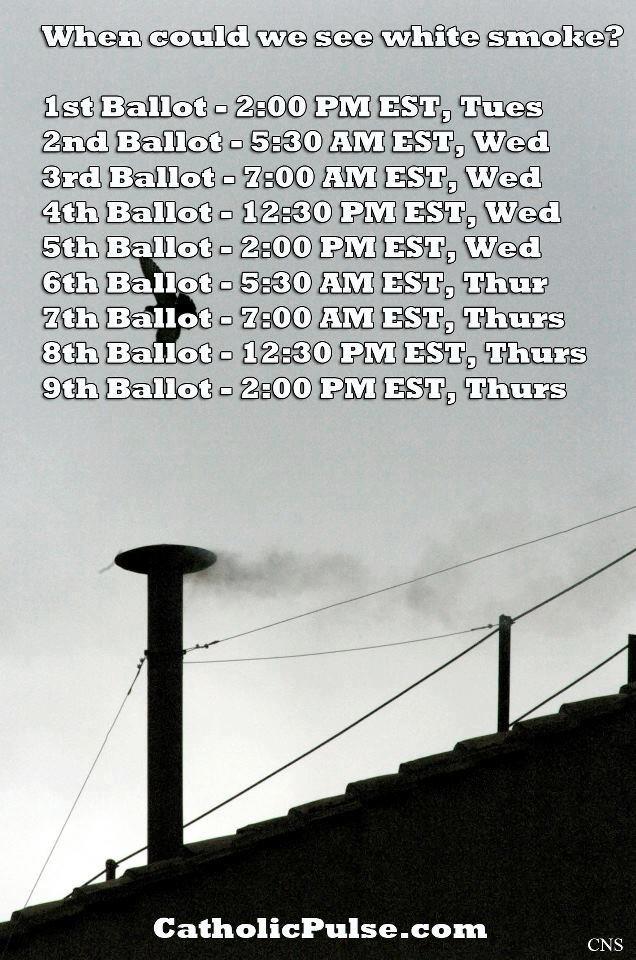
Image

Here are the times when the smoke signals (black or white) will pour out of the chimney and be visible to the public, as the first sign whether the Cardinal-electors had succeeded or failed to elect a new Pope in the previous ballot session.


1. Smoke after 1st ballot (The only Tuesday ballot session, 1st day):

Tuesday, 12 March 2013 at 8 pm Rome time (CET/UTC+1)

Tuesday, 12 March 2013 at 7 pm UTC

Tuesday, 12 March 2013 at 2 pm EST (UTC-5)

Tuesday, 12 March 2013 at 11 am PST (UTC-8)

Wednesday, 13 March 2013 at 2 am WIB (Indonesia, Thailand, etc.) (UTC+7)

Wednesday, 13 March 2013 at 3 am Singapore time (UTC+8)


2. Smoke after 2nd ballot (1st Wednesday morning ballot, 2nd day) : A new Pope is likely to have been elected (if no pope elected after the 2nd ballot, the Cardinal-electors will continue directly to 3rd ballot, and the two ballots will be burned together after the 3rd ballot) :

Wednesday, 13 March 2013 at 11.30 am Rome time (CET/UTC+1)

Wednesday, 13 March 2013 at 10.30 am UTC

Wednesday, 13 March 2013 at 5.30 am EST (UTC-5)

Wednesday, 13 March 2013 at 2.30 am PST (UTC-8)

Wednesday, 13 March 2013 at 5.30 pm WIB (Indonesia, Thailand, etc.) (UTC+7)

Wednesday, 13 March 2013 at 6.30 pm Singapore time (UTC+8)


3. Smoke after 3rd ballot (2nd Wednesday morning ballot, 2nd day) :

Wednesday, 13 March 2013 at 1 pm Rome time (CET/UTC+1)

Wednesday, 13 March 2013 at 12 pm UTC

Wednesday, 13 March 2013 at 7 am EST (UTC-5)

Wednesday, 13 March 2013 at 4 am PST (UTC-8)

Wednesday, 13 March 2013 at 7 pm WIB (Indonesia, Thailand, etc.) (UTC+7)

Wednesday, 13 March 2013 at 8 pm Singapore time (UTC+8)


4. Smoke after 4th ballot (1st Wednesday afternoon ballot, 2nd day) : A new Pope is likely to have been elected

Wednesday, 13 March 2013 at 6.30 pm Rome time (CET/UTC+1)

Wednesday, 13 March 2013 at 5.30 pm UTC

Wednesday, 13 March 2013 at 12.30 pm EST (UTC-5)

Wednesday, 13 March 2013 at 9.30 am PST (UTC-8)

Thursday, 14 March 2013 at 00.30 am WIB (Indonesia, Thailand, etc.) (UTC+7)

Thursday, 14 March 2013 at 1.30 am Singapore time (UTC+8)


5. Smoke after 5th ballot (2nd Wednesday afternoon ballot, 2nd day) :

Wednesday, 13 March 2013 at 8 pm Rome time (CET/UTC+1)

Wednesday, 13 March 2013 at 7 pm UTC

Wednesday, 13 March 2013 at 2 pm EST (UTC-5)

Wednesday, 13 March 2013 at 11 am PST (UTC-8)

Thursday, 14 March 2013 at 2 am WIB (Indonesia, Thailand, etc.) (UTC+7)

Thursday, 14 March 2013 at 3 am Singapore time (UTC+8)


6. Smoke after 6th ballot (1st Thursday morning ballot, 3rd day) : A new Pope is likely to have been elected :

Thursday, 14 March 2013 at 11.30 am Rome time (CET/UTC+1)

Thursday, 14 March 2013 at 10.30 am UTC

Thursday, 14 March 2013 at 5.30 am EST (UTC-5)

Thursday, 14 March 2013 at 2.30 am PST (UTC-8)

Thursday, 14 March 2013 at 5.30 pm WIB (Indonesia, Thailand, etc.) (UTC+7)

Thursday, 14 March 2013 at 6.30 pm Singapore time (UTC+8)


7. Smoke after 7th ballot (2nd Thursday morning ballot, 3rd day) :

Thursday, 14 March 2013 at 1 pm Rome time (CET/UTC+1)

Thursday, 14 March 2013 at 12 pm UTC

Thursday, 14 March 2013 at 7 am EST (UTC-5)

Thursday, 14 March 2013 at 4 am PST (UTC-8)

Thursday, 14 March 2013 at 7 pm WIB (Indonesia, Thailand, etc.) (UTC+7)

Thursday, 14 March 2013 at 8 pm Singapore time (UTC+8)


8. Smoke after 8th ballot (1st Thursday afternoon ballot, 3rd day) : A new Pope is likely to have been elected

Thursday, 14 March 2013 at 6.30 pm Rome time (CET/UTC+1)

Thursday, 14 March 2013 at 5.30 pm UTC

Thursday, 14 March 2013 at 12.30 pm EST (UTC-5)

Thursday, 14 March 2013 at 9.30 am PST (UTC-8)

Friday, 15 March 2013 at 00.30 am WIB (Indonesia, Thailand, etc.) (UTC+7)

Friday, 15 March 2013 at 1.30 am Singapore time (UTC+8)


9. Smoke after 9th ballot (2nd Thursday afternoon ballot, 3rd day) :

Thursday, 14 March 2013 at 8 pm Rome time (CET/UTC+1)

Thursday, 14 March 2013 at 7 pm UTC

Thursday, 14 March 2013 at 2 pm EST (UTC-5)

Thursday, 14 March 2013 at 11 am PST (UTC-8)

Friday, 15 March 2013 at 2 am WIB (Indonesia, Thailand, etc.) (UTC+7)

Friday, 15 March 2013 at 3 am Singapore time (UTC+8)


If until at this point, no one has yet been elected the Pope, they will adjourn for a maximum of one full day for prayer, discernment and consideration. To think and really find out who should be the next Pope. The cycle continues again with the other 3 day ballots, and then break if the Cardinals fail to pick a suitable candidate, and these proceedings will continue until a new Pope had been elected.

If this conclave is fast, as it is expected to be, due to the incoming Holy Week and other mattters, we do not even need to refer to the timing I placed for the later ballots.

Nevertheless, regardless what happens, God is always with us, and He will certainly choose the best one available for the position.