
Pope Benedict XVI’s retirement and what the world thinks of it : Why we should not fear and worry

http://www.catholicherald.co.uk/commentandblogs/2013/03/01/every-snarky-comment-about-the-pope-is-an-insult-to-me/

Indeed, as we all should know, the world does not like us, it does not like the Pope who leads the Church, just as it does not like Christ, as He Himself had said that this world hated Me, and it will also hate and persecute those who believes in Me and follow My teachings and My ways.

But we should not fear, and we should neither worry, but we must be courageous and steadfast as God will guide us and He will surely protect us from harm. Let us all, rather than hating the world and hating these people and institutions which had made so many attacks on the Pope and the Church, let us forgive them, and pray for them. That they all too will learn the truth of Christ, and be enlightened. Let us show them what is the Church and our faith all about, not by attacking back viciously or having any siege mentality, but let us offer ourselves in love, to embrace those who hates us, that they too will believe in God and His love.

God bless us all, and God bless His Holy Church, our Pope Emeritus Benedict XVI, his successor-to-be, and bless the world with all its people. Amen.


Content of the article from site above :


Every snarky comment about the Pope is an insult to me

People outside the faith will never understand how much the Holy Father means to us

By on Friday, 1 March 2013

The See of Peter is vacant, and as a result, like so many others all over the world, I feel a little bereft as I write this. Yesterday, as in so many other parishes, we did our best to mark the end of Benedict XVI’s reign and ministry as Supreme Pastor. The children in our primary school, many of whom were not born when he was elected, had a celebration; and there was, in the evening, Vespers, Benediction and Te Deum, followed by food and drink. It was nice to be able to say goodbye to a Pope while he was still alive – a novel event – rather than to mark his death and burial; but all the time I was aware of those pictures on the television, of the helicopter flying past the dome of St Peter’s taking the Pope away from us all. It felt like a bereavement, and it felt that way because it was a bereavement.

I was born in the early months of Pope Paul VI’s reign, and so I have seen four Popes, and await my fifth. I have had a deep personal attachment to all four, even though I never met any of them in the flesh, and I only ever saw John Paul II from an immense distance. But, the Pope is our father, and we love him; he belongs to us, we are part of the same family of faith. These four pontiffs have had a great formative influence on me, and I do not think that someone who is not a Catholic can really understand this. Andrew Brown,  who writes for the Guardian, always writes well, and he has great insight into religious matters, but he stands outside the family of faith, and as a result, he does not get why this Pope, indeed any Pope, matters to us so intensely. The Church is not an organisation like the United Nations or the European Union or the Liberal Democrat Party. It is the Mystical Body of Christ. To be Catholic is to experience the joy, peace and love that belonging to the Mystical Body brings; it is to be in communion with the Pope, which is the visible sign of that Mystical unity. And that in the end is why I cannot really express to anyone just how intensely I loved Benedict XVI, John Paul II, John Paul I, and Paul VI, or how intensely I will love the Pope who is to be elected shortly.

This is the mystery of the Mystical Body. Those outside the Church need to deal with it. It is the way we are. And it is the reason why when people make snarky comments on Twitter about the Pope, any Pope, they do not really insult the Successor of the Apostles, they insult me.

How happy I am that, wherever I have been in the world, I have been with people who profess the Catholic Faith, people who follow Christ and follow Peter. Ubi Petrus, ibi Ecclesia, ibi vita eterna. For those who need a translation: Where Peter is, there is the Church, there is eternal life!
Saturday, 2 March 2013 : 2nd Week of Lent (Scripture Reflection)

The parable of the prodigal son is indeed a well-known parable and story, that many have heard, which symbolises God’s eternal love for us and His great mercy. Do not be mistaken however, that God will simply just overlook any kind of error and sin because of His love for us. For God first and foremost is Holy and therefore He hates sin in all its forms. He hates evil and things that marred the holiness of His creations. He does have mercy, and His great and the incomprehensible degree of His love allows Him to forgive us, just like the father of the prodigal son.

But how does this forgiveness come about? It is not by being idle and wait for God’s forgiveness. If we stay idle, or worse if we continue to dwell in the world of sin, God will not forgive us, but rather condemn us for our continued rebellion against His love. Remember, that, in the parable of the prodigal son, it is the son, who in great humility and repentance, decided to turn back home and seek his father.

Instead of being haughty and proud, he lowered himself and even declared his unworthiness before the father. The father forgives him first because the younger son is back after being lost into the world, and then because he so humbly had submitted himself to the father’s judgement and in full humility even declared his unworthiness, which made the loving father to love him even more.

Forgiveness is not easy, but the Lord is willing to forgive as long as His children who have sinned, and thus rebelled against Him just like the prodigal son, are to humbly seek His mercy and love. God is kind as He is just, and He will show us great blessings and graces if we are obedient and try our best to remain in His favour, by first listening to the Word of God, and the commandments of love as brought by Christ, and to make our faith manifest through our good works and service for the good of all mankind, starting from those around us.

But do not forget, that God in His great mercy, do not just forgive us like that, for if we are forgiven but we ourselves continue to accuse others who had made mistakes to us, is it not contradictory? Just as Christ had said, love one another as I have loved you, and do upon others as what you wish to be done to you.

Therefore, brothers and sisters in Christ, let us first forgive one another first, forgive those who had made you hurt, those who had ostracised you, and then let us ourselves not hurt others, not ostracise others, and not made others’ lives to suffer. Only then, let us offer ourselves, our sinful beings in humility at God’s feet. He, who is our Father, will lift us up again, and makes us whole again, and once again worthy of Him.

If only love, kindness, and forgiveness can be ever present in everyone in our world today, that world would have been much nicer, is it not? All of us Christians, are just like the elder son of the father in the parable, as we had been brought closer to God through our baptism, and had been taught the faith and the love of God through our priests and our fellow brethren in faith. However, let us not be like the elder son who in jealousy became angry with the father because he seemed to overlook him due to the return of the prodigal younger son.

Because, we, who are like the elder son, have been saved in Christ, provided that we remain faithful to Him and practice our faith through our works and service for others as the Lord commanded us. However, there are many out there, who have yet to listen and receive the Good News of the Lord, and many still are also former believers in Christ, who had lapsed in their faith along the way, and had fallen into the traps of evil, through worldly pleasures, consumerism, secularism, and many others. They are the younger son, the lost prodigal son.

Rather than be annoyed and be jealous of them, when the Lord welcomes them into His kingdom like what the elder son did, let us instead help the Father, in seeking these lost sheep, these lost children of God, for through us, God can work wonders in our world. Let us help one another, particularly these lost ones, in finding together our way to the Lord, who will welcome all of us with His love and outstretched hands, the hands which had been pierced with nails on the cross to redeem us from death and eternal damnation, and into eternal life and union with Him.

Let us pray, brothers and sisters in Christ, that first we will always remain faithful to God, obey His commandments, and do what we can, and whatever is within our abilities to help one another, to love one another, and to reach out especially to those who hunger for God.

Then, let us also pray for our Holy Church, which is now without a shepherd, that God will appoint soon a new shepherd to guide His holy people, that through the Church, God’s work will be made manifest and real in this world, guiding all peoples back towards the Lord from their sinful past. May God, who is our loving Father, bless us all, and remain with us, and always be ready to welcome us back if we had gone astray and then humbly seek His mercy. May God place into our hearts the heart of mercy, the heart of love, and the heart of compassion for others. Blessed be God, forever and ever! Amen.

Saturday, 2 March 2013 : 2nd Week of Lent (Gospel Reading)

Luke 15 : 1-3, 11-32

Meanwhile tax collectors and sinners were seeking the company of Jesus, all of the eager to hear what He had to say. But the Pharisees and the scribes frowned at this, muttering, “This Man welcomes sinners and eats with them.” So Jesus told them this parable.

Jesus continued, “There was a man with two sons. The younger said to his father, ‘Give me my share of the estate.’ So the father divided his property between them. Some days later, the younger son gathered all his belongings, and started off for a distant land, where he squandered his wealth in loose living.”

“Having spent everything, he was hard pressed when a severe famine broke out in that land. So he hired himself out to a well-to-do citizen of that place, and was sent to work on a pig farm. So famished was he, that he longed to fill his stomach even with the food given to the pigs, but no one offered him anything.”

“Finally coming to his senses, he said, ‘How many of my father’s hired workers have food to spare, and here I am starving to death! I will get up and go back to my father, and say to him, Father, I have sinned against God, and before you. I no longer deserve to be called your son. Treat me then as one of your hired servants.’ With that thought in mind, he set off for his father’s house.”

“He was still a long way off, when his father caught sight of him. His father was so deeply moved with compassion that he ran out to meet him, threw his arms around his neck and kissed him. The son said, ‘Father, I have sinned against Heaven and before you. I no longer deserve to be called your son.'”

“But the father turned to his servants : ‘Quick!’ he said, ‘Bring out the finest robe and put it on him! Put a ring on his finger and sandals on his feet! Take the fattened calf and kill it! We shall celebrate and have a feast, for this son of min was dead, and has come back to life; he was lost and is found!’ And the celebration began.”

“Meanwhile, the elder son had been working in the fields. As he returned and approached the house, he heard the sound of music and dancing. He called one of the servants and asked what it was all about. The servant answered, ‘Your brother has come home safe and sound, and your father is so happy about it that he has ordered this celebration, and killed the fattened calf.'”

The elder son became angry and refused to go in. His father came out and pleaded with him. The son, very indignant, said, ‘Look, I have slaved for you all these years. Never have I disobeyed your orders. Yet you have never given me even a young goat to celebrate with my friends. Then when this son of yours returns, after squandering your property with loose women, you kill the fattened calf for him.'”

“The father said, ‘My son, you are always with me, and everything I have is yours. But this brother of yours was dead, and has come back to life; he was lost, and is found. And for that we had to rejoice and be glad.'”

Saturday, 2 March 2013 : 2nd Week of Lent (Psalm)

Psalm 102 : 1-2, 3-4, 9-10, 11-12

Bless the Lord, my soul; all my being, bless His holy Name! Bless the Lord, my soul, and do not forget all His kindness.

He forgives all your sins and heals all your sickness; He redeems your life with destruction and crowns you with love and compassion.

He will not always scold nor will He be angry forever. He does not treat us according to our sins, nor does He punish us as we deserve.

As the heavens are high above the earth, so great is His love for those fearing Him; as far as the east is from the west, so far does He remove from us our sins.

Saturday, 2 March 2013 : 2nd Week of Lent (First Reading)

Micah 7 : 14-15, 18-20

Shepherd Your people with your staff, shepherd the flock of Your inheritance that dwells alone in the scrub, in the midst of a fertile land. Let them feed in Bashan and Gilead as in the days of old, in the days when You went out of Egypt. Show us Your wonders.

Who is a God like You, who takes away guilt and pardons crime for the remnant of His inheritance? Who is like You whose anger does not last? For You delight in merciful forgiveness. Once again You will show us Your loving kindness and trample on our wrongs, casting all our sins into the depth of the sea.

Show faithfulness to Jacob, mercy to Abraham, as You have sworn to our ancestors from the days of old.

First Meeting of the General Congregation of the College of Cardinals : Monday, 4 March 2013

http://www.news.va/en/news/sede-vacante-1st-meeting-of-general-congregation-a

The first meeting of the General Congregation of the College of Cardinals has been set on Monday, 4 March 2013 to discuss the conclave, especially deciding the exact start date of the conclave. Most Cardinals are expected to attend this first meeting as many of them are already in Rome by the end of Pope Benedict XVI’s pontificate on 28 February 2013.


There will be two meetings planned on Monday :

1st Meeting (Morning) : Monday, 4 March 2013 at 9.00 am CET/UTC+1 in the New Synod Hall

2nd Meeting (Afternoon) : Monday, 4 March 2013 at 5.00 pm CET/UTC+1 in the New Synod Hall

Sealing of the Pope’s Apartment : Not to be opened until the new Pope has been elected

The private residence of the Pope in the Vatican City, that is his apartment in the Apostolic Palace beside the Basilica of St. Peter is left vacant upon the death of the Pope, or in this case, the retirement of the reigning Pope, which began the sede vacante, during which no Pope is present.

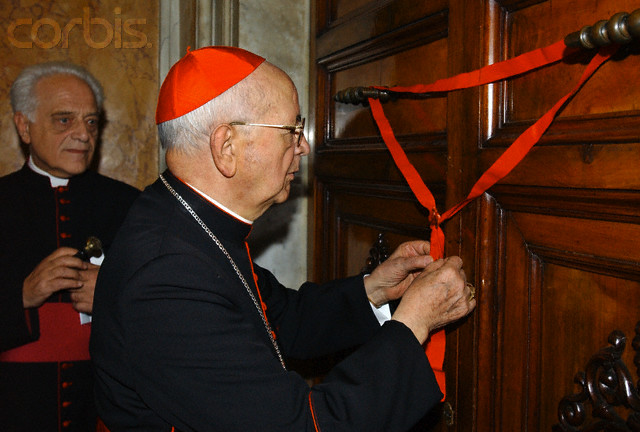
Therefore, in order to avoid fraud and manipulation of papal documents of the previous Pope, and to prevent release of items that can only be done by the new Pope, the Pope’s Apartment is sealed, by a special officer of the Roman Curia, that is the Camerlengo (Chamberlain) of the Holy Roman Church, who is now Cardinal Tarcisio Bertone, who is also the Secretary of State of the Holy See.

The Camerlengo is the leader of the sede vacante transition period, and working in conjunction with the Dean of the College of Cardinals. His duties include sealing the Pope’s apartment and the destruction of the Pope’s Ring of the Fisherman, both of which meant to ensure no fraud documents can be released in absence of the Pope.

The sealing is done as soon as the Pope passed away or stepped down, and done in the presence of the Vice-Camerlengo, who is now Archbishop Pier Luigi Celata, and sealed with a silk string tied and sealed with a wax seal to ensure no one can enter the room, with the unbroken wax seal as evidence.

The room will only be opened again and the seal broken after the conclave is completed and a new Pope is elected.

Image below – from 2005 after the death of Blessed Pope John Paul II, then Camerlengo, Cardinal Eduardo Martinez Somalo sealing the Pope’s apartment

Image

Cardinals summoned to Rome to gather and discuss the start date and details of Conclave

All Cardinals from around the world, from the archdioceses and dioceses have been summoned to Rome as per the decision made in the meeting of the College of Cardinals on Friday, 1 March 2013. Meetings to decide the date of the Conclave, and its details will commence on Monday, 4 March 2013.

Many of the Cardinals would be eager to be able to elect a new Pope before the Holy Week begins, so that if possible, he may even be installed prior to the Holy Week, and therefore the Cardinals will be able to go home and celebrate Holy Week with their respective archdioceses/dioceses.