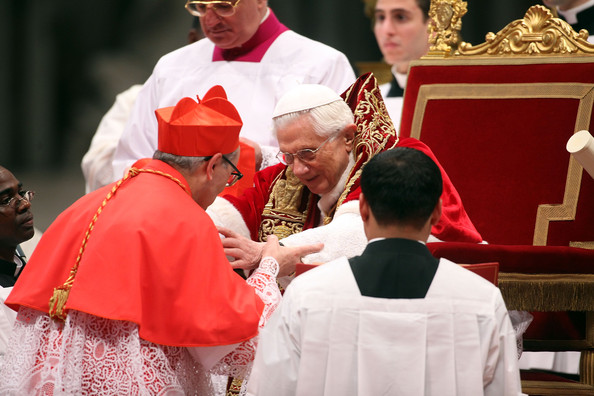
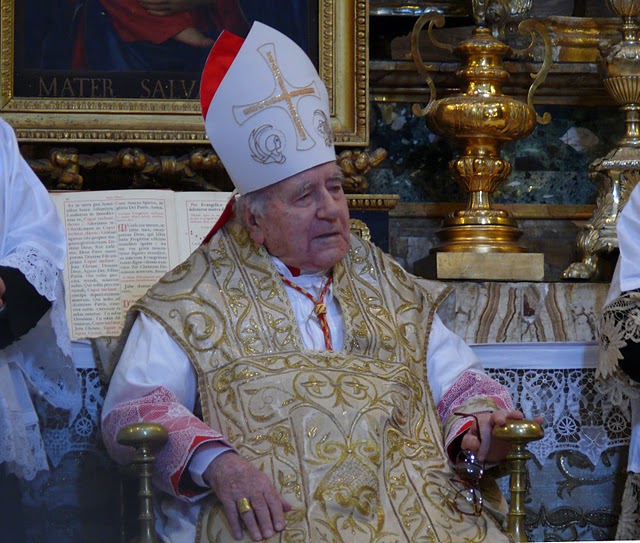
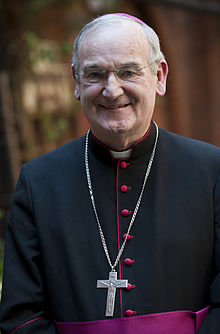
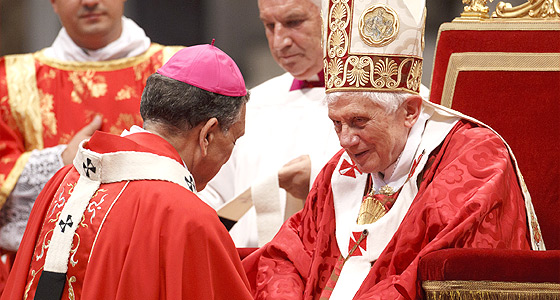
(College of Cardinals Update) Cardinal Antonio Maria Veglio (Italy), President Emeritus of the Pontifical Council for the Pastoral Care of Migrants and Itinerant People turned 80 and becomes ineligible to participate in a future Papal Conclave

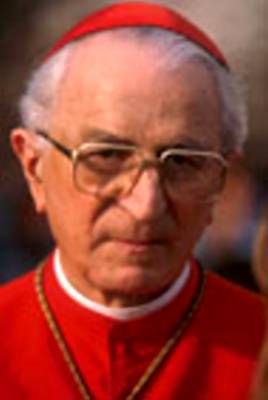
Cardinal Antonio Maria Veglio, Cardinal Deacon of San Cesario in Palatio, President Emeritus of the Pontifical Council for the Pastoral Care of Migrants and Itinerant People has turned 80 on Saturday, 3 February 2018. Therefore, in accordance to the Apostolic Constitution Universi Dominici Gregis, he can no longer vote in a future Papal Conclave.

Cardinal Antonio Maria Veglio has served the Church for many years in the diplomatic service, as the Apostolic Pro-Nuncio of many countries from 1985 to 1989 (Papua New Guinea, Solomon Islands) and 1989 to 1994 (Senegal, Guinea-Bissau, Cape Verde, Mali) and then later as the Apostolic Nuncio to the same countries from 1994 to 1997 before his appointment as Apostolic Nuncio to Lebanon (1997 to 2001) and Kuwait (1997-2001).

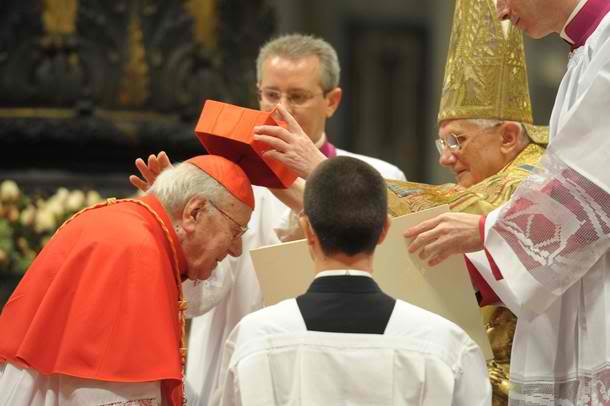
Cardinal Antonio Maria Veglio was appointed Secretary of the Congregation for the Oriental Churches in 2001, and he was appointed as the President of the Pontifical Council for the Pastoral Care of Migrants and Itinerant People, a position he held from 2003 to 2017. He was made a Prince of the Church, as the Cardinal Deacon of San Cesario in Palatio at the Consistory of 18 February 2012 by Pope Benedict XVI, the Vicar of Christ.

We pray for Cardinal Antonio Maria Veglio, that even in his retirement years, he may continue to inspire the faithful and the Church, and keep strongly the teachings of the Church. May he have a good health and be blessed all the days of his life. Ad multos annos!

Currently, there are 119 Cardinal-electors in the College of Cardinals, which means that there is 1 vacancy for Cardinal-electors available at the moment. The next Cardinal to age out will be Cardinal Paolo Romeo, Metropolitan Archbishop Emeritus of Palermo (Italy) on 20 February 2018.

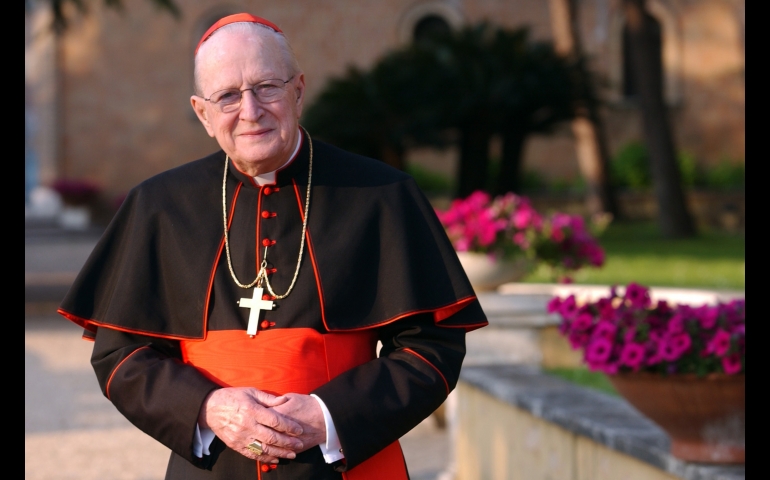
Cardinals Update: Passing of Cardinal Edmund Casimir Szoka, Metropolitan Archbishop Emeritus of Detroit (United States of America), at the age of 86

20140821cnsbr6177

Cardinal Edmund Casimir Szoka, Cardinal-Priest of Ss. Andrea e Gregorio al Monte Celio has passed away on last Wednesday, 20 August 2014 at the age of 86. He was the Metropolitan Archbishop of Detroit, one of the largest and most important Archdioceses in the United States of America, from 1981 to 1990. He was then appointed as the President of the Prefecture of the Economic Affairs of the Holy See, and the President of the Governatorate of the Vatican City State, a post which he held between 1997 to 2006, essentially the top prelate in charge of the day-to-day governance of the smallest country in the world, the Vatican City, where the heart of the Church is.

http://www.gcatholic.org/hierarchy/data/cardJP2-4.htm#169

4538927_G

Cardinal Szoka was created Cardinal in 1988 by Pope St. John Paul II in his fourth Cardinal creation consistory on 28 June 1988. His motto was “To live in faith”. This means an emphasis on truly living the faith in the life he led, and truly, he had been faithful and had already shown that faith through the actions he had done in his long and wonderful life filled with total dedication to the tasks given to him and to the people entrusted to his care.

Cardinal_Edmund_C_Szoka_Credit_Archdiocese_of_Detroit_CNA_8_21_14

We pray for Cardinal Szoka, that he will rest in peace, and God will reward him for all his hard and great work as the long time servant of God as the shepherd of the faithful in Detroit, as well as for all the ministries and good works he had done for the sake of God and His people in the entire Universal Church in his dedication and work in the Roman Curia. May the Lord welcome him into His embrace in heaven and give him eternal rest and happiness that he deserved.

With the passing of Cardinal Szoka, and the recent aging out of Cardinal Carlos Amigo Vallejo, the College of Cardinals now stands at 210 members, with 116 Cardinal-electors and 94 Cardinal non-electors. The number of Cardinal-electors now is 4 below the specified maximum limit of 120.

There are now 4 Cardinal-elector vacancy in the College of Cardinals, 0 vacant Cardinal Suburbicarian Sees (for Cardinal Bishops), 5 vacant Cardinal Titles (for Cardinal Priests) and 9 vacant Cardinal Deaconries (for Cardinal Deacons).

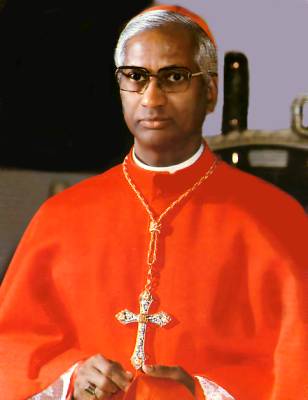
Passing of Cardinal Duraisamy Simon Lourdusamy, Metropolitan Archbishop Emeritus of Bangalore (India) and Protodeacon Emeritus of the College of Cardinals at the age of 90

Caridnal_Lourdusamy

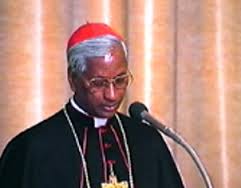
Cardinal Duraisamy Simon Lourdusamy, Cardinal-Priest of S. Maria delle Grazie alle Fornaci fuori Porta Cavalleggeri has passed away on last Monday, 2 June 2014 at the age of 90. He was the Metropolitan Archbishop of Bangalore, one of the large Archdioceses in India, from 1968 to 1971, and then was for a very long time, the member of the Roman Curia, as the Secretary of the Congregation for the Propagation of the Faith from 1973 to 1985, and then as Prefect for the Congregation for Oriental Churches from 1985 to 1991, and eventually as the Protodeacon of the College of Cardinals from 1993 to 1996.

http://www.gcatholic.org/hierarchy/data/cardJP2-3.htm#88%5B/embed%5D

coa_duraisamy_simon_lourdusamy-svg

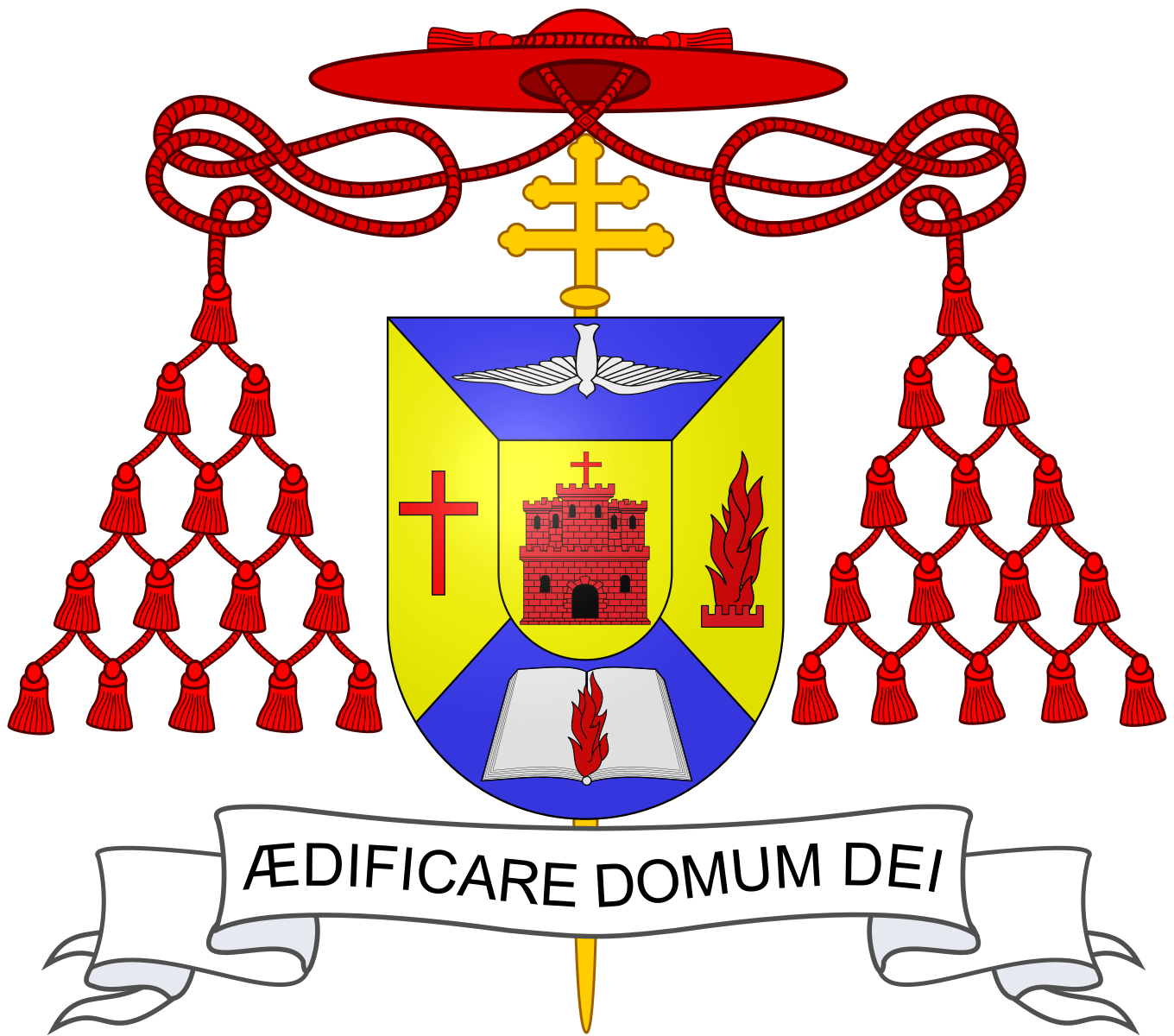
Cardinal Lourdusamy was created Cardinal in 1985 by Pope St. John Paul II in his third Cardinal creation consistory on 25 May 1985. His motto was Aedificare Domum Dei, which means “To build the house of God”. This means an emphasis on the evangelisation to the people of God, to establish His Church, which is growing rapidly in India, as millions grow to know about the Lord and wanting to join the faith in Jesus.

images

We pray for Cardinal Lourdusamy, that he will rest in peace, and God will reward him for all his hard and great work as the long time servant of God as the shepherd of the faithful in Bangalore, as well as for all the ministries and good works he had done in Rome for the sake of God and His people in the entire Universal Church. May the Lord welcome him into His embrace in heaven and give him eternal rest and happiness that he deserved.

With the passing of Cardinal Lourdusamy, the College of Cardinals now stands at 214 members, with 118 Cardinal-electors and 96 Cardinal non-electors. The number of Cardinal-electors now is two below the specified maximum limit.

There are now 2 Cardinal-elector vacancy in the College of Cardinals, 0 vacant Cardinal Suburbicarian Sees (for Cardinal Bishops), 2 vacant Cardinal Title (for Cardinal Priests) and 7 vacant Cardinal Deaconries (for Cardinal Deacons).

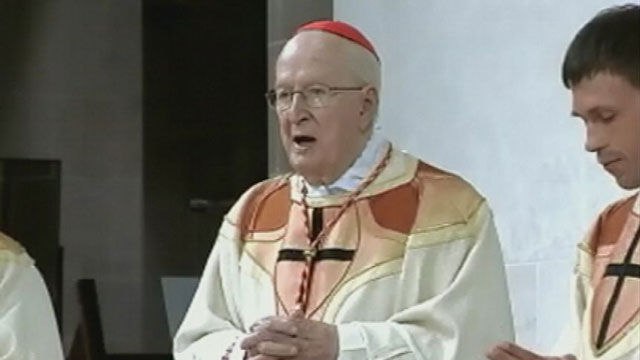
Passing of Cardinal Marco Ce, Cardinal-Patriarch Emeritus of Venice (Italy) at the age of 88

Ce, Cardinal photo

Cardinal Marco Ce, Cardinal-Priest of S. Marco has passed away on Monday, 12 April 2014 at the age of 88. He was the Patriarch of Venice, one of the most preeminent diocese in the world, from 1978 to 2002, and was succeeded in his position by Cardinal Angelo Scola, the likely future successor to the throne of St. Peter.

http://www.gcatholic.org/hierarchy/data/cardJP2-1.htm#31

Cardinal Ce was created Cardinal in 1979 by Pope St. John Paul II in his first Cardinal creation consistory on 30 June 1979. His motto was Christus Ipse Pax, which means “The peace of Christ”. This means an emphasis on proclaiming the peace of Christ, which He proclaimed Himself after His resurrection to be with us.

ce

We pray for Cardinal Ce, that he will rest in peace, and God will reward him for all his hard and great work as the long time servant of God as the shepherd of the faithful in Venice, for all the ministries and good works he had done there for the sake of God and His people. May the Lord welcome him into His embrace in heaven and give him eternal rest and happiness that he deserved.

With the passing of Cardinal Ce, the College of Cardinals now stands at 215 members, with 119 Cardinal-electors and 96 Cardinal non-electors. The number of Cardinal-electors now is just at the specified maximum limit.

There are now 0 Cardinal-elector vacancy in the College of Cardinals, 0 vacant Cardinal Suburbicarian Sees (for Cardinal Bishops), 2 vacant Cardinal Title (for Cardinal Priests) and 6 vacant Cardinal Deaconries (for Cardinal Deacons).

Passing of Cardinal Domenico Bartolucci of Italy, at the age of 96

Bartolucci

Cardinal Domenico Bartolucci, Cardinal Deacon of SS. Nomi di Gesu e Maria in Via Lata has passed away on Monday, 11 November 2013 at the age of 96. He was the Director of the Sistine Chapel Choir (1956-1997), better known as his title of the Director Master of the Pontifical Musical Chorus of the Sistine Chapel.

http://www.gcatholic.org/hierarchy/data/cardB16-3.htm#45954

Jan2011Nov2010BartolucciReuters

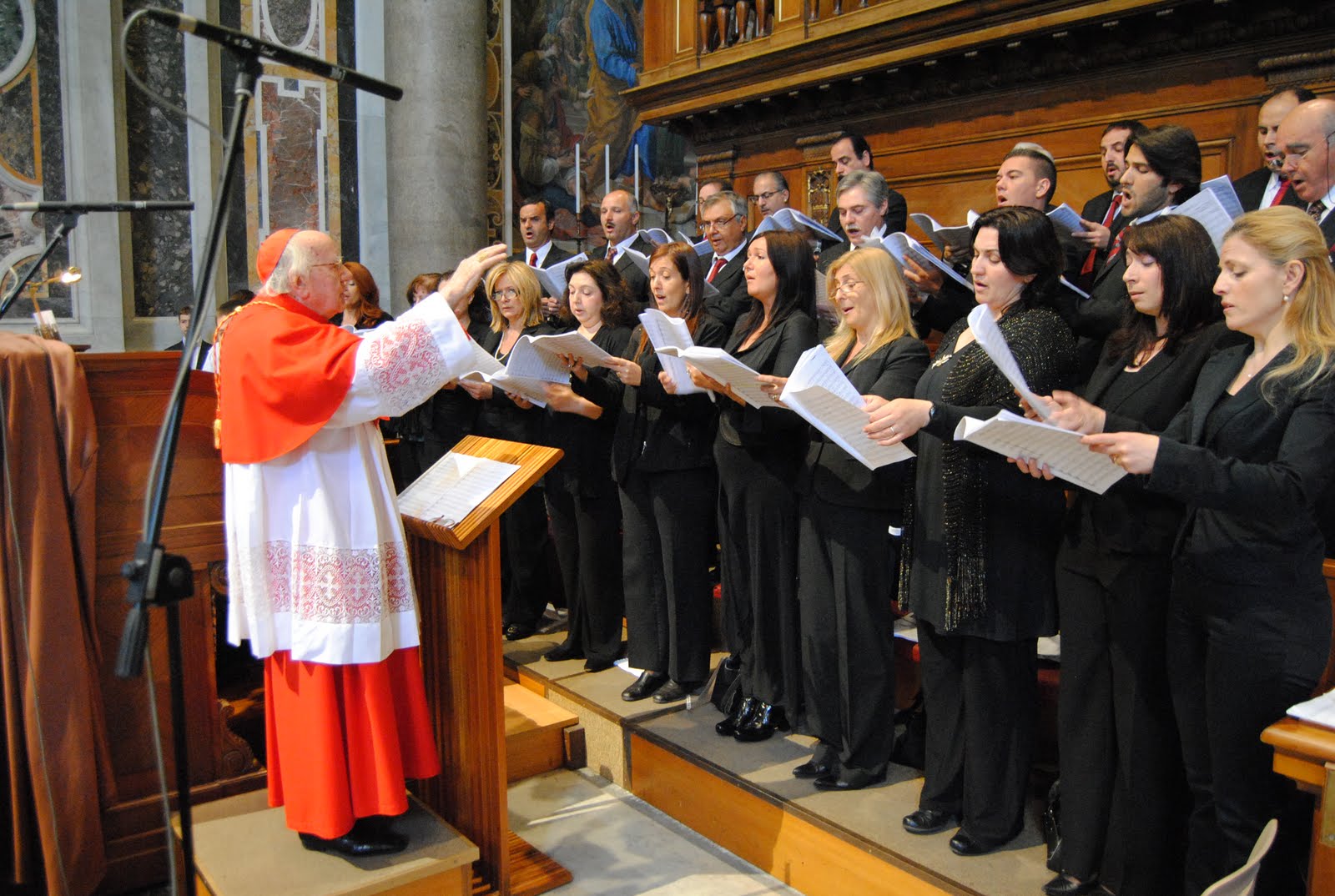
Cardinal Bartolucci was created Cardinal in 2010 by Pope Benedict XVI in his third Cardinal creation consistory and he was a longtime Director of the Sistine Chapel choir, a great conductor and composer of sacred and liturgical music, for over 41 years from 1956 to 1997. Cardinal Bartolucci retired in 1997, but even then, he still conducted his beloved choir and created more beautiful music for worship after he retired. He was honoured by Pope Benedict XVI for his longtime service to the Church by the bestowal of the red hat of a Cardinal in 2010, when he was 93.

brandmuller xvi

We pray for Cardinal Bartolucci, that he will rest in peace, and God will reward him for all his hard and great work as the long time servant of God through music as the conductor, director, and composer of the Papal liturgical music and sacred music through the Sistine Chapel choir  and his numerous other contributions to the Universal Church and for the Lord’s sake. May the Lord welcome him into His embrace in heaven and give him eternal rest and happiness that he deserved.

With the passing of Cardinal Bartolucci, the College of Cardinals now stands at 200 members, with 109 Cardinal-electors and 91 Cardinal non-electors.

There are now 11 Cardinal-elector vacancies in the College of Cardinals, 12 vacant Cardinal Titles (for Cardinal Priests) and 9 vacant Cardinal Deaconries (for Cardinal Deacons)

My Guide to the Papal Conclave : Part I (From before the Conclave to its beginning)

What will happen inside the Conclave, from before the Cardinal-electors enter the Sistine Chapel and be sealed from the outside world, until a new Pope had been elected? Follow the proceedings of the Conclave step-by-step as I explained them here in three parts (Part I, Part II, and Part III) :


1. Before the Conclave, the Cardinals gather in the General Congregations, or meetings where they will raise issues and discuss these matters pertaining to the Church, its governance, and many other matters they may want to bring up to attention to the whole College of Cardinals.

Of great importance is also the necessary and wanted qualities in the next Pope, which will therefore allow the Cardinals to make an informed decision on who to elect. Then finally, the General Congregation also decides the date of the Conclave, when they will actually enter the Sistine Chapel and begin the Conclave officially.

The Conclave can begin only after 15 days of the vacancy of the Apostolic See, but must not begin later than 20 days after the vacancy according to the rules governing the Conclave as written in the Apostolic Constitution Universi Dominici Gregis. However, the provision provided by the Motu Proprio Normas Nonnullas allow the Cardinals to begin the Conclave less than 15 days from the date when the Apostolic See became vacant, providing that all the Cardinal-electors that will take part in the Conclave had all arrived in Rome by then.

The Cardinal-electors will also be assigned their rooms in their residence throughout the Conclave period, the Domus Sancta Marthae by the means of random lots.


2. Particular Congregations also meet during this period before the Conclave, led by Cardinal leaders elected every 3 days, to discuss issues within specific groups within the College of Cardinals, and to complement the General Congregation meetings.

Unlike the General Congregation meeting which can be attended by Cardinal-electors and non-electors (those above the age of 80) alike, Particular Congregations are only attended by Cardinal-electors, and unlike General Congregation which meets before the Conclave, the Particular Congregations continue into the Conclave.


3. Before the Conclave begins, the Cardinals gather and celebrate together the Mass for the Election of the Roman Pontiff or the Missa pro Eligendo Pontifice in St. Peter’s Basilica, to pray for the successful election of the new Pope in the Conclave.


4. Then the Cardinals gather in the Pauline Chapel just before the start of the Conclave in complete choir dress (biretta and mozzetta), and then lead by the Cardinal Dean of the College of Cardinals (currently Cardinal Angelo Sodano, who is a non-elector, and therefore he will not join the Conclave after that) or the most senior Cardinal Bishop who is an elector (Cardinal Giovanni Batista Re), they proceed into the Sistine Chapel while singing together the Hymn Veni Creator Spirit, to invoke the Holy Spirit, and also the Litany of the Saints to ask the prayer from the holy Saints of God on the Cardinal-electors in the election of the new Pope.

The Cardinals will proceed in reverse order of precedence, beginning with the most junior Cardinal Deacon, to the most senior Cardinal Deacon, and then the most junior Cardinal Priest, and to the most senior Cardinal Priest, and then the most junior Cardinal Bishop to the most senior Cardinal Bishop. The last will be the Master of Pontifical Liturgical Celebrations (Monsignor Guido Marini) and the Cardinal Dean (In 2013 conclave, as the Cardinal Dean, Cardinal Angelo Sodano is over 80 and thus is not an elector, he was replaced with the most senior Cardinal Bishop who is an elector, in this case, Cardinal Giovanni Batista Re).


5. Once in the Sistine Chapel, the Cardinal-Dean or the senior Cardinal Bishop-elector will then read out aloud the oath that all the Cardinals have to take, according to the formula written in the Apostolic Constitution, Universi Dominici Gregis, and with the modifications made by the Motu Proprio Normas Nonnullas, all the other personnels involved in the Conclave, and sealed inside the Conclave also have to take the same oath. Then the Cardinal-electors by their order of precedence, march one by one to an open Book of the Gospels, to make the oath by touching their hands on the Gospels and solemnly vow to keep the oath.


The oath in Latin :

Ego N. N. promitto et iuro me inviolate servaturum esse secretum absolutum cum omnibus quotquot participes non sunt Collegii Cardinalium electorum, hoc quidem in perpetuum, nisi mihi datur expresse peculiaris facultas a novo Pontifice electo eiusve Successoribus, in omnibus quae directe vel indirecte respiciunt suffragia et scrutinia ad novum Pontificem eligendum.

Itemque promitto et iuro me nullo modo in Conclavi usurum esse instrumentis quibuslibet ad vocem transmittendam vel recipiendam aut ad imagines exprimendas quovis modo aptis de iis quae tempore electionis fiunt intra fines Civitatis Vaticanae, atque praecipue de iis quae quolibet modo directe vel indirecte attinent ad negotia coniuncta cum ipsa electione. Declaro me editurum esse ius iurandum utpote qui plane noverim quamlibet eius violationem adducturam esse excommunicationis mihi poenam latae sententiae Sedi Apostolicae reservatae.

Sic me Deus adiuvet et haec sancta Dei Evangelia, quae manu mea tango.

The oath in English :

I, N.N., promise and swear that, unless I should receive a special faculty given expressly by the newly-elected Pontiff or by his successors, I will observe absolute and perpetual secrecy with all who are not part of the College of Cardinal electors concerning all matters directly or indirectly related to the ballots cast and their scrutiny for the election of the Supreme Pontiff.

I likewise promise and swear to refrain from using any audio or video equipment capable of recording anything which takes place during the period of the election within Vatican City, and in particular anything which in any way, directly or indirectly, is related to the process of the election itself.

I declare that I take this oath fully aware that an infraction thereof will incur the penalty of automatic (‘latae sententiae’) excommunication reserved to the Apostolic See.

So help me God and these Holy Gospels which I touch with my hand.

6. After all the Cardinal-electors and the personnel locked inside the Conclave had taken their oath, the Master of Pontifical Liturgical Celebrations (Monsignor Guido Marini) will stand at the door of the Sistine Chapel, and all the people not sealed in the Conclave are asked to leave, with the traditional pronouncement, “extra omnes” that means “All/Everybody else, out!”


7. The Master of the Pontifical Liturgical Celebrations, Monsignor Marini will stay behind for a while, while the second meditation is delivered by the ecclesiastic chosen to do so (Cardinal Prosper Grech, Cardinal non-elector from Malta) to the Cardinal-electors.

After the second meditation is completed, both the Master of Pontifical Liturgical Celebrations and the ecclesiastic will leave the Sistine Chapel, and the Conclave will officially begin, and the Sistine Chapel closed off to all except the Cardinal-electors and those sealed with them during the duration of the Conclave.


Continue to Part II here : https://petercanisiusmichaeldavidkang.com/2013/03/09/my-guide-to-the-papal-conclave-part-ii-from-the-beginning-to-the-election-of-the-new-pope/

Episcopal Ordination of Coadjutor Archbishop William Goh of Singapore, Part II : The office of Bishop, what they wear, and their significance

Continuing from the first part, in which I elaborated on the Episcopal Ordination ceremony itself, let us now take a look at the office of the Episcopate itself, that is of a bishop. One may ask, who is a bishop? Bishops are ‘overseers’, which came from the Greek word, Episkopos, which means overseers, as in the early Church, there are those appointed to succeed the Apostles and oversee the Christian communities, to care for them like shepherds care for their flocks of sheep.

Such was the origin of the episcopate, with bishops as those appointed in positions of authority and with oversight over the laity and the religious alike, to keep them faithful to God, and united to the successor of the blessed Apostle Peter, who is our Pope.


This development of the early Church eventually become an office on its own, a separate level from the priesthood, as in the episcopate, there is a fulfillment and completion of the holy orders, which is symbolised by the bishop wearing both the deacon’s dalmatic, and the priest’s chasuble over the dalmatic. This symbolises the union of the ministry of the diaconate and the priesthood in the person of the bishop, who represents the completion of holy orders.

Cardinals and Popes are not separate orders on their own, unlike the diaconate, priesthood, and the episcopate, as these are just different types of bishops, with Cardinals usually being bishops from important dioceses/archdioceses in the world, and the officials of the Roman Curia (the body governing the Universal Church), and the Pope, being the Bishop of Rome, is still a bishop, but is preeminent due to him being the successor of the Apostle Peter, to whom Christ entrusted His Church, and thus the Pope becomes the very Vicar of Christ in this world.


There are also many types of bishops, which I will elaborate further below :


1. Diocesan bishops : These are the ordinary bishops, who head a diocese. A diocese is a division of the Church in a certain geographical area consisting of the faithful in Christ, who may share same culture, language, and customs, or may be of diverse linguistic and cultural origins.


2. Archbishops : These are the bishops who head a more important diocese, either by location, or by history, or by some other reasons. These dioceses therefore are also correspondingly named archdioceses. There are two types of archdioceses :

          a. Metropolitan Archdiocese : An archdiocese that has an overseer status over one or more other dioceses (called suffragan dioceses or suffragan sees) which are grouped together into an Ecclesiastical Province (or Province of the Church), and headed by a Metropolitan Archbishop, whose distinguishing feature is that he wears a pallium (a woolen shoulder band with black crosses).

          b. Archdioceses (directly subject) : These Archdioceses are important dioceses which has either been historically a metropolitan see or diocese that were elevated to an archdiocese status, but these are not overseeing any dioceses under them, and therefore stand alone on its own, directly subject to the Holy See, to the Pope, instead of through a Metropolitan. The Archdiocese of Singapore is of this type.


3. Auxiliary bishops : These are ‘helper’ bishops, who are appointed in larger dioceses/archdioceses to help with the administration of the diocese/archdiocese’s large Catholic population. May also succeed the diocesan bishop/archbishop upon retirement if selected by the Pope, but this succession is not automatic (not like that of a coadjutor). They are given titular see (diocese/archdiocese) upon their appointment as auxiliary bishop.


4. Coadjutor Archbishops/Bishops : These are bishops/archbishops appointed to dioceses/archdioceses to succeed the diocesan bishop/archbishop, whose age may be nearing 75 or in ill health. Bishops have to submit their resignation to the Pope upon reaching the age of 75, so the appointment of a coadjutor is a way to ensure that the diocese does not become vacant if the diocesan bishop resigns, and is a good way to prepare the coadjutor for the eventual succession and duty as the new bishop of the diocese. Coadjutors are not given any titular sees since they are bound immediately to the see (diocese/archdiocese) which they are to succeed in the future.


5. Titular dioceses/archdioceses : These are usually ancient dioceses/archdioceses, mostly located in North Africa and the Middle East, which due to historical events, had fallen into seclusion and extinction. Some can also be found in Europe and Italy, where some dioceses and archdiocese had been suppressed in the past, and become titular sees. These are now given to Apostolic Nuncios, Apostolic Delegates, and the auxiliary bishops.


6. Major Archdioceses : These are only found in the Eastern Catholic Churches, namely the main diocese in the Syro-Malankar, Syro-Malabar, Romanian, and Ukrainian Eastern Catholic Churches, whose importance place them into this special type of Archdioceses, but not high enough to be given the title of a Patriarchate itself.


7. Patriarchate (Latin and Eastern Catholic) : These are the special Patriarchal sees headed by a Patriarch, which in the Eastern Catholic Churches are the leaders of their respective Churches, in full communion with the Bishop of Rome. They are the Patriarchs of the ancient Pentarchy, of Alexandria, Jerusalem, and Antioch, and historically of Constantinople (modern-day Istanbul). However, in our approach to our sister Church of the Eastern Orthodox (who is not yet in full communion with Rome), we respect their Ecumenical Patriarch of Constantinople, who is the leader of the Eastern Orthodox faithful. Latin Patriarchates also exist in Lisbon, Venice, and Goa, which are headed by Roman Catholic Archbishops, but with special Patriarchal title, due to their distinctive history in the Church. Rome itself was a Patriarchate (of the West) until 2006, but was abolished by Pope Benedict XVI to better reflect the position of the Pope as the leader of the Universal Church, and not just the Church of the West (the Roman Church).


So, therefore, after talking about bishops, who they are, and what types of bishops are there, let us now look into the vestments and the items particular to bishops, all of which are steeped in the tradition of the faith and filled with deep symbolism.


1. Working dress (worn outside Mass and important events, the daily wear of bishops, and also for Cardinals and Popes)

a. Simar            
 Image

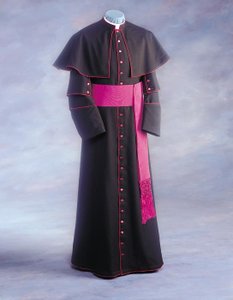
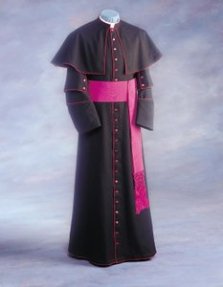
A simar is a special type of cassock worn by the bishops, cardinals, and popes, that is a cassock with a shoulder cape, and a sash (around the waist), which is violet for bishops, scarlet for cardinals, and white for popes. As is well known, the Pope’s simar is white in colour, while bishop’s and cardinal’s simar is black, and with violet lining for bishops, and scarlet lining for cardinals.


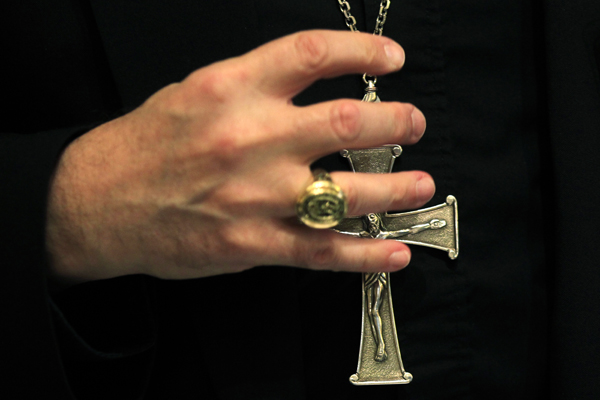
b. Pectoral cross (also part of the pontificalia and the choir dress)
Image


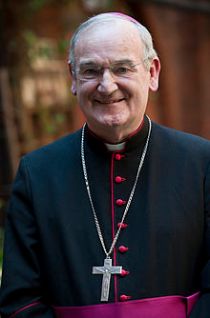
The pectoral cross is worn as its name suggests, on the breast, to represent Christ who protects us from harm, as noted in the prayer of the bishop when he wear the pectoral cross before the Mass, called Munire me dignerisMunire digneris me, Domine Jesu Christe, ab omnibus insidiis inimicorum omnium, signo sanctissimae Crucis tuae: ac concedere digneris mihi indigno servo tuo, ut sicut hanc Crucem, Sanctorum tuorum reliquiis refertam, ante pectus meum teneo, sic semper mente retineam at memoriam passionis, et sanctorum victorias Martyrum. (May You graciously protect me, o Lord Jesus Christ, from all the snares of all my enemies, the sign of the Your most holy Cross: that You would vouch and grant to me and all unworthy of being Your servant, that I may receive the Cross, filled with the remains of Your Saints, in front of my breast, I hold, then it always in mind, but retain the memory of the passion, martyrs and saints victories.). 

This is because pectoral crosses are usually precious and contain the relics of the saints, which therefore be further a reminder that the bishop carries with Him at all times, Christ, and His holy Saints, and a reminder of the Cross, through which the salvation of our Lord comes to us.


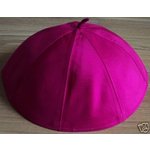
c. Zucchetto (or skullcap)
Image


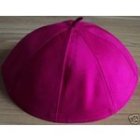
Zucchetto is from the Italian word which means small gourd, because its shape which resembles (half of) a pumpkin. This is a head covering item for the bishops, cardinals, and popes, with the similar pattern of violet for bishops, scarlet for cardinals, and white for popes. This item has a lot in common and may have originated from the Jewish prayer cap, which is somewhat different from the zucchetto in appearance. Originally zucchetto has a practical use in the past, since the clergy in that era were tonsured, that is having their head shaved at the centre, and thus, without the present day heating available, during cold times, the head of the prelate (bishops) would become cold, and the zucchetto came in handy as a covering.

Nowadays, it is a symbol of prayer, and also honor, and therefore, as a sign of humility, it is always removed at the beginning of the Preface of the Eucharistic Prayer and the head of the bishops (including cardinals and Popes) remain bare throughout the Eucharistic Prayer and the Communion.


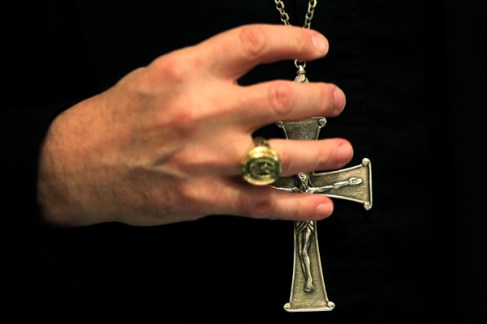
d. Episcopal ring
Image


The episcopal ring symbolises the bishop as the shepherd is married to God’s Church, in particular the diocese and the sheep, the faithful in Christ whom he is supposed to guide as the shepherd. The prayer the bishop said when wearing it reflects that this ring is also a symbol of virtue and sanctification, and blessing : Cordis et corporis mei, Domine, digitos virtute decora, et septiformis Spiritus sanctificatione circumda. (With my heart and of my body, O Lord, decorate my fingers with virtue, and sanctify me with the sevenfold blessing of the Holy Spirit around me).


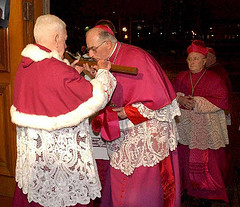
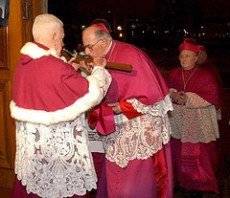
2. Choir dress (worn during the Mass if the bishop is not the celebrant or concelebrant in the Mass, and events like Vespers, and also worn outside for important events)
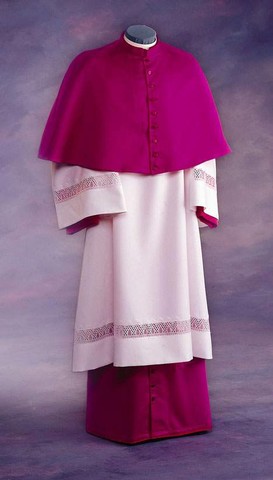
Image

a. Cassock with fascia/sash

This cassock with sash style is similar to the simar, but is entirely violet for bishops and scarlet for cardinals (as opposed to black with violet or scarlet lining)


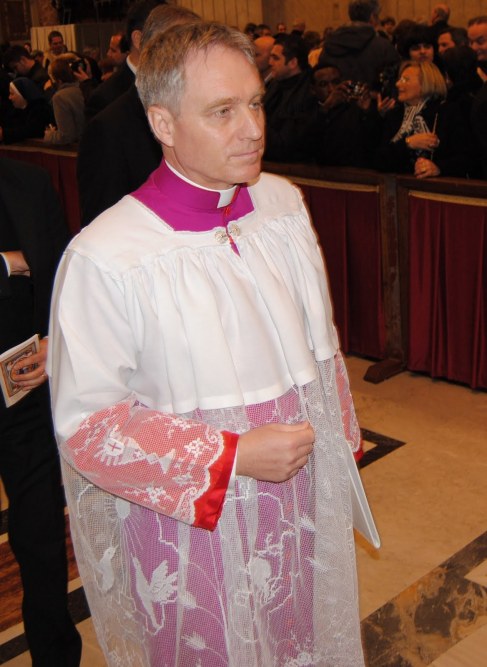
b. Rochet
Image

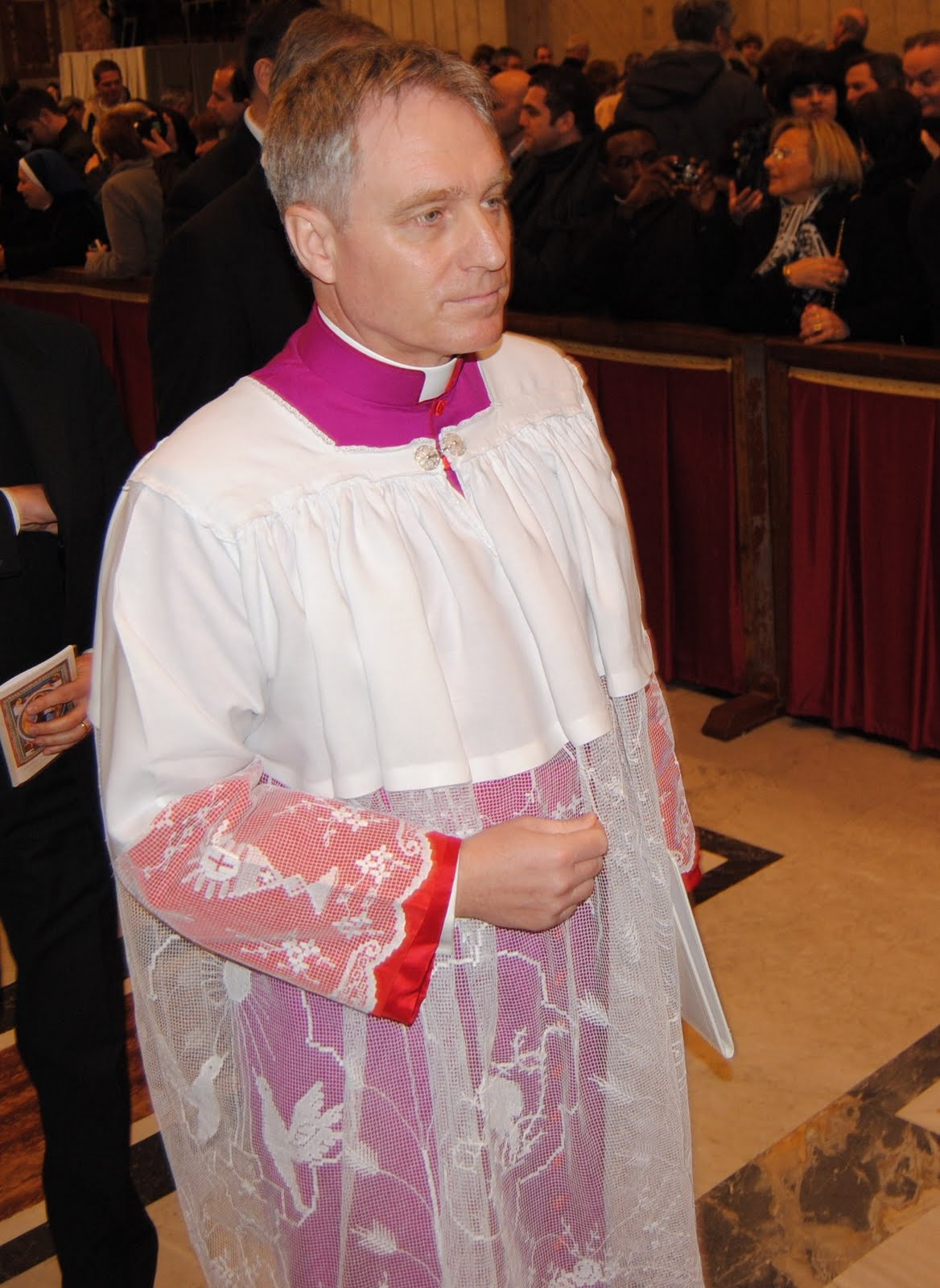
A beautiful, usually thin, either white or translucent, and laced piece of clothing worn over the cassock and the fascia, as seen worn above by Monsignor Georg Ganswein, now Archbishop Ganswein, Prefect of the Pontifical Household.


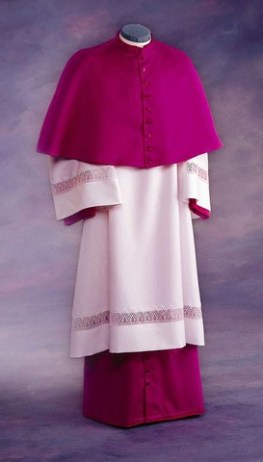
c. Mozzetta
Image


Mozzetta (violet for bishops) is a shoulder cape worn over the rochet and the cassock.


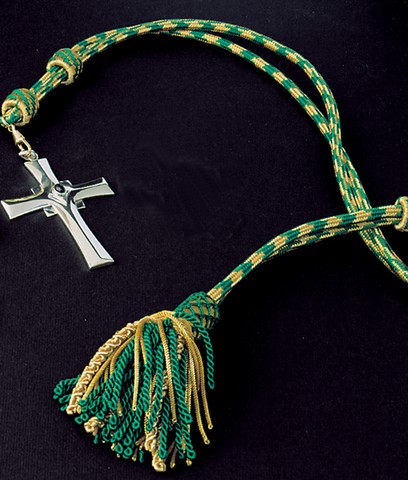
d. Pectoral cross
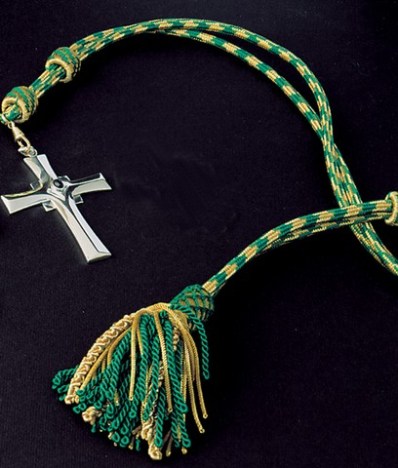
Image

Similar with in working dress, but more often worn with a cord rather than a chain.


e. Zucchetto

Violet for bishops. Similar as in the working dress.


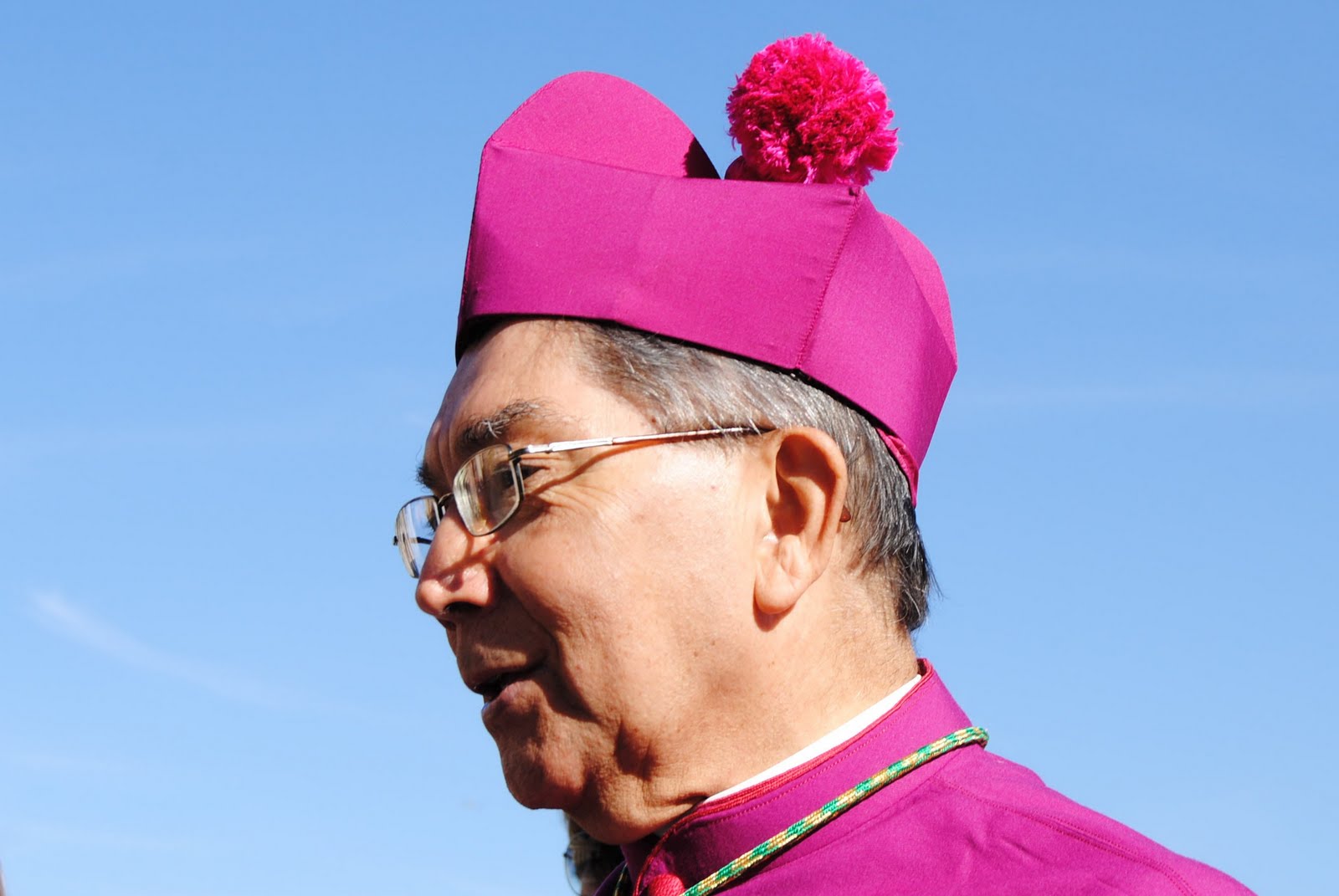
f. Biretta
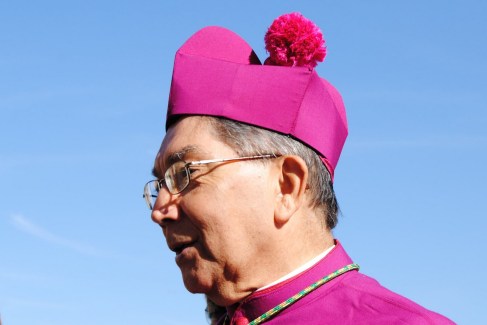
Image


A hat-like item which has the same ancestry as our modern academic mortar board (worn on the graduations in universities), which is violet for bishops and has a pom-pom like object on the top. Only has three peaks, and the unpeaked side is always worn on the left.


3. Bishop’s Pontificalia (worn during the Mass when celebrating)

a. Dalmatic

Image


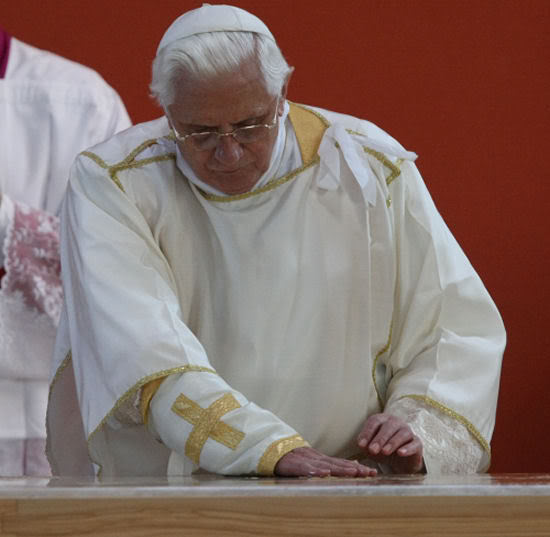
Similar as those worn by deacons, which has squarish-edges as compared to the chasuble (which has more rounded edges), worn over the alb but under the chasuble. Here is the picture of our Pope Benedict XVI wearing the dalmatic during the consecration of a new church in Rome, after he took off his chasuble for the anointing of the altar with holy oils.


b. Chasuble
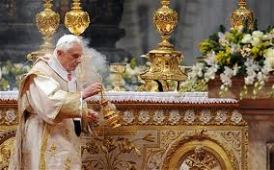
Image


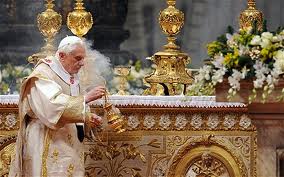
Chasuble as worn by the priests, worn over the dalmatic and the stole, and in this picture, Pope Benedict XVI wore the more traditional Roman-style chasuble, and very visibly underneath the chasuble, is the dalmatic. Only bishops can wear both the chasuble and the dalmatic.


c. Pectoral cross

Worn under the chasuble, not over the chasuble, either the normal chained or corded pectoral cross. Not correctly worn when worn above the chasuble, although many bishops seem to do this. Pope Benedict XVI himself consistently wear the pectoral cross under the chasuble since the beginning of his Pontificate.


d. Episcopal ring

Worn on the finger, which signify his marriage to God and His Church.


e. Mitre
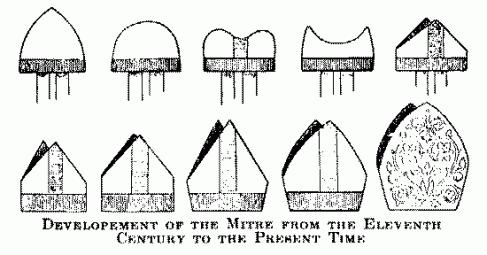
Image


Image


Image


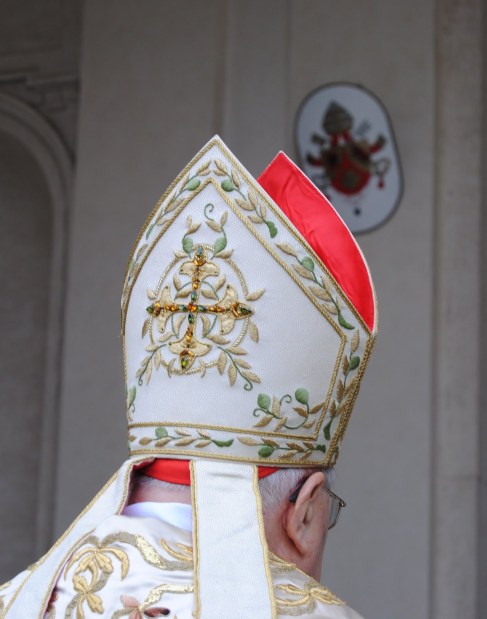
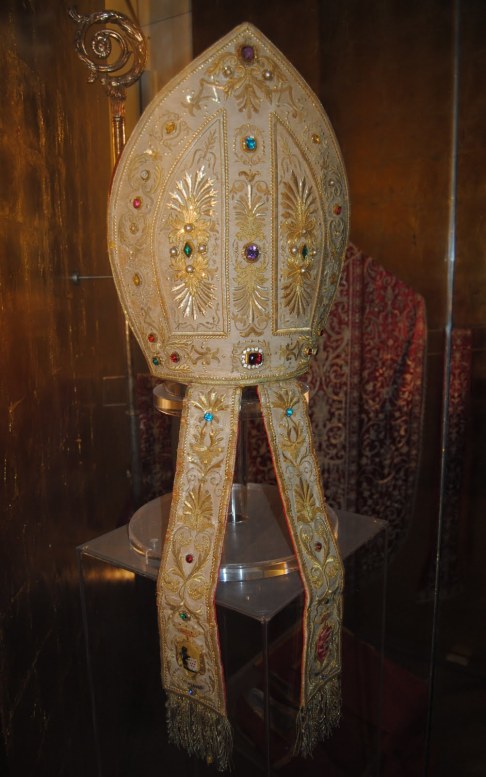
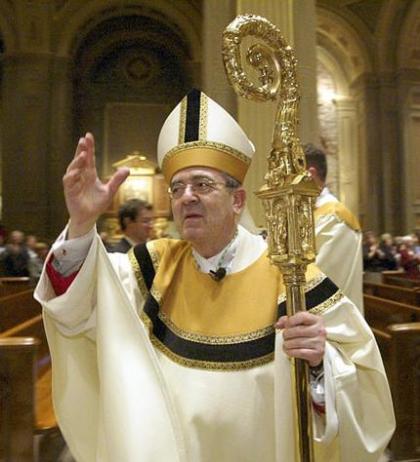
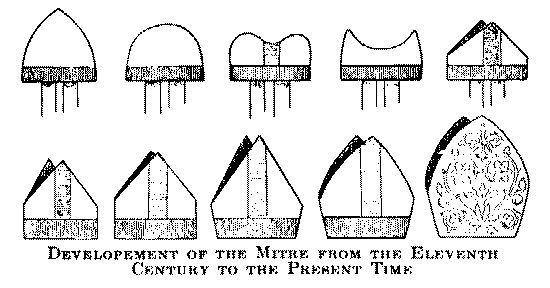
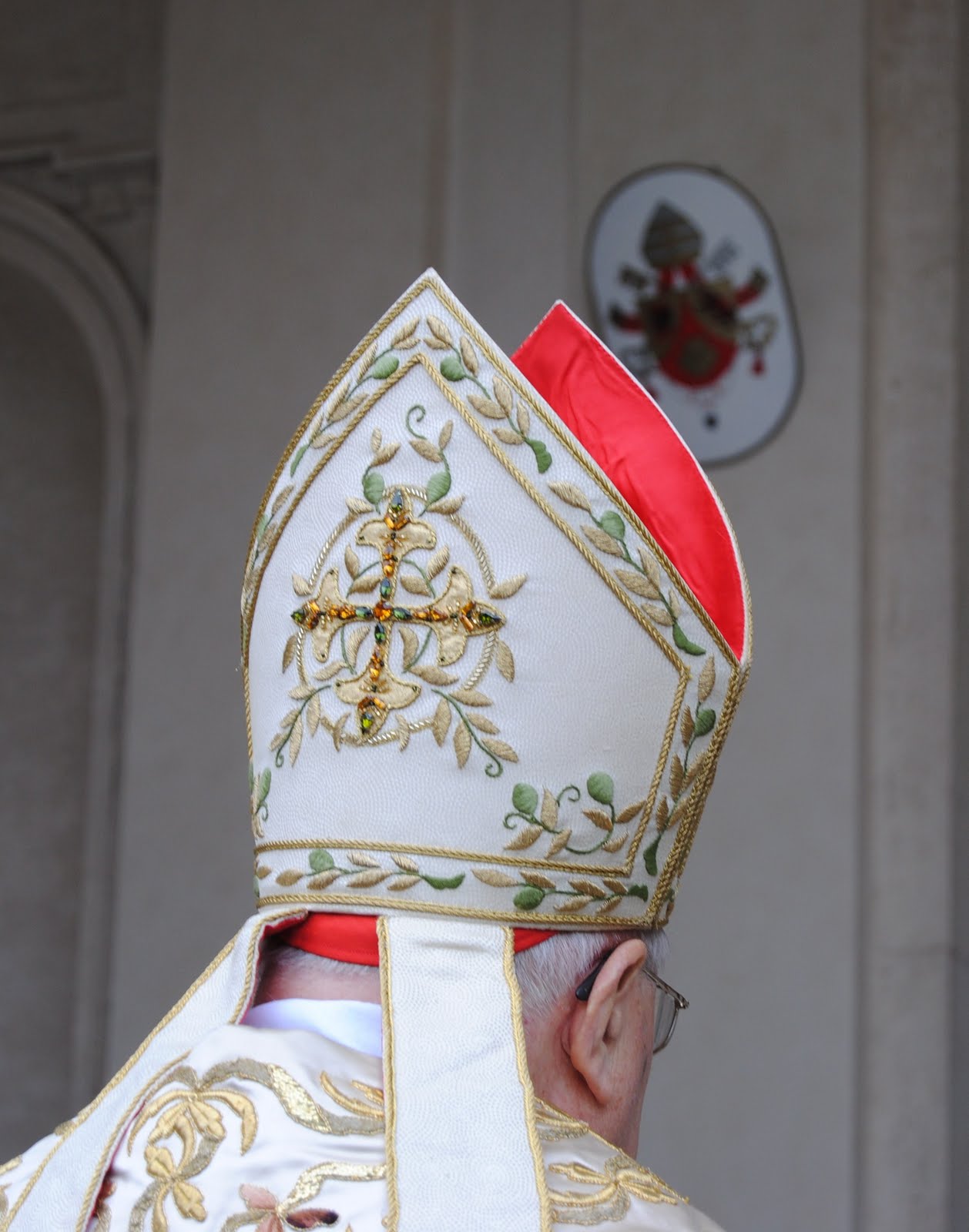
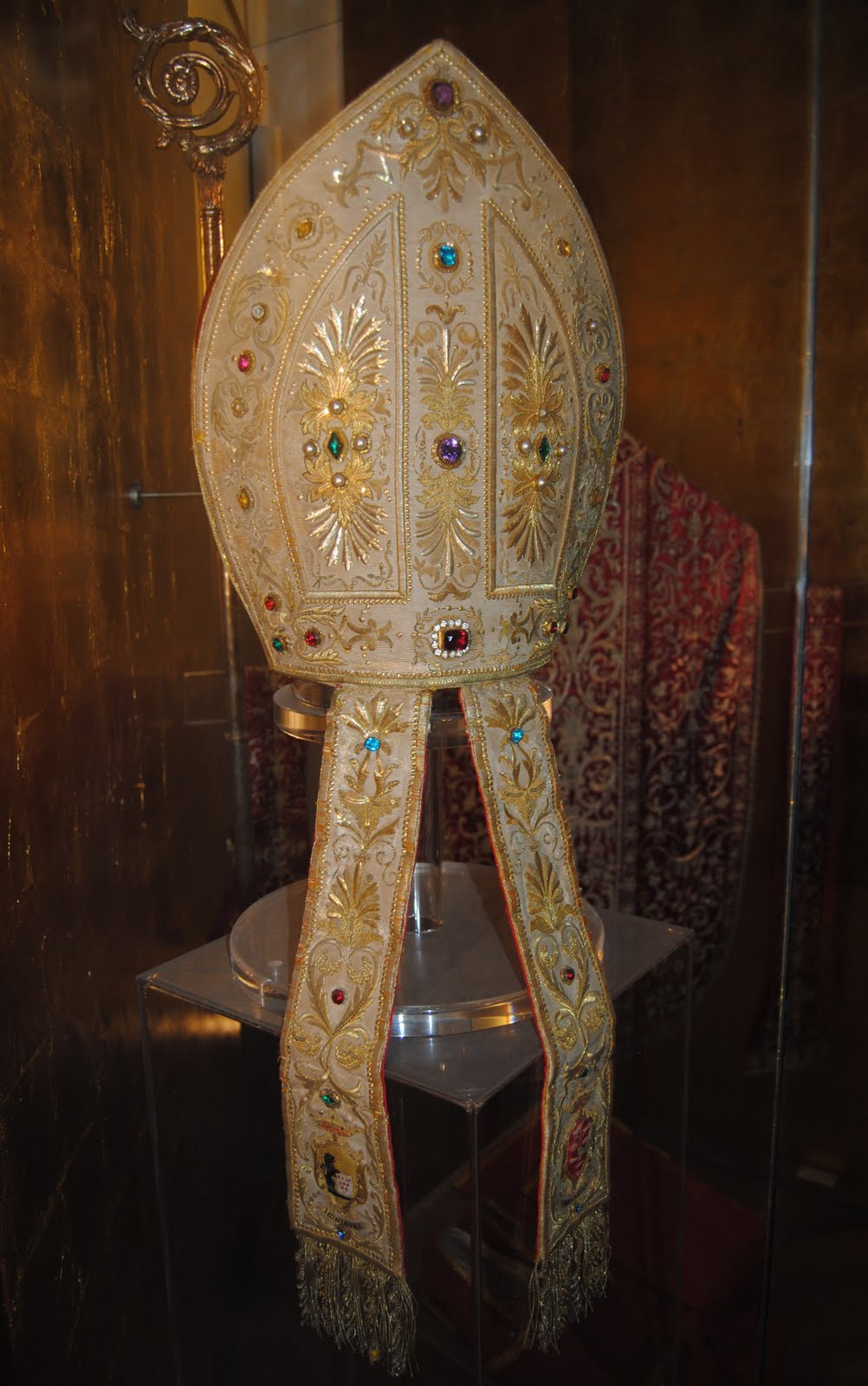
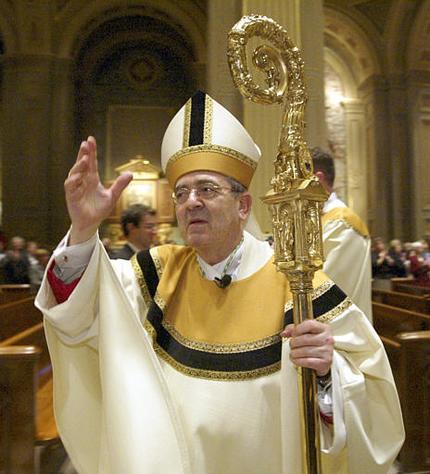
Worn over the zucchetto on the head, and was developed from the camelaucum, or the secular headdress of the late Roman Empire and early Byzantine Empire, where they are also worn by the Popes and the Roman priests, and gradually was restricted only to bishops and abbots.

The mitre symbolises the teaching authority of the bishops, which are symbolised by the two peaks of the mitre, representing the Old and the New Testament, and also recall the flames of the Holy Spirit that inflame the hearts of the Apostles to spread the Good News to all peoples. Therefore, these represents the authority of the bishop to teach the Gospel through the Holy Spirit and based on the Scripture, the Word of God, both the Old and the New Testament. The two lappets behind the mitre themselves also represent the Old and the New Testament, the two sides of the Lord’s Sacred Scripture (which shape looks just like a book marker).


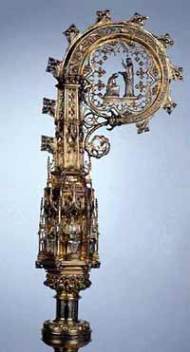
f. Crosier (Pastoral staff)
Image


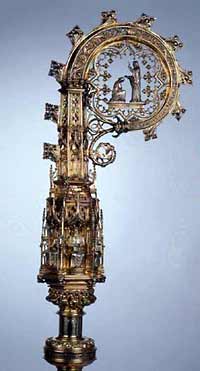
Image


The crosier, or the pastoral staff is the crook-like staff, reminding us on the shepherd’s crook, which they use to shepherd their sheep. Thus, the crosier represents the bishops’ role as the shepherds of the people of God, and guide them in their journey towards the Lord, the Chief Shepherd, the Good Shepherd.


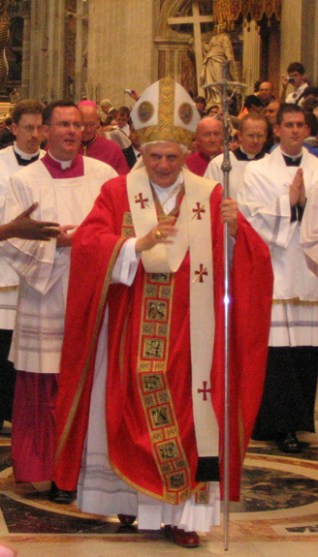
g. Pallium (only for Metropolitan Archbishops and the Pope)
Image

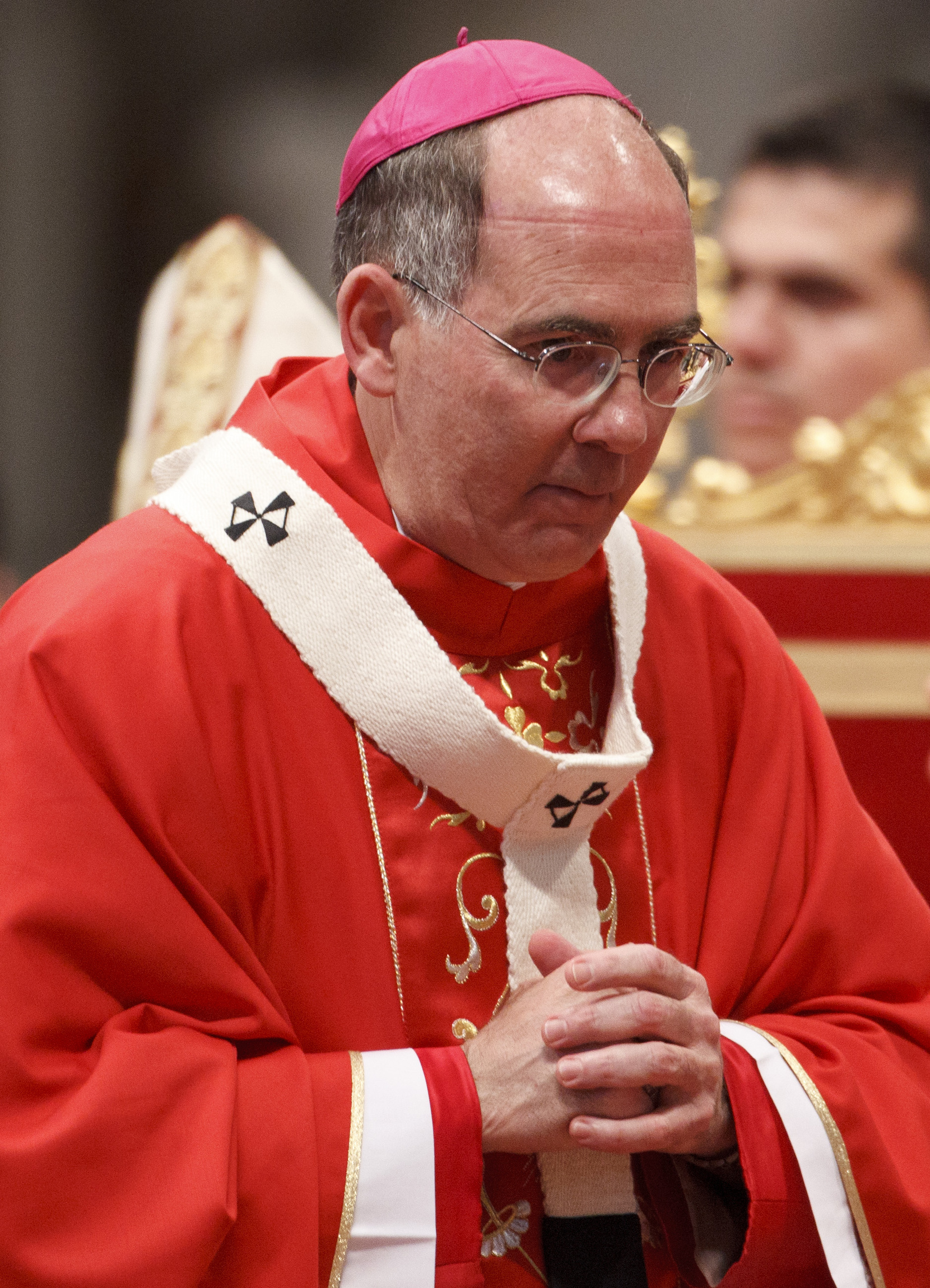
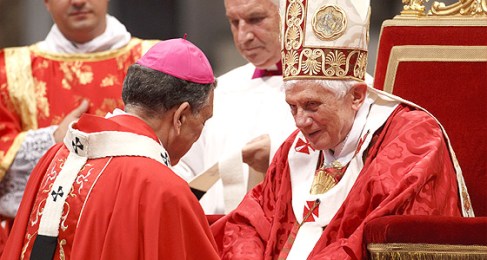
The pallium is a woolen band worn around the shoulder. This represent the metropolitan’s role as the overseer of the faithful, over the sheep of the Lord, that is the faithful people of God, just like Jesus, the Good Shepherd carrying His sheep on His shoulder. Therefore, the pallium represents both the authority of the metropolitan, and the burden presented by his ministry in the service of the Lord.

Image


Image

The pallium used to be much wider, as reflected in the earlier pallium that Pope Benedict XVI wore, which used the style not worn since a millenia ago, in the earlier days of the Church. Now the most common form of the pallium is a shorter and narrower woolen band worn around the shoulders, and adorned with three pins that represent the nails that pieced Christ on the cross, and these pins were placed onto the black crosses (red for Pope Benedict XVI’s new, larger pallium and the earlier, much larger pallium), which represent the wounds of Christ.


After all that, and after looking into what a bishop is, what is the nature of the ministry of the bishops, the types of bishops, what they wear and what symbolisms are there in them, let us now take a time to pray, and pray indeed for the soon-to-be ordained Coadjutor Archbishop, William Goh, of the Archdiocese of Singapore.

May God be with him all the days of his new ministry as bishop, and strengthen him at all times, that when his ministry begins this Friday, the Holy Spirit will guide him and keep him faithful to the ministry he has been chosen for, forever and ever. Amen!