New Cardinals and their assigned Churches in Rome, Consistory of 22 February 2014

On the Feast of the Chair of St. Peter, on Saturday, 22 February 2014, the Vicar of Christ and Bishop of Rome, Leader of the Universal Church, Pope Francis elevates 19 new Cardinals to the Cardinalate by the bestowal of the red biretta, 15 of which are of the order of priests (Cardinal Priests) and 4 of which are of the order of deacons (Cardinal Deacons).

3 of the new Cardinals are non-electors, being above the age of 80, appointed purely as honorary Cardinals for their service to the Church, and the other 16 Cardinals are voting-age Cardinals (below 80), and will be eligible to vote for the next Pope in the next Conclave until they reach the age of 80.

The College of Cardinals now stands at 218 members, with 122 Cardinal-electors and 96 Cardinal non-electors as of 22 February 2014.

In total, 2 new Cardinal churches in Rome are created, 1 for Cardinal Titular church and 1 for Cardinal deaconry.There are as of now, 0 vacant Cardinal Title, and 6 vacant Cardinal Deaconries.


Cardinal Deaconries :

1. Pietro Cardinal Parolin, Cardinal Secretary of State

Cardinal Deaconry of Ss. Simone e Giuda Taddeo e Torre Angela (New Deaconry)


2. Lorenzo Cardinal Baldisseri, Secretary of the Synod of Bishops and College of Cardinals

Cardinal Deaconry of S. Anselmo all’Aventino


3. Gerhard Ludwig Cardinal Muller, Prefect of the Congregation for the Doctrine of the Faith

Cardinal Deaconry of S. Agnese in Agone


4. Beniamino Cardinal Stella, Prefect of the Congregation for Clergy

Cardinal Deaconry of Ss. Cosma e Damiano


Cardinal Titles :

1. Vincent Gerard Cardinal Nichols, Metropolitan Archbishop of Westminster (UK)

Cardinal Title of Ss. Redentore e S. Alfonso in Via Merulana


2. Leopoldo Jose Cardinal Brenes Solorzano, Metropolitan Archbishop of Managua (Nicaragua)

Cardinal Title of S. Gioacchino ai Prati di Castello


3. Gerald Cyprien Cardinal Lacroix, Metropolitan Archbishop of Quebec (Canada)

Cardinal Title of Giuseppe all’Aurelio


4. Jean-Pierre Cardinal Kutwa, Metropolitan Archbishop of Abidjan (Ivory Coast/Cote d’Ivoire)

Cardinal Title of S. Emerenziana a Tor Fiorenza


5. Orani Joao Cardinal Tempesta, Metropolitan Archbishop of Sao Sebastiao do Rio de Janeiro (Brazil)

Cardinal Title of S. Maria Madre della Provvidenza e Monte Verde


6. Gualtiero Cardinal Bassetti, Metropolitan Archbishop of Perugia-Citta della Pieve (Italy)

Cardinal Title of S. Cecilia


7. Mario Aurelio Cardinal Poli, Metropolitan Archbishop of Buenos Aires (Argentina)

Cardinal Title of S. Roberto Bellarmino


8. Andrew Cardinal Yeom Soo-jung, Metropolitan Archbishop of Seoul (South Korea)

Cardinal Title of S. Crisogono


9. Ricardo Cardinal Ezzati Andrello, Metropolitan Archbishop of Santiago (Chile)

Cardinal Title of Ss. Redentore a Valmelaina


10. Philippe Nakellentuba Cardinal Ouedraogo, Metropolitan Archbishop of Ouagadougou (Burkina Faso)

Cardinal Title of S. Marie Consolatrice al Tiburtino


11. Orlando Beltran Cardinal Quevedo, Metropolitan Archbishop of Cotabato (Philippines)

Cardinal Title of S. Maria ‘Regina Mundi’ a Torre Spaccata


12. Chibly Cardinal Langlois, Bishop of Les Cayes (Haiti)

Cardinal Title of S. Giacomo in Augusta (New Title)


13. Loris Francesco Cardinal Capovilla, Titular Archbishop of Mesembria, Personal Secretary to Blessed Pope John XXIII

Cardinal Title of S. Maria in Trastevere


14. Fernando Cardinal Sebastian Aguilar,  Metropolitan Archbishop Emeritus of Pamplona y Tudela (Spain)

Cardinal Title of S. Angela Merici


15. Kelvin Cardinal Edward Felix,  Metropolitan Archbishop Emeritus of Castries (Saint Lucia)

Cardinal Title of S. Maria della Salute a Primavalle
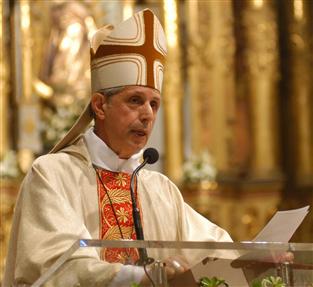
Bishop Mario Aurelio Poli, Bishop of Santa Rosa, appointed new Metropolitan Archbishop of Buenos Aires

Image

In his first appointment of bishop, Pope Francis appointed his successor as the Metropolitan Archbishop of Buenos Aires, which was Pope Francis’ former seat, as Cardinal Jorge Maria Bergoglio.

http://www.gcatholic.org/dioceses/diocese/buen0.htm#5560

Bishop of Santa Rosa and former Auxiliary Bishop of Buenos Aires, Mario Aurelio Poli, was appointed today as the new Metropolitan Archbishop of Buenos Aires, Argentina.

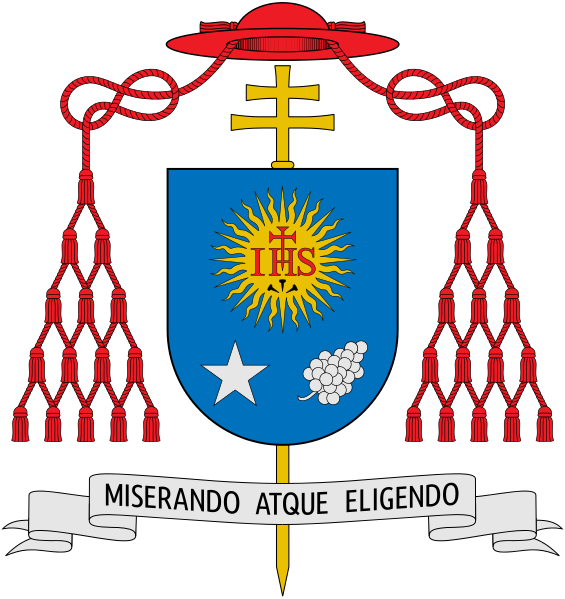
Coat of arms of Cardinal Jorge Maria Bergoglio, S.J., now Pope Francis

Image

This is the coat of arms of Cardinal Jorge Maria Bergoglio, S.J., Metropolitan Archbishop of Buenos Aires, Argentina, who was elected as the 266th Pope and Bishop of Rome last Wednesday, 13 March 2013 and chosen the name Pope Francis.

Pope Francis used his episcopal motto “Miserando atque Eligendo” which means “Lowly but chosen” in English, in line with his views and outlook on humility.

The Cardinal’s fifteen red tassels and the galero on top of it will be replaced by the papal arms standard including the papal tiara/mitre and the crossed keys of the kingdom of heaven (silver and gold).

The symbols that appeared on the shield are first, the IHS symbol surrounded with a sun-like ray is the symbol of the Jesuit order (S.J.) of which Pope Francis is a member of, and the star on the bottom-left, in conjunction with the blue colouration of the shield represents the Virgin Mary, and the grape on the bottom right represents Jesus Christ, as the grower of the vineyard of the Lord.

Pope Francis : First day as Pope, Visit to Papal Basilica of Santa Maria Maggiore

Image

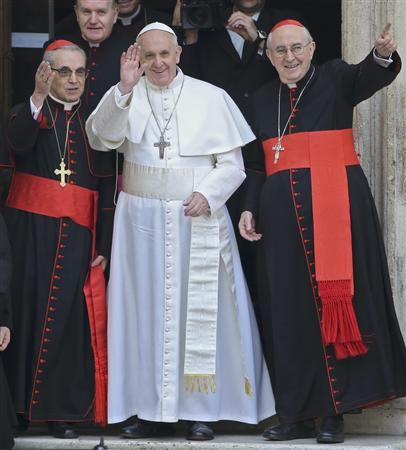
On his first day as Pope, on Thursday morning, 14 March 2013, Pope Francis made his surprise visit to the Papal Basilica of Santa Maria Maggiore (St. Mary Major) to ask for the intercession of the Blessed Virgin Mary for his Pontificate.

State of the College of Cardinals upon the election of Pope Francis as the new Supreme Pontiff

On the beginning of the 2013 Papal Conclave, there are 207 Cardinals in total, out of which 117 are Cardinal-electors (including Cardinal Walter Kasper who turned 80 during the Sede Vacante) and 90 Cardinal non-electors (over 80)

With the election of the Metropolitan Archbishop of Buenos Aires, Argentina, Cardinal Jorge Maria Bergoglio to the position of the Bishop of Rome, as Pope Francis, the 266th Pope and Bishop of Rome, and with Cardinal Walter Kasper, being already over 80, lost his voting rights in any future Conclave :

The current College of Cardinals as of Thursday, 14 March 2013 consists of 206 Cardinals, out of which 115 are Cardinal-electors, and 91 are Cardinal non-electors.

Official Video by the Vatican on the Election of Pope Francis, 266th Pope and Bishop of Rome

The official video released by the Vatican in YouTube, with full coverage of the election of the Metropolitan Archbishop of Buenos Aires, Argentina, Jorge Maria Cardinal Bergoglio as Pope Francis, 266th Pope and Bishop of Rome, and the 265th Successor of St. Peter the Apostle.

My personal thoughts on the election of Pope Francis I and the current state of the Church

I can only hope that Msgr. Guido Marini, the Master of Pontifical Liturgical Celebrations (Papal MC) can indeed stay where he is, as many uttered their concern whether he will still stay as papal MC given the apparent change in this new Pope.

As this is just the first day, I do not know much yet about the direction that our new Pope, Francis I, will bring us all, but I hope that he will not overemphasize inculturation and liberation for the sake of evangelisation, as what was once done under Archbishop Marini, the previous papal MC, but rather focus and renew the spirit of the liturgy as was done by Pope Emeritus Benedict XVI when he was Pope, with the help of Monsignor Marini as the chief liturgical reformer.

There is a need to balance between tradition and innovation, and not to tilt too far to the other side. Already these past few years we had seen a great rebound in the number of seminarians joining the seminary, and also the growing accustomisation among many people all over the world of the use of Latin in the Mass, despite of course emphasis remaining on the vernacular language.

Already, many apparently made comments (as I do) on his choice of not wearing the mozzetta and the stole upon making his first appearance, despite the proper winter papal mozzetta had been prepared for the new Pope. These are little things, but I hope this won’t be a precedent, which if not carefully handled, may undo many of the great things and reforms of the reform of Vatican II that had been painstakingly done in the past few years, and have begun to bear fruit in the Church today.

Balance is important. Already we have seen in many cases after Vatican II, churches and groups going too far towards innovation and liberal thoughts that ended up losing their very Catholic identity. What we need is to preserve our tradition, and yet remain open for innovations that can help new evangelisation, and evangelisation must also be carried in the spirit of the preservation of Apostolic teachings and traditions, and not conform to what the world think, that is relativism.

Social media like twitter, Facebook, blogs, and many others are these great innovations that can help spread the teachings of the Church, and yet let us not be like many Catholics, particularly in the USA, which had been commented as being ‘market Catholics’ where they pick and choose what they want to believe in, as long as it suits them, and reject those that they feel don’t fit with them. No, to be a Catholic means accepting the whole teaching as a whole, and not taking just those parts that you like, and discard the rest.

I need to add that going into extremes into the other direction is also abhorred, as what was made obvious by the SSPX Society, which continued to linger in their ultra-conservatism, and refused to take in several important modifications made by Vatican II.

Just some examples : We no longer blame Jews for the death of Christ, and instead they are our elder brothers in faith, having been chosen and called by God first among all nations.

Then, although indeed I firmly believe in salvation only through the One Church of Christ, but I also believe in the Universal Call to Holiness (by Blessed Pope John Paul II), and there are righteous people outside the Church, who do God’s will, but lacking only the necessary faith in Christ, but that doesn’t mean that they are immediately condemned to hell for that. It is our task to bring the Good News and salvation to them, which can be done through new evangelisation, rooted firmly in tradition and prayer.

However, one wish that I want to make is that, I hope Pope Francis I can thoroughly reform the Roman Curia, to purge from it all ties to corruptions and evil, and to purify our Holy Church that it will once again be immaculate and pure as it should always be, as the One, and only Church God had established in this world, through Peter the Apostle.

And I am touched by his selection of name, Francis, which honoured both St. Francis of Assisi, whom I held in high regard, and St. Francis Xavier, the great missionary and co-founder of the Jesuits (with St. Ignatius Loyola) whom Pope Francis I is a member of. St. Francis Xavier is close to my heart as he is also the patron saint of my early education, and which helped me to learn about the faith, and eventually welcomed into the Church.

I am also deeply touched by his humility, especially when he asked that the people pray for him, and even bowed down to show his humility, which does remind me to another Pope, John Paul I, whose motto is Humilitas, but as history went, he did not have the time to accomplish much. Therefore I hope, the legacy of Pope John Paul I can be continued in Pope Francis I, who had the same quality and personality as Pope John Paul I.

However, humility and simplicity must not lead to the simplification of our faith, but rather let these be tools to further deepen our ties to our faith, and understand more about it.

I noted that Pope Francis I is deeply devoted to the Virgin Mary, whose name is part of his personal name, Jorge Maria Bergoglio. He will be another Marian Pope in the likelihood of Blessed Pope John Paul II. It is important for us to have a strong devotion to the Virgin Mary, as she is the best helper that we can have, in guiding our way towards the Lord, and ensuring that we do not go astray from our path.

May God bless our new Pope Francis I, and at this important juncture at the beginning of the new Pontificate, I hope that the Holy Spirit that has elected him to carry this task, will also guide him, that he will make correct choices that will continue the good works that began with Blessed Pope John Paul II, and was accelerated by Pope Benedict XVI, now Pope Emeritus.

Habemus Papam! Our new Pope, Jorge Maria Cardinal Bergoglio as Pope Francis I

Habemus Papam! We have a Pope!

Bergoglio

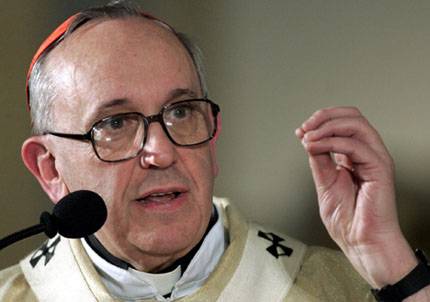
Jorge Maria Cardinal Bergoglio, Metropolitan Archbishop of Buenos Aires, who is 76 years old, had been elected the 265th Successor of St. Peter the Apostle, the 266th Pope and Bishop of Rome, on March 2013.

He has taken the name of Francis, and shall henceforth reign as Pope Francis I. The first non-European and first South/Latin American Pope.