
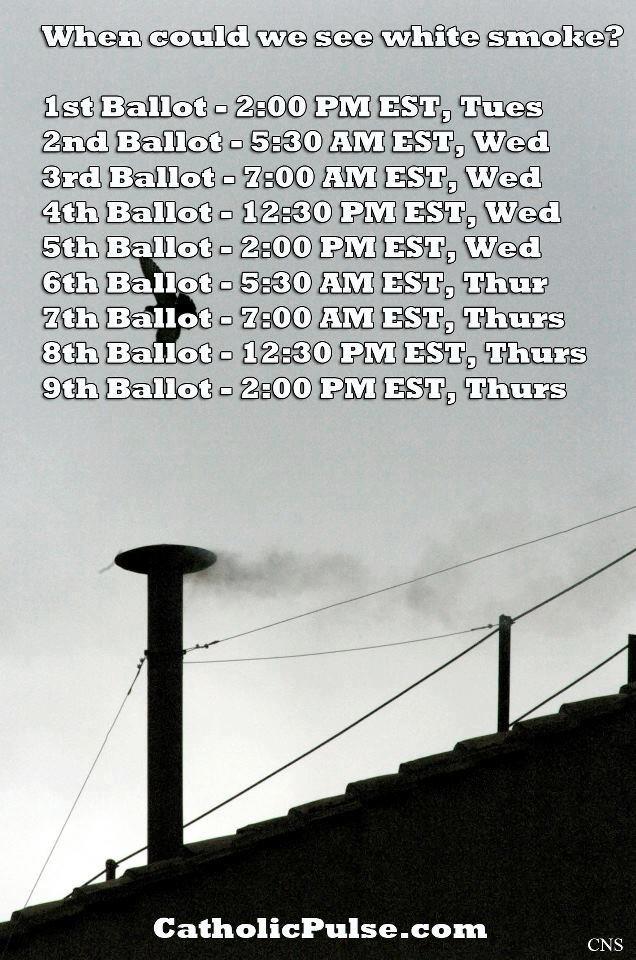
Times to watch for the smoke signal from the Sistine Chapel

Image

Here are the times when the smoke signals (black or white) will pour out of the chimney and be visible to the public, as the first sign whether the Cardinal-electors had succeeded or failed to elect a new Pope in the previous ballot session.


1. Smoke after 1st ballot (The only Tuesday ballot session, 1st day):

Tuesday, 12 March 2013 at 8 pm Rome time (CET/UTC+1)

Tuesday, 12 March 2013 at 7 pm UTC

Tuesday, 12 March 2013 at 2 pm EST (UTC-5)

Tuesday, 12 March 2013 at 11 am PST (UTC-8)

Wednesday, 13 March 2013 at 2 am WIB (Indonesia, Thailand, etc.) (UTC+7)

Wednesday, 13 March 2013 at 3 am Singapore time (UTC+8)


2. Smoke after 2nd ballot (1st Wednesday morning ballot, 2nd day) : A new Pope is likely to have been elected (if no pope elected after the 2nd ballot, the Cardinal-electors will continue directly to 3rd ballot, and the two ballots will be burned together after the 3rd ballot) :

Wednesday, 13 March 2013 at 11.30 am Rome time (CET/UTC+1)

Wednesday, 13 March 2013 at 10.30 am UTC

Wednesday, 13 March 2013 at 5.30 am EST (UTC-5)

Wednesday, 13 March 2013 at 2.30 am PST (UTC-8)

Wednesday, 13 March 2013 at 5.30 pm WIB (Indonesia, Thailand, etc.) (UTC+7)

Wednesday, 13 March 2013 at 6.30 pm Singapore time (UTC+8)


3. Smoke after 3rd ballot (2nd Wednesday morning ballot, 2nd day) :

Wednesday, 13 March 2013 at 1 pm Rome time (CET/UTC+1)

Wednesday, 13 March 2013 at 12 pm UTC

Wednesday, 13 March 2013 at 7 am EST (UTC-5)

Wednesday, 13 March 2013 at 4 am PST (UTC-8)

Wednesday, 13 March 2013 at 7 pm WIB (Indonesia, Thailand, etc.) (UTC+7)

Wednesday, 13 March 2013 at 8 pm Singapore time (UTC+8)


4. Smoke after 4th ballot (1st Wednesday afternoon ballot, 2nd day) : A new Pope is likely to have been elected

Wednesday, 13 March 2013 at 6.30 pm Rome time (CET/UTC+1)

Wednesday, 13 March 2013 at 5.30 pm UTC

Wednesday, 13 March 2013 at 12.30 pm EST (UTC-5)

Wednesday, 13 March 2013 at 9.30 am PST (UTC-8)

Thursday, 14 March 2013 at 00.30 am WIB (Indonesia, Thailand, etc.) (UTC+7)

Thursday, 14 March 2013 at 1.30 am Singapore time (UTC+8)


5. Smoke after 5th ballot (2nd Wednesday afternoon ballot, 2nd day) :

Wednesday, 13 March 2013 at 8 pm Rome time (CET/UTC+1)

Wednesday, 13 March 2013 at 7 pm UTC

Wednesday, 13 March 2013 at 2 pm EST (UTC-5)

Wednesday, 13 March 2013 at 11 am PST (UTC-8)

Thursday, 14 March 2013 at 2 am WIB (Indonesia, Thailand, etc.) (UTC+7)

Thursday, 14 March 2013 at 3 am Singapore time (UTC+8)


6. Smoke after 6th ballot (1st Thursday morning ballot, 3rd day) : A new Pope is likely to have been elected :

Thursday, 14 March 2013 at 11.30 am Rome time (CET/UTC+1)

Thursday, 14 March 2013 at 10.30 am UTC

Thursday, 14 March 2013 at 5.30 am EST (UTC-5)

Thursday, 14 March 2013 at 2.30 am PST (UTC-8)

Thursday, 14 March 2013 at 5.30 pm WIB (Indonesia, Thailand, etc.) (UTC+7)

Thursday, 14 March 2013 at 6.30 pm Singapore time (UTC+8)


7. Smoke after 7th ballot (2nd Thursday morning ballot, 3rd day) :

Thursday, 14 March 2013 at 1 pm Rome time (CET/UTC+1)

Thursday, 14 March 2013 at 12 pm UTC

Thursday, 14 March 2013 at 7 am EST (UTC-5)

Thursday, 14 March 2013 at 4 am PST (UTC-8)

Thursday, 14 March 2013 at 7 pm WIB (Indonesia, Thailand, etc.) (UTC+7)

Thursday, 14 March 2013 at 8 pm Singapore time (UTC+8)


8. Smoke after 8th ballot (1st Thursday afternoon ballot, 3rd day) : A new Pope is likely to have been elected

Thursday, 14 March 2013 at 6.30 pm Rome time (CET/UTC+1)

Thursday, 14 March 2013 at 5.30 pm UTC

Thursday, 14 March 2013 at 12.30 pm EST (UTC-5)

Thursday, 14 March 2013 at 9.30 am PST (UTC-8)

Friday, 15 March 2013 at 00.30 am WIB (Indonesia, Thailand, etc.) (UTC+7)

Friday, 15 March 2013 at 1.30 am Singapore time (UTC+8)


9. Smoke after 9th ballot (2nd Thursday afternoon ballot, 3rd day) :

Thursday, 14 March 2013 at 8 pm Rome time (CET/UTC+1)

Thursday, 14 March 2013 at 7 pm UTC

Thursday, 14 March 2013 at 2 pm EST (UTC-5)

Thursday, 14 March 2013 at 11 am PST (UTC-8)

Friday, 15 March 2013 at 2 am WIB (Indonesia, Thailand, etc.) (UTC+7)

Friday, 15 March 2013 at 3 am Singapore time (UTC+8)


If until at this point, no one has yet been elected the Pope, they will adjourn for a maximum of one full day for prayer, discernment and consideration. To think and really find out who should be the next Pope. The cycle continues again with the other 3 day ballots, and then break if the Cardinals fail to pick a suitable candidate, and these proceedings will continue until a new Pope had been elected.

If this conclave is fast, as it is expected to be, due to the incoming Holy Week and other mattters, we do not even need to refer to the timing I placed for the later ballots.

Nevertheless, regardless what happens, God is always with us, and He will certainly choose the best one available for the position.

Summary of the Tenth and the Last General Congregation of the College of Cardinals, and details on the Conclave

New Cardinals have been elected to lead the Particular Congregations (elected every 3 days) in the Conclave. Cardinal Antonios Naguib for the Cardinal Bishops; Cardinal Marc Ouellet for the Cardinal Priests; Cardinal Francesco Monterisi for the Cardinal Deacons. New leaders will be elected if after three days in the Conclave, the Conclave has not yet ended with the election of a new Pope. Their task is to guide the Cardinal Camerlengo, who is Cardinal Tarcisio Bertone.

28 Cardinals had spoken in the Tenth General Congregation, and a total of 161 Cardinals had already spoken in all the past General Congregations. Not all Cardinals who wanted to speak has spoken, as the number of Cardinals that spoke had made the Cardinals to vote whether to continue or to stop the General Congregation at that point (likely because it has taken too much time).

In the meanwhile, during the Sede Vacante, certain offices that represent the Holy See, particularly diplomatic representation, Nuncios, Delegates, and many other offices of the Holy See continue to function as per normal, even when the Apostolic See is vacant, and the Cardinals waiting to elect a new Pope. The Cardinal Camerlengo, Cardinal Tarcisio Bertone is the leader during the period of the Sede Vacante, having limited powers, with the College of Cardinals, in order to settle all matters, and all things pertaining to election of the new Pope.

This Monday evening at 5.30 pm Rome time / CET / UTC+1, all the personnels, about 90 of them, who are also ‘locked’ together with the Cardinal-electors in the Conclave, including doctors, nurses, bus drivers, and other staffs involved in maintenance of the Cardinals’ residence at Domus Sancta Marthae, will take their solemn oath of secrecy, in the presence of the Camerlengo of the College of Cardinals, Cardinal Tarcisio Bertone, and also in the presence of the Secretary of the College of Cardinals, Archbishop Lorenzo Baldisseri, Master of Pontifical Liturgical Celebrations, Monsignor Guido Marini and other officials.

The swearing of the oath of secrecy by the auxiliary personnel will not be live on Vatican Television (Therefore, may not be viewable in Vatican Player).

The Mass for the Election of the Roman Pontiff or Missa pro Eligendo Pontifice, which will begin the Conclave process, will be celebrated in St. Peter’s Basilica on Tuesday morning at 10 am Rome time / CET / UTC+1, and will be in Latin, but also with translations in Italian and English available in the Vatican official website.

Cardinal Dean of the College of Cardinals, Cardinal Angelo Sodano will be the celebrant of the solemn Mass, the concelebrants will be all the Cardinal-electors and the Cardinal non-electors currently present in Rome. The homily will also be available a short period of time just before the Holy Mass on Tuesday morning (Rome time), likely from the Vatican website.

The Cardinals will enter into the Conclave in the Sistine Chapel from the Pauline Chapel, from Cardinal Prosper Grech, who will deliver the second meditation to the Cardinal-electors, followed by the Cardinals in reverse order of precedence (first by order : bishop, priest, and deacon – reverse this), and then within these order, the Cardinals in order of creation (earlier created then later created, and also within the same consistory, those whose names are earlier in the order of creation have higher precedence – also reverse all this).

The last will be the Master of Pontifical Liturgical Celebrations, Monsignor Guido Marini, and Cardinal Giovanni Batista Re, the senior Cardinal Bishop who is an elector, who will be the leader of the Conclave in absence of Cardinal Sodano, the Dean, who is a non-elector (above 80). The Cardinals will proceed into the Sistine Chapel singing the Litany of the Saints, and the hymn Veni Creator Spiritus. After the oath-taking by the Cardinal-electors, Monsignor Marini will order the traditional “extra omnes”, or “all out!” order to all except the Cardinal-electors.

The entry into the Sistine Chapel will begin on Tuesday afternoon, at 4.30 pm Rome time / CET / UTC+1, and will be broadcasted live.

The first smoke signal from the chimney of the Sistine Chapel will be at sometime around 8 pm Rome time, and will not likely be a white smoke (It is unlikely that the new Pope will be elected in the first ballot, as there will only be one ballot session on Tuesday).

The Vatican camera (available in Vatican Player at http://www.vatican.va/video/) will be fixed on the chimney through this period and available live.

The senior Cardinal Bishop-elector, Cardinal Re, will be the one in place of the Cardinal Dean, who is a non-elector, asking the newly elected Pope whether he accepts the election and also ask him the regnal name that he will assume as the Pope.

A new addition for the 2013 Conclave is that, after the Pope receives the homage from all the Cardinal-electors in the Sistine Chapel, he will proceed with all the Cardinal-electors, to the Pauline Chapel, and the new Pope alone will enter the Chapel to pray before the Blessed Sacrament in the Chapel. In the meanwhile, the Cardinal Protodeacon, Cardinal Jean-Louis Tauran, will announce the traditional Habemus Papam announcement.

It took about one hour in 2005 Conclave from the white smoke appearance until the new Pope made his appearance on the balcony of St. Peter’s Basilica (also known as the Loggia). As the new addition of prayer in the Pauline Chapel is made for the 2013 Conclave, we can expect a time frame of slightly longer than 1 hour between the white smoke, and the appearance of the new Pope on the balcony.

My Guide to the Papal Conclave : Part III (From the election of the new Pope to the Urbi et Orbi blessing by the new Pope)

Part II here : https://petercanisiusmichaeldavidkang.com/2013/03/09/my-guide-to-the-papal-conclave-part-ii-from-the-beginning-to-the-election-of-the-new-pope/


1. After the new Pope had accepted his election as Pope and leader of the Roman Catholic Church, there are several scenarios :


a. If he is already a bishop : The new Pope will immediately be the Bishop of Rome and leader of the Universal Church, the Successor of St. Peter the Apostle. Then he will immediately accept the homage of the Cardinal-electors gathered in the Conclave, after he changes his cardinal’s robes for the new, white papal robes in the Room of Tears.

b. If he is not yet a bishop : The new Pope will need to be immediately ordained a bishop following the proper order of the Ordination of bishops, and the senior Cardinal Bishop by seniority in the Conclave should be the principal consecrator. The new Pope can only receive homage of the Cardinals after his ordination to the episcopate (after he had been ordained a bishop).


2. The new Pope then leaves the Sistine Chapel main hall where the voting took place, into the special ‘Room of Tears’, where three sets of differently-sized white papal robes had been prepared for him to adjust to his size. The new Pope changes from his cardinal’s red robes into the white papal robes and then return to the main hall of the Sistine Chapel.


3. The new Pope, after dressed in the white papal robes (with the red mozzetta and the large state stole) will then receive the homage of all the Cardinals gathered in the Sistine Chapel.


4. New addition in 2013 Conclave : After the homage, the new Pope will proceed with all the Cardinal-electors from the Sistine Chapel to the Pauline Chapel. The new Pope will enter the Pauline Chapel alone, and pray before the Blessed Sacrament in the Chapel.


5. In the meanwhile, the most senior Cardinal in the order of deacons, that is the Cardinal Protodeacon (Cardinal Jean-Louis Tauran for the 2013 conclave) will then appear at the Loggia or the balcony of St. Peter’s Basilica to deliver the announcement of the election of a new Pope.


The formula :

The Cardinal Protodeacon will first greet the assembled people in St. Peter’s Square and throughout the world (done in 2005 conclave in different languages) :

1. Italian : Fratelli e sorelle carissimi

2. Spanish : Queridísimos hermanos y hermanas

3. French : Bien chers frères et sœurs

4. German : Liebe Brüder und Schwestern

5. English : Dear brothers and sisters


Then he continues :

Annuntio vobis gaudium magnum

I announce to you a great joy


Habemus Papam!

We have a Pope!


Eminentissimum ac Reverendissimum Dominum

The most eminent and reverend Lord


Dominum (New Pope’s first name/baptismal name) Sanctae Romanae Ecclesiae Cardinalem (New Pope’s surname)

Lord (New Pope’s first name/baptismal name) Cardinal (New Pope’s surname) of the Holy Roman Church


Qui sibi nomen imposuit (New Pope’s chosen regnal name and number)

Who takes for himself the name of (New Pope’s chosen regnal name and number)


5. After this, after a moment, the new Pope, led by a processional crucifix, made his appearance at the same balcony of St. Peter’s Basilica. He then may deliver his first address as Pope to the people gathered at the Square, and to the world.


6. After the address, then the new Pope will give his Urbi et Orbi special blessing (For the city of Rome (Urbi) and the world (Orbi)), with which is attached plenary indulgence, that is the forgiveness of all temporal sins, providing the people participates in full faith and repentance.


The text of the Urbi et Orbi blessing (Latin):

Sancti Apostoli Petrus et Paulus: de quorum potestate et auctoritate confidimus ipsi intercedant pro nobis ad Dominum.

(Amen)

Precibus et meritis beatæ Mariae semper Virginis, beati Michaelis Archangeli, beati Ioannis Baptistæ, et sanctorum Apostolorum Petri et Pauli et omnium Sanctorum misereatur vestri omnipotens Deus; et dimissis omnibus peccatis vestris, perducat vos Iesus Christus ad vitam æternam.

(Amen)

Indulgentiam, absolutionem et remissionem omnium peccatorum vestrorum, spatium verae et fructuosae poenitentiæ, cor semper penitens, et emendationem vitae, gratiam et consolationem Sancti Spiritus; et finalem perseverantiam in bonis operibus tribuat vobis omnipotens et misericors Dominus.

(Amen)

Et benedictio Dei omnipotentis, Patris et Filii et Spiritus Sancti descendat super vos et maneat semper.

(Amen)


Text of Urbi et Orbi blessing (English)

May the Holy Apostles Peter and Paul, in whose power and authority we have confidence, intercede on our behalf to the Lord.

(Amen)

Through the prayers and merits of the Blessed Mary ever Virgin, of Blessed Michael the Archangel, of Blessed John the Baptist, and of the Holy Apostles Peter and Paul, and of all the saints, may Almighty God have mercy on you, and with your sins forgiven, may Jesus Christ lead you into everlasting life.

(Amen)

May the Almighty and merciful Lord grant you indulgence, absolution, and remission of all your sins, time for a true and fruitful penance, an always repentant heart and amendment of life, the grace and consolation of the Holy Spirit, and final perseverance in good works.

(Amen)

And may the blessing of Almighty God, the Father, the Son, and the Holy Spirit, descend on you and remain with you always.

(Amen)


7. Then the new Pope takes his leave of the people, and return inside St. Peter’s Basilica. The long process of electing a new Pope is over, and the new Pope is now in charge in leading God’s Church in his given mission as the Successor of St. Peter the Apostle.


8. The Papal Inauguration Mass will take place several days after the election (does not have to be on a Sunday), to allow for the foreign dignitaries invited to the event to be able to arrive, to attend the Papal Inauguration Mass. The new Pope will receive his signs of office in this Inauguration, namely, the pallium and the Ring of the Fisherman. The Papal Inauguration most likely will take place at St. Peter’s Square.


9. The new Pope will take possession of his Cathedral, in an enthronement ceremony at the Cathedral of the Diocese of Rome (The Pope is the Bishop of Rome, and contrary to popular perceptions, St. Peter’s Basilica is not a Cathedral). The Cathedral of Rome is the Archbasilica of St. John Lateran

Complete name (Latin) : Archibasilica Sanctissimi Salvatoris et Sanctorum Ioannes Baptista et Evangelista in Laterano, Omnium urbis et orbis Ecclesiarum Mater et Caput

Complete name (English) : Archbasilica of the Most Holy Saviour, Saint John the Baptist, and Saint John the Evangelist in Lateran, Head and Mother Church of All the City and the Whole World

Press briefing on the conclusion of the General Congregations of the College of Cardinals

The Ninth General Congregation of the College of Cardinals have been concluded this Saturday morning, 9 March 2013, and as the date of the beginning of the Conclave came closer (Tuesday, 12 March 2013), Fr. Federico Lombardi, head of the Holy See Press Office clarifies certain matters involving the sede vacante period and the upcoming Conclave.

The Conclave will be preceded by a Solemn Mass for the Election of the Roman Pontiff or the Missa pro Eligendo Pontifice/Papa on Tuesday morning, 12 March 2013 in St. Peter’s Basilica, and then on the same day, Tuesday, in the afternoon, the Cardinals will proceed into the Sistine Chapel to officially begin the Conclave.

The famous chimney which will release the signal whether a new Pope had been elected, had been installed on the roof of the Sistine Chapel on Friday morning, after long work by the technicians in the installing the two stoves where the ballots will be burned after the ballots, and the chimney itself, linked directly to the stoves inside the Sistine Chapel.

The Ring of Fisherman, two papal stamps bearing the image of the Ring of the Fisherman, and the master lead seal, also bearing the Ring’s image, which is used for major documents, have been decommissioned by defacement of the Ring’s image, and therefore while the Ring of the Fisherman has not been completely destroyed,

A commission has been created to ensure that the Conclave has indeed been sealed entirely from the outside world, with no external portal of entry and ensuring that no one tampers with the seal of the Conclave until a new Pope had been elected. Strong frequency and signal jammers had also been installed to prevent any wiretapping and bugging of the Sistine Chapel and the areas where the Cardinals will reside throughout the Conclave.

It is noted that if the Conclave has not been successful to elect a new Pope after three full days (a new Pope can only be elected if he receives more than two-thirds of all the votes of the Cardinal-electors, or 77 votes), the voting sessions will be adjourned for a day of prayer and reflection, so that in the event of the upcoming voting sessions, the Cardinals can gain a new inspiration of the Holy Spirit and therefore hopefully elect a new Pope as soon as possible.

The Motu Proprio released earlier by Pope Benedict XVI in 2007 has modified the rules of the election as written in the Apostolic Constitution Universi Dominici Gregis, as it no longer allows the Cardinal-electors to revert to an absolute majority system once a certain number of days have passed (many days), and the Motu Proprio once again made the election of the new Pope by two-thirds majority alone.

The bells of St. Peter’s Basilica and also the other bells of the churches throughout Rome will also be rung once the new Pope had been elected, just as they were in 2005 conclave, to reinforce and affirm the white smoke signal released through the chimney of the Sistine Chapel.

About 45 minutes or more may pass between the election of the new Pope and his appearance on the Loggia or the balcony of the St. Peter’s Basilica, as there are rites that the new Pope had to go through in the time between, beginning with the acceptance of the election, the entry into the Room of Tears where the Pope will change into his new white Papal cassock, and then homage from all the Cardinals, and of course the announcement of the Habemus Papam by the Cardinal Protodeacon, Jean-Louis Tauran himself, before the new Pope will make his appearance on the balcony.

Ninth General Congregation of the College of Cardinals : Saturday, 9 March 2013

The ninth and probably the last of the General Congregations of the College of Cardinals will take place on Saturday morning at 9.30 am, 9 March 2013, and may be used as an opportunity to clear up outstanding matters and issues, and to help the Cardinals to affirm what they are looking as the characteristics needed in the new Pope, which they will elect in the Conclave that will begin on Tuesday, 12 March 2013.

Now that the date of the Conclave has already been decided, the remaining matter to be completed is to assign the rooms in the Domus Sancta Marthae where the Cardinals will stay during the duration of the Conclave. The room assignment is done by lots and therefore is random, and may be done in the Ninth General Congregation this morning.

The Mass for the Election of the Roman Pontiff or the Missa pro Eligendo Pontifice, has also been confirmed to take place at St. Peter’s Basilica on Tuesday morning before the commencement of the Conclave on Tuesday afternoon, when the Cardinals will march into the Sistine Chapel and henceforth be ‘closed-off’ from the outside world until the new Pope is elected.

Fr. Federico Lombardi, head of the Holy See Press Office will give his usual press briefing on Saturday afternoon at 1pm Rome time (1 pm CET // 12 pm UTC // 7 am EST // 4 am PST // 7 pm WIB or UTC+7 // 8 pm Singapore time or UTC+8).

2013 Papal Conclave : Images and Resources on the Conclave, what will happen, where it takes place, who will be there, and others

Click to access conclave.pdf

Image on the details of the locations to be used in the upcoming Papal Conclave (Domus Sancta Marthae, Sistine Chapel). The image is the same one as the one used for after the death of Blessed Pope John Paul II and preparation of the conclave that elected our Pope Benedict XVI, now Pope Emeritus.

Image

A concise image containing the summary of most you need to know about the conclave, the location, the procedure, and the rough summary of the Cardinals, which country has the most, and what happened when a new Pope is elected (and how to know if he is elected – fumata bianca/white smoke), and length of some past conclaves.

Pictures of all 115 Cardinal-electors of the Holy Roman Church heading into the Conclave

http://www.photovat.com/PHOTOVAT/CARDINALI%20ELETTORI/CARDINALI-ELETTORI.htm

On the Vatican photo website above you can find the pictures of each and every one of the Cardinal-electors, in fact all 117 of them, including Cardinal Julius Darmaatmadja of Indonesia who will not be attending the Conclave due to health problems and failing eyesight, and Cardinal Edwin Frederick O’ Brien of Scotland, UK, who will not be attending the Conclave due to serious allegations against him.

Nevertheless, we pray for both Cardinal O’ Brien and Cardinal Darmaatmadja that God will always be with them, and of course we pray for all the rest of the Cardinal-electors who will go into the Conclave to elect the new Pope! May the Holy Spirit be with them and guide them through until we hear “Habemus Papam! We have a Pope!”

Preliminary News : Conclave to begin on Monday, 11 March 2013 (Confirmation needed from the College of Cardinals)

http://vaticaninsider.lastampa.it/en/the-vatican/detail/articolo/22827/

According to the Vatican Insider, or La Stampa, which is the best source of objective and accurate news on the Vatican, the date of the Conclave has been set on Monday, 11 March 2013, which they posted on Monday, 4 March 2013, today, on their La Stampa edition.

Confirmation from the Holy See Press Office (Fr. Federico Lombardi) is needed however, as the first General Congregation of the College of Cardinals that meets to decide the starting date of the Conclave only began this morning at 9 am CET or Rome time. Therefore, the starting date of the Conclave may still change, but it is highly expected to occur between Saturday, 9 March 2013 and Monday, 11 March 2013.

We hope then to have a Pope by Thursday, 14 March 2013 at the latest, and hope that in that case, the Papal Installation Mass can be held on Sunday, 17 March 2013, the 5th Sunday of Lent. That we can have the new Pope to lead us in the celebration of the Holy Week, and the residential Cardinals too can go home to celebrate the Holy Week in their respective archdioceses/dioceses.

How the Conclave proceeds : A very nice and concise animation!

http://vaticaninsider.lastampa.it/en/the-vatican/come-si-elegge-il-papa/

Go and visit this site, which offers a very good and detailed though simple explanations on the way a Conclave proceeds. Not only that it is easy to follow, step-by-step from the beginning of the Conclave to after a new Pope is elected, I believe it’s quite neat too, with all the animations they did for the occasion. Good job Vatican Insider!

Papabili for the 2013 Papal Conclave (List) : My summary and opinions

Cardinal Angelo Scola : My favourite to be the next Pope. The leading Italian candidate, Archbishop of Milan, and former Patriarch of Venice. He is also a spiritual and intellectual disciple of our beloved Pope Benedict XVI, with similar views on the liturgy. Best person to continue the work that has been started by Pope Benedict XVI on ‘reform of the reform’ and other issues of the faith and the Church.

View his videos, homilies, activities, and Masses at his site : http://angeloscola.it/ and the Youtube page of Archdiocese of Milan at : http://www.youtube.com/user/itleditore

Cardinal Marc Ouellet : Canadian, Prefect of the Congregation for Bishops, former Primate of Canada and Metropolitan Archbishop Emeritus of Quebec. My second favourite and alternative to Cardinal Scola to be the next Bishop of Rome, and also widely regarded as the top non-Italian and non-European candidate. He is also close to our Pope Benedict XVI in his views and intellectually as well, though may be not as close as Cardinal Scola is. He has done a great job at the Congregation, and has seen the appointment of bishops who are not just good administrators, but also good in intellect and faith as well.

Cardinal Gianfranco Ravasi : Italian, President of the Pontifical Council for Culture, well-known for his activity in engaging the media and the new media, particularly through the Internet, via Twitter and other social media in the approach for new evangelisation, and also has done great works among the youth, who are the Church’s future. May have chance if Cardinal Scola’s candidacy does not make it. Drawback is that he has less experience, being only less than 3 years as a Cardinal and about 6 years as a bishop, with little experience outside the Pontifical Council for Culture.

Cardinal Tarcisio Bertone : Italian, Cardinal Secretary of State. The prime Cardinal in the Roman Curia, the second hand of the Pope. He is seen as a strong leader, but many has seen that he is a rather dominating persona, which may be incompatible with the office of the Papacy, and he is also rather too old at 78 going 79 at the end of this year. As Pope Benedict XVI was elected just on his 78th birthday, just like Cardinal Arinze, who is already above 80, the chance of the College of Cardinals to elect someone too old is getting more remote, especially considering the reason for Pope Benedict XVI’s decision to retire and renounce the position as the Bishop of Rome.

Cardinal Timothy Dolan : American, Metropolitan Archbishop of New York. Jovial and lively, reminds me much of Blessed Pope John XXIII. Conservative in issues and outlook. However, being a Cardinal from the world’s only superpower and also the troubles in the American church makes his chances rather slim. However, his youth, his charisma, and his position as the President of the US Catholic Bishops’ Conference may boost his chances to be elected.

Cardinal Raymond Burke : American, Prefect of Supreme Tribunal of Apostolic Signatura (or the Supreme/Chief Justice of the Holy See). Relatively young and traditional, worn the traditional Cardinal dress (galero and cappa magna) and one of the more-traditionally minded Cardinal in the College. Often celebrated the Mass in the Extraordinary Form. May be a good choice for those looking for a more traditional candidate as the next Pope, to continue the ‘reform of the reform’ of Pope Benedict XVI.

Cardinal Christoph Schonborn : Austrian. Metropolitan Archbishop of Vienna. Long seen as the contender for the Papacy, even since the 2005 election. Still rather young at 68 (even younger during the 2005 conclave). However, he is a controversial figure, often recorded with the liturgical abuses (he himself may not mean so, as his funeral Mass for the late Archduke Otto of Austria was done very reverently and liturgically correct), such as the youth Mass with rock concert/party style-Mass and not-so-traditional types of worship, and then with a German currently as the Bishop of Rome, it is less likely that the Cardinals will elect another German as Pope, even though he came from neighbouring Austria.

Cardinal Francis Arinze : Nigerian, Former Prefect of the Congregation for the Divine Worship and the Discipline of the Sacraments. Often touted recently in the media with Cardinal Peter Turkson, another African (Ghana), due to the intense media bias on the possibility of having an African Pope in this Conclave. Not to be biased, but what the media often reported is not what is the actual happening on the ground. Main problem is, according to Universi Dominici Gregis, although it specifically state that he cannot vote as elector because he is already above 80 of age, he may still be elected, but considering that Pope Benedict XVI has resigned at the age of 85 going 86, the Cardinals will likely want to elect someone in their early 70s like Cardinal Scola or late 60s like Cardinal Ouellet.

Cardinal Peter Turkson : Ghana (Africa), President of Pontifical Council for Justice and Peace. Seen by many as a strong contender, but with main issues regarding his frequent gaffes and improper comments regarding Muslim-Christian relations, which is a very important and delicate matter in the Church indeed. He was also censured somewhat for his screening of a clip that showed the rise of Islam in Europe last year, which quite a few Cardinals saw as fearmongering. In addition, his name, Peter, may bring about intense speculation on Petrus Romanus (Peter the Roman) in the Prophecy of St. Malachy on the Popes. Petrus Romanus, being the last Pope, will come at the time near the end of time, heading the Church in the time of persecution (as perhaps told in the Book of Revelations). As this last prophecy is not numbered, it is most likely that St. Malachy purposely did so / the vision given by the Lord purposely did so such that we know what’s going to happen, but not the exact time when the Lord will come again, so that we will always be ready for His coming. So, no, most likely we won’t have a Peter or Pope Peter in this time round. (Addition : Cardinal Turkson has also openly announced that he is ready to be elected if he is. Normally this is frowned, as this is seen as ambition, and incompatible with the will of the Holy Spirit. Remember that the papal conclave is not the same as the US presidential elections or any other secular elections, it is far above that).

Cardinal Luis Antonio Gokim Tagle : Filipino (Asia), Metropolitan Archbishop of Manila. A young and new Cardinal appointed by the Pope at his last consistory last November. This may be seen by some as the Pope appointing his ‘successor’ but it is actually not so. I myself hope that he will be elected Pope, but not this time, maybe after the next one, and he can have the chance to be the 268th Pope instead (we are electing the 267th Bishop of Rome in this conclave). First is his very young age, and his relative lack of experience in both as a Cardinal and the Archbishop of Manila. I have very high opinions on Cardinal Tagle and was very glad when he was named a Cardinal last year, but to me, let Cardinal Tagle do great works first in Manila for many more years, and then, with all those experiences, then he can become an even better Pope next time.

This list is still incomplete, and I will post additions from time to time. In any case, it is not man to decide who’s the next leader of the Universal Church, the Vicar of Christ. It is Christ Himself, through the Holy Spirit, and thus through the Cardinal-electors inspired by the Spirit who decides. Pray for them, and for the entire Universal Church, and for the whole world. Amen.