
On the great Feast day and Solemnity of Saints Peter and Paul, Apostles, the feast day of the Church of Rome, on Saturday, 29 June 2013, 34 new Metropolitan Archbishops will receive the pallium, the symbol of their metropolitan office from Pope Francis, in a Mass at St. Peter’s Basilica.
 (Pallium)
 (Papal Pallium)
Pallium is a woolen band, worn around the shoulders, as a symbol of office, representation of the Good Shepherd, with Jesus carrying the lamb on His shoulder, which is reminiscent of the authority entrusted upon the Metropolitan Archbishops over their flocks. Pallium therefore is a symbol of authority. It is about three fingers wide, and has six black crosses, out of which three are pierced with a golden pin, representing the wounds of Christ pierced by the holy nails on the cross.
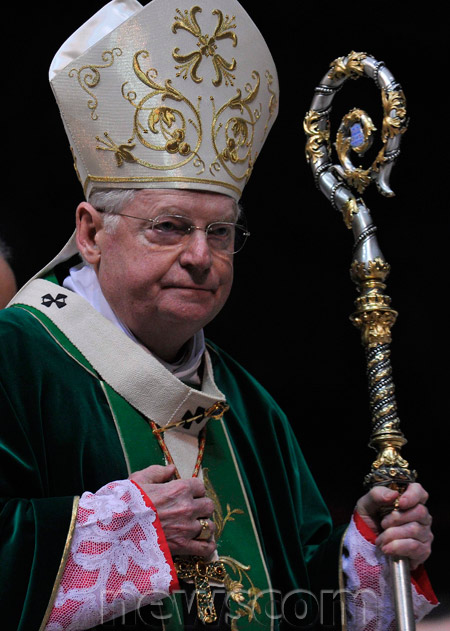
(Above : image of Cardinal Angelo Scola, wearing the pallium, as the Metropolitan Archbishop of Milan, who received the pallium personally from Pope Benedict XVI in 2011)
Papal pallium from 2005 is different, in order to distinguish the nature of the Papal office, as the Pope is not just any bishop or Metropolitan Archbishop, but is Metropolitan over the entire world, the entire Church, as the Vicar of Christ.

(Above : Pope Benedict XVI with the Papal pallium in 2012)
The list of the new Metropolitan Archbishops who will receive the pallium below.
1. Patriarch Manuel Jose Macario do Nascimento Clemente, Patriarch of Lisbon (Portugal)
2. Archbishop Dieudonne Nzapalainga, C.S.Sp., Metropolitan Archbishop of Bangui (Central African Republic)
3. Archbishop Carlo Roberto Maria Redaelli, Metropolitan Archbishop of Gorizia (Italy)
4. Archbishop Claudio Dalla Zuanna, S.C.I., Metropolitan Archbishop of Beira (Mozambique)
5. Archbishop Prakash Mallavarapu, Metropolitan Archbishop of Visakhapatnam (India)
6. Archbishop Antonio Carlos Altieri, S.D.B., Metropolitan Archbishop of Passo Fundo (Brazil)
7. Archbishop Marek Jedraszewski, Metropolitan Archbishop of Lodz (Poland)
8. Archbishop Philip Tartaglia, Metropolitan Archbishop of Glasgow (Great Britain)
9. Archbishop Salvatore Joseph Cordileone, Metropolitan Archbishop of San Francisco (USA)
10. Archbishop Rolando Joven Tria Tirona, O.C.D., Metropolitan Archbishop of Caceres (Philippines)
11. Archbishop Rogelio Cabrera Lopez, Metropolitan Archbishop of Monterrey (Mexico)
12. Archbishop Joseph William Tobin, C.Ss.R., Metropolitan Archbishop of Indianapolis (USA)
13. Archbishop Carlos Maria Franzini, Metropolitan Archbishop of Mendoza (Argentina)
14. Archbishop Lorenzo Ghizzoni, Metropolitan Archbishop of Ravenna-Cervia (Italy)
15. Archbishop George Antonysamy, Metropolitan Archbishop of Madras and Mylapore (India)
16. Archbishop Anil Joseph Thomas Couto, Metropolitan Archbishop of Delhi (India)
17. Archbishop John Wong Soo Kau, Metropolitan Archbishop of Kota Kinabalu (Malaysia)
18. Archbishop Murray Chatlain, Metropolitan Archbishop of Keewatin-Le Pas (Canada)
19. Archbishop Sérgio Eduardo Castriani, C.S.Sp., Metropolitan Archbishop of Manaus (Brazil)
20. Archbishop Peter Loy Chong, Metropolitan Archbishop of Suva, (Fiji)
21. Archbishop Alfonso Cortes Contreras, Metropolitan Archbishop of Leon (Mexico)
22. Archbishop Alexander King Sample, Metropolitan Archbishop of Portland in Oregon (USA)
23. Archbishop Joseph Effiong Ekuwem, Metropolitan Archbishop of Calabar (Nigeria)
24. Archbishop Jesus Juarez Parraga, S.D.B., Metropolitan Archbishop of Sucre (Bolivia)
25. Archbishop Fabio Martinez Castilla, Metropolitan Archbishop of Tuxtla Gutierrez (Mexico)
26. Archbishop Ramon Alfredo Dus, Metropolitan Archbishop of Resistencia (Argentina)
27. Archbishop Mario Aurelio Poli, Metropolitan Archbishop of Buenos Aires (Argentina)
28. Archbishop Gintaras Linas Grusas, Metropolitan Archbishop of Vilnius (Lithuania)
29. Archbishop Michael Owen Jackels, Metropolitan Archbishop of Dubuque (USA)
30. Archbishop Duro Hranic, Metropolitan Archbishop of Dakovo-Osijek (Croatia)
31. Archbishop Moacir Silva, Metropolitan Archbishop of Ribeirao Preto (Brazil)
32. Archbishop Jozef Piotr Kupny, Metropolitan Archbishop of Wroclaw (Poland)
33. Archbishop Sergio Alfredo Gualberti Calandrina, Metropolitan Archbishop of Santa Cruz de la Sierra (Bolivia)
34. Archbishop Giuseppe Petrocchi, Metropolitan Archbishop of L’Aquila (Italy)
In addition, the Metropolitan Archbishop of Hue, Archbishop Francois Xavier Le Van Hong, will not receive the pallium directly from the Pope in Rome, but in his home diocese of Hue, through the papal representative. Therefore, in addition to the 34 Metropolitan Archbishops mentioned above, 35 Metropolitan Archbishops will receive the pallium in this year.
35. Archbishop Francois Xavier Le Van Hong, Metropolitan Archbishop of Hue (Vietnam)
Metropolitan Archbishop differs from normal Archbishops in that, they have jurisdiction over other dioceses that are placed under their supervision, in a group called Ecclesiastical Province of the Church. Archbishops of Archdioceses without Metropolitan character has no jurisdiction over any dioceses under them, and they are usually directly subject to the Holy See.
 petercanisiusmichaeldavidkang