Tuesday, 14 January 2014 : 1st Week of Ordinary Time (First Reading)

Liturgical Colour : Green

1 Samuel 1 : 9-20

After they had eaten and drunk in Shiloh, Hannah stood up not far from Eli, the priest : his seat was beside the doorpost of YHVH’s house. Deeply distressed she went and prayed to YHVH and made this vow, “O YHVH of hosts, if only You will have compassion on Your maidservant and give me a son, I will put him in Your service for as long as he lives and no razor shall touch his head.”

As she prayed before YHVH, Eli observed the movement of her lips. Hannah was praying silently; she moved her lips but uttered no sound and Eli thought Hannah was drunk. He, therefore, said to her : “For how long will you be drunk? Let your drunkenness pass.”

But Hannah answered : “No, my lord, I am a woman in great distress, not drunk. I have not drunk wine or strong drink, but I am pouring out my soul before YHVH. Do not take me for a bad woman. I was so afflicted that my prayer flowed continuously.”

Then Eli said, “Go in peace and may the God of Israel grant you what you asked for.” Hannah answered, “Let Your maidservant deserve Your kindness.” Then she left the temple and when she was at table, she seemed a different woman.

Elkanah rose early in the morning and worshipped before YHVH with his wives. Then they went back home to Ramah. When Elkanah slept with his wife, Hannah, YHVH took compassion on her, and she became pregnant. She gave birth to a son and called him Samuel because she said : “I have asked YHVH to give him to me.”

Monday, 13 January 2014 : 1st Week of Ordinary Time, Memorial of St. Hilary, Bishop and Doctor of the Church (Scripture Reflections)

Liturgical Colour : Green or White (Bishops)

Today, brothers and sisters in Christ, we begin with the catechesis on the story of the prophet Samuel, one of the great prophet of the Old Testament, who was presented to the Lord by his parents, as the gratitude for the fulfillment of God’s love to a barren woman, Hannah, the mother of Samuel. From him would come the first two kings of Israel, namely Saul and David, the great king.

There were actually lots of similarities between the case of Samuel with that of the life of Jesus. Samuel was born from a woman who had not been able to conceive while the other wife of her husband conceived many children. Meanwhile John the Baptist, the herald of the coming of the Messiah, was born after his parents had not been able to conceive a child for many years, and were born only when they were already very old.

Samuel marked the transition period between the judges of Israel and the kings of Israel, while John the Baptist marked the period just before the coming of the Lord, the Messiah, to be the king among His people. Jesus Christ was also the descendant of David, the long awaited and prophesied descendant who would inherit the kingdom given to David the king, and rule it for eternity.

Samuel came to a people who had often forgotten about the Lord their God who saved them from suffering in slavery, and who liberated them with great might. They followed the wicked ways of their neighbours and the people who lived around them, worshipping their idols and false gods, and following their wicked customs inappropriate for the people of God.

Samuel came and made correct the attitude of the people, calling them to repent and follow the will and the laws of God, that they would once again become God’s righteous people. The same happened to John the Baptist, who came to prepare the way for the coming of Christ the Lord. John came to a people who outwardly might seem to be devout and law-abiding, but inside, they have no God or the love for God inside them.

Samuel and John came with the same purpose, that is to open the way for the Lord into the hearts of His people, that the people who had forgotten God’s love could once again enter the heart of His people. They called the people to repent from their sinful ways and once again turned their hearts towards God. Once they have done their duties, they stepped aside for the new era of glory, that is the new king to be the head of all the people, first in Saul and then David, and for John, the coming of the One True King Himself, King of kings and Lord of lords.

Let us then focus on Jesus, who came and called His first disciples in today’s Gospel. He called them, poor fishermen at the lake of Galilee. They were called, that they would no longer to fish for fishes to sell, but instead fish out for mankind, to be the fishers of men, especially those who have been lost to God, that they all may once again be reunited with their loving God through Jesus His Son.

These were to be His Apostles, the chosen ones among His first disciples, who followed Him and listened to His teachings, and to whom He revealed the greater part of the mystery of God and the plan of salvation that God had prepared in Jesus. Then, they were sent off to help with the ministry of Jesus as He went around proclaiming the Good News and the kingdom of God, performing healing and miracles as they went.

After the death, resurrection, and ascension of Jesus to assume His position of power in heaven, they were sent the Holy Spirit at Pentecost, and since then they and their successors went around the world, proclaiming the faith and the truth that is in Jesus, Son of God and Saviour of the world. Even until today, the Church which Christ Himself had established in this world continue to speak out for Him and proclaim His words to all.

Why are all these so important, brothers and sisters in Christ? That is because our Lord will come again as He had promised, that at the end of time, He will once again descend from heaven, this time as a mighty and conquering King, who will rule over all those who remain faithful to Him, while those who reject Him will be cast away into eternal damnation and suffering.

The prophets Samuel and John the Baptist, as well as the Apostles and disciples of Christ essentially all did the same thing, that is to proclaim the Kingdom of God, the Good News and hope in the Messiah and Lord, who will come and save His people. From time to time, the Lord had continued to reveal and repeat His message and promise to us, and His servants in this world continue to proclaim that message and promise to all.

We too, brethren, have a part to play in all these. We too are called to be witnesses of God’s Good News and revelation of truth, that we who believe in Him, may also proclaim His truth to all, to everyone around us, within our own families, within our circle of friends, and within our society. We are also called to be the servant of God and spread His words to all.

Therefore, let us all do our best, to be part of God’s mission, which He had entrusted to us. We all have our part to do in this, just as John the Baptist, Samuel, the Holy Apostles and other saints of God had done their respective parts. May we therefore do our best to bring the Light of God’s salvation and the fruits of God’s word to all mankind, and to bring mankind closer to God, as fishers of men, just as the Apostles were once called. Amen.

Monday, 13 January 2014 : 1st Week of Ordinary Time, Memorial of St. Hilary, Bishop and Doctor of the Church (Gospel Reading)

Liturgical Colour : Green or White (Bishops)

Mark 1 : 14-20

After John was arrested, Jesus went into Galilee and began preaching the Good News of God. He said, “The time has come; the kingdom of God is at hand. Change your ways and believe the Good News.”

As Jesus was walking along the shore of Lake Galilee, He saw Simon and his brother Andrew casting a net in the lake, for they were fishermen. And Jesus said to them, “Follow Me, and I will make you fish for people.”

At once, they abandoned their nets and followed Him. Jesus went a little farther on and saw James and John, the sons of Zebedee; they were in their boat mending their nets.

Immediately Jesus called them and they followed Him, leaving their father Zebedee in the boat with the hired men.

Monday, 13 January 2014 : 1st Week of Ordinary Time, Memorial of St. Hilary, Bishop and Doctor of the Church (Psalm)

Liturgical Colour : Green or White (Bishops)

Psalm 115 : 12-13, 14-17, 18-19

How can I repay the Lord for all His goodness to me? I will lift up the cup of salvation and call on the Name of the Lord.

I will fulfill my vows to the Lord in the presence of all His people. It is painful to the Lord to see the death of His faithful.

O Lord, I am Your servant, truly Your servant, Your handmaid’s son. You have freed me from my bonds. I will offer You a thanksgiving sacrifice; I will call on the Name of the Lord.

I will carry out my vows to the Lord in the presence of His people, in the courts of the house of the Lord, in your midst, o Jerusalem.

Monday, 13 January 2014 : 1st Week of Ordinary Time, Memorial of St. Hilary, Bishop and Doctor of the Church (First Reading)

Liturgical Colour : Green or White (Bishops)

1 Samuel 1 : 1-8

There was a man from Ramathaim, in the hills of Ephraim, whose name was Elkanah. He was son of Tohu, son of Jeroham, of the clan of Zuph. He had two wives, Hannah and Peninnah. Peninnah had children but Hannah had none.

Every year Elkanah went to worship and to sacrifice to YHVH of hosts at Shiloh. The priests there were the two sons of Eli, Hophni and Phineas. Whenever Elkanah offered sacrifice, he gave portions to his wife, Peninnah and to all her sons and daughters.

To Hannah, however, he gave the more delightful portion because he loved her more, although she had no child. Yet Hannah’s rival used to tease her for being barren.

So it happened every year when they went to YHVH’s house. Peninnah irritated Hannah and she would weep and refuse to eat. Once Elkanah, her husband, asked her, “Hannah, why do you weep instead of eating? Why are you sad? Are you not better off with me than with many sons?”

Monday, 16 September 2013 : 24th Week of Ordinary Time, Memorial of St. Cornelius, Pope and Martyr, and St. Cyprian, Bishop and Martyr (Scripture Reflection)

Liturgical Colour : Red

Dear brothers and sisters in Christ, today we listen to the revelation of the great faith in the captain, who was likely a Roman soldier, and therefore not of the people of Israel. And we tie this revelation to the saying of St. Paul in his letter in our first reading today, that there exists only one way to salvation, that is through the great Mediator, Jesus Christ, Messiah of the world.

True faith in God lies not in the prayers after prayers that one utters. Yes, prayer is indeed important, brethren, but what is even more important is one’s own humility and awareness of themselves, and the complete surrender of oneself to the love of God, and in all these, the individual will then have a true, unshakeable faith in God.

It is that many people in Israel put themselves before God, and put their worldly desires before the Lord. That was also why the faith of the people in God, as was evident in how they looked at Jesus and His ministry, was truly shallow and weak faith, unlike that faith the captain of the army possessed for Christ and therefore for the Lord. That was also why, even though the people first proclaimed Jesus as a great Saviour, they were equally quick in condemning Him to death when He was convicted by false testimonies.

They loved not God and have faith not in Him, but on the wondrous things that He had done, and once those things were gone, or when challenges rose up to meet them, they quickly forgot about Him and rose up in rebellion. This was truly evident, when Israel walked through the desert into the Promised Land, that they rebelled and made complaints after complaints to the Lord for not caring for them enough in their journey, and even regretted having been brought out of Egypt.

The same also happened to Jesus, that people applauded Him for the miracles and powers He had shown, in healing the sick, opening the eyes of the blind, and loosening the tongues of the mute, and in raising the dead back into life. They followed Him and listened to His teachings, and yet, these did not take good roots in them, that they were easily shaken by fear and doubt.

On the other hand, the captain of the guards showed great faith in God, that He sent for Jesus to heal his sick servant and save him from death. Then, despite his relatively lofty and high position in the armed forces, and therefore in the society, he did not boast at all. He instead lowered himself before the Lord, as a sinner, who would not be worthy at all to receive the Lord who is good and perfect in his own residence.

One may interpret the way he said things to Jesus through his servant as being rude. After all, how can he say such things to Jesus who had spent so much of His time to come down to his place and heal his servant? Is he not being condescending and demanding of Christ the Lord?

No, brethren, in fact, in that sentence, and which was completely revealed in his last sentence, which we also utter during every Mass before the Lord’s Presence in the Holy Eucharist, showed perfectly the depth of his faith in the Lord and his humility, realising that he was truly nothing, despite his position of power, before the Lord Jesus our Saviour and God.

“Lord, I am not worthy that You should enter under my roof, but only say the word, and my soul shall be healed.” That is the precise words that we utter after the Agnus Dei, when the celebrant of the Mass show to us the Body of Christ crucified, through which He is willing to come upon us, in order to heal us from all our sins, iniquities, and unworthiness. We are unworthy of Him because of our sins, and yet He is willing to come to us, into us, so that He will be with us and stay with us, and we will also remain in Him, in His love.

It is precisely his understanding of his unworthiness before the Saviour of the world, before the Almighty God Himself, that he, the captain, though mighty in the eyes of men, but he is nothing compared to God and he is unworthy to stand before His presence, much less to invite Him to his humble and sinful abode. That is why, using his own experience as the captain of an army unit, he asked in his humility, for the Lord to give the orders, and he has complete faith that whatever the Lord commands, it will be fulfilled.

We too, brothers and sisters, should follow his example, and in saying the words that he had once uttered, every time in the Mass, let us say it with complete understanding and dedication to God, not because we are trained to say it without feelings, and not just because we memorised the phrase, and then utter them out of nothingness. Let us put ourselves into the shoes of the captain, understanding the love that God has for us, when He approaches us and offers Himself to us in His Body and Blood.

Today, brethren, we also celebrate the feast of two great saints of the early Church, namely that of Pope St. Cornelius and St. Cyprian, the great leaders of the Church and the staunch defenders of the faith. They lived at a difficult time for the Church, at the time when the pagan Roman Emperors, particularly Decius and Valerian persecuted Christians and slaughtered them mercilessly.

Pope St. Cornelius and St. Cyprian, his greatest supporter, as the Bishop of Carthage in Africa, also faced a great tribulation of the faith, with a heretical teaching by the priest Novatian, who also contested the Papacy as antipope to Pope St. Cornelius, causing a severe division of the faithful at the time when the enemies of the Church were persecuting strongly against her.

Pope St. Cornelius protected the important tenet of the faith, that is the Lord who is merciful, readily forgives those who had lapsed from the faith, as was often during his time as Pope. St. Cyprian was his strong supporter, against the heretic Novatian, who staunchly opposed to the forgiveness and redemption of those who had lapsed from the faith.

There were many Christians who lapsed from the faith due to various reasons, but many of which were linked with the temptations of the world and sin, especially because of the severe persecutions against the faithful at the time. According to Novatian heresy, these people were doomed, but Pope St. Cornelius and St. Cyprian begged to differ. As Christ had taught His disciples, that even the greatest of sinners can repent and many saints were also once great sinners.

They defended the true faith and maintained the integrity of the Church and the faithful. Through their hard work, many were prevented from falling into the heretical teachings. They died as defenders of the faith under persecution by the Roman authorities, and in their martyrdom, they provided the rich soil upon which the Church could grow further and carry out their work of salvation.

May the Lord opens our eyes and the doors of our hearts, and inspired by the examples and works of Pope St. Cornelius and St. Cyprian that we will be able to learn the unworthy state that we are in, because of our sins, that we, in deepest humility, following the footsteps of the captain, will humble ourselves before Christ, who is the great Mediator, the bridge between us and the Father, through whom, the only path to salvation and eternal life in glory is possible. Let us praise God and thank Him for having mercy and pity on us, coming to us to heal us, despite of our faults and unworthy behaviours. God be with us always and may He show His mercy and love upon us. Amen.

The need to return to ‘Ad Orientem’ celebration

00056_15042010

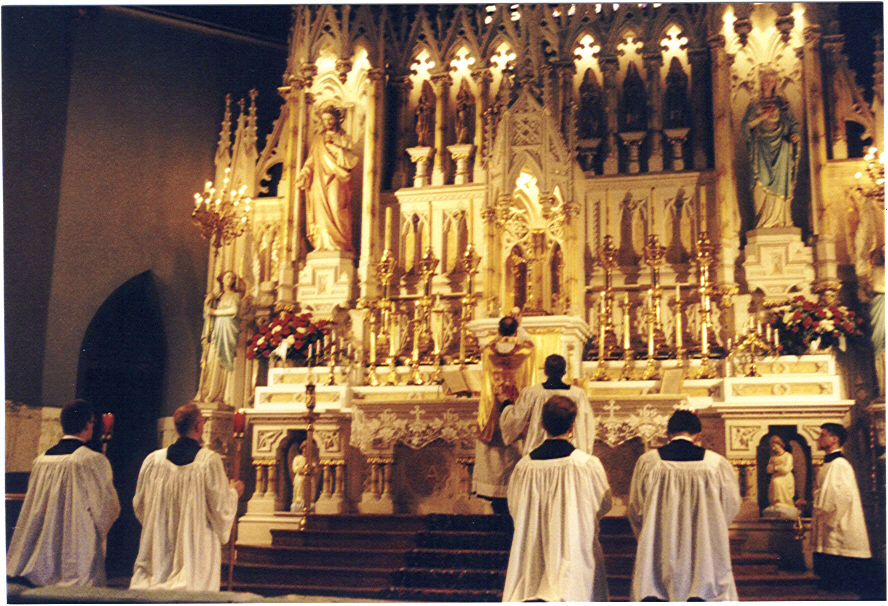
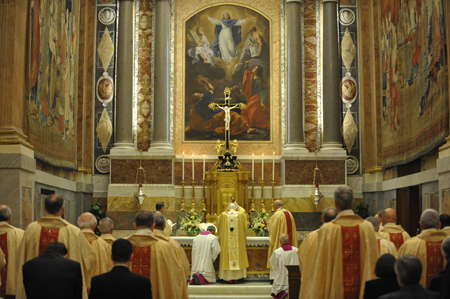
Let us return to the ad orientem celebration! That is facing the Lord TOGETHER with the people, instead of facing the people (ad populum).

The Mass is not a political gathering or a party where everyone faces each other and look at each other. The Mass is about the Holy Sacrifice of Jesus Christ, and we ALL ought to look at Him crucified. Therefore, everyone, including the priest, MUST face the Lord, and ad orientem is the best way.

Elevation

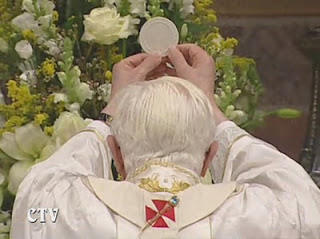
The focus of the Mass is the Lord, not the priest as a person. The priest is Alter Christus, Christ personified in the priest, and when he lifts up that bread turned into the Most Precious Body, It is like Christ lifted up high between the heaven and the earth, offering Himself as a sacrificial victim, to absolve and save all the world from death and sin. When the priest lifts up that chalice with wine, transformed into the Most Precious Blood, it is the Blood of Christ, Jesus Christ Himself we are looking at, His Blood pouring down the cross to us, to wash us from our iniquities and our sins, making our garments white again in the Blood of the Lamb.

Monstrance Baroque

And even the ones who crucified Him, looked at Him “And they shall look at the One whom they pierced”. It is therefore imperative, that we keep our focus at the Lord, as One people, One Church, during and throughout the Mass. The focus is not in the dances and the upbeat songs now often used to arouse people’s attention and interest in the Mass, and neither is the focus on the priest dancing, singing, or the people’s performances, but the focus is Christ.

When the priest faces the people, this fact is quickly and easily lost in both the people, AND the priest. Eye contact is very important in relationships, and eye contact between the priest and the people while can be beneficial (during the homily) it can easily distract our attention from the Lord in the Eucharist, very easily.

In this way too, we take the best from both of the two Form of the Latin Rite we have in the Church, that is the Extraordinary Form (Tridentine) and the Ordinary Form (Novus Ordo), and end the numerous liturgical abuses that had arisen ever since ad populum celebration became commonplace, and many did them inappropriately and without due honour to our Lord Jesus Christ.

papal ad orientem 2010 4

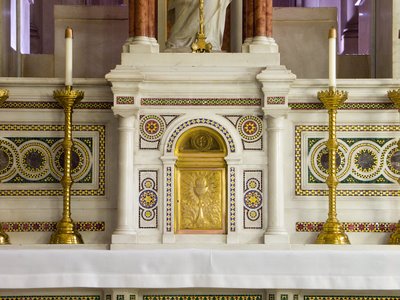
And lastly, it is time to return the Tabernacle with the Most Holy Eucharist back to its place of primary honour behind the Altar, that is where all the people and the priests focus at during the Mass, and not relegated somewhere at the side or a less-than-honorary place in the church building. There can be another Tabernacle for use especially during the Transfer of the Eucharist on Holy Thursday, but the Tabernacle itself should and indeed, must be restored to its position of honour at the Altar!

Cathedral Basilica of Saint Louis, in Saint Louis, Missouri - All Saints Chapel - tabernacle

Ad orientem celebration helps this, as the priest no longer need to show his back all the time to the Lord throughout the Mass if ad populum celebration is done.