The new document just released today by the Dicastery for Promoting Christian Unity titled ‘The Bishop of Rome – Primacy and Synodality in the Ecumenical Dialogues and in the Responses to the Encyclical Ut Unum Sint’
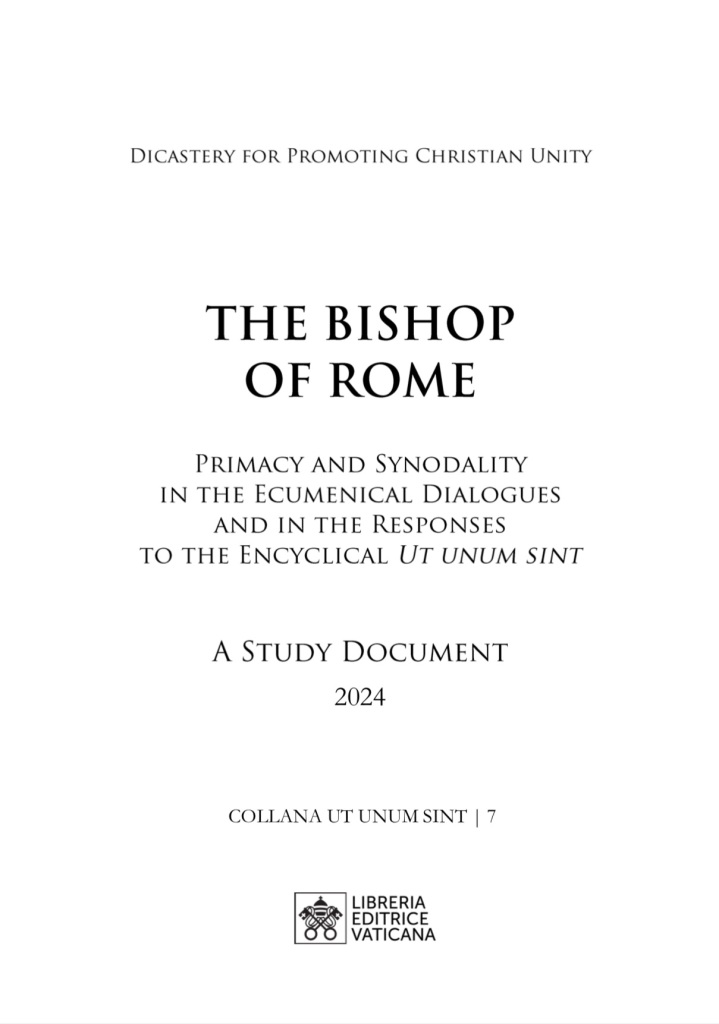
The new document just released today by the Dicastery for Promoting Christian Unity titled ‘The Bishop of Rome – Primacy and Synodality in the Ecumenical Dialogues and in the Responses to the Encyclical Ut Unum Sint’
http://www.zenit.org/en/articles/text-of-joint-declaration-signed-by-pope-and-ecumenical-patriarch
We, Pope Francis and Ecumenical Patriarch Bartholomew I, express our profound gratitude to God for the gift of this new encounter enabling us, in the presence of the members of the Holy Synod, the clergy and the faithful of the Ecumenical Patriarchate, to celebrate together the feast of Saint Andrew, the first–called and brother of the Apostle Peter. Our remembrance of the Apostles, who proclaimed the good news of the Gospel to the world through their preaching and their witness of martyrdom, strengthens in us the aspiration to continue to walk together in order to overcome, in love and in truth, the obstacles that divide us.
On the occasion of our meeting in Jerusalem last May, in which we remembered the historical embrace of our venerable predecessors Pope Paul VI and the Ecumenical Patriarch Athenagoras, we signed a joint declaration. Today on the happy occasion of this further fraternal encounter, we wish to re–affirm together our shared intentions and concerns.
We express our sincere and firm resolution, in obedience to the will of our Lord Jesus Christ, to intensify our efforts to promote the full unity of all Christians, and above all between Catholics and Orthodox. As well, we intend to support the theological dialogue promoted by the Joint International Commission, instituted exactly thirty–five years ago by the Ecumenical Patriarch Dimitrios and Pope John Paul II here at the Phanar, and which is currently dealing with the most difficult questions that have marked the history of our division and that require careful and detailed study. To this end, we offer the assurance of our fervent prayer as Pastors of the Church, asking our faithful to join us in praying “that all may be one, that the world may believe” (Jn17:21).
We express our common concern for the current situation in Iraq, Syria and the whole Middle East. We are united in the desire for peace and stability and in the will to promote the resolution of conflicts through dialogue and reconciliation. While recognizing the efforts already being made to offer assistance to the region, at the same time, we call on all those who bear responsibility for the destiny of peoples to deepen their commitment to suffering communities, and to enable them, including the Christian ones, to remain in their native land. We cannot resign ourselves to a Middle East without Christians, who have professed the name of Jesus there for two thousand years. Many of our brothers and sisters are being persecuted and have been forced violently from their homes.It even seems that the value of human life has been lost, that the human person no longer matters and may be sacrificed to other interests. And, tragically, all this is met by the indifference of many. As Saint Paul reminds us, “If one member suffers, all suffer together; if one member is honoured, all rejoice together” (1 Cor 12:26). This is the law of the Christian life, and in this sense we can say that there is also an ecumenism of suffering. Just as the blood of the martyrs was a seed of strength and fertility for the Church, so too the sharing of daily sufferings can become an effective instrument of unity. The terrible situation of Christians and all those who are suffering in the Middle East calls not only for our constant prayer, but also for an appropriate response on the part of the international community.
The grave challenges facing the world in the present situation require the solidarity of all people of good will, and so we also recognize the importance of promoting a constructive dialogue with Islam based on mutual respect and friendship. Inspired by common values and strengthened by genuine fraternal sentiments, Muslims and Christians are called to work together for the sake of justice, peace and respect for the dignity and rights of every person, especially in those regions where they once lived for centuries in peaceful coexistence and now tragically suffer together the horrors of war. Moreover, as Christian leaders, we call on all religious leaders to pursue and to strengthen interreligious dialogue and to make every effort to build a culture of peace and solidarity between persons and between peoples. We also remember all the people who experience the sufferings of war. In particular, we pray for peace in Ukraine, a country of ancient Christian tradition, while we call upon all parties involved to pursue the path of dialogue and of respect for international law in order to bring an end to the conflict and allow all Ukrainians to live in harmony.
Our thoughts turn to all the faithful of our Churches throughout the world, whom we greet, entrusting them to Christ our Saviour, that they may be untiring witnesses to the love of God. We raise our fervent prayer that the Lord may grant the gift of peace in love and unity to the entire human family.
“May the Lord of peace himself give you peace at all times and in every way. The Lord be with all of you” (2 Thess 3:16).
From the Phanar, 30 November 2014
Liturgical Colour : Red
Dear brothers and sisters in Christ, today we celebrate in this moment, the great celebration of the Church, both of the Church of Rome, and the entirety of the universal Church, of the whole world, for we celebrate today the feast day of the two pillars that established and built up this Church, namely St. Peter the Apostle, the Prince of the Apostles and the first Vicar of Christ, leader of the entire Universal Church, Keeper of the keys of the kingdom of heaven.
And then the other one, St. Paul the Apostle, who was once a great sinner and enemy of the faithful, then called and made to be the Apostle to the Gentiles, to be the one to bring the Word of God’s salvation to all mankind, beyond the limitations of the Jews. And so, while St. Peter stood at the heart of Christendom, St. Paul is the brave and courageous evangeliser who spread wide the Christian message.
These two saints are two great saints and great role models for us, but they were also once ordinary and simple men, coming from unexpected origins, but ended up serving the Lord through their works and ministry to God’s people. And we celebrate their lives and their works today, and we hope that we all will be inspired by what they had done for the sake of God and His faithful.
St. Peter was a fisherman of the Lake Galilee, who was called by Jesus to be the shepherd of His sheep, that is all of us. He was made a fisher of man, as Jesus Himself had said when He called Peter and the other disciples to Himself. Meanwhile, St. Paul was an upper class Jew, who was brought up in strict and orthodox Jewish teachings, becoming kind of a fanatic who ended up persecuting many of the faithful in Israel, before he met the Lord on the way to Damascus and be converted to the cause of the faith.
In both of their stories, the two great saints, St. Peter and St. Paul had encountered a profound change in their lives after they met the Lord and professed their faith for Him. St. Peter was a brave person, but yet he feared death and persecution when the enemies of the Lord came for Him, and thus despite having vowed before the Lord that he would die for Him, he disowned the Lord three times before the Lord’s Passion and death.
And St. Paul was a great enemy of the faithful, the scourge of the believers, hunting down the faithful with zeal, but zeal that is mistaken in purpose and nature. He caused the death and suffering of many, and many would naturally have hated and feared him, but this was not what God intended from him. He was called and taken away, in an ultimate coup-de-grace against Satan, and was made to be the greatest champion of God’s cause in the world.
Both of them went on to spread the Good News to many parts of the known world of that time, the Roman Empire, together with the other Apostles and disciples of Christ who spread the Word of God to the ends of the earth. They went on to spread the Gospel to many cities, towns and villages across the Mediterranean, facing rejection and persecution in many places, but also acceptance by those who willingly received the Word for themselves.
They were persecuted by the Jews and the chief priests, who arrested them many times, harassed and tortured them many times, and handed them to the Romans to be jailed and punished many times. And in the end, both St. Peter and St. Paul went to Rome, the heart of the Roman Empire, ministering to the people of God there and eventually was martyred for the faith there.
The Empire was initially neutral and did not care about the faithful, but as time went on, the Empire and the Emperor Nero became hostile to the Christians, who were made as scapegoats of the many failures and disasters that befell the Empire, including the Great Fire of Rome. The Great Fire of Rome was allegedly started by Nero himself to build himself a grand palace in place of the rubble and ruins. He blamed the fire on the Christians, and as a result, many were martyred and sent to gladiatorial games to be butchered by lions and other wild animals.
St. Peter was martyred by crucifixion, but he did not feel it right to die in the same way as Jesus his Lord and God had died. Therefore, he asked to be crucified upside down, so that he would not die in the same way as his Lord and God. St. Peter embodied the faithfulness and indeed, true faith in God, that he faithfully carried out until the end. For St. Paul, he was beheaded in Rome as part of the great persecution against the faithful by the Emperor, and his blood was spilled that more seeds of faith might grow.
Brothers and sisters in Christ, today we who are in the Church of God are the continuation of the ministry and the divine mission entrusted by the Lord to His Apostles, chiefly among which, St. Peter and St. Paul, who went to be martyred at the heart of the Empire that persecuted the faithful, marking the beginning of the long history of our Church, centred firmly on the authority of the Apostle Peter, whom the Lord had entrusted His Church to, and the entirety of the faithful ones of God that are part of that Church.
Today, we stand strong and courageous with the whole Church, inspired by St. Peter and St. Paul whose examples had inspired us in our own faith. St. Peter taught us to be faithful, and to keep that faith strongly in our lives that our lives may be truly based on a firm and living faith. Then St. Paul taught us how to love others, and how to bring the Lord’s salvation to all men as the manifestation of that love we have for each other.
And we also stand together with our Pope, as our leader, the shepherd of shepherds, and the vicar of the Chief Shepherd, our Lord Jesus Christ. For he is, as the Bishop of Rome, of that city where St. Peter and St. Paul were martyred, the successor of St. Peter as the Vicar of Christ on earth, the leader of the entire Universal Church, through whom we keep our unity, that we may stay and remain as One Body in Christ.
Our Lord Jesus Christ had entrusted Peter with His sheep, the flock of His faithful, whom He asked Peter to take care and keep well. In that way, He entrusted His entire Church to Peter and His successors, the Popes, and they become the symbol of unity and the point of reference, through which the entire Church and the faithful drew their faith to God from.
Indeed, throughout history, sometimes the Popes had been corrupt and abused their power, but as a whole, the office of the Papacy, regardless of its past mistakes, remains as a very important and crucial institution, in particular in this increasingly confused and darkened world, where Satan grew in power day after day. And in addition, St. Paul also reminded us that it is important for us to go forth confidently to spread the Good News to all nations and all peoples.
We cannot evangelise most efficiently if our house itself is not in proper order. We have to ensure that the foundation of our faith is strong, so that we may grow stronger in faith and bring others to salvation. And this strong foundation of the faith can be found today in the Popes, and in the entirety of the teachings of the entire Magisterium of the Church, which the Popes are custodian and guardian of.
That is why we also pray and hope that our Church will be one, and all the estranged members of the Lord’s Body, that is the Church, will repent and come back to the Holy Mother Church, under the leadership of the successor of St. Peter, the Vicar of Christ, whom Jesus had appointed to be the leader of all of His faithful ones and to be the one to represent the Chief Shepherd on this world, a world darkened by the power of evil, the wolves trying to devour the innocent sheep and lambs of the Lord.
We pray that our brethren in the see of St. Andrew, the brother of St. Peter, and in the see of St. Mark, and those in the ‘communion’ born from the insistence and the greed of King Henry VIII and many others who had been misled by false prophets and leaders of the faith, will return to the Lord and be one again with us, even as we celebrate this feast day, and we ask that the two great saints pray for this to happen. For indeed, the unity of the Church is needed, as there is a need for us, greater than ever to stand up for the Lord against Satan and his forces marshalled against us.
The primacy of St. Peter must be upheld, and the primacy and supremacy of his successor the Pope must be upheld by all who believes in Christ, for once again, he is the one on whom the Lord had built His Church on, as the focal point for all the faithful in their faith to the Lord. Those who doubt this fact, fail to understand the meaning of the words when Jesus said, and His commission to Peter, to feed and support His lambs.
Our Church therefore must stand strong and remain truly faithful, and not an iota of its teachings, the teachings of the early Church fathers of the faith, must be lost or contravened. We cannot let this Church which Christ had built on solid rock foundation of Peter and His successors to stumble on the high waves and the storms of this world today. There are indeed many oppositions and currents trying to push the Church in the wrong direction, in the name of adjustment, accommodation and many other reasons, but I say brethren, that we ought to stay faithful as St. Peter had been faithful to the end! And we pray that our Pope, as the successor of St. Peter will keep his duty faithfully and keep close to the teachings of the entire Deposit of the Faith and the Apostolic Tradition.
And ultimately, in the spirit of St. Paul the Apostle, our Church must also be brave to stand up to the faith and spread it to those who are still in darkness and in ignorance or opposition to the faith, as St. Paul had once done. For too long in the recent decades that our Church had become timid in the face of opposition and rejection by the world. We need to rediscover that zeal of the faith and the commitment that St. Paul had once shown through his tireless ministries to the faithful throughout many places until his own martyrdom.
Therefore, brothers and sisters in Christ, today let us pray for one another, and pray for our Church, that first, it may grow stronger in faith and grow more united in the faith to the Lord. May the Lord strengthen us all, that we may become more loving children of God, and a more loving and living Church. May St. Peter and St. Paul intercede for us and help us on our path, that we too may follow their examples in faith and love. God bless us all. Amen.
 petercanisiusmichaeldavidkang