Seventh General Congregation of the College of Cardinals : Friday, 8 March 2013 at 9.30 am Rome time / CET

The seventh General Congregation of the College of Cardinals will commence in a few hours time at 9.30 am today, Friday, 8 March 2013 in Rome, with all the 115 Cardinal-electors having been present in Rome. The date of the Conclave may be decided in this General Congregation, and if so, the usual scheduled press briefing by Fr. Federico Lombardi of the Holy See Press Office, will announce it (at 1 pm today).

There will be no Eighth General Congregation this afternoon. It is not known yet when the General Congregations will begin again, or when the Mass for the Election of the New Pontiff (Missa pro Eligendo Pontifice) will be held.

Continue praying for our Cardinals, that they will soon be able to come into a conclusion on their discussions and meetings, and filled with the Holy Spirit, will be able to go into the Conclave and with their inspiration, elect a great new Pope as our new shepherd!

Tuesday, 5 March 2013 : 3rd Week of Lent (Scripture Reflection)

Forgiveness is not an easy thing to be done. It is a difficult thing to do, but yet also a very noble virtue. Forgiveness allow us to transcend hatred and evil, and allow us to break free from that cycle of hatred and death, and instead enter into the realm of love and compassion. For love is not complete without forgiveness, and how can we truly love someone if we have something between us and that person, that we have yet to forgive?

God loves us and He will never leave us in trouble. Just like the king, if we humble ourselves, and throw ourselves at the feet of the Lord, God will surely have pity on us and be merciful. But there is of course limit to God’s mercy, and there is also something that we have to do, that is to truly transform ourselves, to prove to the Lord that we are truly regretful and repentant of all our sins and faults.

How to do that? Not to do public penance and awesome lamentations, and neither do we fast in public and show our regret, but what matters is, our heart. A contrite heart and a broken spirit, that seeks the Lord for healing and forgiveness. These are what the Lord truly wants from us, as these are the sign of our sincerity and our true love for Him, instead of love that is hidden beneath layers of pride and self-vanity.

Therefore, brothers and sisters in Christ, let us use this holy and fruitful season of Lent, to forgive one another of the faults we have made, either intentionally or unintentionally. Let us reach out to one another in forgiveness and in sincere love, that in doing so, we too show our great love for the Lord. Do not keep grudge for one another, and do not hate, no matter how great the temptations are, for to hate is to bring ourselves into sin, and into evil, and finally into death and separation from God.

Give thanks to the Lord for all the wonders He had given us, for all the guidance He had given us, especially through difficult times, and let us always strive to orient ourselves towards Him and place Him at the centre of our life. Through regular and constant attendance of the Holy Mass, devotions and prayers, and asking His glorious saints and blesseds to pray for us, our faith and our love for God, and for man alike will only ever grow stronger and stronger.

Pray for one another, and especially now that the Church is preparing for the Conclave, let us also pray for the Cardinals that they can elect a new Pope who is loving, faithful, and filled with the Holy Spirit in his leadership of God’s people on this world. Amen.

Regarding Vatican Player video at www.vatican.va/video/ : How to view past videos

If you have missed the live broadcast of any past Papal events and events involving the Holy See, such as the press conferences in recent days by Fr. Federico Lombardi of the Holy See Press Office, you can access the recording at the Vatican Player site itself at http://www.vatican.va/video/

Instead of picking to watch live at the TV tab above (There are three tabs : Radio, TV, and agenda), pick the agenda tab, and then at the calendar at the right side, pick the date of the event that you like (For example, pick 13 February 2013 for the Ash Wednesday Mass and Pope Benedict XVI’s last public Mass). Then pick the event from the left side out of the list of events that occured that particular day.

Only those that has the TV icon has the recording though. If the TV icon is there, click on it, then click on the other TV icon on the upper-right hand side of the window, and then happy watching!

In addition, the website http://www.benedictxvi.tv/ also has a vast collection of papal videos (Pope Benedict XVI and documentaries of other Popes) available. Do visit and support the site!

Preliminary News : Conclave to begin on Monday, 11 March 2013 (Confirmation needed from the College of Cardinals)

http://vaticaninsider.lastampa.it/en/the-vatican/detail/articolo/22827/

According to the Vatican Insider, or La Stampa, which is the best source of objective and accurate news on the Vatican, the date of the Conclave has been set on Monday, 11 March 2013, which they posted on Monday, 4 March 2013, today, on their La Stampa edition.

Confirmation from the Holy See Press Office (Fr. Federico Lombardi) is needed however, as the first General Congregation of the College of Cardinals that meets to decide the starting date of the Conclave only began this morning at 9 am CET or Rome time. Therefore, the starting date of the Conclave may still change, but it is highly expected to occur between Saturday, 9 March 2013 and Monday, 11 March 2013.

We hope then to have a Pope by Thursday, 14 March 2013 at the latest, and hope that in that case, the Papal Installation Mass can be held on Sunday, 17 March 2013, the 5th Sunday of Lent. That we can have the new Pope to lead us in the celebration of the Holy Week, and the residential Cardinals too can go home to celebrate the Holy Week in their respective archdioceses/dioceses.

Who to watch for in 2013 papal conclave? Scola, Ouellet, Ravasi, Scherer

Scola, Ouellet, Ravasi, Scherer, who you should watch for in the Conclave.


Scola (Cardinal Angelo Scola, Metropolitan Archbishop of Milan)

Italian, so that even though he’s not in Curia, he did have experience in Rome, and he is already close to Rome, both in distance and relations. Also close to Pope Emeritus Benedict XVI,
and he has also done great job in Venice and then Milan, in which
these two archdioceses alone produced 5 popes in the past century

Only Pope Benedict XV and Pope Pius XII were not from these (excluding Pope John Paul II and Benedict XVI)

Venice : Pius X, John XXIII, John Paul I
Milan : Pius XI, Paul VI

Also at the forefront of communication with Islam through the publications Oasis he created to reach out to Christians in the Muslim world, and involved in interreligious dialogues.

Scola is also more charismatic than Ouellet and also active in the media via youtube, twitter, his site.

Scola is also a well-known author in bioethics, and certainly is a trait needed for a Pope that will lead the Church in its constant battle against the improper use of Science. Yes to an ethical science, but no to unbridled and uncontrolled use of science!

If the conclave proceeds smoothly, he should be the one elected Pope, within 2 or 3 days from the start of the conclave.


Ouellet (Cardinal Marc Ouellet, Prefect of the Congregation for Bishops)

In the Roman Curia and in charge of the bishops, but with the problem is that his archdiocesan experience is not that good, and the story has come out that the very church and parish we was born into, was no longer there, which is shameful considering the rate of secularisation in the west. Formerly he was the Metropolitan Archbishop of Quebec in Canada.

But so far he has done quite a good job, and quite in line with Pope Benedict XVI, by appointing bishops who are not only known to be good administrators, but more importantly, bishops who are holy, and are steadfast in their faith, with individuals like Archbishop Chaput of Philadelphia and Cardinal Tagle of Manila as example.


Ravasi (Cardinal Gianfranco Ravasi, President of Pontifical Council for Culture)

Ravasi is the forefront in how the Church communicates with social issues and the media, and he has been quite active in twitter, more so than Scola, but his administrative skill has been found rather lacking, since he has only five or six years experience as a bishop and never had any experience in handling major archdioceses or dioceses.

At least Cardinal Ravasi will sure make good use of the social media to help evangelise the faith to many, especially youths. But at the moment, we will also need candidate who are more experienced in administration as well, especially considering the troubles that had befallen the Church in recent years due to some inefficiencies in administration.


Scherer (Cardinal Odilo Pedro Scherer, Metropolitan Archbishop of Sao Paulo)

Scherer is rather conservative and as a Latin American, this may boost his chances, but he is quite young and he is not familiar with the curia and with still a relatively short experience as a senior prelate, he needs more experience in managing important archdioceses and other administrative matters.

In addition, the status of Brazil as a country, although having the largest Catholic population in the world, but the rapidly declining number of Catholics in the country as a percentage of the population and the rapidly growing secularisation in the country (also affect the rest of Latin America) may also affect his chances.


In fact, this time round, just as it was with the election of Pope Benedict XVI, now our Pope Emeritus, we does have a clear leading papabili, and the number of papabili is in fact not as many as the media mentioned it.

It will not be like the election of Pope John XXIII when there is no clear preferred papabili present, which resulted in the election of Cardinal Angelo Roncalli, later Pope John XXIII as the compromise choice.

Why did Pope Emeritus Benedict XVI relinquished the Papacy? (My personal opinion)

In my personal opinion, why our beloved Pope Benedict XVI, now Pope Emeritus Benedict XVI, had decided to step down from his position and relinquish the Papacy, is because of three main factors and events that potentially play major roles in shaping his decision. All of these factors are tied to the first factor, that is his health.


Here are the three factors and events that in my opinion made our Pope Emeritus did what he had done :


1. Health : The Pope’s failing health due to his old age is likely the main reason why he had decided to relinquish the Papacy. Although indeed, he is now at 85 being much more vigorous as compared to Blessed Pope John Paul II’s last years, but as the Pope has great tasks to be done, for the sake of the Lord, and His people, Pope Benedict chose humility and step aside for someone else to take over the good works he had started.

He realised that his increasing difficulty in walking, most likely due to osteoarthritis and the problems with his vision will eventually impair him and preventing him from exercising his ministry as the Bishop of Rome. It has also been reported that Pope Benedict too suffers from Parkinson’s, although likely a mild one or one that is still at an early stage. This disease is well known for the one that debilitated Blessed Pope John Paul II, and Pope Benedict, being very close to the previous Pope, would really want to avoid another of many years of debilitation, where the Pope instead of leading directly the Church, had to delegate most of his works due to his disabilities. It is a matter of choice of course. Blessed John Paul II chose to persevere to show us how suffering for the sake of the Lord is like, and our beloved Benedict XVI stepped down to show us what humility and virtue is like.


2. WYD (World Youth Day) 2013 : The World Youth Day has been scheduled to occur in July 2013. It would have been in 2014, but because it will be held in Brazil, which will host the World Cup event in 2014, it was decided to hold the World Youth Day a year earlier. As the Pope’s health has made doctors to advise him strongly against transatlantic and difficult journeys, which would have limited him from visiting any countries outside of Europe, or even Italy in the coming years.

In 2012, his visits had been limited to Mexico, Cuba, and Lebanon, with only two major visits as opposed to the usual four or five visits per year, a clear sign that the Pope’s health is increasingly frail to travel far beyond Rome. As the World Youth Day 2013 will be held in Rio de Janeiro, Brazil, it is also possible that our beloved Benedict XVI chose to step aside that a more capable and vigorous new Pope can go instead to the event, that the new Pope can fully lead the event without the disabilities that increasingly had debilitated our beloved Benedict XVI.


3. Asia, the Church in Asia : Although Pope Benedict XVI had been known as someone who is particularly very attentive to the problems that the Church is facing in Europe and the West in general, which resulted in his numerous visits to the countries mostly in Europe, but he has also made several visits to countries in Latin America and Africa. Many would have criticised him for leaving out Asia, as although Middle Eastern countries like Jordan, Lebanon, Turkey and Israel had been visited rather often in his short pontificate, but he had yet to visit South Asia, Southeast Asia, and East Asia, where the Church, just as in Africa, had been growing very, very rapidly.

The Pope in fact, loved the Church in Asia, particularly the Church in China, which he had tirelessly worked at, in order that the believers in Christ there can be fully reintegrated into the One Body of the Universal Church, free from any form of external and governmental interventions.

Azerbaijan in Central Asia, was the last country in Central Asia visited by a Pope in 2002. But to truly look into Asia, we should go deeper into South Asia, that is India, and further east. The last time a Pope visited India and South Asia was in 1999 or 14 years ago, and the last time a Pope visited Southeast Asia was in 1995 (World Youth Day 1995, Manila, Philippines) or 18 years ago; and for East Asia, the last Papal visit was to Korea in 1989 or 24 years ago.

Several countries in Asia such as Singapore, Indonesia, Korea, Philippines, and some other Asian countries had also been graced with Papal visits only once or twice in the entire history of the Church, also owing to the recent expansion of the Church to Asia and that only beginning with Pope Paul VI, that the Pope began to travel again outside Rome and Italy after quite some time. Therefore, due to Pope Benedict XVI’s love for the Church, both in the elder Europe and the younger Church in Asia, and already that his debilitation had made him difficult to make transatlantic visits, including the upcoming World Youth Day in Brazil, but a travel plan to Asia would have made it much more difficult.

A younger and healthier Pope therefore will be able to visit Asia (South, Southeast, East Asia) perhaps as early as this year or next year, 2014. This is however not to say that an Asian Pope will be elected, just yet. The time has not come yet in this election for an Asian Pope. Only in the next election, which hopefully will be held in about a decade from now or more, that the first Asian Pope may be possibly elected.


In the end, it is Pope Benedict XVI’s love for God, and God’s people in the Church that made him to decide to step aside for the good of the Church and the good of God’s mission in this world. However, this is not at all interpreted that it will be permanently so or that such a stepping down will be customary for the Popes. The Papacy is not an office, and not an institution, which for example like the Archbishop of Canterbury of the Anglicans, which is rotated after every number of years in manner akin to the secular and the worldly prime ministers and presidents. No, the Bishop of Rome’s position, as Christ’s only Vicar on this world is far beyond that. Only the Pope himself can decide when and if he will resign at all, and only in extreme cases should this be done.

Let us all pray therefore for our beloved Pope Emeritus, His Holiness Benedict XVI, that God will continue to look after him in his retirement, that through his new life dedicated in prayer, he can lead the Church with the new Pope, his successor, whom we also pray for, to fight against the evils of this world. We also pray for those who attack the Pope, the institution of our Church, and those who attack the faithful in Christ, that first we forgive them, and ask the Lord to enlighten their hearts, that they will learn the truth about His Church and its teachings, that they too will believe and be saved through the One, Holy, Catholic, and Apostolic Church.

May God bless all of us, bless His One and Universal Church, and bless the whole world. Amen!

Pope Benedict XVI’s retirement and what the world thinks of it : Why we should not fear and worry

http://www.catholicherald.co.uk/commentandblogs/2013/03/01/every-snarky-comment-about-the-pope-is-an-insult-to-me/

Indeed, as we all should know, the world does not like us, it does not like the Pope who leads the Church, just as it does not like Christ, as He Himself had said that this world hated Me, and it will also hate and persecute those who believes in Me and follow My teachings and My ways.

But we should not fear, and we should neither worry, but we must be courageous and steadfast as God will guide us and He will surely protect us from harm. Let us all, rather than hating the world and hating these people and institutions which had made so many attacks on the Pope and the Church, let us forgive them, and pray for them. That they all too will learn the truth of Christ, and be enlightened. Let us show them what is the Church and our faith all about, not by attacking back viciously or having any siege mentality, but let us offer ourselves in love, to embrace those who hates us, that they too will believe in God and His love.

God bless us all, and God bless His Holy Church, our Pope Emeritus Benedict XVI, his successor-to-be, and bless the world with all its people. Amen.


Content of the article from site above :


Every snarky comment about the Pope is an insult to me

People outside the faith will never understand how much the Holy Father means to us

By on Friday, 1 March 2013

The See of Peter is vacant, and as a result, like so many others all over the world, I feel a little bereft as I write this. Yesterday, as in so many other parishes, we did our best to mark the end of Benedict XVI’s reign and ministry as Supreme Pastor. The children in our primary school, many of whom were not born when he was elected, had a celebration; and there was, in the evening, Vespers, Benediction and Te Deum, followed by food and drink. It was nice to be able to say goodbye to a Pope while he was still alive – a novel event – rather than to mark his death and burial; but all the time I was aware of those pictures on the television, of the helicopter flying past the dome of St Peter’s taking the Pope away from us all. It felt like a bereavement, and it felt that way because it was a bereavement.

I was born in the early months of Pope Paul VI’s reign, and so I have seen four Popes, and await my fifth. I have had a deep personal attachment to all four, even though I never met any of them in the flesh, and I only ever saw John Paul II from an immense distance. But, the Pope is our father, and we love him; he belongs to us, we are part of the same family of faith. These four pontiffs have had a great formative influence on me, and I do not think that someone who is not a Catholic can really understand this. Andrew Brown,  who writes for the Guardian, always writes well, and he has great insight into religious matters, but he stands outside the family of faith, and as a result, he does not get why this Pope, indeed any Pope, matters to us so intensely. The Church is not an organisation like the United Nations or the European Union or the Liberal Democrat Party. It is the Mystical Body of Christ. To be Catholic is to experience the joy, peace and love that belonging to the Mystical Body brings; it is to be in communion with the Pope, which is the visible sign of that Mystical unity. And that in the end is why I cannot really express to anyone just how intensely I loved Benedict XVI, John Paul II, John Paul I, and Paul VI, or how intensely I will love the Pope who is to be elected shortly.

This is the mystery of the Mystical Body. Those outside the Church need to deal with it. It is the way we are. And it is the reason why when people make snarky comments on Twitter about the Pope, any Pope, they do not really insult the Successor of the Apostles, they insult me.

How happy I am that, wherever I have been in the world, I have been with people who profess the Catholic Faith, people who follow Christ and follow Peter. Ubi Petrus, ibi Ecclesia, ibi vita eterna. For those who need a translation: Where Peter is, there is the Church, there is eternal life!

Saturday, 2 March 2013 : 2nd Week of Lent (Scripture Reflection)

The parable of the prodigal son is indeed a well-known parable and story, that many have heard, which symbolises God’s eternal love for us and His great mercy. Do not be mistaken however, that God will simply just overlook any kind of error and sin because of His love for us. For God first and foremost is Holy and therefore He hates sin in all its forms. He hates evil and things that marred the holiness of His creations. He does have mercy, and His great and the incomprehensible degree of His love allows Him to forgive us, just like the father of the prodigal son.

But how does this forgiveness come about? It is not by being idle and wait for God’s forgiveness. If we stay idle, or worse if we continue to dwell in the world of sin, God will not forgive us, but rather condemn us for our continued rebellion against His love. Remember, that, in the parable of the prodigal son, it is the son, who in great humility and repentance, decided to turn back home and seek his father.

Instead of being haughty and proud, he lowered himself and even declared his unworthiness before the father. The father forgives him first because the younger son is back after being lost into the world, and then because he so humbly had submitted himself to the father’s judgement and in full humility even declared his unworthiness, which made the loving father to love him even more.

Forgiveness is not easy, but the Lord is willing to forgive as long as His children who have sinned, and thus rebelled against Him just like the prodigal son, are to humbly seek His mercy and love. God is kind as He is just, and He will show us great blessings and graces if we are obedient and try our best to remain in His favour, by first listening to the Word of God, and the commandments of love as brought by Christ, and to make our faith manifest through our good works and service for the good of all mankind, starting from those around us.

But do not forget, that God in His great mercy, do not just forgive us like that, for if we are forgiven but we ourselves continue to accuse others who had made mistakes to us, is it not contradictory? Just as Christ had said, love one another as I have loved you, and do upon others as what you wish to be done to you.

Therefore, brothers and sisters in Christ, let us first forgive one another first, forgive those who had made you hurt, those who had ostracised you, and then let us ourselves not hurt others, not ostracise others, and not made others’ lives to suffer. Only then, let us offer ourselves, our sinful beings in humility at God’s feet. He, who is our Father, will lift us up again, and makes us whole again, and once again worthy of Him.

If only love, kindness, and forgiveness can be ever present in everyone in our world today, that world would have been much nicer, is it not? All of us Christians, are just like the elder son of the father in the parable, as we had been brought closer to God through our baptism, and had been taught the faith and the love of God through our priests and our fellow brethren in faith. However, let us not be like the elder son who in jealousy became angry with the father because he seemed to overlook him due to the return of the prodigal younger son.

Because, we, who are like the elder son, have been saved in Christ, provided that we remain faithful to Him and practice our faith through our works and service for others as the Lord commanded us. However, there are many out there, who have yet to listen and receive the Good News of the Lord, and many still are also former believers in Christ, who had lapsed in their faith along the way, and had fallen into the traps of evil, through worldly pleasures, consumerism, secularism, and many others. They are the younger son, the lost prodigal son.

Rather than be annoyed and be jealous of them, when the Lord welcomes them into His kingdom like what the elder son did, let us instead help the Father, in seeking these lost sheep, these lost children of God, for through us, God can work wonders in our world. Let us help one another, particularly these lost ones, in finding together our way to the Lord, who will welcome all of us with His love and outstretched hands, the hands which had been pierced with nails on the cross to redeem us from death and eternal damnation, and into eternal life and union with Him.

Let us pray, brothers and sisters in Christ, that first we will always remain faithful to God, obey His commandments, and do what we can, and whatever is within our abilities to help one another, to love one another, and to reach out especially to those who hunger for God.

Then, let us also pray for our Holy Church, which is now without a shepherd, that God will appoint soon a new shepherd to guide His holy people, that through the Church, God’s work will be made manifest and real in this world, guiding all peoples back towards the Lord from their sinful past. May God, who is our loving Father, bless us all, and remain with us, and always be ready to welcome us back if we had gone astray and then humbly seek His mercy. May God place into our hearts the heart of mercy, the heart of love, and the heart of compassion for others. Blessed be God, forever and ever! Amen.

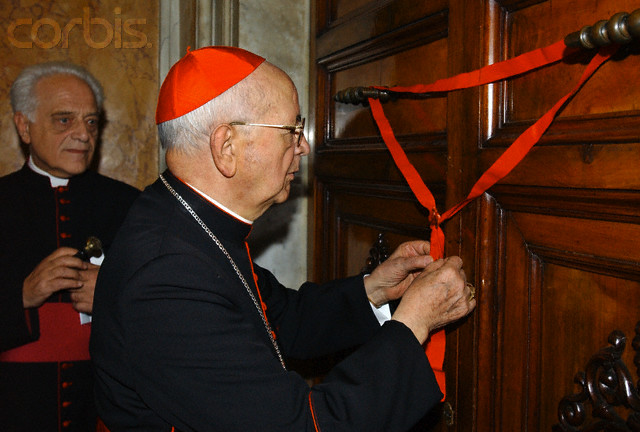
Sealing of the Pope’s Apartment : Not to be opened until the new Pope has been elected

The private residence of the Pope in the Vatican City, that is his apartment in the Apostolic Palace beside the Basilica of St. Peter is left vacant upon the death of the Pope, or in this case, the retirement of the reigning Pope, which began the sede vacante, during which no Pope is present.

Therefore, in order to avoid fraud and manipulation of papal documents of the previous Pope, and to prevent release of items that can only be done by the new Pope, the Pope’s Apartment is sealed, by a special officer of the Roman Curia, that is the Camerlengo (Chamberlain) of the Holy Roman Church, who is now Cardinal Tarcisio Bertone, who is also the Secretary of State of the Holy See.

The Camerlengo is the leader of the sede vacante transition period, and working in conjunction with the Dean of the College of Cardinals. His duties include sealing the Pope’s apartment and the destruction of the Pope’s Ring of the Fisherman, both of which meant to ensure no fraud documents can be released in absence of the Pope.

The sealing is done as soon as the Pope passed away or stepped down, and done in the presence of the Vice-Camerlengo, who is now Archbishop Pier Luigi Celata, and sealed with a silk string tied and sealed with a wax seal to ensure no one can enter the room, with the unbroken wax seal as evidence.

The room will only be opened again and the seal broken after the conclave is completed and a new Pope is elected.

Image below – from 2005 after the death of Blessed Pope John Paul II, then Camerlengo, Cardinal Eduardo Martinez Somalo sealing the Pope’s apartment

Image

Friday, 1 March 2013 : 2nd Week of Lent (Scripture Reflection)

We are urged today, not to have evil thoughts on our brothers and sisters today, as illustrated earlier in the story of Joseph in the first reading and the psalm, and how he was sold off in slavery to Egypt due to his brothers’ jealousy, which caused them to initially harbour evil thought of killing him. The same evil intent and plot also happened in the Gospel when the tenants disposed of the servants and the son of the landowner, in the intention of gaining the lands they have been lent with, and disobeying the owner’s wish.

We should not harbour such evil intent, but instead look upon our brothers and sisters with love. Especially, just as Christ has taught us, we should even also look upon our enemies and our persecutors with love! and pray for them too!

And then indeed, the story of the Gospel today, as many of you would know, is a parable on the life of Christ Himself, with the Pharisees and the chief priests being labeled as the evil tenants, as obviously stated in the Scripture. Jesus is the Son of the owner, who is God the Father, who sent Jesus to us, down to earth, just like the owner sent his son in the hope that he will be able to bring the tenants into line and pay up what they are supposed to pay.

But yet, the rejected ones, as we had seen, in both Jesus and Joseph, had become a great instrument of the Lord through their rejection by the people, represented by the brothers of Joseph and the tenants in the Gospel. For Joseph became the regent of Egypt through the gift of prophecy through dreams granted to him by God, which saved thousands if not many more souls from death, by the wise and ample preparation before famine ravaged Egypt for seven years. All these would not have happened without Joseph and his dreams.

Even greater is therefore the role of Christ, for in being rejected by the people, the ‘tenants’ particularly the chief priests, teachers of the Law, and the Pharisees, He has become the very instrument of salvation of all mankind. This rejection was represented by the arrest of Jesus, His trial by the Sanhedrin, leaders of the priests of Israel, and finally His condemnation to death, and His death on the cross. In this He, as the rejected stone by the builder, had become the cornerstone, the very vital part of God’s plan of salvation.

What is a cornerstone? While we do not often use the terms in daily life, architects and those dealing with infrastructure and buildings will know it very well. For cornerstone is named so, since, at the time of the Roman Empire, there is a passion for building commemorative and triumphal arches. Some of these arches can still be seen even today, and some remained in the city of Rome itself. Why are these arches so strong and so solid to be able to stand for centuries and even millenia? It is because of its structure, which is so wonderfully constructed even without modern technology to keep them intact, all just because of one single stone at the peak of the arch, which is called the cornerstone.

This cornerstone is the focal point and the most important point of the arch. For if the cornerstone is removed, the arch will immediately crumble. As long as the cornerstone remained in place, removing other stones from the arch would have minimum impact on the arch’s integrity. Similarly, cornerstone can also be found in other buildings, also known more as the foundation stone. This stone holds up the integrity of the whole building by just being there, and as long as the stone stands, the building will too.

Christ therefore, has become our cornerstone through His death and sacrifice on the cross, and later His glorious resurrection and triumph over death and evil. Why is He our cornerstone? That is because if we keep our anchor on Him, keeping faith in Him, and ensuring that our faith is anchored deeply and securely in Christ, no amount of worldly temptations, and no amount of attacks and persuasions by evil can sway us and make us to fall away from the grace of God.

Through Christ who is our cornerstone, we then can act out His love and compassion on all mankind, for only if we anchor ourselves in Christ, that we can act with love and kindness, out of our faith in God who also loves us dearly that He did not even hold back His Son to be given to us for sacrifice to liberate us from eternal damnation.

Then Christ too established His Church, our Church, as the living and concrete presence that represents Him and His mission in this world, and there was none other than Peter the Apostle, upon whom, as the Rock, Christ chose to build up His Church, making Peter the cornerstone of His Church, the Body of Christ, which is made up of all of us the faithful in Christ.

Now, that our Pope, Benedict XVI, who was the 264th successor of St. Peter, had stepped down from his position as our Pope effective today, our Church, God’s Church, has been left without that cornerstone of faith, which has been passed down since the day of Peter, the first cornerstone of the Universal Church. We still have Christ of course as our Cornerstone, on whom all hearts and minds must be directed to, but it is through the Apostle Peter and his successors, the Popes, that this is made manifest, by them being the cornerstone of God’s living presence in this world, that is the One, Holy, Catholic, and Apostolic Church.

Therefore, today, and through the sede vacante period, and beyond that, let us pray, brothers and sisters in Christ, that first, we all will remain ever faithful, and that our anchor of faith will ever be solidly planted in the cornerstone that is Christ our Lord, always remembering His rejection and sacrifice on the cross that made Him the cornerstone of our life, the cornerstone of salvation, that enabled mankind to return and be reunited with God.

And then, we also pray in particular for our Church, that God will guide the Cardinal-electors who will elect a new Pope to succeed our beloved Pope Benedict XVI, with the guidance of the Holy Spirit sent by God upon all of them. That the world will again have a tangible cornerstone that is the successor of St. Peter, who made the Cornerstone of Christ manifest and real in this world, as the cornerstone of God’s most Holy Church, and as the cornerstone and head of the Body of Christ, the Church, leading all the faithful in Christ in unity with Christ their Saviour.

In the end, the cornerstone, although important, still requires the presence of all of us, the stones surrounding the cornerstone, for the cornerstone by itself will not make a building. Therefore, brothers and sisters in Christ, let us support the new Pope, whoever he will be, as all the people who believe in Christ, that the new Pope, the future cornerstone of the Church, will together build up a solid and strong Church, that is able to project God’s love and work into this world, that more and more people will be saved.

May God bless all of us, bless His Church, bless our retired Pope Emeritus Benedict XVI, and his soon-to-be elected successor. Amen!