Thursday, 21 February 2013 : 1st Week of Lent, Memorial of St. Peter Damian, Bishop and Doctor (Scripture Reflection)

The Lord our God provides for all of us, and He cares for us. For He is our Father, the creator of all things in this universe. Therefore it is only fitting that He gives us all that we need, and no, those are not material goods and wealth, but love, His love, which fulfills us and make us whole in Him. All if we just simply ask Him, to open ourselves to Him who loves us. God is willing to give many things to us, but many times, we are simply not receptive to His approach and His outstretched hands. Even at other times we turned our back on God, and rejected His love and kindness to us, in favour of the pleasures and good things that the world has to offer us.

Indeed, the world does have many good things, and many of us are fortunate enough to have a comfortable life and enough in all things and material goods that we need to do so. However, many of us, especially those of us who are prosperous, increasingly in these recent years, are growing in their spiritual hunger, in the search of something that can satisfy their life. For material goods and wealth, although may bring joy at first, but it cannot continue to sustain our joy and happiness, not without the Lord as the centre of our life.

For life without God is ultimately empty. Men can gather as much money and wealth that they want, and then spend them as lavishly as they wish. However, as history has often told us, many of these people have no true happiness, since in dealing with their immense worldly possessions, they built for themselves the illusion of happiness, sustained by these wealth, and which blinded us not only to God, but also the plight of many among us who are indeed less fortunate.

Therefore, let us indeed aspire to become more like the Lord, who listens and who pays attention to those who come to Him, just as we are well received when we go and seek for Him in sincerity, and open the doors of His heart to us when we pray to Him in our hearts; Therefore, we too should make ourselves available and reachable to those around us, our friends, our relatives, those whom we do not know but need our help, and even those who hated us and persecuted us.

Let these people come to us, and when they ask, let us not turn them away, just as the Lord does not turn us away when we ask Him for mercy and favour. Open the door for them, and through us, let us be the channel of God’s love. Just as God’s love, grace, and blessing came to us, let us share these blessings, in whatever form, either material or even spiritual with those around us who are lacking. For as many as there are who still suffer from poverty and material deficiency, there are even more people in this world today, who suffer from the poverty of the soul, the emptiness of the soul, only curable by God Himself.

Let us endeavour to bring God to those who seek Him, and let us not deny them this chance, and therefore through us, God has made His work of redemption manifest, to bring the sacrifice of Christ on the cross into completion. Christ offered Himself for our sake that we can be saved, but there are still many who reject Him and reject His teachings.

Today, we commemorate the memorial of St. Peter Damien, was a well-known and respected Cardinal of the Church in the early medieval era, well known for his reform of the religious orders and monastic practices, and the priesthood in general. His great piety and humility, and constant acts of penitence showed his great quality in the faith, and especially important is the numerous writings attributed to him on the faith and the Church, and how these writings had considerable impacts on the later saints, which includes St. Francis of Assisi and other great medieval saints and doctors of the Church, which St. Peter Damian was one of them, a Doctor of the Church through his extensive and influential works on our Christian faith, helping to define the Church in the next centuries following his death.

Like St. Peter Damian too, we can follow in his footsteps and that of other great saints, whose great love for the Lord has made them to seek the Lord and ask Him for strength and perseverance to serve the people of God, and bring God’s love to them. We too can do so in our own ways, in our own daily lives, and among our own relatives, friends, and neighbours. Reach out and share with one another the love and faith you have in God. Remember that a light is not to be hidden, but to be put on a lampstand that all can see in its light. Let us bring light to everyone, through us, who has a share in the Light that is God, that all mankind will one day be united in Christ, in God who loves us dearly.

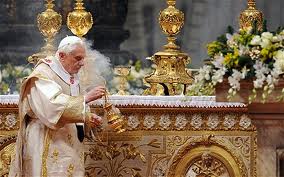
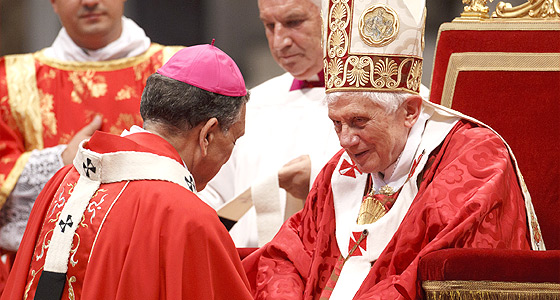
St. Peter Damian, pray for us, and pray for God’s holy Church in this world, for all the bishops, and for our Pope, who in his great humility as you were, gave up his position so that others who are more capable of the great ministry can help accomplish the works that he has begun. St. Peter Damian, we also ask you to pray for Monsignor William Goh, who will be ordained as a bishop tomorrow, that he will be always strong and empowered by the Holy Spirit in his ministry. Amen.

Episcopal Ordination of Coadjutor Archbishop William Goh of Singapore, Part II : The office of Bishop, what they wear, and their significance

Continuing from the first part, in which I elaborated on the Episcopal Ordination ceremony itself, let us now take a look at the office of the Episcopate itself, that is of a bishop. One may ask, who is a bishop? Bishops are ‘overseers’, which came from the Greek word, Episkopos, which means overseers, as in the early Church, there are those appointed to succeed the Apostles and oversee the Christian communities, to care for them like shepherds care for their flocks of sheep.

Such was the origin of the episcopate, with bishops as those appointed in positions of authority and with oversight over the laity and the religious alike, to keep them faithful to God, and united to the successor of the blessed Apostle Peter, who is our Pope.


This development of the early Church eventually become an office on its own, a separate level from the priesthood, as in the episcopate, there is a fulfillment and completion of the holy orders, which is symbolised by the bishop wearing both the deacon’s dalmatic, and the priest’s chasuble over the dalmatic. This symbolises the union of the ministry of the diaconate and the priesthood in the person of the bishop, who represents the completion of holy orders.

Cardinals and Popes are not separate orders on their own, unlike the diaconate, priesthood, and the episcopate, as these are just different types of bishops, with Cardinals usually being bishops from important dioceses/archdioceses in the world, and the officials of the Roman Curia (the body governing the Universal Church), and the Pope, being the Bishop of Rome, is still a bishop, but is preeminent due to him being the successor of the Apostle Peter, to whom Christ entrusted His Church, and thus the Pope becomes the very Vicar of Christ in this world.


There are also many types of bishops, which I will elaborate further below :


1. Diocesan bishops : These are the ordinary bishops, who head a diocese. A diocese is a division of the Church in a certain geographical area consisting of the faithful in Christ, who may share same culture, language, and customs, or may be of diverse linguistic and cultural origins.


2. Archbishops : These are the bishops who head a more important diocese, either by location, or by history, or by some other reasons. These dioceses therefore are also correspondingly named archdioceses. There are two types of archdioceses :

          a. Metropolitan Archdiocese : An archdiocese that has an overseer status over one or more other dioceses (called suffragan dioceses or suffragan sees) which are grouped together into an Ecclesiastical Province (or Province of the Church), and headed by a Metropolitan Archbishop, whose distinguishing feature is that he wears a pallium (a woolen shoulder band with black crosses).

          b. Archdioceses (directly subject) : These Archdioceses are important dioceses which has either been historically a metropolitan see or diocese that were elevated to an archdiocese status, but these are not overseeing any dioceses under them, and therefore stand alone on its own, directly subject to the Holy See, to the Pope, instead of through a Metropolitan. The Archdiocese of Singapore is of this type.


3. Auxiliary bishops : These are ‘helper’ bishops, who are appointed in larger dioceses/archdioceses to help with the administration of the diocese/archdiocese’s large Catholic population. May also succeed the diocesan bishop/archbishop upon retirement if selected by the Pope, but this succession is not automatic (not like that of a coadjutor). They are given titular see (diocese/archdiocese) upon their appointment as auxiliary bishop.


4. Coadjutor Archbishops/Bishops : These are bishops/archbishops appointed to dioceses/archdioceses to succeed the diocesan bishop/archbishop, whose age may be nearing 75 or in ill health. Bishops have to submit their resignation to the Pope upon reaching the age of 75, so the appointment of a coadjutor is a way to ensure that the diocese does not become vacant if the diocesan bishop resigns, and is a good way to prepare the coadjutor for the eventual succession and duty as the new bishop of the diocese. Coadjutors are not given any titular sees since they are bound immediately to the see (diocese/archdiocese) which they are to succeed in the future.


5. Titular dioceses/archdioceses : These are usually ancient dioceses/archdioceses, mostly located in North Africa and the Middle East, which due to historical events, had fallen into seclusion and extinction. Some can also be found in Europe and Italy, where some dioceses and archdiocese had been suppressed in the past, and become titular sees. These are now given to Apostolic Nuncios, Apostolic Delegates, and the auxiliary bishops.


6. Major Archdioceses : These are only found in the Eastern Catholic Churches, namely the main diocese in the Syro-Malankar, Syro-Malabar, Romanian, and Ukrainian Eastern Catholic Churches, whose importance place them into this special type of Archdioceses, but not high enough to be given the title of a Patriarchate itself.


7. Patriarchate (Latin and Eastern Catholic) : These are the special Patriarchal sees headed by a Patriarch, which in the Eastern Catholic Churches are the leaders of their respective Churches, in full communion with the Bishop of Rome. They are the Patriarchs of the ancient Pentarchy, of Alexandria, Jerusalem, and Antioch, and historically of Constantinople (modern-day Istanbul). However, in our approach to our sister Church of the Eastern Orthodox (who is not yet in full communion with Rome), we respect their Ecumenical Patriarch of Constantinople, who is the leader of the Eastern Orthodox faithful. Latin Patriarchates also exist in Lisbon, Venice, and Goa, which are headed by Roman Catholic Archbishops, but with special Patriarchal title, due to their distinctive history in the Church. Rome itself was a Patriarchate (of the West) until 2006, but was abolished by Pope Benedict XVI to better reflect the position of the Pope as the leader of the Universal Church, and not just the Church of the West (the Roman Church).


So, therefore, after talking about bishops, who they are, and what types of bishops are there, let us now look into the vestments and the items particular to bishops, all of which are steeped in the tradition of the faith and filled with deep symbolism.


1. Working dress (worn outside Mass and important events, the daily wear of bishops, and also for Cardinals and Popes)

a. Simar            
 Image

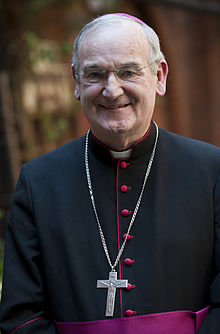
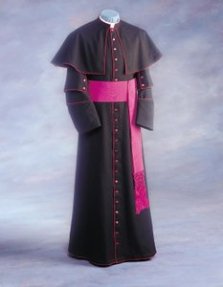
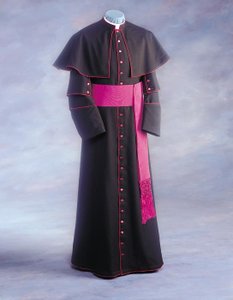
A simar is a special type of cassock worn by the bishops, cardinals, and popes, that is a cassock with a shoulder cape, and a sash (around the waist), which is violet for bishops, scarlet for cardinals, and white for popes. As is well known, the Pope’s simar is white in colour, while bishop’s and cardinal’s simar is black, and with violet lining for bishops, and scarlet lining for cardinals.


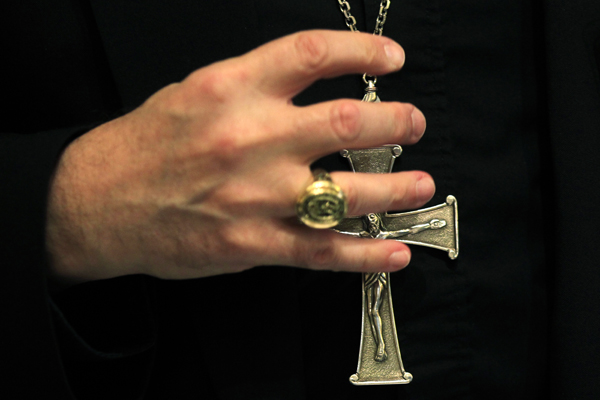
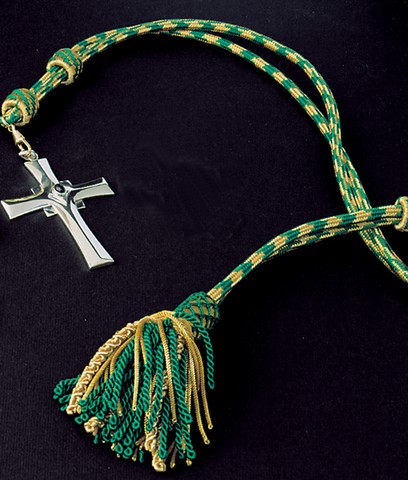
b. Pectoral cross (also part of the pontificalia and the choir dress)
Image


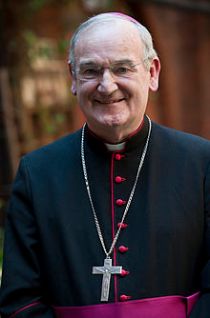
The pectoral cross is worn as its name suggests, on the breast, to represent Christ who protects us from harm, as noted in the prayer of the bishop when he wear the pectoral cross before the Mass, called Munire me dignerisMunire digneris me, Domine Jesu Christe, ab omnibus insidiis inimicorum omnium, signo sanctissimae Crucis tuae: ac concedere digneris mihi indigno servo tuo, ut sicut hanc Crucem, Sanctorum tuorum reliquiis refertam, ante pectus meum teneo, sic semper mente retineam at memoriam passionis, et sanctorum victorias Martyrum. (May You graciously protect me, o Lord Jesus Christ, from all the snares of all my enemies, the sign of the Your most holy Cross: that You would vouch and grant to me and all unworthy of being Your servant, that I may receive the Cross, filled with the remains of Your Saints, in front of my breast, I hold, then it always in mind, but retain the memory of the passion, martyrs and saints victories.). 

This is because pectoral crosses are usually precious and contain the relics of the saints, which therefore be further a reminder that the bishop carries with Him at all times, Christ, and His holy Saints, and a reminder of the Cross, through which the salvation of our Lord comes to us.


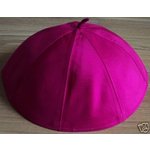
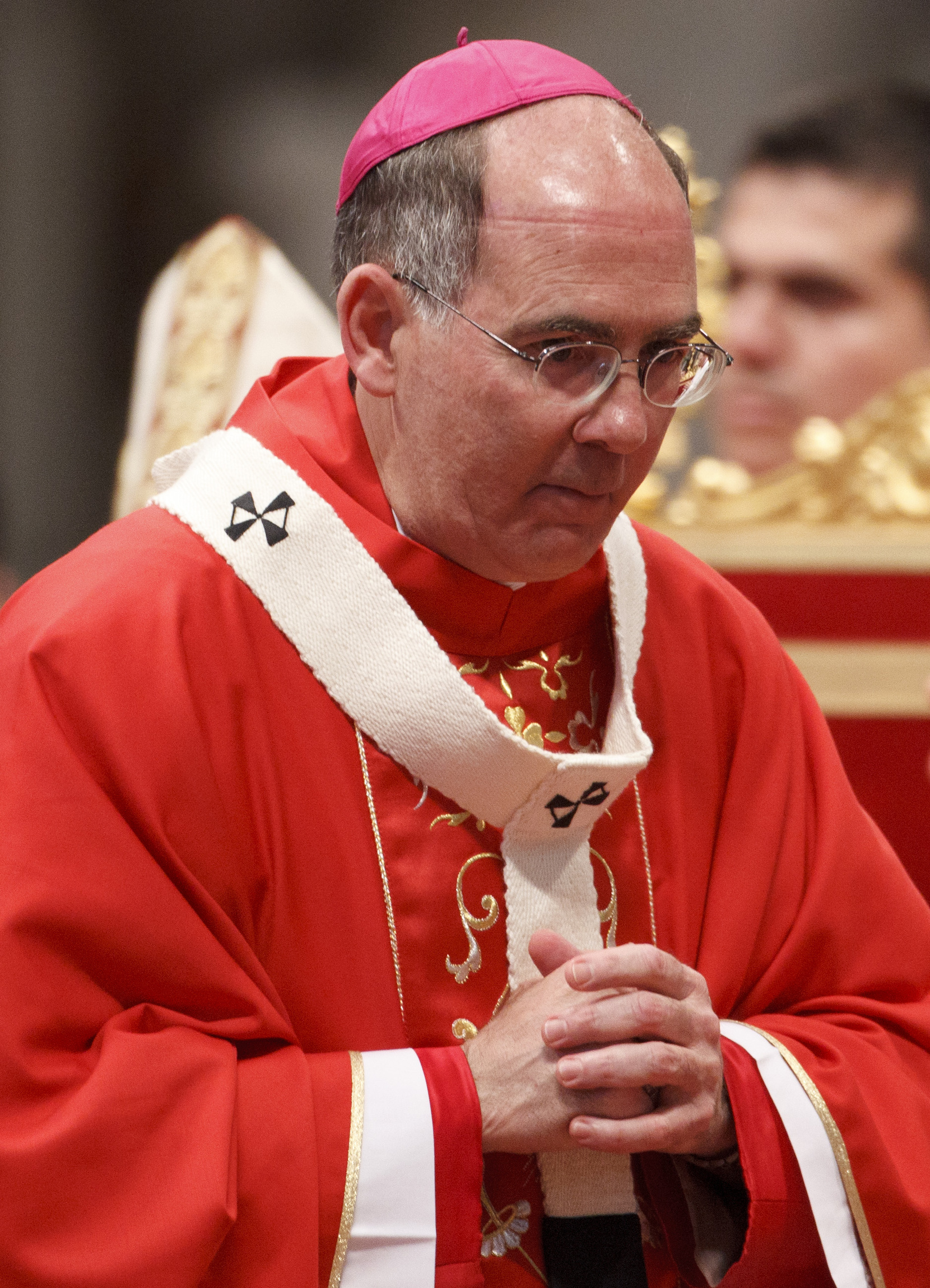
c. Zucchetto (or skullcap)
Image


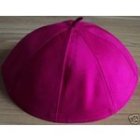
Zucchetto is from the Italian word which means small gourd, because its shape which resembles (half of) a pumpkin. This is a head covering item for the bishops, cardinals, and popes, with the similar pattern of violet for bishops, scarlet for cardinals, and white for popes. This item has a lot in common and may have originated from the Jewish prayer cap, which is somewhat different from the zucchetto in appearance. Originally zucchetto has a practical use in the past, since the clergy in that era were tonsured, that is having their head shaved at the centre, and thus, without the present day heating available, during cold times, the head of the prelate (bishops) would become cold, and the zucchetto came in handy as a covering.

Nowadays, it is a symbol of prayer, and also honor, and therefore, as a sign of humility, it is always removed at the beginning of the Preface of the Eucharistic Prayer and the head of the bishops (including cardinals and Popes) remain bare throughout the Eucharistic Prayer and the Communion.


d. Episcopal ring
Image


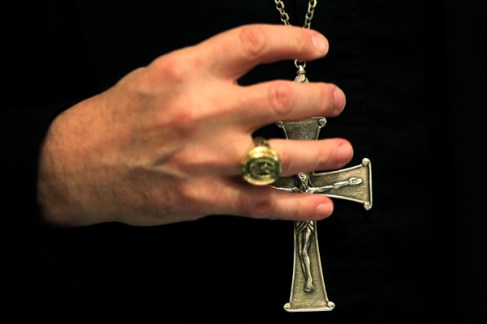
The episcopal ring symbolises the bishop as the shepherd is married to God’s Church, in particular the diocese and the sheep, the faithful in Christ whom he is supposed to guide as the shepherd. The prayer the bishop said when wearing it reflects that this ring is also a symbol of virtue and sanctification, and blessing : Cordis et corporis mei, Domine, digitos virtute decora, et septiformis Spiritus sanctificatione circumda. (With my heart and of my body, O Lord, decorate my fingers with virtue, and sanctify me with the sevenfold blessing of the Holy Spirit around me).


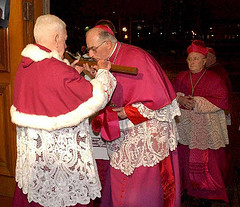
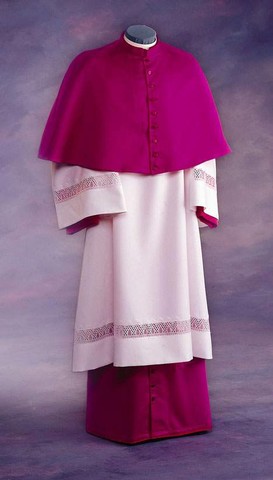
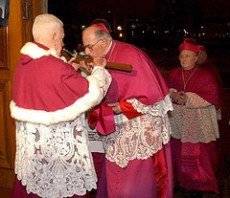
2. Choir dress (worn during the Mass if the bishop is not the celebrant or concelebrant in the Mass, and events like Vespers, and also worn outside for important events)
Image

a. Cassock with fascia/sash

This cassock with sash style is similar to the simar, but is entirely violet for bishops and scarlet for cardinals (as opposed to black with violet or scarlet lining)


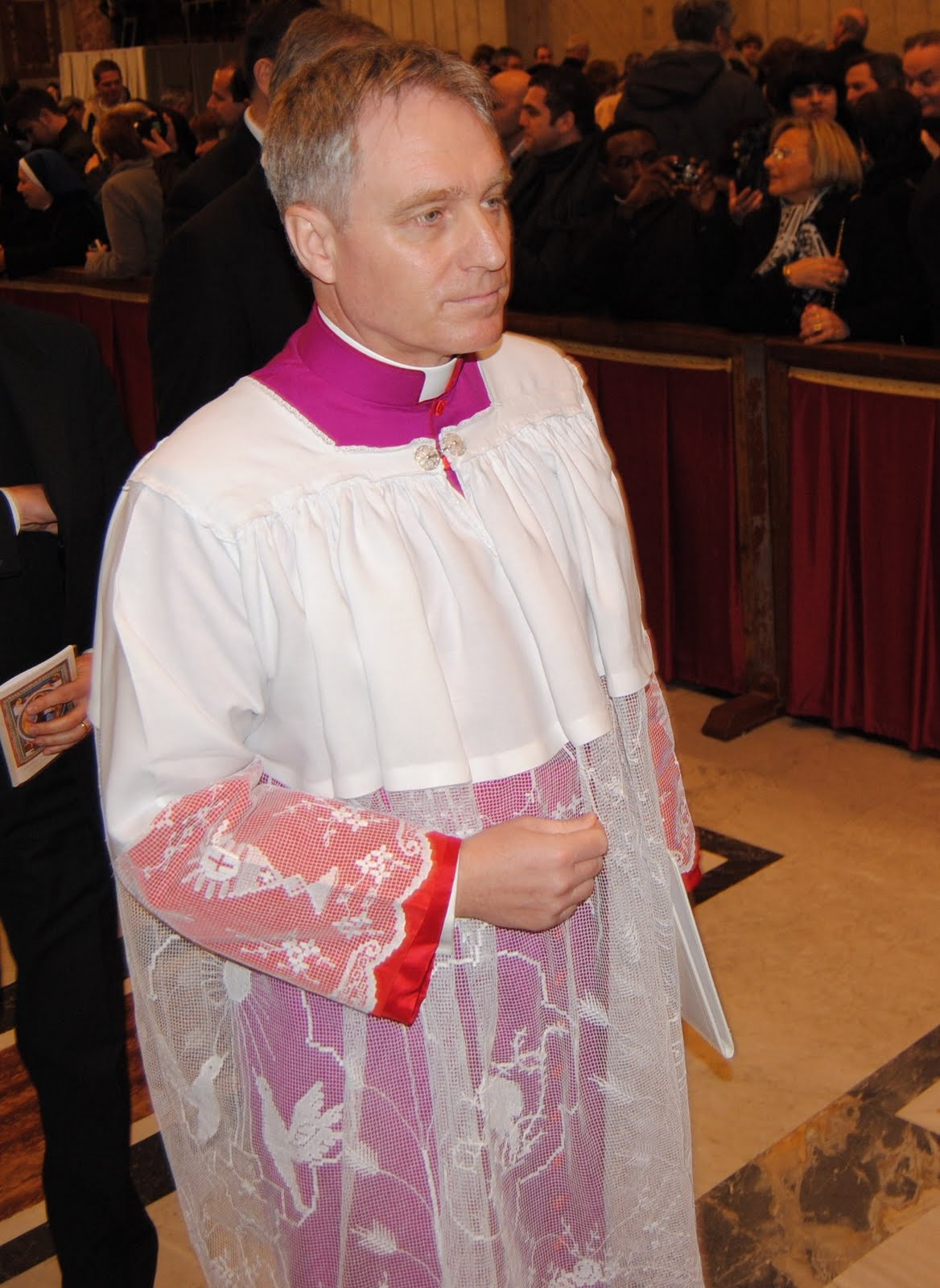
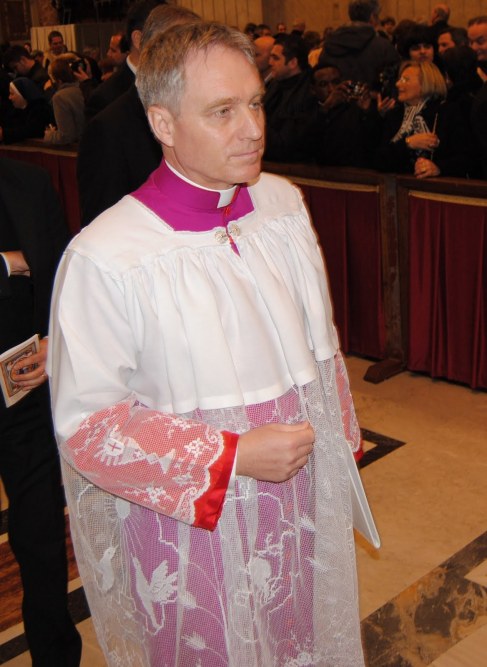
b. Rochet
Image

A beautiful, usually thin, either white or translucent, and laced piece of clothing worn over the cassock and the fascia, as seen worn above by Monsignor Georg Ganswein, now Archbishop Ganswein, Prefect of the Pontifical Household.


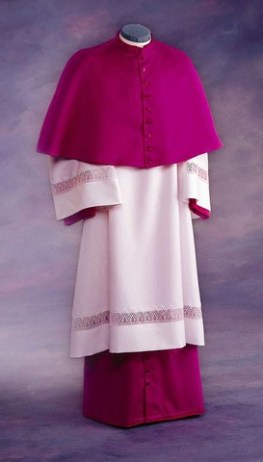
c. Mozzetta
Image


Mozzetta (violet for bishops) is a shoulder cape worn over the rochet and the cassock.


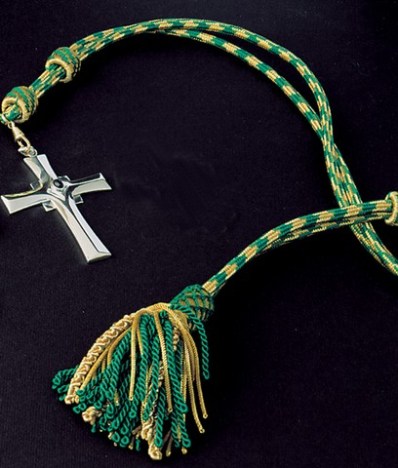
d. Pectoral cross
Image

Similar with in working dress, but more often worn with a cord rather than a chain.


e. Zucchetto

Violet for bishops. Similar as in the working dress.


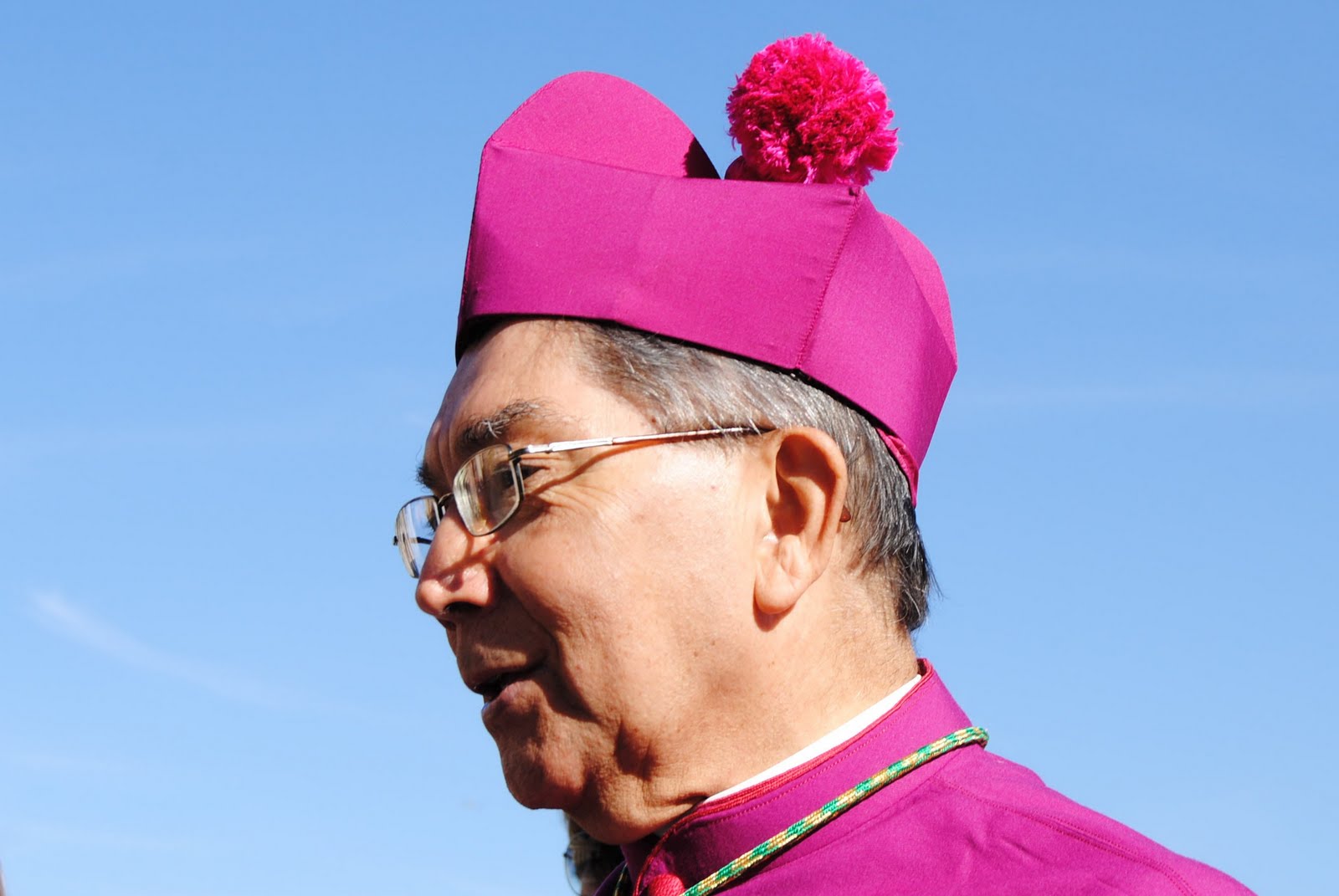
f. Biretta
Image


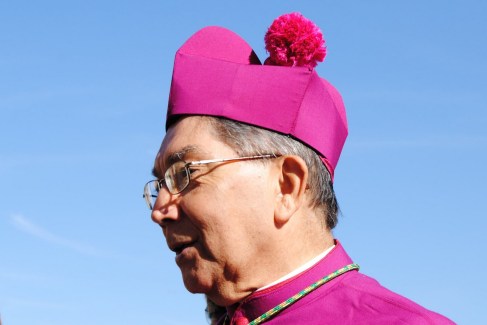
A hat-like item which has the same ancestry as our modern academic mortar board (worn on the graduations in universities), which is violet for bishops and has a pom-pom like object on the top. Only has three peaks, and the unpeaked side is always worn on the left.


3. Bishop’s Pontificalia (worn during the Mass when celebrating)

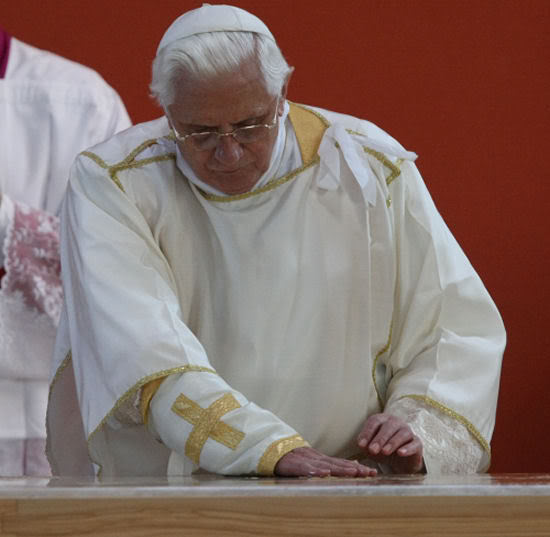
a. Dalmatic

Image


Similar as those worn by deacons, which has squarish-edges as compared to the chasuble (which has more rounded edges), worn over the alb but under the chasuble. Here is the picture of our Pope Benedict XVI wearing the dalmatic during the consecration of a new church in Rome, after he took off his chasuble for the anointing of the altar with holy oils.


b. Chasuble
Image


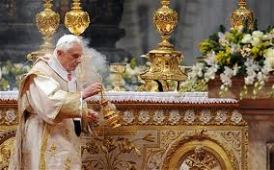
Chasuble as worn by the priests, worn over the dalmatic and the stole, and in this picture, Pope Benedict XVI wore the more traditional Roman-style chasuble, and very visibly underneath the chasuble, is the dalmatic. Only bishops can wear both the chasuble and the dalmatic.


c. Pectoral cross

Worn under the chasuble, not over the chasuble, either the normal chained or corded pectoral cross. Not correctly worn when worn above the chasuble, although many bishops seem to do this. Pope Benedict XVI himself consistently wear the pectoral cross under the chasuble since the beginning of his Pontificate.


d. Episcopal ring

Worn on the finger, which signify his marriage to God and His Church.


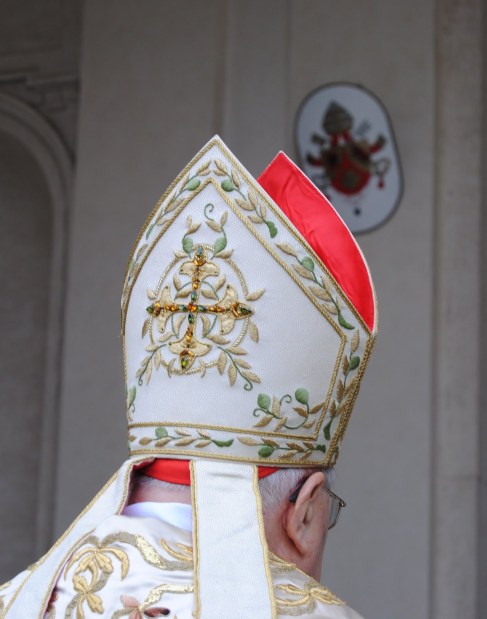
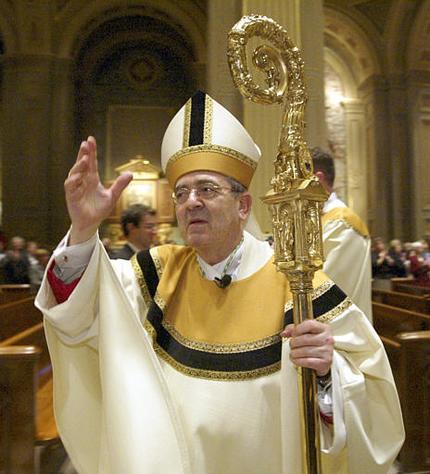
e. Mitre
Image


Image


Image


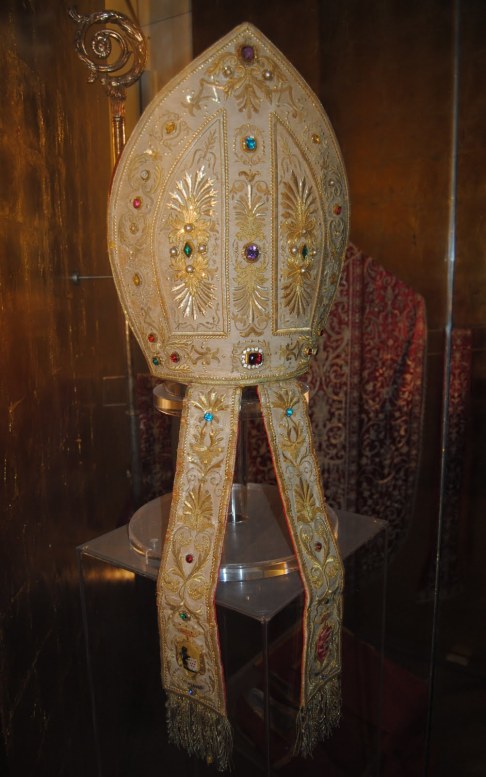
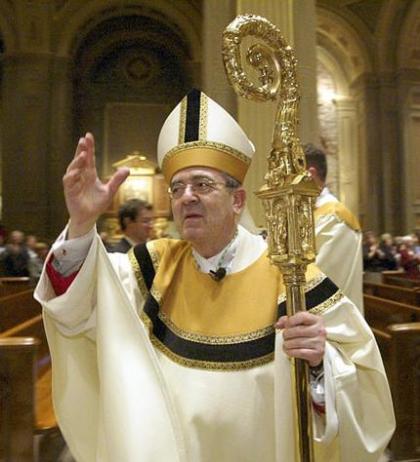
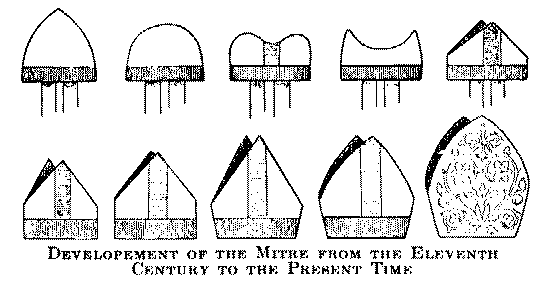
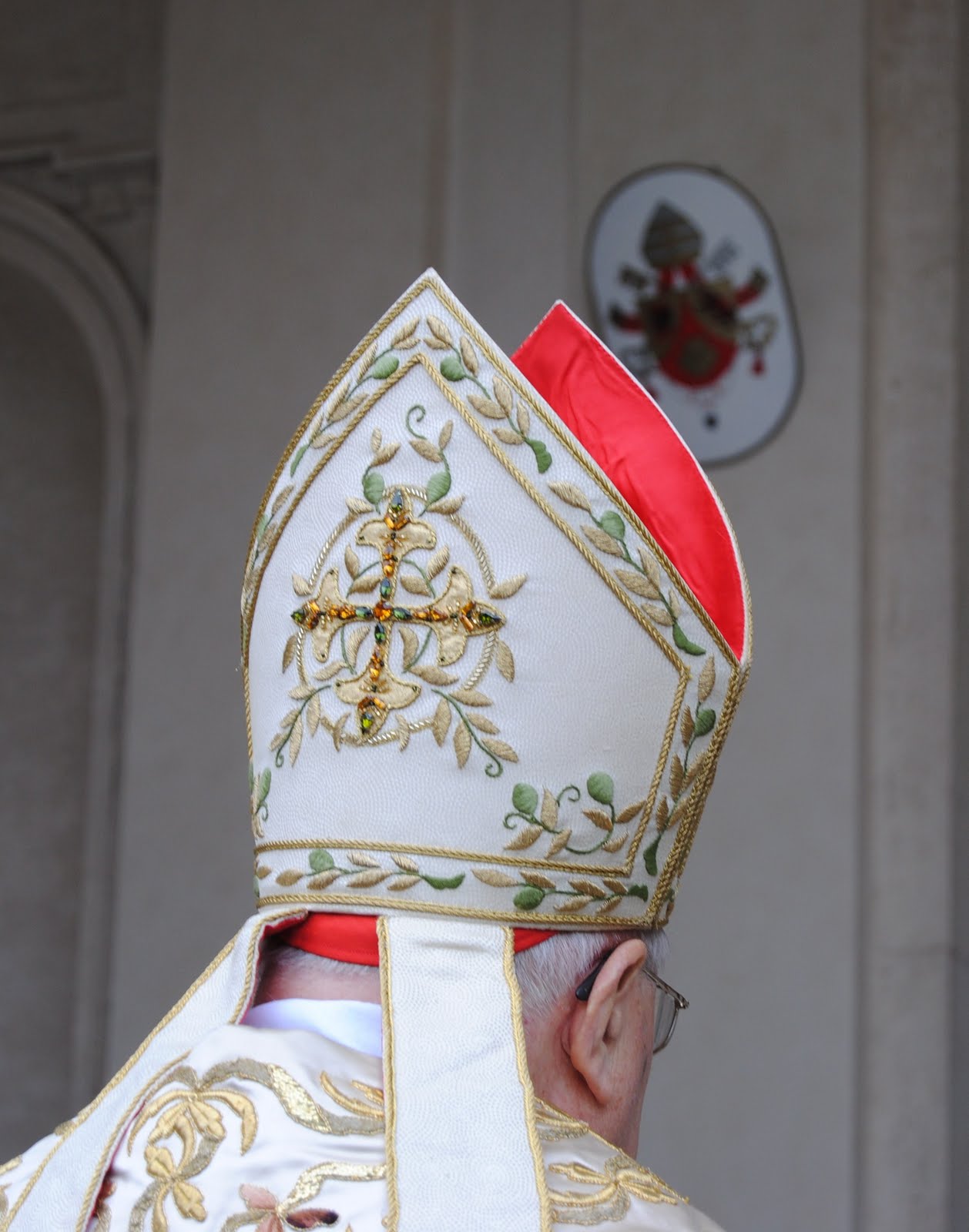
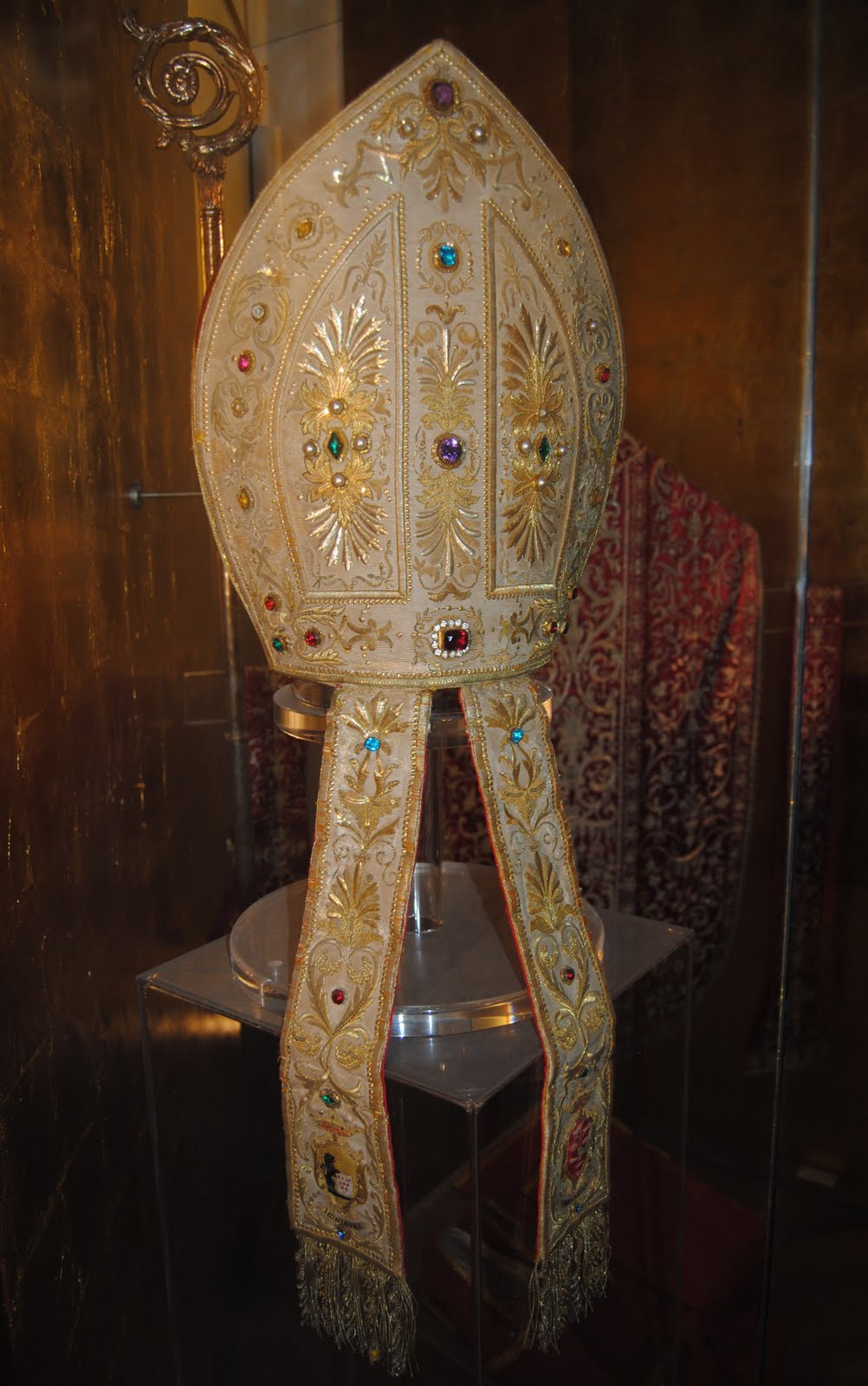
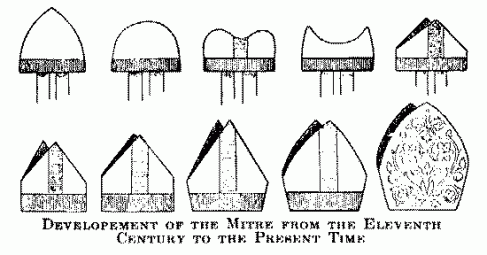
Worn over the zucchetto on the head, and was developed from the camelaucum, or the secular headdress of the late Roman Empire and early Byzantine Empire, where they are also worn by the Popes and the Roman priests, and gradually was restricted only to bishops and abbots.

The mitre symbolises the teaching authority of the bishops, which are symbolised by the two peaks of the mitre, representing the Old and the New Testament, and also recall the flames of the Holy Spirit that inflame the hearts of the Apostles to spread the Good News to all peoples. Therefore, these represents the authority of the bishop to teach the Gospel through the Holy Spirit and based on the Scripture, the Word of God, both the Old and the New Testament. The two lappets behind the mitre themselves also represent the Old and the New Testament, the two sides of the Lord’s Sacred Scripture (which shape looks just like a book marker).


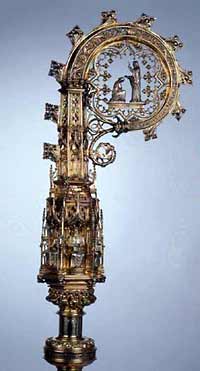
f. Crosier (Pastoral staff)
Image


Image


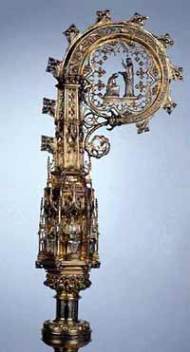
The crosier, or the pastoral staff is the crook-like staff, reminding us on the shepherd’s crook, which they use to shepherd their sheep. Thus, the crosier represents the bishops’ role as the shepherds of the people of God, and guide them in their journey towards the Lord, the Chief Shepherd, the Good Shepherd.


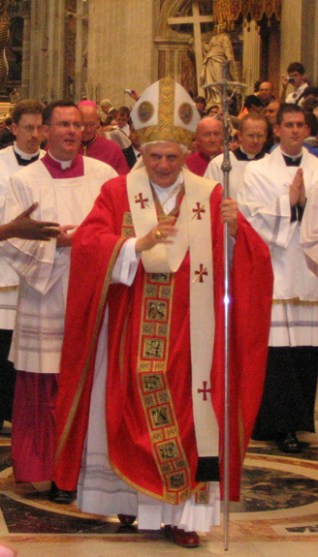
g. Pallium (only for Metropolitan Archbishops and the Pope)
Image

The pallium is a woolen band worn around the shoulder. This represent the metropolitan’s role as the overseer of the faithful, over the sheep of the Lord, that is the faithful people of God, just like Jesus, the Good Shepherd carrying His sheep on His shoulder. Therefore, the pallium represents both the authority of the metropolitan, and the burden presented by his ministry in the service of the Lord.

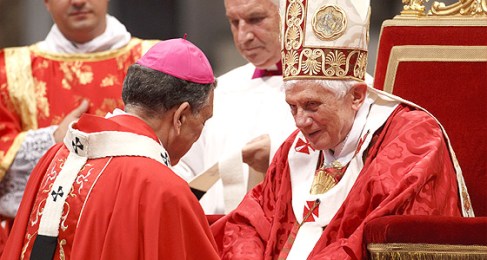
Image


Image

The pallium used to be much wider, as reflected in the earlier pallium that Pope Benedict XVI wore, which used the style not worn since a millenia ago, in the earlier days of the Church. Now the most common form of the pallium is a shorter and narrower woolen band worn around the shoulders, and adorned with three pins that represent the nails that pieced Christ on the cross, and these pins were placed onto the black crosses (red for Pope Benedict XVI’s new, larger pallium and the earlier, much larger pallium), which represent the wounds of Christ.


After all that, and after looking into what a bishop is, what is the nature of the ministry of the bishops, the types of bishops, what they wear and what symbolisms are there in them, let us now take a time to pray, and pray indeed for the soon-to-be ordained Coadjutor Archbishop, William Goh, of the Archdiocese of Singapore.

May God be with him all the days of his new ministry as bishop, and strengthen him at all times, that when his ministry begins this Friday, the Holy Spirit will guide him and keep him faithful to the ministry he has been chosen for, forever and ever. Amen!

 

How the Conclave proceeds : A very nice and concise animation!

http://vaticaninsider.lastampa.it/en/the-vatican/come-si-elegge-il-papa/

Go and visit this site, which offers a very good and detailed though simple explanations on the way a Conclave proceeds. Not only that it is easy to follow, step-by-step from the beginning of the Conclave to after a new Pope is elected, I believe it’s quite neat too, with all the animations they did for the occasion. Good job Vatican Insider!

2013 Papal Conclave Update : Conclave may begin earlier than 15 March 2013

The Vatican has announced that there is indeed a possibility that the Conclave may begin earlier than the earlier announced 15-20 March 2013 timeframe. This is because unlike normal period of sede vacante (or vacant See ‘of Rome’) due to the death of the previous Pope, Pope Benedict XVI’s decision to retire and renounce the Papacy has been announced well ahead of the actual date of beginning of the sede vacante.

Thus, the Cardinals have ample time to prepare for the Conclave and travel to Rome by the time the See becomes vacant on 28 February 2013 at 8.00 pm Rome time. This would then allow the Conclave to begin much earlier, perhaps in early March 2013, and will allow a new Pope to be elected immediately, and then the new Pope can already be installed (at St. Peter’s Square ceremony of the imposition of the pallium and the Fisherman’s Ring) and enthroned (at the Basilica of St. John Lateran, the Cathedral of Rome), before the Holy Week begins on Palm Sunday (24 March 2013).

If the Conclave begins only on the 15th of March or even later, there would be no time left available for the Pope to be properly installed and enthroned before the busy Holy Week begins. Another advantage is also that the Cardinal-electors (especially the residential Archbishops and bishops of Archdioceses and dioceses around the world) can return to their home and celebrate the Holy Week with their diocese/archdiocese, rather than be stuck in Rome due to the late Conclave.

1 month since the beginning of my blog. May God always be with me and my hands!

16 January 2013, a month ago, I have decided to begin this blog, which begun officially on 17 January 2013, the next day.

A month has passed since then, and every time, I always feel the Lord’s guiding my hands to continue writing both on the Scripture, the daily reflections, and the other matters regarding the faith, more so now that a new Coadjutor Archbishop of Singapore will be ordained soon within this week (on Friday, 22 February 2013), and that our beloved Pope Benedict XVI will step down at the end of this month, and his successor to be elected in a month’s time.

Pray for me, pray for the Coadjutor Archbishop of Singapore, Msgr. William Goh, pray for our Pope Benedict XVI, for his successor-to-be, and pray for the Universal Church and for the world. May God be with us all, always, and may His blessing be upon us. Amen.


Statistics of my blog (1 month)

Total Visitors : 1,192

Total Views : 1,801


View statistics by country (Total observed = 1,767)

1. United States of America = 717

2. Singapore = 405

3. United Kingdom = 115

4. Philippines = 107

5. Canada = 82

6. Malaysia = 47

7. Italy = 33

8. Australia = 28

9. France = 21

10. Ireland = 20

11. India = 17

12. Indonesia = 14

13. Poland = 10

14. Germany = 9

15. Switzerland = 7

16. Trinidad and Tobago = 7

17. Belgium = 6

18. Republic of Korea (South Korea) = 6

19. Mexico = 6

20. Brazil = 5

21. Hong Kong = 5

22. Nigeria = 5

23. Spain = 5

24. Czech Republic = 5

25. New Zealand = 5

26. Croatia = 5

27. Bolivia = 4

28. Chile = 4

29. Hungary = 4

30. Kenya = 4

31. Argentina = 3

32. Sri Lanka = 3

33. Brunei Darussalam = 3

34. Malta = 3

35. Thailand = 3

36. South Africa = 2

37. Sweden = 2

38. Zimbabwe = 2

39. Vietnam = 2

40. Greece = 2

41. Namibia = 2

42. Colombia = 2

43. Japan = 2

44. Austria = 2

45. Portugal = 2

46. Laos = 2

47. Venezuela = 2

48. Puerto Rico = 2

49. Turkey = 1

50. Honduras = 1

51. United Arab Emirates = 1

52. Russian Federation = 1

53. Lithuania = 1

54. Timor-Leste = 1

55. Qatar = 1

56. Ghana = 1

57. Bangladesh = 1

58. Romania = 1

59. Pakistan = 1

60. Luxembourg = 1

61. Uganda = 1

62. Slovakia = 1

63. Oman = 1

64. Denmark = 1

65. Macau = 1

66. Saudi Arabia = 1

+Ut Omnes Unum Sint, ad Maiorem Dei Gloriam+

(That they all may be One, for the greater glory of God)

Full text of the Apostolic Constitution, Universi Dominici Gregis, governing the Papal Conclave

http://www.vatican.va/holy_father/john_paul_ii/apost_constitutions/documents/hf_jp-ii_apc_22021996_universi-dominici-gregis_en.html

The Apostolic Constitution, Universi Dominici Gregis, released by Blessed Pope John Paul II on 22 February 1996, which regulates the Papal conclave, and as such, was in effect in the 2005 papal conclave, and should also govern the 2013 papal conclave, which will begin within a month or so from now.

Let us pray for the Cardinal-electors, for our Pope Benedict XVI, for his successor-to-be, and for the Universal Church and the world. Amen.

Papal Conclave will begin between 15 March 2013 to 20 March 2013

http://www.romereports.com/palio/vatican-conclave-will-begin-between-march-15-and-20-english-9048.html

It is confirmed that in accordance with the rules of the Papal Conclave, the Universi Dominici Gregis (UDG), that a conclave must begin within 15 to 20 days from the time the See of Rome is vacant, either by death or the renouncement by the previous Pope, the Conclave date has been set to be sometime in mid-March.

Let us all pray together that God will send His Holy Spirit to all the Cardinal-electors, that we will soon have a new shepherd, the Bishop of Rome, successor to our beloved Pope Benedict XVI, Blessed Pope John Paul II, and St. Peter the Apostle. God be with us all, His Church!

+Ut Omnes Unum Sint, ad Maiorem Dei Gloriam+
(That they all may be One, for the greater glory of God)

Cardinal Marc Ouellet, Prefect of the Congregation for Bishops : My only other alternative as the potential new Pope

Cardinal Marc Ouellet, former Metropolitan Archbishop of Quebec and Primate of Canada, who is now the Prefect of the Congregation for Bishops is my only other choice for the potential next Pope in the Conclave, besides Cardinal Angelo Scola, the Archbishop of Milan.

Cardinal Ouellet is the top non-Italian and non-European in the Roman Curia, and represents the Roman Curia side of the candidacy, just as Cardinal Angelo Scola represents the non-Curial side of the candidacy. Cardinal Ouellet is a great theologian and has done many work in the field of theology and Catholic education. He has also done a great job in the Congregation for Bishops, and strongly committed to the cause in defense of life and the orthodoxy of the faith of the Roman Catholic Church.

He is my only other choice other than Cardinal Scola, who has the best chance of being elected in my opinion. Let the Holy Spirit decides who will be the worthy 267th successor of St. Peter the Apostle, on whom Christ entrusted the keys to the Kingdom of Heaven and built His Church.

Pray for both Cardinal Scola and Cardinal Ouellet too, may God be with them, and the rest of the College of Cardinals. Amen!

Pope Benedict XVI’s message for the World Day of Prayer for the Sick, Monday, 11 February 2013

Pope Benedict XVI announced his resignation or retirement from the office of the Bishop of Rome, and he made his announcement on the Feast day of our Lady of Lourdes, which is also the World Day of Prayer for the Sick, in remembrance of the miraculous healing at Lourdes.

Our Pope has given up his office as he is getting older and unable to shoulder much further the burden of the leadership of the Universal Church, and he is getting sick as old people do. Let us commend him to our Lady of Lourdes, and remember him always in our prayers through his retirement.

Here is the message from the Pope for the occasion, released in January 2013 :

MESSAGE OF THE HOLY FATHER ON THE OCCASION
OF THE TWENTY-FIRST WORLD DAY OF THE SICK
(11 FEBRUARY 2013)

“Go and do likewise” (Lk 10:37)

Dear Brothers and Sisters,

1. On 11 February 2013, the liturgical memorial of Our Lady of Lourdes, the
Twenty-first World Day of the Sick will be solemnly celebrated at the Marian
Shrine of Altötting. This day represents for the sick, for health care workers, for the
faithful and for all people of goodwill “a privileged time of prayer, of sharing, of
offering one’s sufferings for the good of the Church, and a call for all to recognize
in the features of their suffering brothers and sisters the Holy Face of Christ, who,
by suffering, dying and rising has brought about the salvation of mankind” (JOHN
PAUL II, Letter for the Institution of the World Day of the Sick, 13 May 1992, 3). On this
occasion I feel especially close to you, dear friends, who in health care centres or at
home, are undergoing a time of trial due to illness and suffering. May all of you be
sustained by the comforting words of the Fathers of the Second Vatican Council:
“You are not alone, separated, abandoned or useless. You have been called by
Christ and are his living and transparent image” (Message to the Poor, the Sick and the
Suffering).

2. So as to keep you company on the spiritual pilgrimage that leads us from
Lourdes, a place which symbolizes hope and grace, to the Shrine of Altötting, I
would like to propose for your reflection the exemplary figure of the Good
Samaritan (cf. Lk 10:25-37). The Gospel parable recounted by Saint Luke is part of a
series of scenes and events taken from daily life by which Jesus helps us to
understand the deep love of God for every human being, especially those afflicted
by sickness or pain. With the concluding words of the parable of the Good
Samaritan, “Go and do likewise” (Lk 10:37), the Lord also indicates the attitude that
each of his disciples should have towards others, especially those in need. We need
to draw from the infinite love of God, through an intense relationship with him in
prayer, the strength to live day by day with concrete concern, like that of the Good
Samaritan, for those suffering in body and spirit who ask for our help, whether or
not we know them and however poor they may be. This is true, not only for
pastoral or health care workers, but for everyone, even for the sick themselves, who
can experience this condition from a perspective of faith: “It is not by sidestepping
or fleeing from suffering that we are healed, but rather by our capacity for
accepting it, maturing through it and finding meaning through union with Christ,
who suffered with infinite love” (Spe Salvi, 37).

3. Various Fathers of the Church saw Jesus himself in the Good Samaritan; and
in the man who fell among thieves they saw Adam, our very humanity wounded
and disoriented on account of its sins (cf. ORIGEN, Homily on the Gospel of Luke
XXXIV,1-9; AMBROSE, Commentary on the Gospel of Saint Luke, 71-84; AUGUSTINE,
Sermon 171). Jesus is the Son of God, the one who makes present the Father’s love,
a love which is faithful, eternal and without boundaries. But Jesus is also the one
who sheds the garment of his divinity, who leaves his divine condition to assume
the likeness of men (cf. Phil 2:6-8), drawing near to human suffering, even to the
point of descending into hell, as we recite in the Creed, in order to bring hope and
light. He does not jealously guard his equality with God (cf. Phil 2:6) but, filled
with compassion, he looks into the abyss of human suffering so as to pour out the
oil of consolation and the wine of hope.

4. The Year of Faith which we are celebrating is a fitting occasion for intensifying
the service of charity in our ecclesial communities, so that each one of us can be a
good Samaritan for others, for those close to us. Here I would like to recall the
innumerable figures in the history of the Church who helped the sick to appreciate
the human and spiritual value of their suffering, so that they might serve as an
example and an encouragement. Saint Thérèse of the Child Jesus and the Holy
Face, “an expert in the scientia amoris” (Novo Millennio Ineunte, 42), was able to
experience “in deep union with the Passion of Jesus” the illness that brought her
“to death through great suffering” (Address at General Audience, 6 April 2011). The
Venerable Luigi Novarese, who still lives in the memory of many, throughout his
ministry realized the special importance of praying for and with the sick and
suffering, and he would often accompany them to Marian shrines, especially to the
Grotto of Lourdes. Raoul Follereau, moved by love of neighbour, dedicated his life
to caring for people afflicted by Hansen’s disease, even at the world’s farthest
reaches, promoting, among other initiatives, World Leprosy Day. Blessed Teresa of
Calcutta would always begin her day with an encounter with Jesus in the Eucharist
and then she would go out into the streets, rosary in hand, to find and serve the
Lord in the sick, especially in those “unwanted, unloved, uncared for”. Saint Anna
Schäffer of Mindelstetten, too, was able to unite in an exemplary way her sufferings
to those of Christ: “her sick-bed became her cloister cell and her suffering a
missionary service. Strengthened by daily communion, she became an untiring
intercessor in prayer and a mirror of God’s love for the many who sought her
counsel” (Canonization Homily, 21 October 2012). In the Gospel the Blessed Virgin
Mary stands out as one who follows her suffering Son to the supreme sacrifice on
Golgotha. She does not lose hope in God’s victory over evil, pain and death, and
she knows how to accept in one embrace of faith and love, the Son of God who was
born in the stable of Bethlehem and died on the Cross. Her steadfast trust in the
power of God was illuminated by Christ’s resurrection, which offers hope to the
suffering and renews the certainty of the Lord’s closeness and consolation.

5. Lastly, I would like to offer a word of warm gratitude and encouragement to
Catholic health care institutions and to civil society, to Dioceses and Christian
communities, to religious congregations engaged in the pastoral care of the sick, to
health care workers’ associations and to volunteers. May all realize ever more fully
that “the Church today lives a fundamental aspect of her mission in lovingly and
generously accepting every human being, especially those who are weak and sick”
(Christifideles Laici, 38).
I entrust this Twenty-first World Day of the Sick to the intercession of Our
Lady of Graces, venerated at Altötting, that she may always accompany those who
suffer in their search for comfort and firm hope. May she assist all who are
involved in the apostolate of mercy, so that they may become good Samaritans to
their brothers and sisters afflicted by illness and suffering. To all I impart most
willingly my Apostolic Blessing.

From the Vatican, 2 January 2013
BENEDICTUS PP. XVI

The Papacy, St. Peter the Apostle, and Christ : the unbreakable chain

‎”No chain is stronger than its weakest link, and the weakest link of the chain of Popes was the first (Peter). But that weak link was held in the hands of Christ. That is why the papacy will never fail.” – Venerable Fulton Sheen

Christ Himself have the Church firmly in His hands, and He will not let go. He is faithful to us just as we are faithful to Him. The Church He has built and the authority He has given to Peter to feed His sheep, will never fail.