
Thursday, 11 July 2013 : 14th Week of Ordinary Time, Memorial of St. Benedict, Abbot (Scripture Reflection)

Dear brothers and sisters in Christ, today we heard from the readings about the mission that Christ had entrusted all of us with. The mission that He had given to the apostles before He left this world, that is to spread the Good News of salvation to all mankind, and to all the world. Each and every Christians baptised in the Name of the Most Holy Trinity of Father, Son, and the Holy Spirit must uphold this mission and pledge ourselves to its cause, that is the cause of the Lord.

Christ had called all of us to be His disciples, to bring all the people of God back to His loving embrace, to open their eyes and their hearts to God’s divine and everlasting love. The Lord offers His love and His peace freely to all, without exception, even sinners, and especially sinners, because the Lord did come especially for the sake of sinners, those lost sheep lost in the darkness of evil and sin.

Christ gave up His life in sacrifice, as a worthy offering in atonement for all our sins, all of us, without any exceptions. He died for all mankind, past, present, and future so that all may live, and in this new life, be granted eternal life in glory with Him for eternity, as long as we keep to the covenant that He had made with us, a new covenant sealed by His Blood pouring down from the cross.

Our Lord Jesus loves us, brethren, so much that He is willing to suffer all the blows, lashes, and curses, the pain of the nails that pierced his hands and feet, so that all of us do not have to suffer death eternal in hell. For our sins and iniquities the Lamb of God had been slaughtered and sacrificed, innocent and pure as He is, He was made to bear all the sins of the world.

Sadly, as many as those who would accept His call and His words, and followed Him into a new life of purity and holiness, there are even many more who would prefer to remain in their state of sin and darkened life, and preferred the pleasures of the world and Satan to the Lord who loves them. Many would reject Him and reject His messengers and disciples, including all of us who had been called by the Lord to be His apostles in this modern era.

So if Christ is rejected by many, then we will be rejected too, but this does not mean that we should slacken or abandon the mission that has been given to us. Indeed, there are still those who would accept Christ and His Good News, and even among those who have rejected Him and rejected us, there is always still hope, that they will change and receive the Lord. We must remain strong and courageous, and embrace our mission with zeal, devotion, and most importantly, love.

Today, we celebrate the memorial of St. Benedict the abbot, also known widely as St. Benedict of Nursia, the founder of the religious order of St. Benedict, or the Benedictines. He was also an inspiration for our great Pope Emeritus, the beloved Pope Emeritus Benedict XVI, in choosing his regnal name as Pope, together with Pope Benedict XV, his predecessor and the Pope of peace.

St. Benedict of Nursia lived in the first millenium in the late Roman Empire, and he was the founder of a great religious order, the Benedictines, who imposed on them what is well-known as the Rule of St. Benedict. The rule placed a great emphasis on the balance between piety and religiosity and the need for service and good works, which the Benedictines practiced through their charitable acts and service, and a pious and holy lifestyle, dedicated to the Lord in humility and obedience. And important to the Benedictines are also the concept of peace, the need to seek peace in this world, and to be peaceful in one’s own acts.

St. Benedict strengthened the Christian monasticism that was growing up at his era, and he laid much foundations for the future missionary works of the Church and religious orders that helped to preserve the Traditions of the Faith through the tumultous era of the ending of the Roman Empire and the advent of the Dark Ages. Through St. Benedict, the monastic communities had been strengthened, and therefore, the Church itself had been strengthened.

Inspired by the example of St. Benedict of Nursia and other great missionary saints of the monastic orders, we embark on this new journey of the faith in this modern era of secularism and consumerism, where God increasingly take a lesser importance in people’s minds and lives. It is our duty then, to continue the work of faith, to bring the Lord closer to many people around the world who have yet to receive the Good News of the Lord, or even those who had rejected the message of salvation outright.

There will be rejection for sure, for the world will reject us just as it had once rejected Christ Himself. But we must never give up and we must be courageous, to defend our faith, to defend the Lord, and to bring salvation to many who still live in the darkness of evil and sin. May St. Benedict of Nursia intercede for us, and pray for our sake, that God will send His helpers to aid us in our mission in this world. May St. Benedict also intercede for the sake of our beloved Pope Emeritus Benedict XVI, who is fighting for the Church in prayer and solitude. God bless us all, and God bless His Holy Church! Amen.
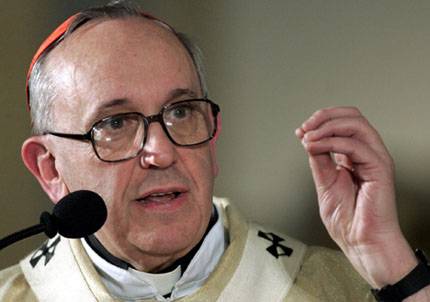
Habemus Papam! Our new Pope, Jorge Maria Cardinal Bergoglio as Pope Francis I

Habemus Papam! We have a Pope!

Bergoglio

Jorge Maria Cardinal Bergoglio, Metropolitan Archbishop of Buenos Aires, who is 76 years old, had been elected the 265th Successor of St. Peter the Apostle, the 266th Pope and Bishop of Rome, on March 2013.

He has taken the name of Francis, and shall henceforth reign as Pope Francis I. The first non-European and first South/Latin American Pope.

Names to watch out for at Habemus Papam announcement : Angelum, Petrum, Odilonem, Marcum, Aloisium, Christophorum

Whose names to watch out for when Cardinal Protodeacon Jean-Louis Tauran reads out the Habemus Papam (We have a Pope) announcement?

http://wdtprs.com/blog/2013/03/latin-names-of-cardinals-well-hear-one-of-these-from-the-loggia-of-st-peters/ (Thanks to Fr. Z’s blog for the latin names he provided for all the Cardinal-electors – I focused into some of them considered papabili/frontrunner)


Here is the announcement text :


Annuntio vobis Gaudium magnum. Habemus Papam! Eminentissimum ac Reverendissimum Dominum.

Dominum (First Name) Sanctae Romanae Ecclesiae Cardinalem (Surname).

Qui sibi nomen imposuit (regnal name) (number)


At the point when we listen the ‘First Name’ in fact we may already know who is the new Pope.


1. Angelum (Angelo) :

Cardinal Angelo Scola, Metropolitan Archbishop of Milan

Cardinal Angelo Bagnasco, Metropolitan Archbishop of Genoa

Cardinal Angelo Amato, Prefect for the Congregation of the Causes of Saints

Cardinal Angelo Comastri, Vicar General of the Diocese of Rome

As there are several Angelo considered as Papabili, for Angelum, there is a need to wait for the surname before confirmation. Similarly with Petrum.


2. Petrum (Peter) :

Cardinal Peter Erdo, Archbishop of Esztergom-Budapest

Cardinal Peter Turkson, President of the Pontifical Council for Justice and Peace


But other names are straightforward :


3. Odilonem (Odilo) :

Cardinal Odilo Pedro Scherer, Metropolitan Archbishop of Sao Paulo


4. Marcum (Marc) :

Cardinal Marc Ouellet : Prefect of the Congregation for Bishops


5. Aloisium (Alois/Luis) :

Cardinal Luis Antonio Gokim Tagle : Metropolitan Archbishop of Manila


6. Christophorum (Christoph) :

Cardinal Christoph Schonborn : Metropolitan Archbishop of Vienna


7. Ioannem Franciscum (Gianfranco) :

Cardinal Gianfranco Ravasi : President of the Pontifical Council for Culture


8. Timotheum (Timothy) :

Cardinal Timothy Michael Dolan : Metropolitan Archbishop of New York

List of possible regnal names for the new Pope, from Benedict to Peter

These are the list of all the possible regnal names (may not be entirely complete, since I may miss some in the way), that the new Pope can and may take as his own regnal name. In parentheses are how the name will look like if the Pope takes the name.

The ones listed below are the names that Popes had been taking since 1775 till today (2013) :

1. Benedict (Benedict XVII) last Benedict still living as Pope Emeritus

2. John Paul (John Paul III) last John Paul died in 2005

3. Paul (Paul VII) last Paul died in 1978

4. John (John XXIV) last John died in 1963, no John before that since 1334

5. Pius (Pius XIII) last Pius died in 1958

6. Leo (Leo XIV) last Leo died in 1903

7. Gregory (Gregory XVII) last Gregory died in 1846


Below are the names that the Popes had taken before 1775, but this does not rule them out from being picked by the new Pope, but chances are remote, with the above 7 names in use for the past 238 years.

8. Clement (Clement XV) last Clement died in1775

9. Innocent (Innocent XIV) last Innocent died in 1724

10. Alexander (Alexander IX) last Alexander died in 1691

11. Urban (Urban IX) last Urban died in 1644

12. Sixtus (Sixtus VI) last Sixtus died in 1590

13. Marcellus (Marcellus III) last Marcellus died in 1555

14. Julius (Julius IV) last Julius died in 1555

15. Adrian (Adrian VII) last Adrian died in 1523, last non-Italian Pope before 1978

16. Callixtus (Callixtus IV) last Callixtus died in 1458

17. Nicholas (Nicholas VI) last Nicholas died in 1455

18. Eugene (Eugene V) last Eugene died in 1447

19. Martin (Martin VI) last Martin died in 1431

20. Boniface (Boniface X) last Boniface died in 1404

21. Celestine (Celestine VI) last Celestine died in 1294, also a Saint, the famous Pope who resigned

22. Honorius (Honorius V) last Honorius died in 1287

23. Lucius (Lucius IV) last Lucius died in 1185

24. Anastasius (Anastasius V) last Anastasius died in 1154

25. Eugene (Eugene IV) last Eugene died in 1153

26. Gelasius (Gelasius III) last Gelasius died in 1119

27. Paschal (Paschal III) last Paschal died in 1118

28. Victor (Victor IV) last Victor died in 1087

29. Stephen (Stephen X) last Stephen died in 1058

30. Damasus (Damasus III) last Damasus died in 1048

31. Sylvester (Sylvester IV) last Sylvester died in 1045

32. Sergius (Sergius V) last Sergius died in 1012

33. Agapetus (Agapetus III) last Agapetus died in 955

34. Marinus (Marinus III) last Marinus died in 946

35. Lando/Landus (Landus II) only used once, died in 914, last Pope whose name is only used once

36. Theodore (Theodore III) last Theodore died in 897

37. Romanus (Romanus II) only used once, died in 897

38. Formosus (Formosus II) only used once, died in 896

39. Valentine (Valentine II) only used once, died in 827

40. Zachary (Zachary II) only used once, died in 752

41. Constantine (Constantine II) only used once, died in 715

42. Sisinnius (Sisinnius II) only used once, died in 708

43. Conon (Conon II) only used once, died in 687

44. Agatho (Agatho II) only used once, last one is Saint, died in 681

45. Donus (Donus II) only used once, last one died in 678

46. Adeodatus (Adeodatus III) last Adeodatus died in 676

47. Vitalian (Vitalian II) only used once, died in 672

48. Severinus (Severinus II) only used once, died in 640

49. Sabinian (Sabinian II) only used once, died in 606

50. Pelagius (Pelagius III) last Pelagius died in 590

51. Vigilius (Vigilius II) only used once, died in 555

52. Silverius (Silverius II) only used once, last one is Saint, died in 537

53. Felix (Felix V) last Felix died in 530


All the names below have been used only once, ever. Most of them are the early Church Fathers and Saints, and therefore, it is rather extremely unlikely any of these names would be picked.

54. Hormisdas (Hormisdas II) only used once, died in 523

55. Symmachus (Symmachus II) only used once, last one is Saint, died in 514

56. Simplicius (Simplicius II) only used once, last one is Saint, died in 483

57. Hilarius (Hilarius II) only used once, last one is Saint, died in 468

58. Zosimus (Zosimus II) only used once, last one is Saint, died in 418

59. Siricius (Siricius II) only used once, last one is Saint, died in 399

60. Liberius (Liberius II) only used once, died in 366

61. Mark (Mark II) only used once, last one is Saint, died in 336

62. Miltiades (Miltiades II) only used once, last one is Saint, died in 314, First Pope after Edict of Milan

63. Eusebius (Eusebius II) only used once, last one is Saint, died in 310

64. Marcellinus (Marcellinus II) only used once, last one is Saint, died in 304

65. Caius (Caius II) only used once, last one is Saint, died in 296

66. Eutychian (Eutychian II) only used once, last one is Saint, died in 283

67. Dionysius (Dionysius II) only used once, last one is Saint, died in 268

68. Cornelius (Cornelius II) only used once, last one is Saint, died in 253

69. Fabian (Fabian II) only used once, last one is Saint, died in 250

70. Anterus (Anterus II) only used once, last one is Saint, died in 236

71. Pontian (Pontian II) only used once, last one is Saint, died in 235

72. Zephyrinus (Zephyrinus II) only used once, last one is Saint, died in 217

73. Eleuterus (Eleuterus II) only used once, last one is Saint, died in 189

74. Soter (Soter II) only used once, last one is Saint, died in 174 or 175

75. Anicetus (Anicetus II) only used once, last one is Saint, died in 166

76. Hyginus (Hyginus II) only used once, last one is Saint, died in 140 or 142

77. Telesphorus (Telesphorus II) only used once, last one is Saint, died in 136 or 138

78. Evaristus (Evaristus II) only used once, last one is Saint, died in 105 or 107

79. Anacletus (Anacletus II) only used once, last one is Saint, died in 88 or 92

80. Linus (Linus II) only used once, last one is Saint, died in 76 or 79

81. Peter (Peter II) only used once, and he is the founder of the Church, Apostle of Jesus Christ, and it is extremely unlikely any future Pope, or any Pope will ever adopt the name of the Prince of the Apostles.

My Guide to the Papal Conclave : Part II (From the beginning of the Conclave to the election of the new Pope)

Part I here : https://petercanisiusmichaeldavidkang.com/2013/03/09/my-guide-to-the-papal-conclave-part-i-from-before-to-the-conclave-to-its-beginning/


1. The Conclave begins after selected prayer done by each of the Cardinal-electors, after which then the Cardinal Dean or the senior Cardinal Bishop who is an elector (Cardinal Giovanni Batista Re) who will then ask if there is any need to confirm and re-explain the rules of the Conclave as written in the Apostolic Constitution Universi Dominici Gregis, and the modifications made by the two Motu Proprios released by Pope Benedict XVI, or whether the election can begin immediately without any issue.

If there is no questions raised or no request for reiteration of the rules, then the balloting to elect the new Pope can begin in earnest.


2. According to the Apostolic Constitution, Universi Dominici Gregis, the election of the new Pope can only be done by scrutiny, that is through secret ballot, in which each of the Cardinal-electors write the name of the Cardinal or the person the Cardinal-elector wishes to vote for as his candidate for the Papacy.


3. Pre-Scrutiny period : Three Cardinal-electors are selected as Scrutineers, another three as Infirmarii, and another three as the Revisers. All selections are done by drawing of lots among the Cardinal-electors. Their duties are :


a. Scrutineers : Add up all the votes that the Cardinal-electors have submitted, and if noone obtains two-thirds of the vote, no Pope has been elected, but otherwise, the new Pope had been elected, with a necessary minimum of more than two-thirds of the vote of all the Cardinal-electors (For 2013 conclave, this requires at least 77 votes).

b. Infirmarii : Carry the voting slips for the Cardinal-electors who are sick and therefore unable to attend the voting directly in the Sistine Chapel. Their task is to obtain the votes from the ill Cardinal-electors and then place them in a sealed container and bring the votes back to the Sistine Chapel to be tallied by the Scrutineers with the rest of the votes.

c. Revisers : Revisers act to check the calculation and tallies made by the Scrutineers to ensure that all the calculations are done meticulously, faithfully, and without any modifications or changes.


4. Scrutiny Proper : The Cardinal-electors receive two or three ballot slips each, with a blank line representing the place where they should place the name of the person they wish to vote for (only one name allowed, otherwise that ballot is invalid). They write the name, and then they bring it one by one to the receptacle on the Altar of the Sistine Chapel for the votes, in the presence of the Scrutineers, and before they place the ballot slip, they recite the words :

Testor Christum Dominum, qui me iudicaturus est, me eum eligere, quem secundum Deum iudico eligi debere.

I call as my witness Christ the Lord who will be my judge, that my vote is given to the one who before God I think should be elected.

Then they place the ballot slip into the receptacle, and then return to their respective places.


5. Once the ballot slips are all collected, the first Scrutineer shake the container to mix the votes, and then the last Scrutineer must count the number of votes inside the receptacle. The number of votes must tally with the number of Cardinal-electors (to avoid double-voting). If the number tallies correctly, the counting of the votes can begin. Otherwise, the votes are burned, and a second vote must immediately be taken.


6. For the vote counting, the first Scrutineer take one ballot paper, unfolding it, and taking note the name on the ballot, then pass the ballot to the second Scrutineer, who also takes note the name on the ballot, and then passing the ballot again to the third Scrutineer, who will then read the name on the ballot aloud to all the Cardinal-electors.

Only one ballot paper is allowed in each. If two ballot papers had been folded to make it look like one ballot, then if the name on both papers are the same, they count only as one vote. But if the names are different, they are invalid.


7. Once all the ballots are accounted for, and the names in them had been read out, the ballot papers are then secured together with a string to ensure that all the papers are in order, and the total votes are tallied together in order to get the number of votes that particular candidates receive in that voting session.

If no one receives more than two-thirds of the vote, then there is no new Pope elected.

If someone receives more than two-thirds of the vote, then a new Pope had been elected.


8. On the first day of the conclave, only one afternoon ballot may be held. Then if there is no Pope elected on that day, four ballots are held in the following days, with two ballot sessions in the morning, and two ballot sessions in the afternoon, until a new Pope is elected when someone receives more than two-thirds of the vote.


9. If after three days there had been no Pope elected, the voting session is suspended for maximum of one day to allow time for prayer and reflection among the Cardinal-electors, to allow them to discern carefully on their choices and pray for the inspiration of the Holy Spirit in electing a candidate as the new Pope.

Seven ballots occur afterwards, and if the Conclave has yet been able to elect a new Pope by then, another day is taken for the same break period for prayer, which is then followed by another seven ballots, and then break if the Conclave still yet fails to elect a new Pope, and so on and so forth until the new Pope had been elected.

If until 30 ballots had passed, and no one has been elected as the new Pope, the Cardinal Camerlengo will ask the Cardinal-electors on how to best proceed with the election of the new Pope. With the Motu Proprio released by Pope Benedict XVI in 2007, the provision allowing the Cardinals to go into absolute majority (50% + 1 vote) had been removed, and therefore election will definitely have to be settled with more than two-thirds majority.

After that discussion (after the 30th ballot), the two names with the greatest number of votes will be selected, and if the two names belong to the Cardinal-electors, these two Cardinal-electors lose their right to vote in the next ballot, in which this ballot will only include these two names. The new Pope however has to be still elected by two-thirds majority out of these two names. (This is to avoid a certain group of Cardinal-electors who fail to secure two-thirds majority for their candidate to stall the conclave so that they can elect their candidate by absolute majority as previously allowed by the Apostolic Constitution Universi Dominici Gregis, but such provision was removed by Pope Benedict XVI’s 2007 Motu Proprio).


10. After two ballots (in the morning, and in the afternoon), the votes from both ballot sessions in the morning or in the afternoon, immediately after the second ballot session (morning/afternoon) is burnt at the special stoves prepared for that purpose. Colouring chemicals are then used to make the smoke either black or white depending whether a new Pope had been elected or not.

The smoke will then come out from the chimney linked to the stoves, which is placed on the roof of the Sistine Chapel, and will be the first sign for the outside world whether a new Pope had been elected. The bells of St. Peter’s Basilica and churches around Rome will also be rung when a new Pope had been elected.

Black smoke (la fumata nera) : No new Pope had been elected, more ballots to go.

White smoke (la fumata bianca) : A new Pope had been elected, and the Conclave has ended.


11. When a new Pope had been elected, the Cardinal Dean, or his Vice Dean if the Dean is elected Pope (as the case in 2005 conclave when Cardinal Dean, Joseph Ratzinger was elected Pope), or the senior Cardinal Bishop present in the Conclave as an elector (Cardinal Giovanni Batista Re), will then approach the newly elected Pope, and ask him the formula of the acceptance :

Acceptasne electionem de te canonice factam in Summum Pontificem?

Do you accept your canonical election as Supreme Pontiff?


He will then answer “Accepto or I accept” if he accepts his election as Pope.


Then he will be asked :

Quo nomine vis vocari?

By what name do you wish to be called?


The new Pope will then answer the name he wish to be called (Benedict for Cardinal Joseph Ratzinger, who became Pope Benedict XVI, as there had been 15 other Popes named Benedict before him).


The names that the Popes had used in the past two centuries (from 1800) and what they will be like if the new Pope uses them in parenthesis :

1. John (John XXIV)

2. Benedict (Benedict XVII)

3. John Paul (John Paul III)

4. Paul (Paul VII)

5. Pius (Pius XIII)

6. Leo (Leo XIV)

7. Gregory (Gregory XVII)


12. After the newly elected Pope accepts his election, the Conclave ends, unless the new Pope says otherwise.


Continue to Part III here : https://petercanisiusmichaeldavidkang.com/2013/03/09/my-guide-to-the-papal-conclave-part-iii-from-the-election-of-the-new-pope-to-the-urbi-et-orbi-blessing-by-the-new-pope/