
Homily of Pope Francis at the Mass of the Palm Sunday of the Passion of our Lord at St. Peter’s Square, Sunday, 24 March 2013

http://www.vatican.va/holy_father/francesco/homilies/2013/documents/papa-francesco_20130324_palme_en.html

Jesus enters Jerusalem. The crowd of disciples accompanies him in festive mood, their garments are stretched out before him, there is talk of the miracles he has accomplished, and loud praises are heard: “Blessed is the King who comes in the name of the Lord. Peace in heaven and glory in the highest!” (Lk 19:38).

Crowds, celebrating, praise, blessing, peace: joy fills the air. Jesus has awakened great hopes, especially in the hearts of the simple, the humble, the poor, the forgotten, those who do not matter in the eyes of the world. He understands human sufferings, he has shown the face of God’s mercy, and he has bent down to heal body and soul.

This is Jesus. This is his heart which looks to all of us, to our sicknesses, to our sins. The love of Jesus is great. And thus he enters Jerusalem, with this love, and looks at us. It is a beautiful scene, full of light – the light of the love of Jesus, the love of his heart – of joy, of celebration.

At the beginning of Mass, we too repeated it. We waved our palms, our olive branches. We too welcomed Jesus; we too expressed our joy at accompanying him, at knowing him to be close, present in us and among us as a friend, a brother, and also as a King: that is, a shining beacon for our lives. Jesus is God, but he lowered himself to walk with us. He is our friend, our brother. He illumines our path here. And in this way we have welcomed him today. And here the first word that I wish to say to you: joy! Do not be men and women of sadness: a Christian can never be sad! Never give way to discouragement! Ours is not a joy born of having many possessions, but from having encountered a Person: Jesus, in our midst; it is born from knowing that with him we are never alone, even at difficult moments, even when our life’s journey comes up against problems and obstacles that seem insurmountable, and there are so many of them! And in this moment the enemy, the devil, comes, often disguised as an angel, and slyly speaks his word to us. Do not listen to him! Let us follow Jesus! We accompany, we follow Jesus, but above all we know that he accompanies us and carries us on his shoulders. This is our joy, this is the hope that we must bring to this world. Please do not let yourselves be robbed of hope! Do not let hope be stolen! The hope that Jesus gives us.

The second word. Why does Jesus enter Jerusalem? Or better: how does Jesus enter Jerusalem? The crowds acclaim him as King. And he does not deny it, he does not tell them to be silent (cf. Lk 19:39-40). But what kind of a King is Jesus? Let us take a look at him: he is riding on a donkey, he is not accompanied by a court, he is not surrounded by an army as a symbol of power. He is received by humble people, simple folk who have the sense to see something more in Jesus; they have that sense of the faith which says: here is the Saviour. Jesus does not enter the Holy City to receive the honours reserved to earthly kings, to the powerful, to rulers; he enters to be scourged, insulted and abused, as Isaiah foretold in the First Reading (cf. Is 50:6). He enters to receive a crown of thorns, a staff, a purple robe: his kingship becomes an object of derision. He enters to climb Calvary, carrying his burden of wood. And this brings us to the second word: Cross. Jesus enters Jerusalem in order to die on the Cross. And it is precisely here that his kingship shines forth in godly fashion: his royal throne is the wood of the Cross! It reminds me of what Benedict XVI said to the Cardinals: you are princes, but of a king crucified. That is the throne of Jesus. Jesus takes it upon himself… Why the Cross? Because Jesus takes upon himself the evil, the filth, the sin of the world, including the sin of all of us, and he cleanses it, he cleanses it with his blood, with the mercy and the love of God. Let us look around: how many wounds are inflicted upon humanity by evil! Wars, violence, economic conflicts that hit the weakest, greed for money that you can’t take with you and have to leave. When we were small, our grandmother used to say: a shroud has no pocket. Love of power, corruption, divisions, crimes against human life and against creation! And – as each one of us knows and is aware – our personal sins: our failures in love and respect towards God, towards our neighbour and towards the whole of creation. Jesus on the Cross feels the whole weight of the evil, and with the force of God’s love he conquers it, he defeats it with his resurrection. This is the good that Jesus does for us on the throne of the Cross. Christ’s Cross embraced with love never leads to sadness, but to joy, to the joy of having been saved and of doing a little of what he did on the day of his death.

Today in this Square, there are many young people: for twenty-eight years Palm Sunday has been World Youth Day! This is our third word: youth! Dear young people, I saw you in the procession as you were coming in; I think of you celebrating around Jesus, waving your olive branches. I think of you crying out his name and expressing your joy at being with him! You have an important part in the celebration of faith! You bring us the joy of faith and you tell us that we must live the faith with a young heart, always: a young heart, even at the age of seventy or eighty. Dear young people! With Christ, the heart never grows old! Yet all of us, all of you know very well that the King whom we follow and who accompanies us is very special: he is a King who loves even to the Cross and who teaches us to serve and to love. And you are not ashamed of his Cross! On the contrary, you embrace it, because you have understood that it is in giving ourselves, in giving ourselves, in emerging from ourselves that we have true joy and that, with his love, God conquered evil. You carry the pilgrim Cross through all the Continents, along the highways of the world! You carry it in response to Jesus’ call: “Go, make disciples of all nations” (Mt 28:19), which is the theme of World Youth Day this year. You carry it so as to tell everyone that on the Cross Jesus knocked down the wall of enmity that divides people and nations, and he brought reconciliation and peace. Dear friends, I too am setting out on a journey with you, starting today, in the footsteps of Blessed John Paul II and Benedict XVI. We are already close to the next stage of this great pilgrimage of the Cross. I look forward joyfully to next July in Rio de Janeiro! I will see you in that great city in Brazil! Prepare well – prepare spiritually above all – in your communities, so that our gathering in Rio may be a sign of faith for the whole world. Young people must say to the world: to follow Christ is good; to go with Christ is good; the message of Christ is good; emerging from ourselves, to the ends of the earth and of existence, to take Jesus there, is good! Three points, then: joy, Cross, young people.

Let us ask the intercession of the Virgin Mary. She teaches us the joy of meeting Christ, the love with which we must look to the foot of the Cross, the enthusiasm of the young heart with which we must follow him during this Holy Week and throughout our lives. May it be so.
Holy Week Mass schedule (Live) with Pope Francis in Rome and the Vatican

Here is the schedule for Papal celebrations of Pope Francis for Holy Week in Rome :


(Live from Rome Reports : http://www.romereports.com/palio/modules.php?name=Content3&pa=showpage&newlang=english&pid=47#.UU4b91fTear)

(Live from Vatican Player : http://vatican.va/video/)

(Live from Vatican YouTube : http://youtube.com/vatican/)


1. Palm Sunday (Solemn Entry into Jerusalem) : Sunday, 24 March 2013 at 9.30 am Rome time / CET / UTC+1 (St. Peter’s Square)

2. Chrism Mass (Blessing of the Holy Oils) : Thursday, 28 March 2013 at 9.30 am Rome time / CET / UTC+1 (St. Peter’s Basilica)

3. Cena Domini (Mass of the Lord’s Supper) : Thursday, 28 March 2013 at 5.30 pm Rome time / CET / UTC+1 (Casa del Marmo prison)

4. Good Friday (Passion of our Lord Jesus Christ) : Friday, 29 March 2013 at 5 pm Rome time / CET / UTC+1 (St. Peter’s Basilica)

5. Way of the Cross at Colosseum : Friday, 29 March 2013 at 9 pm Rome time / CET / UTC+1 (Colosseum)

6. Easter Vigil (Resurrection of our Lord Jesus Christ) : Saturday, 30 March 2013 at 9 pm Rome time / CET / UTC+1 (St. Peter’s Basilica)

7. Easter Sunday (Resurrection of our Lord Jesus Christ) : Sunday, 31 March 2013 at 10 am Rome time / CET / UTC+1 (St. Peter’s Square)

8. Urbi et Orbi Blessing of Easter (Blessing to the city of Rome and the world) : Sunday, 31 March 2013 at 12 pm (noon) Rome time / CET / UTC+1 (St. Peter’s Square)

Pope Francis to visit Castel Gandolfo to meet Pope Emeritus Benedict XVI on Saturday, 23 March 2013

Newly elected Pope Francis will visit his predecessor, Pope Emeritus Benedict XVI, who is currently still staying at the summer papal residence at Castel Gandolfo. Pope Emeritus Benedict XVI will continue to reside there until the former Mater Ecclesiae monastery at the Vatican completes its renovation.

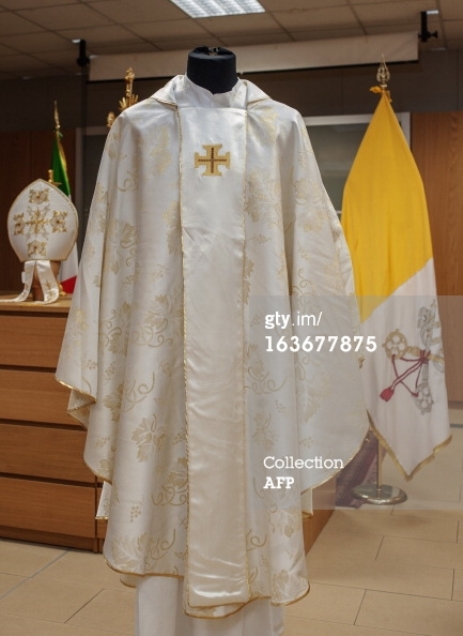
Papal vestment for the Papal Inauguration Mass of Pope Francis, Tuesday, 19 March 2013

Image

The vestments above is the vestment that Pope Francis will wear at the Papal Inauguration Mass in St. Peter’s Square, on the Feast of St. Joseph, Tuesday, 19 March 2013 at 9.30 am Rome time.

The vestments are decent and not over-simplistic, but neither overbearing, while maintaining the beauty of the vesture, which will make the liturgy of the Mass more beautiful and bring people closer to God.

(Update : It seems that Pope Francis chose to wear his personal mitre and the matching vestments that comes with his mitre (as bishop))

First Mass of Pope Francis as Bishop of Rome : Sistine Chapel, Thursday, 14 March 2013 at 5 pm Rome time

Our new Pope, Pope Francis will celebrate his first Mass as our Pope with the Cardinals gathered in Rome, in the Sistine Chapel, at 5 pm (Rome time) on Thursday, 14 March 2013. 

It may be live from the Vatican at Vatican Player (www.vatican.va/player), but I will need to confirm it.

Third Ballot : Black smoke from the chimney of Sistine Chapel. No Pope had been elected yet.

6de75351b30a02082c0f6a706700aa80

At around 11.45 am in the morning on Wednesday, 13 March 2013 in Rome, black smoke poured out of the chimney of the Sistine Chapel, slightly earlier than predicted. Therefore, as of the third ballot we do not have a new Pope elected yet.

Be prepared for the fourth ballot, since it is just possible that in that ballot a new Pope will be elected, since if there is a clear candidate that is worthy of election, the Cardinal-electors may converge on him, and the election may occur at the fourth ballot, if not then the fifth ballot.

Keep praying for our Cardinal-electors!

Second Ballot : No smoke. No Pope had been elected yet

As there was no ‘early’ smoke on Wednesday morning, 13 March 2013 in Rome, it is safe to assume that no Pope had been elected in the second ballot. This is because, instead of the usual 2 ballots per session then burn the ballots of both together at the end (session = morning/afternoon), if a Pope is elected on the first of these two ballots, the second ballot will obviously not take place, and thus, the smoke will be early, and will definitely also be white.

This was also the early sign that a Pope had been elected in 2005, when the afternoon smoke went early (this was after the fourth ballot, first of two afternoon ballots) at near 6 pm Rome time, when the smoke, which should have been later if no Pope was elected.

It may be more likely that the white smoke will appear after the third ballot, or the fourth ballot.

Watch live at : http://www.romereports.com/palio/modules.php?name=Content3&pa=showpage&newlang=english&pid=47#.UUA0qBzLoj7

Missa pro Eligendo Pontifice/Mass for the Election of the Roman Pontiff and the beginning of the Conclave

Both events are live from Rome, at Vatican Player, http://www.vatican.va/video/ and I believe are also covered live by several Catholic televisions in the USA, Canada, and other countries.


1. Missa pro Eligendo Pontifice / Mass for the Election of the Roman Pontiff

The Cardinals present in Rome, all the Cardinal-electors that will be entering the Conclave, will first gather for a Solemn Mass at St. Peter’s Basilica on Tuesday morning, 12 March 2013 at 10 am Rome time (CET or UTC+1). The Mass will be lead by the Cardinal Dean of the College of Cardinals, Cardinal Angelo Sodano, who is a non-elector.

Time in other parts of the world :

Tuesday, 12 March 2013 at 9 am UTC // 4 am EST // 1 am PST // 4 pm WIB or UTC+7 // 5 pm Singapore time or UTC+8


2. Beginning of the Conclave : Entry of the Cardinal-electors into the Sistine Chapel

The Cardinal-electors will assemble in Pauline Chapel on Tuesday afternoon, and the event will begin live at 4.30 pm Rome time (CET or UTC+1). The Cardinals will wear their full choir dress and then will proceed into the Sistine Chapel while singing the hymn Veni Creator Spiritus to invoke the Holy Spirit.

Then in the Sistine Chapel, the Cardinal-electors will take their oath, beginning with the senior Cardinal Bishop-elector, Cardinal Giovanni Batista Re, who leads the Conclave, and then the famous ‘extra omnes’ or ‘everybody else out’ order will be said by the Master of Papal Liturgical Celebrations, Monsignor Guido Marini.

Time in other parts of the world :

Tuesday, 12 March 2013 at 3.30 pm UTC // 10.30 am EST // 7.30 am PST // 11.30 pm WIB or UTC+7 //  Wednesday, 00.30 am Singapore time or UTC+8

Tenth General Congregation of the College of Cardinals and the Oath taking of the personnels involved in the Conclave

The tenth and most likely last of the General Congregation meetings of the College of Cardinals will take place on Monday, 11 March 2013 in the usual Hall of the Synod of Bishops in the Vatican City.

As the Cardinal-electors had all been assigned their rooms in the Domus Sancta Marthae, their residence during the Conclave, the Tenth General Congregation is likely therefore as the last opportunity for the Cardinals, both electors and non-electors to raise any remaining issues or clarify the need for certain qualities in the new Pope to be elected, as well as completing any outstanding issues before the Conclave commence on Tuesday, 12 March 2013.

Fr. Federico Lombardi, head of the Holy See Press Office, will conduct his usual press briefing at 1 pm, Rome time, on Monday, most likely to divulge the outcome of the Tenth General Congregation and likely to answer any remaining questions the journalists have on the Conclave.

In the evening, at 5.30 pm Rome time (CET/UTC+1) on Monday, 11 March 2013, live from Rome at Vatican Player (www.vatican.va/video/) can be viewed the oath-taking of all the personnels involved in the Conclave and locked together with the Cardinal-electors.

They will take the same oath as the Cardinal-electors (who will only take the oath when they enter the Conclave the next day, Tuesday), as prescribed by the Motu Proprio Normas Nonnullas released by Pope Benedict XVI to modify the rules of the Conclave as written in the Apostolic Constitution Universi Dominici Gregis.

My Guide to the Papal Conclave : Part III (From the election of the new Pope to the Urbi et Orbi blessing by the new Pope)

Part II here : https://petercanisiusmichaeldavidkang.com/2013/03/09/my-guide-to-the-papal-conclave-part-ii-from-the-beginning-to-the-election-of-the-new-pope/


1. After the new Pope had accepted his election as Pope and leader of the Roman Catholic Church, there are several scenarios :


a. If he is already a bishop : The new Pope will immediately be the Bishop of Rome and leader of the Universal Church, the Successor of St. Peter the Apostle. Then he will immediately accept the homage of the Cardinal-electors gathered in the Conclave, after he changes his cardinal’s robes for the new, white papal robes in the Room of Tears.

b. If he is not yet a bishop : The new Pope will need to be immediately ordained a bishop following the proper order of the Ordination of bishops, and the senior Cardinal Bishop by seniority in the Conclave should be the principal consecrator. The new Pope can only receive homage of the Cardinals after his ordination to the episcopate (after he had been ordained a bishop).


2. The new Pope then leaves the Sistine Chapel main hall where the voting took place, into the special ‘Room of Tears’, where three sets of differently-sized white papal robes had been prepared for him to adjust to his size. The new Pope changes from his cardinal’s red robes into the white papal robes and then return to the main hall of the Sistine Chapel.


3. The new Pope, after dressed in the white papal robes (with the red mozzetta and the large state stole) will then receive the homage of all the Cardinals gathered in the Sistine Chapel.


4. New addition in 2013 Conclave : After the homage, the new Pope will proceed with all the Cardinal-electors from the Sistine Chapel to the Pauline Chapel. The new Pope will enter the Pauline Chapel alone, and pray before the Blessed Sacrament in the Chapel.


5. In the meanwhile, the most senior Cardinal in the order of deacons, that is the Cardinal Protodeacon (Cardinal Jean-Louis Tauran for the 2013 conclave) will then appear at the Loggia or the balcony of St. Peter’s Basilica to deliver the announcement of the election of a new Pope.


The formula :

The Cardinal Protodeacon will first greet the assembled people in St. Peter’s Square and throughout the world (done in 2005 conclave in different languages) :

1. Italian : Fratelli e sorelle carissimi

2. Spanish : Queridísimos hermanos y hermanas

3. French : Bien chers frères et sœurs

4. German : Liebe Brüder und Schwestern

5. English : Dear brothers and sisters


Then he continues :

Annuntio vobis gaudium magnum

I announce to you a great joy


Habemus Papam!

We have a Pope!


Eminentissimum ac Reverendissimum Dominum

The most eminent and reverend Lord


Dominum (New Pope’s first name/baptismal name) Sanctae Romanae Ecclesiae Cardinalem (New Pope’s surname)

Lord (New Pope’s first name/baptismal name) Cardinal (New Pope’s surname) of the Holy Roman Church


Qui sibi nomen imposuit (New Pope’s chosen regnal name and number)

Who takes for himself the name of (New Pope’s chosen regnal name and number)


5. After this, after a moment, the new Pope, led by a processional crucifix, made his appearance at the same balcony of St. Peter’s Basilica. He then may deliver his first address as Pope to the people gathered at the Square, and to the world.


6. After the address, then the new Pope will give his Urbi et Orbi special blessing (For the city of Rome (Urbi) and the world (Orbi)), with which is attached plenary indulgence, that is the forgiveness of all temporal sins, providing the people participates in full faith and repentance.


The text of the Urbi et Orbi blessing (Latin):

Sancti Apostoli Petrus et Paulus: de quorum potestate et auctoritate confidimus ipsi intercedant pro nobis ad Dominum.

(Amen)

Precibus et meritis beatæ Mariae semper Virginis, beati Michaelis Archangeli, beati Ioannis Baptistæ, et sanctorum Apostolorum Petri et Pauli et omnium Sanctorum misereatur vestri omnipotens Deus; et dimissis omnibus peccatis vestris, perducat vos Iesus Christus ad vitam æternam.

(Amen)

Indulgentiam, absolutionem et remissionem omnium peccatorum vestrorum, spatium verae et fructuosae poenitentiæ, cor semper penitens, et emendationem vitae, gratiam et consolationem Sancti Spiritus; et finalem perseverantiam in bonis operibus tribuat vobis omnipotens et misericors Dominus.

(Amen)

Et benedictio Dei omnipotentis, Patris et Filii et Spiritus Sancti descendat super vos et maneat semper.

(Amen)


Text of Urbi et Orbi blessing (English)

May the Holy Apostles Peter and Paul, in whose power and authority we have confidence, intercede on our behalf to the Lord.

(Amen)

Through the prayers and merits of the Blessed Mary ever Virgin, of Blessed Michael the Archangel, of Blessed John the Baptist, and of the Holy Apostles Peter and Paul, and of all the saints, may Almighty God have mercy on you, and with your sins forgiven, may Jesus Christ lead you into everlasting life.

(Amen)

May the Almighty and merciful Lord grant you indulgence, absolution, and remission of all your sins, time for a true and fruitful penance, an always repentant heart and amendment of life, the grace and consolation of the Holy Spirit, and final perseverance in good works.

(Amen)

And may the blessing of Almighty God, the Father, the Son, and the Holy Spirit, descend on you and remain with you always.

(Amen)


7. Then the new Pope takes his leave of the people, and return inside St. Peter’s Basilica. The long process of electing a new Pope is over, and the new Pope is now in charge in leading God’s Church in his given mission as the Successor of St. Peter the Apostle.


8. The Papal Inauguration Mass will take place several days after the election (does not have to be on a Sunday), to allow for the foreign dignitaries invited to the event to be able to arrive, to attend the Papal Inauguration Mass. The new Pope will receive his signs of office in this Inauguration, namely, the pallium and the Ring of the Fisherman. The Papal Inauguration most likely will take place at St. Peter’s Square.


9. The new Pope will take possession of his Cathedral, in an enthronement ceremony at the Cathedral of the Diocese of Rome (The Pope is the Bishop of Rome, and contrary to popular perceptions, St. Peter’s Basilica is not a Cathedral). The Cathedral of Rome is the Archbasilica of St. John Lateran

Complete name (Latin) : Archibasilica Sanctissimi Salvatoris et Sanctorum Ioannes Baptista et Evangelista in Laterano, Omnium urbis et orbis Ecclesiarum Mater et Caput

Complete name (English) : Archbasilica of the Most Holy Saviour, Saint John the Baptist, and Saint John the Evangelist in Lateran, Head and Mother Church of All the City and the Whole World