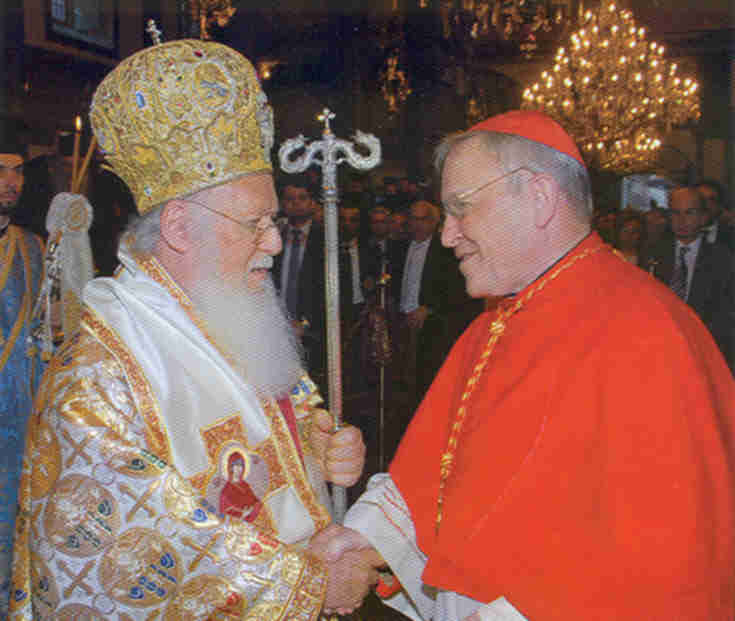
Cardinal Walter Kasper (Germany) turns 80 today (5 March 2013) but will still be eligible to vote in the Conclave

image033009

Cardinal Walter Kasper of Germany, the President Emeritus of the Pontifical Council for Promoting Christian Unity turns 80 today, Tuesday, 5 March 2013. As such, normally he would have lost his voting rights in a Conclave as a Cardinal-elector.

http://www.gcatholic.org/hierarchy/data/cardJP2-8.htm#76

However, as the rights of a Cardinal-elector is such that as long as he has not yet turned 80 at the moment when the Apostolic See (the Papacy) becomes vacant (Thursday, 28 February 2013), the Cardinal will still be an elector in the conclave that elects the next Pope. Therefore, Walter Kasper will still be an elector in the upcoming conclave, and thus, also the oldest of the Cardinal-electors to enter the Sistine Chapel in a week’s time.

Ad multos annos, Your Eminence! and we will always pray for you and for your brother Cardinals, especially the electors of our next Pope!

Third General Congregation of the College of Cardinals and the Holy See Press Office Announcement

The third General Congregation of the College of Cardinals is now ongoing in Rome, starting since an hour ago (Tuesday, 5 March 2013 at 9.30 am Rome time / CET / UTC+1), and will continue on until another two hours. The date of the conclave had not been announced, but with still a few Cardinal-electors due to arrive in Rome by today, it might be that the date for the Conclave may not be known until the Holy See Press Office announcement by Fr. Federico Lombardi either today or tomorrow (both at 1 pm Rome time / CET / UTC+1).

Watch at the Vatican Player at http://www.vatican.va/video/ for the press release by Fr. Lombardi in another 2.5 hours or so, and as always, pray for all the Cardinals, especially the electors!

There will be only one General Congregation today and on the following days as opposed to two the previous day, as decided in the Second General Congregation yesterday evening (Rome time), thus the fourth General Congregation of the College of Cardinals, if there is one, will only commence tomorrow morning at 9.30 am (Wednesday, 6 March 2013).

103 Cardinal-electors attended the first General Congregation yesterday morning, out of a total of 115, and another 4 joined in the second General Congregation in the afternoon (107 out of 115), thus only another 8 Cardinal-electors, who are all hoped to arrive in Rome by today.

Regarding Vatican Player video at www.vatican.va/video/ : How to view past videos

If you have missed the live broadcast of any past Papal events and events involving the Holy See, such as the press conferences in recent days by Fr. Federico Lombardi of the Holy See Press Office, you can access the recording at the Vatican Player site itself at http://www.vatican.va/video/

Instead of picking to watch live at the TV tab above (There are three tabs : Radio, TV, and agenda), pick the agenda tab, and then at the calendar at the right side, pick the date of the event that you like (For example, pick 13 February 2013 for the Ash Wednesday Mass and Pope Benedict XVI’s last public Mass). Then pick the event from the left side out of the list of events that occured that particular day.

Only those that has the TV icon has the recording though. If the TV icon is there, click on it, then click on the other TV icon on the upper-right hand side of the window, and then happy watching!

In addition, the website http://www.benedictxvi.tv/ also has a vast collection of papal videos (Pope Benedict XVI and documentaries of other Popes) available. Do visit and support the site!

Pictures of all 115 Cardinal-electors of the Holy Roman Church heading into the Conclave

http://www.photovat.com/PHOTOVAT/CARDINALI%20ELETTORI/CARDINALI-ELETTORI.htm

On the Vatican photo website above you can find the pictures of each and every one of the Cardinal-electors, in fact all 117 of them, including Cardinal Julius Darmaatmadja of Indonesia who will not be attending the Conclave due to health problems and failing eyesight, and Cardinal Edwin Frederick O’ Brien of Scotland, UK, who will not be attending the Conclave due to serious allegations against him.

Nevertheless, we pray for both Cardinal O’ Brien and Cardinal Darmaatmadja that God will always be with them, and of course we pray for all the rest of the Cardinal-electors who will go into the Conclave to elect the new Pope! May the Holy Spirit be with them and guide them through until we hear “Habemus Papam! We have a Pope!”

Pictures of the First General Congregation of the College of Cardinals (Monday, 4 March 2013 at 9.30 am)

https://www.facebook.com/media/set/?set=a.505028852894470.1073741832.171224532941572&type=1

The First General Congregation of the College of Cardinals had ended, and the pictures can be found in the Facebook link of Vatican News above. Now they are in the Second General Congregation, likely to discuss the date of the Conclave, which may be revealed by tomorrow. So stay tuned! and pray for our Cardinal-electors!

Who to watch for in 2013 papal conclave? Scola, Ouellet, Ravasi, Scherer

Scola, Ouellet, Ravasi, Scherer, who you should watch for in the Conclave.


Scola (Cardinal Angelo Scola, Metropolitan Archbishop of Milan)

Italian, so that even though he’s not in Curia, he did have experience in Rome, and he is already close to Rome, both in distance and relations. Also close to Pope Emeritus Benedict XVI,
and he has also done great job in Venice and then Milan, in which
these two archdioceses alone produced 5 popes in the past century

Only Pope Benedict XV and Pope Pius XII were not from these (excluding Pope John Paul II and Benedict XVI)

Venice : Pius X, John XXIII, John Paul I
Milan : Pius XI, Paul VI

Also at the forefront of communication with Islam through the publications Oasis he created to reach out to Christians in the Muslim world, and involved in interreligious dialogues.

Scola is also more charismatic than Ouellet and also active in the media via youtube, twitter, his site.

Scola is also a well-known author in bioethics, and certainly is a trait needed for a Pope that will lead the Church in its constant battle against the improper use of Science. Yes to an ethical science, but no to unbridled and uncontrolled use of science!

If the conclave proceeds smoothly, he should be the one elected Pope, within 2 or 3 days from the start of the conclave.


Ouellet (Cardinal Marc Ouellet, Prefect of the Congregation for Bishops)

In the Roman Curia and in charge of the bishops, but with the problem is that his archdiocesan experience is not that good, and the story has come out that the very church and parish we was born into, was no longer there, which is shameful considering the rate of secularisation in the west. Formerly he was the Metropolitan Archbishop of Quebec in Canada.

But so far he has done quite a good job, and quite in line with Pope Benedict XVI, by appointing bishops who are not only known to be good administrators, but more importantly, bishops who are holy, and are steadfast in their faith, with individuals like Archbishop Chaput of Philadelphia and Cardinal Tagle of Manila as example.


Ravasi (Cardinal Gianfranco Ravasi, President of Pontifical Council for Culture)

Ravasi is the forefront in how the Church communicates with social issues and the media, and he has been quite active in twitter, more so than Scola, but his administrative skill has been found rather lacking, since he has only five or six years experience as a bishop and never had any experience in handling major archdioceses or dioceses.

At least Cardinal Ravasi will sure make good use of the social media to help evangelise the faith to many, especially youths. But at the moment, we will also need candidate who are more experienced in administration as well, especially considering the troubles that had befallen the Church in recent years due to some inefficiencies in administration.


Scherer (Cardinal Odilo Pedro Scherer, Metropolitan Archbishop of Sao Paulo)

Scherer is rather conservative and as a Latin American, this may boost his chances, but he is quite young and he is not familiar with the curia and with still a relatively short experience as a senior prelate, he needs more experience in managing important archdioceses and other administrative matters.

In addition, the status of Brazil as a country, although having the largest Catholic population in the world, but the rapidly declining number of Catholics in the country as a percentage of the population and the rapidly growing secularisation in the country (also affect the rest of Latin America) may also affect his chances.


In fact, this time round, just as it was with the election of Pope Benedict XVI, now our Pope Emeritus, we does have a clear leading papabili, and the number of papabili is in fact not as many as the media mentioned it.

It will not be like the election of Pope John XXIII when there is no clear preferred papabili present, which resulted in the election of Cardinal Angelo Roncalli, later Pope John XXIII as the compromise choice.

Why did Pope Emeritus Benedict XVI relinquished the Papacy? (My personal opinion)

In my personal opinion, why our beloved Pope Benedict XVI, now Pope Emeritus Benedict XVI, had decided to step down from his position and relinquish the Papacy, is because of three main factors and events that potentially play major roles in shaping his decision. All of these factors are tied to the first factor, that is his health.


Here are the three factors and events that in my opinion made our Pope Emeritus did what he had done :


1. Health : The Pope’s failing health due to his old age is likely the main reason why he had decided to relinquish the Papacy. Although indeed, he is now at 85 being much more vigorous as compared to Blessed Pope John Paul II’s last years, but as the Pope has great tasks to be done, for the sake of the Lord, and His people, Pope Benedict chose humility and step aside for someone else to take over the good works he had started.

He realised that his increasing difficulty in walking, most likely due to osteoarthritis and the problems with his vision will eventually impair him and preventing him from exercising his ministry as the Bishop of Rome. It has also been reported that Pope Benedict too suffers from Parkinson’s, although likely a mild one or one that is still at an early stage. This disease is well known for the one that debilitated Blessed Pope John Paul II, and Pope Benedict, being very close to the previous Pope, would really want to avoid another of many years of debilitation, where the Pope instead of leading directly the Church, had to delegate most of his works due to his disabilities. It is a matter of choice of course. Blessed John Paul II chose to persevere to show us how suffering for the sake of the Lord is like, and our beloved Benedict XVI stepped down to show us what humility and virtue is like.


2. WYD (World Youth Day) 2013 : The World Youth Day has been scheduled to occur in July 2013. It would have been in 2014, but because it will be held in Brazil, which will host the World Cup event in 2014, it was decided to hold the World Youth Day a year earlier. As the Pope’s health has made doctors to advise him strongly against transatlantic and difficult journeys, which would have limited him from visiting any countries outside of Europe, or even Italy in the coming years.

In 2012, his visits had been limited to Mexico, Cuba, and Lebanon, with only two major visits as opposed to the usual four or five visits per year, a clear sign that the Pope’s health is increasingly frail to travel far beyond Rome. As the World Youth Day 2013 will be held in Rio de Janeiro, Brazil, it is also possible that our beloved Benedict XVI chose to step aside that a more capable and vigorous new Pope can go instead to the event, that the new Pope can fully lead the event without the disabilities that increasingly had debilitated our beloved Benedict XVI.


3. Asia, the Church in Asia : Although Pope Benedict XVI had been known as someone who is particularly very attentive to the problems that the Church is facing in Europe and the West in general, which resulted in his numerous visits to the countries mostly in Europe, but he has also made several visits to countries in Latin America and Africa. Many would have criticised him for leaving out Asia, as although Middle Eastern countries like Jordan, Lebanon, Turkey and Israel had been visited rather often in his short pontificate, but he had yet to visit South Asia, Southeast Asia, and East Asia, where the Church, just as in Africa, had been growing very, very rapidly.

The Pope in fact, loved the Church in Asia, particularly the Church in China, which he had tirelessly worked at, in order that the believers in Christ there can be fully reintegrated into the One Body of the Universal Church, free from any form of external and governmental interventions.

Azerbaijan in Central Asia, was the last country in Central Asia visited by a Pope in 2002. But to truly look into Asia, we should go deeper into South Asia, that is India, and further east. The last time a Pope visited India and South Asia was in 1999 or 14 years ago, and the last time a Pope visited Southeast Asia was in 1995 (World Youth Day 1995, Manila, Philippines) or 18 years ago; and for East Asia, the last Papal visit was to Korea in 1989 or 24 years ago.

Several countries in Asia such as Singapore, Indonesia, Korea, Philippines, and some other Asian countries had also been graced with Papal visits only once or twice in the entire history of the Church, also owing to the recent expansion of the Church to Asia and that only beginning with Pope Paul VI, that the Pope began to travel again outside Rome and Italy after quite some time. Therefore, due to Pope Benedict XVI’s love for the Church, both in the elder Europe and the younger Church in Asia, and already that his debilitation had made him difficult to make transatlantic visits, including the upcoming World Youth Day in Brazil, but a travel plan to Asia would have made it much more difficult.

A younger and healthier Pope therefore will be able to visit Asia (South, Southeast, East Asia) perhaps as early as this year or next year, 2014. This is however not to say that an Asian Pope will be elected, just yet. The time has not come yet in this election for an Asian Pope. Only in the next election, which hopefully will be held in about a decade from now or more, that the first Asian Pope may be possibly elected.


In the end, it is Pope Benedict XVI’s love for God, and God’s people in the Church that made him to decide to step aside for the good of the Church and the good of God’s mission in this world. However, this is not at all interpreted that it will be permanently so or that such a stepping down will be customary for the Popes. The Papacy is not an office, and not an institution, which for example like the Archbishop of Canterbury of the Anglicans, which is rotated after every number of years in manner akin to the secular and the worldly prime ministers and presidents. No, the Bishop of Rome’s position, as Christ’s only Vicar on this world is far beyond that. Only the Pope himself can decide when and if he will resign at all, and only in extreme cases should this be done.

Let us all pray therefore for our beloved Pope Emeritus, His Holiness Benedict XVI, that God will continue to look after him in his retirement, that through his new life dedicated in prayer, he can lead the Church with the new Pope, his successor, whom we also pray for, to fight against the evils of this world. We also pray for those who attack the Pope, the institution of our Church, and those who attack the faithful in Christ, that first we forgive them, and ask the Lord to enlighten their hearts, that they will learn the truth about His Church and its teachings, that they too will believe and be saved through the One, Holy, Catholic, and Apostolic Church.

May God bless all of us, bless His One and Universal Church, and bless the whole world. Amen!

Pope Benedict XVI’s retirement and what the world thinks of it : Why we should not fear and worry

http://www.catholicherald.co.uk/commentandblogs/2013/03/01/every-snarky-comment-about-the-pope-is-an-insult-to-me/

Indeed, as we all should know, the world does not like us, it does not like the Pope who leads the Church, just as it does not like Christ, as He Himself had said that this world hated Me, and it will also hate and persecute those who believes in Me and follow My teachings and My ways.

But we should not fear, and we should neither worry, but we must be courageous and steadfast as God will guide us and He will surely protect us from harm. Let us all, rather than hating the world and hating these people and institutions which had made so many attacks on the Pope and the Church, let us forgive them, and pray for them. That they all too will learn the truth of Christ, and be enlightened. Let us show them what is the Church and our faith all about, not by attacking back viciously or having any siege mentality, but let us offer ourselves in love, to embrace those who hates us, that they too will believe in God and His love.

God bless us all, and God bless His Holy Church, our Pope Emeritus Benedict XVI, his successor-to-be, and bless the world with all its people. Amen.


Content of the article from site above :


Every snarky comment about the Pope is an insult to me

People outside the faith will never understand how much the Holy Father means to us

By on Friday, 1 March 2013

The See of Peter is vacant, and as a result, like so many others all over the world, I feel a little bereft as I write this. Yesterday, as in so many other parishes, we did our best to mark the end of Benedict XVI’s reign and ministry as Supreme Pastor. The children in our primary school, many of whom were not born when he was elected, had a celebration; and there was, in the evening, Vespers, Benediction and Te Deum, followed by food and drink. It was nice to be able to say goodbye to a Pope while he was still alive – a novel event – rather than to mark his death and burial; but all the time I was aware of those pictures on the television, of the helicopter flying past the dome of St Peter’s taking the Pope away from us all. It felt like a bereavement, and it felt that way because it was a bereavement.

I was born in the early months of Pope Paul VI’s reign, and so I have seen four Popes, and await my fifth. I have had a deep personal attachment to all four, even though I never met any of them in the flesh, and I only ever saw John Paul II from an immense distance. But, the Pope is our father, and we love him; he belongs to us, we are part of the same family of faith. These four pontiffs have had a great formative influence on me, and I do not think that someone who is not a Catholic can really understand this. Andrew Brown,  who writes for the Guardian, always writes well, and he has great insight into religious matters, but he stands outside the family of faith, and as a result, he does not get why this Pope, indeed any Pope, matters to us so intensely. The Church is not an organisation like the United Nations or the European Union or the Liberal Democrat Party. It is the Mystical Body of Christ. To be Catholic is to experience the joy, peace and love that belonging to the Mystical Body brings; it is to be in communion with the Pope, which is the visible sign of that Mystical unity. And that in the end is why I cannot really express to anyone just how intensely I loved Benedict XVI, John Paul II, John Paul I, and Paul VI, or how intensely I will love the Pope who is to be elected shortly.

This is the mystery of the Mystical Body. Those outside the Church need to deal with it. It is the way we are. And it is the reason why when people make snarky comments on Twitter about the Pope, any Pope, they do not really insult the Successor of the Apostles, they insult me.

How happy I am that, wherever I have been in the world, I have been with people who profess the Catholic Faith, people who follow Christ and follow Peter. Ubi Petrus, ibi Ecclesia, ibi vita eterna. For those who need a translation: Where Peter is, there is the Church, there is eternal life!

First Meeting of the General Congregation of the College of Cardinals : Monday, 4 March 2013

http://www.news.va/en/news/sede-vacante-1st-meeting-of-general-congregation-a

The first meeting of the General Congregation of the College of Cardinals has been set on Monday, 4 March 2013 to discuss the conclave, especially deciding the exact start date of the conclave. Most Cardinals are expected to attend this first meeting as many of them are already in Rome by the end of Pope Benedict XVI’s pontificate on 28 February 2013.


There will be two meetings planned on Monday :

1st Meeting (Morning) : Monday, 4 March 2013 at 9.00 am CET/UTC+1 in the New Synod Hall

2nd Meeting (Afternoon) : Monday, 4 March 2013 at 5.00 pm CET/UTC+1 in the New Synod Hall

Sealing of the Pope’s Apartment : Not to be opened until the new Pope has been elected

The private residence of the Pope in the Vatican City, that is his apartment in the Apostolic Palace beside the Basilica of St. Peter is left vacant upon the death of the Pope, or in this case, the retirement of the reigning Pope, which began the sede vacante, during which no Pope is present.

Therefore, in order to avoid fraud and manipulation of papal documents of the previous Pope, and to prevent release of items that can only be done by the new Pope, the Pope’s Apartment is sealed, by a special officer of the Roman Curia, that is the Camerlengo (Chamberlain) of the Holy Roman Church, who is now Cardinal Tarcisio Bertone, who is also the Secretary of State of the Holy See.

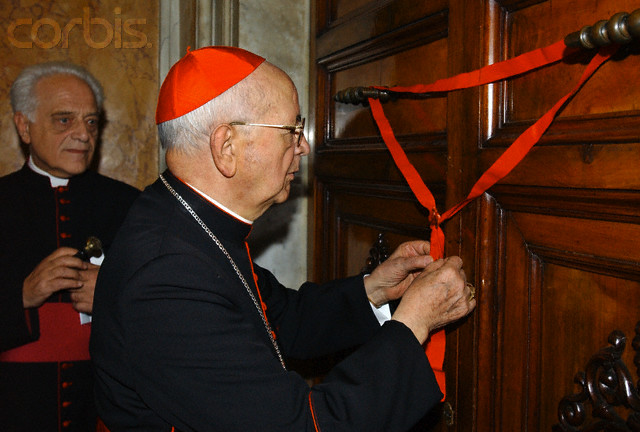
The Camerlengo is the leader of the sede vacante transition period, and working in conjunction with the Dean of the College of Cardinals. His duties include sealing the Pope’s apartment and the destruction of the Pope’s Ring of the Fisherman, both of which meant to ensure no fraud documents can be released in absence of the Pope.

The sealing is done as soon as the Pope passed away or stepped down, and done in the presence of the Vice-Camerlengo, who is now Archbishop Pier Luigi Celata, and sealed with a silk string tied and sealed with a wax seal to ensure no one can enter the room, with the unbroken wax seal as evidence.

The room will only be opened again and the seal broken after the conclave is completed and a new Pope is elected.

Image below – from 2005 after the death of Blessed Pope John Paul II, then Camerlengo, Cardinal Eduardo Martinez Somalo sealing the Pope’s apartment

Image