Friday, 17 January 2014 : 1st Week of Ordinary Time, Memorial of St. Anthony, Abbot (Gospel Reading)

Liturgical Colour : White (Priests and Abbots)

Mark 2 : 1-12

After some days Jesus returned to Capernaum. As the news spread that He was in the house, so many people gathered, that there was no longer room even outside the door. While Jesus was preaching the Word to them, some people brought a paralysed man to Him.

The four men who carried him could not get near Jesus because of the crowd, so they opened the roof above the room where Jesus was and, through the hole, lowered the man on his mat. When Jesus saw the faith of these people, He said to the paralytic, “My son, your sins are forgiven.”

Now some teachers of the Law, who were sitting there, wondered within themselves, “How can He speak like this, insulting God? Who can forgive sins except God?”

At once Jesus knew in His Spirit what they were thinking, and asked, “Why do you wonder? Is it easier to say to this paralysed man, ‘Your sins are forgiven,’ or to say, ‘Rise, take up your mat and walk?’ But now you shall know that the Son of Man has authority on earth to forgive sins.”

And He said to the paralytic, “Stand up, take up your mat and go home.” The man rose and, in the sight of all those people, he took up his mat and went out. All of them were astonished and praised God, saying, “Never have we seen anything like this!”

Thursday, 16 January 2014 : 1st Week of Ordinary Time (Gospel Reading)

Liturgical Colour : Green

Mark 1 : 40-45

A leper came to Jesus and begged Him, “If You want to, You can make me clean.” Moved with pity, Jesus stretched out His hand and touched him, saying, “I do want to; be clean.”

The leprosy left the man at once and he was made clean. As Jesus sent the man away, He sternly warned him, “Do not tell anyone about this, but go and show yourself to the priest, and for the cleansing bring the offering ordered by Moses; in this way you will give to them your testimony.”

However, as soon as the man went out, he began spreading the news everywhere, so that Jesus could no longer openly enter any town. But even though He stayed in the rural areas, people came to Him from everywhere.

Wednesday, 15 January 2014 : 1st Week of Ordinary Time (Gospel Reading)

Liturgical Colour : Green

Mark 1 : 29-39

On leaving the synagogue, Jesus went to the home of Simon and Andrew with James and John. As Simon’s mother-in-law was sick in bed with fever, they immediately told Him about her. Jesus went to her and, taking her by the hand, raised her up.

The fever left her and she began to wait on them. That evening at sundown, people brought to Jesus all the sick and those who had evil spirits : the whole town was pressing around the door. Jesus healed many who had various diseases, and drove out many demons; but He did not let them speak, for they knew who He was.

Very early in the morning, before daylight, Jesus went off to a lonely place where He prayed. Simon and the others went out also, searching for Him; and when they found Him, they said, “Everyone is looking for You.” Then Jesus answered, “Let us go to the nearby villages so that I may preach there too; for that is why I came.”

So Jesus set out to preach in all the synagogues throughout Galilee; He also cast out demons.

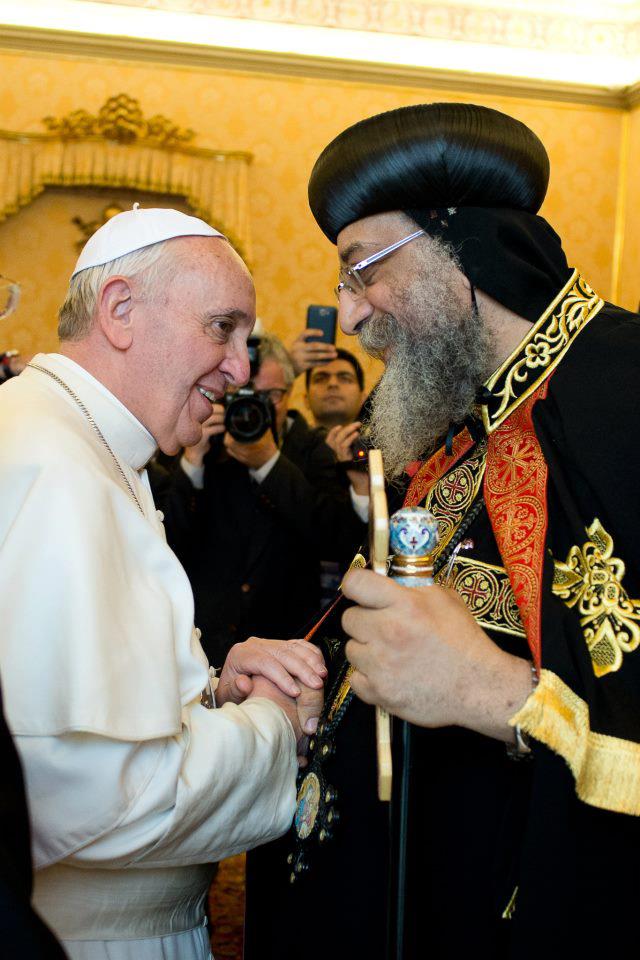
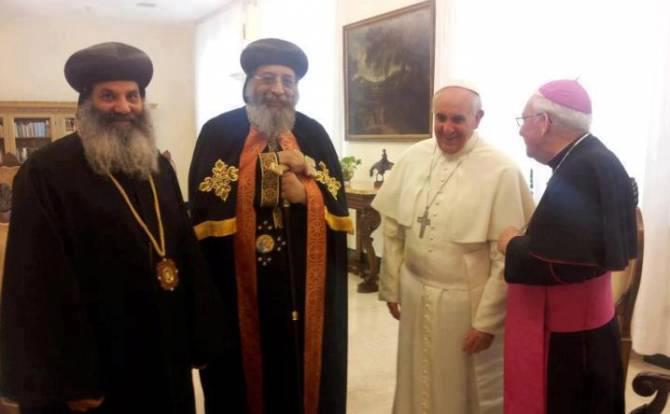
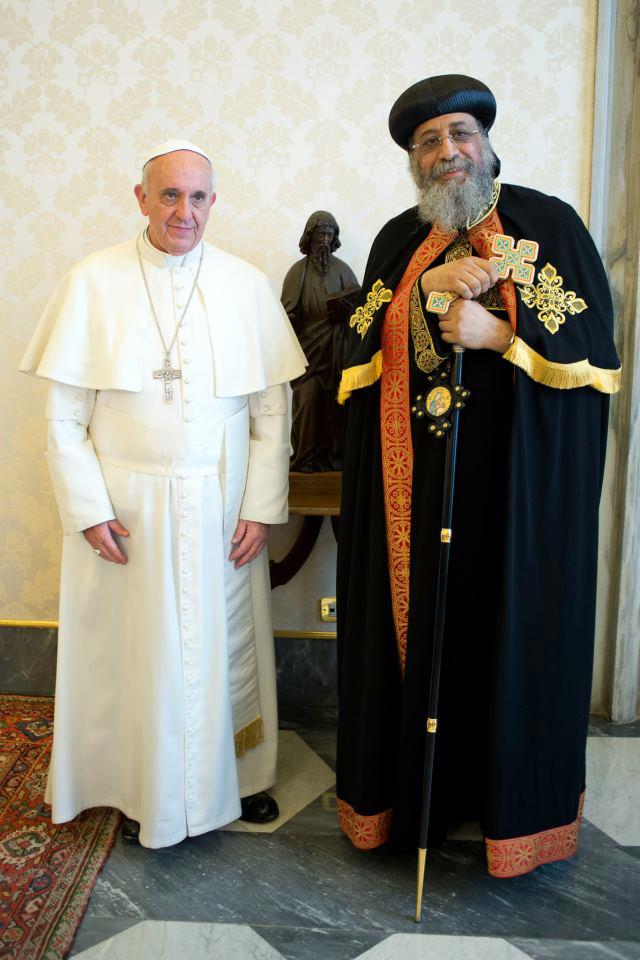
Historic visit by Pope and Patriarch of Alexandria, Pope Tawadros II to the Pope of the Church, Pope Francis

Image

Pope Tawadros II (Theodore II) of Alexandria, the head of the Coptic Church, Successor of St. Mark the Evangelist, first Bishop of Alexandria, is visiting Rome to pay a visit to the Pope and Supreme leader of the Universal Church and Successor of St. Peter the Prince of the Apostles, Pope Francis.

Image

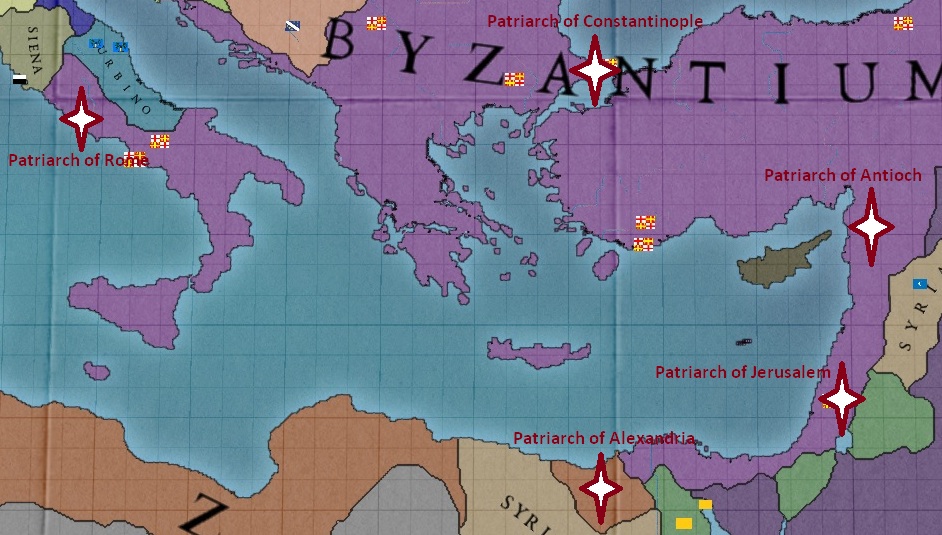
The Coptic Church is the direct descendant of the Patriarchate of Alexandria of the early Christian Pentarchy (Rome, Constantinople, Alexandria, Antioch, and Jerusalem), which broke apart from Rome and the Universal Church due to the disagreement in the Council of Chalcedon of 451, on the true nature of Christ.

Image

This disagreement is more due to misunderstanding in the nature of God, whether Christ’s human and divine persona is distinct or mixed. The initial term for non-Chalcedonians is monophysites, which is a heresy stating that both persona are mixed and indistinguishable. In fact, the Coptics and the other non-Chalcedonians in fact adopt miaphysitism, which while distinguishing the human and divine nature of Christ, but also acknowledge the mystery of the relationship between the two persona.

Image

Pope Tawadros II visits Rome in conjunction with the historic first meeting between the two Popes of Rome and Alexandria in 1973 by Pope Shenouda III, Pope Tawadros II’s predecessor, and Pope Paul VI. During that meeting a historic joint declaration of faith and friendship was announced and declared between the two Churches of God.

Image

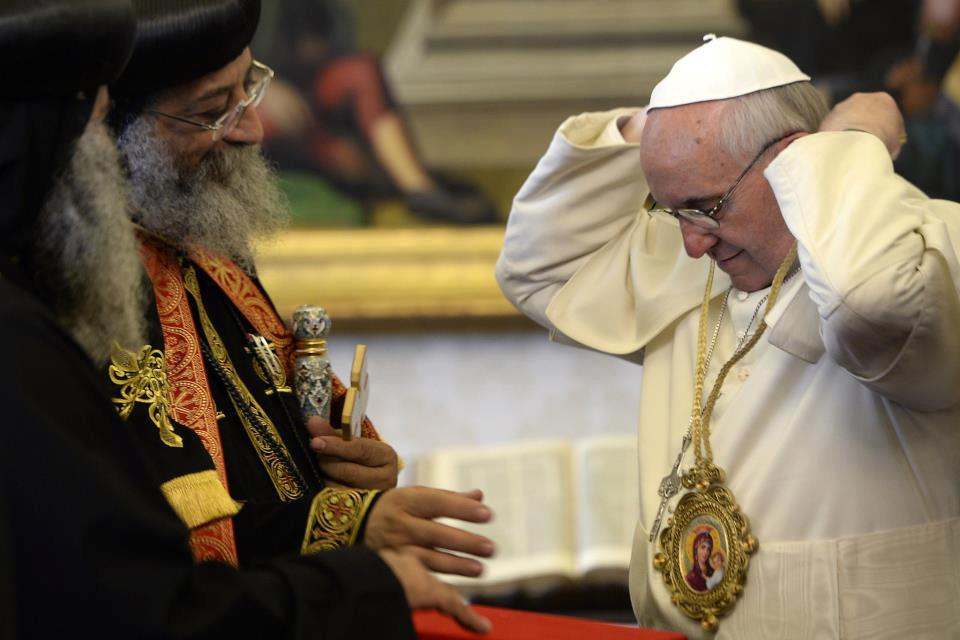
Pope Francis received a gift of an engolpion, which is a form of imagery in medallion, which is worn in the same way as pectoral cross, which are worn by the bishops of the Eastern Rite.

Image

We hope that all Christians, with the Copts and the Orthodox Churches can be reunited once again with the true and only Church, that is the Church of God, as one Body, indivisible by men and worldly ambitions, in the One, Holy, Roman, Catholic, and Apostolic Church.


Pray always for Christian Unity. That we are One, just as Christ our Lord and the Father in heaven are One.


Ut Omnes Unum Sint, ad Maiorem Dei Gloriam

(That they all may be One, for the greater glory of God)

Thursday, 25 April 2013 : 4th Week of Easter, Feast of St. Mark the Evangelist (Scripture Reflection)

Dear brothers and sisters in Christ, today we commemorate the feast day of one of the greatest pillars of our Church and our faith. For without him, we would be missing one of the four Gospels, that is the Gospel of Mark. St. Mark was not part of the Twelve originally chosen by Christ, but he was mentored by the apostles, especially St. Paul, and later on wrote one of the four Gospels inspired by the Holy Spirit.

St. Mark established the Church in Alexandria, then capital of Egypt, and from there the faith blossomed in Egypt and throughout the eastern Mediterranean, establishing the strong base from which much of the Church was born from. He became the first bishop of Alexandria, and from him, came a long series of bishops and later Patriarchs of Alexandria, the most important descendant of which is what we today know as the Coptic Orthodox Church, our brethren in faith.

The Gospel of St. Mark, although at sixteen chapters may be the shortest of the four Gospels, but was full with fundamental truths about the mission of Christ and His nature as our Messiah and our Lord. It is also the earliest written Gospel of the four. Mark concentrated on the nature of Christ as the Messiah who suffer, who suffer persecution and later death, and yet was raised again in glory for the salvation of mankind.

In today’s Gospel reading taken from the last chapter of Mark’s Gospel, Jesus commanded His disciples to go make disciples of all the nations, to spread the Good News to all mankind, to the ends of the earth. He gave this mission to the disciples, to spread all the teachings He had given and said to the apostles during His life on this world, and through the Gospels, all the nations would hear the Good News of the Lord, and believe in the One whom God the Father had sent.

Jesus’ mission is still relevant to us today. Even though the faith in our Lord had been indeed spread throughout the world to the ends of earth, but today, there is an even greater need for more people to take up the mission to become evangelisers of the Lord’s message. Let us take up that mission and follow the example of the Evangelists like St. Mark. And just like St. Mark, who wrote the Gospel, and also preached the Good News with his fellow brethren at the time, there are just many ways to evangelise to other people.

Evangelisation does not just mean speeches, speeches, and talks. Yes, words of mouth are important, and people do tend to listen to speeches and words, but remember that not everyone is endowed with good ability of speech. Yes, the Holy Spirit would provide and would give us the strength and courage indeed to tell the people of the Good News, but evangelisation can also be done through action, through simple gestures and works, and we will not even need to venture far to evangelise.

Simply look around us, at our own family, our parents, our siblings, and our children. Even among our friends, there are bound to be ample opportunities for evangelisation to occur. There are many even among those who are faithful to God, who had been lax in their faith, and who became ‘Sunday Catholics’. Dear brothers and sisters in Christ, we have the power given to us by the Holy Spirit, to make a difference in the lives of our fellow men. Let us not let it go to waste, and utilise the gift of the Holy Spirit which the Lord has passed down to the Apostles, and from them, through our priests, to us.

We are called to be the messenger of the Lord’s message, and as disciples and servants of our God. Let us go forth and bring forth the light of Christ in this darkened world of ours. Beginning from those near to us, to all the nations till the ends of the earth. St. Mark the Evangelist, and the holy Apostles and saints of God, pray for us. Amen.

Thursday, 25 April 2013 : 4th Week of Easter, Feast of St. Mark the Evangelist (Gospel Reading)

Mark 16 : 15-20

Then He told them, “Go out to the whole world and proclaim the Good News to all creation. The one who believes and is baptised will be saved; the one who refuse to believe will be condemned. Signs like these will accompany those who have believed : in My Name they will cast out demons and speak new languages; they will pick up snakes, and if they drink anything poisonous, they will be unharmed; they will lay their hands on the sick, and they will be healed.”

So then, after speaking to them, the Lord Jesus was taken up into heaven and took His place at the right hand of God. The Eleven went forth and preached everywhere, while the Lord worked with them and confirmed the message by the signs that accompanied it.

Thursday, 25 April 2013 : 4th Week of Easter, Feast of St. Mark the Evangelist (Psalm)

Psalm 88 : 2-3, 6-7, 16-17

I will sing forever, o Lord, of Your love and proclaim Your faithfulness from age to age. I will declare how steadfast is Your love, how firm Your faithfulness.

The heavens proclaim Your wonders, o Lord; the assembly of the holy ones recalls Your faithfulness. Who in the skies can compare with the Lord; who of the heaven-born is like Him?

Blessed is the people who know Your praise. They walk in the light of Your face. They celebrate all day Your Name and Your protection lifts them up.

Thursday, 25 April 2013 : 4th Week of Easter, Feast of St. Mark the Evangelist (First Reading)

1 Peter 5 : 5b-14

All of you must clothe yourself with humility in your dealings with one another, because God opposes the proud but gives His grace to the humble. Bow down, then, before the power of God so that He will raise you up at the appointed time. Place all your worries on Him since He takes care of you.

Be sober and alert because your enemy the devil prowls about like a roaring lion seeking someone to devour. Stand your ground, firm in your faith, knowing that our brothers and sisters, scattered throughout the world, are confronting similar sufferings. God, the giver of all grace, has called you to share in Christ’s eternal Glory and after you have suffered a little, He will bring you to perfection : He will confirm, strengthen, and establish you forever. Glory be to Him forever and ever. Amen.

I have had these few lines of encouragement written to you by Silvanus, our brother, whom I know to be trustworthy. For I wanted to remind you of the kindness of God really present in all this. Hold on to it.

Greetings from the community in Babylon, gathered by God, and from my son, Mark. Greet one another with a friendly embrace. Peace to you all who are in Christ.

Wednesday, 24 April 2013 : 4th Week of Easter, Memorial of St. Fidelis of Sigmaringen, Priest and Martyr (First Reading)

Acts 12 : 24 – Acts 13 : 5a

Meanwhile the word of God was increasing and spreading. Barnabas and Saul carried out their mission and then came back to Jerusalem, taking with them John, also called Mark.

There were at Antioch – in the Church which was there – prophets and teachers : Barnabas, Symeon known as Niger, Lucius of Cyrene, Manaen who had been brought up with Herod, and Saul. On one occasion while they were celebrating the Lord and fasting, the Holy Spirit said to them, “Set apart for Me, Barnabas and Saul to do the work for which I have called them.”

So, after fasting and praying, they laid their hands on them and sent them off. These then, sent by the Holy Spirit, went down to the port of Seleucia and from there sailed to Cyprus. Upon their arrival in Salamis they proclaimed the word of God in the Jewish synagogue.