The world today needs peace more than ever, as violence and hatred increasingly become more common in our society. We should profess love and peace, not hatred and violence!
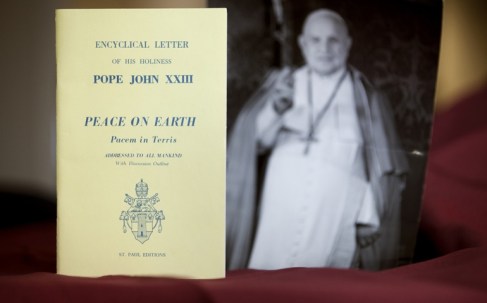
PACEM IN TERRIS
ENCYCLICAL OF POPE JOHN XXIII
ON ESTABLISHING UNIVERSAL PEACE IN TRUTH,
JUSTICE, CHARITY, AND LIBERTY
APRIL 11, 1963
To Our Venerable Brethren the Patriarchs, Primates, Archbishops, Bishops, and all other Local Ordinaries who are at Peace and in Communion with the Apostolic See, and to the Clergy and Faithful of the entire Catholic World, and to all Men of Good Will.
Venerable Brethren and Dearest Sons Health and Apostolic Benediction.
Peace on Earth—which man throughout the ages has so longed for and sought after—can never be established, never guaranteed, except by the diligent observance of the divinely established order.
Order in the Universe
2. That a marvelous order predominates in the world of living beings and in the forces of nature, is the plain lesson which the progress of modern research and the discoveries of technology teach us. And it is part of the greatness of man that he can appreciate that order, and devise the means for harnessing those forces for his own benefit.
3. But what emerges first and foremost from the progress of scientific knowledge and the inventions of technology is the infinite greatness of God Himself, who created both man and the universe. Yes; out of nothing He made all things, and filled them with the fullness of His own wisdom and goodness. Hence, these are the words the holy psalmist used in praise of God: “O Lord, our Lord: how admirable is thy name in the whole earth!” (1) And elsewhere he says: “How great are thy works, O Lord! Thou hast made all things in wisdom.” (2)
Moreover, (2a) God created man “in His own image and likeness,” (3) endowed him with intelligence and freedom, and made him lord of creation. All this the psalmist proclaims when he says: “Thou hast made him a little less than the angels: thou hast crowned him with glory and honor, and hast set him over the works of thy hands. Thou hast subjected all things under his feet.” (4)
Order in Human Beings
4. And yet there is a disunity among individuals and among nations which is in striking contrast to this perfect order in the universe. One would think that the relationships that bind men together could only be governed by force.
5. But the world’s Creator has stamped man’s inmost being with an order revealed to man by his conscience; and his conscience insists on his preserving it. Men “show the work of the law written in their hearts. Their conscience bears witness to them.” (5) And how could it be otherwise? All created being reflects the infinite wisdom of God. It reflects it all the more clearly, the higher it stands in the scale of perfection. (6)
6. But the mischief is often caused by erroneous opinions. Many people think that the laws which govern man’s relations with the State are the same as those which regulate the blind, elemental forces of the universe. But it is not so; the laws which govern men are quite different. The Father of the universe has inscribed them in man’s nature, and that is where we must look for them; there and nowhere else.
7. These laws clearly indicate how a man must behave toward his fellows in society, and how the mutual relationships between the members of a State and its officials are to be conducted. They show too what principles must govern the relations between States; and finally, what should be the relations between individuals or States on the one hand, and the world-wide community of nations on the other. Men’s common interests make it imperative that at long last a world-wide community of nations be established.
I. ORDER BETWEEN MEN
8. We must devote our attention first of all to that order which should prevail among men.
9. Any well-regulated and productive association of men in society demands the acceptance of one fundamental principle: that each individual man is truly a person. His is a nature, that is, endowed with intelligence and free will. As such he has rights and duties, which together flow as a direct consequence from his nature. These rights and duties are universal and inviolable, and therefore altogether inalienable. (7)
10. When, furthermore, we consider man’s personal dignity from the standpoint of divine revelation, inevitably our estimate of it is incomparably increased. Men have been ransomed by the blood of Jesus Christ. Grace has made them sons and friends of God, and heirs to eternal glory.
Rights
11. But first We must speak of man’s rights. Man has the right to live. He has the right to bodily integrity and to the means necessary for the proper development of life, particularly food, clothing, shelter, medical care, rest, and, finally, the necessary social services. In consequence, he has the right to be looked after in the event of illhealth; disability stemming from his work; widowhood; old age; enforced unemployment; or whenever through no fault of his own he is deprived of the means of livelihood. (8)
Rights Pertaining to Moral and Cultural Values
12. Moreover, man has a natural right to be respected. He has a right to his good name. He has a right to freedom in investigating the truth, and—within the limits of the moral order and the common good—to freedom of speech and publication, and to freedom to pursue whatever profession he may choose. He has the right, also, to be accurately informed about public events.
13. He has the natural right to share in the benefits of culture, and hence to receive a good general education, and a technical or professional training consistent with the degree of educational development in his own country. Furthermore, a system must be devised for affording gifted members of society the opportunity of engaging in more advanced studies, with a view to their occupying, as far as possible, positions of responsibility in society in keeping with their natural talent and acquired skill. (9)
The Right to Worship God According to One’s Conscience
14. Also among man’s rights is that of being able to worship God in accordance with the right dictates of his own conscience, and to profess his religion both in private and in public. According to the clear teaching of Lactantius, “this is the very condition of our birth, that we render to the God who made us that just homage which is His due; that we acknowledge Him alone as God, and follow Him. It is from this ligature of piety, which binds us and joins us to God, that religion derives its name.” (l0)
Hence, too, Pope Leo XIII declared that “true freedom, freedom worthy of the sons of God, is that freedom which most truly safeguards the dignity of the human person. It is stronger than any violence or injustice. Such is the freedom which has always been desired by the Church, and which she holds most dear. It is the sort of freedom which the Apostles resolutely claimed for themselves. The apologists defended it in their writings; thousands of martyrs consecrated it with their blood.”(11)
The Right to Choose Freely One’s State in Life
15. Human beings have also the right to choose for themselves the kind of life which appeals to them: whether it is to found a family—in the founding of which both the man and the woman enjoy equal rights and duties—or to embrace the priesthood or the religious life.(12)
16. The family, founded upon marriage freely contracted, one and indissoluble, must be regarded as the natural, primary cell of human society. The interests of the family, therefore, must be taken very specially into consideration in social and economic affairs, as well as in the spheres of faith and morals. For all of these have to do with strengthening the family and assisting it in the fulfilment of its mission.
17. Of course, the support and education of children is a right which belongs primarily to the parents. (13)
Economic Rights
18. In the economic sphere, it is evident that a man has the inherent right not only to be given the opportunity to work, but also to be allowed the exercise of personal initiative in the work he does. (14)
19. The conditions in which a man works form a necessary corollary to these rights. They must not be such as to weaken his physical or moral fibre, or militate against the proper development of adolescents to manhood. Women must be accorded such conditions of work as are consistent with their needs and responsibilities as wives and mothers.(15)
20. A further consequence of man’s personal dignity is his right to engage in economic activities suited to his degree of responsibility.(16) The worker is likewise entitled to a wage that is determined in accordance with the precepts of justice. This needs stressing. The amount a worker receives must be sufficient, in proportion to available funds, to allow him and his family a standard of living consistent with human dignity. Pope Pius XII expressed it in these terms:
“Nature imposes work upon man as a duty, and man has the corresponding natural right to demand that the work he does shall provide him with the means of livelihood for himself and his children. Such is nature’s categorical imperative for the preservation of man.”(17)
21. As a further consequence of man’s nature, he has the right to the private ownership of property, including that of productive goods. This, as We have said elsewhere, is “a right which constitutes so efficacious a means of asserting one’s personality and exercising responsibility in every field, and an element of solidity and security for family life, and of greater peace and prosperity in the State.”(18)
22. Finally, it is opportune to point out that the right to own private property entails a social obligation as well. (19)
The Right of Meeting and Association
23. Men are by nature social, and consequently they have the right to meet together and to form associations with their fellows. They have the right to confer on such associations the type of organization which they consider best calculated to achieve their objectives. They have also the right to exercise their own initiative and act on their own responsibility within these associations for the attainment of the desired results(20).
24. As We insisted in Our encyclical Mater et Magistra, the founding of a great many such intermediate groups or societies for the pursuit of aims which it is not within the competence of the individual to achieve efficiently, is a matter of great urgency. Such groups and societies must be considered absolutely essential for the safeguarding of man’s personal freedom and dignity, while leaving intact a sense of responsibility.(21)
The Right to Emigrate and Immigrate
25. Again, every human being has the right to freedom of movement and of residence within the confines of his own State. When there are just reasons in favor of it, he must be permitted to emigrate to other countries and take up residence there.(22) The fact that he is a citizen of a particular State does not deprive him of membership in the human family, nor of citizenship in that universal society, the common, world-wide fellowship of men.
Political Rights
26. Finally, man’s personal dignity involves his right to take an active part in public life, and to make his own contribution to the common welfare of his fellow citizens. As Pope Pius XII said, “man as such, far from being an object or, as it were, an inert element in society, is rather its subject, its basis and its purpose; and so must he be esteemed.”(23)
27. As a human person he is entitled to the legal protection of his rights, and such protection must be effective, unbiased, and strictly just. To quote again Pope Pius XII: “In consequence of that juridical order willed by God, man has his own inalienable right to juridical security. To him is assigned a certain, well-defined sphere of law, immune from arbitrary attack.”(24)
Duties
8. The natural rights of which We have so far been speaking are inextricably bound up with as many duties, all applying to one and the same person. These rights and duties derive their origin, their sustenance, and their indestructibility from the natural law, which in conferring the one imposes the other.
9. Thus, for example, the right to live involves the duty to preserve one’s life; the right to a decent standard of living, the duty to live in a becoming fashion; the right to be free to seek out the truth, the duty to devote oneself to an ever deeper and wider search for it.
Reciprocity of Rights and Duties Between Persons
30. Once this is admitted, it follows that in human society one man’s natural right gives rise to a corresponding duty in other men; the duty, that is, of recognizing and respecting that right. Every basic human right draws its authoritative force from the natural law, which confers it and attaches to it its respective duty. Hence, to claim one’s rights and ignore one’s duties, or only half fulfill them, is like building a house with one hand and tearing it down with the other.
Mutual Collaboration
31. Since men are social by nature, they must live together and consult each other’s interests. That men should recognize and perform their respective rights and duties is imperative to a well ordered society. But the result will be that each individual will make his whole-hearted contribution to the creation of a civic order in which rights and duties are ever more diligently and more effectively observed.
32. For example, it is useless to admit that a man has a right to the necessities of life, unless we also do all in our power to supply him with means sufficient for his livelihood.
33. Hence society must not only be well ordered, it must also provide men with abundant resources. This postulates not only the mutual recognition and fulfillment of rights and duties, but also the involvement and collaboration of all men in the many enterprises which our present civilization makes possible, encourages or indeed demands.
An Attitude of Responsibility
34. Man’s personal dignity requires besides that he enjoy freedom and be able to make up his own mind when he acts. In his association with his fellows, therefore, there is every reason why his recognition of rights, observance of duties, and many-sided collaboration with other men, should be primarily a matter of his own personal decision. Each man should act on his own initiative, conviction, and sense of responsibility, not under the constant pressure of external coercion or enticement. There is nothing human about a society that is welded together by force. Far from encouraging, as it should, the attainment of man’s progress and perfection, it is merely an obstacle to his freedom.
Social Life in Truth, Justice, Charity and Freedom
35. Hence, before a society can be considered well-ordered, creative, and consonant with human dignity, it must be based on truth. St. Paul expressed this as follows: “Putting away lying, speak ye the truth every man with his neighbor, for we are members one of another.”(25) And so will it be, if each man acknowledges sincerely his own rights and his own duties toward others.
Human society, as We here picture it, demands that men be guided by justice, respect the rights of others and do their duty. It demands, too, that they be animated by such love as will make them feel the needs of others as their own, and induce them to share their goods with others, and to strive in the world to make all men alike heirs to the noblest of intellectual and spiritual values. Nor is this enough; for human society thrives on freedom, namely, on the use of means which are consistent with the dignity of its individual members, who, being endowed with reason, assume responsibility for their own actions .
36. And so, dearest sons and brothers, we must think of human society as being primarily a spiritual reality. By its means enlightened men can share their knowledge of the truth, can claim their rights and fulfill their duties, receive encouragement in their aspirations for the goods of the spirit, share their enjoyment of all the wholesome pleasures of the world, and strive continually to pass on to others all that is best in themselves and to make their own the spiritual riches of others. It is these spiritual values which exert a guiding influence on culture, economics, social institutions, political movements and forms, laws, and all the other components which go to make up the external community of men and its continual development.
God and the Moral Order
37. Now the order which prevails in human society is wholly incorporeal in nature. Its foundation is truth, and it must be brought into effect by justice. It needs to be animated and perfected by men’s love for one another, and, while preserving freedom intact, it must make for an equilibrium in society which is increasingly more human in character.
38. But such an order—universal, absolute and immutable in its principles—finds its source in the true, personal and transcendent God. He is the first truth, the sovereign good, and as such the deepest source from which human society, if it is to be properly constituted, creative, and worthy of man’s dignity, draws its genuine vitality. (26) This is what St. Thomas means when he says: “Human reason is the standard which measures the degree of goodness of the human will, and as such it derives from the eternal law, which is divine reason . . . Hence it is clear that the goodness of the human will depends much more on the eternal law than on human reason.” (27)
Characteristics of the Present Day
39. There are three things which characterize our modern age.
40. In the first place we notice a progressive improvement in the economic and social condition of working men. They began by claiming their rights principally in the economic and social spheres, and then proceeded to lay claim to their political rights as well. Finally, they have turned their attention to acquiring the more cultural benefits of society.
Today, therefore, working men all over the world are loud in their demands that they shall in no circumstances be subjected to arbitrary treatment, as though devoid of intelligence and freedom. They insist on being treated as human beings, with a share in every sector of human society: in the socio-economic sphere, in government, and in the realm of learning and culture.
41. Secondly, the part that women are now playing in political life is everywhere evident. This is a development that is perhaps of swifter growth among Christian nations, but it is also happening extensively, if more slowly, among nations that are heirs to different traditions and imbued with a different culture. Women are gaining an increasing awareness of their natural dignity. Far from being content with a purely passive role or allowing themselves to be regarded as a kind of instrument, they are demanding both in domestic and in public life the rights and duties which belong to them as human persons.
42. Finally, we are confronted in this modern age with a form of society which is evolving on entirely new social and political lines. Since all peoples have either attained political independence or are on the way to attaining it, soon no nation will rule over another and none will be subject to an alien power.
43. Thus all over the world men are either the citizens of an independent State, or are shortly to become so; nor is any nation nowadays content to submit to foreign domination. The longstanding inferiority complex of certain classes because of their economic and social status, sex, or position in the State, and the corresponding superiority complex of other classes, is rapidly becoming a thing of the past.
Equality of Men
44. Today, on the contrary the conviction is widespread that all men are equal in natural dignity; and so, on the doctrinal and theoretical level, at least, no form of approval is being given to racial discrimination. All this is of supreme significance for the formation of a human society animated by the principles We have mentioned above, for man’s awareness of his rights must inevitably lead him to the recognition of his duties. The possession of rights involves the duty of implementing those rights, for they are the expression of a man’s personal dignity. And the possession of rights also involves their recognition and respect by other people.
45. When society is formed on a basis of rights and duties, men have an immediate grasp of spiritual and intellectual values, and have no difficulty in understanding what is meant by truth, justice, charity and freedom. They become, moreover, conscious of being members of such a society. And that is not all. Inspired by such principles, they attain to a better knowledge of the true God—a personal God transcending human nature. They recognize that their relationship with God forms the very foundation of their life—the interior life of the spirit, and the life which they live in the society of their fellows.
II. RELATIONS BETWEEN INDIVIDUALS AND THE PUBLIC AUTHORITIES
46. Human society can be neither well-ordered nor prosperous without the presence of those who, invested with legal authority, preserve its institutions and do all that is necessary to sponsor actively the interests of all its members. And they derive their authority from God, for, as St. Paul teaches, “there is no power but from God”.(28)
In his commentary on this passage, St. John Chrysostom writes: “What are you saying? Is every ruler appointed by God? No, that is not what I mean, he says, for I am not now talking about individual rulers, but about authority as such. My contention is that the existence of a ruling authority—the fact that some should command and others obey, and that all things not come about as the result of blind chance—this is a provision of divine wisdom.”(29)
God has created men social by nature, and a society cannot “hold together unless someone is in command to give effective direction and unity of purpose. Hence every civilized community must have a ruling authority, and this authority, no less than society itself, has its source in nature, and consequently has God for its author.”(30)
47. But it must not be imagined that authority knows no bounds. Since its starting point is the permission to govern in accordance with right reason, there is no escaping the conclusion that it derives its binding force from the moral order, which in turn has God as its origin and end.
Hence, to quote Pope Pius XII, “The absolute order of living beings, and the very purpose of man—an autonomous being, the subject of duties and inviolable rights, and the origin and purpose of human society—have a direct bearing upon the State as a necessary community endowed with authority. Divest it of this authority, and it is nothing, it is lifeless…. But right reason, and above all Christian faith, make it clear that such an order can have no other origin but in God, a personal God, our Creator. Hence it is from Him that State officials derive their dignity, for they share to some extent in the authority of God Himself.”(31)
An Appeal to Conscience
48. Hence, a regime which governs solely or mainly by means of threats and intimidation or promises of reward, provides men with no effective incentive to work for the common good. And even if it did, it would certainly be offensive to the dignity of free and rational human beings. Authority is before all else a moral force. For this reason the appeal of rulers should be to the individual conscience, to the duty which every man has of voluntarily contributing to the common good. But since all men are equal in natural dignity, no man has the capacity to force internal compliance on another. Only God can do that, for He alone scrutinizes and judges the secret counsels of the heart.
49. Hence, representatives of the State have no power to bind men in conscience, unless their own authority is tied to God’s authority, and is a participation in it.(32)
50. The application of this principle likewise safeguards the dignity of citizens. Their obedience to civil authorities is never an obedience paid to them as men. It is in reality an act of homage paid to God, the provident Creator of the universe, who has decreed that men’s dealings with one another be regulated in accordance with that order which He Himself has established. And we men do not demean ourselves in showing due reverence to God. On the contrary, we are lifted up and ennobled in spirit, for to serve God is to reign.(33)
51. Governmental authority, therefore, is a postulate of the moral order and derives from God. Consequently, laws and decrees passed in contravention of the moral order, and hence of the divine will, can have no binding force in conscience, since “it is right to obey God rather than men “(34).
Indeed, the passing of such laws undermines the very nature of authority and results in shameful abuse. As St. Thomas teaches, “In regard to the second proposition, we maintain that human law has the rationale of law in so far as it is in accordance with right reason, and as such it obviously derives from eternal law. A law which is at variance with reason is to that extent unjust and has no longer the rationale of law. It is rather an act of violence.”(35)
52. The fact that authority comes from God does not mean that men have no power to choose those who are to rule the State, or to decide upon the type of government they want, and determine the procedure and limitations of rulers in the exercise of their authority. Hence the above teaching is consonant with any genuinely democratic form of government.(36)
Attainment of the Common Good is the Purpose of the Public Authority
53. Men, both as individuals and as intermediate groups, are required to make their own specific contributions to the general welfare. The main consequence of this is that they must harmonize their own interests with the needs of others, and offer their goods and services as their rulers shall direct—assuming, of course, that justice is maintained and the authorities are acting within the limits of their competence. Those who have authority in the State must exercise that authority in a way which is not only morally irreproachable, but also best calculated to ensure or promote the State’s welfare.
54. The attainment of the common good is the sole reason for the existence of civil authorities. In working for the common good, therefore, the authorities must obviously respect its nature, and at the same time adjust their legislation to meet the requirements of the given situation .(37)
Essentials of the Common Good
55. Among the essential elements of the common good one must certainly include the various characteristics distinctive of each individual people. (38) But these by no means constitute the whole of it. For the common good, since it is intimately bound up with human nature, can never exist fully and completely unless the human person is taken into account at all times. Thus, attention must be paid to the basic nature of the common good and what it is that brings it about. (39)
56. We must add, therefore, that it is in the nature of the common good that every single citizen has the right to share in it—although in different ways, depending on his tasks, merits and circumstances. Hence every civil authority must strive to promote the common good in the interest of all, without favoring any individual citizen or category of citizen. As Pope Leo XIII insisted: “The civil power must not be subservient to the advantage of any one individual, or of some few persons; inasmuch as it was established for the common good of all.” (40)
Nevertheless, considerations of justice and equity can at times demand that those in power pay more attention to the weaker members of society, since these are at a disadvantage when it comes to defending their own rights and asserting their legitimate interests. (41)
The Spiritual, Too
57. In this connection, We would draw the attention of Our own sons to the fact that the common good is something which affects the needs of the whole man, body and soul. That, then, is the sort of good which rulers of States must take suitable measure to ensure. They must respect the hierarchy of values, and aim at achieving the spiritual as well as the material prosperity of their subjects.(42)
58. These principles are clearly contained in that passage in Our encyclical Mater et Magistra where We emphasized that the common good “must take account of all those social conditions which favor the full development of human personality.(43)
59. Consisting, as he does, of body and immortal soul, man cannot in this mortal life satisfy his needs or attain perfect happiness. Thus, the measures that are taken to implement the common good must not jeopardize his eternal salvation; indeed, they must even help him to obtain it.(44)
Responsibilities of the Public Authority, and Rights and Duties of Individuals
60. It is generally accepted today that the common good is best safeguarded when personal rights and duties are guaranteed. The chief concern of civil authorities must therefore be to ensure that these rights are recognized, respected, co-ordinated, defended and promoted, and that each individual is enabled to perform his duties more easily. For “to safeguard the inviolable rights of the human person, and to facilitate the performance of his duties, is the principal duty of every public authority.”(45)
61. Thus any government which refused to recognize human rights or acted in violation of them, would not only fail in its duty; its decrees would be wholly lacking in binding force.(46)
Reconciliation and Protection of Rights and Duties of Individuals
62. One of the principal duties of any government, moreover, is the suitable and adequate superintendence and co-ordination of men’s respective rights in society. This must be done in such a way 1) that the exercise of their rights by certain citizens does not obstruct other citizens in the exercise of theirs; 2) that the individual, standing upon his own rights, does not impede others in the performance of their duties; 3) that the rights of all be effectively safeguarded, and completely restored if they have been violated.(47)
Duty of Promoting the Rights of Individuals
63. In addition, heads of States must make a positive contribution to the creation of an overall climate in which the individual can both safeguard his own rights and fulfill his duties, and can do so readily. For if there is one thing we have learned in the school of experience, it is surely this: that, in the modern world especially, political, economic and cultural inequities among citizens become more and more widespread when public authorities fail to take appropriate action in these spheres. And the consequence is that human rights and duties are thus rendered totally ineffective.
64. The public administration must therefore give considerable care and thought to the question of social as well as economic progress, and to the development of essential services in keeping with the expansion of the productive system. Such services include road-building, transportation, communications, drinking-water, housing, medical care, ample facilities for the practice of religion, and aids to recreation. The government must also see to the provision of insurance facilities, to obviate any likelihood of a citizen’s being unable to maintain a decent standard of living in the event of some misfortune, or greatly in creased family responsibilities.
The government is also required to show no less energy and efficiency in the matter of providing opportunities for suitable employment, graded to the capacity of the workers. It must make sure that working men are paid a just and equitable wage, and are allowed a sense of responsibility in the industrial concerns for which they work. It must facilitate the formation of intermediate groups, so that the social life of the people may become more fruitful and less constrained. And finally, it must ensure that everyone has the means and opportunity of sharing as far as possible in cultural benefits.
Harmonious Relations Between Public Authority’s Two Forms of Intervention
65. The common welfare further demands that in their efforts to co-ordinate and protect, and their efforts to promote, the rights of citizens, the civil authorities preserve a delicate balance. An excessive concern for the rights of any particular individuals or groups might well result in the principal advantages of the State being in effect monopolized by these citizens. Or again, the absurd situation can arise where the civil authorities, while taking measures to protect the rights of citizens, themselves stand in the way of the full exercise of these rights. “For this principle must always be retained: that however extensive and far-reaching the influence of the State on the economy may be, it must never be exerted to the extent of depriving the individual citizen of his freedom of action. It must rather augment his freedom, while effectively guaranteeing the protection of everyone’s essential, personal rights.” (48)
66. And the same principle must be adopted by civil authorities in their various efforts to facilitate the exercise of rights and performance of duties in every department of social life.
Structure and Operation of the Public Authority
67. For the rest, it is not possible to give a general ruling on the most suitable form of government, or the ways in which civil authorities can most effectively fulfill their legislative, administrative, and judicial functions.
68. In determining what form a particular government shall take, and the way in which it shall function, a major consideration will be the prevailing circumstances and the condition of the people; and these are things which vary in different places and at different times.
We think, however, that it is in keeping with human nature for the State to be given a form which embodies a threefold division of public office properly corresponding to the three main functions of public authority. In such a State a precise legal framework is provided, not only for the official functions of government, but also for the mutual relations between citizens and public officials. This will obviously afford sure protection to citizens, both in the safeguarding of their rights and in the fulfilment of their duties.
69. If, however, this juridical and political structure is to realize its potential benefits, it is absolutely essential that public officials do their utmost to solve the problems that arise; and they must do so by using policies and techniques which it is within their competence to implement, and which suit the actual condition of the State. It is also essential that, despite constantly changing conditions, legislators never disregard the moral law or constitutional provision, nor act at variance with the exigencies of the common good. And as justice must be the guiding principle in the administration of the State, and executives must thoroughly understand the law and carefully weigh all attendant circumstances, so too in the courts: justice must be administered impartially, and judges must be wholly incorrupt and uninfluenced by the solicitations of interested parties. The good order of society also requires that individuals and subsidiary groups within the State be effectively protected by law in the affirmation of their rights and the performance of their duties, both in their relations with each other and with government officials.(49)
Law and Conscience
70. There can be no doubt that a State juridical system which conforms to the principles of justice and rightness, and corresponds to the degree of civic maturity evinced by the State in question, is highly conducive to the attainment of the common good.
71. And yet social life is so complex, varied and active in this modern age, that even a juridical system which has been established with great prudence and foresight often seems inadequate to the need.
72. Moreover, the relations of citizens with each other, of citizens and intermediate groups with public authorities, and the relations between public authorities of the same State, are sometimes seen to be of so ambiguous and explosive a nature, that they are not susceptible of being regulated by any hard and fast system of laws.
In such cases, if the authorities want to preserve the State’s juridical system intact—in itself and in its application to specific cases—and if they want to minister to the principal needs of society, adapt the laws to the conditions of modern life and seek solutions to new problems, then it is essential that they have a clear idea of the nature and limits of their own legitimate spheres of action. Their calmness, integrity, clear sightedness and perseverance must be such that they will recognize at once what is needed in a given situation, and act with promptness and efficiency.(50)
Citizens’ Participation in Public Life
73. A natural consequence of men’s dignity is unquestionably their right to take an active part in government, though their degree of participation will necessarily depend on the stage of development reached by the political community of which they are members.
74. For the rest, this right to take part in government opens out to men a new and extensive field of opportunity for service. A situation is created in which civic authorities can, from the greater frequency of their contacts and discussions with the citizens, gain a clearer idea of what policies are in fact effectual for the common good; and in a system which allows for a regular succession of public officials, the authority of these officials, far from growing old and feeble, takes on a new vitality in keeping with the progressive development of human society. (51)
Characteristics of the Present Day
75. There is every indication at the present time that these aims and ideals are giving rise to various demands concerning the juridical organization of States. The first is this: that a clear and precisely worded charter of fundamental human rights be formulated and incorporated into the State’s general constitutions.
76. Secondly, each State must have a public constitution, couched in juridical terms, laying down clear rules relating to the designation of public officials, their reciprocal relations, spheres of competence and prescribed methods of operation.
77. The final demand is that relations between citizens and public authorities be described in terms of rights and duties. It must be clearly laid down that the principal function of public authorities is to recognize, respect, co-ordinate, safeguard and promote citizens’ rights and duties
78. We must, however, reject the view that the will of the individual or the group is the primary and only source of a citizen’s rights and duties, and of the binding force of political constitutions and the government’s authority.(52)
79. But the aspirations We have mentioned are a clear indication of the fact that men, increasingly aware nowadays of their personal dignity, have found the incentive to enter government service and demand constitutional recognition for their own inviolable rights. Not content with this, they are demanding, too, the observance of constitutional procedures in the appointment of public authorities, and are insisting that they exercise their office within this constitutional framework.
III. RELATIONS BETWEEN STATES
80. With respect to States themselves, Our predecessors have constantly taught, and We wish to lend the weight of Our own authority to their teaching, that nations are the subjects of reciprocal rights and duties. Their relationships, therefore, must likewise be harmonized in accordance with the dictates of truth, justice, willing cooperation, and freedom. The same law of nature that governs the life and conduct of individuals must also regulate the relations of political communities with one another.
81. This will be readily understood when one reflects that it is quite impossible for political leaders to lay aside their natural dignity while acting in their country’s name and in its interests They are still bound by the natural law, which is the rule that governs all moral conduct, and they have no authority to depart from its slightest precepts.
82. The idea that men, by the fact of their appointment to public office, are compelled to lay aside their own humanity, is quite inconceivable Their very attainment to this high-ranking office was due to their exceptional gifts and intellectual qualities, which earned for them their reputation as outstanding representatives of the body politic
83. Moreover, a ruling authority is indispensable to civil society. That is a fact which follows from the moral order itself. Such authority, therefore, cannot be misdirected against the moral order. It would immediately cease to exit, being deprived of its whole raison d’être. God Himself warns us of this: “Hear, therefore, ye kings, and understand: learn, ye that are judges of the ends of the earth. Give ear, you that rule the people, and that please yourselves in multitudes of nations. For power is given you by the Lord, and strength by the Most High, who will examine your works, and search out your thoughts.” (53)
84. And lastly one must bear in mind that, even when it regulates the relations between States, authority must be exercised for the promotion of the common good. That is the primary reason for its existence.
An lmperative of the Common Good
85. But one of the principal imperatives of the common good is the recognition of the moral order and the unfailing observance of its precepts. “A firmly established order between political communities must be founded on the unshakable and unmoving rock of the moral law, that law which is revealed in the order of nature by the Creator Himself, and engraved indelibly on men’s hearts . . . Its principles are beacon lights to guide the policies of men and nations. They are also warning lights—providential signs—which men must heed if their laborious efforts to establish a new order are not to encounter perilous storms and shipwreck.” (54)
In Truth
86. The first point to be settled is that mutual ties between States must be governed by truth. Truth calls for the elimination of every trace of racial discrimination, and the consequent recognition of the inviolable principle that all States are by nature equal in dignity.
Each of them accordingly has the right to exist, to develop, and to possess the necessary means and accept a primary responsibility for its own development. Each is also legitimately entitled to its good name and to the respect which is its due.
87. As we know from experience, men frequently differ widely in knowledge, virtue, intelligence and wealth, but that is no valid argument in favor of a system whereby those who are in a position of superiority impose their will arbitrarily on others. On the contrary, such men have a greater share in the common responsibility to help others to reach perfection by their mutual efforts.
88. So, too, on the international level: some nations may have attained to a superior degree of scientific, cultural and economic development. But that does not entitle them to exert unjust political domination over other nations. It means that they have to make a greater contribution to the common cause of social progress.
89. The fact is that no one can be by nature superior to his fellows, since all men are equally noble in natural dignity. And consequently there are no differences at all between political communities from the point of view of natural dignity. Each State is like a body, the members of which are human beings. And, as we know from experience, nations can be highly sensitive in matters in any way touching their dignity and honor; and with good reason.
The Question of Propaganda
90. Truth further demands an attitude of unruffled impartiality in the use of the many aids to the promotion and spread of mutual understanding between nations which modern scientific progress has made available. This does not mean that people should be prevented from drawing particular attention to the virtues of their own way of life, but it does mean the utter rejection of ways of disseminating information which violate the principles of truth and justice, and injure the reputation of another nation. (55)
In Justice
91. Relations between States must furthermore be regulated by justice. This necessitates both the recognition of their mutual rights, and, at the same time, the fulfilment of their respective duties.
92. States have the right to existence, to self development, and to the means necessary to achieve this. They have the right to play the leading part in the process of their own development, and the right to their good name and due honors. Consequently, States are likewise in duty bound to safeguard all such rights effectively, and to avoid any action that could violate them. And just as individual men may not pursue their own private interests in a way that is unfair and detrimental to others, so too it would be criminal in a State to aim at improving itself by the use of methods which involve other nations in injury and unjust oppression. There is a saying of St. Augustine which has particular relevance in this context: “Take away justice, and what are kingdoms but mighty bands of robbers “(56)
93. There may be, and sometimes is, a clash of interests among States, each striving for its own development. When differences of this sort arise, they must be settled in a truly human way, not by armed force nor by deceit or trickery. There must be a mutual assessment of the arguments and feelings on both sides, a mature and objective investigation of the situation, and an equitable reconciliation of opposing views.
The Treatment of Minorities
94. A special instance of this clash of interests is furnished by that political trend (which since the nineteenth century has become widespread throughout the world and has gained in strength) as a result of which men of similar ethnic background are anxious for political autonomy and unification into a single nation. For many reasons this cannot always be effected, and consequently minority peoples are often obliged to live within the territories of a nation of a different ethnic origin. This situation gives rise to serious problems.
95. It is quite clear that any attempt to check the vitality and growth of these ethnic minorities is a flagrant violation of justice; the more so if such perverse efforts are aimed at their very extinction .
96. Indeed, the best interests of justice are served by those public authorities who do all they can to improve the human conditions of the members of these minority groups, especially in what concerns their language, culture, ancient traditions, and their economic activity and enterprise. (57)
A Cautionary Note
97. It is worth noting, however, that these minority groups, in reaction, perhaps, to the enforced hardships of their present situation, or to historical circumstances, frequently tend to magnify unduly characteristics proper to their own people. They even rate them above those human values which are common to all mankind, as though the good of the entire human family should subserve the interests of their own particular groups. A more reasonable attitude for such people to adopt would be to recognize the advantages, too, which accrue to them from their own special situation. They should realize that their constant association with a people steeped in a different civilization from their own has no small part to play in the development of their own particular genius and spirit. Little by little they can absorb into their very being those virtues which characterize the other nation. But for this to happen these minority groups must enter into some kind of association with the people in whose midst they are living, and learn to share their customs and way of life. It will never happen if they sow seeds of disaffection which can only produce a harvest of evils, stifling the political development of nations.
Active Solidarity
98. Since relationships between States must be regulated in accordance with the principles of truth and justice, States must further these relationships by taking positive steps to pool their material and spiritual resources. In many cases this can be achieved by all kinds of mutual collaboration; and this is already happening in our own day in the economic, social, political, educational, health and athletic spheres—and with beneficial results. We must bear in mind that of its very nature civil authority exists, not to confine men within the frontiers of their own nations, but primarily to protect the common good of the State, which certainly cannot be divorced from the common good of the entire human family
99. Thus, in pursuing their own interests, civil societies, far from causing injury to others, must join plans and forces whenever the efforts of particular States cannot achieve the desired goal. But in doing so great care must be taken. What is beneficial to some States may prove detrimental rather than advantageous to others.
Contacts Between Races
100. Furthermore, the universal common good requires the encouragement in all nations of every kind of reciprocation between citizens and their intermediate societies. There are many parts of the world where we find groupings of people of more or less different ethnic origin. Nothing must be allowed to prevent reciprocal relations between them. Indeed such a prohibition would flout the very spirit of an age which has done so much to nullify the distances separating peoples.
Nor must one overlook the fact that whatever their ethnic background, men possess, besides the special characteristics which distinguish them from other men, other very important elements in common with the rest of mankind. And these can form the basis of their progressive development and self-realization especially in regard to spiritual values. They have, therefore, the right and duty to carry on their lives with others in society.
The Proper Balance Between Population, Land and Capital
101. As everyone is well aware, there are some countries where there is an imbalance between the amount of arable land and the number of inhabitants; others where there is an imbalance between the richness of the resources and the instruments of agriculture available. It is imperative, therefore, that nations enter into collaboration with each other, and facilitate the circulation of goods, capital and manpower. (58)
102. We advocate in such cases the policy of bringing the work to the workers, wherever possible, rather than bringing workers to the scene of the work. In this way many people will be afforded an opportunity of increasing their resources without being exposed to the painful necessity of uprooting themselves from their own homes, settling in a strange environment, and forming new social contacts.
The Problem of Political Refugees
103. The deep feelings of paternal love for all mankind which God has implanted in Our heart makes it impossible for Us to view without bitter anguish of spirit the plight of those who for political reasons have been exiled from their own homelands. There are great numbers of such refugees at the present time, and many are the sufferings—the incredible sufferings—to which they are constantly exposed.
104. Here surely is our proof that, in defining the scope of a just freedom within which individual citizens may live lives worthy of their human dignity, the rulers of some nations have been far too restrictive. Sometimes in States of this kind the very right to freedom is called in question, and even flatly denied. We have here a complete reversal of the right order of society, for the whole raison d’etre of public authority is to safeguard the interests of the community. Its sovereign duty is to recognize the noble realm of freedom and protect its rights.
The Refugee’s Rights
105. For this reason, it is not irrelevant to draw the attention of the world to the fact that these refugees are persons and all their rights as persons must be recognized. Refugees cannot lose these rights simply because they are deprived of citizenship of their own States.
106. And among man’s personal rights we must include his right to enter a country in which he hopes to be able to provide more fittingly for himself and his dependents. It is therefore the duty of State officials to accept such immigrants and—so far as the good of their own community, rightly understood, permits—to further the aims of those who may wish to become members of a new society.
Commendable Efforts
107. We therefore take this opportunity of giving Our public approval and commendation to every undertaking, founded on the principles of human solidarity or of Christian charity, which aims at relieving the distress of those who are compelled to emigrate from their own country to another.
108. And We must indeed single out for the praise of all right-minded men those international agencies which devote all their energies to this most important work.
Causes of the Arms Race
109. On the other hand, We are deeply distressed to see the enormous stocks of armaments that have been, and continue to be, manufactured in the economically more developed countries. This policy is involving a vast outlay of intellectual and material resources, with the result that the people of these countries are saddled with a great burden, while other countries lack the help they need for their economic and social development .
110. There is a common belief that under modern conditions peace cannot be assured except on the basis of an equal balance of armaments and that this factor is the probable cause of this stockpiling of armaments. Thus, if one country increases its military strength, others are immediately roused by a competitive spirit to augment their own supply of armaments. And if one country is equipped with atomic weapons, others consider themselves justified in producing such weapons themselves, equal in destructive force.
111. Consequently people are living in the grip of constant fear. They are afraid that at any moment the impending storm may break upon them with horrific violence. And they have good reasons for their fear, for there is certainly no lack of such weapons. While it is difficult to believe that anyone would dare to assume responsibility for initiating the appalling slaughter and destruction that war would bring in its wake, there is no denying that the conflagration could be started by some chance and unforeseen circumstance. Moreover, even though the monstrous power of modern weapons does indeed act as a deterrent, there is reason to fear that the very testing of nuclear devices for war purposes can, if continued, lead to serious danger for various forms of life on earth.
Need for Disarmament
112. Hence justice, right reason, and the recognition of man’s dignity cry out insistently for a cessation to the arms race. The stock-piles of armaments which have been built up in various countries must be reduced all round and simultaneously by the parties concerned. Nuclear weapons must be banned. A general agreement must be reached on a suitable disarmament program, with an effective system of mutual control. In the words of Pope Pius XII: “The calamity of a world war, with the economic and social ruin and the moral excesses and dissolution that accompany it, must not on any account be permitted to engulf the human race for a third time.” (59)
113. Everyone, however, must realize that, unless this process of disarmament be thoroughgoing and complete, and reach men’s very souls, it is impossible to stop the arms race, or to reduce armaments, or—and this is the main thing—ultimately to abolish them entirely. Everyone must sincerely co-operate in the effort to banish fear and the anxious expectation of war from men’s minds. But this requires that the fundamental principles upon which peace is based in today’s world be replaced by an altogether different one, namely, the realization that true and lasting peace among nations cannot consist in the possession of an equal supply of armaments but only in mutual trust. And We are confident that this can be achieved, for it is a thing which not only is dictated by common sense, but is in itself most desirable and most fruitful of good.
Three Motives
114. Here, then, we have an objective dictated first of all by reason. There is general agreement—or at least there should be—that relations between States, as between individuals, must be regulated not by armed force, but in accordance with the principles of right reason: the principles, that is, of truth, justice and vigorous and sincere co-operation.
115. Secondly, it is an objective which We maintain is more earnestly to be desired. For who is there who does not feel the craving to be rid of the threat of war, and to see peace preserved and made daily more secure?
116. And finally it is an objective which is rich with possibilities for good. Its advantages will be felt everywhere, by individuals, by families, by nations, by the whole human race. The warning of Pope Pius XII still rings in our ears: “Nothing is lost by peace; everything may be lost by war.” (60)
A Call to Unsparing Effort
117. We therefore consider it Our duty as the vicar on earth of Jesus Christ—the Saviour of the world, the Author of peace—and as interpreter of the most ardent wishes of the whole human family, in the fatherly love We bear all mankind, to beg and beseech mankind, and above all the rulers of States, to be unsparing of their labor and efforts to ensure that human affairs follow a rational and dignified course.
118. In their deliberations together, let men of outstanding wisdom and influence give serious thought to the problem of achieving a more human adjustment of relations between States throughout the world. It must be an adjustment that is based on mutual trust, sincerity in negotiation, and the faithful fulfilment of obligations assumed. Every aspect of the problem must be examined, so that eventually there may emerge some point of agreement from which to initiate treaties which are sincere, lasting, and beneficial in their effects.
119. We, for Our part, will pray unceasingly that God may bless these labors by His divine assistance, and make them fruitful.
In Liberty
120. Furthermore, relations between States must be regulated by the principle of freedom. This means that no country has the right to take any action that would constitute an unjust oppression of other countries, or an unwarranted interference in their affairs. On the contrary, all should help to develop in others an increasing awareness of their duties, an adventurous and enterprising spirit, and the resolution to take the initiative for their own advancement in every field of endeavor.
The Evolution of Economically Under-developed Countries
121. All men are united by their common origin and fellowship, their redemption by Christ, and their supernatural destiny. They are called to form one Christian family. In Our encyclical Mater et Magistra, therefore, We appealed to the more wealthy nations to render every kind of assistance to those States which are still in the process of economic development. (61)
122. It is no small consolation to Us to be able to testify here to the wide acceptance of Our appeal, and We are confident that in the years that lie ahead it will be accepted even more widely. The result We look for is that the poorer States shall in as short a time as possible attain to a degree of economic development that enables their citizens to live in conditions more in keeping with their human dignity.
123. Again and again We must insist on the need for helping these peoples in a way which guarantees to them the preservation of their own freedom. They must be conscious that they are themselves playing the major role in their economic and social development; that they are themselves to shoulder the main burden of it.
124. Hence the wisdom of Pope Pius XII’s teaching: “A new order founded on moral principles is the surest bulwark against the violation of the freedom, integrity and security of other nations, no matter what may be their territorial extension or their capacity for defense. For although it is almost inevitable that the larger States, in view of their greater power and vaster resources, will themselves decide on the norms governing their economic associations with small States, nevertheless these smaller States cannot be denied their right, in keeping with the common good, to political freedom, and to the adoption of a position of neutrality in the conflicts between nations. No State can be denied this right, for it is a postulate of the natural law itself, as also of international law. These smaller States have also the right of assuring their own economic development. It is only with the effective guaranteeing of these rights that smaller nations can fittingly promote the common good of all mankind, as well as the material welfare and the cultural and spiritual progress of their own people”. (62)
125. The wealthier States, therefore, while providing various forms of assistance to the poorer, must have the highest possible respect for the latter’s national characteristics and timehonored civil institutions. They must also repudiate any policy of domination. If this can be achieved, then “a precious contribution will have been made to the formation of a world community, in which each individual nation, conscious of its rights and duties, can work on terms of equality with the rest for the attainment of universal prosperity.” (63)
Signs of the Times
126. Men nowadays are becoming more and more convinced that any disputes which may arise between nations must be resolved by negotiation and agreement, and not by recourse to arms.
127. We acknowledge that this conviction owes its origin chiefly to the terrifying destructive force of modern weapons. It arises from fear of the ghastly and catastrophic consequences of their use. Thus, in this age which boasts of its atomic power, it no longer makes sense to maintain that war is a fit instrument with which to repair the violation of justice.
128. And yet, unhappily, we often find the law of fear reigning supreme among nations and causing them to spend enormous sums on armaments. Their object is not aggression, so they say—and there is no reason for disbelieving them—but to deter others from aggression.
129. Nevertheless, We are hopeful that, by establishing contact with one another and by a policy of negotiation, nations will come to a better recognition of the natural ties that bind them together as men. We are hopeful, too, that they will come to a fairer realization of one of the cardinal duties deriving from our common nature: namely, that love, not fear, must dominate the relationships between individuals and between nations. It is principally characteristic of love that it draws men together in all sorts of ways, sincerely united in the bonds of mind and matter; and this is a union from which countless blessings can flow.
IV. RELATIONSHIP OF MEN AND OF POLITICAL COMMUNITIES
WITH THE WORLD COMMUNITY
130. Recent progress in science and technology has had a profound influence on man’s way of life. This progress is a spur to men all over the world to extend their collaboration and association with one another in these days when material resources, travel from one country to another, and technical information have so vastly increased. This has led to a phenomenal growth in relationships between individuals, families and intermediate associations belonging to the various nations, and between the public authorities of the various political communities. There is also a growing economic interdependence between States. National economies are gradually becoming so interdependent that a kind of world economy is being born from the simultaneous integration of the economies of individual States. And finally, each country’s social progress, order, security and peace are necessarily linked with the social progress, order, security and peace of every other country.
131. From this it is clear that no State can fittingly pursue its own interests in isolation from the rest, nor, under such circumstances, can it develop itself as it should. The prosperity and progress of any State is in part consequence, and in part cause, of the prosperity and progress of all other States.
Inadequacy of Modern States to Ensure Universal Common Good the
132. No era will ever succeed in destroying the unity of the human family, for it consists of men who are all equal by virtue of their natural dignity. Hence there will always be an imperative need—born of man’s very nature—to promote in sufficient measure the universal common good; the good, that is, of the whole human family.
133. In the past rulers of States seem to have been able to make sufficient provision for the universal common good through the normal diplomatic channels, or by top-level meetings and discussions, treaties and agreements; by using, that is, the ways and means suggested by the natural law, the law of nations, or international law.
134. In our own day, however, mutual relationships between States have undergone a far reaching change. On the one hand, the universal common good gives rise to problems of the utmost gravity, complexity and urgency—especially as regards the preservation of the security and peace of the whole world. On the other hand, the rulers of individual nations, being all on an equal footing, largely fail in their efforts to achieve this, however much they multiply their meetings and their endeavors to discover more fitting instruments of justice. And this is no reflection on their sincerity and enterprise. It is merely that their authority is not sufficiently influential.
135. We are thus driven to the conclusion that the shape and structure of political life in the modern world, and the influence exercised by public authority in all the nations of the world are unequal to the task of promoting the common good of all peoples.
Connection Between the Common Good and Political Authority
136. Now, if one considers carefully the inner significance of the common good on the one hand, and the nature and function of public authority on the other, one cannot fail to see that there is an intrinsic connection between them. Public authority, as the means of promoting the common good in civil society, is a postulate of the moral order. But the moral order likewise requires that this authority be effective in attaining its end. Hence the civil institutions in which such authority resides, becomes operative and promotes its ends, are endowed with a certain kind of structure and efficacy: a structure and efficacy which make such institutions capable of realizing the common good by ways and means adequate to the changing historical conditions.
137. Today the universal common good presents us with problems which are world-wide in their dimensions; problems, therefore, which cannot be solved except by a public authority with power, organization and means co-extensive with these problems, and with a world-wide sphere of activity. Consequently the moral order itself demands the establishment of some such general form of public authority.
Public Authority Instituted by Common Consent and Not Imposed by Force
138. But this general authority equipped with world-wide power and adequate means for achieving the universal common good cannot be imposed by force. It must be set up with the consent of all nations. If its work is to be effective, it must operate with fairness, absolute impartiality, and with dedication to the common good of all peoples. The forcible imposition by the more powerful nations of a universal authority of this kind would inevitably arouse fears of its being used as an instrument to serve the interests of the few or to take the side of a single nation, and thus the influence and effectiveness of its activity would be undermined. For even though nations may differ widely in material progress and military strength, they are very sensitive as regards their juridical equality and the excellence of their own way of life. They are right, therefore, in their reluctance to submit to an authority imposed by force, established without their co-operation, or not accepted of their own accord.
The Universal Common Good and Personal Rights
139. The common good of individual States is something that cannot be determined without reference to the human person, and the same is true of the common good of all States taken together. Hence the public authority of the world community must likewise have as its special aim the recognition, respect, safeguarding and promotion of the rights of the human person. This can be done by direct action, if need be, or by the creation throughout the world of the sort of conditions in which rulers of individual States can more easily carry out their specific functions.
The Principle of Subsidiarity
140. The same principle of subsidiarity which governs the relations between public authorities and individuals, families and intermediate societies in a single State, must also apply to the relations between the public authority of the world community and the public authorities of each political community. The special function of this universal authority must be to evaluate and find a solution to economic, social, political and cultural problems which affect the universal common good. These are problems which, because of their extreme gravity, vastness and urgency, must be considered too difficult for the rulers of individual States to solve with any degree of success.
141. But it is no part of the duty of universal authority to limit the sphere of action of the public authority of individual States, or to arrogate any of their functions to itself. On the contrary, its essential purpose is to create world conditions in which the public authorities of each nation, its citizens and intermediate groups, can carry out their tasks, fullfill their duties and claim their rights with greater security. (64)
Modern Developments
142. The United Nations Organization (U.N.) was established, as is well known, on June 26, 1945. To it were subsequently added lesser organizations consisting of members nominated by the public authority of the various nations and entrusted with highly important international functions in the economics, social, cultural, educational and health fields. The United Nations Organization has the special aim of maintaining and strengthening peace between nations, and of encouraging and assisting friendly relations between them, based on the principles of equality, mutual respect, and extensive cooperation in every field of human endeavor.
143. A clear proof of the farsightedness of this organization is provided by the Universal Declaration of Human Rights passed by the United Nations General Assembly on December 10, 1948. The preamble of this declaration affirms that the genuine recognition and complete observance of all the rights and freedoms outlined in the declaration is a goal to be sought by all peoples and all nations.
144. We are, of course, aware that some of the points in the declaration did not meet with unqualified approval in some quarters; and there was justification for this. Nevertheless, We think the document should be considered a step in the right direction, an approach toward the establishment of a juridical and political ordering of the world community. It is a solemn recognition of the personal dignity of every human being; an assertion of everyone’s right to be free to seek out the truth, to follow moral principles, discharge the duties imposed by justice, and lead a fully human life. It also recognized other rights connected with these.
145. It is therefore Our earnest wish that the United Nations Organization may be able progressively to adapt its structure and methods of operation to the magnitude and nobility of its tasks. May the day be not long delayed when every human being can find in this organization an effective safeguard of his personal rights; those rights, that is, which derive directly from his dignity as a human person, and which are therefore universal, inviolable and inalienable. This is all the more desirable in that men today are taking an ever more active part in the public life of their own nations, and in doing so they are showing an increased interest in the affairs of all peoples. They are becoming more and more conscious of being living members of the universal family of mankind.
V. PASTORAL EXHORTATIONS
146. Here once more We exhort Our sons to take an active part in public life, and to work together for the benefit of the whole human race, as well as for their own political communities. It is vitally necessary for them to endeavor, in the light of Christian faith, and with love as their guide, to ensure that every institution, whether economic, social, cultural or political, be such as not to obstruct but rather to facilitate man’s self betterment, both in the natural and in the supernatural order.
Scientific Competence, Technical Capacity and Professional Experience
147. And yet, if they are to imbue civilization with right ideals and Christian principles, it is not enough for Our sons to be illumined by the heavenly light of faith and to be fired with enthusiasm for a cause; they must involve themselves in the work of these institutions, and strive to influence them effectively from within.
148. But in a culture and civilization like our own, which is so remarkable for its scientific knowledge and its technical discoveries, clearly no one can insinuate himself into public life unless he be scientifically competent, technically capable, and skilled in the practice of his own profession . Apostolate of a Trained Laity
149. And yet even this must be reckoned insufficient to bring the relationships of daily life into conformity with a more human standard, based, as it must be, on truth, tempered by justice, motivated by mutual love, and holding fast to the practice of freedom.
150. If these policies are really to become operative, men must first of all take the utmost care to conduct their various temporal activities in accordance with the laws which govern each and every such activity, observing the principles which correspond to their respective natures. Secondly, men’s actions must be made to conform with the precepts of the moral order. This means that their behavior must be such as to reflect their consciousness of exercising a personal right or performing a personal duty. Reason has a further demand to make. In obedience to the providential designs and commands of God respecting our salvation and neglecting the dictates of conscience, men must conduct themselves in their temporal activity in such a way as to effect a thorough integration of the principal spiritual values with those of science, technology and the professions.
Integration of Faith and Action
151. In traditionally Christian States at the present time, civil institutions evince a high degree of scientific and technical progress and possess abundant machinery for the attainment of every kind of objective. And yet it must be owned that these institutions are often but slightly affected by Christian motives and a Christian spirit.
152. One may well ask the reason for this, since the men who have largely contributed—and who are still contributing—to the creation of these institutions are men who are professed Christians, and who live their lives, at least in part, in accordance with the precepts of the gospels. In Our opinion the explanation lies in a certain cleavage between faith and practice. Their inner, spiritual unity must be restored, so that faith may be the light and love the motivating force of all their actions.
Integral Education
153. We consider too that a further reason for this very frequent divorce between faith and practice in Christians is an inadequate education in Christian teaching and Christian morality. In many places the amount of energy devoted to the study of secular subjects is all too often out of pro portion to that devoted to the study of religion. Scientific training reaches a very high level, whereas religious training generally does not advance beyond the elementary stage. It is essential, therefore, that the instruction given to our young people be complete and continuous, and imparted in such a way that moral goodness and the cultivation of religious values may keep pace with scientific knowledge and continually advancing technical progress. Young people must also be taught how to carry out their own particular obligations in a truly fitting manner.(65)
Constant Endeavor
154. In this connection We think it opportune to point out how difficult it is to understand clearly the relation between the objective requirements of justice and concrete situations; to define, that is, correctly to what degree and in what form doctrinal principles and directives must be applied in the given state of human society.
155. The definition of these degrees and forms is all the more difficult in an age such as ours, driven forward by a fever of activity. And yet this is the age in which each one of us is required to make his own contribution to the universal common good. Daily is borne in on us the need to make the reality of social life conform better to the requirements of justice. Hence Our sons have every reason for not thinking that they can relax their efforts and be satisfied with what they have already achieved.
156. What has so far been achieved is insufficient compared with what needs to be done; all men must realize that. Every day provides a more important, a more fitting enterprise to which they must turn their hands—industry, trade unions, professional organizations, insurance, cultural institutions, the law, politics, medical and recreational facilities, and other such activities. The age in which we live needs all these things. It is an age in which men, having discovered the atom and achieved the breakthrough into outer space, are now exploring other avenues, leading to almost limitless horizons.
Relations Between Catholics and Non-Catholics in Social and Economic Affairs
157. The principles We have set out in this document take their rise from the very nature of things. They derive, for the most part, from the consideration of man’s natural rights. Thus the putting of these principles into effect frequently involves extensive co-operation between Catholics and those Christians who are separated from this Apostolic See. It even involves the cooperation of Catholics with men who may not be Christians but who nevertheless are reasonable men, and men of natural moral integrity. “In such circumstances they must, of course, bear themselves as Catholics, and do nothing to compromise religion and morality. Yet at the same time they should show themselves animated by a spirit of understanding and unselfishness, ready to co-operate loyally in achieving objects which are good in themselves, or conducive to good.”(66)
Error and the Errant
158. It is always perfectly justifiable to distinguish between error as such and the person who falls into error—even in the case of men who err regarding the truth or are led astray as a result of their inadequate knowledge, in matters either of religion or of the highest ethical standards. A man who has fallen into error does not cease to be a man. He never forfeits his personal dignity; and that is something that must always be taken into account. Besides, there exists in man’s very nature an undying capacity to break through the barriers of error and seek the road to truth. God, in His great providence, is ever present with His aid. Today, maybe, a man lacks faith and turns aside into error; tomorrow, perhaps, illumined by God’s light, he may indeed embrace the truth.
Catholics who, in order to achieve some external good, collaborate with unbelievers or with those who through error lack the fullness of faith in Christ, may possibly provide the occasion or even the incentive for their conversion to the truth.
Philosophies and Historical Movements
159. Again it is perfectly legitimate to make a clear distinction between a false philosophy of the nature, origin and purpose of men and the world, and economic, social, cultural, and political undertakings, even when such undertakings draw their origin and inspiration from that philosophy. True, the philosophic formula does not change once it has been set down in precise terms, but the undertakings clearly cannot avoid being influenced to a certain extent by the changing conditions in which they have to operate. Besides, who can deny the possible existence of good and commendable elements in these undertakings, elements which do indeed conform to the dictates of right reason, and are an expression of man’s lawful aspirations?
160. It may sometimes happen, therefore, that meetings arranged for some practical end—though hitherto they were thought to be altogether useless—may in fact be fruitful at the present time, or at least offer prospects of success. But whether or not the moment for such cooperation has arrived, and the manner and degree of such co-operation in the attainment of economic, social, cultural and political advantages—these are matters for prudence to decide; prudence, the queen of all the virtues which rule the lives of men both as individuals and in society.
As far as Catholics are concerned, the decision rests primarily with those who take a leading part in the life of the community, and in these specific fields. They must, however, act in accordance with the principles of the natural law, and observe the Church’s social teaching and the directives of ecclesiastical authority. For it must not be forgotten that the Church has the right and duty not only to safeguard her teaching on faith and morals, but also to exercise her authority over her sons by intervening in their external affairs whenever a judgment has to be made concerning the practical application of this teaching. (67)
Little by Little
161. There are indeed some people who, in their generosity of spirit, burn with a desire to institute wholesale reforms whenever they come across situations which show scant regard for justice or are wholly out of keeping with its claims. They tackle the problem with such impetuosity that one would think they were embarking on some political revolution.
162. We would remind such people that it is the law of nature that all things must be of gradual growth. If there is to be any improvement in human institutions, the work must be done slowly and deliberately from within. Pope Pius XII expressed it in these terms: “Salvation and justice consist not in the uprooting of an outdated system, but in a well designed policy of development. Hotheadedness was never constructive; it has always destroyed everything. It has inflamed passions, but never assuaged them. It sows no seeds but those of hatred and destruction. Far from bringing about the reconciliation of contending parties, it reduces men and political parties to the necessity of laboriously redoing the work of the past, building on the ruins that disharmony has left in its wake.”68
An Immense Task
163. Hence among the very serious obligations incumbent upon men of high principles, We must include the task of establishing new relationships in human society, under the mastery and guidance of truth, justice, charity and freedom—relations between individual citizens, between citizens and their respective States, between States, and finally between individuals, families, intermediate associations and States on the one hand, and the world community on the other. There is surely no one who will not consider this a most exalted task, for it is one which is able to bring about true peace in accordance with divinely established order.
164. Considering the need, the men who are shouldering this responsibility are far too few in number, yet they are deserving of the highest recognition from society, and We rightfully honor them with Our public praise. We call upon them to persevere in their ideals, which are of such tremendous benefit to mankind. At the same time We are encouraged to hope that many more men, Christians especially, will join their cause, spurred on by love and the realization of their duty. Everyone who has joined the ranks of Christ must be a glowing point of light in the world, a nucleus of love, a leaven of the whole mass. He will be so in proportion to his degree of spiritual union with God.
165. The world will never be the dwellingplace of peace, till peace has found a home in the heart of each and every man, till every man preserves in himself the order ordained by God to be preserved. That is why St. Augustine asks the question: “Does your mind desire the strength to gain the mastery over your passions? Let it submit to a greater power, and it will conquer all beneath it. And peace will be in you—true, sure, most ordered peace. What is that order? God as ruler of the mind; the mind as ruler of the body. Nothing could be more orderly.” (69)
The Prince of Peace
166. Our concern here has been with problems which are causing men extreme anxiety at the present time; problems which are intimately bound up with the progress of human society. Unquestionably, the teaching We have given has been inspired by a longing which We feel most keenly, and which We know is shared by all men of good will: that peace may be assured on earth.
167. We who, in spite of Our inadequacy, are nevertheless the vicar of Him whom the prophet announced as the Prince of Peace, (70) conceive of it as Our duty to devote all Our thoughts and care and energy to further this common good of all mankind. Yet peace is but an empty word, if it does not rest upon that order which Our hope prevailed upon Us to set forth in outline in this encyclical. It is an order that is founded on truth, built up on justice, nurtured and animated by charity, and brought into effect under the auspices of freedom.
168. So magnificent, so exalted is this aim that human resources alone, even though inspired by the most praiseworthy good will, cannot hope to achieve it. God Himself must come to man’s aid with His heavenly assistance, if human society is to bear the closest possible resemblance to the kingdom of God.
169. The very order of things therefore, demands that during this sacred season we pray earnestly to Him who by His bitter passion and death washed away men’s sins, which are the fountainhead of discord, misery and inequality; to Him who shed His blood to reconcile the human race to the heavenly Father, and bestowed the gifts of peace. “For He is our peace, who hath made both one . . . And coming, He preached peace to you that were afar off; and peace to them that were nigh.” (71)
170. The sacred liturgy of these days reechoes the same message: “Our Lord Jesus Christ, after His resurrection stood in the midst of His disciples and said: Peace be upon you, alleluia. The disciples rejoiced when they saw the Lord.” (72) It is Christ, therefore, who brought us peace; Christ who bequeathed it to us: “Peace I leave with you: my peace I give unto you: not as the world giveth, do I give unto you.” (73)
171. Let us, then, pray with all fervor for this peace which our divine Redeemer came to bring us. May He banish from the souls of men whatever might endanger peace. May He transform all men into witnesses of truth, justice and brotherly love. May He illumine with His light the minds of rulers, so that, besides caring for the proper material welfare of their peoples, they may also guarantee them the fairest gift of peace.
Finally, may Christ inflame the desires of all men to break through the barriers which divide them, to strengthen the bonds of mutual love, to learn to understand one another, and to pardon those who have done them wrong. Through His power and inspiration may all peoples welcome each other to their hearts as brothers, and may the peace they long for ever flower and ever reign among them.
172. And so, dear brothers, with the ardent wish that peace may come upon the flocks committed to your care, for the special benefit of those who are most lowly and in the greatest need of help and defense, lovingly in the Lord We bestow on you, on Our priests both secular and regular, on religious both men and women, on all the faithful and especially those who give wholehearted obedience to these Our exhortations, Our Apostolic Blessing. And upon all men of good will, to whom We also address this encyclical, We implore from God health and prosperity.
Given at Rome, at St. Peter’s, on Holy Thursday, the eleventh day of April, in the year 1963, the fifth of Our Pontificate.
JOHN XXIII



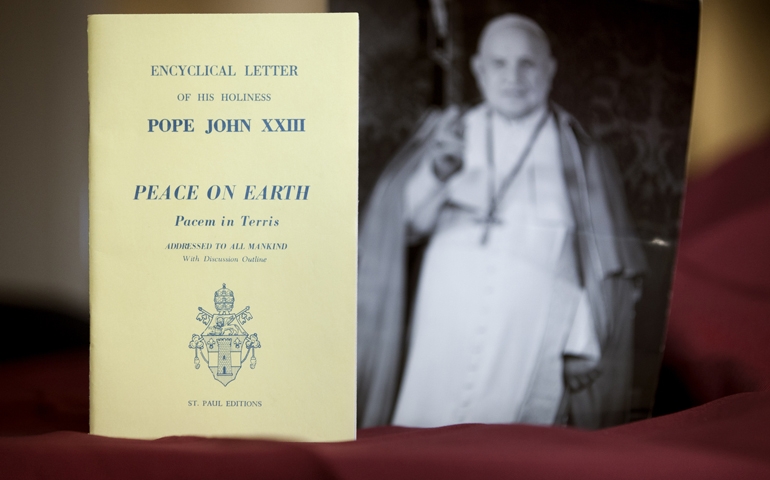
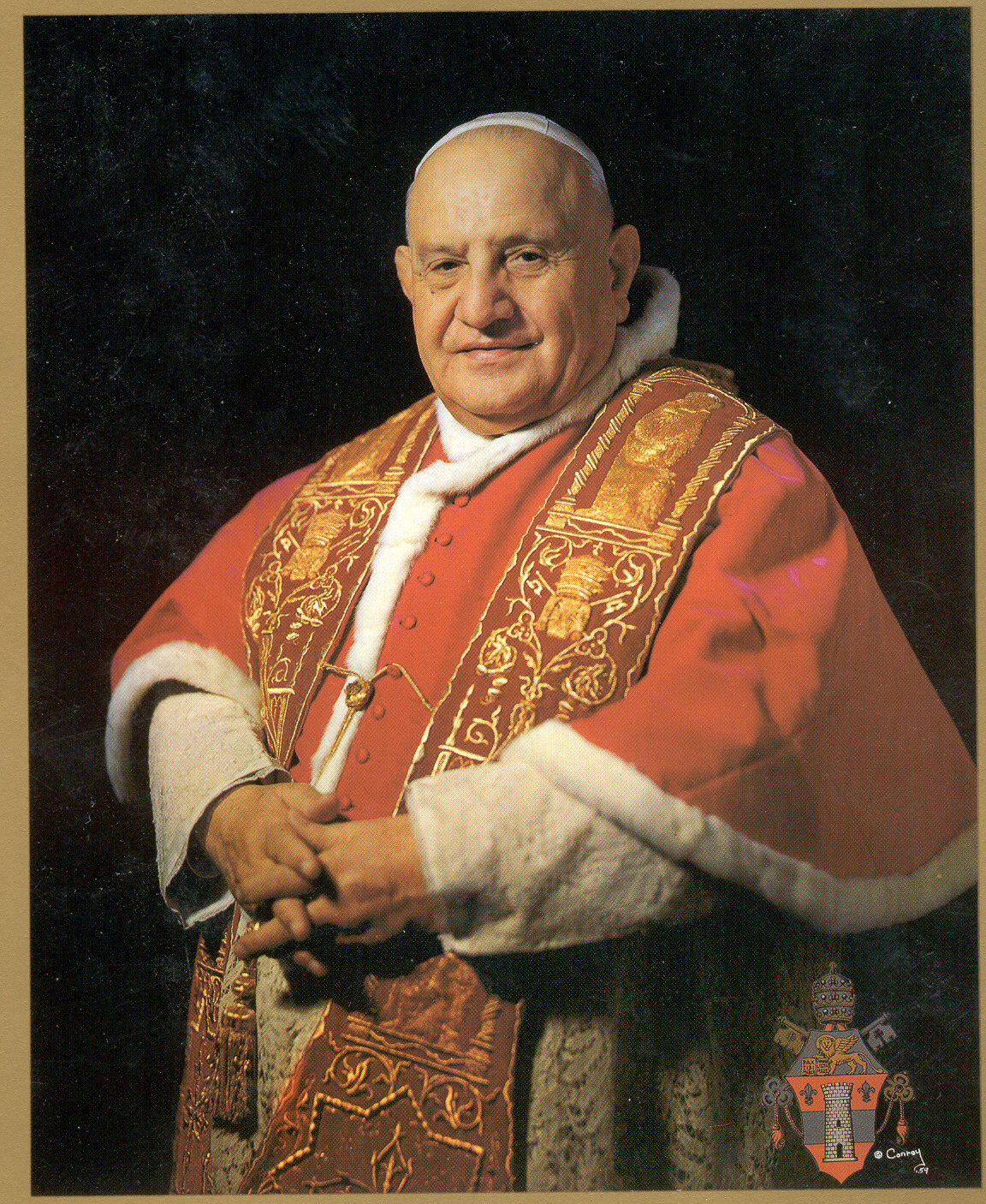


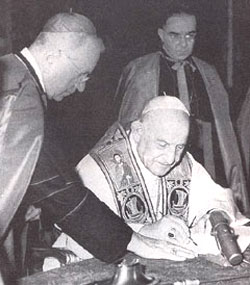
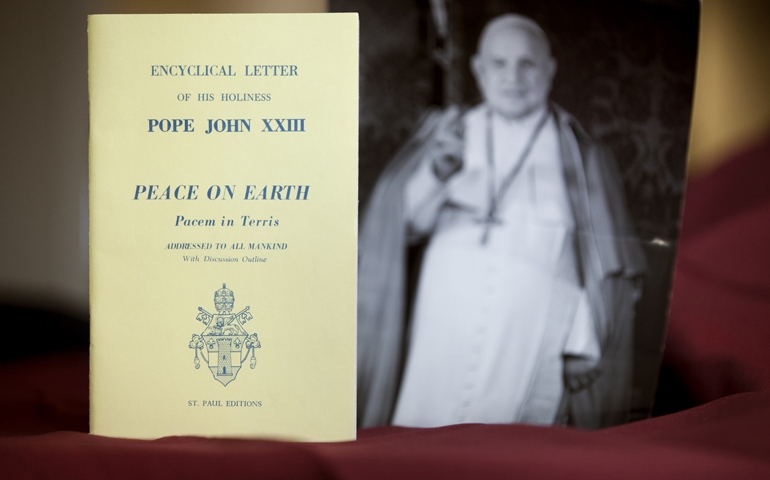

 petercanisiusmichaeldavidkang