Thursday, 29 August 2013 : 21st Week of Ordinary Time, Memorial of the Passion of St. John the Baptist (Scripture Reflection)

Liturgical Colour : Red

Dear brothers and sisters in Christ, today we commemorate a great feast in our faith, that is the Passion of St. John the Baptist, when he died in the prison of King Herod because of his uprightness, his faith, and his courage. St. John the Baptist, as we all know, is a relative to Jesus, the son of Elizabeth, the cousin of Mary, the Mother of our Lord. He was the one to open the way for Christ and straighten His path in this world.

St. John the Baptist was a truly upright man, who followed the Lord faithfully even unto his suffering and death. He was not even afraid of chastising a king, scolding him for having improper relationship with his brother’s wife, Herodias. He suffered prison, but he did not fear. He had also suffered rejection, mockery, and doubt, by the Pharisees and the chief priests, who disliked whatever he was doing when he baptised many people in the Jordan, and even questioned his authority.

He stood up courageously and rebuked them as an evil nest of vipers, just as he had in the same way rebuked Herod and his new wife. He feared not human hatred nor opposition, because to Him, it is the love of God that truly mattered to him. His death is part of the Lord’s plan for salvation, that his work in preparing the way for the Lord was then complete, having initiated our Lord Jesus through His baptism at the Jordan, marking the formal beginning of the Lord’s ministry on earth.

St. John the Baptist took his ministry seriously and dutifully, and he truly loved God and was glad of the part he had done in the Lord’s plan of salvation. When Jesus’ ministry began and many people began to come to Jesus instead of John, he was happy and slowly and quietly drifting away into nothingness, while still doing whatever he could to the people who came to him, and directed them to Christ the Lord. He showed true humility, unlike the Pharisees and the chief priests who viewed both him and Jesus as threats to their teaching authority.

Today we are reminded, and indeed urged to do more good and less of the vices, things abhorred in the eyes of the Lord our God. We are urged to follow the examples of St. John the Baptist while keeping away from the vices of Herod and Herodias, wicked people in the eyes of God. Yet, it is very natural for all of us to follow the path of Herod rather than that of John. Why is it so, brothers and sisters? Precisely because we all are weak, weak to sin, open to sin, and vulnerable to sin.

It is most likely that Herodias, even after she was widowed by Philip, the brother of Herod, remained very attractive and beautiful, and that was what attracted Herod to his own brother’s wife, even though as king, he could have had many women as his partner, he chose to follow his urges and desires and chose Herodias. The same can be said of Herodias, the wife. She certainly craved power and authority and wealth that only a king could muster, and that was why she was complicit in the improper relations between her and Herod, her husband’s brother.

Therefore, brothers and sisters in Christ, as we are reminded today of the unjust death of St. John the Baptist, messenger of God and the one who prepared the way before the Lord, that we too should be upright, just, and truthful in our lives, in all our words, actions, deeds, and dealings with others, and not be led by our human emotions and even less so to fall into the temptations of the devil and embrace them.

We must not let ourselves be swayed like Herod had done, in promising even up to half of his kingdom to the daughter of Herodias, just because he was fascinated by her and her dance. Lust, passion, and desire can indeed bring us to destruction, just as it had done to Herod. Herod killed the messenger of God, John the Baptist, and therefore incurred for certainty, the eternal wrath of God, all because of the vow he made to the daughter of Herodias, words that came out of desire and lust, which later on came back to haunt him.

Let us all, brothers and sisters in Christ, follow the example of John, that we will be ever courageous to stand up for our faith, to stand up for what we believe in, to be faithful defenders of the Lord in our increasingly hostile world. Let us not be afraid of saying the truth and live an upright life just as John had done. Guard our emotions and have a strong and healthy prayer life, that the devil will not be able to enter into our hearts and corrupt them, as he had done to Herod.

John showed his disciples that Christ is the Lamb of God, and therefore, today he too showed us to Christ, as the pathway and the only door to salvation. Let us be faithful to Christ our Lord, and be inspired by John His servant and messenger, and let us also adopt his humility, in not seeking human glory and human praise, but seeking the greater glory and praise in God instead. Let us strive to love God more by acting on His will, and do as He wants us, that is to love Him with all our strength and our being, and to give ourselves in love to our brethren, especially those who are unloved, those who are lonely, and those who are abandoned. May God bless us all. Amen.
Thursday, 29 August 2013 : 21st Week of Ordinary Time, Memorial of the Passion of St. John the Baptist (Gospel Reading)

Liturgical Colour : Red

Mark 6 : 17-29

For this is what had happened : Herod had ordered John to be arrested, and had had him bound and put in prison because of Herodias, the wife of his brother Philip. Herod had married her, and John had told him, “It is not right for you to live with your brother’s wife.”

So Herodias held a grudge against John; and wanted to kill him, but she could not, because Herod respected John. He knew John to be an upright and holy man, and kept him safe. And he liked listening to him, although he became very disturbed, whenever he heard him.

Herodias had her chance on Herod’s birthday, when he gave a dinner for all the senior government officials, military chiefs, and the leaders of Galilee. On that occasion the daughter of Herodias came in and danced; and she delighted Herod and his guests. The king said to the girl, “Ask me for anything you want and I will give it to you.” And he went so far as to say with many oaths, “I will give you anything you ask, even half my kingdom.”

She went out and said to her mother, “What shall I ask for?” The mother replied, “The head of John the Baptist.” The girl hurried to the king and made her request, “I want you to give me the head of John the Baptist, here and now, on a dish.”

The king was very displeased, but he would not refuse in front of his guests because of his oaths. So he sent one of the bodyguards with orders to bring John’s head. He went and beheaded John in prison; then he brought the head on a dish and gave it to the girl. And the girl gave it to her mother.

When John’s disciples heard of this, they came and took his body and buried it.

Thursday, 29 August 2013 : 21st Week of Ordinary Time, Memorial of the Passion of St. John the Baptist (Psalm)

Liturgical Colour : Red

Psalm 70 : 1-2, 3-4a, 5-6ab, 15ab and 17

In You, o Lord, I seek refuge; let me not be disgraced. In Your justice help me and deliver me, turn Your ear to me and save me!

Be my rock of refuge, a stronghold to give me safety, for You are my rock and my fortress. Rescue me, o my God, from the hand of the wicked.

For You, o Lord, have been my hope, my trust, o God, from my youth. I have relied on You from birth : from my mother’s womb You brought me forth.

My lips will proclaim Your intervention and tell of Your salvation all day. You have taught me from my youth and until now I proclaim Your marvels.

Thursday, 29 August 2013 : 21st Week of Ordinary Time, Memorial of the Passion of St. John the Baptist (First Reading)

Liturgical Colour : Red

Jeremiah 1 : 17-19

But you, get ready for action; stand up and say to them all that I command you. Be not scared of them or I will scare you in their presence!

See, I will make you a fortified city, a pillar of iron with walls of bronze, against all the nations, against the kings and princes of Judah, against the priests and the people of the land.

They will fight against you but shall not overcome you, for I am with you to rescue you – it is YHVH who speaks.

The need to return to ‘Ad Orientem’ celebration

00056_15042010

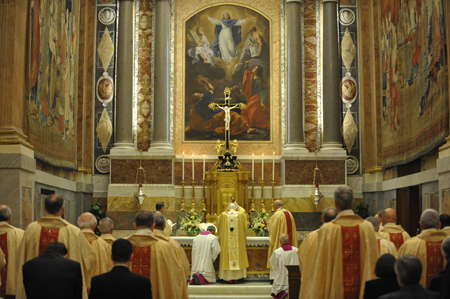
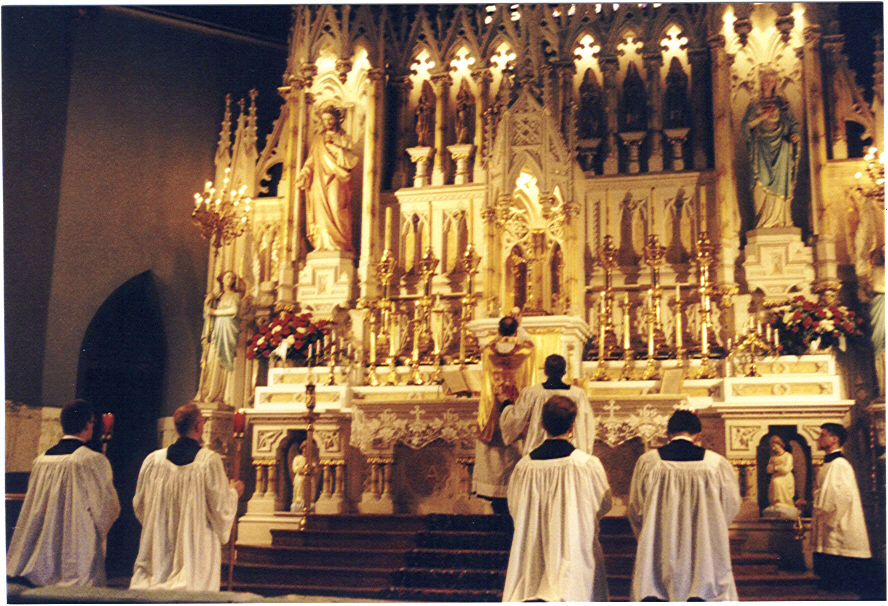
Let us return to the ad orientem celebration! That is facing the Lord TOGETHER with the people, instead of facing the people (ad populum).

The Mass is not a political gathering or a party where everyone faces each other and look at each other. The Mass is about the Holy Sacrifice of Jesus Christ, and we ALL ought to look at Him crucified. Therefore, everyone, including the priest, MUST face the Lord, and ad orientem is the best way.

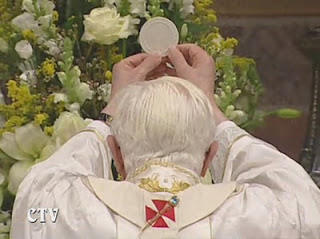
Elevation

The focus of the Mass is the Lord, not the priest as a person. The priest is Alter Christus, Christ personified in the priest, and when he lifts up that bread turned into the Most Precious Body, It is like Christ lifted up high between the heaven and the earth, offering Himself as a sacrificial victim, to absolve and save all the world from death and sin. When the priest lifts up that chalice with wine, transformed into the Most Precious Blood, it is the Blood of Christ, Jesus Christ Himself we are looking at, His Blood pouring down the cross to us, to wash us from our iniquities and our sins, making our garments white again in the Blood of the Lamb.

Monstrance Baroque

And even the ones who crucified Him, looked at Him “And they shall look at the One whom they pierced”. It is therefore imperative, that we keep our focus at the Lord, as One people, One Church, during and throughout the Mass. The focus is not in the dances and the upbeat songs now often used to arouse people’s attention and interest in the Mass, and neither is the focus on the priest dancing, singing, or the people’s performances, but the focus is Christ.

When the priest faces the people, this fact is quickly and easily lost in both the people, AND the priest. Eye contact is very important in relationships, and eye contact between the priest and the people while can be beneficial (during the homily) it can easily distract our attention from the Lord in the Eucharist, very easily.

In this way too, we take the best from both of the two Form of the Latin Rite we have in the Church, that is the Extraordinary Form (Tridentine) and the Ordinary Form (Novus Ordo), and end the numerous liturgical abuses that had arisen ever since ad populum celebration became commonplace, and many did them inappropriately and without due honour to our Lord Jesus Christ.

papal ad orientem 2010 4

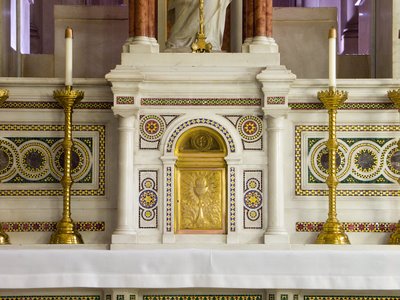
And lastly, it is time to return the Tabernacle with the Most Holy Eucharist back to its place of primary honour behind the Altar, that is where all the people and the priests focus at during the Mass, and not relegated somewhere at the side or a less-than-honorary place in the church building. There can be another Tabernacle for use especially during the Transfer of the Eucharist on Holy Thursday, but the Tabernacle itself should and indeed, must be restored to its position of honour at the Altar!

Cathedral Basilica of Saint Louis, in Saint Louis, Missouri - All Saints Chapel - tabernacle

Ad orientem celebration helps this, as the priest no longer need to show his back all the time to the Lord throughout the Mass if ad populum celebration is done.