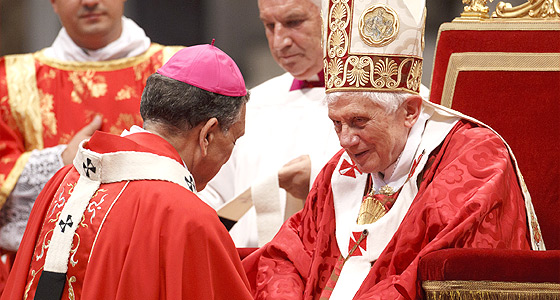
Friday, 22 February 2013 : Feast of Chair of St. Peter the Apostle (Additional Second Reading)

(This reading is used in important Masses on the Feast of Chair of Saint Peter, including Episcopal Ordinations)

2 Corinthians 5 : 13-21

Now, if I have spoken foolishly, let God alone hear; if what I have said makes sense, take it for yourselves. Indeed the love of Christ holds us and we realise that if He died for us all, all have died. He died for all so that those who live may live no longer for themselves, but for Him who died and rose again for them. And so from now on, we do not regard anyone from a human point of view; and even if we once knew Christ personally, we should now regard Him in another way.

For that same reason, the one who is in Christ is a new creature. For Him the old things have passed away; a new world has come. All this is the work of God who in Christ reconciled us to Himself, and who entrusted to us the ministry of reconciliation. Because in Christ, God reconciled the world with Himself, no longer taking into account their trespasses and entrusting to us the message of reconciliation.

So we present ourselves as ambassadors in the name of Christ, as if God Himself makes an appeal to you through us. Let God reconcile you; this we ask you in the name of Christ. He had no sin, but God made Him bear our sin, so that in Him we might share the holiness of God.

Friday, 22 February 2013 : Feast of Chair of Saint Peter, the Apostle (Psalm)

Psalm 22 : 1-3a, 3b-4, 5, 6

The Lord is my shepherd, I shall not want. He makes me lie down in green pastures. He leads me beside the still waters. He restores my soul.

He guides me through the right paths for His Name’s sake. Although I walk through the valley of the shadow of death, I fear no evil, for You are beside me : Your rod and Your staff comfort me.

You spread a table before me in the presence of my foes. You anoint my head with oil; my cup is overflowing.

Goodness and kindness will follow me all the days of my life. I shall dwell in the house of the Lord as long as I live.

Friday, 22 February 2013 : Feast of Chair of Saint Peter, the Apostle (First Reading)

1 Peter 5 : 1-4

I now address myself to those elders among you; I too, am an elder and a witness to the sufferings of Christ, hoping to share the Glory that is to be revealed. Shepherd the flock which God has entrusted to you, guarding it not out of obligation but willingly for God’s sake; not as one looking for a reward but with a generous heart; do not lord it over those in your care, rather be an example to your flock.

Then, when the Chief Shepherd appears, you will be given a crown of unfading glory.

Episcopal Ordination of Coadjutor Archbishop William Goh of Singapore, Part II : The office of Bishop, what they wear, and their significance

Continuing from the first part, in which I elaborated on the Episcopal Ordination ceremony itself, let us now take a look at the office of the Episcopate itself, that is of a bishop. One may ask, who is a bishop? Bishops are ‘overseers’, which came from the Greek word, Episkopos, which means overseers, as in the early Church, there are those appointed to succeed the Apostles and oversee the Christian communities, to care for them like shepherds care for their flocks of sheep.

Such was the origin of the episcopate, with bishops as those appointed in positions of authority and with oversight over the laity and the religious alike, to keep them faithful to God, and united to the successor of the blessed Apostle Peter, who is our Pope.


This development of the early Church eventually become an office on its own, a separate level from the priesthood, as in the episcopate, there is a fulfillment and completion of the holy orders, which is symbolised by the bishop wearing both the deacon’s dalmatic, and the priest’s chasuble over the dalmatic. This symbolises the union of the ministry of the diaconate and the priesthood in the person of the bishop, who represents the completion of holy orders.

Cardinals and Popes are not separate orders on their own, unlike the diaconate, priesthood, and the episcopate, as these are just different types of bishops, with Cardinals usually being bishops from important dioceses/archdioceses in the world, and the officials of the Roman Curia (the body governing the Universal Church), and the Pope, being the Bishop of Rome, is still a bishop, but is preeminent due to him being the successor of the Apostle Peter, to whom Christ entrusted His Church, and thus the Pope becomes the very Vicar of Christ in this world.


There are also many types of bishops, which I will elaborate further below :


1. Diocesan bishops : These are the ordinary bishops, who head a diocese. A diocese is a division of the Church in a certain geographical area consisting of the faithful in Christ, who may share same culture, language, and customs, or may be of diverse linguistic and cultural origins.


2. Archbishops : These are the bishops who head a more important diocese, either by location, or by history, or by some other reasons. These dioceses therefore are also correspondingly named archdioceses. There are two types of archdioceses :

          a. Metropolitan Archdiocese : An archdiocese that has an overseer status over one or more other dioceses (called suffragan dioceses or suffragan sees) which are grouped together into an Ecclesiastical Province (or Province of the Church), and headed by a Metropolitan Archbishop, whose distinguishing feature is that he wears a pallium (a woolen shoulder band with black crosses).

          b. Archdioceses (directly subject) : These Archdioceses are important dioceses which has either been historically a metropolitan see or diocese that were elevated to an archdiocese status, but these are not overseeing any dioceses under them, and therefore stand alone on its own, directly subject to the Holy See, to the Pope, instead of through a Metropolitan. The Archdiocese of Singapore is of this type.


3. Auxiliary bishops : These are ‘helper’ bishops, who are appointed in larger dioceses/archdioceses to help with the administration of the diocese/archdiocese’s large Catholic population. May also succeed the diocesan bishop/archbishop upon retirement if selected by the Pope, but this succession is not automatic (not like that of a coadjutor). They are given titular see (diocese/archdiocese) upon their appointment as auxiliary bishop.


4. Coadjutor Archbishops/Bishops : These are bishops/archbishops appointed to dioceses/archdioceses to succeed the diocesan bishop/archbishop, whose age may be nearing 75 or in ill health. Bishops have to submit their resignation to the Pope upon reaching the age of 75, so the appointment of a coadjutor is a way to ensure that the diocese does not become vacant if the diocesan bishop resigns, and is a good way to prepare the coadjutor for the eventual succession and duty as the new bishop of the diocese. Coadjutors are not given any titular sees since they are bound immediately to the see (diocese/archdiocese) which they are to succeed in the future.


5. Titular dioceses/archdioceses : These are usually ancient dioceses/archdioceses, mostly located in North Africa and the Middle East, which due to historical events, had fallen into seclusion and extinction. Some can also be found in Europe and Italy, where some dioceses and archdiocese had been suppressed in the past, and become titular sees. These are now given to Apostolic Nuncios, Apostolic Delegates, and the auxiliary bishops.


6. Major Archdioceses : These are only found in the Eastern Catholic Churches, namely the main diocese in the Syro-Malankar, Syro-Malabar, Romanian, and Ukrainian Eastern Catholic Churches, whose importance place them into this special type of Archdioceses, but not high enough to be given the title of a Patriarchate itself.


7. Patriarchate (Latin and Eastern Catholic) : These are the special Patriarchal sees headed by a Patriarch, which in the Eastern Catholic Churches are the leaders of their respective Churches, in full communion with the Bishop of Rome. They are the Patriarchs of the ancient Pentarchy, of Alexandria, Jerusalem, and Antioch, and historically of Constantinople (modern-day Istanbul). However, in our approach to our sister Church of the Eastern Orthodox (who is not yet in full communion with Rome), we respect their Ecumenical Patriarch of Constantinople, who is the leader of the Eastern Orthodox faithful. Latin Patriarchates also exist in Lisbon, Venice, and Goa, which are headed by Roman Catholic Archbishops, but with special Patriarchal title, due to their distinctive history in the Church. Rome itself was a Patriarchate (of the West) until 2006, but was abolished by Pope Benedict XVI to better reflect the position of the Pope as the leader of the Universal Church, and not just the Church of the West (the Roman Church).


So, therefore, after talking about bishops, who they are, and what types of bishops are there, let us now look into the vestments and the items particular to bishops, all of which are steeped in the tradition of the faith and filled with deep symbolism.


1. Working dress (worn outside Mass and important events, the daily wear of bishops, and also for Cardinals and Popes)

a. Simar            

 Image

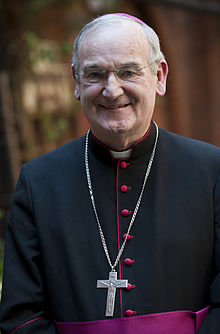
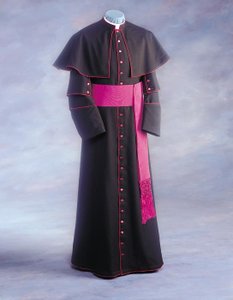
A simar is a special type of cassock worn by the bishops, cardinals, and popes, that is a cassock with a shoulder cape, and a sash (around the waist), which is violet for bishops, scarlet for cardinals, and white for popes. As is well known, the Pope’s simar is white in colour, while bishop’s and cardinal’s simar is black, and with violet lining for bishops, and scarlet lining for cardinals.


b. Pectoral cross (also part of the pontificalia and the choir dress)

Image


The pectoral cross is worn as its name suggests, on the breast, to represent Christ who protects us from harm, as noted in the prayer of the bishop when he wear the pectoral cross before the Mass, called Munire me dignerisMunire digneris me, Domine Jesu Christe, ab omnibus insidiis inimicorum omnium, signo sanctissimae Crucis tuae: ac concedere digneris mihi indigno servo tuo, ut sicut hanc Crucem, Sanctorum tuorum reliquiis refertam, ante pectus meum teneo, sic semper mente retineam at memoriam passionis, et sanctorum victorias Martyrum. (May You graciously protect me, o Lord Jesus Christ, from all the snares of all my enemies, the sign of the Your most holy Cross: that You would vouch and grant to me and all unworthy of being Your servant, that I may receive the Cross, filled with the remains of Your Saints, in front of my breast, I hold, then it always in mind, but retain the memory of the passion, martyrs and saints victories.). 

This is because pectoral crosses are usually precious and contain the relics of the saints, which therefore be further a reminder that the bishop carries with Him at all times, Christ, and His holy Saints, and a reminder of the Cross, through which the salvation of our Lord comes to us.


c. Zucchetto (or skullcap)

Image


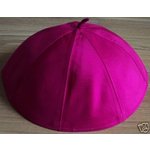
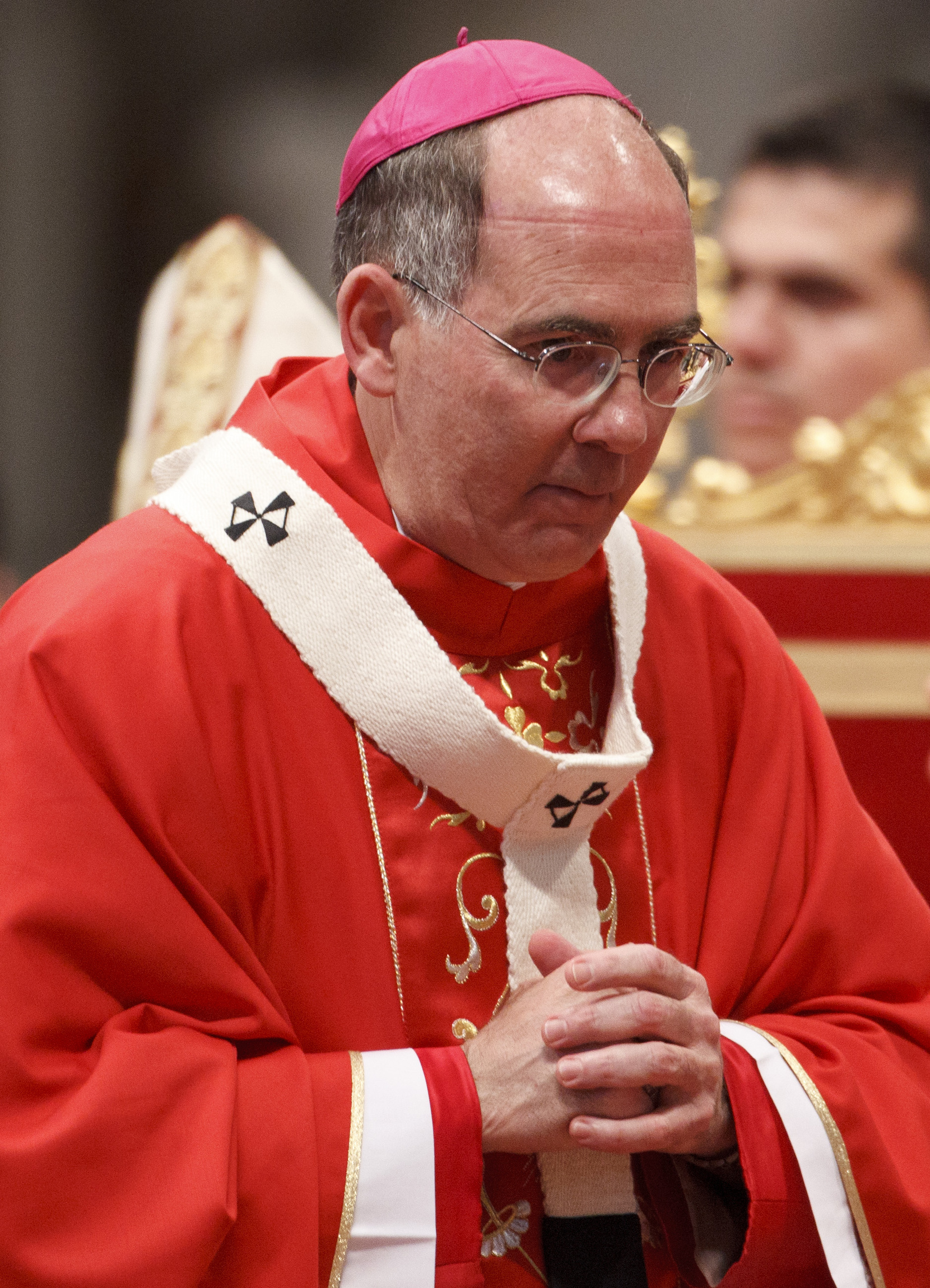
Zucchetto is from the Italian word which means small gourd, because its shape which resembles (half of) a pumpkin. This is a head covering item for the bishops, cardinals, and popes, with the similar pattern of violet for bishops, scarlet for cardinals, and white for popes. This item has a lot in common and may have originated from the Jewish prayer cap, which is somewhat different from the zucchetto in appearance. Originally zucchetto has a practical use in the past, since the clergy in that era were tonsured, that is having their head shaved at the centre, and thus, without the present day heating available, during cold times, the head of the prelate (bishops) would become cold, and the zucchetto came in handy as a covering.

Nowadays, it is a symbol of prayer, and also honor, and therefore, as a sign of humility, it is always removed at the beginning of the Preface of the Eucharistic Prayer and the head of the bishops (including cardinals and Popes) remain bare throughout the Eucharistic Prayer and the Communion.


d. Episcopal ring

Image


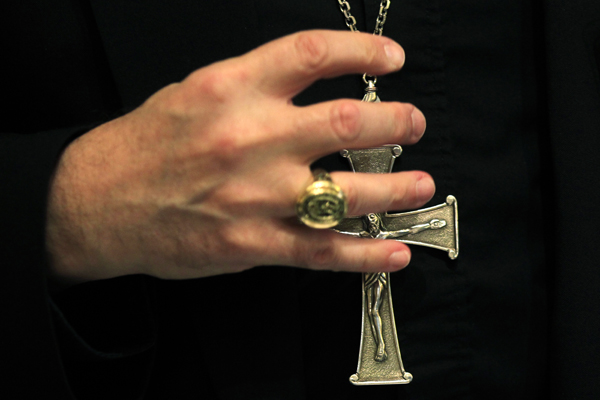
The episcopal ring symbolises the bishop as the shepherd is married to God’s Church, in particular the diocese and the sheep, the faithful in Christ whom he is supposed to guide as the shepherd. The prayer the bishop said when wearing it reflects that this ring is also a symbol of virtue and sanctification, and blessing : Cordis et corporis mei, Domine, digitos virtute decora, et septiformis Spiritus sanctificatione circumda. (With my heart and of my body, O Lord, decorate my fingers with virtue, and sanctify me with the sevenfold blessing of the Holy Spirit around me).


2. Choir dress (worn during the Mass if the bishop is not the celebrant or concelebrant in the Mass, and events like Vespers, and also worn outside for important events)

Image

a. Cassock with fascia/sash

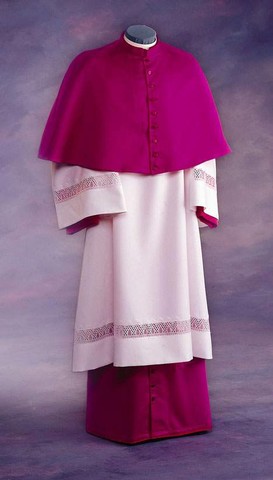
This cassock with sash style is similar to the simar, but is entirely violet for bishops and scarlet for cardinals (as opposed to black with violet or scarlet lining)


b. Rochet

Image

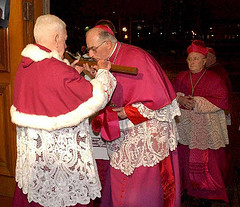
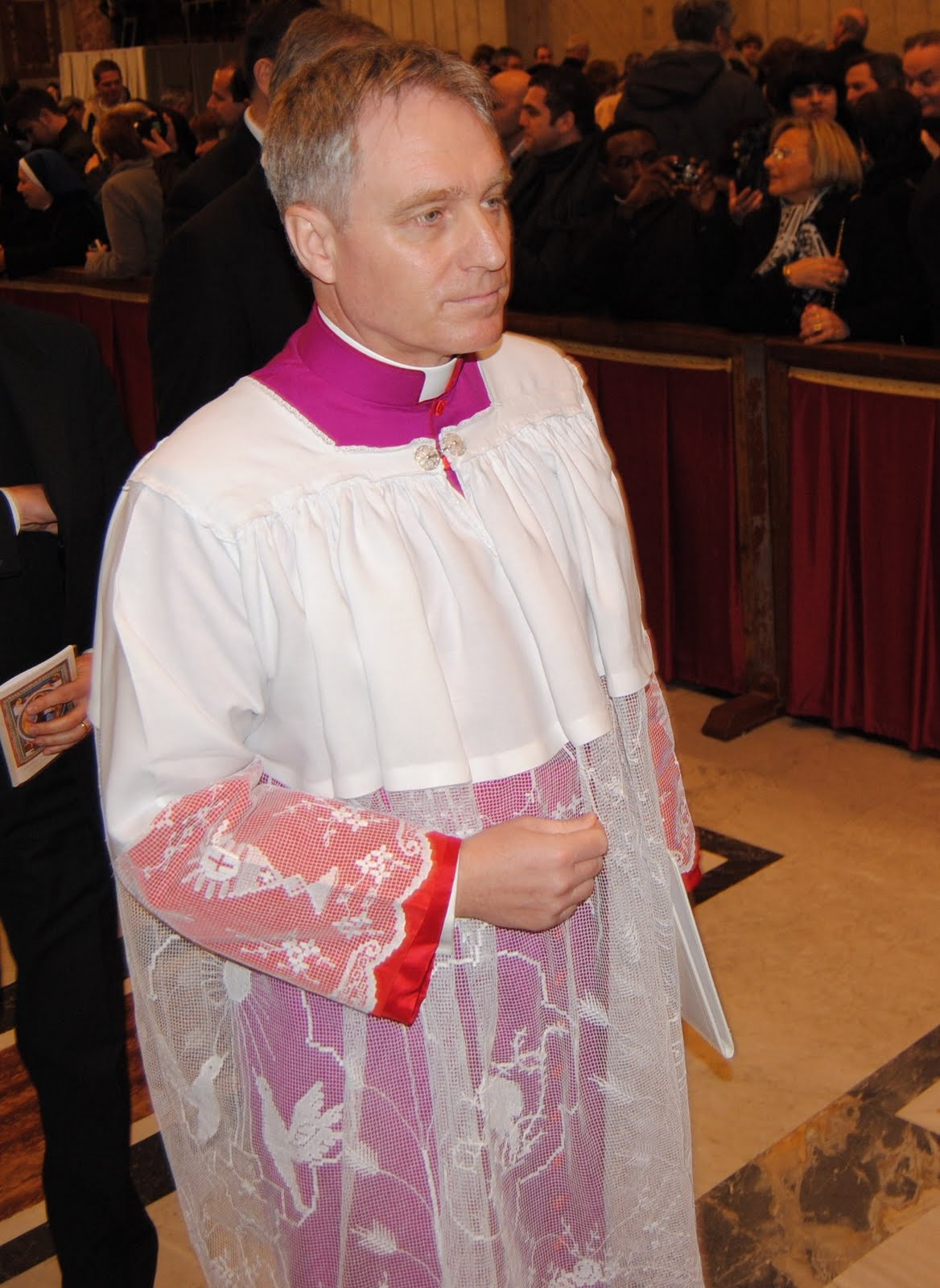
A beautiful, usually thin, either white or translucent, and laced piece of clothing worn over the cassock and the fascia, as seen worn above by Monsignor Georg Ganswein, now Archbishop Ganswein, Prefect of the Pontifical Household.


c. Mozzetta

Image


Mozzetta (violet for bishops) is a shoulder cape worn over the rochet and the cassock.


d. Pectoral cross

Image

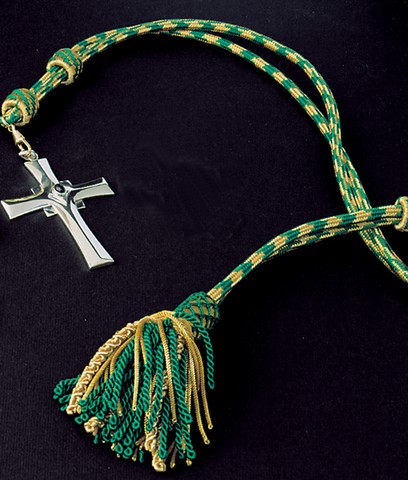
Similar with in working dress, but more often worn with a cord rather than a chain.


e. Zucchetto

Violet for bishops. Similar as in the working dress.


f. Biretta

Image


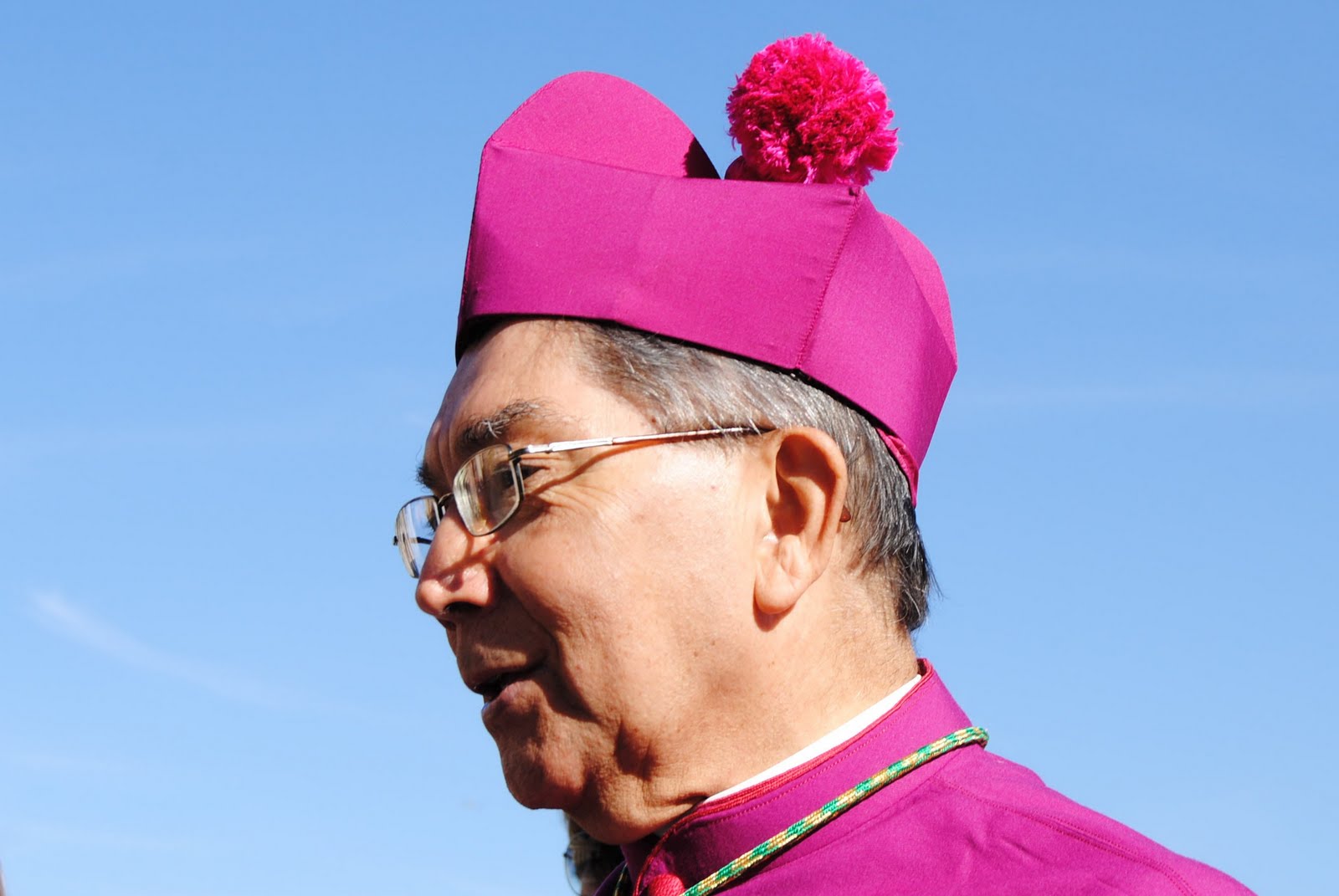
A hat-like item which has the same ancestry as our modern academic mortar board (worn on the graduations in universities), which is violet for bishops and has a pom-pom like object on the top. Only has three peaks, and the unpeaked side is always worn on the left.


3. Bishop’s Pontificalia (worn during the Mass when celebrating)

a. Dalmatic

Image


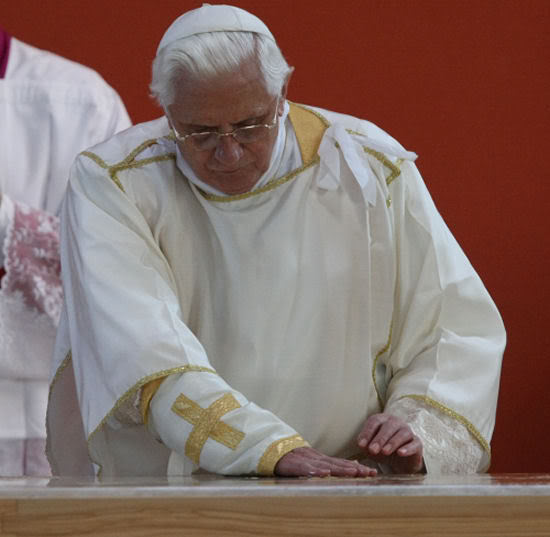
Similar as those worn by deacons, which has squarish-edges as compared to the chasuble (which has more rounded edges), worn over the alb but under the chasuble. Here is the picture of our Pope Benedict XVI wearing the dalmatic during the consecration of a new church in Rome, after he took off his chasuble for the anointing of the altar with holy oils.


b. Chasuble

Image


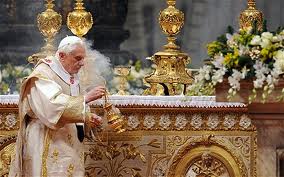
Chasuble as worn by the priests, worn over the dalmatic and the stole, and in this picture, Pope Benedict XVI wore the more traditional Roman-style chasuble, and very visibly underneath the chasuble, is the dalmatic. Only bishops can wear both the chasuble and the dalmatic.


c. Pectoral cross

Worn under the chasuble, not over the chasuble, either the normal chained or corded pectoral cross. Not correctly worn when worn above the chasuble, although many bishops seem to do this. Pope Benedict XVI himself consistently wear the pectoral cross under the chasuble since the beginning of his Pontificate.


d. Episcopal ring

Worn on the finger, which signify his marriage to God and His Church.


e. Mitre

Image


Image


Image


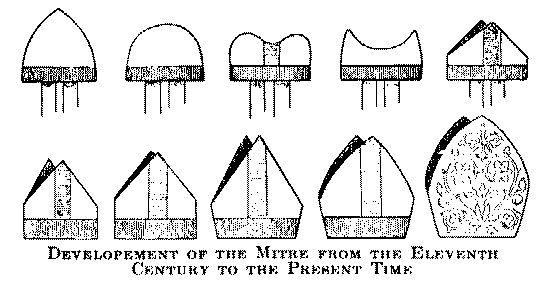
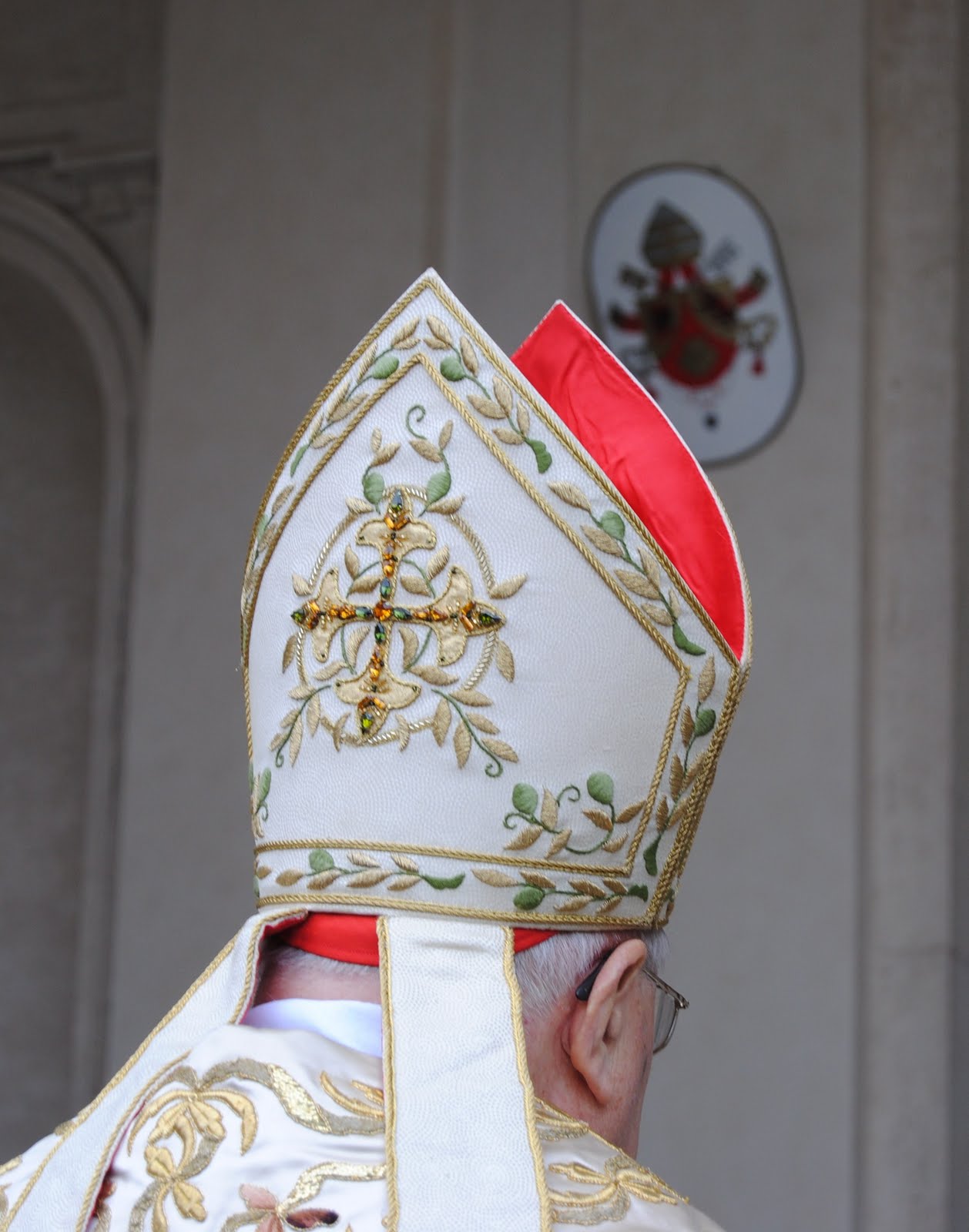
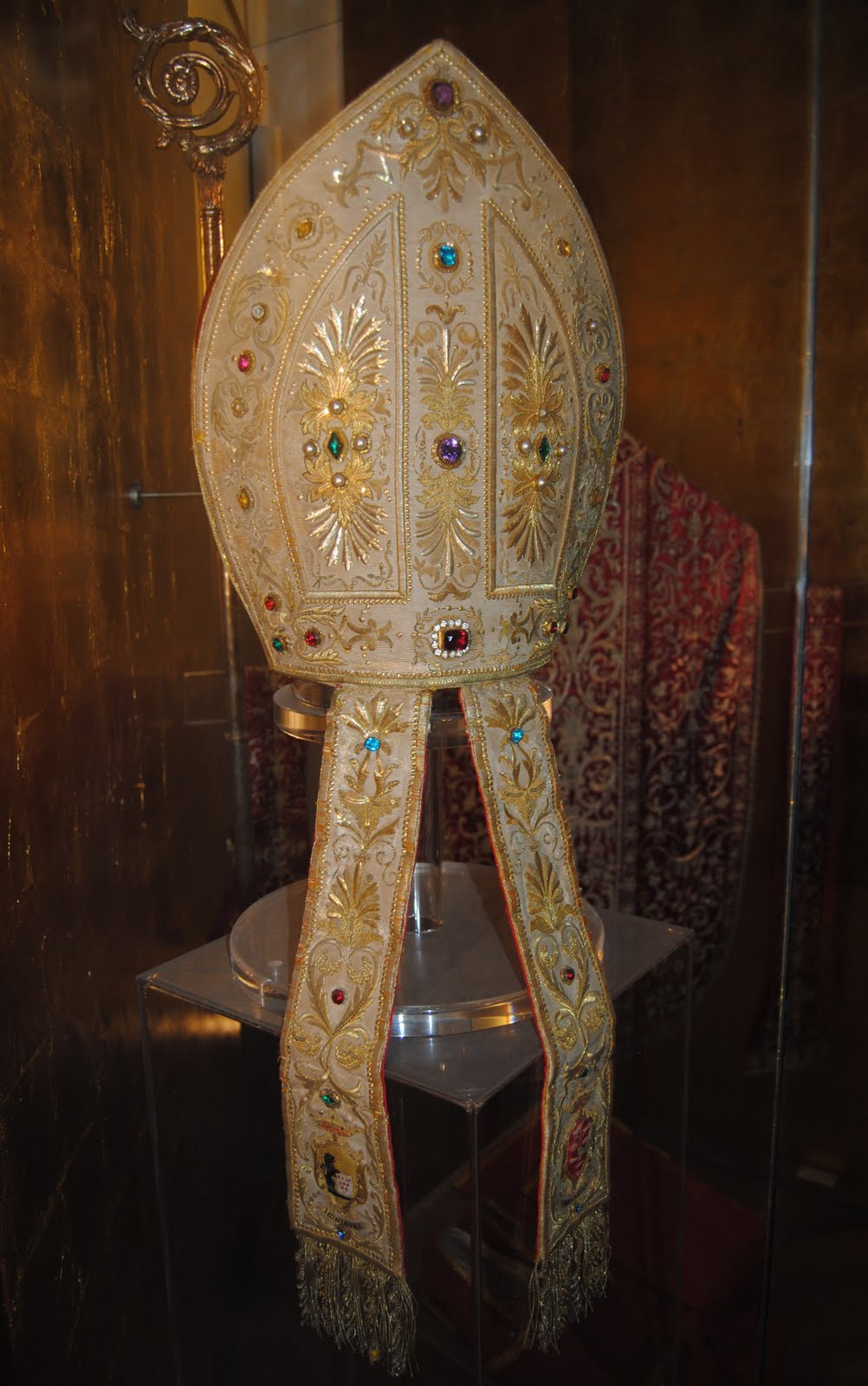
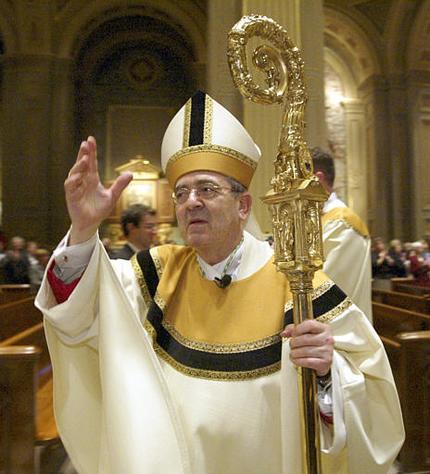
Worn over the zucchetto on the head, and was developed from the camelaucum, or the secular headdress of the late Roman Empire and early Byzantine Empire, where they are also worn by the Popes and the Roman priests, and gradually was restricted only to bishops and abbots.

The mitre symbolises the teaching authority of the bishops, which are symbolised by the two peaks of the mitre, representing the Old and the New Testament, and also recall the flames of the Holy Spirit that inflame the hearts of the Apostles to spread the Good News to all peoples. Therefore, these represents the authority of the bishop to teach the Gospel through the Holy Spirit and based on the Scripture, the Word of God, both the Old and the New Testament. The two lappets behind the mitre themselves also represent the Old and the New Testament, the two sides of the Lord’s Sacred Scripture (which shape looks just like a book marker).


f. Crosier (Pastoral staff)

Image


Image


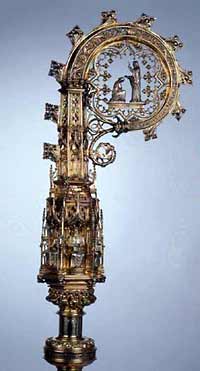
The crosier, or the pastoral staff is the crook-like staff, reminding us on the shepherd’s crook, which they use to shepherd their sheep. Thus, the crosier represents the bishops’ role as the shepherds of the people of God, and guide them in their journey towards the Lord, the Chief Shepherd, the Good Shepherd.


g. Pallium (only for Metropolitan Archbishops and the Pope)

Image

The pallium is a woolen band worn around the shoulder. This represent the metropolitan’s role as the overseer of the faithful, over the sheep of the Lord, that is the faithful people of God, just like Jesus, the Good Shepherd carrying His sheep on His shoulder. Therefore, the pallium represents both the authority of the metropolitan, and the burden presented by his ministry in the service of the Lord.

Image


Image

The pallium used to be much wider, as reflected in the earlier pallium that Pope Benedict XVI wore, which used the style not worn since a millenia ago, in the earlier days of the Church. Now the most common form of the pallium is a shorter and narrower woolen band worn around the shoulders, and adorned with three pins that represent the nails that pieced Christ on the cross, and these pins were placed onto the black crosses (red for Pope Benedict XVI’s new, larger pallium and the earlier, much larger pallium), which represent the wounds of Christ.


After all that, and after looking into what a bishop is, what is the nature of the ministry of the bishops, the types of bishops, what they wear and what symbolisms are there in them, let us now take a time to pray, and pray indeed for the soon-to-be ordained Coadjutor Archbishop, William Goh, of the Archdiocese of Singapore.

May God be with him all the days of his new ministry as bishop, and strengthen him at all times, that when his ministry begins this Friday, the Holy Spirit will guide him and keep him faithful to the ministry he has been chosen for, forever and ever. Amen!


Episcopal Ordination of Coadjutor Archbishop William Goh of Singapore, Part I : The Mass and ceremony itself

What is an Episcopal Ordination? It is the event celebrated with a Mass that mark the continuation of the Apostolic ministry to a new bishop, signified most importantly by the laying of hands by other bishops and the presiding bishop (consecrator), and the imposition of the pontificalia or the vestments and items particular to bishops, which are all representative of his ministry as bishop.

I have written this in conjunction with the Episcopal Ordination of the Coadjutor Archbishop of the Archdiocese of Singapore, Archbishop William Goh Seng Chye, which will be held in the EXPO, Singapore on Friday, 22 February 2013, on the Feast of Chair of St. Peter.


Some terms :

Consecrator : the main presiding bishop at the Episcopal Ordination, similar to celebrant in the celebration of the Mass. In the case of Friday’s ordination, it will be the Apostolic Nuncio to Singapore, Archbishop Leopoldo Girelli

Co-consecrators : the assistant bishops at the Episcopal Ordination, similar to concelebrant in the celebration of the Mass. In the case of Friday’s ordination, it will be the Archbishop of Singapore, Archbishop Nicholas Chia, and the Metropolitan Archbishop of Kuala Lumpur, Archbishop Murphy Pakiam.

Other bishops present in the Ordination can also help out with the laying of the hands, following that of the consecrator and co-consecrator’s laying of hands.


The ceremony itself will begin as a usual Mass would, beginning with the entrance procession. The new bishop to be ordained usually walks in front of the presiding bishop (consecrator), and usually accompanied by two deacons (just as all bishops should, that means the presiding bishop too when available should also have two deacons to accompany him).

Then begin the Mass as usual with the incensing of the altar, the sign of the Cross, the opening address if there is any, and followed by the Penitential Act (I confess to Almighty God…) and the Kyrie (Lord have mercy). Gloria follows after that. One may ask that this is Lenten season where Gloria is not used, but the day of the ordination for this case, 22 February falls on the Feast of Chair of St. Peter where Gloria is used (as is Te Deum later in the ceremony).


After Gloria concludes, then it comes to the opening prayer, and then the readings come as per the usual Mass. First Reading, followed by the Psalm, and finally by the Gospel. No Alleluia for this case since it happens during Lent, and at Lent Alleluia is always omitted, so we have the Lenten Gospel Acclamation instead.

After the Gospel, the Ordination ceremony proper begins.


The first part begins with usually the singing of the Hymn of the Holy Spirit (Veni Creator Spiritus), with all the verses used. Then after the Hymn is completed, this is followed by the presentation of the Bishop/Archbishop-elect, that is Coadjutor Archbishop-elect William Goh in this case (He is not yet legally and validly bishop at this point).

The presiding bishop can give a homily following the presentation of the Bishop-elect, usually to explain on the ministry of the bishop and the nature of that ministry.


Then the promise/vow of the bishop-elect follows, where the new Bishop solemnly vows before God his promise : (In Latin and English)

1. Latin : Antiqua sanctorum Patrum institutio praecipit, ut, qui Episcopus ordinandus est, coram populo interrogetur de proposito fidei servandae et muneris exsequendi.

Vultis ergo, frater carissimus (fratres carissimi if plural), munus nobis ab Apostolis creditum et vobis per impositionem manuum nostrarum tradendum cum gratia Spiritus Sancti usque ad mortem explere?

English : The ancient rule of the holy Fathers ordains that a Bishop-elect is to be questioned in the presence of the people on his resolve to uphold the faith and to discharge his duty.

And so dear brothers, do you resolve by the grace of the Holy Spirit to discharge until death the office entrusted to us by the Apostles, which we are about to pass on to you by the laying on of our hands?

The bishop-elect answers : Volo (English : I do)


2. Latin : Vultis Evangelium Christi fideliter et indesinenter praedicare?

English : Do you resolve to preach the Gospel of Christ with constancy and fidelity?

The bishop-elect answers : Volo (English : I do)


3. Latin : Vultis depositum fidei, secundum traditionem inde ab Apostolis in Ecclesia semper et ubique servatam, purum et integrum custodire?

English : Do you resolve to guard the deposit of faith, entire and incorrupt, as handed down by the Apostles and preserved in the Church everywhere and at all times?

The bishop-elect answers : Volo (English : I do)


4. Latin : Vultis corpus Christi, Ecclesiam eius, aedificare et eius unitate cum Ordine Episcoporum, sub auctoritate successoris beati Petri Apostoli, permanere?

English : Do you resolve to build up the body of Christ, His Church, and to remain in the unity of that body together with the Order of Bishops under the authority of the successor of Saint Peter the Apostle?

The bishop-elect answers : Volo (English : I do)


5. Latin : Vultis beati Petri Apostoli successori, obaedientiam fideliter exhibere?

English : Do you resolve to render obedience faithfully to the succesor of the blessed Apostle Peter?

The bishop-elect answers : Volo (English : I do)


6. Latin : Vultis plebem Dei sanctam, cum comministris vestris presbyteris et diaconis, ut pii pater, fovere et in viam salutis dirigere?

English : Do you resolve to guide the holy people of God in the way of salvation as devoted father and sustain them with the help of your fellow ministers, the priests, and deacons?

The bishop-elect answers : Volo (English : I do)


7. Latin : Vultis pauperibus et peregrinis omnibusque indigentibus propter nomen Domini affabiles et misericordes vos praebere?

English : Do you resolve, for the sake of the Lord’s Name, to be welcoming and merciful to the poor, to strangers, and to all who are in need?

The bishop-elect answers : Volo (English : I do)


8. Latin : Vultis oves errantes ut boni pastores requirere et ovili dominico aggregare?

English : Do you resolve as good shepherds to seek out the sheep who stray and gather them into the Lord’s fold?

The bishop-elect answers : Volo (English : I do)


9. Latin : Vultis Deum omnipotentem pro populo sancto indesinenter orare et sine reprehensione summi sacerdotii munus explere?

English : Do you resolve to pray without ceasing to Almighty God for the holy people and to carry out the office of high priest without reproach?

The bishop-elect answers : Volo, Deo auxiliante (English : I do, with the help of God)


After this, the Litany of the Saints begins, asking the prayer from all the saints, martyrs, and all holy men of God to pray for the new bishop. The bishop-elect prostrate himself on the floor as a sign of humility before God, during the Litany of the Saints.


(R = reply) (Here shown both Latin and English versions)

1. Kyrie, eleison                                        R : Kyrie, eleison

Lord, have mercy                                    R : Lord, have mercy


2. Christe, eleison                                    R : Christe, eleison

Christ have mercy                                   R : Christ, have mercy


3. Kyrie, eleison                                       R : Kyrie, eleison

Lord have mercy                                     R : Lord, have mercy


4. Sancta Maria, Mater Dei                  R : ora pro nobis

Holy Mary, Mother of God                  R : pray for us


5. Sancte Michael                                    R : ora pro nobis

Saint Michael                                            R : pray for us


6. Sancti Angeli Dei                                 R : orate pro nobis

Holy Angels of God                                 R : pray for us


7. Sancte Ioannes Baptista                   R : ora pro nobis

Saint John the Baptist                             R : pray for us


8. Sancte Ioseph                                        R : ora pro nobis

Saint Joseph                                                R : pray for us


9. Sancte Petre                                            R : ora pro nobis

Saint Peter                                                    R : pray for us


10. Sancte Paule                                         R : ora pro nobis

Saint Paul                                                      R : pray for us


11. Sancte Andrea                                      R : ora pro nobis

Saint Andrew                                               R : pray for us


12. Sancte Iacobe                                       R : ora pro nobis

Saint James                                                   R : pray for us


13. Sancte Ioannes                                     R : ora pro nobis

Saint John                                                      R : pray for us


14. Sancte Thoma                                        R : ora pro nobis

Saint Thomas                                                 R : pray for us


15. Sancte Iacobe                                        R : ora pro nobis

Saint James                                                    R : pray for us


16. Sancte Philippe                                      R : ora pro nobis

Saint Philip                                                      R : pray for us


17. Sancte Bartholomae                             R : ora pro nobis

Saint Bartholomew                                       R : pray for us


18. Sancte Matthae                                       R : ora pro nobis

Saint Matthew                                                 R : pray for us


19. Sancte Simon                                            R : ora pro nobis

Saint Simon                                                       R : pray for us


20. Sancte Thaddae                                       R : ora pro nobis

Saint Thaddeus                                                R : pray for us


21. Sancte Matthia                                         R : ora pro nobis

Saint Matthew                                                  R : pray for us


22. Sancta Maria Magdalena                      R : ora pro nobis

Saint Mary Magdalene                                  R : pray for us


23. Sancte Stephane                                       R : ora pro nobis

Saint Stephen                                                    R : pray for us


24. Sancte Ignati Antiochene                     R : ora pro nobis

Saint Ignatius of Antioch                              R : pray for us


25. Sancte Laurenti                                         R : ora pro nobis

Saint Lawrence                                                  R : pray for us


26. Sanctae Perpetua et Felicitas               R : orate pro nobis

Saint Perpetua and Saint Felicity               R : pray for us


27. Sancta Agnes                                              R : ora pro nobis

Saint Agnes                                                         R : pray for us


28. Sancte Georgi                                             R : ora pro nobis

Saint George                                                       R : pray for us


29. Sancte Fortunate                                      R : ora pro nobis

Saint Fortunatus                                               R : pray for us


30. Sancte Gregori                                           R : ora pro nobis

Saint Gregory                                                     R : pray for us


31. Sancte Augustine                                      R : ora pro nobis

Saint Augustine                                                R : pray for us


32. Sancte Athanasi                                        R : ora pro nobis

Saint Athanasius                                              R : pray for us


33. Sancte Basili                                               R : ora pro nobis

Saint Basil                                                            R : pray for us


34, Sancte Martine                                          R : ora pro nobis

Saint Martin                                                       R : pray for us


35. Sancte Nicolae                                          R : ora pro nobis

Saint Nicholas                                                   R : pray for us


36. Sancte Benedicte                                     R : ora pro nobis

Saint Benedict                                                  R : pray for us


37. Sancte Francisce et Dominice            R : orate pro nobis

Saint Francis and Saint Dominic               R : pray for us


38. Sancte Francisce Xavier                       R : ora pro nobis

Saint Francis Xavier                                      R : pray for us


39. Sancte Vincenti de Paul                        R : ora pro nobis

Saint Vincent de Paul                                    R : pray for us


40. Sancte Ioannes Maria Vianney         R : ora pro nobis

Saint John Mary Vianney                            R : pray for us


41. Sancta Catharina Senensis                   R : ora pro nobis

Saint Catherine of Siena                               R : pray for us


42. Sancta Teresia a Iesu                             R : ora pro nobis

Saint Teresa of Jesus                                     R : pray for us


43. Omnes Sancti et Sanctae Dei                   R : orate pro nobis

All holy men and women, Saints of God    R : pray for us


44. Propitius esto                                           R : libera nos, Domine

Lord, be merciful                                            R : Lord, deliver us, we pray


45. Ab omni malo                                           R : libera nos, Domine

From all evil                                                     R : Lord, deliver us, we pray


46. Ab omni peccato                                     R : libera nos, Domine

From every sin                                                R : Lord, deliver us, we pray


47. A morte perpetua                                    R : libera nos, Domine

From everlasting death                                R : Lord, deliver us, we pray


48. Per incarnationem tuam                       R : libera nos, Domine

By Your incarnation                                       R : Lord, deliver us, we pray


49. Per mortem et resurrectionem tuam        R :  libera nos, Domine

By Your death and resurrection                        R : Lord, deliver us, we pray


50. Per effusionem Spiritus Sancti             R : libera nos, Domine

By the outpouring of the Holy Spirit         R : Lord, deliver us, we pray


51. Peccatores                                                    R : Te rogamus, audi nos

Be merciful to us sinners                               R : Lord, we ask You, hear our prayer


52. Ut Ecclesiam tuam sanctam regere et conservare digneris

R : Te rogamus, audi nos

Govern and protect your Holy Church

R : Lord, we ask You, hear our prayer


53. Ut domnum apostolicum et omnes ecclesiasticos ordines in sancta religione conservare digneris

R : Te rogamus, audi nos

Keep the Pope and all the ordained in faithful service to Your Church

R : Lord, we ask You, hear our prayer


54. Ut hos electos benedicere digneris              R : Te rogamus, audi nos

Bless these (this) chosen men (man)                   R : Lord, we ask You, hear our prayer


55. Ut hos electos benedicere et santificare digneris

R : Te rogamus, audi nos

Bless and sanctify these (this) chosen men (man)

R : Lord, we ask You, hear our prayer


56. Ut hos electos benedicere et sanctificare et consecrare digneris

R : Te rogamus, audi nos

Bless, sanctify, and consecrate these (this) chosen men (man)

R : Lord, we ask You, hear our prayer


57. Ut cunctis populis pacem et veram concordiam donare digneris

R : Te rogamus, audi nos

Bring all peoples together in peace and true harmony

R : Lord, we ask You, hear our prayer


58. Ut omnis in tribulatione versantibus misericordiam tuam largiri digneris

R : Te rogamus, audi nos

Comfort with Your mercy the troubled and the afflicted

R : Lord, we ask You, hear our prayer


59. Ut nosmetipsos in tuo sancto servitio confortare et conservare digneris

R : Te rogamus, audi nos

Strengthen all of us and keep us in Your holy service

R : Lord, we ask You, hear our prayer


60. Iesu, Fili Dei vivi                                            R : Te rogamus, audi nos

Jesus, Son of the living God                              R : Lord, we ask You, hear our prayer


61. Christe, audi nos                                            R : Christe, audi nos

Christ, hear us                                                        R : Christ, hear us


62. Christe, exaudi nos                                      R : Christe, exaudi nos

Christ, graciously hear us                                R : Christ, graciously hear us


(The Litany of the Saints is slightly different and longer than the usual one as this one is used for the Episcopal Ordination Mass proper, which contains more prayers for the bishop-elect)


Then the presider will pray this prayer after the Litany :

Latin : Propitiare, Domine, supplicationibus nostris, et inclinato super hos famulos tuos cornu gratiae sacerdotalis, benedictionis tuae in eos effunde virtutem. Per Christum Dominum nostrum. Amen.

English : Graciously hear our petitions, o Lord, and pour out upon these, Your servants, the power of Your blessing, flowing from the horn of priestly grace. Through Christ our Lord. Amen.


The imposition or laying of hands then follow. Beginning with the consecrator and the co-consecrators, they lay their hands on the bishop-elect’s head, as a sign of the passing down of the Holy Spirit they themselves have received through the Apostolic Succession, from the Apostles, and therefore from Christ.

(During this time, the other bishops in attendance may also lay their hands on the head of the new Bishop as a symbol of the continuing power that came from the Apostles, the unbroken Apostolic Succession from the Apostles themselves, empowering the new Bishop with the same authority and power God has given to the Apostles).


Then this is followed by the placing of the Holy Scripture opened up above the head of the new Bishop, as a symbol that the new Bishop will stay true to the Word of God in the Scripture, and will do his best to carry out the will of God, and make the Word of God centre of his life and his mission as the Bishop, as the shepherd of God’s people.

The moment and words that made an Episcopal Ordination valid and legal (when done by the proper authority and in accordance with the Canon Law) are highlighted in bold below. The Principal consecrator then pray together with the co-consecrators and the other bishops over the new Bishop (with the Sacred Scripture above his head).


Latin : Deus et Pater Domini nostri Iesu Christi, Pater misericordiarum et Deus totius consolationis, qui in excelsis habeas et humilia respicis, qui cognoscis omnia antequam nascantur, tu qui dedisti in Ecclesia tua normas per verbum gratiae tuae, qui praedestinasti ex principio genus iustorum ab Abraham, qui constituisti principes et sacerdotes, et sanctuarium tuum sine ministerio non dereliquisti, cui ab initio mundi placuit in his quos eligisti glorificari :

Et nunc effunde super hos electos eam virtutem, quae a te est, Spiritum principalem, quem dedisti dilecto Filio tuo Iesu Christo, quem ipse donavit sanctis Apostolis, qui constituerunt Ecclesiam per singula loca ut sanctuarium tuum, in gloriam et laudem indeficientem nominis tui.

Da, cordium cognitor Pater, his servis tuis, quos elegisti ad Episcopatum, ut pascant gregem sanctum tuum, et suum sacerdotium tibi exhibeant sine reprehensione, servientes tibi nocte et die, ut incessanter vultum tuum propitium reddant et offerant dona sanctae Ecclesiae tuae; da ut virtute Spiritus summi sacerdotii habeant potestatem dimittendi peccata secundum mandatum tuum; ut distribuant munera secundum praeceptum tuum et solvant omne vinculum secundum potestatem quam dedisti Apostolis; placeant tibi in mansuetudine et mundo corde, offerentes tibi odorem suavitatis, per Filium tuum Iesum Christum, per quem tibi gloria et potentia et honor, cum Spiritu Sancto in sancta Ecclesia et nunc et in saecula saeculorum. Amen.


English : God and Father of our Lord Jesus Christ, Father of mercies and God of all consolation, who dwell on high and look on the lowly, who know all things before they come to be; and who laid down observances in Your Church through the word of Your grace; who from the beginning, foreordained a nation of the just, born of Abraham; who established rulers and priests and did not leave Your sanctuary without ministers, and who, from the foundation of the world, were pleased to be glorified in those You have chosen :

Pour out now upon these (this) chosen ones (one) that power which is from You, the Spirit of governance whom You gave to Your beloved Son, Jesus Christ, the Spirit whom He bestowed upon the holy Apostles, who established the Church in each place as Your sanctuary for the glory and unceasing praise of Your Name.

Grant, o Father, knower of all hearts, that these (this), Your servant(s), whom You have chosen for the office of Bishop may shepherd Your holy flock, Serving You night and day, may they fulfill before You without reproach the ministry of the High Priesthood; so that, always gaining Your favour, they (he) may offer up the gifts of Your Holy Church. Grant that, by the power of the Spirit of the High Priesthood, they may have the power to forgive sins according to Your command, assign offices according to Your decree, and loose every bond according to the power given by You to the Apostles. May they please You by their meekness and purity of heart, presenting a fragrant offering in You, through Your Son, Jesus Christ, through whom glory and power and honor are Yours with the Holy Spirit in the Holy Church, now and forever. Amen.


After this, the consecrator bishop will anoint the hands of the new Bishop with the sacred chrism oil, signifying that the bishop is the anointed one of God, given by God the authority of the High Priesthood of Christ, which he share.

Latin : Deus, qui summi Christi sacerdotii participem te effecit, ipse te mysticae delibutionis liquore perfundat, et spiritualis benedictionis ubertate fecundet.

English : May God, who has made you a sharer in the High Priesthood of Christ, Himself pour out upon you the oil of mystical anointing and make you fruitful with an abundance of spiritual blessings.


Then, the new Bishop receives the Book of the Gospels (Evangelium), the Word of God, to remind him of his duty to teach and preach the word of God to his flock.

Latin : Accipe Evangelium et verbum Dei praedica in omni patientia et doctrina.

English : Receive the Gospel and preach the word of God with all patience and sound teaching.


Then, the new Bishop receives the Episcopal ring, the sign that he is married to God and His Holy Church, and thus the flock he is entrusted to.

Latin : Accipe anulum, fidei signaculum : et sponsam Dei, sanctam Ecclesiam, intemerata fide orantus, illibate custodi.

English : Receive this ring, the seal of fidelity : adorned with undefiled faith, preserve unblemished the bride of God, the holy Church.


Then, the new Bishop receives the mitre, the symbol of authority, that he now teach as the teacher of faith in the authority given to Him by Christ, and as a crown of glory and holiness given to him by Christ.

Latin : Accipe mitram, et clarescat in te splendor sanctitatis, ut cum apparuerit princeps pastorum, immarcescibilem gloriae coronam percipere merearis.

English : Receive the mitre, and may the splendour of holiness shine forth in you, so that when the Chief Shepherd appears you may deserve to receive from Him an unfading crown of glory.


Finally, the new Bishop receives the pastoral crosier, which is a symbol of his pastoral office as a shepherd to God’s people, the sheep entrusted to him to care, and to govern through the authority given to him by the Holy Spirit.

Latin : Accipe baculum, pastoralis muneris signum, et attende universo gregi, in quo te Spiritus Sanctus posuit Episcopum regere Ecclesiam Dei.

English : Receive the crosier, the sign of your pastoral office, and keep watch over the whole flock in which the Holy Spirit has placed you as Bishop to govern the Church of God.


After all are done, the new Bishop is presented to the people and all the faithful. An appropriate hymn, or hymn in honour of the new Bishop may be sung or played at this time. Then the Mass proceeds as normal with the Creed.


The Mass and the Eucharist, and then the Communion proceed as it is in a normal Mass. Then, after the concluding prayer (Prayer after Communion) is said, Te Deum is usually sung. Te Deum as the hymn that glorifies God and usually sang at events including ordinations, and show that through the ordination of this new bishop, God’s glory is made manifest in this world.


Te Deum


Te Deum laudamus, te Dominum confitemur

We praise You, o God, we acclaim You as the Lord.


Te aeternum Patrem, omnis terra veneratur.

Everlasting Father, all the world bows down before You.


Tibi omnes angeli, tibi caeli et universae potestatis;

All the angels sing Your praise, the hosts of heaven and all the angelic powers;


tibi cherubim et seraphim incessabili voce proclamant :

all the cherubim and seraphim call out to You in unending song :


Sanctus, Sanctus, Sanctus Dominus Deus Sabaoth.

Holy, Holy, Holy, is the Lord of God of the angelic hosts.


Pleni sunt caeli et terra, maiestatis gloriae tuae.

The heavens and the earth are filled with Your majesty and glory.


Te gloriosus Apostolorum chorus,

The glorious band of apostles,


te prophetarum laudabilis numerus,

the noble company of prophets,


te martyrum candidatus laudat exercitus.

the marytrs who shed their blood for Christ, all sing Your praise.


Te per orbem terrarum sancta confitetur Ecclesia,

And to the ends of the earth, Your Holy Church proclaims her faith in You,


Patrem immensae maiestatis;

Father, whose majesty is boundless;


venerandum  tuum verum et unicum Filium;

Your true and only Son, who is to be adored;


Sanctum quoque Paraclitum Spiritum.

the Holy Spirit sent to be our Advocate.


Tu rex gloriae, Christe.

You, Christ, are the King of glory.


Tu Patris sempiternus es Filius.

Son of the Eternal Father.


Tu, ad liberandum suscepturus hominem, non horruisti Virginis uterum.

When You took our nature to save mankind, You did not shrink from birth in the Virgin’s womb.


Tu, devicto mortis aculeo, aperuisti credentibus regna caelorum.

You overcame the power of death, opening the Father’s kingdom to all who believe in You.


Tu ad dexteram Dei sedes, in gloria Patris.

Enthroned at God’s right hand, in the glory of the Father.


Iudex crederis esse venturus.

You will come in judgement according to Your promise.


Te ergo quaesumus, tuis famulis subveni, quos pretioso sanguine redemisti.

You redeemed Your people by Your Precious Blood. Come, we implore You, to our aid.


Aeterna fac cum sanctis tuis in gloria numerari.

Grant us with the saints, a place in eternal glory.


Then the Mass ends with the final blessing and dismissal. Thus ends the Episcopal Ordination Mass. The guide above is not conclusive, as there may be variations in the wording and the hymn depending on the local needs and customs.


Let us pray for the Coadjutor Archbishop of Singapore, Msgr. William Goh, that God will truly pour down on him, the Holy Spirit, that he will be a great shepherd to His people, in His Church in Singapore. Amen.

Tuesday, 12 February 2013 : 5th Week of Ordinary Time (Scripture Reflection)

Christ reminds us today that what justifies us is not the externals, or rather I would say, not just the externals, but even more important is the internal. If our soul is not clean, and we do not keep ourselves pure in heart and filled with the love of God, we will not be able to justify ourselves before God, even if we do all the rites correctly and follow all the traditions. Christ today is not about abolishing all traditions and rites, as arguably many who misunderstood and misinterpreted these words of the Lord as the abhorrence against all sorts of tradition, including the Apostolic Tradition of our own Holy Roman Catholic Church, would believe, and therefore would even attack the Church Christ has established, just because we keep the Tradition and follow closely the teachings passed down to us from the Apostles.

What Christ meant was that, we should not and indeed must not follow traditions blindly. Tradition is good, and indeed it is necessary, but to follow the tradition just because for the sake of following it or just because it is there is ultimately empty. What Christ wants is that we understand the Traditions, and follow the Tradition with the correct heart and alignment of our being towards God through these traditions. For these Traditions, unlike those of the extreme Laws made by the Jewish leaders at that time, should serve to make one closer to God, by the correct orientation of our hearts towards Him, through greater understanding of our faith, through the Tradition!

The Jews has a total of 613 laws that was crafted from the laws given by God to Moses in the Mountain of the Lord, Mount Horeb. These laws govern many things in the Jewish community, from etiquette, marriage, and even to simple matters like the washing of hands and eating utensils as mentioned in today’s Gospel passage. However, strict adherence to these laws, including that of the Sabbath often mentioned, has made man actually subservient to these laws, being no more than just slaves to the Tradition these elders created from the laws of God given to Moses.

These laws, while they were good, they were there because of the rebellious nature of the people of Israel against God at that time. Remember that while Moses was up on the mountain, the people of Israel revolted and forced Aaron to build for them a golden calf for them to worship as their god. This and many other instances of disobedience has caused the Lord to be tough against the people of Israel, all out of His love for them, desiring their salvation, and did not wish them to falter again and fall into hell due to them worshipping pagan gods instead of the One, True God.

However, Christ had come, not to abolish all the laws and Tradition, but rather to perfect them. He was there to make the understanding of these Tradition and laws much clearer to us. For in Christ, the greatest thing is love, and nothing is greater than love, either one’s love for God, or one’s love for his or her brethren. It is in the love of God that we have to base our Tradition, and He was set to make all the rules and Laws truly pure again, that is to have these laws solely for the purpose of glorifying God and to make all of us closer to God, and not instead make us slaves to these laws and be suppressed by them.

For God, who had created the world, the entire universe, had created mankind, in His image, to be the greatest and the most beloved of all His creations. To us, He has given authority over all creation, and over the world. These laws are there, because as administrators of this world, we must be responsible administrators, and use the resources given to us wisely. Otherwise, being weak as we are, we would readily succumb to greed and wanting for more and more. Ever since Adam and Eve fell into sin at the Garden of Eden, mankind had been subject to the sin of greed and avarice, to desire more and more from what is given to them by God, even to the extent of causing suffering and death to their fellow men. This is what the Lord does not want from us, as He wants us to rule over creation, but rule responsibly and wisely.

Therefore, brothers and sisters in Christ, we who have received the Good News of the Lord, and who through the Apostolic Tradition and teachings passed down to us from the Apostles through our bishops and priests, should strive to follow and understand the Sacred Tradition and the faith that we have, utilising both in our race and journey towards the Lord. For faith without nurturing will not grow, and through the beauty of the Tradition, manifested in the Liturgy of the Church, we can grow deeper in faith, if we open ourselves to understanding more on the Liturgy and the Tradition we have.

This is why, brothers and sisters in Christ, it is important for us to appreciate the Liturgy, to seek to fully understand every rites and parts of our Liturgy in the Mass and other celebrations, and to fully participate through our greater understanding, that whenever we attend the Mass, as frequently as we can do so, we will grow ever greater in our faith and love of the Lord, so much that not only that we are brought closer to the Lord who created us, and who loves us so much to send His Son, Jesus Christ to explain to us about the Traditions, and to shed more light to us so that we can understand our faith in Him better through these Sacred Traditions and rites; but also to be good and responsible stewards of this world and its resources, as given by God to be our right, but also to be our responsibility to take care of.

Let us therefore pray that all of us will be able to grow deeper in our understanding of the Liturgy of the Church, and through it the Sacred Tradition and teachings given to us through the Apostles, and finally to grow ever deeper in our love and passion for the Lord. May God always bless all of us, all the days of our life. Amen!

Sunday, 10 February 2013 : 5th Sunday of Ordinary Time and Chinese New Year (Scripture Reflection)

We have seen today, that the Lord is everything for us, and He loves, and cares for us deeply. There is no other being with greater love. He provided for us in our daily lives, He guided us, taught us, and blessed us with abundance. That we have enough but not excessive, so that we may live comfortably, but not be ensnared by the lures of money and therefore greed.

As today, Chinese around the world celebrate Chinese New Year, the most important day in the whole Chinese calendar year, let us reflect on the readings today, with regards on the matter of blessing and prosperity, on which Chinese New Year frequently base itself on. On Chinese New Year, we Chinese visit one another in the family and relatives, and bring one another the spirit of joy and love. The day is a celebration of life, and of love, through the family blessed by God with ample goods and graces. This is what we should remember on this festive Chinese New Year day, and not instead, the culture of materialism, that increasingly become more and more common amongst Chinese, and people around the world in general.

Chinese New Year has often been associated with wealth, prosperity, money, auspiciousness, and lavishness, with lavish reunion dinners, lavish new clothings, and concerns about etiquette while visiting one another. In today’s modern world, intense commercialisation and materialism has led to Chinese New Year celebrations to become increasingly elaborate. This also applies to other types of celebrations around the world, which are becoming increasingly commercialised and with focus placed much on the glamour and glitz instead of the true meaning of the celebrations themselves.

Jesus reminded us today, that God as our Father has given us everything that we need, and that He as the Ultimate Judge of all life too, has the life of all creation known and measured, without our knowledge of these. Indeed, no matter how much wealth we accumulate in this life on earth, how many houses, cars, or even private jets we have, ultimately, when we die, we will not bring these with us. What we instead bring with us is just ourselves, our soul. Will you rather choose to be wealthy in this world and then judged unworthy by the Lord in the end? To suffer separation from Him all eternity, out of which there is no hope? Or would you rather to be not so wealthy in this world, but build up spiritual wealth instead, and be richly rewarded by God for your meaningful life filled with actions out of love for others and God?

Do not however, be mistaken. God does not hate or condemn wealth and money, and indeed, naturally, we need those to support ourselves, our own families, and to live rather comfortably. However, the main point is, not to be mastered by these instead of us mastering them. We must take charge of our wealth, and whenever we can, try to share some with the less fortunate.

Unfortunately, in our present day world, as it had happened in the past as well, many people guard their treasures with greed and jealousy, without even thinking of others in need. Many concern themselves everyday on the pursuit of gathering more wealth, buying more luxury goods, possessing more cars and other amenities, until to the point that they are actually mastered and enslaved by wealth, instead of the other way around.

Wealth is not everything indeed, and although it is essential, we Christians should heed the message in the readings today, to know how to feel ‘enough’, to know the ‘limit’ of our wishes, and to know how to be satisfied. We should look at others around us, when we are engrossed in our pursuit of wealth and prosperity, so excessive that we neglect even to look around. There are many others amongst us who are not so fortunate, and these people are already very thankful when they even have enough to eat for the day, and there are even those who do not have enough.

One may then ask, isn’t the Lord saying that He provides enough for all of us everyday? Then why are there these people who beg? Why are there people who hunger? Why then there are people who still die of neglect and poverty? This is because, the Lord does His work, through us, through His children, and Jesus taught us in the Scripture to give thanks to God for what we receive, and to share them with our fellow brothers and sisters in God.

It is we who ought to open our ‘granaries’ of food and ‘banks’ of wealth to share some of excesses we have, which we do not need, with those who cannot afford them. Remember, the Lord does not disdain or hate wealth, it is just that He wants all of us to live happily in love, sharing our joy together, sharing our sorrow together, in a community based in the faith in the Lord, who gives enough to all everyday, without the need to worry.

The poor no longer will need to worry about what they will survive on tomorrow, and whether their children will be taken care of properly, and the rich will also no longer need to worry about what investment to make tomorrow, where to profit on tomorrow, and what car or what property to buy tomorrow. Do as you always do, and work as you have always worked, but do not make yourselves slaves to your career and to whatever you are doing. Rather, always remember the Lord in all things that we do, and make Him the centre of our lives. We will realise that once we put God into all things that we do, we will no longer desire more and more, and will be satisfied with whatever blessings and generous gifts God has given us.

Let us therefore, in this Chinese New Year celebration, renew the commitment to love one another, and not just within one’s family, but also to others beyond that, for we are all one family in Christ. While we party, drink, and eat much food, remember always in our prayers those who are less fortunate. Whatever excesses we have in our celebration, let us pass them to them, that they too will be able to joyfully participate in the celebration. Let us be inclusive as the Lord wants us to be, and not be greedy and exclusive.

All said, as the other readings show us, we still have our missions to fulfill, namely to reach out to others who have yet to listen to the Word of God and the Good News, and that is why Christ told His disciples on the boat to go out and put the net out to the deep. So far, we have caught the ‘fish’ on the surface and those who are near, but there are many who are located deeper and farther away from the love of God, who are yet caught by us.

Christ made Simon the fisherman into Peter the fisher of man, and so did He make the other Apostles fishers of men. This mission, reiterated by Christ after His resurrection, to go out to all the nations and deliver to them the Good News of the Lord, and baptise them in the name of the Father, Son, and the Holy Spirit, is still true today, and all of us Christians, should also reach out further and deeper, to those amongst us, who are yet to receive the grace of the Word of God.

Do not worry that we cannot do this mission as Christ asked us to. Remember that God provides everything for us, and He will provide all that we need to do our mission. We can begin simply with our own lives, to live a life of love and faith to God, such that we become such a shining beacon of goodness, that others will come to us, and through us, God will make His wonderful work, and the Word of God will be brought to all mankind, even through just one faithful and dedicated disciple of the Lord.

Let us be fishers of men, just like the Apostles, beginning from ourselves, and even our own families. I myself came from a non-Christian family background, and although my mother is a Catholic, but my father is not, and he was a very staunch follower of his own beliefs. It is not easy to bring the Word of God, the Good News to everyone, but we can begin indeed in showing that God is Love, and through His Spirit, that our own actions will be filled with love and all, even those who do not yet believe in God, will believe in Him, through us, and our actions.

May God bless all of us on this wonderful day, and bless all the Chinese people throughout the world celebrating this magnificent Chinese New Year, and remind us always that on top of the parties and the celebrations that we have, we also have a mission to do, that is to share the Good News to all, and indeed, to share the joy, happiness, and blessings that we receive, particularly on this festive moment, with those who have little or none. God bless us all, and bless His holy Church! Amen.

Sunday, 10 February 2013 : 5th Sunday of Ordinary Time (Chinese New Year) (Second Reading)

1 Corinthians 15 : 1-11

Let me remind you, brothers and sisters, of the Good News that I preached to you and which you received and on which you stand firm. By that Gospel you are saved, provided that you hold to it as I preached it. Otherwise, you will have believed in vain.

In the first place, I have passed on to you what I myself received that Christ died for our sins, as Scripture says; that He was buried; that He was raised on the third day, according to the Scriptures; that He appeared to Cephas and then to the Twelve.

Afterwards He appeared to more than five hundred brothers and sisters together; most of them are still alive, although some have already gone to rest. Then He appeared to James and after that to all the apostles. And last of all, He appeared to the most despicable of them, this is to me. For I am the last of the apostles, and I do not even deserve to be called an apostle. because I persecuted the Church of God.

Nevertheless, by the grace of God, I am what I am, and His grace towards me has not been without fruit. Far from it, I have toiled more than all of them, although not I, rather the grace of God in me.

Now, whether it was I or they, this we preach and this you have believed.


(Alternative reading – shorter version, 1 Corinthians 3-8, 11)

In the first place, I have passed on to you what I myself received that Christ died for our sins, as Scripture says; that He was buried; that He was raised on the third day, according to the Scriptures; that He appeared to Cephas and then to the Twelve.

Afterwards He appeared to more than five hundred brothers and sisters together; most of them are still alive, although some have already gone to rest. Then He appeared to James and after that to all the apostles. And last of all, He appeared to the most despicable of them, this is to me.

Now, whether it was I or they, this we preach and this you have believed.

Saturday, 9 February 2013 : 4th Week of Ordinary Time (Gospel Reading)

Mark 6 : 30-34

The apostles returned and reported to Jesus all they had done and taught. Then He said to them, “Go off by yourselves to a remote place and have some rest.” For there were so many people coming and going that the apostles had no time even to eat. And they went away in the boat to a secluded area by themselves.

But people saw them leaving, and many could guess where they were going. So, from all the towns, they hurried there on foot, arriving ahead of them.

As Jesus went ashore, He saw a large crowd, and He had compassion on them for they were like sheep without a shepherd. And He began a long teaching session with them.

Thursday, 7 February 2013 : 4th Week of Ordinary Time (Scripture Reflection)

The Lord in today’s reading sent out His disciples to begin spreading His work across broader spectrum of the society of Israel. This is also the base of the authority that our priests and bishops today have, since the Lord has commissioned the Apostles to heal the sick and cast out demons, with authority that came directly from Himself. Through the Apostles, in an unbroken chain of succession, this authority is passed down to our bishops today, and thus to all our priests. It is in this authority that our priests today exercise many of the similar faculties as those of the Apostles.

Our priests are also important in the Church, since they administer to us spiritual healing of our soul, they listen to our sins and by the authority given to them by our Lord through the Apostles, our sins can be forgiven in the confession, if we truly repent and vow to change our sinful ways. They also can cast out demons with the authority of the Lord, in what we know as exorcism. Although this rarely happen today, but it does still happen, and we must always keep each other strong in faith that we do not allow evil to dwell within us, and exploit the absence of light in our hearts.

Sadly, despite the good works that Christ has commissioned the Apostles to, and therefore, the missions that our priests and missionaries have, many still reject the approaches that the Lord has made. Ironically, even many of these rejections also come from ourselves, from those who believe in the Lord. It does not mean that once we are baptised and in the Church, that we no longer need to listen to the Word of God, and receive God’s good graces and work through the priests. We still need these, and indeed, it is important that we read the Scripture and reflect on it daily, in order to gain our daily ‘food’ of the Word of God.

The priests too, by the same power and authority, conduct the Transubstantiation, which is the turning of the bread and wine into the Precious Body and Blood of our Lord Jesus Christ, in the same Sacrifice that the Lord made once and for all in Calvary, the very blood that Christ, the Lamb of God, poured down on us, and being a blood more worthy than all others, even that of Abel’s, this perfect offering is accepted by God, and thus, also the Precious Body and Blood on the Altar at the Mass, for our salvation and redemption from sin.

Therefore, let us strive to regularly and frequently receive the Lord into ourselves, and make ourselves always ready and worthy to receive Him into ourselves. That Jesus will be in us, and we in Him, and through Him, we are justified in our faith. Let the Lord to reside in us, and keep ourselves also nourished always with the words of the Holy Scripture, keep ourselves holy, and anchor all our actions in love, in the love that is of the Lord.

Let us pray together too, my brothers and sisters in Christ, that the Lord will ignite the hearts of those whom He called, to be priests of the Lord, and ministers to all the faithful in Christ. Remember that while the harvest is truly plentiful, but we do not have good labourers and workers to harvest them. We need holy, young, and faithful young men blessed and called by the Lord to be His missionaries, just like how Jesus sent the Twelve Apostles. We pray for all the seminarians and those who are on their journey towards the priesthood, that God will bless them and keep them holy and faithful in their journey.

We also pray for ourselves, that all of us can also increase further in faith, in love, and in our dedication to God and to the mission that has been entrusted to all of us. Help one another, and support one another in faith, through love. May God bless all of us, and bless His most holy Church, all the priests, religious, and our Pope, Benedict XVI. Amen.