Sunday, 29 June 2014 : Solemnity of St. Peter and St. Paul, Apostles and Feast Day of the Church of Rome (First Reading)

Liturgical Colour : Red

Acts 12 : 1-11

About that time King Herod decided to persecute some members of the Church. He had James, the brother of John, killed with the sword, and when he saw how it pleased the Jews, he proceeded to arrest Peter also.

This happened during the festival of the Unleavened Bread. Herod had him seized and thrown into prison with four squads, each of four soldiers, to guard him. He wanted to bring him to trial before the people after the Passover feast, but while Peter was kept in prison, the whole Church prayed earnestly for him.

On the very night before Herod was to bring him to trial, Peter was sleeping between two soldiers, bound by a double chain, while guards kept watch at the gate of the prison. Suddenly an angel of the Lord stood there and a light shone in the prison cell. The angel tapped Peter on the side and woke him saying, “Get up quickly!”

At once the chains fell from Peter’s wrists. The angel said, “Put on your belt and your sandals.” Peter did so, and the angel added, “Now, put on your cloak and follow me.”

Peter followed him out; yet he did not realise what was happening with the angel was real; he thought he was seeing a vision. They passed the first guard and then the second and they came to the iron door leading out to the city, which opened of itself for them. They went out and made their way down a narrow alley, when suddenly the angel left him.

Then Peter recovered his senses and said, “Now I know that the Lord has sent His angel and has rescued me from Herod’s clutches and from all that the Jews had in store for me.”

Monday, 18 November 2013 : 33rd Week of Ordinary Time, Memorial of the Dedication of the Basilica of St. Peter and the Basilica of St. Paul Outside the Walls (Scripture Reflections)

Liturgical Colour : Green or White (Dedication of Basilica)

Dear brothers and sisters in Christ, we listen today to the beginnings of a great tragedy, where the people of Israel, was subjected to the attempts of acculturation and Hellenisation, which happened during the years after Alexander the Great conquered much of the known world. They suffered persecution and ridicule, subjected into attempts to corrupt them from the one and true faith in God.

In the second reading, the same happened, with St. Paul being led into custody of the Romans, brought to Rome, the capital of the Roman Empire, to be judged by the Emperor for his supposed crimes. St. Paul was charged by his Jewish opponents, who resisted his attempts to bring the Good News to them. Rather than being killed at Jerusalem, St. Paul chose to appeal to the Emperor, and in doing so, as we listened, he gained a chance to evangelise yet one last time, at the city of Rome, where the centre of our Church now lies.

Today we listened to the tale of both St. Paul and St. Peter, the earlier as mentioned, and the latter, as we listened to the story of Jesus performing the miracle of walking on the water in the middle of the storm. St. Peter took the scene, as he tried to walk on the water and as he doubted, he almost sank into the water. Jesus rescued him and chided him about his lack of faith in Him. So we heard today about both St. Paul and St. Peter, who at the end of their lives, went to Rome to be martyred there.

Yes, in that old and venerable city, the Eternal City, as many would call it. It is where the two greatest saints and pillars of the Church were welcomed into the hands of the Lord through holy martyrdom. Today we mark the commemoration of the dedication of two great basilicas, namely the Papal Basilica of St. Peter, where most of the Pope’s celebrations take place, and the Papal Basilica of St. Paul, also known as St. Paul Outside the Walls, because it was located outside the walls of the ancient city of Rome. It was also where St. Paul stayed during his two year stay in Rome, prior to his martyrdom by the Emperor Nero.

These two saints were exemplary in their actions, just as what some brave people of Israel, God’s first chosen people had done at the time of persecution under the Greek king Antiochus Epiphanes. They stood up bravely and courageously for their faith without being corrupted or tempted by the offers of worldly pleasures and temporary glories offered to them, if they just would betray the Lord and their faith.

Yet these people were also pretty much ordinary people like ourselves, and they too were much like us sinful and weak, as St. Peter himself had shown in that storm in the lake, where his lack of faith to God made him almost sink as he walked on the water towards Jesus. St. Paul was once a great enemy of the faith, and he hounded many hundreds if not thousands of the early believers of the Lord, sending them to their deaths. We too lacked the faith at times, brothers and sisters, and doubt is always in our mind.

And yet, through Christ and His love, they have been transformed into powerful tools of His presence and love. God made them to be the bearers of the Good News and they went on faithfully with their missions to the end. And through their hard and dedicated works, many people were saved. Their works of salvation continues even today, through their successors, our bishops and their priests, and primarily, the Bishop of Rome, our Pope, now Pope Francis, the leader of the entire Universal Church.

It is often that times are truly hard for our Church, especially in the recent times. The ways of the world are increasingly becoming more and more antithesis to what our Church stands up for, that is our faith in God, true and just. The corruptions of this world threaten to sink many people in the storm of this turbulent world. Remember what had happened to St. Peter in that stormy night.

The Lord picked him up by the hand and strengthened his faith. Indeed, St. Peter was to abandon his faith yet another time, when he denied knowing the Lord, not just once, but three times in total! He did so, because his faith in God is wavering, having seen Jesus, the one hope that he and the other apostles had had, captured, tortured, and mocked like a lowly criminal. He abandoned the Lord for the security of the world.

St. Paul too was a leading Jew, who was a Pharisee and very strict in his observation of the Law, and was particularly hostile to the followers of Jesus in the early days of the Church. He hunted them without mercy, and caused the death of many people of the Lord. He took part in the stoning and murder is St. Stephen, the first martyr, and was a great scourge to the faithful.

Then what differentiates them from the people of Israel, who abandoned their faith in God, for the sake of their own security and to secure the favour of the king? And how was St. Peter even different from Judas Iscariot, the traitor? Did they both not betray the Lord? One through direct betrayal and the other by abandoning Him at the time of His greatest sorrow?

That is because, St. Peter professed his true and undying faith in the Lord, and he repented from his past mistakes. Everyone makes mistakes, as is common to us because of our humanity, for we are predisposed to sin ever since we were exposed to it. What is important is that, we learn from those mistakes, face them with courage and faith, and repent, that is change our ways, to conform again to that of God! That was what St. Peter, as well as St. Paul had done.

Judas Iscariot felt the guilt after he had betrayed the Lord, but instead of learning from his mistakes, and accepting the chance of repentance the Lord gave him, he chose the quick way out, that is suicide. He did not repent, and therefore was counted among the lost ones. He also stole the money of the Lord and His disciples and was unrepentant about it, even to the end.

St. Peter professed his love and dedication to the Lord, and he showed it with true sincerity, knowing fully the guilt and the faults he had done, and yet, he still professed that love he has for God, and the Lord gave him, the stewardship over this world, over all of the faithful ones in God, as His Vicar on earth. St. Paul too met a life-changing experience, after the Lord appeared to him on the road to Damascus. He received the empowerment of the Holy Spirit, and the truth about all things were revealed to him in its entirety.

Ever since, both Apostles, as well as the other apostles and disciples of Christ, tirelessly laboured for the sake of God and His kingdom, without end going from one end of the earth to the other, as witnesses to God and His saving power. They laboured hard and the fruits grew aplenty, as the faith spread among many, converting many to the cause of Christ. And despite the storm that threatened to engulf all the faithful, they stabilised the ship, and made it last to the present day.

St. Peter was crucified upside down in Rome, at the site now where the Basilica of St. Peter now stood. He chose to do so because he found himself unworthy to be crucified in the same way the Lord had done. St. Paul too was beheaded in Rome, after the burning of Rome was blamed by the reigning Emperor, Nero, on the followers of Christ. See the dedication, faith, and love that these two saints have for our Lord!

Today, therefore, as we commemorate the two great Basilicas dedicated in their honour, that of St. Peter, the Vicar of Christ, and St. Paul, the Apostle to the Gentiles, let us take this opportunity to reflect, on whether we have taken the same choice or whether we will be ready to commit ourselves to the same choice that both saints had chosen. Remember that saints too were called from sinners. We can opt to choose the easy way, that is what Judas and the people of Israel had done, or take the difficult and challenge-ridden path that the Apostles had once taken, all the way to the end, where the glory of heaven awaits them.

May our Lord Jesus, who helped St. Peter out of the water in his doubt, also help us to overcome our doubts and empower us with love, hope, and faith, that we will be able to make a commitment towards reaching out to the Lord, choosing the right path in the end. May He continue to love us and watch over us. Amen.

Monday, 18 November 2013 : 33rd Week of Ordinary Time, Memorial of the Dedication of the Basilica of St. Peter and the Basilica of St. Paul Outside the Walls (Gospel Reading)

Liturgical Colour : Green or White (Dedication of Basilica)

Luke 18 : 35-43

When Jesus drew near to Jericho, a blind man was sitting by the road, begging. As he heard the crowd passing by, he inquired what was happening, and they told him that Jesus of Nazareth was going by.

Then he cried out, “Jesus, Son of David, have mercy on me!” The people in front of him scolded him. “Be quiet!” they said, but he cried out all the more, “Jesus, Son of David, have mercy on me!”

Jesus stopped, and ordered the blind man to be brought to Him; and when he came near, Jesus asked him, “What do you want Me to do for you?” And the man said, “Lord, that I may see!”

Jesus said, “Receive your sight, your faith has saved you.” At once the blind man was able to see, and he followed Jesus, giving praise to God. And all the people who were there also praised God.

Alternate Reading (Mass for Dedication of the Basilicas)


Matthew 14 : 22-33

Immediately Jesus obliged His disciples to get into the boat and go ahead of Him to the other side, while He sent the crowd away. And having sent the people away, He went up the mountain by Himself to pray. At nightfall, He was there alone.

Meanwhile, the boat was very far from land, dangerously rocked by the waves, for the wind was against it. At daybreak, Jesus came to them walking on the sea. When they saw Him walking on the sea, they were terrified, thinking that It was a ghost. And they cried out in fear.

But at once Jesus said to them, “Courage! Do not be afraid. It is Me!”

Peter answered, “Lord, if it is You, command me to come to You walking on the water.” Jesus said to him, “Come!” And Peter got out of the boat, and walked on the water to go to Jesus. But seeing the strong wind, he was afraid and begtan to sink; and he cried out, “Lord, save me!”

Jesus immediately stretched out His hand and took hold of him, saying, “Man of little faith, why did you doubt?”

As they got into the boat, the wind dropped. Then those in the boat bowed down before Jesus, saying, “Truly, You are the Son of God!”

Monday, 18 November 2013 : 33rd Week of Ordinary Time, Memorial of the Dedication of the Basilica of St. Peter and the Basilica of St. Paul Outside the Walls (Psalm)

Liturgical Colour : Green or White (Dedication of Basilica)

Psalm 118 : 53, 61, 134, 150, 155, 158

I feel indignant at the wicked who have forsaken Your law.

The wicked have me trapped in their snares, but I have not forgotten Your laws.

Rescue me from human oppression, and help me keep Your precepts.

My persecutors close in with evil intent; they are far from Your Law.

Salvation is far from the wicked, for they do not seek Your statutes.

I look upon the faithless with loathing, because they do not obey Your ruling.

Alternate Reading (Mass for Dedication of the Basilicas)


Psalm 97 : 1, 2-3ab, 3c-4, 5-6

Sing to the Lord a new song, for He has done wonders; His right hand, His holy arm, has won victory for Him.

The Lord has shown His salvation, revealing His justice to the nations. He has not forgotten His love nor His faithfulness to Israel.

The farthest ends of the earth all have seen God’s saving power. All you lands, make a joyful noise to the Lord, break into song and sing praise.

With melody of the lyre and with music of the harp. With trumpet blast and sound of the horn, rejoice before the King, the Lord!

Monday, 18 November 2013 : 33rd Week of Ordinary Time, Memorial of the Dedication of the Basilica of St. Peter and the Basilica of St. Paul Outside the Walls (First Reading)

Liturgical Colour : Green or White (Dedication of Basilica)

1 Maccabees 1 : 10-15, 41-43, 54-57, 62-64

From the kings who followed Alexander (the Great), from their descendants there came a godless offshoot, Antiochus Epiphanes, son of King Antiochus, who had been held as hostage in Rome. He became king in the one hundred and thirty-seventh year of the Greek era (175 B.C.).

It was then that some rebels emerged from Israel, who succeeded in winning over many people. They said, “Let us renew contact with the peoples around us for we had endured many misfortunes since we separated from them.”

This proposal was well-received and some eagerly went to the king. The king authorised them to adopt the customs of the pagan nations. With his permission, they built a gymnasium in Jerusalem in the pagan style. And as they wanted to be like the pagans in everything, they made artificial foreskins for themselves and abandoned the Holy Covenant, sinning as they pleased.

Antiochus issued a decree to his whole kingdom. All the peoples of his empire had to renounce their particular customs and become one people. All the pagan nations obeyed and respected the king’s decree, and even in Israel many accepted the imposed cult. They offered sacrifices to idols and no longer respected the Sabbath.

On the fifteenth day of the month of Chislev, in the year one hundred and forty-five, Antiochus erected the “abominable idol of the invaders” on the altar of the Temple. Pagan altars were built throughout the whole land of Judea; incense was offered at the doors of their houses and in the squares. There wicked men tore up the books of the Law they found and burned them. They killed anyone they caught in possession of the book of the Covenant and who fulfilled the precepts of the Law, as the royal decree had ordered.

But in spite of all this, many Israelites still remained firm and determined not to eat unclean food. They preferred to die rather than to make themselves unclean with those foods prohibited by the Law, that violated the Holy Covenant. And Israel suffered a very great trial.

Alternate Reading (Mass for Dedication of the Basilicas)


Acts 28 : 11-16, 30-31

After three months, we boarded a ship that had spent the winter at the island. It belonged to an Alexandrian company and carried the figurehead of Castor and Pollux as insignia. We sailed for Syracuse, staying there for three days and, after circling the coast, we arrived at Rhegium.

On the following day, a south wind began to blow, and at the end of two days we arrived at Puteoli, where we found some of our brothers who invited us to stay with them for a week. And that was how we came to Rome.

There the brothers and sisters had been informed of our arrival and came out to meet us as far as the Appian Forum and the Three Taverns. When Paul saw them, he gave thanks to God and took courage.

Upon our arrival in Rome, the captain turned the prisoners over to the military governor, but permitted Paul to lodge in a private house with the soldier who guarded him.

Paul stayed for two whole years in a house he himself rented, where he received without any hindrance all those who came to see him. He proclaimed the kingdom of God and taught the truth about Jesus Christ, the Lord, quite openly and without any hindrance.

Pope Francis’ Schedule of Celebrations and Events from May to July 2013 (After Pentecost to World Youth Day)

http://attualita.vatican.va/sala-stampa/bollettino/2013/05/17/news/31002.html

Pope Francis’ schedule for the months of May to July 2013 (After Pentecost Sunday to World Youth Day 2013)


May 2013


Thursday, 23 May 2013 at 6 pm in the Basilica of St. Peter, Vatican

Profession of faith with the bishops of the Italian Episcopal Conference (CEI)


Sunday, 26 May 2013 at 9.30 am (Solemnity of the Most Holy Trinity)

Visit to the Parish of St. Elizabeth and Zachary in the Diocese of Rome, followed by Holy Mass


Thursday, 30 May 2013 at 7 pm in the Lateran Square (in front of the Lateran Basilica)

Holy Mass of the Solemnity of the Most Precious Body and Blood of our Lord (Corpus Christi), followed by Eucharistic Adoration and Procession to the Basilica of St. Mary Major.


June 2013


Sunday, 2 June 2013 (9th Ordinary Sunday) at 6 pm in the Basilica of St. Peter, Vatican

Eucharistic Adoration


Sunday, 16 June 2013 (11th Ordinary Sunday)at 10.30 am in the St. Peter’s Square, Vatican

Holy Mass to commemorate the Encyclical (by Blessed Pope John Paul II) Evangelium Vitae, on the Sanctity of Life (Literal : The Gospel of Life)


Saturday, 29 June 2013 at 9.30 am in the Basilica of St. Peter, Vatican

Holy Mass of the great Solemnity of Sts. Peter and Paul, with the imposition of the pallium on the newly appointed Metropolitan Archbishops by the Pope


July 2013


Sunday, 7 July 2013 (14th Ordinary Sunday) at 9.30 am in the Basilica of St. Peter, Vatican

Holy Mass with seminarians and religious novices


Monday, 22 July 2013 – Monday, 29 July 2013

World Youth Day 2013 celebrations in Rio de Janeiro, Brazil

(Official) Conclave to begin on Tuesday, 12 March 2013

http://www.news.va/en/news/conclave-to-begin-tuesday-march-12th

The College of Cardinals have voted on the starting date of the conclave, and had decided in the Eighth General Congregation of the College of Cardinals, which takes place on Friday evening 8 March 2013, that the Conclave will begin on Tuesday, 12 March 2013 in the afternoon.

The Mass for the Election of the Roman Ponfiff or the Missa pro Eligendo Pontifice will be celebrated at St. Peter’s Basilica on Tuesday morning, 12 March 2013.

Let us pray for the Cardinal-electors going into the Conclave, that God will guide them through the Holy Spirit to make a careful and well-discerned choice to elect our new Pope, to be the shepherd of the Universal Church.

(Update) Summary of the Fifth General Congregation of the College of Cardinals : Thursday, 7 March 2013

http://www.news.va/en/news/general-congregations-with-all-electors-present-st

Rumour had mentioned that the St. Peter’s Basilica is booked for the Mass for the Election of the Roman Pontiff (Missa pro Eligendo Pontifice), but has been dismissed as untrue by Fr. Federico Lombardi, head of the Holy See Press Office.

152 Cardinals attended the Fifth General Congregation, with 114 Cardinal-electors attending. The last Cardinal-elector to arrive, Cardinal Jean-Baptiste Pham Minh-Man of Ho Chi Minh, Vietnam will arrive in time to attend the Sixth General Congregation on Thursday evening.

New Particular Congregation leaders are elected to aid the Camerlengo during this period with term of 3 days each cycle. Particular Congregation is only limited to Cardinal-electors and divided into three groups depending on the orders of the Cardinals (Bishops, priests, or deacons), and also scheduled to meet among themselves for discussions.

1. Cardinal Bishops : Cardinal Bechara Rai (Cardinal-Patriarch)

2. Cardinal Priests : Cardinal Laurent Monsengwo Pasinya of Kinshasa, Zaire

3. Cardinal Deacons : Cardinal Velasio de Paolis

Dean of the College of Cardinals, Cardinal Angelo Sodano has also read and sent the letter of condolence to the late Venezuelan leader, Hugo Chavez.

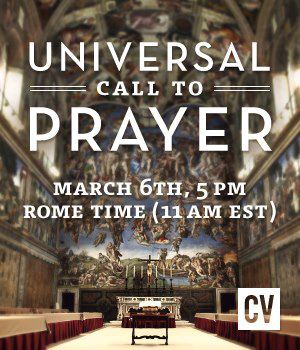
(Live from Rome) Prayer for the Universal Church : Wednesday, 6 March 2013 at 5 pm CET / Rome Time

Dear brothers and sisters in Christ, members of the One, Holy, Catholic, and Apostolic Church throughout the world. Let us all join together with the prayers for the Church that will be held today in Rome at 5 pm, and wherever we are in the world, let us spend the time for prayer for the Church, for the Cardinal-electors, and for the election of our new Pope.

602760_624609867556405_1994490267_n

The event will be live from Rome at Vatican Player, at either http://www.vatican.va/video/ or http://player.rv.va/?language=en&visual=VaticanTic. Do join in the prayers, and if you are unable to do so, and still in the workplace or busy with other commitments, just pray in your hearts, for the sake of our Holy Church.


Timing :

1. Rome : Wednesday, 6 March 2013 at 5 pm (UTC+1)

2. UTC : Wednesday, 6 March 2013 at 4 pm

3. EST : Wednesday, 6 March 2013 at 11 am (UTC-5)

4. PST : Wednesday, 6 March 2013 at 8 am (UTC-8)

5. WIB : Wednesday, 6 March 2013 at 11 pm (UTC+7) (West Indonesian Time, Bangkok, etc.)

6. Singapore : Thursday, 7 March 2013 at 0.00 am (UTC+8) (Singapore, Malaysia, HK, Macau, China, etc.)


The Cardinals, led by the Dean of the College of Cardinals, Cardinal Angelo Sodano, will pray together at St. Peter’s Basilica, and also participate in Eucharistic Adoration, led by the Cardinal Dean of the College. Let us pray for them, and pray that the Conclave will begin soon, and a new Pope, and a good Pope can be soon elected.

Live Holy Mass for the Solemnity of the Presentation of the Lord from the Basilica of St. Peter in Vatican with Pope Benedict XVI

http://www.vatican.va/video/

The Holy Mass for the Solemnity of the Presentation of the Lord, to be celebrated by His Holiness Pope Benedict XVI will begin at 5.20 pm CET (Central European Time/UTC+1) on Saturday, 2 February 2013.

The timing in other time zones :

Saturday, 2 February 2013 – 4.20 pm UTC/GMT

Saturday, 2 February 2013 – 11.20 am EST (Eastern Standard Time/UTC-5)

Saturday, 2 February 2013 – 8.20 am PST (Pacific Standard Time/UTC-8)

Saturday, 2 February 2013 – 11.20 pm WIT (West Indonesian Time/WIB/UTC+7)

Sunday, 3 February 2013 – 00.20 am UTC+8 (for Singapore, Malaysia, HK, and China, and Central Indonesian Time)

If you missed the live Mass, you can see the full recording of the Mass at the same website http://www.vatican.va/video/, pick Agenda, then select the date (2 February 2013), then click at the event (Holy Mass for the Solemnity of the Presentation of the Lord). If there is a TV icon on the event, that means a recording is available for watching. God bless!

+Ut Omnes Unum Sint, ad Maiorem Dei Gloriam+