
Sunday, 2 August 2015 : Eighteenth Sunday of Ordinary Time, Memorial of St. Eusebius of Vercelli, Bishop and St. Peter Julian Eymard, Priest (Homily and Scripture Reflections)

Liturgical Colour : Green

Dear brothers and sisters in Christ, on this day, we heard about the readings from the Scriptures, both from the Old and New Testament, on how God fed His people and made them satisfied. We heard first how the people of Israel during their Exodus from Egypt was fed with manna, or the bread from heaven, so that even in the middle of the desert they would not go hungry.

Every morning, the Lord would bring manna to them in the morning mist together with the dew, and all had enough manna for themselves to eat. And every evening, the Lord sent huge flocks of birds for the people to catch and eat. And through Moses, God gave His people crystal clear and sweet water to drink, and all these He had done, so that His people may know of His love, and may be filled with good things to satisfaction.

Yet in the Gospel today, Jesus rebuked the people who followed Him, because He knew that He had fed them and they saw that He could feed them and therefore they followed Him. Why is this so, brethren? That is because what Jesus wanted the people to know, and by extension for all of us to know is that, true faith is not about believing just because we saw what had happened and be amazed at it, and neither can we have faith that is just as much as our stomach is, that is our desires.

A good lesson for us can be gained by observing exactly what happened to the people of Israel in the desert. They were fed with manna, with large birds and other food otherwise not to be found in a desert, and were supplied with rich water and ample provisions, but see what had happened to them. They did not remain faithful to the Lord who loved them and cared for them so much.

Firstly they were mesmerised by gold, by the wealth of this world, which the Egyptians had provided them amply with as they left Egypt, when the Egyptians wanted to have nothing nothing else to do with them and gave them whatever they wanted. All these gold got into their hearts, blinding them against God’s love and made them very, very proud of themselves and greed grew in their hearts.

And we know what happened next, when at the mountain of God at Horeb, as Moses went up the mountain to establish covenant between the people of God and their Lord, they whored themselves and sold themselves to the pagan gods, making a golden calf as their idol and their god, claiming that it was that golden calf that led them out of Egypt, even though they had seen the glory and might of God.

Then, throughout their journey across the desert itself, did the people of God remain faithful and did they thank the Lord for the food which God had given them? The very bread that the angels eat and share in the bliss of heaven, of which among men, they were the only ones to have a taste of? No, they were not thankful, and instead, they bickered among themselves and made complaints after complaints, and even complaining that their lives in bondage in Egypt was better than whatever God had given them.

These people had followed the call of their stomach rather than the call of their heart. They followed and submitted to their earthly and worldly desires rather than trying to find the true joy and happiness which only God can give. They placed their trust in earthly things and seek worldly approval and trying to sustain and satisfy their wants and wishes.

And this, coupled with whatever they have done in wickedness have made them to be judged as unworthy and as people rejected by God. They ate the bread from heaven and they died, because they had no life in them, and they did not try to find what true life is about, for life lies with God alone, and they did not find what they need in God, for their worldly concerns and occupations prevented them to find the Lord.

Brothers and sisters in Christ, in the Gospel we heard the truth, that Jesus Christ our Lord, who came down from heaven, God Himself, His Word who had taken up the flesh of man, had made Himself an offering worthy of our redemption and brought about our salvation, by giving us freely, the true bread of heaven, the true Bread of Life, that is He Himself. He is the Bread of Life, for whoever partake in His Body and drink His Blood, shall have life in them, and death shall no longer reign over them.

This does not mean that those who share in the Body and Blood of our Lord shall not die, but this instead mean that death has no longer any dominion over them. While previously we ought to fear death for it is a consequence and punishment for our sins, we now know that because of Christ, our Lord, we have a new opportunity, a new chance given to us, and a new path to our complete victory and triumph against sin and death is before us.

And all these is again because of God’s love and care which He had shown us freely. Just as He had fed His beloved people with manna, the bread from heaven, with large birds and with sweet and crystal-clear water from rocks itself, therefore now, He feeds us with the true Bread and Wine of Life, that is His own Flesh and Blood. Which God cares for us so much that He would give us this to eat? And especially who would love us so much so as to suffer and bear the burden of all our sins?

It is God who loves us so much, that He would provide for us, feed us and satisfy us with care, and most important of all, to have all of us to have a share in Him, by giving His own Body and Blood through the bread and wine, which our priests transformed completely into the very substance and matter of our Lord Himself. We who partake in the Eucharist worthily therefore, share with one another the true life and salvation which comes from God alone.

Therefore, brothers and sisters in Christ, shall we all look deep into ourselves and reflect, and use this opportunity to think about whether we have found the Lord who is really present in the Eucharist, and whether we have understood and realised the love which He had for all of us, whom He had cared for since the beginning of time, and whether we have sincerely sought for Him and desired to find Him in our lives.

May we all grow to love the Lord all the more, and may we strive to make ourselves worthy of Him as we live our lives in this world. Let us shun all forms of worldliness and wickedness in our behaviours, so that by our virtues and good works, we may detach ourselves from the desires and wants we have in our hearts, be no longer oppressed and controlled by them, and in all things may we grow ever more grateful for all the things and blessings God had given us. Lord Jesus Christ, Bread of Life, be with us all always. Amen.
Sunday, 2 August 2015 : Eighteenth Sunday of Ordinary Time, Memorial of St. Eusebius of Vercelli, Bishop and St. Peter Julian Eymard, Priest (Gospel Reading)

Liturgical Colour : Green

John 6 : 24-35

At that time, when the people saw that neither Jesus nor His disciples were there, they got into the boats and went to Capernaum looking for Jesus. When they found Him on the other side of the lake, they asked Him, “Master, when did You come here?”

Jesus answered, “Truly, I say to you, you look for Me, not because of the signs which you have seen, but because you ate bread and were satisfied. Work then, not for perishable food, but for the lasting food which gives eternal life. The Son of Man will give it to you, for He is the One on whom the Father has put His mark.”

Then the Jews asked Him, “What shall we do? What are the works that God wants us to do?” And Jesus answered them, “The work God wants is this : that you believe in the One whom God has sent.” Then they said, “Show us miraculous signs, that we may see and believe You. What sign do You perform? Our ancestors ate manna in the desert; as Scripture says : They were given bread from heaven to eat.”

Jesus then said to them, “Truly, I say to you, it was not Moses who gave you the bread from heaven. My Father gives you true bread from heaven. The bread God gives is the One who comes from heaven and gives life to the world.” And they said to Him, “Give us this bread always.”

Jesus said to them, “I am the Bread of Life; whoever comes to Me shall never be hungry, and whoever believes in Me shall never be thirsty.”

Sunday, 2 August 2015 : Eighteenth Sunday of Ordinary Time, Memorial of St. Eusebius of Vercelli, Bishop and St. Peter Julian Eymard, Priest (Second Reading)

Liturgical Colour : Green

Ephesians 4 : 17, 20-24

I say to you, then, and with insistence I advise you in the Lord : do not imitate the pagans who live an aimless kind of life. But it is not for this that you have followed Christ. For I suppose that you heard of Him and received His teaching which is seen in Jesus Himself.

You must give up your former way of living, the old self, whose deceitful desires bring self-destruction. Renew yourselves spiritually, from inside, and put on the new self, or self according to God, that is created in true righteousness and holiness.

Sunday, 2 August 2015 : Eighteenth Sunday of Ordinary Time, Memorial of St. Eusebius of Vercelli, Bishop and St. Peter Julian Eymard, Priest (Psalm)

Liturgical Colour : Green

Psalm 77 : 3 and 4bc, 23-24, 25 and 54

Old mysteries which we have heard and known, which our ancestors have told us. We will announce them to the coming generation : the glorious deeds of the Lord, His might and the wonders He has done.

Yet the Lord commanded the skies above and opened the doors of heaven; He rained down manna upon His people and fed them with the heavenly grain.

They ate and had more than their fill of the bread of angels. He brought them to His holy land, to the mountain His right hand had won.

Sunday, 2 August 2015 : Eighteenth Sunday of Ordinary Time, Memorial of St. Eusebius of Vercelli, Bishop and St. Peter Julian Eymard, Priest (First Reading)

Liturgical Colour : Green

Exodus 16 : 2-4, 12-15

In the desert the whole community of Israel grumbled against Moses and Aaron and said to them, “If only we had died by the hand of YHVH in Egypt when we sat down to caldrons of meat and ate all the bread we wanted, whereas you have brought us to this desert to let the whole assembly die of starvation!”

YHVH then said to Moses, “Now I am going to rain down bread from heaven for you. Each day the people are to gather what is needed for that day. In this way I will test them to see if they will follow My Teaching or not. I have heard the complaints of Israel. Speak to them and say : Between the two evenings you will eat meat, and in the morning you will have bread to your heart’s content; then you shall know that I am YHVH, your God!”

In the evening quails came up and covered the camp. And in the morning, dew had fallen around the camp. When the dew lifted, there was on the surface of the desert a thin crust like hoarfrost. The people of Israel upon seeing it said to one another, “What is it?” for they did not know what it was. Moses told them, “It is the bread that YHVH has given you to eat.”

Saturday, 4 October 2014 : 26th Week of Ordinary Time, Memorial of St. Francis of Assisi (Homily and Scripture Reflections)

Liturgical Colour : White

Dear brothers and sisters in Christ, today we celebrate together the feast of the famous and renowned saint of our Church, that is St. Francis of Assisi, the epitome and model of our faith, and the faithful servant of God, through whose works and legacies, he had brought countless souls into salvation in God, and through whose dedications and works he had become an example for countless more who followed and walked in his path.

He was the founder of the Franciscan order, or the Order of the Friars Minor, renowned for their brown coloured habit and dedication to simple life and poverty, entrusting everything to the Lord, giving it all to the Lord and abandoning all worldly possessions. He was also contributed to the founding of several other religious orders, and his works and dedications had truly profound effect on the Church and the faith as a whole, even until today.

Brothers and sisters in Christ, St. Francis of Assisi was himself once like us all, an ordinary man, the son of a wealthy and influential merchant, named Pietro di Bernardone at his birth, as the heir of his father’s fortune and business. He was educated and prepared for a life of glory and happiness, being well versed in the ways of the world and in all matters of finances.

However, St. Francis of Assisi, then known as Pietro, always had that emptiness in his heart, which he could not satisfy with what he had gained in the happy life he had, and in the privileged life he had been given by his father. And therefore, there began the new life journey of who would eventually become the holy man of Assisi, one of the greatest saints of the Universal Church.

He was praying in a rather dilapidated church building, when he heard a voice, from the Lord, saying to him to repair and rebuild His Church. The young Pietro Bernardone mistook this for the order to rebuild the dilapidated church building where he was praying in, and where he had heard the voice of God. As his father was a wealthy merchant dealing in precious goods such as silk trading, he took some of his father’s stock of silk, sold it and used the proceeds to pay for the repair work of the church.

The word of this action came to the knowledge of Pietro’s father, the rich merchant, who then confronted him on his actions. At this time, Pietro, having heard the call of the Lord had decided that the path of his life was not through what he had always been prepared to be, and he sought refuge at the local bishop’s residence at his cathedral.

The father of Pietro, the future St. Francis of Assisi, confronted the bishop and his son, contending and made noises over the amount of money and preparation he had given to his son and heir, and the supposedly humiliating action of his son, stealing and selling his goods and donating them to the Church. In response, St. Francis of Assisi took off all his clothes and possessions, and stood naked in front of the bishop, who then immediately covered him and protected him with his voluminous cope.

In that way therefore, Pietro Bernardone rejected the temptations of wealth and the world, giving up everything to follow the Lord, and began his journey of faith and suffering, to be who we know now as the holy St. Francis of Assisi, the great servant of God, and went to truly rebuild and strengthen the Church of God as God had once called him. He went from place to place, preaching about the Lord and growing ever stronger in faith, and in various occasions, he experienced various experiences of faith that further strengthened his devotion to the Lord.

St. Francis of Assisi also championed the faithful living of abandoning all forms of worldly attachments, and living in joyful poverty, in a life where everything he has belongs to the Lord, and where there is no need for worry, as everything will be taken care of by the Lord. St. Francis of Assisi thus established a new religious orders, now known famously as the Franciscans, after their founder, as a body to accommodate those who also desired to follow the Lord after the example of St. Francis of Assisi.

Like St. Pius of Pietrelcina, another famous Franciscan monk and priest, who had received the five wounds of Jesus, called the stigmata, St. Francis also received the holy wounds of Christ through the moment of euphoria and holy vision, where he received the honour to bear the five wounds that were also once on the feet and hands of the crucified Lord Jesus Christ. These wounds would bring him great suffering but also great joy until the end of his life just a few years later.

St. Francis of Assisi was known to be a holy and pious servant of God, and he was also exemplary in his life, loving all the people of God and he held great sincerity seeking to find a way to help bring the salvation of souls to as many souls as possible. St. Francis of Assisi was renowned for his prayer for peace, also known as the Peace Prayer of St. Francis, where he extolled the values blessed by the Lord in the Beatitudes, on those who championed peace and who are devoted to the Lord with all of their hearts.

And therefore, St. Francis of Assisi is truly a great role model which we can follow in this life, that in all of his actions and deeds, we hope that we may also follow in his footsteps and therefore, we may also share in the justification which he had attained. And we should also follow in the loving ways of St. Francis, whose love for all the creations of God, mankind and animals alike, that we truly can become epitome of love as he had indeed become.

And referring to the readings of the Holy Scriptures and the Gospels today, it is quite clear that God will reward all those who had believed in Him and remained true to Him in faith. To Job who remained faithful in his humility and obedience, He granted him great graces and blessings which He had bestowed once before, and then gave him even greater things, to the point that what Job had after his suffering was far greater than what he once had.

And Jesus also gave thanks to the Lord His Father for the faith and the good works which His disciples had on Him and which they had done in His Name. And He revealed the truth about Himself, and how blessed they were indeed, for the righteous and the faithful had indeed seen the Lord Himself in action. And thus, all of us here who are also faithful and true to our faith will be blessed with greatness and riches beyond all things.

Thus, brothers and sisters in Christ, following the example of St. Francis of Assisi and the other holy saints of God, let us all from now on excise from ourselves, from our hearts, our minds and our souls, the darkness and evils of this world, committing ourselves in the same manner as St. Francis of Assisi had done. It is not necessary that we ought to all abandon everything of possession and goodness as he had done, but what is important is that we try to imitate him in his actions and deeds, which reflected his standing as a pious servant of God.

Brothers and sisters in Christ, let us all renew our faith in the Lord, not just through empty words or superficial application of faith, but through a dedicated and real devotion reflected in our actions and deeds, so that we may indeed be generous with our love, be caring for one another, especially those who are poor, sick and weak. Let us be peacemakers in this world, abandoning the ways of violence and hatred, and instead follow the path of love and justice.

May Almighty God help and guide us in this endeavour, that in all the things we do we may become ever more and more faithful and devoted to the ways of the Lord in the same way as St. Francis of Assisi had done. May He guide us all, that we may become justified through our loving actions, filled with faith, hope and love. God bless us all. Amen.

Saturday, 4 October 2014 : 26th Week of Ordinary Time, Memorial of St. Francis of Assisi (Gospel Reading)

Liturgical Colour : White

Luke 10 : 17-24

The seventy-two disciples returned full of joy. They said, “Lord, even the demons obeyed us when we called on Your Name.”

Then Jesus replied, “I saw Satan fall like lightning from heaven. You see, I have given you authority to trample on snakes and scorpions and to overcome all the power of the Enemy, so that nothing will harm you. Nevertheless, do not rejoice because the evil spirits submit to you; rejoice rather that your names are written in heaven.”

At that time Jesus was filled with the joy of the Holy Spirit, and said, “I praise You, Father, Lord of heaven and earth, for You have hidden these things from the wise and learned, and made them known to little ones. Yes, Father, such has been Your gracious will. I have been given all things by My Father, so that no one knows the Son except the Father, and no one knows the Father except the Son, and he to whom the Son chooses to reveal Him.”

Then Jesus turned to His disciples and said to them privately, “Fortunate are you to see what you see, for I tell you that many prophets and kings would have liked to see what you see, but did not see it; and to hear what you hear, but did not hear it.”

Saturday, 4 October 2014 : 26th Week of Ordinary Time, Memorial of St. Francis of Assisi (Psalm)

Liturgical Colour : White

Psalm 118 : 66, 71, 75, 91, 125, 130

Give me knowledge and good judgment for I trust in Your commands.

It is good for me to have been afflicted, for I have deeply learnt Your statutes.

I know, o Lord, that Your laws are just, and there is justice in my affliction.

Your ordinances last to this day, for all things are made to serve You.

Give me knowledge; I am Your servant who desires to understand Your statutes.

As Your words unfold, light is shed, and the simple-hearted understand.

Saturday, 4 October 2014 : 26th Week of Ordinary Time, Memorial of St. Francis of Assisi (First Reading)

Liturgical Colour : White

Job 42 : 1-3, 5-6, 12-16

This was the answer Job gave to YHVH : “I know that You are all powerful; no plan of Yours can be thwarted. I spoke of things I did not understand, too powerful for me to know.”

“My ears had heard of You, but now my eyes have seen You. Therefore I retract all I have said, and in dust and ashes I repent.”

YHVH blessed Job’s latter days much more than his earlier ones. He came to own fourteen thousand sheep, six thousand camels, a thousand yoke of oxen, and a thousand she-donkeys. He was also blessed with seven sons and three daughters.

The first daughter he named Dove, the second Cinnamon, and the third Bottle of Perfume. Nowhere in the land was there found any woman who could compare in beauty with Job’s daughters. Their father granted them an inheritance along with their brothers.

Job lived a hundred and forty years; he saw his children and their children to the fourth generation.

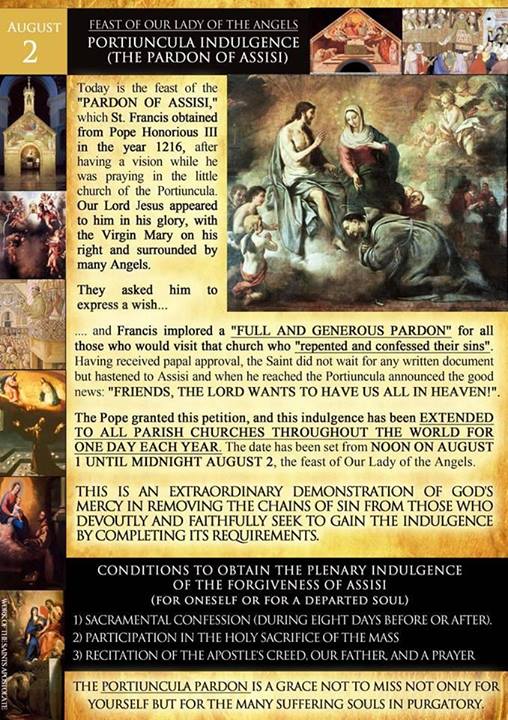
Portiuncula Indulgence (Pardon of Assisi) – on 2 August of each year

Image

The Portiuncula Indulgence, also known as the Pardon of Assisi, is offered every year to all the faithful every 2 August of each year.

The Indulgence include complete reparation from sins and faults, and the total forgiveness granted to us for all our temporal sins, since 1216, when St. Francis of Assisi first requested it through the intercession of the Most Blessed Virgin Mary.

There are three conditions required for the Portiuncula Indulgence :

1. Receiving the Sacrament of Confession within eight days before or after 2 August each year

2. Attendance and full participation at the Holy Sacrifice of the Mass (Full devotion in the Mass)

3. Devout recitation of the Apostle’s Creed, Our Father, and a personal Prayer