
Message and Reflection on the Occasion of the Great Feast Day of the Church, Solemnity of St. Peter, Prince of the Apostles and Vicar of Christ, and St. Paul, Apostle to the Gentiles, the Patron Saints of Rome

Liturgical Colour : Red

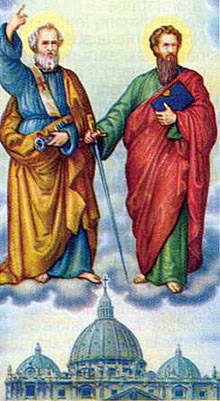
Dear brothers and sisters in Christ, today we celebrate in this moment, the great celebration of the Church, both of the Church of Rome, and the entirety of the universal Church, of the whole world, for we celebrate today the feast day of the two pillars that established and built up this Church, namely St. Peter the Apostle, the Prince of the Apostles and the first Vicar of Christ, leader of the entire Universal Church, Keeper of the keys of the kingdom of heaven.

And then the other one, St. Paul the Apostle, who was once a great sinner and enemy of the faithful, then called and made to be the Apostle to the Gentiles, to be the one to bring the Word of God’s salvation to all mankind, beyond the limitations of the Jews. And so, while St. Peter stood at the heart of Christendom, St. Paul is the brave and courageous evangeliser who spread wide the Christian message.

These two saints are two great saints and great role models for us, but they were also once ordinary and simple men, coming from unexpected origins, but ended up serving the Lord through their works and ministry to God’s people. And we celebrate their lives and their works today, and we hope that we all will be inspired by what they had done for the sake of God and His faithful.

St. Peter was a fisherman of the Lake Galilee, who was called by Jesus to be the shepherd of His sheep, that is all of us. He was made a fisher of man, as Jesus Himself had said when He called Peter and the other disciples to Himself. Meanwhile, St. Paul was an upper class Jew, who was brought up in strict and orthodox Jewish teachings, becoming kind of a fanatic who ended up persecuting many of the faithful in Israel, before he met the Lord on the way to Damascus and be converted to the cause of the faith.

In both of their stories, the two great saints, St. Peter and St. Paul had encountered a profound change in their lives after they met the Lord and professed their faith for Him. St. Peter was a brave person, but yet he feared death and persecution when the enemies of the Lord came for Him, and thus despite having vowed before the Lord that he would die for Him, he disowned the Lord three times before the Lord’s Passion and death.

And St. Paul was a great enemy of the faithful, the scourge of the believers, hunting down the faithful with zeal, but zeal that is mistaken in purpose and nature. He caused the death and suffering of many, and many would naturally have hated and feared him, but this was not what God intended from him. He was called and taken away, in an ultimate coup-de-grace against Satan, and was made to be the greatest champion of God’s cause in the world.

Both of them went on to spread the Good News to many parts of the known world of that time, the Roman Empire, together with the other Apostles and disciples of Christ who spread the Word of God to the ends of the earth. They went on to spread the Gospel to many cities, towns and villages across the Mediterranean, facing rejection and persecution in many places, but also acceptance by those who willingly received the Word for themselves.

They were persecuted by the Jews and the chief priests, who arrested them many times, harassed and tortured them many times, and handed them to the Romans to be jailed and punished many times. And in the end, both St. Peter and St. Paul went to Rome, the heart of the Roman Empire, ministering to the people of God there and eventually was martyred for the faith there.

The Empire was initially neutral and did not care about the faithful, but as time went on, the Empire and the Emperor Nero became hostile to the Christians, who were made as scapegoats of the many failures and disasters that befell the Empire, including the Great Fire of Rome. The Great Fire of Rome was allegedly started by Nero himself to build himself a grand palace in place of the rubble and ruins. He blamed the fire on the Christians, and as a result, many were martyred and sent to gladiatorial games to be butchered by lions and other wild animals.

St. Peter was martyred by crucifixion, but he did not feel it right to die in the same way as Jesus his Lord and God had died. Therefore, he asked to be crucified upside down, so that he would not die in the same way as his Lord and God. St. Peter embodied the faithfulness and indeed, true faith in God, that he faithfully carried out until the end. For St. Paul, he was beheaded in Rome as part of the great persecution against the faithful by the Emperor, and his blood was spilled that more seeds of faith might grow.

Brothers and sisters in Christ, today we who are in the Church of God are the continuation of the ministry and the divine mission entrusted by the Lord to His Apostles, chiefly among which, St. Peter and St. Paul, who went to be martyred at the heart of the Empire that persecuted the faithful, marking the beginning of the long history of our Church, centred firmly on the authority of the Apostle Peter, whom the Lord had entrusted His Church to, and the entirety of the faithful ones of God that are part of that Church.

Today, we stand strong and courageous with the whole Church, inspired by St. Peter and St. Paul whose examples had inspired us in our own faith. St. Peter taught us to be faithful, and to keep that faith strongly in our lives that our lives may be truly based on a firm and living faith. Then St. Paul taught us how to love others, and how to bring the Lord’s salvation to all men as the manifestation of that love we have for each other.

And we also stand together with our Pope, as our leader, the shepherd of shepherds, and the vicar of the Chief Shepherd, our Lord Jesus Christ. For he is, as the Bishop of Rome, of that city where St. Peter and St. Paul were martyred, the successor of St. Peter as the Vicar of Christ on earth, the leader of the entire Universal Church, through whom we keep our unity, that we may stay and remain as One Body in Christ.

Our Lord Jesus Christ had entrusted Peter with His sheep, the flock of His faithful, whom He asked Peter to take care and keep well. In that way, He entrusted His entire Church to Peter and His successors, the Popes, and they become the symbol of unity and the point of reference, through which the entire Church and the faithful drew their faith to God from.

Indeed, throughout history, sometimes the Popes had been corrupt and abused their power, but as a whole, the office of the Papacy, regardless of its past mistakes, remains as a very important and crucial institution, in particular in this increasingly confused and darkened world, where Satan grew in power day after day. And in addition, St. Paul also reminded us that it is important for us to go forth confidently to spread the Good News to all nations and all peoples.

We cannot evangelise most efficiently if our house itself is not in proper order. We have to ensure that the foundation of our faith is strong, so that we may grow stronger in faith and bring others to salvation. And this strong foundation of the faith can be found today in the Popes, and in the entirety of the teachings of the entire Magisterium of the Church, which the Popes are custodian and guardian of.

That is why we also pray and hope that our Church will be one, and all the estranged members of the Lord’s Body, that is the Church, will repent and come back to the Holy Mother Church, under the leadership of the successor of St. Peter, the Vicar of Christ, whom Jesus had appointed to be the leader of all of His faithful ones and to be the one to represent the Chief Shepherd on this world, a world darkened by the power of evil, the wolves trying to devour the innocent sheep and lambs of the Lord.

We pray that our brethren in the see of St. Andrew, the brother of St. Peter, and in the see of St. Mark, and those in the ‘communion’ born from the insistence and the greed of King Henry VIII and many others who had been misled by false prophets and leaders of the faith, will return to the Lord and be one again with us, even as we celebrate this feast day, and we ask that the two great saints pray for this to happen. For indeed, the unity of the Church is needed, as there is a need for us, greater than ever to stand up for the Lord against Satan and his forces marshalled against us.

The primacy of St. Peter must be upheld, and the primacy and supremacy of his successor the Pope must be upheld by all who believes in Christ, for once again, he is the one on whom the Lord had built His Church on, as the focal point for all the faithful in their faith to the Lord. Those who doubt this fact, fail to understand the meaning of the words when Jesus said, and His commission to Peter, to feed and support His lambs.

Our Church therefore must stand strong and remain truly faithful, and not an iota of its teachings, the teachings of the early Church fathers of the faith, must be lost or contravened. We cannot let this Church which Christ had built on solid rock foundation of Peter and His successors to stumble on the high waves and the storms of this world today. There are indeed many oppositions and currents trying to push the Church in the wrong direction, in the name of adjustment, accommodation and many other reasons, but I say brethren, that we ought to stay faithful as St. Peter had been faithful to the end! And we pray that our Pope, as the successor of St. Peter will keep his duty faithfully and keep close to the teachings of the entire Deposit of the Faith and the Apostolic Tradition.

And ultimately, in the spirit of St. Paul the Apostle, our Church must also be brave to stand up to the faith and spread it to those who are still in darkness and in ignorance or opposition to the faith, as St. Paul had once done. For too long in the recent decades that our Church had become timid in the face of opposition and rejection by the world. We need to rediscover that zeal of the faith and the commitment that St. Paul had once shown through his tireless ministries to the faithful throughout many places until his own martyrdom.

Therefore, brothers and sisters in Christ, today let us pray for one another, and pray for our Church, that first, it may grow stronger in faith and grow more united in the faith to the Lord. May the Lord strengthen us all, that we may become more loving children of God, and a more loving and living Church. May St. Peter and St. Paul intercede for us and help us on our path, that we too may follow their examples in faith and love. God bless us all. Amen.

Monday, 18 November 2013 : 33rd Week of Ordinary Time, Memorial of the Dedication of the Basilica of St. Peter and the Basilica of St. Paul Outside the Walls (Scripture Reflections)

Liturgical Colour : Green or White (Dedication of Basilica)

Dear brothers and sisters in Christ, we listen today to the beginnings of a great tragedy, where the people of Israel, was subjected to the attempts of acculturation and Hellenisation, which happened during the years after Alexander the Great conquered much of the known world. They suffered persecution and ridicule, subjected into attempts to corrupt them from the one and true faith in God.

In the second reading, the same happened, with St. Paul being led into custody of the Romans, brought to Rome, the capital of the Roman Empire, to be judged by the Emperor for his supposed crimes. St. Paul was charged by his Jewish opponents, who resisted his attempts to bring the Good News to them. Rather than being killed at Jerusalem, St. Paul chose to appeal to the Emperor, and in doing so, as we listened, he gained a chance to evangelise yet one last time, at the city of Rome, where the centre of our Church now lies.

Today we listened to the tale of both St. Paul and St. Peter, the earlier as mentioned, and the latter, as we listened to the story of Jesus performing the miracle of walking on the water in the middle of the storm. St. Peter took the scene, as he tried to walk on the water and as he doubted, he almost sank into the water. Jesus rescued him and chided him about his lack of faith in Him. So we heard today about both St. Paul and St. Peter, who at the end of their lives, went to Rome to be martyred there.

Yes, in that old and venerable city, the Eternal City, as many would call it. It is where the two greatest saints and pillars of the Church were welcomed into the hands of the Lord through holy martyrdom. Today we mark the commemoration of the dedication of two great basilicas, namely the Papal Basilica of St. Peter, where most of the Pope’s celebrations take place, and the Papal Basilica of St. Paul, also known as St. Paul Outside the Walls, because it was located outside the walls of the ancient city of Rome. It was also where St. Paul stayed during his two year stay in Rome, prior to his martyrdom by the Emperor Nero.

These two saints were exemplary in their actions, just as what some brave people of Israel, God’s first chosen people had done at the time of persecution under the Greek king Antiochus Epiphanes. They stood up bravely and courageously for their faith without being corrupted or tempted by the offers of worldly pleasures and temporary glories offered to them, if they just would betray the Lord and their faith.

Yet these people were also pretty much ordinary people like ourselves, and they too were much like us sinful and weak, as St. Peter himself had shown in that storm in the lake, where his lack of faith to God made him almost sink as he walked on the water towards Jesus. St. Paul was once a great enemy of the faith, and he hounded many hundreds if not thousands of the early believers of the Lord, sending them to their deaths. We too lacked the faith at times, brothers and sisters, and doubt is always in our mind.

And yet, through Christ and His love, they have been transformed into powerful tools of His presence and love. God made them to be the bearers of the Good News and they went on faithfully with their missions to the end. And through their hard and dedicated works, many people were saved. Their works of salvation continues even today, through their successors, our bishops and their priests, and primarily, the Bishop of Rome, our Pope, now Pope Francis, the leader of the entire Universal Church.

It is often that times are truly hard for our Church, especially in the recent times. The ways of the world are increasingly becoming more and more antithesis to what our Church stands up for, that is our faith in God, true and just. The corruptions of this world threaten to sink many people in the storm of this turbulent world. Remember what had happened to St. Peter in that stormy night.

The Lord picked him up by the hand and strengthened his faith. Indeed, St. Peter was to abandon his faith yet another time, when he denied knowing the Lord, not just once, but three times in total! He did so, because his faith in God is wavering, having seen Jesus, the one hope that he and the other apostles had had, captured, tortured, and mocked like a lowly criminal. He abandoned the Lord for the security of the world.

St. Paul too was a leading Jew, who was a Pharisee and very strict in his observation of the Law, and was particularly hostile to the followers of Jesus in the early days of the Church. He hunted them without mercy, and caused the death of many people of the Lord. He took part in the stoning and murder is St. Stephen, the first martyr, and was a great scourge to the faithful.

Then what differentiates them from the people of Israel, who abandoned their faith in God, for the sake of their own security and to secure the favour of the king? And how was St. Peter even different from Judas Iscariot, the traitor? Did they both not betray the Lord? One through direct betrayal and the other by abandoning Him at the time of His greatest sorrow?

That is because, St. Peter professed his true and undying faith in the Lord, and he repented from his past mistakes. Everyone makes mistakes, as is common to us because of our humanity, for we are predisposed to sin ever since we were exposed to it. What is important is that, we learn from those mistakes, face them with courage and faith, and repent, that is change our ways, to conform again to that of God! That was what St. Peter, as well as St. Paul had done.

Judas Iscariot felt the guilt after he had betrayed the Lord, but instead of learning from his mistakes, and accepting the chance of repentance the Lord gave him, he chose the quick way out, that is suicide. He did not repent, and therefore was counted among the lost ones. He also stole the money of the Lord and His disciples and was unrepentant about it, even to the end.

St. Peter professed his love and dedication to the Lord, and he showed it with true sincerity, knowing fully the guilt and the faults he had done, and yet, he still professed that love he has for God, and the Lord gave him, the stewardship over this world, over all of the faithful ones in God, as His Vicar on earth. St. Paul too met a life-changing experience, after the Lord appeared to him on the road to Damascus. He received the empowerment of the Holy Spirit, and the truth about all things were revealed to him in its entirety.

Ever since, both Apostles, as well as the other apostles and disciples of Christ, tirelessly laboured for the sake of God and His kingdom, without end going from one end of the earth to the other, as witnesses to God and His saving power. They laboured hard and the fruits grew aplenty, as the faith spread among many, converting many to the cause of Christ. And despite the storm that threatened to engulf all the faithful, they stabilised the ship, and made it last to the present day.

St. Peter was crucified upside down in Rome, at the site now where the Basilica of St. Peter now stood. He chose to do so because he found himself unworthy to be crucified in the same way the Lord had done. St. Paul too was beheaded in Rome, after the burning of Rome was blamed by the reigning Emperor, Nero, on the followers of Christ. See the dedication, faith, and love that these two saints have for our Lord!

Today, therefore, as we commemorate the two great Basilicas dedicated in their honour, that of St. Peter, the Vicar of Christ, and St. Paul, the Apostle to the Gentiles, let us take this opportunity to reflect, on whether we have taken the same choice or whether we will be ready to commit ourselves to the same choice that both saints had chosen. Remember that saints too were called from sinners. We can opt to choose the easy way, that is what Judas and the people of Israel had done, or take the difficult and challenge-ridden path that the Apostles had once taken, all the way to the end, where the glory of heaven awaits them.

May our Lord Jesus, who helped St. Peter out of the water in his doubt, also help us to overcome our doubts and empower us with love, hope, and faith, that we will be able to make a commitment towards reaching out to the Lord, choosing the right path in the end. May He continue to love us and watch over us. Amen.

Peter’s Pence Collection, Solemnity of Saints Peter and Paul, Apostles

Peters Pence

In case any of you are wondering what is Peter’s Pence, which is collected every Sunday nearest to the Solemnity of Saints Peter and Paul, Apostles, which falls on 29 June every year (Therefore this year Peter’s Pence is collected on Sunday, 30 June 2013, 13th Sunday of Ordinary Time), Peter’s Pence is a special collection in which the collection will not go into the local church or parish fund, but gathered from all over the world and sent to Rome, to the Holy See. Thus, the collection made during the offertory this Sunday will go directly to Rome.

What is the purpose of the Peter’s Pence collection? Exactly to support the numerous charitable activities and organisations managed by the Holy See, by our Church, all over the world. There are thousands, tens of thousands of charity under the supervision of the Church, and to be able to continue with the action, funds are definitely necessary to provide a solid backing. That is why, Peter’s Pence is done once every year, on the Sunday nearest to the Solemnity of Saints Peter and Paul.

1045213_354782624625355_1349576998_n

Why Solemnity of Saints Peter and Paul? That is because on that day lie the great celebration of the two great saints and apostles that defined our Church, because they met their martyrdom in Rome. St. Peter, the Prince and leader of all the Apostles, whom the Pope is the successor of today, met his martyrdom in what is now Vatican City, through crucifixion, and St. Paul, the Apostle to the Gentiles, and author of the Epistles in the New Testament, met his martyrdom in Rome, through beheading.

Peter’s Pence itself had its origins in the late dark ages and early medieval period, particularly from England, where it got the name Peter’s ‘Pence’. Pence is the unit of money still in use until today in the United Kingdom and the related monetary units. ‘Peter’ simply point to the fact that the collection or ‘pence’ is intended to be sent to Rome, to the Pope, in order to support various Church activities.

Friday, 17 May 2013 : 7th Week of Easter (Gospel Reading)

John 21 : 15-19

After they had finished breakfast, Jesus said to Simon Peter, “Simon, son of John, do you love Me more than these?” He answered, “Yes, Lord, You know that I love You.” And Jesus said, “Feed My lambs.”

A second time Jesus said to him, “Simon, son of John, do you love Me?” And Peter answered, “Yes, Lord, You know that I love You.” Jesus said to him, “Look after My sheep.” And a third time He said to him, “Simon, son of John, do you love Me?”

Peter was saddened because Jesus asked him a third time, “Do you love Me?” and he said, “Lord, You know everything; You know that I love You.” Jesus then said, “Feed My sheep! Truly I say to you, when you were young, you put on your belt and walked where you liked. But when you grow old, you will stretch out your hands, and another will put a belt around you, and lead you where you do not wish to go.”

Jesus said this to make known the kind of death by which Peter was to glorify God. And He added, “Follow Me.”