
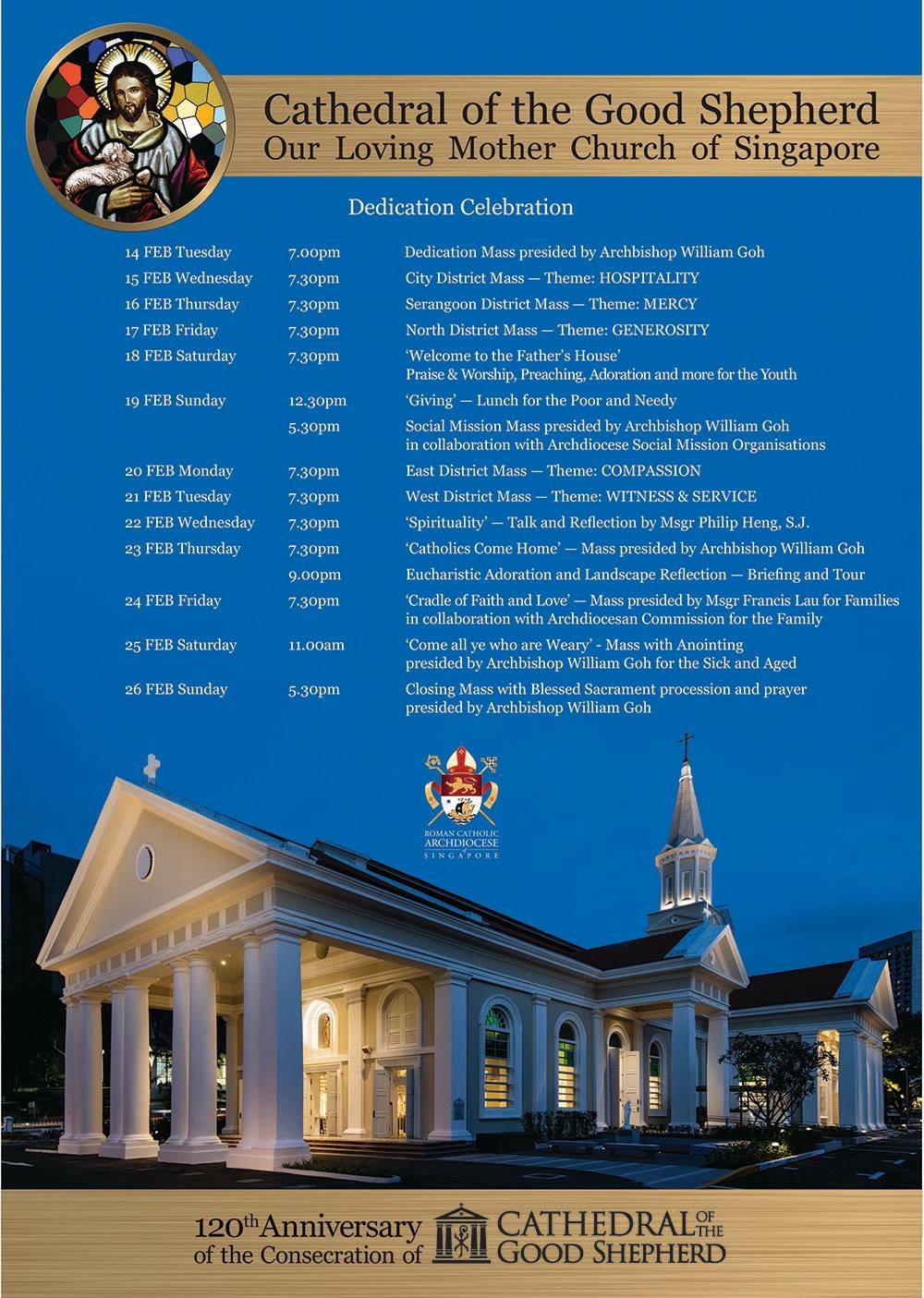
(Special Post) Dedication of the Cathedral of the Good Shepherd, Mother Church of the Roman Catholic Archdiocese of Singapore, also the 120th Anniversary of its Consecration (14 February 1897) – History of the Cathedral of the Good Shepherd

img_0596
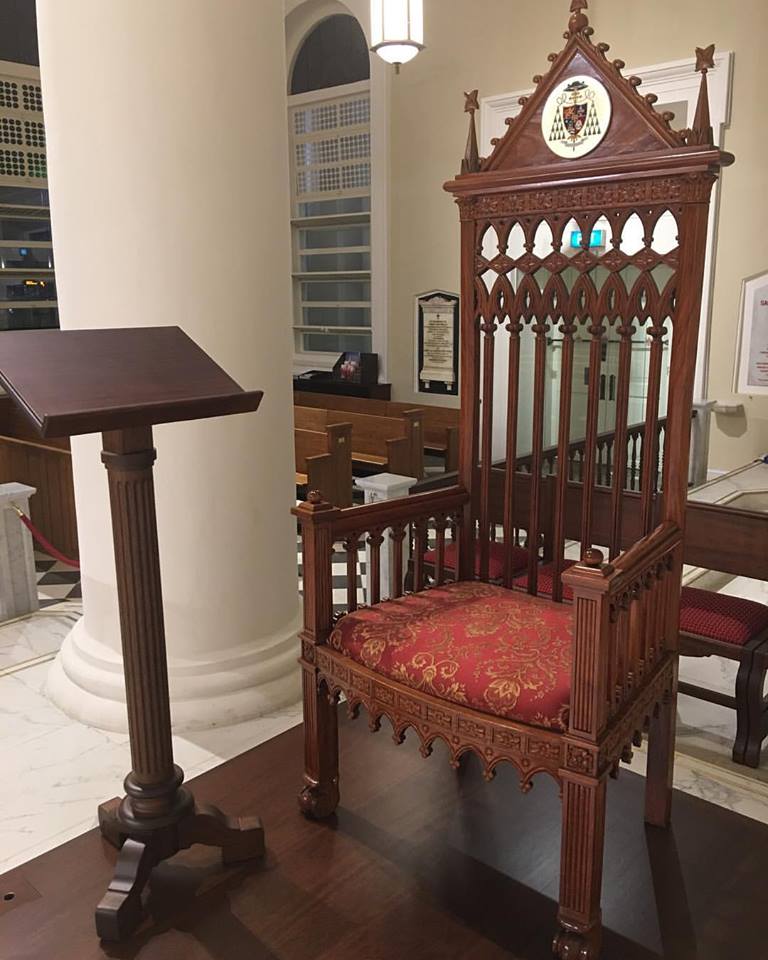
On 14 February 2017, the Church in Singapore is going to celebrate a great occasion of the Dedication of the Cathedral of the Good Shepherd, which is the principal and mother of all the parishes and churches in Singapore. As the Cathedral of the Archdiocese of Singapore, it is the place where the Cathedra or the seat of the Archbishop of Singapore is located at.
16508650_10154997994658221_5910988247782148139_n
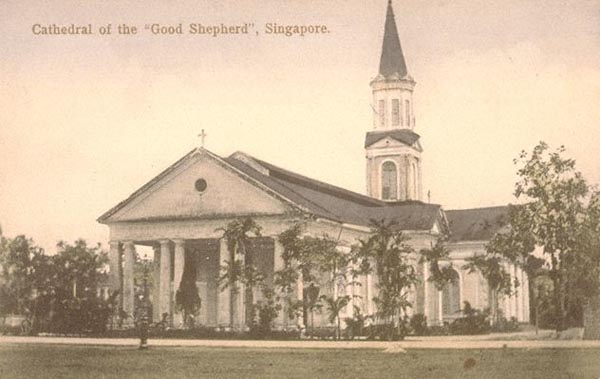
The Cathedral of the Good Shepherd was established as one of the first church buildings in Singapore, in the earliest days of its history as a British colony after it was discovered by Sir Thomas Stamford Raffles in the year 1819. The Cathedral had its origins in a simple and small chapel built from wooden and attap structure constructed between the year 1832 and 1833.
However, the rapid growth of the Church in Singapore, growing number of the faithful and pressing need for a more appropriate place for divine worship resulted in the efforts to establish a permanent place of worship for the faithful in Singapore. Upon generous donations from various individuals including that of the Queen of France and the Archbishop of Manila, the permanent church building that would become the Cathedral of the Good Shepherd became a reality.
good-shepherd

The foundation stone was placed in the site of the future Cathedral in the year 1843 and the completed church was opened and blessed on 18 June 1847, on the Feast of Corpus Christi by Father Jean-Marie Beurel, one of the pioneer priests and evangelisers in Singapore.

father-jean-marie-beurel-mep
(Picture: Fr. Jean-Marie Beurel)

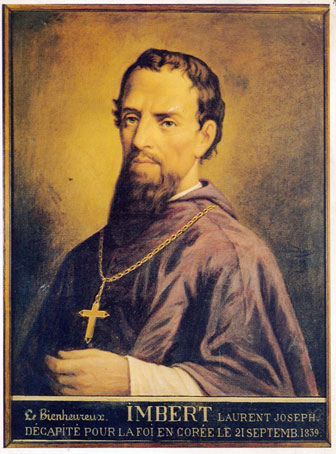
The Cathedral of the Good Shepherd was named as such upon the inspiration from the holy martyr St. Laurent Imbert, one of the first Catholic priests to visit Singapore, who went on to be the first Vicar Apostolic to Korea, and was martyred for his faith there during the violent persecution against the Church and the faithful. It was told that he gave himself up to the authorities in order to safeguard the other faithful under his care, saying that “in times of great need, the Good Shepherd lays down his life for his sheep.” in the imitation of the Lord, our Good Shepherd.
st-laurent-marie-joseph-imbert

(Picture: St. Laurent Imbert)
As the Diocese of Malacca (established in 1558 in Malacca, now in Malaysia) was reestablished in the year 1888 after it has been temporarily suppressed in 1839 (and later revived as the Vicariate Apostolic of Western Siam in 1841), the church that was to become the Cathedral of the Good Shepherd was elevated to the status of a cathedral, and Bishop Edouard Gasnier became its first bishop. He was interred in the Cathedral’s crossing (between nave and transepts) upon his death in 1896.
The Cathedral was dedicated by Bishop Gasnier’s successor, Bishop Rene-Michel-Marie Fee, who dedicated and consecrated the Cathedral to our Lord Jesus the Good Shepherd, on 14 February of the year 1897, 120 years ago to the current date. Ever since, the Cathedral had become the hub for the growth of the Church and the Christian faith both in Singapore and throughout the region for the next 120 years.
Ever since, the Cathedral had weathered through good and difficult times, including the turbulent years of the Japanese Occupation of Singapore, when it was functioning as an emergency hospital, but it weathered through them. Nevertheless, time and the rapid construction around it and underneath the ground due to the building of the Mass Rapid Transit train line caused the foundation of the Cathedral to be affected, and serious cracks started to appear on the structure.
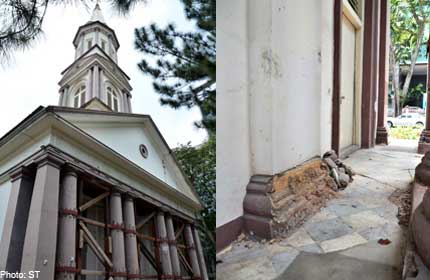
20130510-154155_catholic-church_st
Therefore, serious efforts for a major renovation was carried out, and after many years of preparation, the Cathedral of the Good Shepherd finally was closed on 28 October 2013, for a thorough and extensive renovation and modification. Throughout this major project, various discoveries were made on the historic nature of this Cathedral, including the discovery of the original foundation stone placed in site in the year 1843. The original layout and architecture of the Cathedral were also restored.
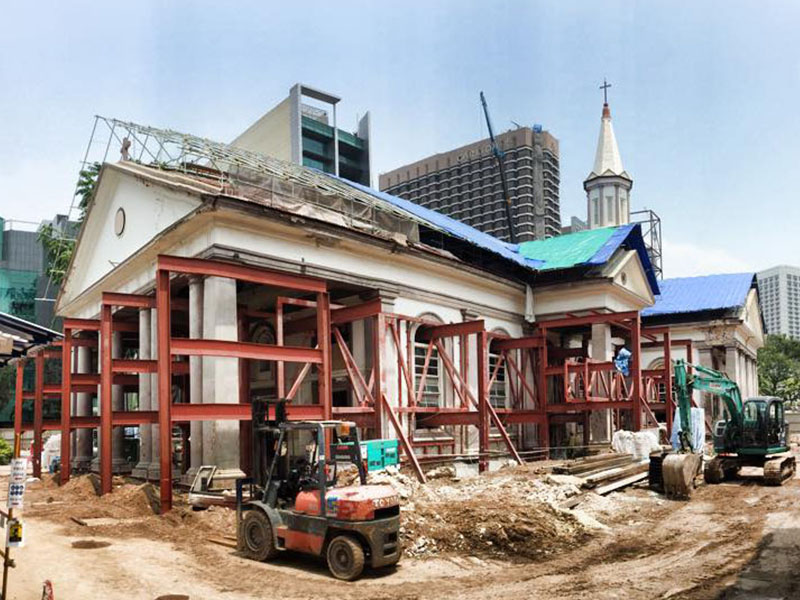
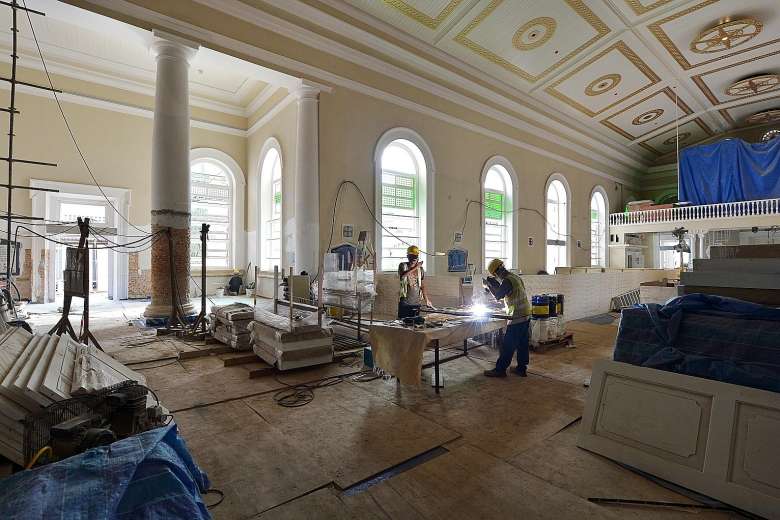
800x600_construction

st_20160630_cathedral30_2405986
Finally the Cathedral of the Good Shepherd was reopened on 20 November 2016, on the Solemnity of Jesus Christ the King, by His Excellency Archbishop William Goh of Singapore during the Opening Mass, where he solemnly reopened the Cathedral for the purpose of divine worship.
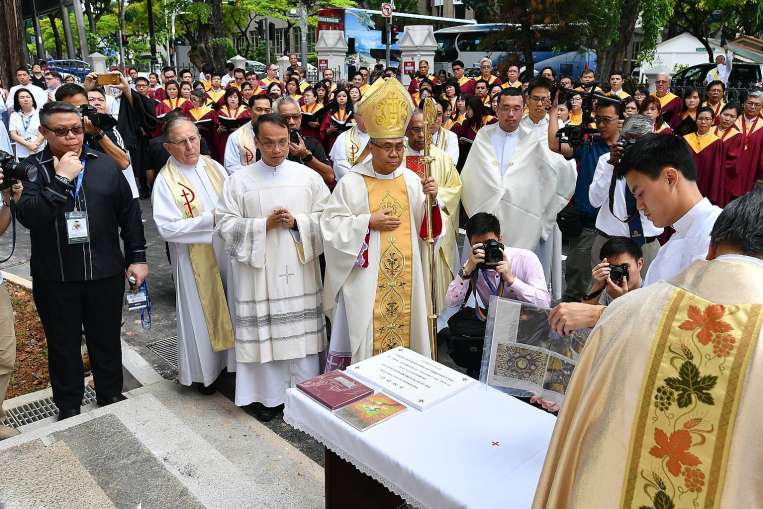
st_20161121_mass21_2755493

800x600_openingmassrecessional

And now, on the 14th day of February of the Year of our Lord 2017, the Cathedral of the Good Shepherd is going to be dedicated to the Lord before all the faithful people of God.

Pray for the Cathedral of the Good Shepherd, pray for the Church of God in Singapore!

(Singapore – Solemn Pontifical High Mass) Tuesday, 14 February 2017 : 120th Anniversary of the Dedication of the Cathedral of the Good Shepherd (14 February 1897), Solemnity of the Dedication of the Cathedral of the Good Shepherd after 2013-2016 Major Restoration (Gospel Reading)

Liturgical Colour : White

Luke 19 : 1-10

Jesus entered Jericho and was passing through it. A man named Zaccheus lived there. He was a tax collector and a wealthy man. He wanted to see what Jesus was like, but he was a short man and could not see Him because of the crowd. So he ran ahead and climbed up a sycamore tree. From there he would be able to see Jesus, Who was going to pass that way.

When Jesus came to the place, He looked up and said to him, “Zaccheus, come down quickly, for I must stay at your house today.” So Zaccheus climbed down and received Him joyfully. All the people who saw it began to grumble, and said, “He has gone as a guest to the house of a sinner.”

But Zaccheus spoke to Jesus, “Half of what I own, Lord, I will give to the poor, and if I have cheated anyone, I will pay him back four times as much.” Looking at him Jesus said, “Salvation has come to this house today, for he is also a true son of Abraham. The Son of Man has come to seek and to save the lost.”

(Singapore – Solemn Pontifical High Mass) Tuesday, 14 February 2017 : 120th Anniversary of the Dedication of the Cathedral of the Good Shepherd (14 February 1897), Solemnity of the Dedication of the Cathedral of the Good Shepherd after 2013-2016 Major Restoration (Second Reading)

Liturgical Colour : White
Ephesians 2 : 19-22

Now, you are no longer strangers or guests, but fellow citizens of the holy people : you are of the household of God. You are the house, whose foundations are the Apostles and prophets, and whose cornerstone is Christ Jesus.

In Him, the whole structure is joined together, and rises, to be a holy temple, in the Lord. In Him, you, too, are being built, to become the spiritual Sanctuary of God.

(Singapore – Solemn Pontifical High Mass) Tuesday, 14 February 2017 : 120th Anniversary of the Dedication of the Cathedral of the Good Shepherd (14 February 1897), Solemnity of the Dedication of the Cathedral of the Good Shepherd after 2013-2016 Major Restoration (Psalm)

Liturgical Colour : White

Psalm 18: 8-10, 15

The Law of the Lord is perfect : it gives life to the soul. The word of YHVH is trustworthy : it gives wisdom to the simple.

The precepts of YHVH are right : they give joy to the heart. The commandments of YHVH are clear : they enlighten the eyes.

The fear of YHVH is pure, it endures forever; the judgments of YHVH are true, all of them just and right.

May the words of my mouth and the meditations of my heart find favour in Your sight, o YHVH – my Redeemer, my Rock!

(Singapore – Solemn Pontifical High Mass) Tuesday, 14 February 2017 : 120th Anniversary of the Dedication of the Cathedral of the Good Shepherd (14 February 1897), Solemnity of the Dedication of the Cathedral of the Good Shepherd after 2013-2016 Major Restoration (First Reading)

Liturgical Colour : White
Nehemiah 8 : 1-4a, 5-6, 8-10

In the seventh month, all the people gathered as one man in the square before the Water Gate, and they asked Ezra to bring the book of the law of Moses, which YHVH had given to Israel. Ezra brought the law before the assembly, both men, women and all the children who could understand what was being read. It was the first day of the seventh month.

So he read it before the plaza in front of the Water Gate from dawn till noon, before the men, women and those children who could understand. All the people were eager to hear the book of the law. Ezra, the teacher of the law, stood on a wooden platform built for that occasion.

Ezra opened the book in the sight of all the people, for he was in a higher place; and when he opened it, all the people stood. Ezra praised YHVH the great God; and all the people lifted up their hands and answered, “Amen! Amen!” And they bowed their heads to the ground.

They read from the book of the law of God, clarifying and interpreting the meaning, so that everyone might understand what they were hearing. Then Ezra, the teacher of the law, said to the people, “This day is dedicated to YHVH, your God, so do not be sad or weep.”

He said this because all wept when they heard the reading of the law. Then he said to them, “Go and eat rich foods, drink sweet wine and share with him who has nothing prepared. This day is dedicated to the Lord, so do not be sad. The joy of YHVH is our strength.”

Tuesday, 14 February 2017 : 6th Week of Ordinary Time, Memorial of St. Cyril, Monk and St. Methodius, Bishop, Patron Saints of Europe (Homily and Scripture Reflections)

Liturgical Colour : White
Dear brothers and sisters in Christ, in today’s Scripture readings, we heard of the time when God saved the righteous among His people from among the wicked and those who refused to repent their sins, when He cleansed the whole earth from the wickedness of the descendants of Cain, those who involved themselves in all sorts of debauchery and wickedness.

He saved Noah and his family with the Ark, rescuing them from the great flood that came to engulf all the wicked people of the world, bringing with them all sorts of animals and plants. This is a story which all of us are surely quite familiar with. But at the centre of it all is how God loves all of mankind, all those whom He had created with love, those who live in this world.

That is what Jesus had also done to the people whom He loved, in the Gospel today when we heard about how Jesus had fed the multitudes of the five thousand men, not counting the women and children, which led to even more people whom God had fed and cared for, out of the love and pity which He had for His people who are suffering.

Then one might ask, why then God sent a great flood to destroy all the wicked and erase their existence from the earth? Should He not be loving and kind, merciful and graceful to us? Should He not show His love to all, even to great sinners and disobedient people? But why did He then destroy His people? Surely this is what bothered many of us, something that we cannot comprehend, that the God of love should destroy His people?

That is because while God loves all of us mankind, each and every one of us without exception, and He also extends His mercy freely and gracefully, but His love and mercy only come to its fullness when we mankind are receptive to that love, and open our hearts to welcome the love which God gave us. The love of God then can enter our hearts, and transform us with love, and make us into a people filled with love, grace, righteousness and justice.

But when mankind refused to open their hearts to welcome God’s love, and stubbornly closed the doors of their heart before the Lord, rejecting the offer of God’s mercy and love, then God’s mercy and love will not take effect with us. And that is why while the sins of sinners who repent and commit themselves to change will be forgiven their sins, but sinners who refuse to repent will remain in the state of sin.

Brothers and sisters in Christ, today is a time of reflection, a time for us to take a step back and look into our lives, whether we have been faithful to God, and whether we have been receptive to God’s love and mercy. If we have been faithful thus far, then it is good with us, and we need to continue the good works that we have started. Meanwhile, if we have not been faithful, then we really need to do something in order to change our lives for the better.

Perhaps we should look up the examples of St. Cyril and St. Methodius, the saints whose feast we are celebrating on this day. St. Cyril and St. Methodius were brothers who devoted themselves and their lives into the service of God, and were known as Patron Saints of Europe because of what they had contributed massively in the field of evangelisation to many people, particularly to the pagans who lived in what is now central and eastern parts of Europe.

St. Cyril and St. Methodius helped to translate the Scriptures and the teachings of the Church into the versions readable and understandable by the pagans, particularly among the Slavic peoples. It was their evangelising work that laid the foundation of the faith among the Slavs, most of whom now call themselves as Christians, all of which were rooted from the work of these two saints.

They have allowed God to work His great and wonderful works through them, committing themselves to a life of service to Him, spreading and preaching the word of God to peoples in faraway lands, those who have not yet had the chance to listen to the word of God, and still lived in the darkness of sin. This is what all of us Christians ought to do, that we become God’s intermediate, that through us the conversions of many can be done.

Brothers and sisters in Christ, let us all commit ourselves anew to the Lord, and inspired by the examples of St. Cyril and St. Methodius, and also from the righteous Noah and his family, let us all commit ourselves to a life of virtue and grace, filled with God’s love and light, and share this faith we have with one another, helping each other to find our way to the Lord.

May the Lord bless us all and strengthen us, that our faith will be ever stronger, so that we may commit ourselves and empower one another to be righteous and be worthy of God’s love, that we will not find our due among those who perished in the great flood. May God be with us all, now and forever. Amen.

Tuesday, 14 February 2017 : 6th Week of Ordinary Time, Memorial of St. Cyril, Monk and St. Methodius, Bishop, Patron Saints of Europe (Gospel Reading)

Liturgical Colour : White
Mark 8 : 14-21

At that time, the disciples had forgotten to bring more bread, and had only one loaf with the in the boat. Then Jesus warned them, “Keep your eyes open, and beware of the yeast of the Pharisees and the yeast of Herod.” And they said of one another, “He saw that we have no bread.”

Aware of this, Jesus asked them, “Why are you talking about the loaves you are short of? Do you not see or understand? Are your minds closed? Have your eyes that do not see and ears that do not hear? And do you not remember when I broke the five loaves among five thousand? How many baskets full of letfovers did you collect?”

They answered, “Twelve.” “And having distributed seven loaves to the four thousand, how many wicker baskets of leftovers did you collect?” They answered, “Seven.” Then Jesus said to them, “Do you still not understand?”

Tuesday, 14 February 2017 : 6th Week of Ordinary Time, Memorial of St. Cyril, Monk and St. Methodius, Bishop, Patron Saints of Europe (Psalm)

Liturgical Colour : White
Psalm 28 : 1a and 2, 3ac-4, 3b and 9b-10

Give the Lord, o sons of God, give the Lord the glory due His Name; worship the Lord in great liturgy.

The voice of the Lord is over the waters; the Lord thunders over vast waters. How powerful is the voice of the Lord, how splendorous is the voice of the Lord.

The God of glory thunders, the Lord strips the forests bare, and in His Temple all cry, “Glory!” Over the flood the Lord was sitting; the Lord is King and He reigns forever.

Tuesday, 14 February 2017 : 6th Week of Ordinary Time, Memorial of St. Cyril, Monk and St. Methodius, Bishop, Patron Saints of Europe (First Reading)

Liturgical Colour : White
Genesis 6 : 5-8 and Genesis 7 : 1-5, 10

YHVH saw how great was the wickedness of man on the earth and that evil was always the only thought of his heart. YHVH regretted having created man on the earth and His heart grieved. He said, “I will destroy man whom I created and blot him out from the face of the earth, as well as the beasts, creeping creatures and birds, for I am sorry I made them.” But Noah was pleasing to God.

YHVH said to Noah, “Go into the Ark, you and all your household, for I see that you are just in this generation. Of all the clean animals, you are to take with you seven of each kind, male and female, and a pair of unclean animals, a male and a female. In the same way for the birds of the air, take seven and seven, male and female, to keep their kind alive over all the earth, for in seven days I will send rain on the earth for forty days and forty nights. I will blot out from the face of the earth all the living creatures I have created.”

Noah did all as YHVH had commanded. And after seven days the waters of the flood were over the earth.