Reflections on the Motu Proprio Traditionis Custodes, for the good of the Universal Church

Brothers and sisters in Christ, I am sure that many of you are left with questions and even disappointments after listening to the publication of the new Motu Proprio ‘Traditionis Custodes’ (Custodians of Tradition) by His Holiness Pope Francis on 16 July 2021 regarding the rules and regulations on the celebration of the Holy Mass in the Roman Rite using the 1962 Missal, also known as the Extraordinary Form of the Roman Rite or Usus Antiquior.
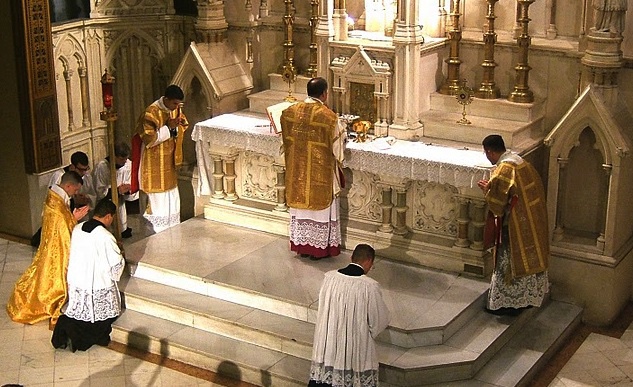
There are undoubtedly many different responses from all segments of the Church, from utter dismay and anger by those who felt betrayed and oppressed by the new stricter regulations, to those who are rejoicing and exuberant because they had long opposed and were vocal critics of the ancient Mass and tradition. Unfortunately, the nature of these responses is exactly why the release of this Motu Proprio is an opportunity for the entire Church to reflect carefully on what our faith and our authentic liturgical expression is all about.

First of all, Traditionis Custodes does not equate the banning or attempt to make the Extraordinary Form of the Roman Rite illegal, unlike what quite a few individuals and groups had been saying. Unsurprisingly, these are the same groups and individuals that had been the very reason why Traditionis Custodes had been promulgated and published in the first place. These are the clear minority among those who treasure faith and tradition, and yet, are the most vocal and radical in their viewpoints, which unfortunately led to the broad characterisation and prejudice against the entire communities of the faithful favourable to the Extraordinary Form and tradition as a whole.

On the other extreme, we also have those who will not stop at anything to ‘change’ the Church and its teachings, a relativistic attitude to conform to worldly preferences and desires, to change the Church teachings and ways to suit the comforts and conveniences of men. These are also usually the same ones who are most jubilant and happy at the imposition of strict regulations as stipulated in the Motu Proprio Traditionis Custodes. In any case, these people who represent extreme attitudes are incompatible with the Universal Church, and were the ones that caused divisions within our Church and the communities of the faithful.

As such, we have to first of all appreciate that the ultimate goal of Popes since the efforts of Pope St. John Paul II in liberalising the use of the Extraordinary Form through the Motu Proprio Ecclesia Dei in 1988 and Pope Benedict XVI with Summorum Pontificum in 2007, is to bring together all the faithful in one expression of faith through the liturgy, encompassing both the liturgical reforms of the Second Vatican Council while appreciating the riches of the tradition of the ancient liturgy, from which the Ordinary Form ultimately also stemmed from.
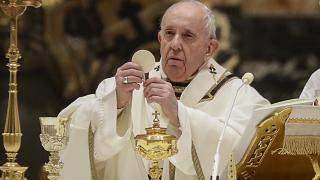
What the Popes intended is for all the faithful communities to benefit mutually from the best of each liturgies, the theology and the rich symbolism of the ancient Extraordinary Form, its adherence to the rubrics and emphasis on the Sacrificial nature of the Holy Mass, while also appreciating the beauty and outreach of the vernacular and the more widespread use of the Scriptures and its contents in the Ordinary Form, which remained faithful in all to the true essence of the Mass, that is the celebration of the Lord’s one and only Sacrifice at Calvary.

Unfortunately, there were those who continued to be stubborn and refused to acknowledge, respect or accept the reforms of the Second Vatican Council. Although indeed there were abuses and grave errors in how some interpreted the Council and how they took the liturgy to the extent of liturgical abuse, but it can’t be denied that the actions of those who refused to accept the decisions, documents and developments of the Second Vatican Council have led to division within the united Church, the Body of Christ, with some even insisting on more extreme ideologies, rejecting even the Pope and other teachings of the Church.

That is why as we continue moving on forward as one united Body of Christ, the Church, we must make sure that the provisions of the Motu Proprio Traditionis Custodes are adhered to and followed. We have to trust in the Lord and the Holy Spirit, that the bishops to whom the authority had been entrusted in the management of the celebration of the Holy Mass in the Extraordinary Form, will exercise prudence and sound judgment, charity and generosity in extending the permission to celebrate to all those who have been deemed suitable to celebrate with reverence, the Extraordinary Form of the Roman Rite, for the benefit of all the faithful.

We also pray that the Lord will continue to bring us to true unity, that we will no longer be divided by our ideologies, and especially not by our liturgical preferences. The Holy Mass is after all, the same, valid and worthy, regardless whether it is done in the Ordinary Form or in the Extraordinary Form. What is important is the need for us to be reverent in our celebration of the Holy Mass, to be inclusive in our worship and to put God first and foremost in all things, especially in our worship above all else. That is why we should neither discriminate or be prejudiced against either the Ordinary or Extraordinary Form, or to be lacking in proper reverence and respect of the Lord, as some of the worst liturgical abuses had done in the past decades.

Let us all look deep into our faith and the traditions that our forefathers had upheld, and together with the Pope, our bishops and priests, and as one Universal Church, be more united to the Lord through prayer, and resolve to commit ourselves to better and ever more perfect unity through Him, that we may benefit from the riches of both Forms of our most noble Roman Rite, and grow ever stronger in our faith, with each and every passing moment. Let us all grow ever stronger in charity and compassion towards others, and develop a most loving and inclusive community of the faithful, united in the Lord, in purpose and mission, in our love and reverence to the Lord.

Peter C.M. David Kang

康銘琮

Singapore

18 July 2021
Wednesday, 27 August 2014 : 21st Week of Ordinary Time, Memorial of St. Monica (First Reading)

Liturgical Colour : White

2 Thessalonians 3 : 6-10, 16-18

We command you, beloved, to stay away from believers who are living in idleness contrary to the traditions we passed on to you. You know how you ought to follow our example : we worked while we were with you. Day and night we laboured and toiled so as not to be a burden to any of you.

We had the right to act otherwise, but we wanted to give you an example. Besides, while we were with you, we said clearly : If anyone is not willing to work, neither should that one eat.

May the Lord of peace give you His peace at all times and in every way. May the Lord be with you all. I, Paul, write this greeting with my own hand. This is my signature in all my letters. This is how I write. May the grace of Christ Jesus our Lord be with you.

Sunday, 13 July 2014 : 15th Sunday of Ordinary Time, Bible Sunday (Scripture Reflections)

Liturgical Colour : Green

Dear brothers and sisters in Christ, today we celebrate a special occasion in our Liturgical year, when we celebrate Bible or Scripture Sunday, when we honour the Book from which we gained all that we need to know about our faith, and about our Lord and God. For the Bible or the Holy Scriptures is in itself the Word of God, the words of revelation which God had given to mankind over the ages, through His many prophets and servants.

The Holy Scripture is the revelation of the word of God, through which God made His will known to mankind, and through the advancement in technology and availability of printing, now we can have them as what we know now as the Bible. We have this privilege which members of the early Church did not have, and we should indeed be truly grateful for these gifts of the Bible we have with us.

How did then, the people of God and the faithful know about the Holy Scriptures? They did it through passing around oral stories and traditions, which they kept faithfully down through the generations, which were eventually compiled together and made into what we know as the Holy Scriptures, of which there are a total of seventy-three books, comprising of forty-six books of the Old Testament, of the time before the coming of Jesus Christ, and twenty-seven books of the New Testament, after the coming of Christ into the world.

One may ask, then, why the division between the Old and the New Testament? It is all in fact because of Christ, that is Jesus Christ, the Son of God, who as divine incarnate, became Man and came into this world. If we read the Gospel of John, on the first chapter, in what was faithfully read every Mass as the Last Gospel, it is all made clear. Jesus is the Word of God, who was made flesh, and became Man, for the sake of our salvation.

Thus the Old Testament refers to the ancient and old revelations of the Lord and the faith, before the Word Himself came into the world, while the New Testament reveals truly the new testament of faith, by none other than Jesus Himself, the Word of salvation. Those who believe in Jesus and in His teachings will be saved, and those who reject them will be doomed and damned for eternity.

There are sadly however, those who believe strictly in the words of the Bible as it is, without considering the different meanings that it may have carried and not immediately obvious to us, and sometimes even to the greatest intelligent minds that men possessed. This belief, which is also known as ‘sola scriptura’, is definitely wrong, and is truly a chief cause for the great divisions between the many so-called branches of the Church, separated by the evil act of the ‘reformation’ a few centuries ago.

The greatest flaw is that, no man should ever claim to be able to understand or fully comprehend the meaning of the word of God contained in the Holy Scriptures all by himself or herself. This emphasis on the sole dependence on the Holy Scripture is not right, and will confound our understanding of the true faith in the long term. What then, should be the foundation of our faith? We should put our faith in God, and on His teachings which were made known to us through the tradition of faith among God’s people.

The sacred tradition of the faith is important, and it is also present strongly in our Church. This sacred tradition is the one that complements our faith and understanding of the faith, as we obtained from the Scriptures. It is like a guide for us in understanding the Scriptures, that we may not make the same mistake as what many throughout the ages had done, misinterpreting the Scriptures and the Holy Gospels as they liked.

It is important that we guard ourselves from the misinterpretations and misunderstandings of the Gospel’s and the Scriptures’ message, that we do not end up causing divisions among ourselves and in the Church, as what had happened before in the past. Our feeble and limited minds are not capable of understanding the fullness of the truth of God, and therefore we are bound to misunderstand its true meaning without guidance.

This is precisely the mistake that caused so many people to stray away from the faith in the one and only Church of Christ, to follow their own flawed human instincts and ways, in an open rebellion against God and His will.

Therefore, brothers and sisters in Christ, let us all remain faithful and obedient to the teachings of Christ through the Holy Mother Church, that is the Holy Catholic Church, the one and only legal and rightful authority on this earth and under heaven to teach the fullness of faith, as its role in defending the fullness of the truth of the faith. If we do so, we will be able to adhere more faithfully and closely to the truth of the Scriptures and the Word of God.

However, brothers and sisters, we have to always remember that being faithful alone is not sufficient. This is because a faith without works is dead. Remember this saying? It comes from the Letter of St. James the Apostle, who wrote how our faith must be living and genuine, and based on strong sense of love. Faith that is based on strong and living love is a strong and solid faith.

Jesus told His disciples and all of us these, in His parable of the sower and the seeds, where He mentioned the fates of the seeds that ended up in various different types of soil and growth conditions. In this parable, Jesus clearly explained how faith cannot remain dormant, but must be always living and growing so that it may prosper in us and we may be saved.

The seeds are the seeds of faith, and none other than the word of God, which God had planted in us through His Holy Scriptures and teachings which He imparted to us through His disciples and Apostles. But those seeds really have different fates depending on how we use them and how we put them in our own lives, which is indeed the soil where the seeds grow on.

The first scenario, where the seeds fell along the path and got eaten by the birds, represent the situation when the word of God is not properly internalised by us, and as a result, Satan, represented by the birds, come and take us deep into the darkness. This is what happens when we do not receive the word of God, and reject what the Lord had revealed to us.

The second scenario, the seeds that fell on the rocky ground and were not able to grow well, because they did not have deep roots, is basically our faith if we do not commit the word of God into our lives, that is exactly what I had mentioned. Yes, if we do not have a living faith, then our faith will not take deep root in our hearts, and with the coming of troubles, we will stumble and fall into darkness and evil.

The third scenario, the seeds that fell on soil infested with thistles. Thistles are plants that can grow quickly and wrap themselves around other plants, eventually competing with those plants for nutrients, and in the end, literally choking the life out of the other plants. In this case, as Jesus mentioned, the worries and concerns of the world, the pleasures and corruption of the world get in the way, and the word of God did not take root either.

It is only when we commit the word of God that we heard and read from the Holy Scriptures and the Holy Gospels into our hearts and minds, and commit to real and true actions in our lives, then the word of God may grow healthily and strongly in us, and therefore gain for us a rich bounty of harvest and returns in the faith. With regards to this, Jesus did not just promise a meager or small increase in the results, but in fact, none less than thirty, sixty, and hundred-fold or even more from what we put in as our effort.

What is this eternal reward then? This great reward is none other than eternal life with God, which He grants to all those who remain truly faithful to Him, and to those who did not just talk about their faith, but also live that faith in their daily lives. This is the way for us to achieve salvation in God, the culmination of our long effort to reach out to our Lord. It cannot be done without hard work, that is to ensure that the word of God is growing on a rich and good soil.

Therefore, brothers and sisters in Christ, on this occasion of Bible Sunday, let us all use this opportunity to renew our commitments to the Lord, first by reading the Bible itself, so that we may know His words, and then, apply what we know into our own lives, in our words, actions and deeds. Then, and only then, we can truly grow strong in faith and reap rich rewards in the end.

May our Lord Jesus Christ, the Word made flesh, bring into us a greater understanding of the Word of God, so that we may live always in His grace, and remain truly faithful to Him. Amen.

Wednesday, 19 February 2014 : 6th Week of Ordinary Time (Scripture Reflections)

Liturgical Colour : Green

Brothers and sisters in Christ, today we are called to reflect on our lives and on our attitudes towards our faith. Have we seen our faith as something that needs just to be there as a belief? Or have we seen it as something that constantly need to be kept alive by active contributions and works? That was what St. James in his letter in today’s first reading tried to tell us about the faith.

Our faith cannot be dormant or be based on mere words or letters of the word. Our faith must be supported with a strong foundation, that is the foundation of love and devotion to God. And in order to do that, we have to act, and be active in love. Remember what Christ had told us? That we ought to love one another, especially those who are least and weakest in our societies?

St. James was particularly condemned and shunned by the Protestant heretics, who held firm to their false and twisted idea of sola fide and sola scriptura, that is the firm belief that only the Holy Scriptures is correct and the only thing to be followed, and more importantly, sola fide, that means faith is sufficient, certainly by literal understanding of the words of Christ, when He said to some, that their faith had saved them.

Yet, they had truly missed the point by their extremely literal understanding of the true meaning of God’s message. Faith is important, and indeed we have to put our complete faith and belief in the Lord, but faith cannot be merely that, meaning just faith. We do not have true and living faith if we just merely say, Lord, Lord, I believe in You, and keep ourselves to reading the Holy Bible all day long without action.

Action, that is action based in love, is an integral part of our faith, and therefore, an integral part of our salvation in Jesus. We cannot separate action of love from faith in love itself, for God Himself is Love, and Jesus is the embodiment of that Love. God so loved the world that He gave us His only Son, Jesus Christ, that all who believe in Him will not die, but receive eternal life.

Faith is important, but can we believe in Love, that is the love of God, if we ourselves do not practice love in our words, deeds and actions? If our actions are instead based on hatred, prejudice, jealousy, and many other negative influences, then are we not contradicting our own faith in the Lord? And does that not mean that we have actually no faith in God?

That is precisely why the path of those who believed in salvation by faith alone is wrong, because many of them in their blind zeal to prove and fight for their version of the faith, they sowed much hatred, prejudice, and jealousy among themselves against the truth that is in God and in His Church. But again, they are not the only ones that are in the wrong, because we ourselves too often do not truly follow what the Lord wants from us.

We are often ignorant of our own faith, and we treat our faith as nothing more than a profession of the Creed and attendance at the Mass every Sundays. We do not truly practice our faith, and in our own daily habits and activities, we often do not reflect the love of God. This ignorance of our faith is something that we have to avoid at all cost, for again, I would like to remind you that this kind of faith is dead, and will do us no good before God.

Practice our faith, brothers and sisters in Christ, and put love in all of our words, actions and deeds. Put what the Lord had revealed and taught to us into real action. As Jesus had said, let all of us love one another, all of our brothers and sisters, children of the same God just as much as we care and love for ourselves. And of course, love God with all of our hearts and our strength.

But loving God does not mean for us to keep ourselves enclosed in our own world of desire for salvation, for doing that will mean selfishness. Loving God can be much more concretely professed, by following what He told us! Yes, that is to love our brethren, especially those who are the last, the lost, and the least. And Jesus Himself said that whatever we had done for them, we did them for God.

Hence, brothers and sisters in Christ, shall we heed what St. James had called us to do, and indeed challenged us to do? Shall we change our perspective on our own faith in God? Shall we from now on make our faith in God truly vibrant and alive? We have to make our faith in God concrete through actions, and that is actions based on love.

May our Lord Jesus Christ guide us and bless us with wisdom and understanding, that we may realise how important it is to love, and how crucial it is towards our salvation. May God continue to be with us and walk with us, that we may continue to love Him and devote ourselves to Him with full, living faith. God bless us all. Amen.

Thursday, 2 January 2014 : Weekday of Christmas Time, Memorial of St. Basil the Great and St. Gregory Nazianzen, Bishops and Doctors of the Church (Scripture Reflections)

Liturgical Colour : White

Brothers and sisters in Christ, many of us like to deny the Lord and those who had worked hard to bring God closer to us through their teachings. Instead we often let ourselves be swayed by the forces of this world, that we end up following the ways of the world instead of the ways of God. We doubt the presence of God in us, and put our trust instead in the weakness of men and the pleasures of the world.

Indeed, brothers and sisters in Christ, today, we deal with the theme of the authority of teaching of the faith, and the truth about what had happened as the Lord had done, when He once came into this world as man, Jesus Christ our Lord. This truth had been told across generations through the prophets, before the Lord came, and after His death, resurrection and ascension into heaven, by the Apostles and the countless saints who stood up for their faith in God.

These saints and holy people stood up for the Lord, defending the faith they have in God, protecting the deposit of the faith that is in the one and only Church of God, the Catholic or Universal Church. These teachings were passed down to us today through the bishops and the priests who succeeded the Apostles and the other leaders of the early Church, through whom they passed down whatever had been revealed to them by Christ Himself and by the Holy Spirit.

These saints testified for the Lord who had come to save the world, and through their testimony and their teachings, again passed down to us through the Church. Through these teachings we are brought close to the Lord, and it is revealed to us what the Lord wants from us, that is to follow Him and be saved. But the devil certainly did not stay quiet and let everything go smoothly according to the Lord’s plan.

Just as he had tried so much to undermine the good works of the Lord by tempting Him directly, and when that failed, by opposing Him in every turns and corners, questioning His authority and teaching through the Pharisees and the scribes, and many other ways that he had employed to keep mankind away from salvation in God.

Satan opposed the Lord and all of His faithful ones, by sowing the seeds of dissension, jealousy, pride and arrogance in the hearts of the enemies of Christ. As in the Gospel today, the Pharisees and the scribes questioned the authority of John the Baptist, that is under whose authority he did all the baptisms and the teachings about the coming of the Messiah. They should have known about the coming of John the Baptist as the herald of the Messiah, because after all they are the learnt ones, the ones who knew the Scriptures inside out in their heart.

They instead gave in to their human vulnerabilities, that is they let Satan into their hearts, and they in essence, become the tools of Satan through which he tried to undermine the works of our Lord to save us. Such an irony indeed, and sad indeed, that the very leaders of the people, the supposedly pious and educated ones at that, were the very ones that betrayed the Lord.

This is because they gave in to vanity and human greed, the greed for authority, power, as well as the jealousy of human heart and desire, which is for power and influence within the society, within the society of the people of God. They resented those who they perceived to be undermining their own teaching authority, for the Pharisees and the scribes advocated a very strict observation of the laws of Moses and did not entertain any kind of dissent against what they taught.

And as you know, the Pharisees and the scribes continuously harassed Jesus and His followers, and right up to when they delivered the coup de grace, condemning Jesus to death with false witnesses, testimonies and accusations that led to the crucifixion of Jesus. And Satan surely rejoiced at that moment, for he thought that he had undermined the Lord’s plan to save us. And yet, what he had done was merely part of the Lord’s salvation plan, made fulfilled through the death of Jesus on the cross.

After that defeat, Satan did not give up. He continued to try to deceive the people  of God through his lies spread through many false prophets he sent to the world. Today we celebrate the feast of two great saints of the Eastern Church, who were brave and courageous defenders of the faith, fighting constantly against the heresies of the faith in the Church spread exactly by these false prophets.

They are St. Basil the Great, also known as St. Basil of Caesarea, and St. Gregory Nazianzen, also known as St. Gregory of Nazianzus. Both of them were renowned theologians and leaders of the faithful, living at the time of the fourth century after the birth of Christ, after Christianity had become the majority faith of the people of the Roman Empire.

A preacher named Arius spread unorthodox and heretical teachings about Christ. That Jesus Christ is not equal to the father as the Son of God. Instead of the true faith and teaching that God the Son is equal in all aspects to the Father and the Holy Spirit, one in unity and essence, existing before all ages, Arius preached that the Father is superior to the Son, and Jesus was created rather than existing with the Father, being begotten not created.

Arius’ teachings spread wildly across many parts of the Roman Empire, converting many people to this heretical teaching of the faith. He was wildly popular and swayed many to sin by believing in the falsehood of the devil. It was St. Basil the Great and St. Gregory Nazianzen who led the people of the true and orthodox faith in the campaign against the heresy of Arius, also known as Arianism.

We were warned by St. John the Evangelist on the presence of false prophets who would lead the people astray in their path towards the salvation in God, and the example of Arius had proven just to be the case, as much as many other heretics and false prophets who appeared both before and after him. St. Basil the Great and St. Gregory Nazianzen tirelessly championed the cause of the true faith, often in opposition even to the people whom they were shepherding and leading, who had been corrupted by the false teachings of Arius.

Yet they did not fear and continued to work hard, at times even they have to suffer persecution and suffering, as well as rejection and mockery by those who supported the false faith and the lies of the devil. Nevertheless, they continued to move on, and on, and on, until their death, they never ceased to work hard to purify the faith from these lies of the devil and all the seeds of falsehood that he has planted in the hearts of the Lord’s faithful through his false prophets.

Even today, brethren, false prophets can be abound, numerous, and we often may not know who they are. That is why, it is important for us to deepen the knowledge and understanding that we have of our faith in God. We cannot be idle or lest we risk to fall into the corruption of the lies of the evil one. Hold firmly on the deposit of faith, and the richness of the teachings that had been handed down to us from the Lord and His Apostles, through the Church.

Dear brothers and sisters in Christ, let us ask St. Basil the Great and St. Gregory Nazianzen to pray for us, that we will be protected by the Lord and His angels, so that we will not easily fall prey to heresy or succumb to the lies and temptations of the evil one. Let us also help one another, that we can keep all the faithful ones in God to remain faithful, now and till the end of time. God be with us all. Amen.

Tuesday, 3 September 2013 : 22nd Week of Ordinary Time, Memorial of St. Gregory the Great, Pope and Doctor of the Church (Scripture Reflection)

Liturgical Colour : Green or White

Dear brothers and sisters in Christ, we celebrate today the great feast of one principal saint of Christendom, none other than St. Gregory the Great, also known as Pope St. Gregory the Great who lived and reigned as Pope in the turn of the seventh century after the birth of Christ. He lived during the time of troubles, of the Dark Ages Europe, after the fall of the Roman Empire in Western Europe, with barbarians plundering the former lands of the Empire and settling in them as permanent settlers.

Even Rome and Italy at the time the birth of Pope St. Gregory the Great was under the authority and power of the Ostrogoths, one of the Gothic barbarian peoples who had settled in Italy after the fall of the Empire in the west. The Ostrogoths adopted the Arian heretic belief, and the predecessors of Pope St. Gregory the Great, as the Pope and the Bishop of Rome, worked hard to convert them to the true faith of the Apostles and reject their heretical beliefs.

Pope St. Gregory the Great lived through a time of great difficulties before he became Pope in 590 AD. The Ostrogothic kingdom went through a series of civil wars and internal conflicts, and together with the reconquest campaign by the Eastern Roman Empire, which saw Italy and Rome back at the hand of the Empire, had wrecked much of the local population, ravaged by warfare and deadly disease.

On the backdrop of these events, Pope St. Gregory the Great lived his early life and his adult years, and yet, he grew up to be a pious, zealous, and well educated man, who joined the religious life and became a monk. He was deeply devoted to Christ and immersed himself in his religious devotions as a monk, and prayed fervently and worked hard for the sake of God. Even after his election to the See of Peter, he remained the same, and continued his good works for the sake of God and God’s holy people.

Most importantly, Pope St. Gregory the Great reinvigorated the Church and its missionary efforts, in spreading the faith and the Holy Gospels to the pagan peoples and to the heretics who had walked away from the true path of God, the path of salvation. He sent many missionaries to the far ends of Christendom, to England through St. Augustine of Canterbury, and to other parts of Europe, converting many to the faith in God, and bringing many souls to salvation.

Not only that, Pope St. Gregory the Great was truly irreplaceable for his crucial role in the reform of the Church, particularly in its liturgy and rules of worship in the Mass. Both the Mass we have today, in all its forms, and the Divine Liturgy that our brethren of the Eastern Churches celebrate can trace their origins to the reforms and changes made by Pope St. Gregory the Great, the holy and great reformer Pope.

If you find the name Gregorian Chant familiar, yes, this wonderful music of worship is named after this great Pope, who reformed Church music in such a radical way, that it totally changed the landscape of divine song and songs of worship over the centuries even until today. To Pope St. Gregory the Great, the Lord our God in Jesus Christ is so great and glorious in heaven, and so profound is His might and power, that we ought to honour Him the best way we can with our abilities and senses, and hence, his reforms of the Mass and the Church music in the Gregorian chants.

Pope St. Gregory the Great gave much of his love and care for others, for the poor through charity, and for everyone through his dedicated and loving actions in Christ. He brought the Lord close to everyone through his own deeds and words, and indeed, through his copious writings. Many of Pope St. Gregory the Great’s writing remained and became source of inspiration for our faith, just as it had been during his time as Pope. He worked hard to defend the people against heresies and against the temptations of the devil, doing as much as he could to bring more and more souls towards salvation.

Yes, brethren, this great and saintly Pope truly is worthy of heaven, and he preached with the authority of Jesus Christ the Lord and Saviour of all, who is so mighty and all-powerful, that even the evil spirits obeyed Him, as we heard in the Gospel today. Even the devil would kneel before the Lord crucified, the Almighty Creator of all, for He is the light of the world, and no darkness would be able to stand before Him.

We are the children of light, brothers and sisters in Christ, and as long as we do the will of God, and follow His ways, we will always reflect His brilliant light, and the devil will have no power over us, for he is doomed to destruction and eternal torture, while we who are saved in Christ are fated to be in the eternal light of God and enjoy the fruits of our faith, the fruits of our salvation. Fear not, brethren, for our Lord and God who loves us, desires not our death and destruction, as what He truly wishes for us, is to live, and not just any life, but an eternal life filled with love and true joy in Him.

That was why He sent us many help along the way, all His saints, including Pope St. Gregory the Great, whom we talked about just before. Through their hard work, we have known the Lord our loving God, and through their labours, we have received the teachings of the Lord and grow to understand the extent of His great love and dedication to all of us. However, the work did not just stop there, brethren, as even today, much work awaits us, and we too are called to be the saints and the apostles of our own time.

Dear brothers and sisters in Christ, therefore, inspired by the examples of Pope St. Gregory the Great, and by the love and sacrifice of our Lord, through which He showed us His infinite love, let us also be proactive, in all our dealings, all of our words and all of our actions, that we will always reflect the love of God with zeal, and therefore obey His will, that is to love, to love Him with all our hearts and all our strength, and do the same to our fellow brothers and sisters.

May the Lord our God who showed us His mercy and love, and who rebuked evil spirits from the hearts of men that we may be clean and pure and worthy of Him, bless us, strengthen us, and empower us, that we will be reunited with Him when He comes again in glory and bring us to eternal life with Him, forever and ever. Amen.

Tuesday, 3 September 2013 : 22nd Week of Ordinary Time, Memorial of St. Gregory the Great, Pope and Doctor of the Church (Gospel Reading)

Liturgical Colour : Green or White

Luke 4 : 31-37

Jesus went down to Capernaum, a town of Galilee, and began teaching the people at the sabbath meetings. They were astonished at the way He taught them, for His word was spoken with authority.

In the synagogue there was a man possessed by an evil spirit, who shouted in a loud voice, “What do You want with us, Jesus of Nazareth? Have You come to destroy us? I recognise You : You are the Holy One of God.”

Then Jesus said to him sharply, “Be silent and leave this man!” The evil spirit then threw the man down in front of them, and came out of him without doing him harm.

Amazement seized all these people, and they said to one another, “What does this mean? He commands the evil spirits with authority and power. He orders, and you see how they come out!” And news about Jesus spread throughout the surrounding area.

Tuesday, 3 September 2013 : 22nd Week of Ordinary Time, Memorial of St. Gregory the Great, Pope and Doctor of the Church (Psalm)

Liturgical Colour : Green or White

Psalm 26 : 1, 4, 13-14

The Lord is my light and my salvation – whom shall I fear? The Lord is the rampart of my life; I will not be afraid.

One thing I ask of the Lord, one thing I seek – that I may dwell in His house all the days of my life, to gaze at His jewel and to visit His sanctuary.

I hope, I am sure, that I will see the goodness of the Lord in the land of the living. Trust in the Lord, be strong and courageous. Yes, put your hope in the Lord!

Tuesday, 3 September 2013 : 22nd Week of Ordinary Time, Memorial of St. Gregory the Great, Pope and Doctor of the Church (First Reading)

Liturgical Colour : Green or White

1 Thessalonians 5 : 1-6, 9-11

You do not need anyone to write to you about the delay and the appointed time for these events. You know that the Day of the Lord will come like a thief in the night. When people feel secure and at peace, the disaster will suddenly come upon them as the birth pangs of a woman in labour, and they will not escape.

But you, beloved, are not in darkness; so that day will not surprise you like a thief. All of you are citizens of the light and the day; we do not belong to night and darkness. Let us not, therefore, sleep as others do, but remain alert and sober.

For God has not willed us to be condemned but to win salvation through Christ Jesus our Lord. He died for us so that we might enter into life with Him, whether we are still awake or already asleep. Therefore encourage one another and build up one another, as you are doing now.

The need to return to ‘Ad Orientem’ celebration

00056_15042010

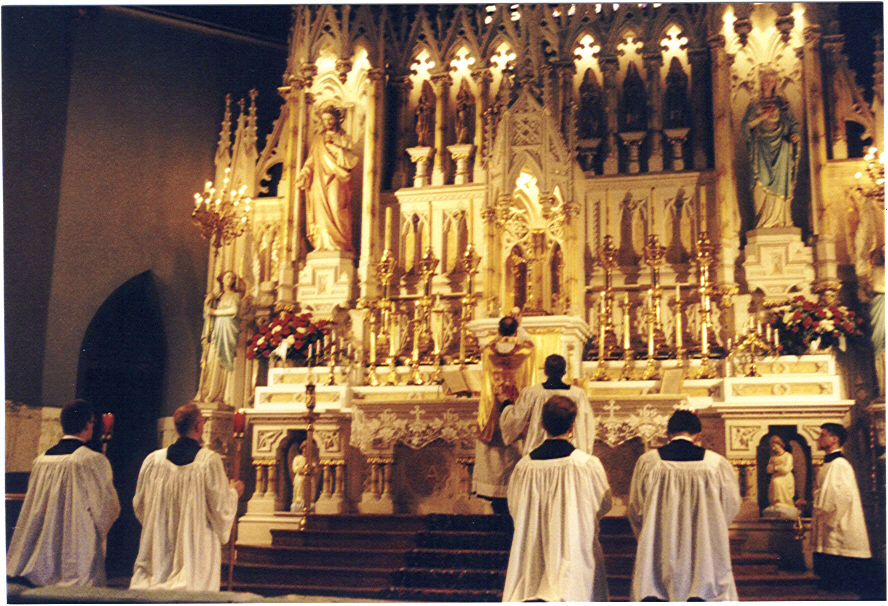
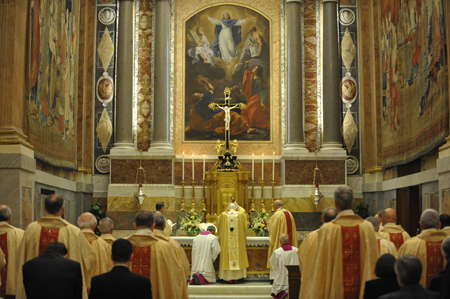
Let us return to the ad orientem celebration! That is facing the Lord TOGETHER with the people, instead of facing the people (ad populum).

The Mass is not a political gathering or a party where everyone faces each other and look at each other. The Mass is about the Holy Sacrifice of Jesus Christ, and we ALL ought to look at Him crucified. Therefore, everyone, including the priest, MUST face the Lord, and ad orientem is the best way.

Elevation

The focus of the Mass is the Lord, not the priest as a person. The priest is Alter Christus, Christ personified in the priest, and when he lifts up that bread turned into the Most Precious Body, It is like Christ lifted up high between the heaven and the earth, offering Himself as a sacrificial victim, to absolve and save all the world from death and sin. When the priest lifts up that chalice with wine, transformed into the Most Precious Blood, it is the Blood of Christ, Jesus Christ Himself we are looking at, His Blood pouring down the cross to us, to wash us from our iniquities and our sins, making our garments white again in the Blood of the Lamb.

Monstrance Baroque

And even the ones who crucified Him, looked at Him “And they shall look at the One whom they pierced”. It is therefore imperative, that we keep our focus at the Lord, as One people, One Church, during and throughout the Mass. The focus is not in the dances and the upbeat songs now often used to arouse people’s attention and interest in the Mass, and neither is the focus on the priest dancing, singing, or the people’s performances, but the focus is Christ.

When the priest faces the people, this fact is quickly and easily lost in both the people, AND the priest. Eye contact is very important in relationships, and eye contact between the priest and the people while can be beneficial (during the homily) it can easily distract our attention from the Lord in the Eucharist, very easily.

In this way too, we take the best from both of the two Form of the Latin Rite we have in the Church, that is the Extraordinary Form (Tridentine) and the Ordinary Form (Novus Ordo), and end the numerous liturgical abuses that had arisen ever since ad populum celebration became commonplace, and many did them inappropriately and without due honour to our Lord Jesus Christ.

papal ad orientem 2010 4

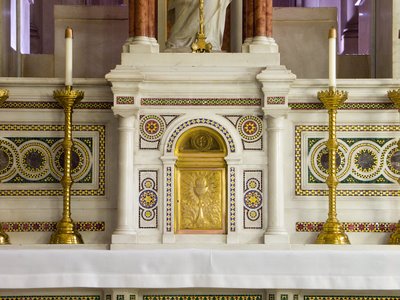
And lastly, it is time to return the Tabernacle with the Most Holy Eucharist back to its place of primary honour behind the Altar, that is where all the people and the priests focus at during the Mass, and not relegated somewhere at the side or a less-than-honorary place in the church building. There can be another Tabernacle for use especially during the Transfer of the Eucharist on Holy Thursday, but the Tabernacle itself should and indeed, must be restored to its position of honour at the Altar!

Cathedral Basilica of Saint Louis, in Saint Louis, Missouri - All Saints Chapel - tabernacle

Ad orientem celebration helps this, as the priest no longer need to show his back all the time to the Lord throughout the Mass if ad populum celebration is done.