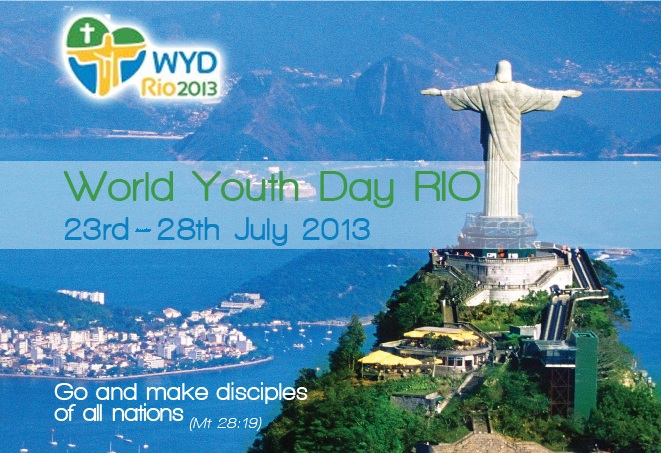
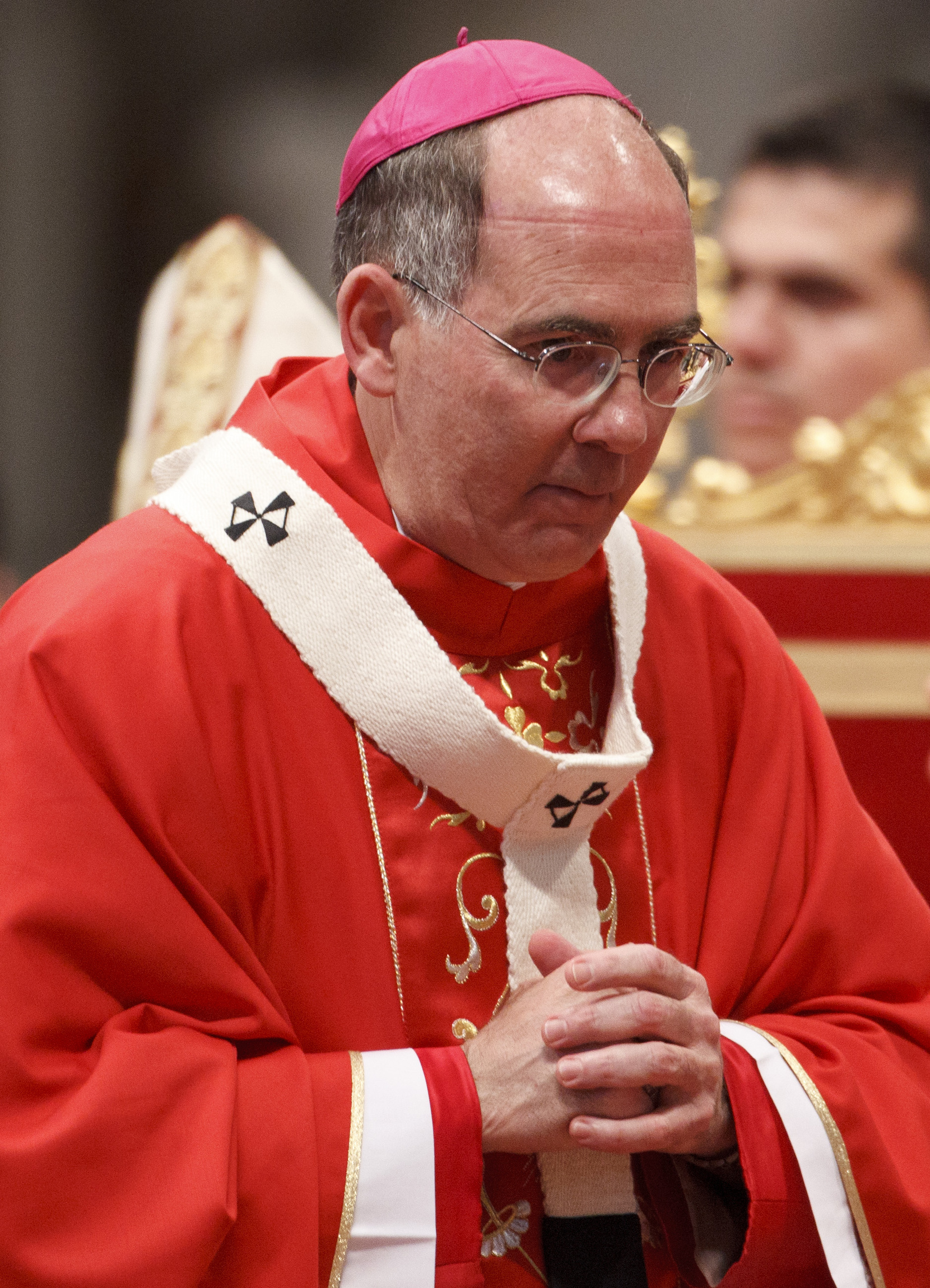
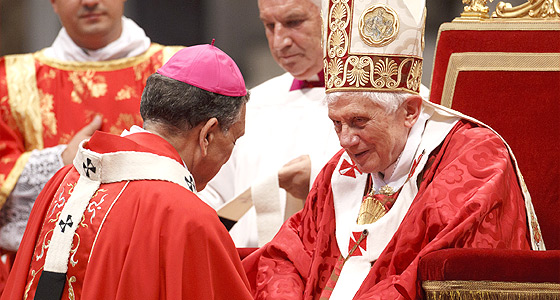
Official Schedule of Pope Francis in World Youth Day 2013 at Rio de Janeiro, Brazil (23 – 28 July 2013)

wyd-rio-2013


http://www.romereports.com/palio/popes-brazil-schedule-released-as-rio-gets-ready-for-world-youth-day-english-9964.html#.UYjtL8rTc78

http://attualita.vatican.va/sala-stampa/bollettino/2013/05/07/news/30948.html

Pope Francis’ complete schedule for the World Youth Day 2013 celebrations in Rio de Janeiro, Brazil had been released by the Vatican. As the schedule above is in Italian, I will translate it as best as I can into English here.

The Schedule (The times depicted are local time, Rome time = UTC+2 and Rio de Janeiro time = UTC-3) :


Monday, 22 July 2013

08.45 am (Rome Time) : Departure from Rome’s Ciampino Airport to Rio de Janeiro

04.00 pm (Rio Time) : Arrival at the Galeao International Airport in Rio de Janeiro

05.00 pm : Welcome ceremony for Pope Francis at the Guanabara Palace in Rio de Janeiro

05.40 pm : Visit by Pope Francis to the President of Brazil at the same Guanabara Palace


Pope Francis will then stay at a private residence in the Sumare region of Rio de Janeiro. No event scheduled for Tuesday, 23 July 2013


Wednesday, 24 July 2013 

08.15 am (Rio Time) : Pope Francis will depart his residence at Sumare by helicopter to visit the famous Basilica of the National Shrine of Our Lady of Aparecida

09.30 am : Pope Francis arrives at the Basilica of the National Shrine of Our Lady of Aparecida
10.00 am : Pope Francis will venerate an image of the Virgin Mary at the Basilica located in the Hall of the Sanctuary of the Twelve Apostles

10.30 am : Holy Mass led by Pope Francis at the Basilica of the National Shrine of Our Lady of Aparecida

01.00 pm : Pope Francis will have lunch with the Bishops of the Ecclesiastical Province of Aparecida and the seminarians of the Seminary of Aparecida

04.10 pm : Pope Francis will return to Rio de Janeiro from Aparecida by helicopter

05.25 pm : Pope Francis is scheduled to return to Rio de Janeiro by helicopter

06.30 pm : Pope Francis will visit the St. Francis Assisi Hospital in Rio de Janeiro


Thursday, 25 July 2013
07.30 am : Private Mass led by Pope Francis in his official WYD 2013 residence in Sumare, Rio de Janeiro

09.45 am : Pope Francis will receive the keys of the city of Rio de Janeiro and he will also bless the Olympic Flags of Rio de Janeiro (will be host for 2016 Olympics) at the city square of Rio de Janeiro

11.00 am : Pope Francis will visit the slum community of Varginha (Manguinhos)

06.00 pm : Pope Francis will receive youths attending the WYD 2013 at the Copacabana waterfront area, Rio de Janeiro


Friday, 26 July 2013

07.30 am : Private Mass led by Pope Francis in his official WYD 2013 residence in Sumare, Rio de Janeiro

10.00 am : Pope Francis will conduct confession sessions with youths attending WYD 2013 in the Quinta da Boa Vista Park of Rio de Janeiro

11.30 am : Pope Francis will meet some young prisoners at the Archbishop’s Palace at Rio de Janeiro

12.00 pm : Pope Francis will lead Angelus prayer from the balcony of the Archbishop’s Palace

12.15 pm : Pope Francis will greet the organising committee and benefactors of WYD 2013 in the Archbishop’s Palace, Rio de Janeiro

01.00 pm : Pope Francis will have lunch with youths at the Archbishop’s Palace

06.00 pm : Way of the Cross led by Pope Francis at the Copacabana waterfront, Rio de Janeiro


Saturday, 27 July 2013

09.00 am : Holy Mass with the bishops, priests, seminarians, and religious at the Cathedral of the Archdiocese of San Sebastian Rio de Janeiro (Cathedral of Rio de Janeiro)

11.30 am : Pope Francis will meet with the leaders of Brazil in the Municipal Theatre of Rio de Janeiro

01.00 pm : Pope Francis will have lunch with the Cardinals of Brazil, the President of the Episcopal Conference of Brazil, bishops of the Rio de Janeiro region, and the Papal entourage of WYD 2013 in the Sumare residence, Rio de Janeiro

07.30 pm : Pope Francis will lead the prayer vigil with the youths at Guaratiba, Rio de Janeiro


Sunday, 28 July 2013

10.00 am : Holy Mass of the Closing of WYD 2013 at Guaratiba, Rio de Janeiro.

12.00 am : Pope Francis will lead the recitation of the Angelus prayer at Guaratiba

02.00 pm : Pope Francis will have lunch with the Papal entourage of WYD 2013 in the Sumare residence, Rio de Janeiro

04.00 pm : Pope Francis will meet with the leaders of CELAM, the Latin American Episcopal Conference at Sumare, Rio de Janeiro

04.40 pm : Pope Francis leaves the Sumare residence

05.30 pm : Pope Francis will meet with the volunteers of the WYD 2013 at Hall 5 of Rio Centre, Rio de Janeiro

06.30 pm : Farewell ceremony at the Galeao International Airport of Rio de Janeiro

07.00 pm : Departure from the Galeao International Airport to return to Rome


Monday, 29 July 2013

11.30 am (Rome Time) : Arrival at the Ciampino Airport of Rome

Wednesday, 24 April 2013 : 4th Week of Easter, Memorial of St. Fidelis of Sigmaringen, Priest and Martyr (Scripture Reflection)

Dear brothers and sisters in Christ, we are reminded today that Christ had come into our world as our salvation, to save us from our condemnation to death by our rebellion against the love of God. He came into our world as light that shed off the darkness that is in our world, and most importantly, the darkness that is within our hearts.

He had been sent into this world that it, together with all of us who lives in it, can be saved rather than cast off together with Satan and his angels into the sea of fire and eternal damnation and separation from God. God’s love desires that all mankind be reunited into Himself, and Christ, whose birth was announced by the prophets, did exactly just that, by serving as the bridge that spans heaven and earth, and linked mankind back to God their Father, providing the only path to salvation and eternal life.

Today, we also commemorate the feast day of St. Fidelis of Sigmaringen, who was a priest, and also a martyr, and while St. Adalbert whom we commemorated yesterday preached the Good News to the pagans, St. Fidelis who lived during the height of the Protestant Reformation and rebellion had to contend against the heretical Protestants, particularly the Calvinists in the region now known as Switzerland.

St. Fidelis fearlessly waged into the Calvinist strongholds and preached the true faith of the Church, against the erroneous beliefs of the Protestants of the era. Despite the harassment and hatred of those to whom he had ministered, and under the threat of death, St. Fidelis pressed on, and was finally martyred when he rejected outright the persuasion of Calvinist soldiers who pressed him to renounce his Catholic faith, and prayed for them, for the salvation of their souls.

In St. Fidelis, and in St. Adalbert, we saw the truth that is in God, which was revealed through Christ and made manifest in this world. Truth is hard, and it is difficult to be taken in by many, who preferred the lies of Satan to the truth of God. Yet, these saints strived to open the eyes of many who had been fooled by Satan and his earthly minions set to destroy God’s people by false prophets and ideas, and even braved martyrdom in the process.

In our modern day world, we may not see such similar scenario and condition as what the two saints had witnessed in their own times, but in fact, in our present day world, the need for the light of Christ to illuminate the hearts of many had never been greater. Many had abandoned God for the relative comfort of this world’s allures and temptations. The evil one has many ways to seduce mankind into his fold, and to abandon the path of God.

We can do our own part in evangelisation, and we do not even need to brave death as what the two martyrs had done, but most importantly, we begin from our own surroundings, that we show the truth of the Lord through our words and actions, to show the light of Christ through our own beings, and through what we are doing in our lives.

May God guide us always in our lives, and make us into lights for all mankind, that in us, those who have yet to believe in Christ or those who had abandoned Him will once again see the true Light that is Christ, our Lord and Saviour. Amen.

Holy Week 2013 Schedule for the Cathedral of the Good Shepherd, Archdiocese of Singapore

Here is the schedule for 2013’s Holy Week (Sunday, 24 March 2013 – Sunday, 31 March 2013) at the Cathedral of the Good Shepherd, Archdiocese of Singapore :


1. Palm Sunday : Saturday, 23 March 2013 at 6.30 pm; Sunday, 24 March 2013 at 8 am, 10 am, and 6 pm

(Mass at 10 am will be celebrated by Archbishop Nicholas Chia, the Archbishop of Singapore)


2. Cena Domini (Mass of the Lord’s Supper) : Thursday, 28 March 2013 at 6.30 pm. Adoration of the Blessed Sacrament after the Mass until midnight.

(To be celebrated by Archbishop Nicholas Chia of Singapore, Coadjutor Archbishop William Goh of Singapore, and Apostolic Nuncio to Singapore, Archbishop Leopoldo Girelli)


3. Good Friday : Friday, 29 March 2013 at 2.30 pm and 5.30 pm

(Service at 2.30 pm with Way of the Cross, Service begins at 3 pm and to be celebrated by Archbishop Nicholas Chia, the Archbishop of Singapore)


4. Easter Vigil : Saturday, 30 March 2013 at 9 pm

(Celebrant : Archbishop Nicholas Chia, the Archbishop of Singapore)


5. Easter Sunday : Sunday, 31 March 2013 at 8 am, 10 am, and 6 pm

Ring of the Fisherman for Pope Francis, 266th Pope, Successor of St. Peter the Apostle, leader of the Universal Church

Image

Another image from Rome Reports

6719_10151417713052928_1657486910_n

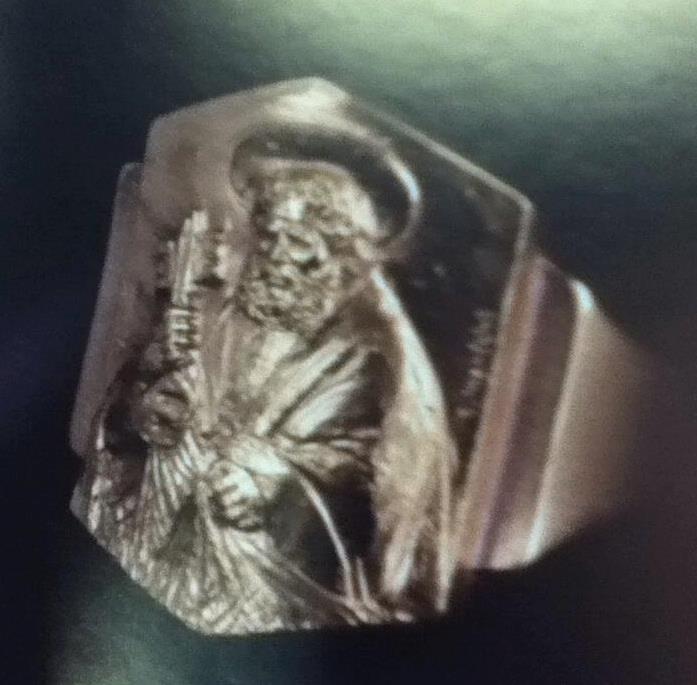
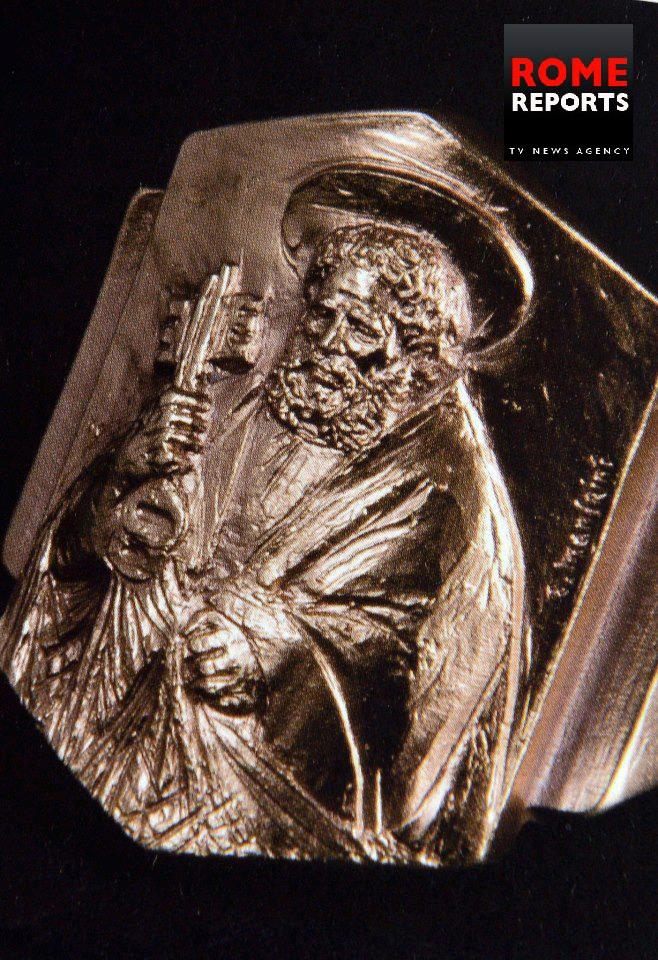
Pope Francis’ Ring of the Fisherman, which is one of the symbol of the authority as the Pope, as both a bishop (episcopal ring) and the Successor of St. Peter the Apostle, leader of the entire Universal Church. It will be given to Pope Francis at the celebration of the Papal Inauguration Mass, on the Feast of St. Joseph, Tuesday, 19 March 2013, together with another symbol, that is the pallium.

The ring’s image closely follow that of Pope Benedict XVI’s Ring of the Fisherman, with slight difference in the shape of the ring, and the ring being made of gold-plated silver instead of gold. Depicted on the ring is the image of St. Peter holding onto the keys of the kingdom of heaven, and fishing, as he was a fisherman, but called by God to be a ‘fisher of man’.

Official coat-of-arms of Pope Francis, the 266th Pope, Leader of the Universal Church

Image

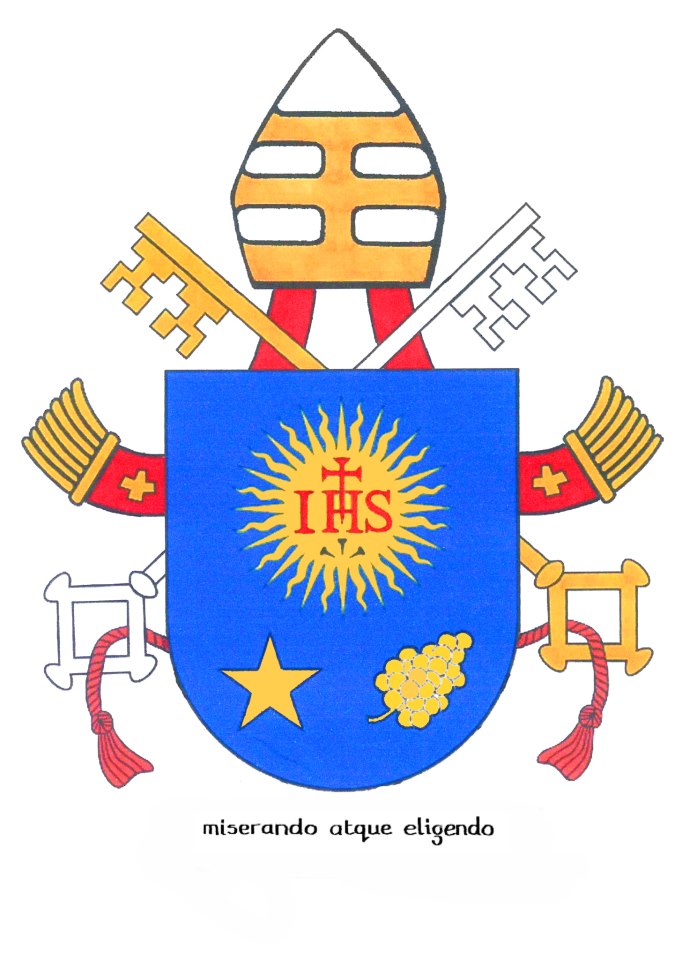
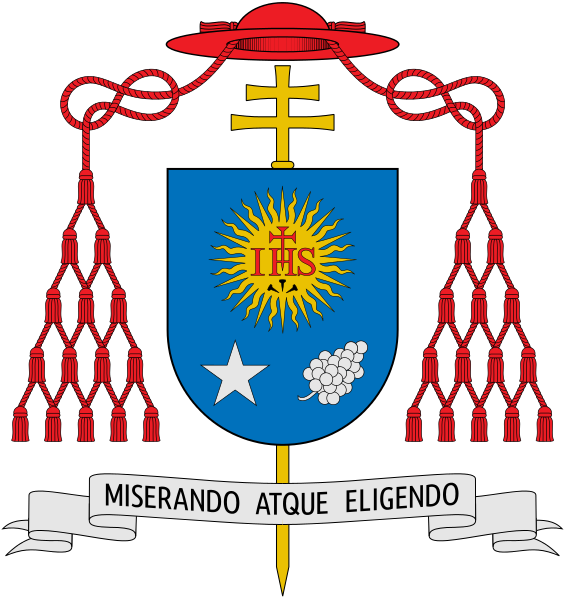
The official coat-of-arms of Pope Francis, which followed closely the model established by Pope Benedict XVI, in placing the ‘three-tiered’ ‘papal mitre’ instead of the papal tiara, and following the same shield model as that of his Cardinalate and episcopal coat-of-arms, but with altered colours for the star and the grapes, from silver to gold.

Image

Pope Francis used his episcopal motto “Miserando atque Eligendo” which means “Lowly but chosen” in English, in line with his views and outlook on humility.

The Cardinal’s fifteen red tassels and the galero on top of it, is replaced by the papal arms standard including the three-tiered papal mitre and the crossed keys of the kingdom of heaven (silver and gold).

The symbols that appeared on the shield are first, the IHS symbol surrounded with a sun-like ray is the symbol of the Jesuit order (S.J.) of which Pope Francis is a member of, and the star on the bottom-left, in conjunction with the blue colouration of the shield represents the Virgin Mary, and the grape on the bottom right represents Jesus Christ, as the grower of the vineyard of the Lord.

What is our faith really about? And how to answer questions that directly address our faith (From a comment)

You see how much lies evil had planted in the heart of many in this world to lead them away from the truth in God (From my blog’s comment and my reply). Do not reject them, and do not turn them away.

Especially if they ask you about your faith in God, through the Church, stand up tall, and shielded with our faith and knowledge of that faith that we have gained through the teachings of the Church, answer confidently, in courage, in love, and of course, offer a welcoming hand for them, and teach them the truth, that they too may join us in salvation in Christ.

Let us work together to accomplish the unity of all Christians in the One, Holy, Catholic, and Apostolic Church! Ut Omnes Unum Sint, ad Maiorem Dei Gloriam! That they all may be One, for the greater glory of God!

The comment :

What of the pope Petrus Romanus as described by St. Malachy in 1139 to be the next and final pope? St. Malachy’s final words regarding his full listing of all future popes (which has proven to be correct to the last detail) – “Rome, the seat of the Vatican, will be destroyed and the dreadful Judge will judge the people.”

Please pray to our Lord and Savior, our only Redeemer and mediator with God, Jesus Christ our one true King!
Ephesians 2:8-9; 1599 Geneva Bible (GNV)
8 For by [a]grace are ye saved through faith, and that not of yourselves: it is the gift of God,
9 [b]Not of works, lest any man should boast himself.

It is not through a church, catholic, evangelical, or other that we find our way. It is only with a relationship with Jesus, our Lord and Savior. It is not through saying rote prayers or seeking after a “favor” or “abolition” from any mere human (past or present).

It is only with our Lord Jesus. His mother Mary was highly “favored” which never meant she was to be placed higher than our Lord. Period. Seek after and follow Him and know others by the fruits of their hearts not the fruits of this world (fame or fortunes) as they are always meant to decieve.

Thank you for reading and seeking Him!

My reply :

I have no need to comment on that prophecy, which may after all be false and forgery. Even if that prophecy is true, it only showed that the Church led by the successor of blessed St. Peter the Apostle, remained faithful to the last, with that last Bishop of Rome as shepherd to feed the lambs of our Lord, through time of persecution of the Church, and even likely to suffer death at the hands of Satan and those who hated the Church and wished for its destruction, as it is the last bastion of Christ and His light in this world.

For grace and salvation is indeed through faith, but faith alone does not save one, and neither does work alone. For what you mentioned here of boasting is, work done without faith, but work done in faith serve only to affirm that faith in the Lord, and faith without works is dead. Faith needs to be alive, and nothing better to make it alive and manifest through our actions, in simple acts that we do in our daily lives, through our love for our neighbours and fellow men.

For believing solely in faith, to be frank, how do you even define faith? Faith is not mere words, and not mere ‘personal’ relationship, but it is as communal as it is personal. Nobody can have faith if they never show it through their good works following what Christ had taught us. It is a danger to believe that we are saved simply by faith, and then we can do as we like. Faith is through our love and works for our brethren, the poor, the weak, and the less fortunate, that through this living faith, we are justified by the Lord. Not enough by mere personal relations and personal dedications to God, for if that is the case, then the faith of the Pharisees would have been sufficient.

No! Christ mentioned that we are saved by faith, because this faith is not just once, and not just once and for all, and not through a single moment, but this faith is manifest throughout our entire life, and reflected through our prayers, our actions, and our concrete works for the good of others, and for the sake of God. The Church is the community through which we can make our faith manifest in this world even more.

Mary, the mother of our Lord, is never placed higher than our Lord Jesus Christ Himself. That is a severe misunderstanding of the true faith of our Church, and that is what people outside the Church had been led to believe by the evil one, so that they will too take part in destroying the very one and only Church that God had established.

Mary, as the mother of our Lord, in the faith of the Church, is the mother who brought Christ into this world, and through her perfect obedience of God’s will, by her answers to the Archangel Gabriel, the salvation of this world through Christ is possible. Her faith and love is proven throughout Christ’s life on earth, even to accompany Him on the foot of the Cross.

For Mary is our closest and most direct intercessor to our God, for who else is closer to Christ in this world than His own mother? Remember the wedding at Cana, when Christ apparently refused to perform the necessary miracle because ‘it was not yet His time’, but when Mary interceded for their sake, the Lord did listen and performed the miracle of water, turning into wine.

Therefore, we venerate Mary, not as a goddess, not as equal of God, but as a being so great, and so noble, and as the first and greatest of all the saints in heaven, all of whom pray for us ceaselessly before the Lord, and no one else in ever closer to God than Mary, His mother.

If only we humble ourselves and ask God, through Mary, His mother, in great humility and repentance, our prayers will surely be heard. It is of course up to God’s will, whether He will fulfill our wishes, but that is how great indeed that God works in His own mysterious ways.

Rosary, and all that dedication to Mary? Simply our way of adoring her, who is the greatest saint and the one who made all salvation possible through her acceptance of her mission, that is to bear Christ the Saviour in her, and taking care of our Lord all the way to Calvary.

She is the pillar of support of the Lord’s mission in salvation, and it is in this spirit that we dedicate our prayers through Mary, honouring her, and in honouring Mary, we honour her Son, our God.

Do not listen to the lies of Satan and the world, and learn the truth of God’s love through the Church. The Church is not perfect, and it is led by humble and sinful men, like all of us, but through the Church, and through the authority God has granted it via the Apostles, especially through Peter, God has made His power, His redemption, and His presence manifest in this world.

Our faith is communal as it is personal. It is not enough to just have a personal relationship in Christ, but we must also have a ‘communal relationship’, that is through the Church, that is the One, Holy, Catholic, and Apostolic Church.

God bless you, dear brother, and may God guide you to the truth, and be joined as one, that I, and all my brothers and sisters in Christ and in faith, can soon call you our brethren.

Episcopal Ordination of Coadjutor Archbishop William Goh of Singapore, Part II : The office of Bishop, what they wear, and their significance

Continuing from the first part, in which I elaborated on the Episcopal Ordination ceremony itself, let us now take a look at the office of the Episcopate itself, that is of a bishop. One may ask, who is a bishop? Bishops are ‘overseers’, which came from the Greek word, Episkopos, which means overseers, as in the early Church, there are those appointed to succeed the Apostles and oversee the Christian communities, to care for them like shepherds care for their flocks of sheep.

Such was the origin of the episcopate, with bishops as those appointed in positions of authority and with oversight over the laity and the religious alike, to keep them faithful to God, and united to the successor of the blessed Apostle Peter, who is our Pope.


This development of the early Church eventually become an office on its own, a separate level from the priesthood, as in the episcopate, there is a fulfillment and completion of the holy orders, which is symbolised by the bishop wearing both the deacon’s dalmatic, and the priest’s chasuble over the dalmatic. This symbolises the union of the ministry of the diaconate and the priesthood in the person of the bishop, who represents the completion of holy orders.

Cardinals and Popes are not separate orders on their own, unlike the diaconate, priesthood, and the episcopate, as these are just different types of bishops, with Cardinals usually being bishops from important dioceses/archdioceses in the world, and the officials of the Roman Curia (the body governing the Universal Church), and the Pope, being the Bishop of Rome, is still a bishop, but is preeminent due to him being the successor of the Apostle Peter, to whom Christ entrusted His Church, and thus the Pope becomes the very Vicar of Christ in this world.


There are also many types of bishops, which I will elaborate further below :


1. Diocesan bishops : These are the ordinary bishops, who head a diocese. A diocese is a division of the Church in a certain geographical area consisting of the faithful in Christ, who may share same culture, language, and customs, or may be of diverse linguistic and cultural origins.


2. Archbishops : These are the bishops who head a more important diocese, either by location, or by history, or by some other reasons. These dioceses therefore are also correspondingly named archdioceses. There are two types of archdioceses :

          a. Metropolitan Archdiocese : An archdiocese that has an overseer status over one or more other dioceses (called suffragan dioceses or suffragan sees) which are grouped together into an Ecclesiastical Province (or Province of the Church), and headed by a Metropolitan Archbishop, whose distinguishing feature is that he wears a pallium (a woolen shoulder band with black crosses).

          b. Archdioceses (directly subject) : These Archdioceses are important dioceses which has either been historically a metropolitan see or diocese that were elevated to an archdiocese status, but these are not overseeing any dioceses under them, and therefore stand alone on its own, directly subject to the Holy See, to the Pope, instead of through a Metropolitan. The Archdiocese of Singapore is of this type.


3. Auxiliary bishops : These are ‘helper’ bishops, who are appointed in larger dioceses/archdioceses to help with the administration of the diocese/archdiocese’s large Catholic population. May also succeed the diocesan bishop/archbishop upon retirement if selected by the Pope, but this succession is not automatic (not like that of a coadjutor). They are given titular see (diocese/archdiocese) upon their appointment as auxiliary bishop.


4. Coadjutor Archbishops/Bishops : These are bishops/archbishops appointed to dioceses/archdioceses to succeed the diocesan bishop/archbishop, whose age may be nearing 75 or in ill health. Bishops have to submit their resignation to the Pope upon reaching the age of 75, so the appointment of a coadjutor is a way to ensure that the diocese does not become vacant if the diocesan bishop resigns, and is a good way to prepare the coadjutor for the eventual succession and duty as the new bishop of the diocese. Coadjutors are not given any titular sees since they are bound immediately to the see (diocese/archdiocese) which they are to succeed in the future.


5. Titular dioceses/archdioceses : These are usually ancient dioceses/archdioceses, mostly located in North Africa and the Middle East, which due to historical events, had fallen into seclusion and extinction. Some can also be found in Europe and Italy, where some dioceses and archdiocese had been suppressed in the past, and become titular sees. These are now given to Apostolic Nuncios, Apostolic Delegates, and the auxiliary bishops.


6. Major Archdioceses : These are only found in the Eastern Catholic Churches, namely the main diocese in the Syro-Malankar, Syro-Malabar, Romanian, and Ukrainian Eastern Catholic Churches, whose importance place them into this special type of Archdioceses, but not high enough to be given the title of a Patriarchate itself.


7. Patriarchate (Latin and Eastern Catholic) : These are the special Patriarchal sees headed by a Patriarch, which in the Eastern Catholic Churches are the leaders of their respective Churches, in full communion with the Bishop of Rome. They are the Patriarchs of the ancient Pentarchy, of Alexandria, Jerusalem, and Antioch, and historically of Constantinople (modern-day Istanbul). However, in our approach to our sister Church of the Eastern Orthodox (who is not yet in full communion with Rome), we respect their Ecumenical Patriarch of Constantinople, who is the leader of the Eastern Orthodox faithful. Latin Patriarchates also exist in Lisbon, Venice, and Goa, which are headed by Roman Catholic Archbishops, but with special Patriarchal title, due to their distinctive history in the Church. Rome itself was a Patriarchate (of the West) until 2006, but was abolished by Pope Benedict XVI to better reflect the position of the Pope as the leader of the Universal Church, and not just the Church of the West (the Roman Church).


So, therefore, after talking about bishops, who they are, and what types of bishops are there, let us now look into the vestments and the items particular to bishops, all of which are steeped in the tradition of the faith and filled with deep symbolism.


1. Working dress (worn outside Mass and important events, the daily wear of bishops, and also for Cardinals and Popes)

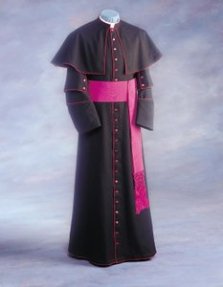
a. Simar            
 Image

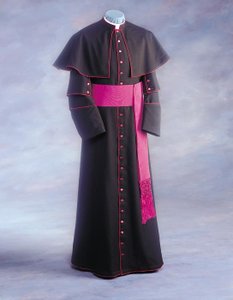
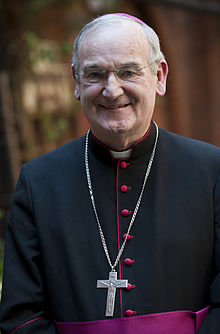
A simar is a special type of cassock worn by the bishops, cardinals, and popes, that is a cassock with a shoulder cape, and a sash (around the waist), which is violet for bishops, scarlet for cardinals, and white for popes. As is well known, the Pope’s simar is white in colour, while bishop’s and cardinal’s simar is black, and with violet lining for bishops, and scarlet lining for cardinals.


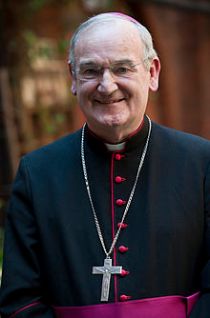
b. Pectoral cross (also part of the pontificalia and the choir dress)
Image


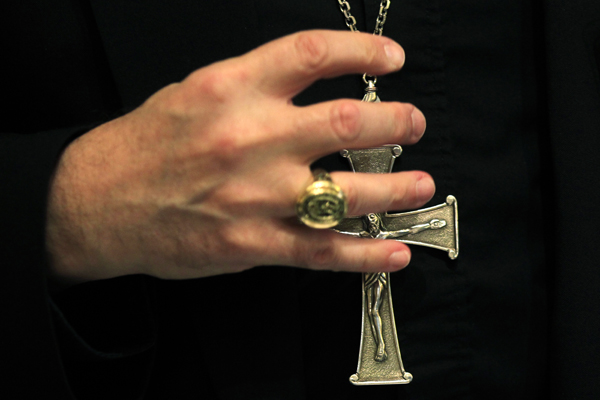
The pectoral cross is worn as its name suggests, on the breast, to represent Christ who protects us from harm, as noted in the prayer of the bishop when he wear the pectoral cross before the Mass, called Munire me dignerisMunire digneris me, Domine Jesu Christe, ab omnibus insidiis inimicorum omnium, signo sanctissimae Crucis tuae: ac concedere digneris mihi indigno servo tuo, ut sicut hanc Crucem, Sanctorum tuorum reliquiis refertam, ante pectus meum teneo, sic semper mente retineam at memoriam passionis, et sanctorum victorias Martyrum. (May You graciously protect me, o Lord Jesus Christ, from all the snares of all my enemies, the sign of the Your most holy Cross: that You would vouch and grant to me and all unworthy of being Your servant, that I may receive the Cross, filled with the remains of Your Saints, in front of my breast, I hold, then it always in mind, but retain the memory of the passion, martyrs and saints victories.). 

This is because pectoral crosses are usually precious and contain the relics of the saints, which therefore be further a reminder that the bishop carries with Him at all times, Christ, and His holy Saints, and a reminder of the Cross, through which the salvation of our Lord comes to us.


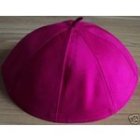
c. Zucchetto (or skullcap)
Image


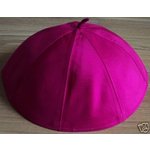
Zucchetto is from the Italian word which means small gourd, because its shape which resembles (half of) a pumpkin. This is a head covering item for the bishops, cardinals, and popes, with the similar pattern of violet for bishops, scarlet for cardinals, and white for popes. This item has a lot in common and may have originated from the Jewish prayer cap, which is somewhat different from the zucchetto in appearance. Originally zucchetto has a practical use in the past, since the clergy in that era were tonsured, that is having their head shaved at the centre, and thus, without the present day heating available, during cold times, the head of the prelate (bishops) would become cold, and the zucchetto came in handy as a covering.

Nowadays, it is a symbol of prayer, and also honor, and therefore, as a sign of humility, it is always removed at the beginning of the Preface of the Eucharistic Prayer and the head of the bishops (including cardinals and Popes) remain bare throughout the Eucharistic Prayer and the Communion.


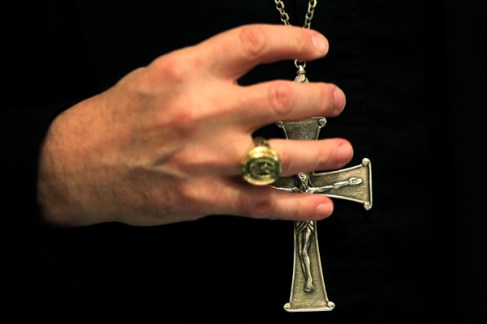
d. Episcopal ring
Image


The episcopal ring symbolises the bishop as the shepherd is married to God’s Church, in particular the diocese and the sheep, the faithful in Christ whom he is supposed to guide as the shepherd. The prayer the bishop said when wearing it reflects that this ring is also a symbol of virtue and sanctification, and blessing : Cordis et corporis mei, Domine, digitos virtute decora, et septiformis Spiritus sanctificatione circumda. (With my heart and of my body, O Lord, decorate my fingers with virtue, and sanctify me with the sevenfold blessing of the Holy Spirit around me).


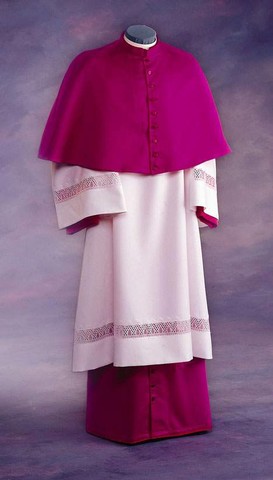
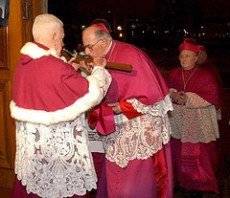
2. Choir dress (worn during the Mass if the bishop is not the celebrant or concelebrant in the Mass, and events like Vespers, and also worn outside for important events)
Image

a. Cassock with fascia/sash

This cassock with sash style is similar to the simar, but is entirely violet for bishops and scarlet for cardinals (as opposed to black with violet or scarlet lining)


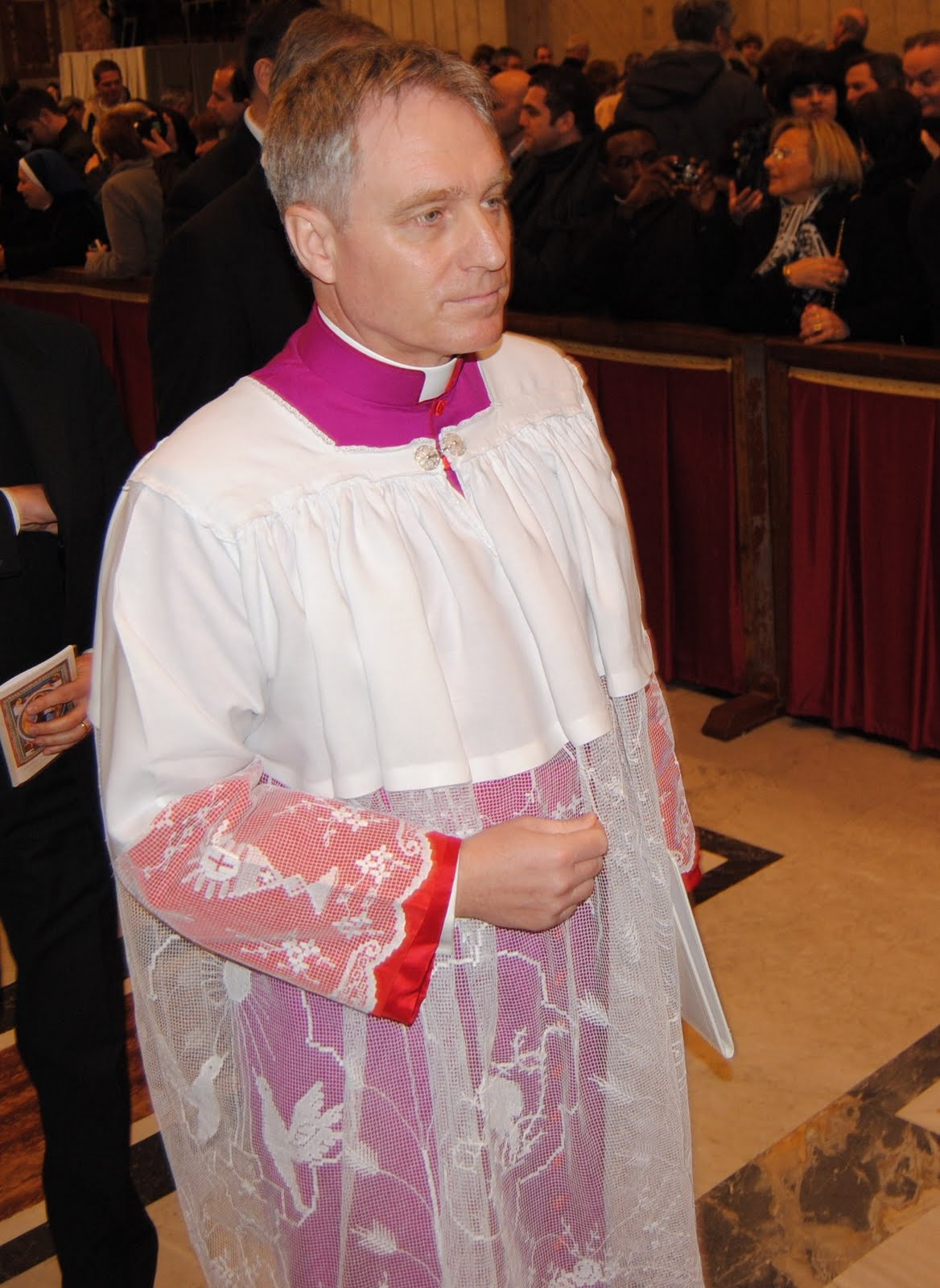
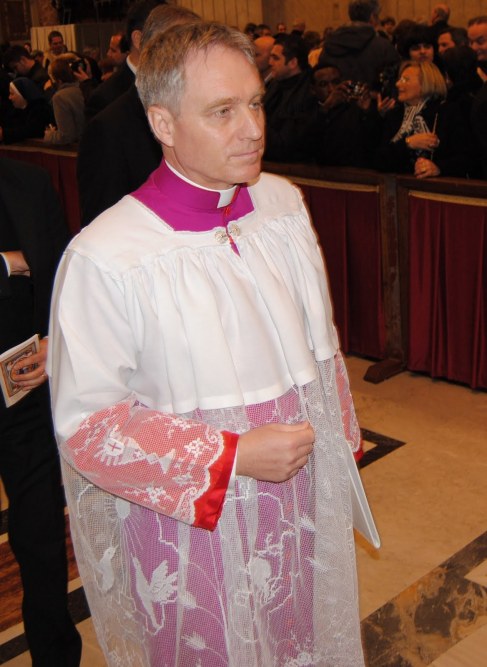
b. Rochet
Image

A beautiful, usually thin, either white or translucent, and laced piece of clothing worn over the cassock and the fascia, as seen worn above by Monsignor Georg Ganswein, now Archbishop Ganswein, Prefect of the Pontifical Household.


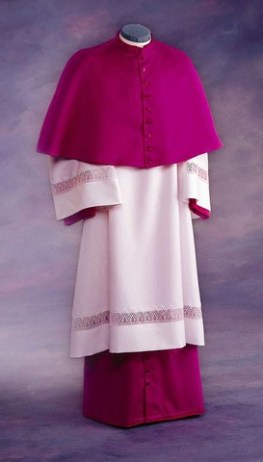
c. Mozzetta
Image


Mozzetta (violet for bishops) is a shoulder cape worn over the rochet and the cassock.


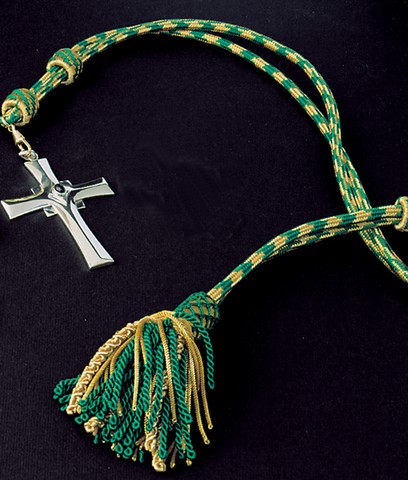
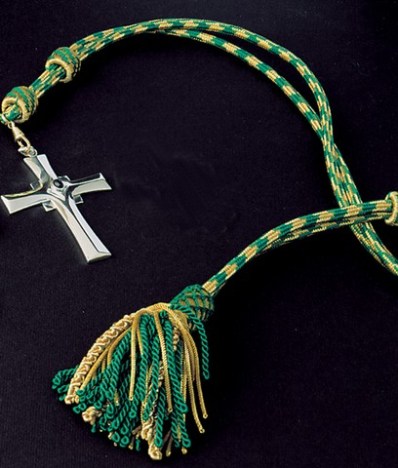
d. Pectoral cross
Image

Similar with in working dress, but more often worn with a cord rather than a chain.


e. Zucchetto

Violet for bishops. Similar as in the working dress.


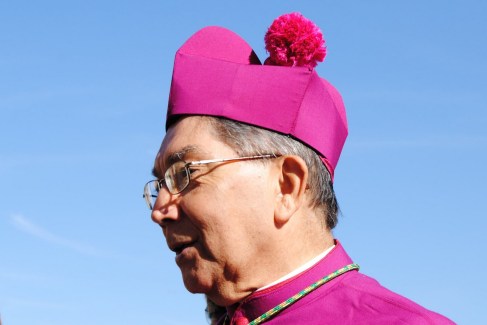
f. Biretta
Image


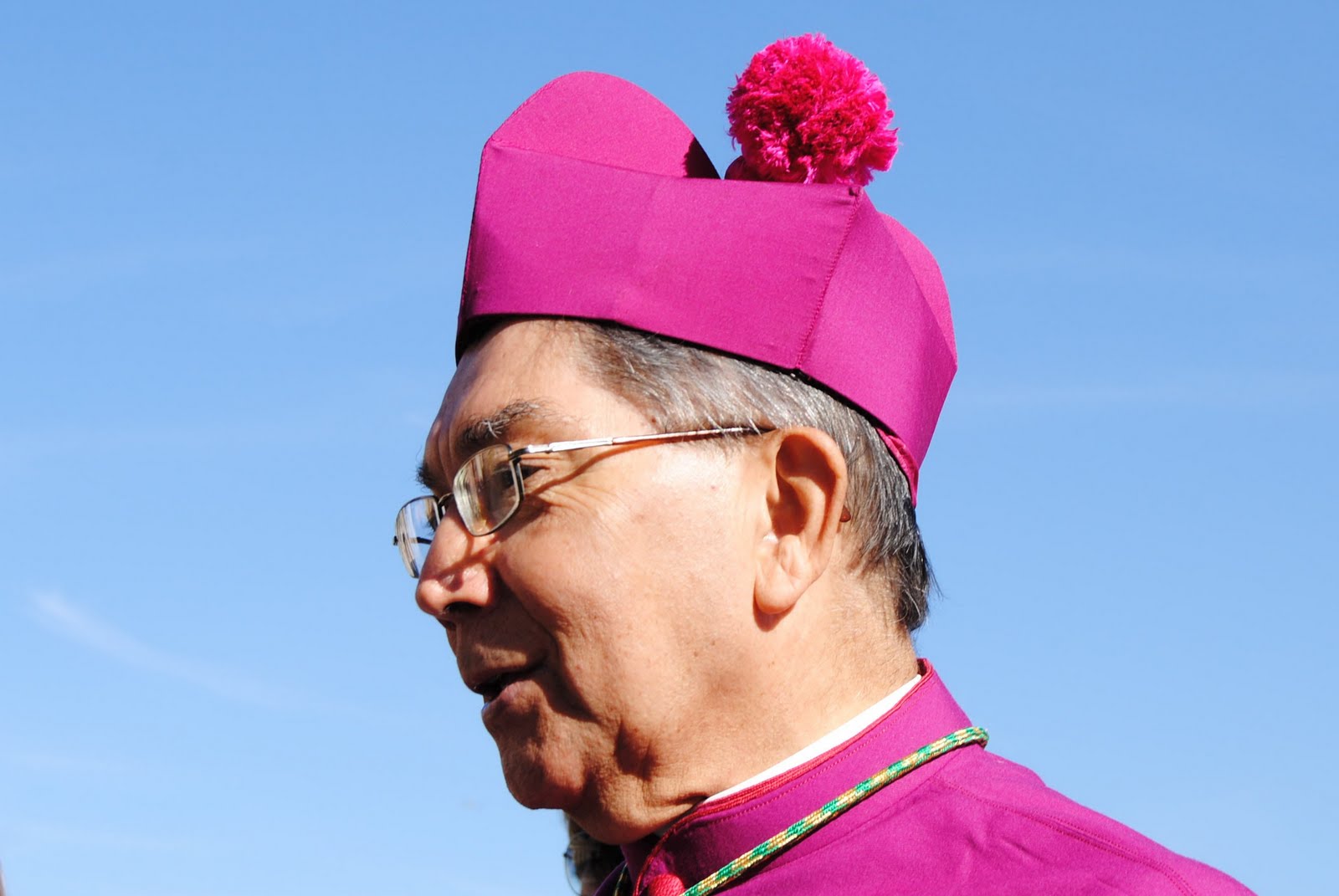
A hat-like item which has the same ancestry as our modern academic mortar board (worn on the graduations in universities), which is violet for bishops and has a pom-pom like object on the top. Only has three peaks, and the unpeaked side is always worn on the left.


3. Bishop’s Pontificalia (worn during the Mass when celebrating)

a. Dalmatic

Image


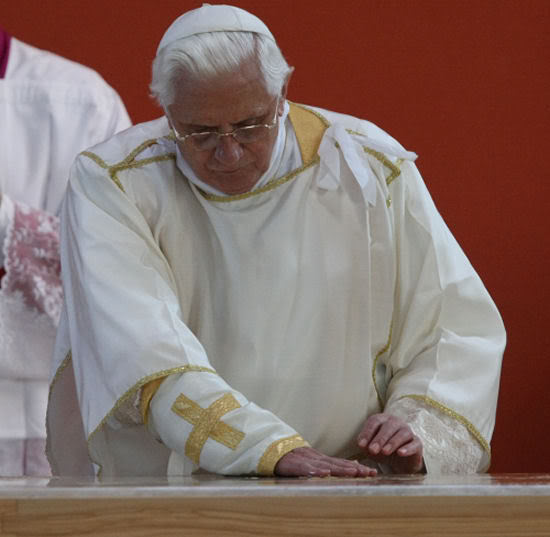
Similar as those worn by deacons, which has squarish-edges as compared to the chasuble (which has more rounded edges), worn over the alb but under the chasuble. Here is the picture of our Pope Benedict XVI wearing the dalmatic during the consecration of a new church in Rome, after he took off his chasuble for the anointing of the altar with holy oils.


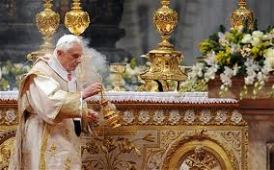
b. Chasuble
Image


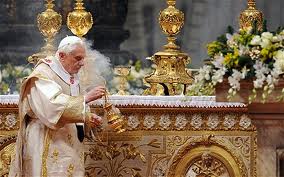
Chasuble as worn by the priests, worn over the dalmatic and the stole, and in this picture, Pope Benedict XVI wore the more traditional Roman-style chasuble, and very visibly underneath the chasuble, is the dalmatic. Only bishops can wear both the chasuble and the dalmatic.


c. Pectoral cross

Worn under the chasuble, not over the chasuble, either the normal chained or corded pectoral cross. Not correctly worn when worn above the chasuble, although many bishops seem to do this. Pope Benedict XVI himself consistently wear the pectoral cross under the chasuble since the beginning of his Pontificate.


d. Episcopal ring

Worn on the finger, which signify his marriage to God and His Church.


e. Mitre
Image


Image


Image


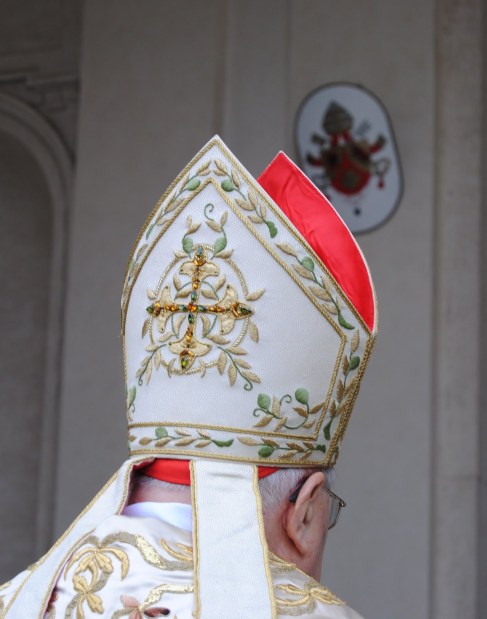
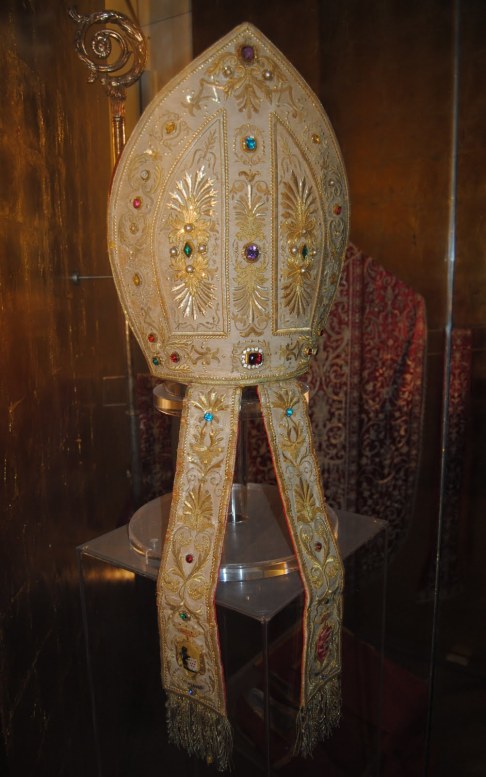
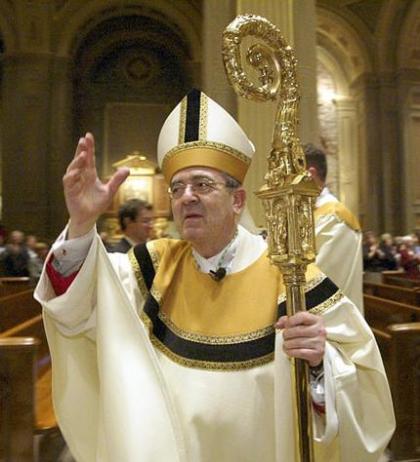
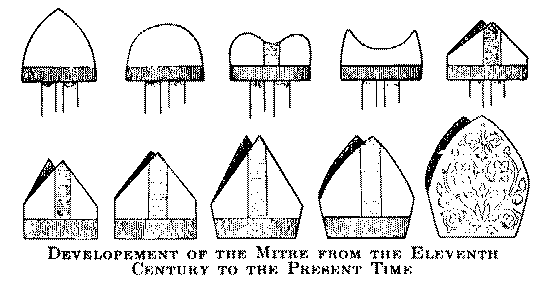
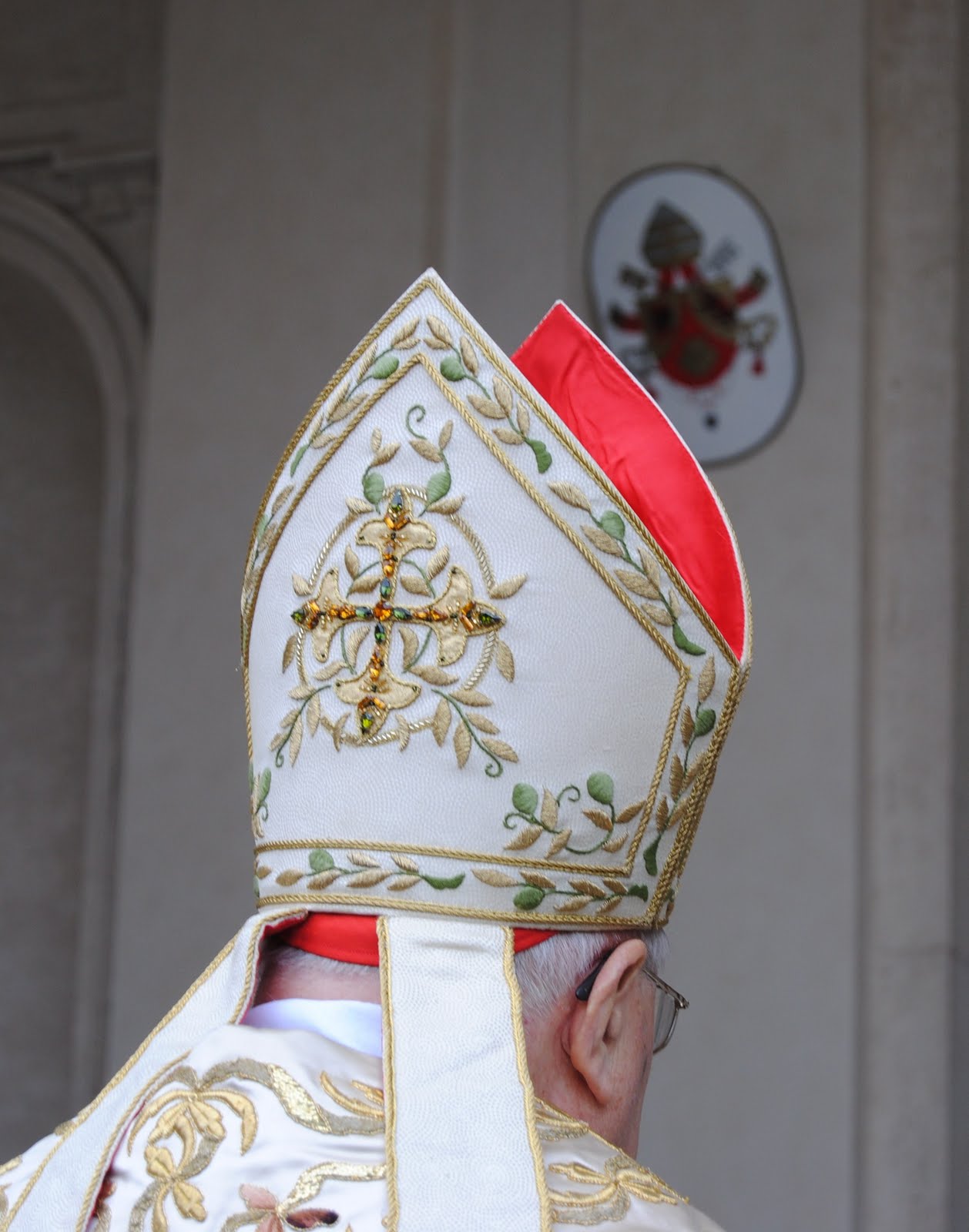
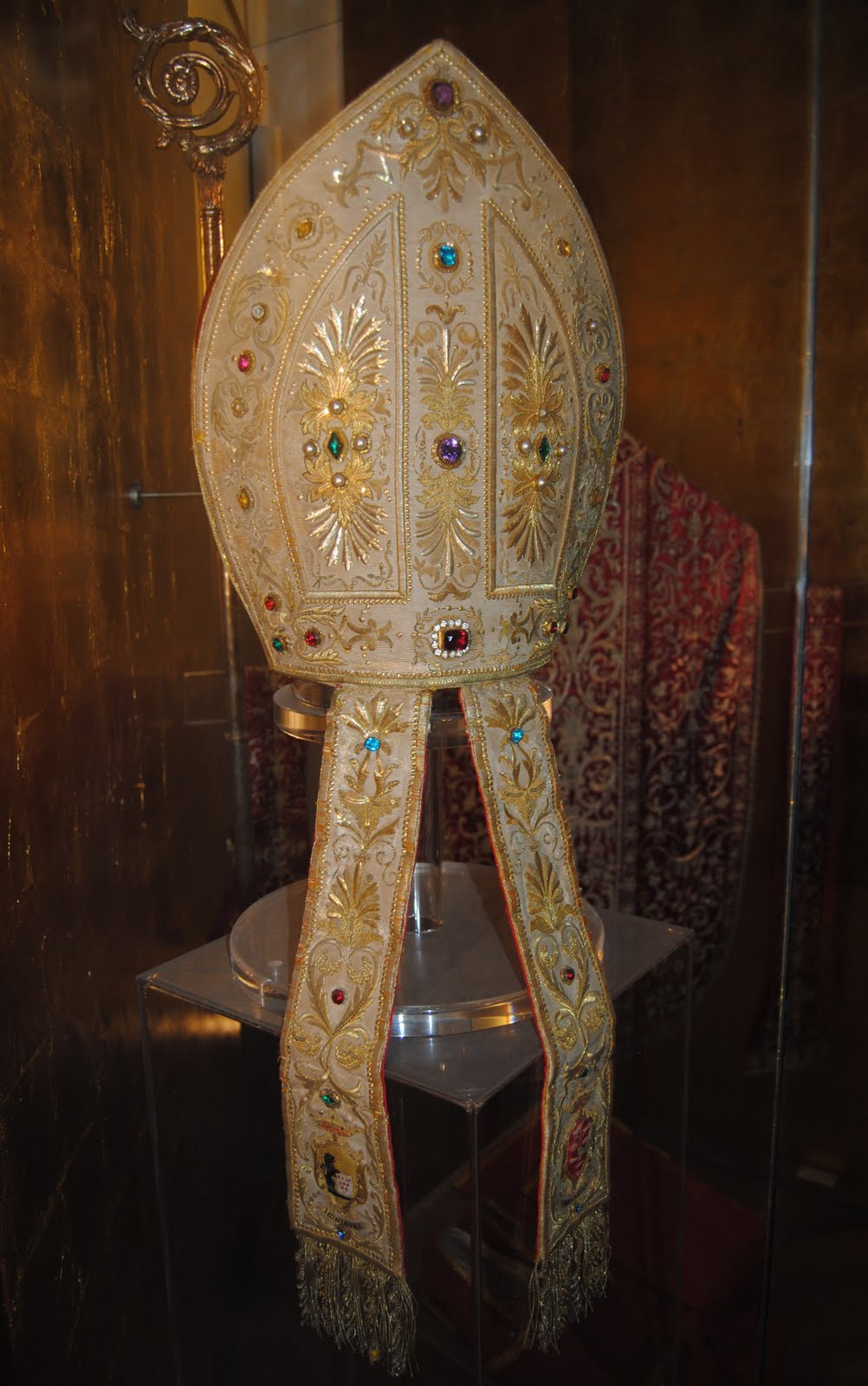
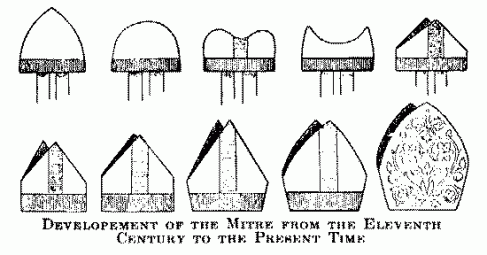
Worn over the zucchetto on the head, and was developed from the camelaucum, or the secular headdress of the late Roman Empire and early Byzantine Empire, where they are also worn by the Popes and the Roman priests, and gradually was restricted only to bishops and abbots.

The mitre symbolises the teaching authority of the bishops, which are symbolised by the two peaks of the mitre, representing the Old and the New Testament, and also recall the flames of the Holy Spirit that inflame the hearts of the Apostles to spread the Good News to all peoples. Therefore, these represents the authority of the bishop to teach the Gospel through the Holy Spirit and based on the Scripture, the Word of God, both the Old and the New Testament. The two lappets behind the mitre themselves also represent the Old and the New Testament, the two sides of the Lord’s Sacred Scripture (which shape looks just like a book marker).


f. Crosier (Pastoral staff)
Image


Image


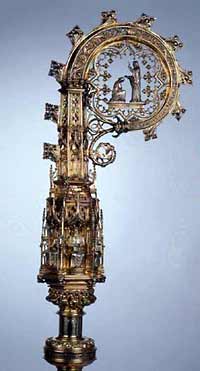
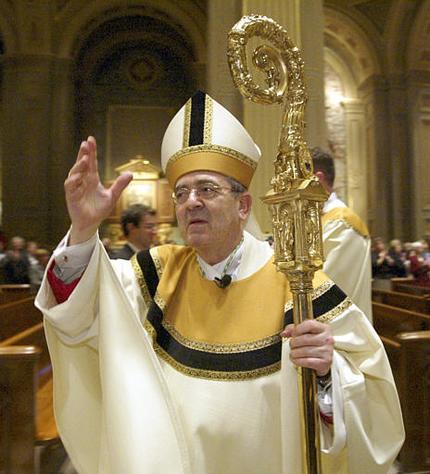
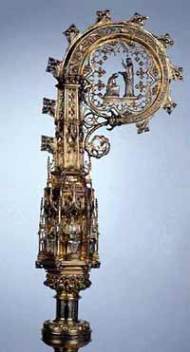
The crosier, or the pastoral staff is the crook-like staff, reminding us on the shepherd’s crook, which they use to shepherd their sheep. Thus, the crosier represents the bishops’ role as the shepherds of the people of God, and guide them in their journey towards the Lord, the Chief Shepherd, the Good Shepherd.


g. Pallium (only for Metropolitan Archbishops and the Pope)
Image

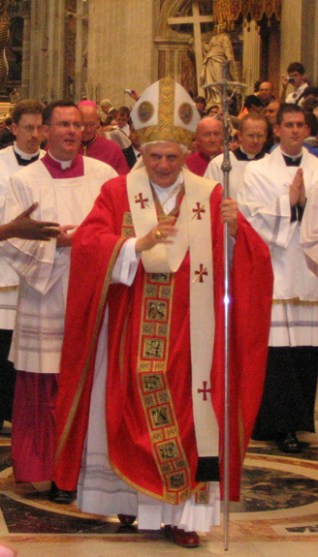
The pallium is a woolen band worn around the shoulder. This represent the metropolitan’s role as the overseer of the faithful, over the sheep of the Lord, that is the faithful people of God, just like Jesus, the Good Shepherd carrying His sheep on His shoulder. Therefore, the pallium represents both the authority of the metropolitan, and the burden presented by his ministry in the service of the Lord.

Image


Image

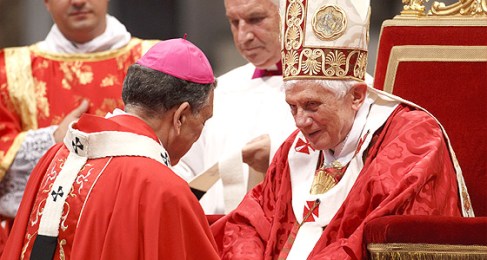
The pallium used to be much wider, as reflected in the earlier pallium that Pope Benedict XVI wore, which used the style not worn since a millenia ago, in the earlier days of the Church. Now the most common form of the pallium is a shorter and narrower woolen band worn around the shoulders, and adorned with three pins that represent the nails that pieced Christ on the cross, and these pins were placed onto the black crosses (red for Pope Benedict XVI’s new, larger pallium and the earlier, much larger pallium), which represent the wounds of Christ.


After all that, and after looking into what a bishop is, what is the nature of the ministry of the bishops, the types of bishops, what they wear and what symbolisms are there in them, let us now take a time to pray, and pray indeed for the soon-to-be ordained Coadjutor Archbishop, William Goh, of the Archdiocese of Singapore.

May God be with him all the days of his new ministry as bishop, and strengthen him at all times, that when his ministry begins this Friday, the Holy Spirit will guide him and keep him faithful to the ministry he has been chosen for, forever and ever. Amen!