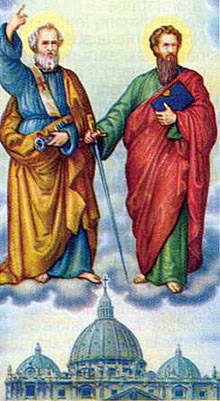
Saturday, 29 June 2013 : Solemnity of Saints Peter and Paul, Apostles, Great Feast Day of the Church of Rome (Psalm)

Psalm 33 : 2-3, 4-5, 6-7, 8-9

I will bless the Lord all my days; His praise will be ever on my lips. My soul makes its boast in the Lord; let the lowly hear and rejoice.

Oh, let us magnify the Lord, together let us glorify His Name! I sought the Lord, and He answered me; from all my fears He delivered me.

They who look to Him are radiant with joy, their faces never clouded with shame. When the poor cry out, the Lord hears and saves them from distress.

The Lord’s angel encamps and patrols to keep safe those who fear Him. Oh, see and taste the goodness of the Lord! Blessed is the one who finds shelter in Him!

Saturday, 29 June 2013 : Solemnity of Saints Peter and Paul, Apostles, Great Feast Day of the Church of Rome (Second Reading)

2 Timothy 4 : 6-8, 17-18

As for me, I am already poured out as a libation, and the moment of my departure has come. I have fought the good fight, I have finished the race, I have kept the faith. Now there is laid up for me the crown of righteousness with which the Lord, the just Judge, will reward me on that day; and not only me, but all those who have longed for His glorious coming.

But the Lord was at my side, giving me strength to proclaim the Word fully, and let all the pagans hear it. So I was rescued from the lion’s mouth. The Lord will save me from all evil, bringing me to His heavenly kingdom. Glory to Him forever and ever. Amen!

Saturday, 29 June 2013 : Solemnity of Saints Peter and Paul, Apostles, Great Feast Day of the Church of Rome (First Reading)

Acts 12 : 1-11

About that time King Herod decided to persecute some members of the Church. He had James, the brother of John, killed with the sword, and when he saw how it pleased the Jews, he proceeded to arrest Peter also.

This happened during the festival of the Unleavened Bread. Herod had him seized and thrown into prison with four squads, each of four soldiers, to guard him. He wanted to bring him to trial before the people after the Passover feast, but while Peter was kept in prison, the whole Church prayed earnestly for him.

On the very night before Herod was to bring him to trial, Peter was sleeping between two soldiers, bound by a double chain, while guards kept watch at the gate of the prison. Suddenly an angel of the Lord stood there and a light shone in the prison cell. The angel tapped Peter on the side and woke him saying, “Get up quickly!” At once the chains fell from Peter’s wrists.

The angel said, “Put on your belt and your sandals.” Peter did so, and the angel added, “Now, put on your cloak and follow me.” Peter followed him out; yet he did not realise that what was happening with the angel was real; he thought he was seeing a vision. They passed the first guard and then the second and they came to the iron door leading out to the city, which opened of itself for them. They went out and made their way down a narrow alley, when suddenly the angel left him.

Then Peter recovered his senses and said, “Now I know that the Lord has sent His angel and has rescued me from Herod’s clutches and from all that the Jews had in store for me.”

Friday, 28 June 2013 : Vigil Mass of the Solemnity of Saints Peter and Paul, Apostles, Great Feast Day of the Church of Rome (Scripture Reflection)

Dear brothers and sisters in Christ, today we celebrate one of the greatest feast days in our Church, that is the feast day of the two great Apostles, Saints Peter and Paul, the pillars of the Church. This is because both of them went to Rome and were martyred there in the defence of their faith. They were martyred in Rome and therefore, cemented the position of Rome as the centre of all Christendom, with Peter as the very first Bishop of Rome, and therefore the first Pope, the first leader of the Church, Vicar of Christ on earth.

Despite the greatness of Peter, the chief of the Apostles, and Paul, the Apostle to the Gentiles, the great apostle through his four missionary journeys across the eastern Mediterranean region, both of them had humble and unworthy origins, and each, as we all should know had their weaknesses in the very beginning, and along their own journeys of the faith.

St. Peter was once a poor fisherman plying his trade in fishing at the Lake of Galilee, leading a simple fisherman’s life, until He was called by the Lord, through His brother, Andrew. He was Simon, son of Jonah, until Christ gave him a new name, that is Cephas, or ‘rock’, which in Greek, ‘Petros’ and in Latin, ‘Petrus’, which eventually give raise to the name Peter, the name of the chief of the apostles that we knew of.

St. Peter did not lead a very faithful life at first, although his faith in the Lord is indeed at the same time firm and solid. We surely remember that he was the one who declared that the Lord Jesus is the Messiah and Lord, when He asked His disciples about His true identity. Only a steadfast and strong faith may recognise such nature in Jesus, that others failed to do.

St. Peter did deny the Lord, by denying Him three times, out of fear of the Jewish authorities, because He did not want to be exposed as a disciple of Jesus, at the time when the Lord was under incarceration by the chief priests. He did it out of fear, not out of any true desire to betray the Lord, and Peter is still indeed faithful to the Lord. He recognised the faults that he had done, and he repented in great sorrow. The Lord knew this and forgave Peter.

That was why, even though Peter had denied the Lord three times, He forgave him three times as well, by asking Peter to profess his love for Him. The true nature of Peter came out in the Gospel reading today, that despite his frailty and fear, he truly loved the Lord, and the Lord knew that, even without asking. He rewarded him for his steadfast faith, like a ‘rock’, by establishing His very Church on the faith of Peter, on the solid ‘rock’ of faith, that no powers of evil and hell can overcome.

St. Paul, the other great apostle, did much for the Lord, by evangelising to the four corners of the world at the time, spreading the words of the Gospel like no other Apostle has done. But he too had his humble and sinful origins, as we all knew that St. Paul was once Saul, the great persecutor of the Church of Christ.

Saul did great sins once and killed many people who believed in God. He would definitely had been condemned into hell and eternal damnation, had the Lord had not actually chosen him to be His tool for bringing the faith into many who still lived in darkness. The Lord appeared to him on the way to Damascus, and transformed him from the great monster that persecuted Christians, into the greatest champion of the faith.

Saul then was transformed into Paul, the great apostle. He did not have an easy life and an easy work. Instead, he faced many persecutions and sufferings, from beatings, lashes, prison, and even many near-death experiences. He was accepted in many places, but there were equally many if not more places that rejected him and his teachings on the Lord. Even within the Christian community, he faced many problems, as they were not of the same mind, and having disparage ideas on the faith and how to believe in the Lord.

St. Paul did not fear death, and faced it openly, believing that the Lord is always with him. He embraced death, and went to Rome, to be judged by the Emperor, Nero at that time. When the Emperor caused fire to certain buildings in Rome in order to secure a place to build his palace, and caused the Great Fire of Rome, he blamed the Christians for the fire, and St. Paul faced his martyrdom there, in the defence of his faith.

The Lord our God called the two apostles from their different origins, living in a world of sin and darkness, and transformed them into the tools for the divine good works. Their story is an inspiration for all of us, to be more like them, to be faithful as they are for Christ, and to be loving for our fellow brethren as they had given their love for the fellow Christians of their time.

May God strengthen our faith, that our faith will be as strong as Peter’s, that is like a rock, and that we will not face any fear, and remain steadfast, just as Paul had done. God bless us all. Amen.

Friday, 28 June 2013 : Vigil Mass of the Solemnity of Saints Peter and Paul, Apostles, Great Feast Day of the Church of Rome (Gospel Reading)

John 21 : 15-19

After they had finished breakfast, Jesus said to Simon Peter, “Simon, son of John, do you love Me more than these?” He answered, “Yes, Lord, You know that I love You.” And Jesus said, “Feed My lambs.”

A second time Jesus said to him, “Simon, son of John, do you love Me?” And Peter answered, “Yes, Lord, You know that I love You.” Jesus said to him, “Look after My sheep.” And a third time He said to him, “Simon, son of John, do you love Me?”

Peter was saddened because Jesus asked him a third time, “Do you love Me?” and he said, “Lord, You know everything; You know that I love You.” Jesus then said, “Feed My sheep! Truly, I say to you, when you were young, you put on your belt and walked where you liked. But when you grow old, you will stretch out your hands, and another will put a belt around you, and lead you where you do not wish to go.”

Jesus said this to make known the kind of death by which Peter was to glorify God. And He added, “Follow Me.”

Friday, 28 June 2013 : Vigil Mass of the Solemnity of Saints Peter and Paul, Apostles, Great Feast Day of the Church of Rome (Second Reading)

Galatians 1 : 11-20

Let me remind you, brothers and sisters, that the Gospel we preached to you is not a human message, nor did I receive it from anyone, I was not taught of it but it came to me as a revelation from Christ Jesus. You have heard of my previous activity in the Jewish community; I furiously persecuted the Church of God and tried to destroy it.

For I was more devoted to the Jewish religion than many fellow Jews of my age, and I defended the traditions of my ancestors more fanatically. But one day God called me out of His great love, He who had chosen me from my mother’s womb; and He was pleased to reveal in me His Son, that I might make Him known among the pagan nations.

Then I did not seek human advice nor did I go up to Jerusalem to those who were apostles before me. I immediately went to Arabia, and from there I returned again to Damascus. Later, after three years, I went up to Jerusalem to meet Cephas, and I stayed with him for fifteen days. But I did not see any other apostle except James, the Lord’s brother.

On writing this to you, I affirm before God that I am not lying.

Friday, 28 June 2013 : Vigil Mass of the Solemnity of Saints Peter and Paul, Apostles, Great Feast Day of the Church of Rome (Psalm)

Psalm 18 : 2-3, 4-5

The heavens declare the glory of God; the firmament proclaims the work of His hands. Day talks it over with day; night hands on the knowledge to night.

No speech, no words, no voice is heard – but the call goes on throughout the universe, the message is felt to the ends of the earth.

Friday, 28 June 2013 : Vigil Mass of the Solemnity of Saints Peter and Paul, Apostles, Great Feast Day of the Church of Rome (First Reading)

Acts 3 : 1-10

Once when Peter and John were going up to the Temple at three in the afternoon, the hour for prayer, a man crippled from birth was being carried in. Every day they would bring him and put him at the temple gate called “Beautiful”; there he begged from those who entered the Temple.

When he saw Peter and John on their way into the Temple, he asked for alms. Then Peter with John at his side looked straight at him and said, “Look at us.” So he looked at them, expecting to receive something from them. But Peter said, “I have neither silver nor gold, but what I have I give you : In the Name of Jesus of Nazareth, the Messiah, walk!”

Then he took the beggar by his right hand and helped him up. At once his feet and ankles became firm, and jumping up he stood on his feet and began to walk. And he went with them into the Temple walking and leaping and praising God.

All the people saw him walking and praising God; they recognised him as the one who used to sit begging at the Beautiful Gate of the Temple, and they were all astonished and amazed at what had happened to him.

Peter’s Pence Collection, Solemnity of Saints Peter and Paul, Apostles

Peters Pence

In case any of you are wondering what is Peter’s Pence, which is collected every Sunday nearest to the Solemnity of Saints Peter and Paul, Apostles, which falls on 29 June every year (Therefore this year Peter’s Pence is collected on Sunday, 30 June 2013, 13th Sunday of Ordinary Time), Peter’s Pence is a special collection in which the collection will not go into the local church or parish fund, but gathered from all over the world and sent to Rome, to the Holy See. Thus, the collection made during the offertory this Sunday will go directly to Rome.

What is the purpose of the Peter’s Pence collection? Exactly to support the numerous charitable activities and organisations managed by the Holy See, by our Church, all over the world. There are thousands, tens of thousands of charity under the supervision of the Church, and to be able to continue with the action, funds are definitely necessary to provide a solid backing. That is why, Peter’s Pence is done once every year, on the Sunday nearest to the Solemnity of Saints Peter and Paul.

1045213_354782624625355_1349576998_n

Why Solemnity of Saints Peter and Paul? That is because on that day lie the great celebration of the two great saints and apostles that defined our Church, because they met their martyrdom in Rome. St. Peter, the Prince and leader of all the Apostles, whom the Pope is the successor of today, met his martyrdom in what is now Vatican City, through crucifixion, and St. Paul, the Apostle to the Gentiles, and author of the Epistles in the New Testament, met his martyrdom in Rome, through beheading.

Peter’s Pence itself had its origins in the late dark ages and early medieval period, particularly from England, where it got the name Peter’s ‘Pence’. Pence is the unit of money still in use until today in the United Kingdom and the related monetary units. ‘Peter’ simply point to the fact that the collection or ‘pence’ is intended to be sent to Rome, to the Pope, in order to support various Church activities.

Imposition of the pallium on the new Metropolitan Archbishops by Pope Francis

On the great Feast day and Solemnity of Saints Peter and Paul, Apostles, the feast day of the Church of Rome, on Saturday, 29 June 2013, 34 new Metropolitan Archbishops will receive the pallium, the symbol of their metropolitan office from Pope Francis, in a Mass at St. Peter’s Basilica.
Pallium (Pallium)
1_0_674753 (Papal Pallium)
Pallium is a woolen band, worn around the shoulders, as a symbol of office, representation of the Good Shepherd, with Jesus carrying the lamb on His shoulder, which is reminiscent of the authority entrusted upon the Metropolitan Archbishops over their flocks. Pallium therefore is a symbol of authority. It is about three fingers wide, and has six black crosses, out of which three are pierced with a golden pin, representing the wounds of Christ pierced by the holy nails on the cross.
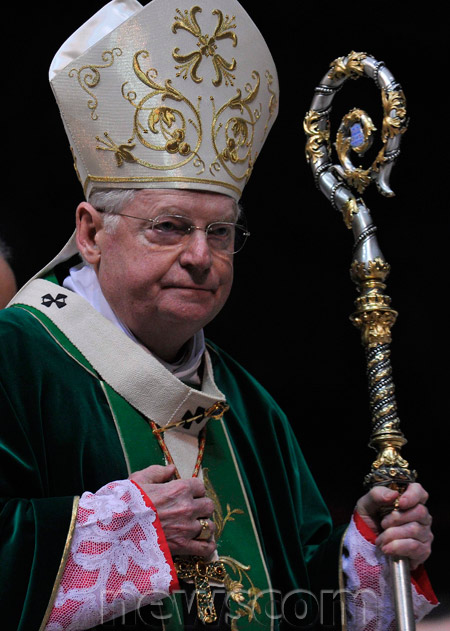
angelo-scola
(Above : image of Cardinal Angelo Scola, wearing the pallium, as the Metropolitan Archbishop of Milan, who received the pallium personally from Pope Benedict XVI in 2011)
Papal pallium from 2005 is different, in order to distinguish the nature of the Papal office, as the Pope is not just any bishop or Metropolitan Archbishop, but is Metropolitan over the entire world, the entire Church, as the Vicar of Christ.
Pope-Benedict-XVI
(Above : Pope Benedict XVI with the Papal pallium in 2012)

The list of the new Metropolitan Archbishops who will receive the pallium below.

1. Patriarch Manuel Jose Macario do Nascimento Clemente, Patriarch of Lisbon (Portugal)
2. Archbishop Dieudonne Nzapalainga, C.S.Sp., Metropolitan Archbishop of Bangui (Central African Republic)
3. Archbishop Carlo Roberto Maria Redaelli, Metropolitan Archbishop of Gorizia (Italy)
4. Archbishop Claudio Dalla Zuanna, S.C.I., Metropolitan Archbishop of Beira (Mozambique)
5. Archbishop Prakash Mallavarapu, Metropolitan Archbishop of Visakhapatnam (India)
6. Archbishop Antonio Carlos Altieri, S.D.B., Metropolitan Archbishop of Passo Fundo (Brazil)
7. Archbishop Marek Jedraszewski, Metropolitan Archbishop of Lodz (Poland)
8. Archbishop Philip Tartaglia, Metropolitan Archbishop of Glasgow (Great Britain)
9. Archbishop Salvatore Joseph Cordileone, Metropolitan Archbishop of San Francisco (USA)
10. Archbishop Rolando Joven Tria Tirona, O.C.D., Metropolitan Archbishop of Caceres (Philippines)
11. Archbishop Rogelio Cabrera Lopez, Metropolitan Archbishop of Monterrey (Mexico)
12. Archbishop Joseph William Tobin, C.Ss.R., Metropolitan Archbishop of Indianapolis (USA)
13. Archbishop Carlos Maria Franzini, Metropolitan Archbishop of Mendoza (Argentina)
14. Archbishop Lorenzo Ghizzoni, Metropolitan Archbishop of Ravenna-Cervia (Italy)
15. Archbishop George Antonysamy, Metropolitan Archbishop of Madras and Mylapore (India)
16. Archbishop Anil Joseph Thomas Couto, Metropolitan Archbishop of Delhi (India)
17. Archbishop John Wong Soo Kau, Metropolitan Archbishop of Kota Kinabalu (Malaysia)
18. Archbishop Murray Chatlain, Metropolitan Archbishop of Keewatin-Le Pas (Canada)
19. Archbishop Sérgio Eduardo Castriani, C.S.Sp., Metropolitan Archbishop of Manaus (Brazil)
20. Archbishop Peter Loy Chong, Metropolitan Archbishop of Suva, (Fiji)
21. Archbishop Alfonso Cortes Contreras, Metropolitan Archbishop of Leon (Mexico)
22. Archbishop Alexander King Sample, Metropolitan Archbishop of Portland in Oregon (USA)
23. Archbishop Joseph Effiong Ekuwem, Metropolitan Archbishop of Calabar (Nigeria)
24. Archbishop Jesus Juarez Parraga, S.D.B., Metropolitan Archbishop of Sucre (Bolivia)
25. Archbishop Fabio Martinez Castilla, Metropolitan Archbishop of Tuxtla Gutierrez (Mexico)
26. Archbishop Ramon Alfredo Dus, Metropolitan Archbishop of Resistencia (Argentina)
27. Archbishop Mario Aurelio Poli, Metropolitan Archbishop of Buenos Aires (Argentina)
28. Archbishop Gintaras Linas Grusas, Metropolitan Archbishop of Vilnius (Lithuania)
29. Archbishop Michael Owen Jackels, Metropolitan Archbishop of Dubuque (USA)
30. Archbishop Duro Hranic, Metropolitan Archbishop of Dakovo-Osijek (Croatia)
31. Archbishop Moacir Silva, Metropolitan Archbishop of Ribeirao Preto (Brazil)
32. Archbishop Jozef Piotr Kupny, Metropolitan Archbishop of Wroclaw (Poland)
33. Archbishop Sergio Alfredo Gualberti Calandrina, Metropolitan Archbishop of Santa Cruz de la Sierra (Bolivia)
34. Archbishop Giuseppe Petrocchi, Metropolitan Archbishop of L’Aquila (Italy)
In addition, the Metropolitan Archbishop of Hue, Archbishop Francois Xavier Le Van Hong, will not receive the pallium directly from the Pope in Rome, but in his home diocese of Hue, through the papal representative. Therefore, in addition to the 34 Metropolitan Archbishops mentioned above, 35 Metropolitan Archbishops will receive the pallium in this year.
35. Archbishop Francois Xavier Le Van Hong, Metropolitan Archbishop of Hue (Vietnam)

Metropolitan Archbishop differs from normal Archbishops in that, they have jurisdiction over other dioceses that are placed under their supervision, in a group called Ecclesiastical Province of the Church. Archbishops of Archdioceses without Metropolitan character has no jurisdiction over any dioceses under them, and they are usually directly subject to the Holy See.