Saturday, 18 November 2017 : 32nd Week of Ordinary Time, Memorial of the Dedication of the Papal Basilica of St. Peter and Papal Basilica of St. Paul-Outside-the-Walls (Psalm)

Liturgical Colour : Green or White (Dedication of a Basilica)

Psalm 104 : 2-3, 36-37, 42-43

Sing to YHVH, sing His praise, proclaim all His wondrous deeds. Glory in His holy Name; let those who seek YHVH rejoice.

Then He smote all the firstborn, the first fruits of their manhood. He led Israel out of the alien land, laden with silver and gold, and none were left behind.

For He remembered His promise to Abraham, His servant. So He led forth His people with joy, His chosen ones with singing.

Alternative reading (Mass for Dedication of the Basilicas of St. Peter and St. Paul)

Psalm 97 : 1, 2-3ab, 3cd-4, 5-6

Sing to YHVH a new song, for He has done wonders; His right hand, His holy arm, has won victory for Him.

YHVH has shown His salvation, revealing His justice to the nations. He has not forgotten His love, nor His faithfulness to Israel.

The farthest ends of the earth all have seen God’s saving power. All you, lands, make a joyful noise to YHVH, break into song and sing praise.

With melody of the lyre and with music of the harp. With trumpet blast and sound of the horn, rejoice before the King, YHVH!

Saturday, 18 November 2017 : 32nd Week of Ordinary Time, Memorial of the Dedication of the Papal Basilica of St. Peter and Papal Basilica of St. Paul-Outside-the-Walls (First Reading)

Liturgical Colour : Green or White (Dedication of a Basilica)

Wisdom 18 : 14-16 and Wisdom 19 : 6-9

While all was in quiet silence and the night was in the middle of its course, Your Almighty Word leapt down from the royal throne – a stern Warrior to a doomed world. Carrying Your fearful command like a sharpened sword and stretching from heaven to earth, He filled the universe with death.

All creation in its different forms was fashioned anew at Your command, in order to protect Your people. The cloud covered the camp with its shadow, dry land emerged where water had been. A safe passage was opened through the Red Sea, the tempestuous flood became a green plain where the whole nation of those protected by Your hand passed across, witnessing Your astounding deeds.

They were like horses led to pasture, or like frolicking lambs, praising You, their Lord, Who had delivered them.

Alternative reading (Mass for Dedication of the Basilicas of St. Peter and St. Paul)

Acts 28 : 11-16, 30-31

After three months, we boarded a ship that had spent the winter at the island. It belonged to an Alexandrian company, and carried the figurehead of Castor and Pollux as insignia. We sailed for Syracuse, staying there for three days; and, after circling the coast, we arrived at Rhegium.

On the following day, a south wind began to blow, and, at the end of two days, we arrived at Puteoli, where we found some of our brothers, who invited us to stay with them for a week. And that was how we came to Rome. There, the brothers and sisters had been informed of our arrival, and came out to meet us as far as the Appian Forum and the Three Taverns.

When Paul saw them, he gave thanks to God and took courage. Upon our arrival in Rome, the captain turned the prisoners over to the military governor, but permitted Paul to lodge in a private house, with the soldier who guarded him.

Paul stayed for two whole years, in a house he, himself, rented, where he received, without any hindrance, all those who came to see him. He proclaimed the kingdom of God, and taught the truth about Jesus Christ, the Lord, quite openly and without any hindrance.

Thursday, 9 November 2017 : Feast of the Dedication of the Lateran Basilica (Homily and Scripture Reflections)

Liturgical Colour : White

Dear brothers and sisters in Christ, on this day we celebrate with the whole Universal Church the feast of the Dedication and Consecration of the most important church in all of Christendom, and it is indeed fitting to say that this church is the heart of the entire Christian world. Why is that so? That is because on this day, about seventeen centuries ago, the great Basilica of St. John Lateran was dedicated to our Lord Jesus Christ, the Saviour of the World, as well as to St. John the Baptist and St. John the Evangelist.

This Basilica, and not the Papal Basilica of St. Peter in Vatican, is the place where the Pope, as the Bishop of Rome and the Leader of the Universal Church, has his Cathedra, or the seat of the Bishop. And where the Cathedra is, therefore lies the Cathedral. And indeed, the Papal Basilica of St. John Lateran is the Cathedral of the Pope and the Diocese of Rome, and as such, just as the Cathedrals throughout the world are the mother churches of their own respective dioceses and archdioceses, this particular Cathedral is the Mother Church of the entire world.

Thus, on the feast day of this illustrious church, known in full as the Archbasilica of the Most Holy Saviour and Saints John the Baptist and John the Evangelist at the Lateran, we rejoice together with the entire Universal Church as one united Church, for the grace of God which He had poured down onto the Church for all these years. The Cathedra of Rome in the Archbasilica of St. John Lateran is the seat of the Pope’s authority, which he inherited through unbroken series of succession right from St. Peter the Apostle, the first Pope and Bishop of Rome.

And as we all know, the Lord Jesus Himself established His Church in this world and entrusted it to St. Peter the Apostle, as the leader of all the Apostles and as the Vicar entrusted by God to be His chief representative on earth, and therefore, this edifice which was established seventeen centuries ago is a representation of the foundation of the entire Church in this world, which God first established on the faith of St. Peter, the Rock of the Church.

But today’s celebration is much more than just a happy celebration of the dedication and consecration of this great Archbasilica, as the Scripture passages today pointed out the true meaning of God’s churches and the houses in which He dwell in this world. The churches of God are not just the physical buildings, the beautiful chapels, or churches, or grand Basilicas or Cathedrals of the dioceses. These are indeed part of the Church, as the Houses of God, where God Himself dwells in each of them, in the Eucharist, in the Tabernacle.

For we all believe that the Lord Himself is truly present in our churches, housed in the Tabernacle, where the bread consecrated by the priests, whose authority eventually came from Christ through St. Peter and the Apostles, had become the Most Precious Body and the Real Presence of our Lord. As such, God Himself dwells in the churches, as the new Temples of God, no longer just like the Temple of Jerusalem of old.

In the past, the Lord dwelled in Jerusalem, in the Temple that king Solomon built for Him, which was destroyed by the Babylonians and then rebuilt after many years, as the Temple which existed at the time of Jesus. He was in the Holy of Holies, the innermost sanctum of the Temple in Jerusalem. Yet, what we have today is far greater than that, for God Himself has come upon us in Jesus Christ, His Son, revealing Himself to the whole world, to all those who believe in Him and accept Him as Lord and Saviour.

And we believe this because, the Lord Himself is fully present in our churches and places of sacred worship, be it from the grandest and largest churches, Basilicas and Cathedrals, to the smallest, least and simplest of chapels which have been dedicated for the purpose of sacred worship. The dedication of a church signify the official marking and recognition given to the edifice and place, that it is now worthy of the Sacrifice of the Holy Mass, and dedicated to either Our Lord Himself, or to His mother Mary, or to one or more of His many saints.

For on the altar of the church, the same sacrifice which Our Lord Jesus Christ lovingly offered for the sake of our redemption is enacted, not a recollection, nor it is a repeat, and neither a mere remembrance or memory, but instead the one and very same actual Sacrifice which occurred two millennia ago at Calvary, when Our Lord willingly accept death on the cross, condemned as a criminal, so that through that death, He might redeem many, those who believed and accepted Him, from their sins.

And in that Sacrifice, God Himself has given His own Most Precious Body and Blood, which through the priestly authority given to our priests today, have transformed the mere bread and wine into the very Real Presence of Our God. Thus that is why we consecrate and dedicate the churches to the Lord, for these must be truly holy places, of special sanctity in order for they to be worthy of being the place where God Himself dwells, His Real Presence in the new Temples, our churches.

And today, as we rejoice together remembering the day when the greatest of these physical Temples, the churches, that is the Archbasilica of St. John Lateran, is dedicated to God, all of us should also use this time to reflect on two very important matters that all of us will need to pay close attention to. First of all, it is regarding how we ought to behave and participate in the churches, and secondly, with regards to our alternative first reading today from the Epistle of St. Paul to the Corinthians, for all of us baptised Christians that we are all the Temples of God as well.

Thus, first of all, let us all reflect on how we have behaved thus far in the church during the Holy Mass, during Adoration and Benediction sessions, and during any other liturgical functions, or even during any other times when we are just present in the church for prayers or silent contemplation. How many of us chatted unnecessarily during the Holy Mass, or during times when we ought to be silent, or to be participated during singing of hymns and prayers?

How many of us are distracting ourselves with the use of mobile phones, apps and all the other things that we should not be doing in the Mass? Yet, even though we know that God is truly present in the Eucharist, and stored in the Tabernacle that He is still always present even after the Mass and throughout the day, we did all sorts of things that we should not have done in the presence of God, in His House. And that is how we relate to what we have just heard in our Gospel passage today.

Jesus cast out the merchants and money changers from the Temple of God in Jerusalem, chasing them all out with a whip, turning over their tables and scattering off all their coins and transactions, cattle and animals they were selling for the sacrifices at the Temple. Why did Jesus do that? That is because, He was rightful to be very angry at what those merchants and money changers had done, and to a certain extent, the priests of the Temple as well.

Those people were cheating the people from their money, by charging them extra expensive for the services and for the purchase of animal sacrifices and other things, gaining profits in the process. And the priests and the Temple allowed such heinous acts to continue in the hallowed House of God. No wonder Jesus was angry at them all, having made the House of God, His Father, to be a den of robbers and wicked men, committing sins right before God’s presence.

In the same manner therefore, when we are in the presence of God in the church, from the grandest Basilicas and Cathedrals to the smallest and simplest of chapels, do we truly realise that He is there, and because He is truly present in all of those places, then we ought to keep the place holy through genuine reverence and prayerful silence? Sadly, there are many Christians who did not do this, and it scandalises our faith because there are many who had said that they do not believe in God, because they themselves witnessed that Christians had not done what they should.

Imagine, brothers and sisters in Christ, how are we to persuade others to believe in the Real Presence in the Eucharist, if they see many of us disrespecting the Lord in the Eucharist, either by receiving Him unworthily, or without due respect, or receiving Him half-heartedly as if we are no different from queueing to get our fast food meal from the many fast food chains out there. Is this how we should behave? If we do not do what we must, then not only that we have neglected our responsibilities, but we may have also turned many others from God’s salvation as well.

And secondly, and more importantly, what I want each and every one of us to realise and internalise is the fact that, each and every one of us who have validly received the Sacrament of Baptism and Initiation, have been made God’s Temple, as the Lord Himself in the completeness of His Holy Trinity has been received in us, dwelling in our very own bodies, hearts, minds, and our entire beings.

If I have mentioned how we must keep the great sanctity in the churches, chapels, Cathedrals and Basilicas and the grave consequences should we fail to do that, then we have to remember that all these, which are physical human products of building and construction, pale in comparison in the physical term, as compared to each and every one of us, mankind, who have been crafted and constructed by none other than God Himself, and we have also been made in the very image of God no less.

We are the perfect Sanctuaries and Temples of God’s Holy Presence, which have once been defiled by sin, by all the immoralities and all the wickedness we have committed. But through the waters of baptism, we have been cleansed and the Lord has entered into ourselves, dwelling in our very own being. Thus, each and every one of us, in accordance with what St. Paul also reminded us in the Epistle, ‘Do you not know that all of you are God’s Temple?’, must live a life that is righteous and free from all forms of sins.

Otherwise, God will severely punish those who desecrate the sanctity of this Holy Temple, and every sin is a corruption that desecrates the sanctity of this Holy Temple that is our body, our mind, our heart, and our whole being. In reality, it is indeed difficult for us to sustain a pure life, free from sin, as we are always tempted all the time, to sin and to disobey God. Yet, the free will and choice have been given to us by God. We are free to choose to continue to sin and do what is wicked in the sight of God, or to do what is right, and repent wholeheartedly from the sins we have committed.

Therefore, brothers and sisters in Christ, I cannot stress any less, that it is important for us all Christians to recognise that each and every one of us are sinners, and as we have sinned, we must strive to do what is right and just in the sight of God. And we are called to go to confession regularly and receive the Sacrament of Penance as often as we can, so that the taints of sin and its corruption will not continue to defile the sanctity of the Temple of God in our body, heart, mind and our whole being.

Let us all then, from now on, strive to live a true Christian life, by devoting ourselves to God, deepening our relationship with Him through prayer and charity, by loving others, our brothers and sisters who are in need, giving our time, attention, love, care, compassion and help wherever it is needed. May the Lord help each and every one of us, to keep the sanctity of the Temples of His Holy Presence, that all of us as Christians will be worthy Houses of God, where He dwells, just as He dwells in all of our chapels, churches, Basilicas and Cathedrals. Amen.

Thursday, 9 November 2017 : Feast of the Dedication of the Lateran Basilica (Gospel Reading)

Liturgical Colour : White

John 2 : 13-22

At that time, as the Passover of the Jews was at hand, Jesus went up to Jerusalem. In the Temple court He found merchants selling oxen, sheep and doves, and money-changers seated at their tables.

Making a whip of cords, He drove them all out of the Temple court, together with the oxen and sheep. He knocked over the tables of the money-changers, scattering the coins, and ordered the people selling doves, “Take all this away, and stop making a marketplace of My Father’s house!” His disciples recalled the words of Scripture : Zeal for Your house devours me like fire.

The Jews then questioned Jesus, “Where are the miraculous signs which give You the right to do this?” And Jesus said, “Destroy this Temple and in three days I will raise it up.” The Jews then replied, “The building of this Temple has already taken forty-six years, and will You raise it up in three days?”

Actually, Jesus was referring to the Temple of His Body. Only when He had risen from the dead did His disciples remember these words; then they believed both the Scripture and the words Jesus had spoken.

Thursday, 9 November 2017 : Feast of the Dedication of the Lateran Basilica (Psalm)

Liturgical Colour : White

Psalm 45 : 2-3, 5-6, 8-9

God is our strength and protection, an ever-present help in affliction. We will not fear, therefore; though the earth be shaken and the mountains plunge into the seas.

There is a river whose streams bring joy to the City of God, the holy place, where the Most High dwells. God is within, the city cannot quake, for God’s help is upon it at the break of day.

For with us is YHVH of hosts, the God of Jacob, our refuge. Come, see the works of YHVH – the marvellous things He has done in the world.

Thursday, 9 November 2017 : Feast of the Dedication of the Lateran Basilica (First Reading)

Liturgical Colour : White

Ezekiel 47 : 1-2, 8-9, 12

The Man brought me back to the entrance of the Temple and I saw water coming out from the threshold of the Temple and flowing eastward. The Temple faced the east and the water flowed from the south side of the Temple, from the south side of the Altar. He then brought me out through the north gate and led me around the outside, to the outer gate facing the east; and there I saw the stream coming from the south side.

He said to me, “This water goes to the east, down to the Arabah, and when it flows into the sea of foul-smelling water, the water will become wholesome. Wherever the river flows, swarms of creatures will live in it; fish will be plentiful; and the seawater will become fresh. Wherever it flows, life will abound.”

“Near the river on both banks, there will be all kinds of fruit trees, with foliage that will not wither; and fruit that will never fail; each month they will bear a fresh crop, because the water comes from the Temple. The fruit will be good to eat and the leaves will be used for healing.”

Alternative reading

1 Corinthians 3 : 9c-11, 16-17

But you are God’s field and building. I, as good architect, according to the capacity given to me, I laid the foundation, and another is to build upon it. Each one must be careful how to build upon it. No one can lay a foundation other than the One which is already laid, which is Jesus Christ.

Do you not know that you are God’s Temple, and that God’s Spirit abides within you? If anyone destroys the Temple of God, God will destroy him. God’s Temple is holy, and you are this Temple.

(Special Post) Dedication of the Cathedral of the Good Shepherd, Mother Church of the Roman Catholic Archdiocese of Singapore, also the 120th Anniversary of its Consecration (14 February 1897) – History of the Cathedral of the Good Shepherd

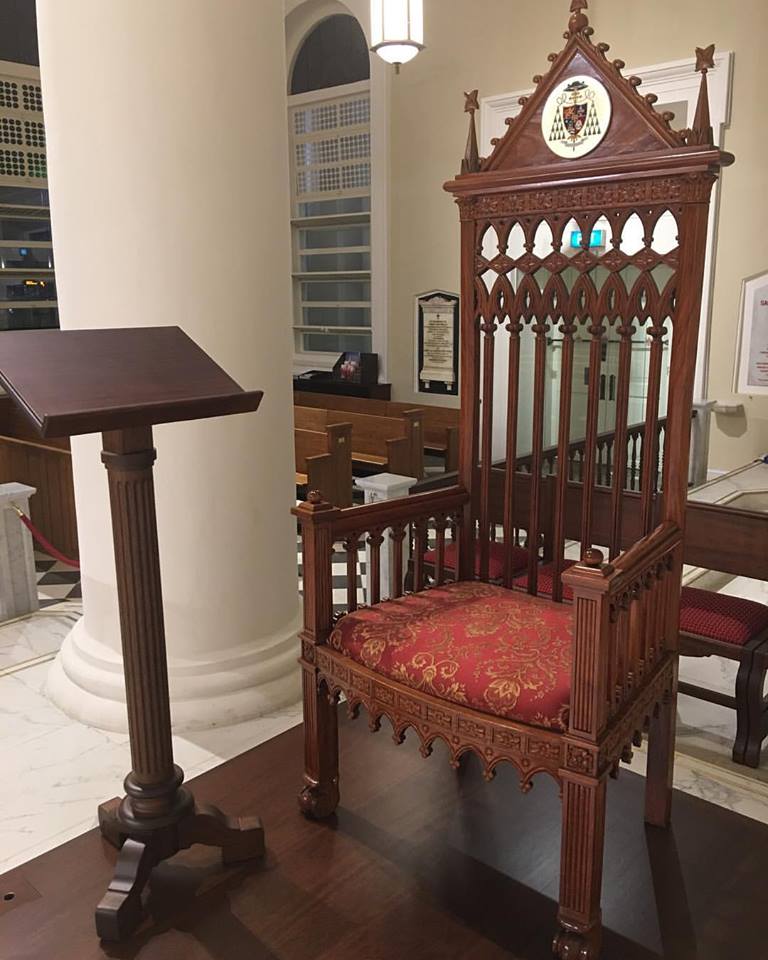
img_0596
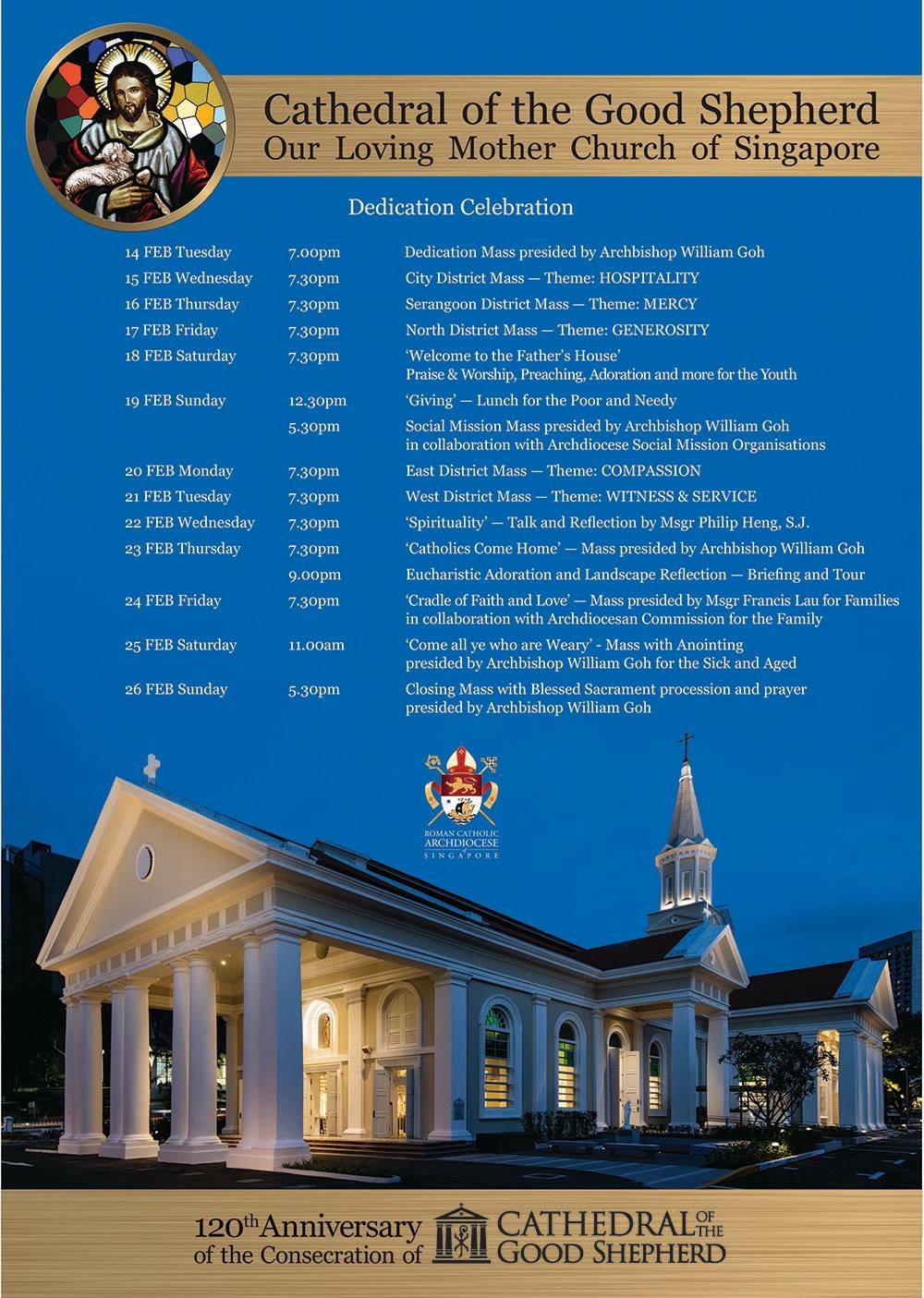
On 14 February 2017, the Church in Singapore is going to celebrate a great occasion of the Dedication of the Cathedral of the Good Shepherd, which is the principal and mother of all the parishes and churches in Singapore. As the Cathedral of the Archdiocese of Singapore, it is the place where the Cathedra or the seat of the Archbishop of Singapore is located at.

16508650_10154997994658221_5910988247782148139_n
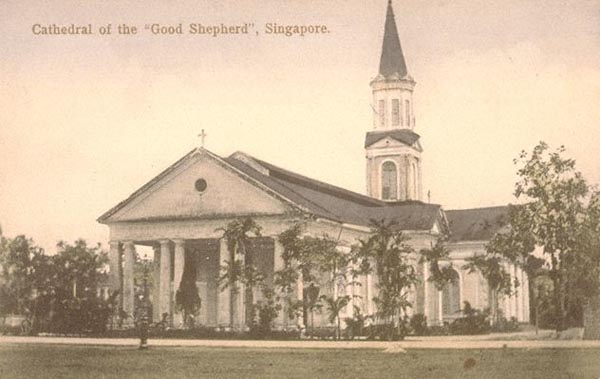
The Cathedral of the Good Shepherd was established as one of the first church buildings in Singapore, in the earliest days of its history as a British colony after it was discovered by Sir Thomas Stamford Raffles in the year 1819. The Cathedral had its origins in a simple and small chapel built from wooden and attap structure constructed between the year 1832 and 1833.
However, the rapid growth of the Church in Singapore, growing number of the faithful and pressing need for a more appropriate place for divine worship resulted in the efforts to establish a permanent place of worship for the faithful in Singapore. Upon generous donations from various individuals including that of the Queen of France and the Archbishop of Manila, the permanent church building that would become the Cathedral of the Good Shepherd became a reality.

good-shepherd

The foundation stone was placed in the site of the future Cathedral in the year 1843 and the completed church was opened and blessed on 18 June 1847, on the Feast of Corpus Christi by Father Jean-Marie Beurel, one of the pioneer priests and evangelisers in Singapore.

father-jean-marie-beurel-mep
(Picture: Fr. Jean-Marie Beurel)

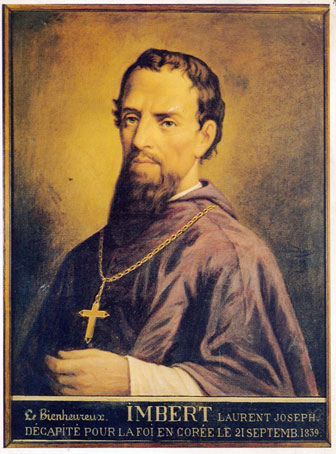
The Cathedral of the Good Shepherd was named as such upon the inspiration from the holy martyr St. Laurent Imbert, one of the first Catholic priests to visit Singapore, who went on to be the first Vicar Apostolic to Korea, and was martyred for his faith there during the violent persecution against the Church and the faithful. It was told that he gave himself up to the authorities in order to safeguard the other faithful under his care, saying that “in times of great need, the Good Shepherd lays down his life for his sheep.” in the imitation of the Lord, our Good Shepherd.

st-laurent-marie-joseph-imbert

(Picture: St. Laurent Imbert)
As the Diocese of Malacca (established in 1558 in Malacca, now in Malaysia) was reestablished in the year 1888 after it has been temporarily suppressed in 1839 (and later revived as the Vicariate Apostolic of Western Siam in 1841), the church that was to become the Cathedral of the Good Shepherd was elevated to the status of a cathedral, and Bishop Edouard Gasnier became its first bishop. He was interred in the Cathedral’s crossing (between nave and transepts) upon his death in 1896.
The Cathedral was dedicated by Bishop Gasnier’s successor, Bishop Rene-Michel-Marie Fee, who dedicated and consecrated the Cathedral to our Lord Jesus the Good Shepherd, on 14 February of the year 1897, 120 years ago to the current date. Ever since, the Cathedral had become the hub for the growth of the Church and the Christian faith both in Singapore and throughout the region for the next 120 years.
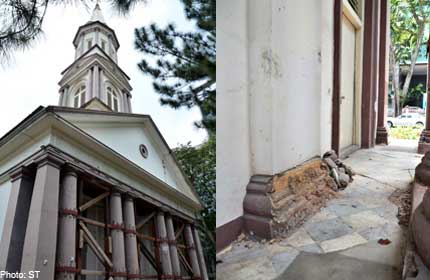
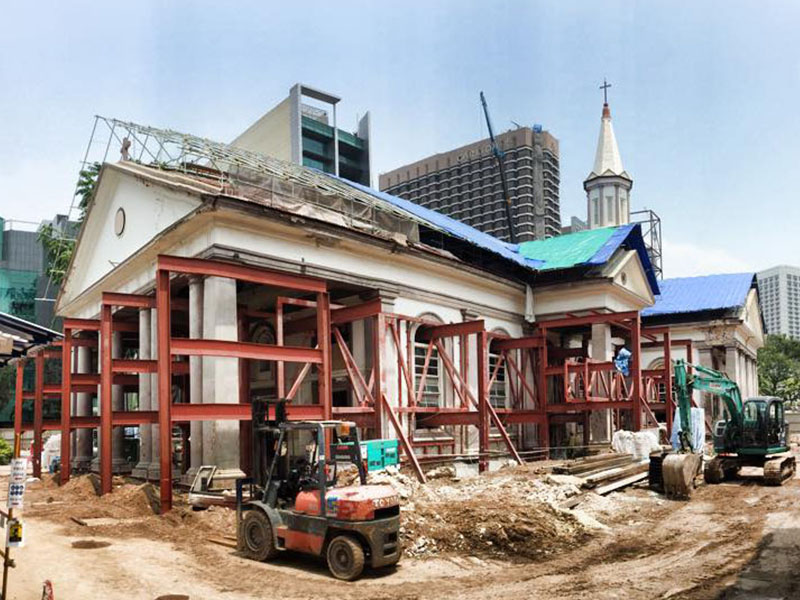
Ever since, the Cathedral had weathered through good and difficult times, including the turbulent years of the Japanese Occupation of Singapore, when it was functioning as an emergency hospital, but it weathered through them. Nevertheless, time and the rapid construction around it and underneath the ground due to the building of the Mass Rapid Transit train line caused the foundation of the Cathedral to be affected, and serious cracks started to appear on the structure.
20130510-154155_catholic-church_st
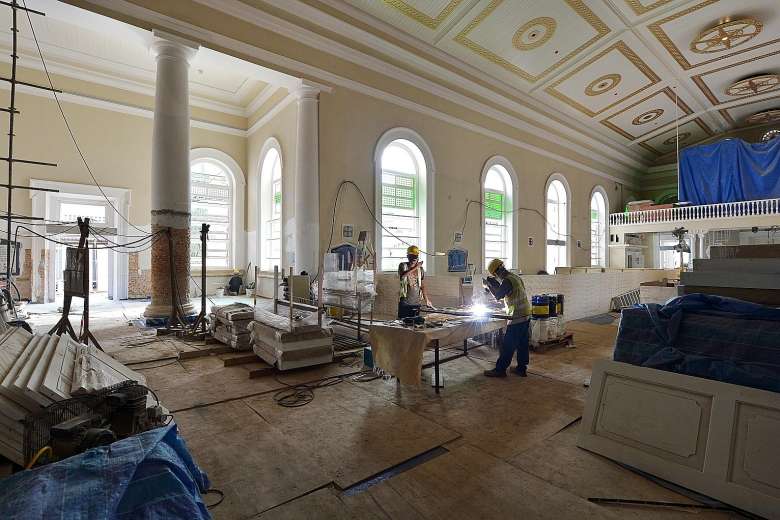
Therefore, serious efforts for a major renovation was carried out, and after many years of preparation, the Cathedral of the Good Shepherd finally was closed on 28 October 2013, for a thorough and extensive renovation and modification. Throughout this major project, various discoveries were made on the historic nature of this Cathedral, including the discovery of the original foundation stone placed in site in the year 1843. The original layout and architecture of the Cathedral were also restored.

800x600_construction

st_20160630_cathedral30_2405986
Finally the Cathedral of the Good Shepherd was reopened on 20 November 2016, on the Solemnity of Jesus Christ the King, by His Excellency Archbishop William Goh of Singapore during the Opening Mass, where he solemnly reopened the Cathedral for the purpose of divine worship.

st_20161121_mass21_2755493

800x600_openingmassrecessional

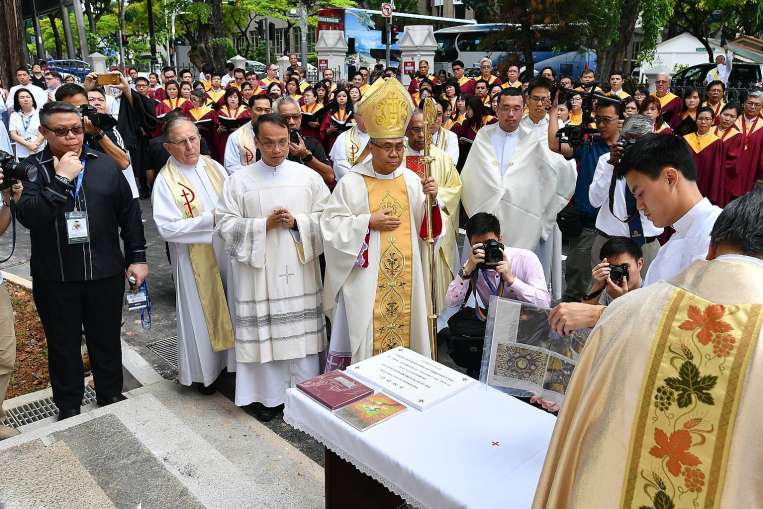
And now, on the 14th day of February of the Year of our Lord 2017, the Cathedral of the Good Shepherd is going to be dedicated to the Lord before all the faithful people of God.

Pray for the Cathedral of the Good Shepherd, pray for the Church of God in Singapore!

Friday, 18 November 2016 : 33rd Week of Ordinary Time, Memorial of the Dedication of the Papal Basilica of St. Peter the Apostle and the Papal Basilica of St. Paul-outside-the-Walls (Homily and Scripture Reflections)

Liturgical Colour : Green or White (Dedication of a Basilica)
Dear brothers and sisters in Christ, on this day we commemorate together the memorial of the dedication of two of the great Papal Basilicas located in the holy city of Rome, dedicated to the two greatest of the saints of Christendom, the pillars of the Church, none other than St. Peter the Apostle, Prince and leader of all the Apostles of our Lord, and also St. Paul the Apostle, the Apostle to the Gentiles and writer of the many Epistles in the New Testament.

Both of them were martyred in Rome, and therefore were seen as the patron saints of the city of Rome, where their tombs were located at, and at that time, Rome was the heart of the Roman Empire, the heart and centre of the secular superpower that was the Roman Empire, and where the Caesars, that is the Emperors ruled with absolute authority, and demanded from all others obedience and also worship.

For the Emperors were worshipped as gods and as incarnation of the gods, and by elevating themselves to the divinity, they deemed themselves as above others, and thus the Imperial Cult of the Roman Empire was created. And against this, came the two Apostles of our Lord, who in their separate ways ended up in the city of Rome, continuing the missions entrusted to them by the Lord.

And they were not chosen by the Lord for their might, their greatness or their talents, unlike the Roman Emperors who boasted of their wealth, or their human and military prowess. Instead, God chose a diverse range of people, and many of them are just like us, common people with our own stories and unique origins. He called His disciples and chose His Apostles from among fishermen, bandits, even tax collectors and others.

And it was not that their faith was great, or that they were as intelligent as the Pharisees and the teachers of the Law, who at that time were those who were educated in the society, knowing the entirety of the laws of Moses. Most of the Apostles were uneducated and even illiterate, and yet, they went on to perform great deeds, some of which were told to us in the Acts of the Apostles. And why is that so? It was none other than because of the Lord and His works on them.

If we remember the passage from the Scriptures we heard today, and what we know of the Apostles, particularly that of St. Peter and St. Paul, certainly, they did not have an outstanding and great faith from the start. Both of them struggled and were troubled in their faith, and were also shaken at certain times, when doubt overpowered them and made them to tremble, and in the case of St. Peter, to sink in the waves, when he tried to walk towards Jesus, because he doubted.

The Apostles were afraid and doubtful when the elders and the chief priests sent guards to arrest Jesus, after He had been betrayed by one of His own Apostles, Judas Iscariot the traitor. The Apostles fled the scene and went into hiding when their Lord and Master was arrested, and we know how St. Peter himself, after having sworn to give his life for the sake of the Lord that very night, denied his Lord and Master three times in order to protect himself from harm.

I am sure that we also know how St. Paul grew up as a zealous and fanatical Pharisee, determined to hunt down as many followers of Christ as he could, arresting them and torturing them as he was misguided by his blind obedience to the false understanding of the Law of God. In fact, St. Peter and St. Paul were just like us, sinners and filled with doubt, indeed as what some of us would say, that we are unworthy of our Lord and His love.

But what made them different? In fact, what made our holy saints and martyrs to be different from us? It is because all of them went through a thorough and wholesome change in their lives, in how they lived their lives and in how they carried out their actions henceforth, and they turned from sinners and into God’s holy and devoted people, His saints.

St. Peter dedicated his whole life thereafter in the service of God, leading His fellow Apostles and the other disciples of Christ, coordinating the immense task of guiding and leading the early Church through moments of difficulties and through good moments when many became believers and therefore had to require new shepherds and guides, new bishops to be appointed to lead these.

St. Paul was converted when God called him on that fateful day when he was on his way to Damascus. God revealed His truth to him, and after having heard the truth and realising how wrong he was, St. Paul made that dramatic turnaround and from one of the greatest enemies of the Lord and His faithful people, he then became one of the Church and the Faith’s greatest champion and defender.

There is something that all of us can learn from this, brothers and sisters in Christ, that we did not choose to become servants of the Lord, but rather, He chose us and made us worthy. The Apostles, saints and many martyrs were ordinary men and women just like us, but they changed their ways of life and followed the Lord with conviction and commitment.

God transformed the holy Apostles St. Peter and St. Paul, from their humble and even sinful origins, to become His greatest tools, as His greatest servants in bringing the souls of many of His beloved ones closer to Him and allowing many through them to listen to the truth about His salvation. The same call is now therefore made upon us as well. Each and every one of us as Christians have been called to serve the Lord, and to evangelise and preach the Good News of God to all.

And this is related to our celebration today, remembering the moment when the two great Basilicas dedicated to these two Apostles were consecrated and dedicated, made holy and had incense and the holy oils applied to it and the Altar within the Basilicas, and through the blessing of the Almighty God, these two great edifices became more than just a space, but rather they become a place worthy to house the Holy Presence of God.

Before a church, be it a small parish church, a large church, an important one such as Cathedrals and Basilicas, none of these can be used for the purpose of the celebration of the Holy Mass if they have not been consecrated and dedicated yet. And as I have mentioned in my homily for the Dedication of the Archbasilica of St. John Lateran just two weeks earlier, this has implication and relevance for us that we all should know and understand.

Undedicated and unconsecrated, the great Basilicas and cathedrals are just mere buildings, spaces with architecture without meaning. Through the consecration, it has been made into a worthy and holy Residence and House of God. In the same manner, through our own baptism, through the dwelling of the Holy Spirit by our confirmation, and through the reception of the Most Precious Body and Blood of our Lord in the Eucharist, each and every one of us, our bodies, minds, hearts and souls have been consecrated and dedicated to the Lord to be His holy Temples, where He shall dwell in us.

We are the Temple and the House of God, for God Himself has dwelled inside us, inside our mortal bodies and existence. And as a result, we should make sure that we live in accordance to the way of the Lord, obeying His laws and precepts, or else we would defile the sanctity of this Temple and House of God. God has transformed our humble and simple bodies and beings into His glorious residence, as much as those magnificent buildings and edifices has been transformed into the great places of worship.

Let us all therefore spend some time to reflect on this, thinking carefully of what each and every one of us should be doing in our respective lives. We should imitate the examples of the saints in their dedication and commitment, and follow the examples set by the Apostles St. Peter and St. Paul. Do not be discouraged if we think that our faith is easily shaken and weak, for the Apostles themselves were once filled with doubt as well.

Let us all open ourselves, heart, mind, body and soul, that God may come into each and every one of us, transforming us completely from being creatures of the flesh and darkness, into creatures of the light, into sons and daughters of our Lord, worthy of the eternal life He has promised to all of His faithful ones. St. Peter and St. Paul, pray for us sinners, that we may be like you and follow in your footsteps. Amen.

Friday, 18 November 2016 : 33rd Week of Ordinary Time, Memorial of the Dedication of the Papal Basilica of St. Peter the Apostle and the Papal Basilica of St. Paul-outside-the-Walls (Gospel Reading)

Liturgical Colour : Green or White (Dedication of a Basilica)
Luke 19 : 45-48

At that time, Jesus entered the Temple area and began to drive out the merchants. And He said to them, “God says in the Scriptures, ‘My house shall be a house of prayer, but you have turned it into a den of robbers!'”

Jesus was teaching every day in the Temple. The chief priests and teachers of the Law wanted to kill Him, and the elders of the Jews as well, but they were unable to do anything, for all the people were listening to Him and hanging on His words.

Alternative reading (in Mass for Dedication of the Basilicas)
Matthew 14 : 22-33

At that time, immediately Jesus obliged His disciples to get into the boat and go ahead of Him to the other side, while He sent the crowd away. And having sent the people away, He went up the mountain by Himself to pray. At nightfall, He was there alone. Meanwhile, the boat was very far from land, dangerously rocked by the waves, for the wind was against it.

At daybreak, Jesus came to them walking on the sea. When they saw Him walking on the sea, they were terrified, thinking that It was a ghost. And they cried out in fear. But at once Jesus said to them, “Courage! Do not be afraid. It is Me!”

Peter answered, “Lord, if it is You, command me to come to You walking on the water.” Jesus said to him, “Come!” And Peter got out of the boat, and walked on the water to go to Jesus. But seeing the strong wind, he was afraid and began to sink; and he cried out, “Lord, save me!” Jesus immediately stretched out His hand and took hold of him, saying, “Man of little faith, why did you doubt?”

As they got into the boat, the wind dropped. Then those in the boat bowed down before Jesus, saying, “Truly, You are the Son of God!”

Friday, 18 November 2016 : 33rd Week of Ordinary Time, Memorial of the Dedication of the Papal Basilica of St. Peter the Apostle and the Papal Basilica of St. Paul-outside-the-Walls (Psalm)

Liturgical Colour : Green or White (Dedication of a Basilica)
Psalm 118 : 14, 24, 72, 103, 111, 131

I delight in following Your laws, more so than in all riches.

Your laws are my delight, my counsellors who uphold me.

Your law is more precious to me than heaps of silver and gold.

How sweet are Your promises to my taste, sweeter than honey to my mouth!

Your statutes are my heritage forever, they are the joy of my heart.

I gasp in ardent yearning for Your commandments that I love.

Alternative reading (in Mass for Dedication of the Basilicas)
Psalm 97 : 1, 2-3ab, 3cd-4, 5-6

Sing to the Lord a new song, for He has done wonders; His right hand, His holy arm, has won victory for Him.

The Lord has shown His salvation, revealing His justice to the nations. He has not forgotten His love nor His faithfulness to Israel.

The farthest ends of the earth all have seen God’s saving power. All you lands, make a joyful noise to the Lord, break into song and sing praise.

With melody of the lyre and with music of the harp. With trumpet blast and sound of the horn, rejoice before the King, the Lord!