Monday, 24 June 2013 : Solemnity of the Nativity of St. John the Baptist (Second Reading)

Acts 13 : 22-26

After that time, God removed Saul and raised up David as king, to whom He bore witness saying : ‘I have found David, the son of Jesse, a man after My own heart, who will do all I want him to do.’ It is from the descendants of David that God has now raised up the promised Saviour of Israel, Jesus.

Before He appeared, John proclaimed a baptism of repentance for all the people of Israel. As John was ending his life’s work, he said : ‘I am not what you think I am, for after me another One is coming whose sandal I am not worthy to untie.’

Brothers, children and descendants of Abraham, and you also who fear God, it is to you that this message of salvation has been sent.

Monday, 24 June 2013 : Solemnity of the Nativity of St. John the Baptist (Psalm)

Psalm 138 : 1-3, 13-14ab, 14c-15

O Lord, You know me : You have scrutinised me. You know when I sit and when I rise; beforehand You discern my thoughts. You observe my activities and times of rest; You are familiar with all my ways.

It was You who formed my inmost part and knit me together in my mother’s womb. I thank You for these wonders You have done.

My heart praises You for Your marvellous deeds. Even my bones were known to You when I was being formed in secret, fashioned in the depths of the earth.

Monday, 24 June 2013 : Solemnity of the Nativity of St. John the Baptist (First Reading)

Isaiah 49 : 1-6

Listen to me, o islands, pay attention, peoples from distant lands. YHVH called me from my mother’s womb; He pronounced my name before I was born. He made my mouth like a sharpened sword. He hid me in the shadow of His hand. He made me into a polished arrow set apart in His quiver. He said to me, “You are Israel, My servant, through you I will be known.”

“I have laboured in vain,” I thought and spent my strength for nothing.” Yet what is due me was in the hand of YHVH, and my reward was with my God. I am important in the sight of YHVH, and my God is my strength. And now YHVH has spoken, He who formed me in the womb to be His servant, to bring Jacob back to Him.

He said : “It is not enough that you be my servant, to restore the tribes of Jacob, to bring back the remnant of Israel, I will make you the light of the nations, that My salvation will reach to the ends of the earth.”

Peter’s Pence Collection, Solemnity of Saints Peter and Paul, Apostles

Peters Pence

In case any of you are wondering what is Peter’s Pence, which is collected every Sunday nearest to the Solemnity of Saints Peter and Paul, Apostles, which falls on 29 June every year (Therefore this year Peter’s Pence is collected on Sunday, 30 June 2013, 13th Sunday of Ordinary Time), Peter’s Pence is a special collection in which the collection will not go into the local church or parish fund, but gathered from all over the world and sent to Rome, to the Holy See. Thus, the collection made during the offertory this Sunday will go directly to Rome.

What is the purpose of the Peter’s Pence collection? Exactly to support the numerous charitable activities and organisations managed by the Holy See, by our Church, all over the world. There are thousands, tens of thousands of charity under the supervision of the Church, and to be able to continue with the action, funds are definitely necessary to provide a solid backing. That is why, Peter’s Pence is done once every year, on the Sunday nearest to the Solemnity of Saints Peter and Paul.

1045213_354782624625355_1349576998_n

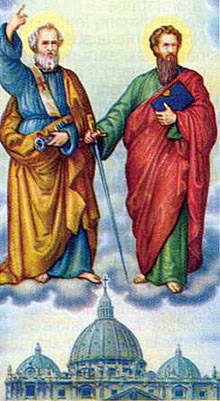
Why Solemnity of Saints Peter and Paul? That is because on that day lie the great celebration of the two great saints and apostles that defined our Church, because they met their martyrdom in Rome. St. Peter, the Prince and leader of all the Apostles, whom the Pope is the successor of today, met his martyrdom in what is now Vatican City, through crucifixion, and St. Paul, the Apostle to the Gentiles, and author of the Epistles in the New Testament, met his martyrdom in Rome, through beheading.

Peter’s Pence itself had its origins in the late dark ages and early medieval period, particularly from England, where it got the name Peter’s ‘Pence’. Pence is the unit of money still in use until today in the United Kingdom and the related monetary units. ‘Peter’ simply point to the fact that the collection or ‘pence’ is intended to be sent to Rome, to the Pope, in order to support various Church activities.

Imposition of the pallium on the new Metropolitan Archbishops by Pope Francis

On the great Feast day and Solemnity of Saints Peter and Paul, Apostles, the feast day of the Church of Rome, on Saturday, 29 June 2013, 34 new Metropolitan Archbishops will receive the pallium, the symbol of their metropolitan office from Pope Francis, in a Mass at St. Peter’s Basilica.
Pallium (Pallium)
1_0_674753 (Papal Pallium)
Pallium is a woolen band, worn around the shoulders, as a symbol of office, representation of the Good Shepherd, with Jesus carrying the lamb on His shoulder, which is reminiscent of the authority entrusted upon the Metropolitan Archbishops over their flocks. Pallium therefore is a symbol of authority. It is about three fingers wide, and has six black crosses, out of which three are pierced with a golden pin, representing the wounds of Christ pierced by the holy nails on the cross.
angelo-scola
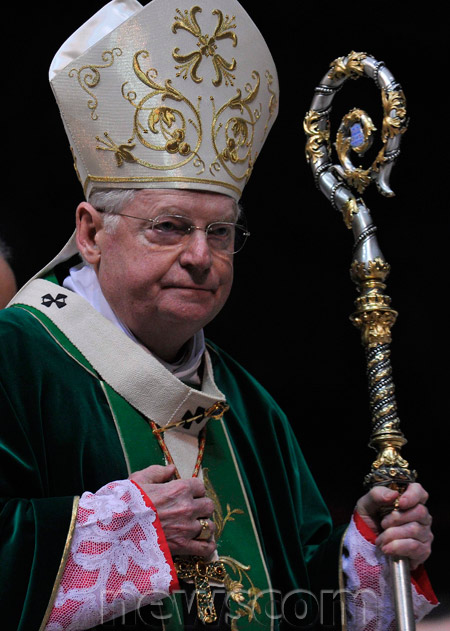
(Above : image of Cardinal Angelo Scola, wearing the pallium, as the Metropolitan Archbishop of Milan, who received the pallium personally from Pope Benedict XVI in 2011)
Papal pallium from 2005 is different, in order to distinguish the nature of the Papal office, as the Pope is not just any bishop or Metropolitan Archbishop, but is Metropolitan over the entire world, the entire Church, as the Vicar of Christ.
Pope-Benedict-XVI
(Above : Pope Benedict XVI with the Papal pallium in 2012)

The list of the new Metropolitan Archbishops who will receive the pallium below.

1. Patriarch Manuel Jose Macario do Nascimento Clemente, Patriarch of Lisbon (Portugal)
2. Archbishop Dieudonne Nzapalainga, C.S.Sp., Metropolitan Archbishop of Bangui (Central African Republic)
3. Archbishop Carlo Roberto Maria Redaelli, Metropolitan Archbishop of Gorizia (Italy)
4. Archbishop Claudio Dalla Zuanna, S.C.I., Metropolitan Archbishop of Beira (Mozambique)
5. Archbishop Prakash Mallavarapu, Metropolitan Archbishop of Visakhapatnam (India)
6. Archbishop Antonio Carlos Altieri, S.D.B., Metropolitan Archbishop of Passo Fundo (Brazil)
7. Archbishop Marek Jedraszewski, Metropolitan Archbishop of Lodz (Poland)
8. Archbishop Philip Tartaglia, Metropolitan Archbishop of Glasgow (Great Britain)
9. Archbishop Salvatore Joseph Cordileone, Metropolitan Archbishop of San Francisco (USA)
10. Archbishop Rolando Joven Tria Tirona, O.C.D., Metropolitan Archbishop of Caceres (Philippines)
11. Archbishop Rogelio Cabrera Lopez, Metropolitan Archbishop of Monterrey (Mexico)
12. Archbishop Joseph William Tobin, C.Ss.R., Metropolitan Archbishop of Indianapolis (USA)
13. Archbishop Carlos Maria Franzini, Metropolitan Archbishop of Mendoza (Argentina)
14. Archbishop Lorenzo Ghizzoni, Metropolitan Archbishop of Ravenna-Cervia (Italy)
15. Archbishop George Antonysamy, Metropolitan Archbishop of Madras and Mylapore (India)
16. Archbishop Anil Joseph Thomas Couto, Metropolitan Archbishop of Delhi (India)
17. Archbishop John Wong Soo Kau, Metropolitan Archbishop of Kota Kinabalu (Malaysia)
18. Archbishop Murray Chatlain, Metropolitan Archbishop of Keewatin-Le Pas (Canada)
19. Archbishop Sérgio Eduardo Castriani, C.S.Sp., Metropolitan Archbishop of Manaus (Brazil)
20. Archbishop Peter Loy Chong, Metropolitan Archbishop of Suva, (Fiji)
21. Archbishop Alfonso Cortes Contreras, Metropolitan Archbishop of Leon (Mexico)
22. Archbishop Alexander King Sample, Metropolitan Archbishop of Portland in Oregon (USA)
23. Archbishop Joseph Effiong Ekuwem, Metropolitan Archbishop of Calabar (Nigeria)
24. Archbishop Jesus Juarez Parraga, S.D.B., Metropolitan Archbishop of Sucre (Bolivia)
25. Archbishop Fabio Martinez Castilla, Metropolitan Archbishop of Tuxtla Gutierrez (Mexico)
26. Archbishop Ramon Alfredo Dus, Metropolitan Archbishop of Resistencia (Argentina)
27. Archbishop Mario Aurelio Poli, Metropolitan Archbishop of Buenos Aires (Argentina)
28. Archbishop Gintaras Linas Grusas, Metropolitan Archbishop of Vilnius (Lithuania)
29. Archbishop Michael Owen Jackels, Metropolitan Archbishop of Dubuque (USA)
30. Archbishop Duro Hranic, Metropolitan Archbishop of Dakovo-Osijek (Croatia)
31. Archbishop Moacir Silva, Metropolitan Archbishop of Ribeirao Preto (Brazil)
32. Archbishop Jozef Piotr Kupny, Metropolitan Archbishop of Wroclaw (Poland)
33. Archbishop Sergio Alfredo Gualberti Calandrina, Metropolitan Archbishop of Santa Cruz de la Sierra (Bolivia)
34. Archbishop Giuseppe Petrocchi, Metropolitan Archbishop of L’Aquila (Italy)
In addition, the Metropolitan Archbishop of Hue, Archbishop Francois Xavier Le Van Hong, will not receive the pallium directly from the Pope in Rome, but in his home diocese of Hue, through the papal representative. Therefore, in addition to the 34 Metropolitan Archbishops mentioned above, 35 Metropolitan Archbishops will receive the pallium in this year.
35. Archbishop Francois Xavier Le Van Hong, Metropolitan Archbishop of Hue (Vietnam)

Metropolitan Archbishop differs from normal Archbishops in that, they have jurisdiction over other dioceses that are placed under their supervision, in a group called Ecclesiastical Province of the Church. Archbishops of Archdioceses without Metropolitan character has no jurisdiction over any dioceses under them, and they are usually directly subject to the Holy See.

Saturday, 22 June 2013 : 11th Week of Ordinary Time, Memorials of St. Paulinus of Nola, Bishop, Saints John Fisher, Bishop and Thomas More, Martyrs (Scripture Reflection)

Dear brothers and sisters in Christ, today we heard the words of the Gospel, in which we are told not to worry about our needs and our desires in this world. Christ had taught His disciples that the Lord takes care of the needs of His people, and He will protect those whom He considers as His own. Therefore, as long as we belong to Christ, to the Lord, we will be safe and we will always be provided, with all the things that we need.

Worry is a natural part of a human being, and worry cannot be separated from our own selves, from our own insecurities and our own natural predisposition to the desire for things, material or otherwise, in order to secure our own survival. Such is also the law of nature according to those who study it, that we are always concerned with our own survival, and therefore would do all that we can in our own power, in order to maintain our survival.

That is why we grow increasingly concerned with our own human needs, of food, of material goods, and even of relationships and love. We worry about things that may happen to us in the future, especially if those things may affect us in a negative manner. Fuelled by these insecurities, we end up becoming selfish and overprotective of ourselves and those precious to us, that end up in numerous causes for sorrow and anguish.

Many problems of this world can be traced to our own worries, our own insecurities. The reason that many nations maintain powerful armies and forces is because they are always ever insecure about their own future, with often endless probabilities and possible scenarios of ‘enemy’ attacks on them, so that they, in their insecurity, end up building that tool of destruction, in order to protect themselves, but inadvertently, when the violence does come, that tool is often used to cause great destruction and mayhem in our world.

One of the most important reasons why countries become embroiled in long-drawn conflicts is because of conflict over resources and material wealth of the earth, with well-known examples of crude oil, gas, and other precious metals, which become a source of contention between states, and led to the build-up of enmity and mutual hostility between nations.

That was why Christ told us that we should not worry, and indeed that we should put a complete trust in God, for God who loves and cares for us will take care of us and provide us all that we need. Let us take note that it is very often that what we want is not what we truly need. Many items that we want are merely the product of our own desires and greed, driven by this world, which had brought upon us countless lucrative deals that entice us to want to have more and more of such goods.

Commercialism and materialism are rampant in our world today, brothers and sisters in Christ. One can just imagine its extent from the insatiable human desire for things that bring wealth and prestige to their owners. Our media is filled with advertisements and channels that promote decadent lifestyles. A lifestyle of great excesses and waste. A lifestyle that is apathetic to the needs of others, and a lifestyle that is often lived in ignorance of the reality of life in this world.

Today we commemorate the feast day of St. Paulinus of Nola, a bishop who lived in the later years of the Roman Empire, and also the feast day of St. John Fisher, a bishop in the late Renaissance England, in the times of the English Reformation, and his fellow saint, with whom he was also martyred, St. Thomas More, who is also known as the patron saint of lawyers.

St. Paulinus of Nola was a bishop who renounced his privileged early life as an influential senator of the Roman Empire, and chose to follow the ways of the ascetics, to give himself fully to the Lord, and eventually became a priest and bishop of Nola. He was also a well-known writer and poet, with many of his writings influencing later people and saints of the Church.

The example of St. Paulinus of Nola, who disavowed wealth and did not pursue human glory and possessions. He looked for what is more valuable to him, and indeed should be truly valuable to all of us, that is the Lord Himself, our real and true treasure. He did not find it shameful to abandon all the worldly pursuit of wealth, and all the fame and affluence he had while he was an influential senator of Rome.

It does not mean that all of us should then become monks though, and follow ascetic lifestyle. But certainly the examplary life of St. Paulinus of Nola, whose writings inspired many in the faith, and whose pursuit of the true richness in Christ, can become a powerful driving engine behind our own personal journey in the faith. And equally, just as St. Paulinus of Nola had shown all of us, the examples of Saints John Fisher and Thomas More too, cannot be ignored.

Saints John Fisher and Thomas More lived in a difficult time, a difficult and troubled time to be a follower of the Lord, and to be the faithful ones in the Church of God. For they lived at the time when the English Reformation begun, under the persona of King Henry VIII, whose greatest sin was to break away from the Apostolic authority of Rome just because he did not get his second marriage approved, in his crazed and ultimately fruitless pursuit for an heir, a son to inherit the throne of England.

St. John Fisher was the bishop of Rochester, and a closer advisor to the king, while St. Thomas More was a laity, the powerful chancellor for the king of England. When the king began his upstart new ‘church’, naturally, he wanted all of his subjects to follow him into his rebellion against the authority of the Church, especially those nearest to him in confidence and power.

Those who followed the king into his disobedience and rebellion gained prestige with the king and much material wealth and affluence, which was also the reason why many followed the king into his disobedience against Rome. Yet, St. Thomas More, and also St. John Fisher, despite the offers made by the king, particularly St. Thomas More’s lucrative chancellorship, they remained steadfast to their faith in the Lord, and remained firmly within the Church, against all attempts and temptations for them to leave the Church of God.

In refusing the order of the king, they faced suffering, persecution, prison, and eventually death in martyrdom, in their defense of the faith. They remained faithful and true to the Lord to the end, and they received their eternal reward and glory in heaven, having shedding their blood for the sake of their faith.

The lesson to be learnt here is of course not that we must shed our blood and our life like what the two martyrs of the faith had done, but just like St. Paulinus of Nola, we must value our faith and the Lord our God as the much more valuable and priceless treasure, the true treasure of our life, over any kind of worldly and material wealth, that is offered by our world, and especially in our present day world, becoming ever more tempting in their approach to all of us.

Do not give up our faith in God and our righteousness for moments of pleasure and false happiness, through the means of material goods of this world. Not that we cannot enjoy what this world can offer and neither should we restrain from gaining any material possession or money, but all of these must be done in moderation, so that it would not end up in these shutting out the Lord from our hearts, because remember that the Lord Himself said that wherever the treasure is, the our hearts lie.

Therefore, my dear brothers and sisters in Christ, let us today renew our commitment to strengthen our faith in the Lord, that we will ever keep Him in our hearts, that He will know that we belong to Him, and will reward us greatly when He comes again as our King. God bless us all. Amen.

Saturday, 22 June 2013 : 11th Week of Ordinary Time, Memorials of St. Paulinus of Nola, Bishop, Saints John Fisher, Bishop and Thomas More, Martyrs (Gospel Reading)

Matthew 6 : 24-34

No one can serve two masters; for he will either hate one and love the other, or he will be loyal to the first and look down on the second. You cannot at the same time serve God and money.

This is why I tell you not to be worried about food and drink for yourself, or about clothes for your body. Is not life more important than food, and is not the body more important than clothes? Look at the birds of the air; they do not sow, they do not harvest and do not store food in barns, and yet your heavenly Father feeds them. Are you not less worthy than they are?

Can any of you add a day to your life by worrying about it? Why are you so worried about your clothes? Look at how the flowers in the fields grow. They do not toil or spin. But I tell you that not even Solomon in all his wealth was clothed like one of these.

If God so clothes the grass in the field, which blooms today and is to be burned tomorrow in an oven, how much more will He clothe you? What little faith you have! Do not worry and say : What are we going to eat? What are we going to drink? or : What shall we wear? The pagans busy themselves with such things; but your heavenly Father knows that you need them all.

Set your heart first on the kingdom and justice of God, and all these things will also be given to you. Do not worry about tomorrow, for tomorrow will worry about itself. Each day has enough trouble of its own.

Saturday, 22 June 2013 : 11th Week of Ordinary Time, Memorials of St. Paulinus of Nola, Bishop, Saints John Fisher, Bishop and Thomas More, Martyrs (Psalm)

Psalm 33 : 8-9, 10-11, 12-13

The Lord’s angel encamps and patrols to keep safe those who fear Him. Oh, see and taste the goodness of the Lord! Blessed is the one who finds shelter in Him!

Revere the Lord, all you His saints, for those who fear Him do not live in want. The mighty may be hungry and in need, but those who seek the Lord lack nothing.

Come, listen to me, my children; I will show you how to fear the Lord. If you desire long life, if you want to enjoy prosperity.

Saturday, 22 June 2013 : 11th Week of Ordinary Time, Memorials of St. Paulinus of Nola, Bishop, Saints John Fisher, Bishop and Thomas More, Martyrs (First Reading)

2 Corinthians 12 : 1-10

It is useless to boast; but if I have to, I will go on to some visions and revelations of the Lord. I know a certain Christian : fourteen years ago he was taken up to the third heaven. Whether in the body or out of the body, I do not know, God knows. But I know that this man, whether in the body or out of the body – I do not know, God knows – was taken up to Paradise where he heard words that cannot be told : things which humans cannot express.

Of that man I can indeed boast, but of myself I will not boast except of my weaknesses. If I wanted to boast, it would not be foolish of me, for I would speak the truth. However, I better give up lest somebody think more of me than what is seen in me or heard from me.

Lest I become proud after so many and extraordinary revelations, I was given a thorn in my flesh, a true messenger of Satan, to slap me in the face. Three times I prayed to the Lord that it leave me, but He answered, “My grace is enough for you; My great strength is revealed in weakness.”

Gladly, then, will I boast of my weakness that the strength of Christ may be mine. So I rejoice when I suffer infirmities, humiliations, want, persecutions : all for Christ! For when I am weak, then I am strong.

Friday, 21 June 2013 : 11th Week of Ordinary Time, Memorial of St. Aloysius Gonzaga, Religious (Scripture Reflection)

Dear brothers and sisters in Christ, our faith in the Lord is possibly the greatest treasure that we will ever have in this world. What is treasure? A treasure is something that we find precious and really have a substantial meaning and value to us, either in financial terms or in any other terms. Basically, it is something very valuable to us, and presumably we will want to have it and keep it from losing it.

But, if we notice, in our world today, too many people are enamoured with treasure, so much, that they become obsessed with it. Treasure in this means worldly treasure, the treasure of wealth, possessions, goods, and amenities, that come with our world today and all its conveniences. All of these materialisms widespread in our world today, can easily be seen in the amounts of the advertisements in our television programmes, and in the internet media.

These advertisements take advantage of our human desire, of our greed and desire to have more of the material goods and pleasures that this world can offer in its various forms. Not that this is bad, brothers and sisters in Christ, as a tempered desire for possessions and wealth may indeed be beneficial if not necessary for mankind at times. We do need money and certain goods in order to lead a good normal life in our world today. What matters is however, do we really seek what we need? Or do we seek so much more than what we need, that it becomes a kind of greed?

When Christ mentioned that in the treasures lie our heart, He was not further than the truth. Indeed, our heart certainly lie with our treasures. Imagine a man with an enormous wealth stored inside a safety box inside his house. Certainly he will do all that he can in order to ensure that the treasure ‘chest’ remain safe from all external threats, such as thieves and even maybe natural disasters. He would not have done such things if his heart had not been with the treasure.

But what Christ had rightly warned us is that, these kind of wealth are temporary. my brothers and sisters. They are not permanent, nor will they remain with us forever. We will not bring our wealth and possessions with us to the afterlife, be it to heaven or hell, because in heaven we have no need for such possessions, because the Lord alone is our possession, and we will have enough, and in hell, no amount of material goods will be able to alleviate the ultimate suffering of the separation of man from God.

Another example I would like to bring to your attention is the recent curious cases of entire life savings being destroyed by termites that managed to get into the safely kept money, and almost brought disaster to the old lady who had saved the money. The bank kindly replaced most of the money for her, but this gives us yet another reminder that these possessions are not permanent, nor will they be able to withstand natural forces, just as Christ had mentioned.

And yet another case, where a safety box in a bank in India was thought to be untouched and safe, but in fact a colony of termites managed to find their way inside and destroy whatever it was that were kept inside that safety box. Nothing of this world lasts, brothers and sisters in Christ.

That is why, Christ told us, to seek the true treasure of our lives, that is God, because God, unlike the worldly material possessions can never be subjected to rust and the natural forces of destruction, termites or whatsoever. If we keep faithful to God’s covenant with us, keep His commandments at all times, God will belong to us, and we too will belong to God. This divine possession is lasting and eternal, my dear brothers and sisters in Christ.

Yes, of course, we are free to seek to obtain possessions and treasures of this world, but always remember that in doing so, let us always remember that in God, we have the true treasure, such that we will never be led astray by the worldly treasures or even overcome by our greed and human desire, that we fall into sin and be led away from God, which will end likely in eternal damnation in hell. No amount of our wealth in this world will be able to save us or alleviate our suffering in hell, my brethen.

Today, we commemorate the feast of St. Aloysius Gonzaga, a former noble youth from Italy, from the very renowned Gonzaga family of lords, dukes, and kings. But despite being the firstborn of the family, and therefore was entitled to inherit all the titles he was entitled to, with all its possessions and wealth, that many of us even today can only dream of, he was awakened to the true treasure of this life, that is the Lord.

He forsook all the privileges he had and his inheritance, seeking to become a religious, dedicating his entire life and entire being to the Lord. He forsook the inheritance of the powerful and the wealth of the world to seek a nobler and greater purpose in life, that is the Lord, and to serve the people of God. Yes, many opposed his decision, especially his father, who was completely surprised and angered by his decision. Nevertheless, in the end, St. Aloysius Gonzaga managed to be what he wanted to be.

Although unfortunately, St. Aloysius Gonzaga died early in his early twenties, in his short life, he had shown us the virtue of seeking the true treasure of our life. No, this does not mean that all of us should enter the monasteries and embrace the ascetic lifestyle of monks, and neither we should impoverish ourselves by selling all the things that we have. Yes, some of us can do that, if they do choose to do so, but what matters is, to look beyond the material and the pleasures of this world, in seeking the real treasure that will never be depleted, and that will never be lost.

No matter how much money and possessions that we have, eventually, they can run out. No matter how much pleasures we have in our lives, they can also run out, and we can also become bored of such possessions and pleasures, because they are not the true treasure. The love of God, that is our true treasure, will fill us and renew us, such that we will never be empty again. He will fill us and make us whole. God is always with us, if we too, love Him and remain in His grace. Amen.