Thursday, 30 June 2016 : 13th Week of Ordinary Time, Memorial of the First Martyrs of the Holy Roman Church (First Reading)

Liturgical Colour : Green or Red (Martyrs)

Amos 7 : 10-17

Amaziah, the priest of Bethel, then sent word to king Jeroboam of Israel, “Amos is conspiring against you in the very centre of Israel; what he says goes too far. These are his very words : Jeroboam shall die by the sword and Israel shall be exiled from its land.”

Amaziah then said to Amos, “Off with you, seer, go back to the land of Judah. Earn your bread there by prophesying. But never again prophesy at Bethel for it is a king’s sanctuary and a national shrine.”

Amos replied to Amaziah, “I am not a prophet or one of the fellow prophets. I am a breeder of sheep and a dresser of sycamore trees. But YHVH took me from shepherding the flock and said to me : Go, prophesy to My people Israel. Now hear the word of YHVH, you who say : No more prophecy against Israel, no more insults against the family of Isaac!”

“This is what YHVH says : Your wife shall be made a harlot in the city, your sons and daughters shall fall by the sword, your land shall be divided up and given to others, and you yourself shall die in a foreign land, for Israel shall be driven far from its land.”

Thursday, 13 August 2015 : 19th Week of Ordinary Time, Memorial of Pope St. Pontian, Pope, and St. Hippolytus, Priest, Martyrs (Homily and Scripture Reflections)

Liturgical Colour : Green or Red (Martyrs)

Dear brothers and sisters in Christ, on this day we heard first in the first reading from the Book of Joshua, the continuation of the narration of the story of Israel’s passage from Egypt to the Promised Land of Canaan after their Exodus. Moses who led them through the desert for forty years because of the disobedience and rebellion of many among the Israelites, had passed away, and now had been replaced as leader by Joshua.

The people of Israel had reached the vicinity of the River Jordan, which separated the Land of Promise and the other lands. And in a repeat of what He had shown to the people at the Red Sea, God made His people to cross the river Jordan on dry ground, opening the river before them and halting its flow so that they might pass unhindered and enter into the Promised Land of Canaan, which was to be their inheritance.

In the Gospel however, we heard about Jesus who spoke of a parable to His disciples and to the people, teaching them a story about a servant who had owed a large debt to his master, and he was supposed to be punished. But when the servant begged for mercy and forgiveness, the master’s heart was touched and moved, and he forgave the servant all of his debts.

But the servant did not follow the example of his master, and he confronted another servant who owed him a small amount of debt, a mere fraction of what the former owed his master and which he had been forgiven from. The master who knew what the wicked servant had done was very angry, and he did not let the wickedness to go unpunished. The punishment for the old debts were reinstated and the wicked servant went to his suffering without mercy.

How are these two readings related? They may seem to be distinct and unrelated, but in fact they are really very related in meaning, in reality as well as in symbolism. For we all have to understand that what we witnessed today in the Book of Joshua was the final part of the long journey of Israel through the desert, where they wandered for over forty years as mentioned.

They wandered so many years in the desert because of their disobedience, since they refused to listen to the Lord, and feared men more than God, and they did not put their full trust in the Lord, even though again and again, many times they had witnessed first hand the glory and power of God. They were too stubborn in their heart to appreciate the love and care with which God had taken care of them.

But God is at the same time also merciful and loving, just as He is filled with hatred and righteous anger towards all sorts of sin and wickedness. He shows mercy to all those who repented and those who committed themselves to change their way and follow Him. But those who were unrepentant and refused to listen to Him, He will cast away from His presence into the utter darkness and eternal suffering.

God is the master in the parable, and we are the servants whom the master has command over. The debts are our sins and wickedness, which have become our undoing. The debts bring with them punishment and justice, that is death, and we should have deserved death because we have sinned and disobeyed our Lord, the Master and Lord of all life.

But God heard our pleas and prayers, and He forgives us our sins, just as He had sent down to us His own Son, our Lord Jesus Christ, that through Him, our sins may be destroyed and we may be freed from them. He has granted us pardon just as the master had pardoned the wicked servant from his debts. Now what matters is that, we have to heed the clear lesson from Jesus’s teaching and discourse on this matter.

We have to listen to the word of God, His teachings and His ways, and then practice it ourselves in our own actions and in how we live our lives in this world. The wicked servant did not imitate his master in his mercy and love, and instead, he oppressed others in his own ego and pride. As a result, he was punished severely for his wrongdoings. Thus, we too should not follow his ways, and rather, submit ourselves to the way of the Lord, loving one another and forgiving each other our sins.

Today we celebrate the feast of Pope St. Pontian and St. Hippolytus, who were at that time the rival Pope to St. Pontian, elected by rival camps in the Church, at a time when division could be ill-afforded, as the Roman Empire was stepping up its great and terrible persecution of both the Church and the faithful. The two camps bickered at who should have been the legitimate Successor of St. Peter, and much harm was done to the Church.

But by the grace of God, the two men were reconciled with each other, and the misunderstandings that happened and came between them were dispelled. As a result, the unity of the Church was restored completely. Pope St. Pontian and St. Hippolytus were arrested by the authorities and were sentenced to death in the mines of Sardinia.

They were both martyred there, and before he went off to his death, Pope St. Pontian voluntarily relinquished the leadership of the Church, to allow others to step in and rebuild the community he left behind when he went to his martyrdom. And the forgiveness and reconciliation which Pope St. Pontian and St. Hippolytus showed each other should be an inspiration for all of us, as the driving force behind our own conversion to the truth and reconciliation with our Lord and God.

Remember when the people of Israel passed through the River Jordan? It was there too that Jesus our Lord was baptised by St. John the Baptist. This is also a symbolic meaning, of how when we were baptised, we pass just as the Israelites through the waters of baptism, from a barren land, the desert, into the promised land of milk and honey, and so we are brought from our past state of sin into a renewed life filled with the joy of the Holy Spirit.

May Almighty God be with us always, and fill our hearts with the desire to seek Him and to find His mercy, that He may forgive our sins and trespasses, and make us worthy again of His love. God bless us all. Amen.

Thursday, 13 August 2015 : 19th Week of Ordinary Time, Memorial of Pope St. Pontian, Pope, and St. Hippolytus, Priest, Martyrs (Gospel Reading)

Liturgical Colour : Green or Red (Martyrs)

Matthew 18 : 21 – Matthew 19 : 1

At that time, Peter asked Jesus, “Lord, how many times must I forgive the offences of my brother or sister? Seven times?” Jesus answered, “No, not seven times, but seventy-seven times.”

“This story throws light on the kingdom of Heaven : A king decided to settle the accounts of his servants. Among the first was one who owed him ten thousand pieces of gold. As the man could not repay the debt, the king commanded that he be sold as a slave with his wife, his children and all his goods, as repayment.”

“The servant threw himself at the feet of the king and said, ‘Give me time, and I will pay you back everything.’ The king took pity on him, and not only set him free, but even cancelled his debt. When this servant left the king’s presence, he met one of his companions, who owed him a hundred pieces of silver.”

“He grabbed him by the neck and almost choked him, shouting, ‘Pay me what you owe!’ His companion threw himself at his feet and begged him, ‘Give me time, and I will pay everything.’ The other did not agree, but sent him to prison until he had paid all his debt.”

“Now his fellow servants saw what had happened. They were extremely upset, and so they went and reported everything to their lord. Then the lord summoned his servant and said, ‘Wicked servant, I forgave you all that you owed when you begged me to do so. Were you not bound to have pity on your companion, as I had pity on you?'”

“The Lord was now angry, so he handed his servant over to be punished, until he had paid his whole debt.” Jesus added, “So will My heavenly Father do with you, unless you sincerely forgive your brothers and sisters.”

When Jesus had finished this teaching, He left Galilee and arrived at the border of Judea, on the other side of the Jordan River.

Thursday, 13 August 2015 : 19th Week of Ordinary Time, Memorial of Pope St. Pontian, Pope, and St. Hippolytus, Priest, Martyrs (Psalm)

Liturgical Colour : Green or Red (Martyrs)

Psalm 113A : 1-2, 3-4, 5-6

Alleluia! When Israel came out of Egypt, the family of Jacob from a people of foreign language. Judah became His sanctuary, Israel His possession.

At His sight the sea fled and the Jordan retreated; the mountains skipped like rams, the hills frolicked like lambs.

Why is it, sea, that you flee? Jordan, that you turn back? Mountains, that you skip like rams? Hills, that you frolic like lambs?

Thursday, 13 August 2015 : 19th Week of Ordinary Time, Memorial of Pope St. Pontian, Pope, and St. Hippolytus, Priest, Martyrs (First Reading)

Liturgical Colour : Green or Red (Martyrs)

Joshua 3 : 7-10a, 11, 13-17

Then YHVH said to Joshua : “Today I will begin to make you great in the eyes of Israel and they shall know that I am with you as I was with Moses. Give this order to the priests who carry the Ark of the Covenant : As soon as you come to the banks of the Jordan, stand still in the river.”

And Joshua said to the Israelites : “Come nearer and listen to the words of YHVH, our God. Do you want a sign that YHVH, the living God, is in your midst? See, the Ark of the Covenant of the Lord of all the earth is going to cross the Jordan before you.”

“When the priests who carry the Ark of the Lord of all the earth put their feet into the water of the Jordan, the water coming from upstream shall stop flowing and stand in one single mass.”

When the people set out from their camp to cross the Jordan, the priests who carried the Ark of the Covenant went before them. There was much water in the Jordan, for it was overflowing its banks at this time of the barley harvest. Nevertheless, when those who carried the Ark went down to the river and their feet touched the edge of the water, the water from upstream stopped flowing.

The water stood still, forming something like a dam very far from that place, near Adam, the neighbouring city of Zarethan. The water flowing down to the Dead Sea was completely cut off, and so the people could cross opposite Jericho. The priests who carried the Ark of the Covenant remained in the middle of the river which dried up, until all the Israelites had crossed the Jordan.

My Guide to the Papal Conclave : Part III (From the election of the new Pope to the Urbi et Orbi blessing by the new Pope)

Part II here : https://petercanisiusmichaeldavidkang.com/2013/03/09/my-guide-to-the-papal-conclave-part-ii-from-the-beginning-to-the-election-of-the-new-pope/


1. After the new Pope had accepted his election as Pope and leader of the Roman Catholic Church, there are several scenarios :


a. If he is already a bishop : The new Pope will immediately be the Bishop of Rome and leader of the Universal Church, the Successor of St. Peter the Apostle. Then he will immediately accept the homage of the Cardinal-electors gathered in the Conclave, after he changes his cardinal’s robes for the new, white papal robes in the Room of Tears.

b. If he is not yet a bishop : The new Pope will need to be immediately ordained a bishop following the proper order of the Ordination of bishops, and the senior Cardinal Bishop by seniority in the Conclave should be the principal consecrator. The new Pope can only receive homage of the Cardinals after his ordination to the episcopate (after he had been ordained a bishop).


2. The new Pope then leaves the Sistine Chapel main hall where the voting took place, into the special ‘Room of Tears’, where three sets of differently-sized white papal robes had been prepared for him to adjust to his size. The new Pope changes from his cardinal’s red robes into the white papal robes and then return to the main hall of the Sistine Chapel.


3. The new Pope, after dressed in the white papal robes (with the red mozzetta and the large state stole) will then receive the homage of all the Cardinals gathered in the Sistine Chapel.


4. New addition in 2013 Conclave : After the homage, the new Pope will proceed with all the Cardinal-electors from the Sistine Chapel to the Pauline Chapel. The new Pope will enter the Pauline Chapel alone, and pray before the Blessed Sacrament in the Chapel.


5. In the meanwhile, the most senior Cardinal in the order of deacons, that is the Cardinal Protodeacon (Cardinal Jean-Louis Tauran for the 2013 conclave) will then appear at the Loggia or the balcony of St. Peter’s Basilica to deliver the announcement of the election of a new Pope.


The formula :

The Cardinal Protodeacon will first greet the assembled people in St. Peter’s Square and throughout the world (done in 2005 conclave in different languages) :

1. Italian : Fratelli e sorelle carissimi

2. Spanish : Queridísimos hermanos y hermanas

3. French : Bien chers frères et sœurs

4. German : Liebe Brüder und Schwestern

5. English : Dear brothers and sisters


Then he continues :

Annuntio vobis gaudium magnum

I announce to you a great joy


Habemus Papam!

We have a Pope!


Eminentissimum ac Reverendissimum Dominum

The most eminent and reverend Lord


Dominum (New Pope’s first name/baptismal name) Sanctae Romanae Ecclesiae Cardinalem (New Pope’s surname)

Lord (New Pope’s first name/baptismal name) Cardinal (New Pope’s surname) of the Holy Roman Church


Qui sibi nomen imposuit (New Pope’s chosen regnal name and number)

Who takes for himself the name of (New Pope’s chosen regnal name and number)


5. After this, after a moment, the new Pope, led by a processional crucifix, made his appearance at the same balcony of St. Peter’s Basilica. He then may deliver his first address as Pope to the people gathered at the Square, and to the world.


6. After the address, then the new Pope will give his Urbi et Orbi special blessing (For the city of Rome (Urbi) and the world (Orbi)), with which is attached plenary indulgence, that is the forgiveness of all temporal sins, providing the people participates in full faith and repentance.


The text of the Urbi et Orbi blessing (Latin):

Sancti Apostoli Petrus et Paulus: de quorum potestate et auctoritate confidimus ipsi intercedant pro nobis ad Dominum.

(Amen)

Precibus et meritis beatæ Mariae semper Virginis, beati Michaelis Archangeli, beati Ioannis Baptistæ, et sanctorum Apostolorum Petri et Pauli et omnium Sanctorum misereatur vestri omnipotens Deus; et dimissis omnibus peccatis vestris, perducat vos Iesus Christus ad vitam æternam.

(Amen)

Indulgentiam, absolutionem et remissionem omnium peccatorum vestrorum, spatium verae et fructuosae poenitentiæ, cor semper penitens, et emendationem vitae, gratiam et consolationem Sancti Spiritus; et finalem perseverantiam in bonis operibus tribuat vobis omnipotens et misericors Dominus.

(Amen)

Et benedictio Dei omnipotentis, Patris et Filii et Spiritus Sancti descendat super vos et maneat semper.

(Amen)


Text of Urbi et Orbi blessing (English)

May the Holy Apostles Peter and Paul, in whose power and authority we have confidence, intercede on our behalf to the Lord.

(Amen)

Through the prayers and merits of the Blessed Mary ever Virgin, of Blessed Michael the Archangel, of Blessed John the Baptist, and of the Holy Apostles Peter and Paul, and of all the saints, may Almighty God have mercy on you, and with your sins forgiven, may Jesus Christ lead you into everlasting life.

(Amen)

May the Almighty and merciful Lord grant you indulgence, absolution, and remission of all your sins, time for a true and fruitful penance, an always repentant heart and amendment of life, the grace and consolation of the Holy Spirit, and final perseverance in good works.

(Amen)

And may the blessing of Almighty God, the Father, the Son, and the Holy Spirit, descend on you and remain with you always.

(Amen)


7. Then the new Pope takes his leave of the people, and return inside St. Peter’s Basilica. The long process of electing a new Pope is over, and the new Pope is now in charge in leading God’s Church in his given mission as the Successor of St. Peter the Apostle.


8. The Papal Inauguration Mass will take place several days after the election (does not have to be on a Sunday), to allow for the foreign dignitaries invited to the event to be able to arrive, to attend the Papal Inauguration Mass. The new Pope will receive his signs of office in this Inauguration, namely, the pallium and the Ring of the Fisherman. The Papal Inauguration most likely will take place at St. Peter’s Square.


9. The new Pope will take possession of his Cathedral, in an enthronement ceremony at the Cathedral of the Diocese of Rome (The Pope is the Bishop of Rome, and contrary to popular perceptions, St. Peter’s Basilica is not a Cathedral). The Cathedral of Rome is the Archbasilica of St. John Lateran

Complete name (Latin) : Archibasilica Sanctissimi Salvatoris et Sanctorum Ioannes Baptista et Evangelista in Laterano, Omnium urbis et orbis Ecclesiarum Mater et Caput

Complete name (English) : Archbasilica of the Most Holy Saviour, Saint John the Baptist, and Saint John the Evangelist in Lateran, Head and Mother Church of All the City and the Whole World

Sede Vacante : Which offices are suspended, which ones has important roles and which remains in place during the sede vacante

http://www.gcatholic.org/events/sede-vacante.htm

A superb collection and data collated by GCatholic site, on the list of all offices that are suspended during the Sede Vacante period (that is between the vacancy of the Apostolic See by the death or resignation of the previous Pope, and the election of a new Pope).

The suspended offices are mainly the prefects of the Congregations of the Roman Curia (example : Congregation for the Doctrine of the Faith), presidents of the Pontifical Councils (example : Pontifical Council for Justice and Peace), and many other members and offices of the Roman Curia. The new Pope will be able to either confirm them to continue in their respective offices, or choose to replace them with his own preferred candidates.

The offices that continue to be exercised during the Sede Vacante, include the offices that has important roles in the Sede Vacante period and the Conclave, such as the Camerlengo, the Vice-Camerlengo (who seals the papal apartments and destroy the Ring of the Fisherman), several other officers of the Roman Curia, head of the Papal Household (currently Archbishop Georg Ganswein), all the Apostolic Nuncios, Apostolic Delegates, and other diplomatic representatives of the Holy See, whose diplomatic authority remains even during the Sede Vacante.

Amongst the Cardinals themselves and some other officials, there are special duties that they are supposed to carry out during the Conclave, which includes the Cardinal-electors by their order (Bishop, priest, or deacon), in the running of the Conclave, the Papal Master of Ceremonies (currently Monsignor Guido Marini), who is the one stating the ‘extra omnes’ order officially beginning the lockdown of the Conclave, and other offices.

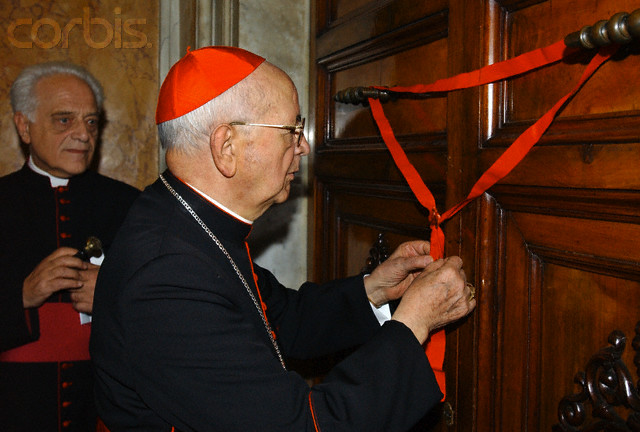
Sealing of the Pope’s Apartment : Not to be opened until the new Pope has been elected

The private residence of the Pope in the Vatican City, that is his apartment in the Apostolic Palace beside the Basilica of St. Peter is left vacant upon the death of the Pope, or in this case, the retirement of the reigning Pope, which began the sede vacante, during which no Pope is present.

Therefore, in order to avoid fraud and manipulation of papal documents of the previous Pope, and to prevent release of items that can only be done by the new Pope, the Pope’s Apartment is sealed, by a special officer of the Roman Curia, that is the Camerlengo (Chamberlain) of the Holy Roman Church, who is now Cardinal Tarcisio Bertone, who is also the Secretary of State of the Holy See.

The Camerlengo is the leader of the sede vacante transition period, and working in conjunction with the Dean of the College of Cardinals. His duties include sealing the Pope’s apartment and the destruction of the Pope’s Ring of the Fisherman, both of which meant to ensure no fraud documents can be released in absence of the Pope.

The sealing is done as soon as the Pope passed away or stepped down, and done in the presence of the Vice-Camerlengo, who is now Archbishop Pier Luigi Celata, and sealed with a silk string tied and sealed with a wax seal to ensure no one can enter the room, with the unbroken wax seal as evidence.

The room will only be opened again and the seal broken after the conclave is completed and a new Pope is elected.

Image below – from 2005 after the death of Blessed Pope John Paul II, then Camerlengo, Cardinal Eduardo Martinez Somalo sealing the Pope’s apartment

Image

Prophecy of the Popes by St. Malachy (No! The last one is not the next one, only God knows!)

To those who believe in the Prophecy of St. Malachy on the Popes :

Do not think that the next Pope will be the last one, since there is no number assigned to the last prophecy, and therefore there will be a number of Popes before the last one. After all, it is only God who knows the time, not us. To the Saint is revealed the vision of the prophecy, but the last was purposely made vague so that we will always be ready for the coming of the Lord, whenever it will be. God be with Pope Benedict XVI and his successors!

http://en.wikipedia.org/wiki/Prophecy_of_the_Popes

In persecutione extrema Sanctae Romanae Ecclesiae sedebit Petrus Romanus, qui pascet oves in multis tribulationibus : quibus transactis civitas septicollis diruetur, Iudex tremedus iudicabit populum suum. Finis.

(In the extreme persecution of the Holy Roman Church, there will sit (as the Bishop of Rome), Peter the Roman (Petrus Romanus), who will pasture his sheep in many tribulations : and when these things are finished, the city of seven hills (Rome) will be destroyed, and the ‘terrible’ Judge (Christ) will judge His people. The end.)

Even the last Bishop of Rome will likely face martyrdom for his faith in the Lord, from the enemies of His Church, in the command of the evil one, who are now increasing their attacks on the Lord’s faithful. Pray for our current Pope Benedict XVI, and whoever his successor as the Bishop of Rome will be. That our next Pope will be a great shepherd, a guide in our journey towards Christ, and a unifier of the Church!