Liturgical Colour : Green
Brothers and sisters in Christ, the readings of this Sunday refers very, very clearly to the loving nature of our Lord, God and Father, who created all of us at the beginning of time, to be the most beloved of all His creations. He is truly like a father to us all, giving us life and all that we need, and He paved the path for us in our lives, guiding us in all the things that we do, that even though we often do not realise what He had done, but He is indeed there, watching over us and leading us towards Himself.
God who loves us has prepared all goodness for us, and He has blessed us with great riches, all the inheritance which are promised to us. This is shown by Jesus, when He told the people and His disciples, of the parable of the king and the banquet, where He told them of a king who prepared a great feast and invited many people to come to His banquet.
The banquet represented the promise of good life and eternal joy with God, and just as the king intended to celebrate and be merry with all those who had been invited to the feast, God intended for all of us, His beloved creations, to enjoy the fullness of happiness with Him. That was exactly also what He intended for us at the beginning. But like the guests who refused to come and listen to the king, our ancestors beginning from Adam also refused to listen to God and His will.
The guests might have a variety of reasons for not coming to the banquet prepared for them, and we may not know them, since it was never mentioned by Jesus. But certainly, by observing our own human behaviours and reactions, surely we are able to easily predict them. The guests might have had other businesses and commitments to handle, but then we can ask, has the king not given them the notice for the banquet in advance? And what is so important that they should skip the banquet of the king for something else?
Thus the same often happens to us, as we live our lives in this world. How often is it that when God calls us and guides us to His ways, that we said no to them and quickly go about worrying about our own selves? How often is it that we prefer to follow our own hearts’ desires and wants, rather than to listen to God and follow His will for us? We often complained that God interferes in our lives on one hand, saying that we prefer to do things on our own, but on the other hand, when we are in trouble, we are also quick to blame God for not helping us when we are in need.
Brothers and sisters in Christ, men are not easy to satisfy, and our hearts continue to lead us to listen to our own desires and wants. It is within our human nature to succumb to the temptations of our flesh, and as a result, like the guests, we tend to regard our own concerns as priority, thinking about ourselves first and how to please ourselves first before that of others.
And the other possible ‘reason’ for their disobedience is indeed their laziness and sloth, preferring to remain idle in the comfort of their houses rather than to travel to the king’s palace to attend the banquet. And this we can indeed relate to ourselves, on how we tend to be slothful in this life, refusing the apparently more difficult path which the Lord offered us, and prefer the ‘easy’ and happy life which this world apparently gives.
Thus I would also like to share with you what St. Faustina Kowalska, the one who introduced the devotion to the Divine Mercy, had seen in one of her visions. She saw two paths and men who walked along these two paths. One path is a path that is filled with flowers and wonderful things, wide and pleasant to walk on, while the other path is a path filled with thorns, obstacles, and both narrow and difficult to walk on.
But then, she saw that the easy and pleasant path hide a terrible secret, that at the end, the many people who walked on that path, fell into an endless chasm that suddenly arose on the path of the road, and many were unaware of the chasm, and fell into the chasm as they walked. Meanwhile, on the narrow and difficult road, much fewer people travelled through it, but even as those who persevered on continued, when they reached the end, they found a very beautiful garden filled with goodness, where they lived on ever after.
Thus, the vision presented us yet again, that the Lord offers us goodness and the promise of eternal happiness in Him, and He will not renege on the promise which He had made and renewed over the many generations again and again. It is our choice whether we follow Him and trust in Him, or instead trust in Satan who ought not to be trusted. He leads us into damnation with him, but he is very clever indeed, and as we know in how he tried to tempt even Jesus, he offered all the goodness which he can offer us, be it food, power, wealth or glory, or other things that fulfill and satisfy our desires.
Thus we must be vigilant, and we cannot let go our our guard against the possible assaults by Satan, who awaits at every corner hoping to deceive us and lead us into harm. And that was why Jesus continued His story, by saying that after the king in his anger had destroyed all those who had disobeyed and spurned his invitation, he invited many others who were brought to his banquet instead of the first invited.
This is to highlight first the fate that all those who refused to listen to God, and prefer to follow their own paths and desires is death and destruction, just as those who walked the easy path fell into the chasm of infinite suffering in the vision of St. Faustina Kowalska. The path which the Lord offers may not seem easy, and indeed that obstacles will be plenty, but if we remain faithful to the end, we will be richly rewarded.
And then, when Jesus mentioned about the man who came to the banquet not wearing the proper banquet garment, He was in fact referring to how we lead our faith life. In being faithful to the Lord, we cannot be half-hearted, and in our effort to seek the Lord our God we cannot be divided between Him and something else. Thus, when we come to the banquet of the Lord, we too cannot be divided in our hearts, our minds and our souls.
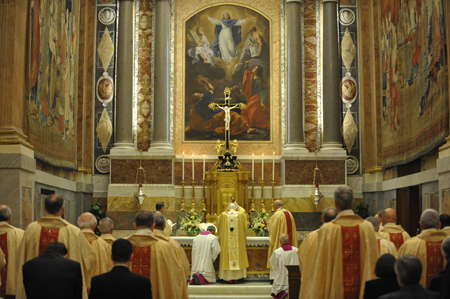
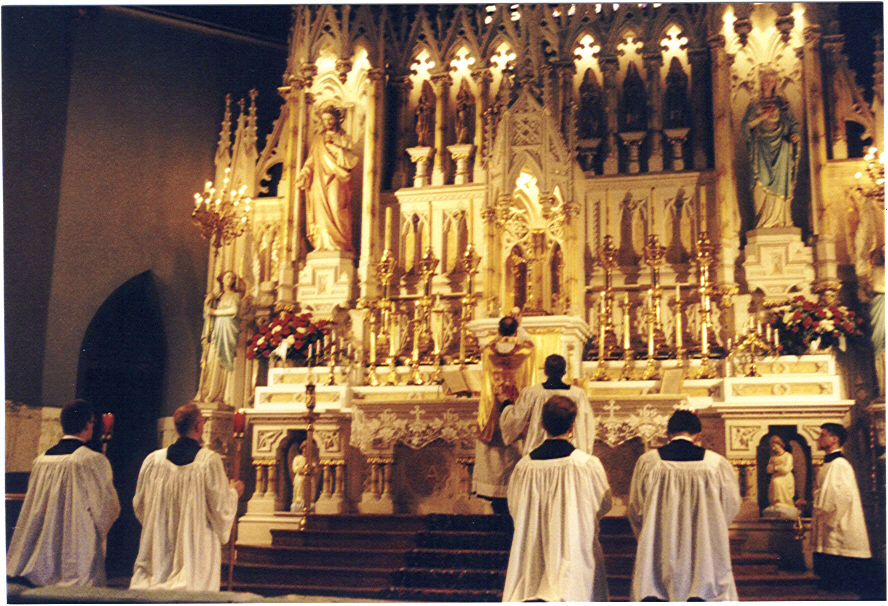
What is this banquet of the Lord which God had prepared for all of us? That is none other than the celebration of the Holy Sacrifice of the Mass, where we celebrate in unity with the singular act of God’s greatest act of love for us all, that is His sacrifice, suffering and death on the cross, where He bared Himself to all those whom He loved, offering Himself as the perfect offering for the reparation and the redemption of all of us from our sins.
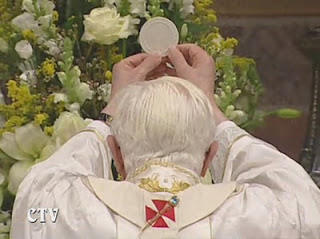
And just as the king prepared lavish food and drinks in the banquet, so thus the Lord also gave the best of all food and drink to all of us, who comes to His banquet, that is His own Precious Body and Precious Blood. Remember when Jesus said that those who eat of His Body and drink of His Blood will not die but live eternally with God? And that is the case indeed. If we are to come to attend the banquet, that is the Holy Mass, should we not then be properly ‘attired’?
This attire does not mean just that we should be properly attired with proper clothing and wear when we come for the Mass. Certainly we do not come to the banquet of the Lord wearing clothes as if we are about to go for a picnic or a leisure walk. Instead we should wear our very best and look our very best to honour the Lord our God. However, if this is as far as we go, then it is not enough.
How many of us attend the Holy Mass and yet our minds are not in the Mass at all? How many of us prefer to talk among ourselves and with our friends, and also to pay attention to our phones and other communication devices, contacting persons even outside the Holy Mass, and not to focus our heart, mind and soul to the Lord, who should be at the centre of the celebration? Ought the king not be given his proper place in his own banquet? And thus, should we not indeed give the Lord the proper adoration and respect He deserve in the Mass?
Think about these, brothers and sisters in Christ. There are two key messages which our Lord Jesus Christ and His revelations through the Scriptures want to tell us all today. First is that, we have a choice, either to follow the easier way out, that is to follow what we want and disregard the Lord, or to follow Him, and walk in His ways, even though that path might indeed be difficult and challenging. But the reward is clear, while the first path leads to destruction in the end, the path of the Lord never disappoints.
And then second, that if we choose to follow the Lord, He who loves us so much that He gave us everything, and held back not even His own Son, to bear our sins and die for our sake, that we may have life in Him, we cannot be half-hearted or be divided in our hearts, in our souls, and in our minds’ desires to follow Him. We cannot serve both God and our own heart’s desire, that is the temptations of the flesh.
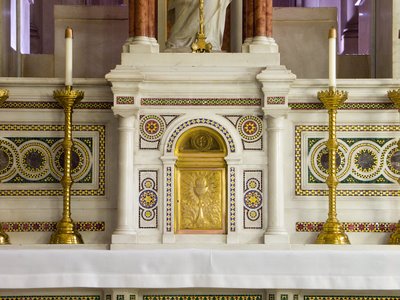
And thus, as I have mentioned, we have to give it all, at the banquet of the Lord where He had given His own Body and Blood to us, in the celebration of the Holy Sacrifice of the Holy Mass, that we have to be fully prepared and properly attired in our body, in our mind, in our soul, and in our hearts. Our focus should be completely on the Lord. Look at Him who is in the Eucharist, and focus our entire being to Him! If we do so, then He, who is the King of all, will approve of us and our actions, and justify us in our faith.
Therefore, brothers and sisters in Christ, as we go on with our lives from today onwards, let us all dedicate ourselves anew and renew our commitment to the Lord. Let us from now on attend and fully participate in the Holy Sacrifice of the Mass, giving our Lord all of our love and devotion, just as He had loved us first to the fullness of His heart, that He even gave us His life.
May Almighty God be with us all, and may He guide us to Himself, that amidst all the difficulties and challenges which we may and will indeed encounter, we may remain faithful, and with our gaze fixed at Him, may we gain the promise of eternal life, which God gives freely to all who are true to Him in faith and love. Amen.
1.284379
103.842230


 petercanisiusmichaeldavidkang