Friday, 8 November 2013 : 31st Week of Ordinary Time (Gospel Reading)

Liturgical Colour : Green

Luke 16 : 1-8

At another time Jesus told His disciples, “There was a rich man, whose steward was reported to him for fraudulent service. He summoned the steward and asked him, ‘What is this I hear about you? I want you to render an account of your service, for it is about to be terminated.'”

“The steward thought to himself, ‘What am I to do now? My master will surely dismiss me. I am not strong enough to do hard work, and I am ashamed to beg. I know what I will do : I must make sure that when I am dismissed, there will be people who will welcome me into their homes.'”

“So he called his master’s debtors, one by one. He asked the first debtor, ‘How much do you owe my master?’ The reply was, ‘A hundred jars of oil.’ The steward said, ‘Here is your bill. Sit down quickly and write fifty.'”

“To the second debtor he put the same question, ‘How much do you owe?’ The answer was, ‘A hundred measures of wheat.’ Then the steward said, ‘Take your bill and write eighty.'”

“The master commended his dishonest steward for his astuteness : for the people of this world are more astute, in dealing with their own kind, than are the people of light.”

Monday, 21 October 2013 : 29th Week of Ordinary Time (Gospel Reading)

Liturgical Colour : Green

Luke 12 : 13-21

Someone in the crowd spoke to Jesus, “Master, tell my brother to share with me the family inheritance.”

He replied, “My friend, who has appointed Me as your judge or your attorney?” Then Jesus said to the people, “Be on your guard and avoid every kind of greed, for even though you have many possessions, it is not that which gives you life.”

And Jesus continued with this story, “There was a rich man, and his land had produced a good harvest. He thought, ‘What shall I do, for I am short of room to store my harvest? Alright, I know what I shall do : I will pull down my barns and I will build bigger ones, to store all this grain, which is my wealth.’”

“‘Then I will say to myself : My friend, you have a lot of good things put by for many years. Rest, eat, drink and enjoy yourself.’ But God said to him, ‘You fool! This very night your life will be taken from you. Tell Me who shall get all you have put aside?’ This is the lot of the one who stores up riches for himself and is not wealthy in the eyes of God.”

Monday, 12 August 2013 : 19th Week of Ordinary Time, Memorial of St. Jane Frances de Chantal, Religious (Gospel Reading)

Liturgical Colour : Green or White (Religious)

Matthew 17 : 22-27

While Jesus was in Galilee with the Twelve, He said to them, “The Son of Man will be delivered into the hands of men, and they will kill Him. But He will rise on the third day.” The Twelve were deeply grieved.

When they returned to Capernaum, the Temple tax collectors came to Peter and asked him, “Does your Master pay the Temple tax?” He answered, “Certainly.”

Peter then entered the house, and immediately Jesus asked him, “What do you think, Simon? Who pay taxes or tribute to the kings of the earth : their sons or the other people?”

Peter replied, “The other people.” And Jesus told him, “The sons, then, are tax-free. But so as not to offend these people, go to the sea, throw in a hook, and open the mouth of the first fish you catch. You will find a coin in it. Take the coin and let it pay for you and for Me.”

My Prayer Intention for Sunday, 4 August 2013

1. For all of us. That we will always be reminded that our lives in this world are short, and the times and happiness that we have in our world is temporary. That we may use whatever time given to us in this world to the fullest, to the greatest potential, in serving the Lord and our fellow brethren, with love, compassion, and dedication. May we focus on seeking true happiness and joy in the Lord, and in the happiness and joy of our brothers and sisters, that we may share that happiness and joy with one another.

2. For people working in financial institutions and money-related careers. That they will not lose sight of their true goal in life, that is the Lord and His love, and that they will not succumb to the temptation of money and wealth, remaining faithful to their true vocation in life. May they be able to discern that the true objectives of their career is to make a difference in the lives of others through their own work in its various ways, and not to seek to increase their own personal wealth, especially not in the expense of others.

3. For our leaders and those in positions of power. That they will use their power and the authority entrusted to them by us and by the Lord with full sense of responsibility and clear understanding. That they will first seek to serve others and look for their own good before thinking about their own self. May our leaders be dedicated and loving leaders and people of justice, integrity, and love, who are dedicated to serving the people of God with zeal and commitment.

4. For all of us. That we will treasure all our loved ones, our families and friends, whom we had met in our lives, and those who had made a difference in our lives, in their own ways. May the Lord show us and open our eyes, that we still have those who love us, and we have the Lord Himself who loves us all the time, that we will begin to treasure this life we had been given, and give thanks to Him who had breathed the breath of life into us, mere dust made alive.

May the Lord accept our humble prayers, and may His saints and angels succour always in times of need, in our times of difficulties, reminding us always that the Lord is always with us, walking with us, and supporting us without ceasing. God be with us all and may His blessings and graces remain with us at all times. Amen.

Friday, 5 July 2013 : 13th Week of Ordinary Time, Memorial of St. Anthony Zaccaria, Priest (Scripture Reflection)

Brothers and sisters in Christ, today we reflect on the calling of Matthew, who was a tax collector, and according to the Pharisees, a sinner. He was called from his custom-house and followed Christ, eventually to become one of the Twelve Apostles and one of the Four Evangelists, who wrote the Gospel of Matthew, which passage we are reading today.

Why did the Pharisees consider the tax collectors as sinners? We should understand the history and condition of the region at the time, of the region called Palestine today, and Judea at that time. At the time of Jesus, Judea was still a semi-independent kingdom, led by a king, Herod Antipas at that time, the son of Herod the Great, who tried to kill Jesus as a baby. But despite the semblance of independence generated by the presence of a ‘king of the Jews’ in Herod, the Romans, which had become an Empire by that time, had the overall command and control as the master of the people of Judea.

The Romans established an efficient taxation system throughout their Empire, and that made up the main source of their annual income, and Judea is no exception to the rule. The people of Judea, including the Jews, had to pay their taxes to the Roman authorities, and this was greatly despised by the Jews, particularly the Pharisees and the teachers of the Law. Not just because it showed a subordination to the greater Roman authority, but it seemed that it also contradicted the fact that one should obey and give honour to the Lord alone.

The Roman coins used in the tax payment itself could be considered blasphemous by the Jews at the time, because every single coins were engraved with the facial image of the Emperor, and therefore could be considered as tantamount to idolatry, worship of the Emperor, as what was indeed happening in Rome at that time, as Emperors increasingly became more autocratic, they also attributed more divinity towards themselves, and would in time be established as the cult of the Emperors, where the Roman Emperors were worshipped as divine, living in the flesh.

All these sparked the notion that paying taxes to the Romans was a detestable idea at best, and the people did not like it for certain, for other than the religious reasons, taxes also burdened them financially, and that was why, out of all people, the tax collectors were always considered to be at the bottom of the society and were considered, particularly by the ‘pious’ Pharisees, to be morally corrupt and unworthy as well as incapable of redemption.

The tax collectors were treated and condemned as sinners, even though they might actually be good people. Remember that tax collectors often had no choice to be one, because they themselves had to earn a living, and it was indeed not an easy job to be done, as I had mentioned, being tax collectors meant that one had to endure the hatred and displeasure of the general population, the priesthood, and many other people, and endure the label of evil placed unfairly onto them.

The Jewish people themselves were very nationalistic in nature, and were very proud of their descent from Abraham, their forefather both in blood and faith. They kept mostly to themselves and married one another, in order to prevent themselves from being tainted by the pagans around them. This had happened since the time of Abraham himself, as you would have noted in our first reading today, who asked Eliezer his servant to find a wife for his son, Isaac, from among his own people, his own family, and not among the women of Canaan.

This had further made the contempt given to the tax collectors and other Roman collaborators even greater. They were barely tolerated in the society, cursed and rejected by many. They may be able to survive financially, but in terms of their lives, it was truly miserable. This was the condition that formed the backdrop of the situation as it was when Jesus called Matthew to be His disciple, and when He ate with him and his fellow tax-collectors in his house with the Pharisees.

Jesus then highlighted His mission in this world to His disciples, the Pharisees, and the tax collectors, that is to heal the world and those afflicted in this world, those who are condemned to damnation in hell, those who are suffering, those who are immersed deeply in the darkness of sin. That is because these are the ones who really need help and assistance in order to ensure that they will not fall into hell. God loves all, everyone, especially the greatest of sinners, who are in greatest need for God’s mercy and love.

That is because those of us who had been saved, and had been following the commandments of the Lord will remain safe, as long as we keep the Lord’s commandments and stay in His grace. As long as we remain faithful to the Lord, no harm can come our way. That is why it is those who are ‘sick’ from sin and evil would need much more assistance and help than we do. But we should not let Christ do that alone, but we ourselves, as the children of God, can also play our part in ensuring the salvation of all, especially those whose sins are the greatest.

The Pharisees themselves, who considered themselves most pious and blessed of all the children of God because of their strict adherence to the Law of Moses, were in fact in great need of salvation themselves. They had indeed observed ‘sacrifices’ so much that they had forgotten ‘mercy’, and forgotten love. God desires not sacrifices from man, but their love, both towards Him and towards His other children, our brothers and sisters.

The Pharisees did not love and do the true will of God, and instead became too focused on their own strict laws made by men, and even condemned those so-called sinners such as prostitutes and tax collectors as morally bankrupt and evil, while in fact, it is they themselves who were deep in the darkness, and worse still, blind to their own inadequacies and iniquities.

Today, brothers and sisters, we also commemorate the feast day of St. Anthony Zaccaria, a priest who lived in the late Renaissance era Italy. He was a priest who placed a great emphasis on the love of God and the teachings of the Church as espoused by St. Paul and the Apostles. He put the emphasis on acts of love and mercy, in addition to devotions and prayers, that made the faithful become even more devout and strong in their faith.

St. Anthony Zaccaria showed to the people of his time that to love God, is to both worship Him in prayer and supplication, in the offering of the ‘sacrifice’ of our hearts, the true sacrifice that our Lord wants from us, and also to make our love evident through our own deeds and actions, so that the love that is in us will not be an empty love, but a vibrant love in both word and action.

Therefore, following the zeal and example of St. Anthony Zaccaria, let us be loving person, loving children of God our Father, who is Love. May all of us truly show our love for Him through our complete dedication to Him, and also our loving service to our neighbours, particularly those in greatest need of help.

May the Lord be with us and remain with us, blessing us with His love and mercy at all times. St. Anthony Zaccaria, pray for us. Amen.

Peter’s Pence Collection, Solemnity of Saints Peter and Paul, Apostles

Peters Pence

In case any of you are wondering what is Peter’s Pence, which is collected every Sunday nearest to the Solemnity of Saints Peter and Paul, Apostles, which falls on 29 June every year (Therefore this year Peter’s Pence is collected on Sunday, 30 June 2013, 13th Sunday of Ordinary Time), Peter’s Pence is a special collection in which the collection will not go into the local church or parish fund, but gathered from all over the world and sent to Rome, to the Holy See. Thus, the collection made during the offertory this Sunday will go directly to Rome.

What is the purpose of the Peter’s Pence collection? Exactly to support the numerous charitable activities and organisations managed by the Holy See, by our Church, all over the world. There are thousands, tens of thousands of charity under the supervision of the Church, and to be able to continue with the action, funds are definitely necessary to provide a solid backing. That is why, Peter’s Pence is done once every year, on the Sunday nearest to the Solemnity of Saints Peter and Paul.

1045213_354782624625355_1349576998_n

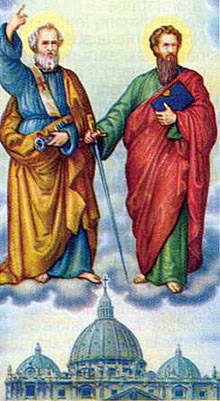
Why Solemnity of Saints Peter and Paul? That is because on that day lie the great celebration of the two great saints and apostles that defined our Church, because they met their martyrdom in Rome. St. Peter, the Prince and leader of all the Apostles, whom the Pope is the successor of today, met his martyrdom in what is now Vatican City, through crucifixion, and St. Paul, the Apostle to the Gentiles, and author of the Epistles in the New Testament, met his martyrdom in Rome, through beheading.

Peter’s Pence itself had its origins in the late dark ages and early medieval period, particularly from England, where it got the name Peter’s ‘Pence’. Pence is the unit of money still in use until today in the United Kingdom and the related monetary units. ‘Peter’ simply point to the fact that the collection or ‘pence’ is intended to be sent to Rome, to the Pope, in order to support various Church activities.