Details on the Papal Inauguration Mass and ceremony of Pope Francis, 266th Pope and Bishop of Rome

Mass appeal: some details of tomorrow’s papal inauguration—UPDATED

Today, Tuesday, 19 March 2013, our new Pope will be solemnly inaugurated to begin his Pontificate. He is already our Pope, ever since he accepted the rightful election in the Conclave, but the Inauguration ceremony affirms and completes that process, with the imposition of the symbols of the authority of the Pope, as the leader of the entire Universal Church.

There will be some changes to the liturgy this year, as the imposition of the Pallium and the Ring of the Fisherman will take place just before the Mass starts, instead of being within the Mass itself, as the impositions are seen as more of an extra-liturgical event.

The Pope will pray with the leaders of the Eastern Catholic Churches, the Patriarchs and Major Archbishops at the Tomb of St. Peter underneath the main altar of St. Peter’s Basilica, where the pallium and the ring had been placed since the night before.

The Pope will then proceed with all the other concelebrating Cardinals and prelates outside to the Altar at St. Peter’s Square, which in the meanwhile the Laudes Regia hymn or ‘Laud to the King (Christ)’, that is a glorious rendition of the Litany of the Saints, with the new innovation of the inclusion of part asking the past Popes who had been canonised as saints for the new Pope, their successor, beginning from Pope St. Linus to Pope St. Pius X.

Following after this is the imposition of the papal pallium, which is different from the pallium worn by the Metropolitan Archbishops. Pope Francis’ pallium will be the same in appearance with that of Pope Benedict XVI’s pallium, with red crosses instead of black ones, representing the wounds of Christ, with three gold pins on three of the crosses, representing the nails that bound both hands and the legs of Christ onto the cross. The pallium symbolises the authority the Pope has over the entire Universal Church. The pallium will be imposed by the senior Cardinal of the order of Priest in the Cardinal-electorate, Cardinal Godfried Danneels.

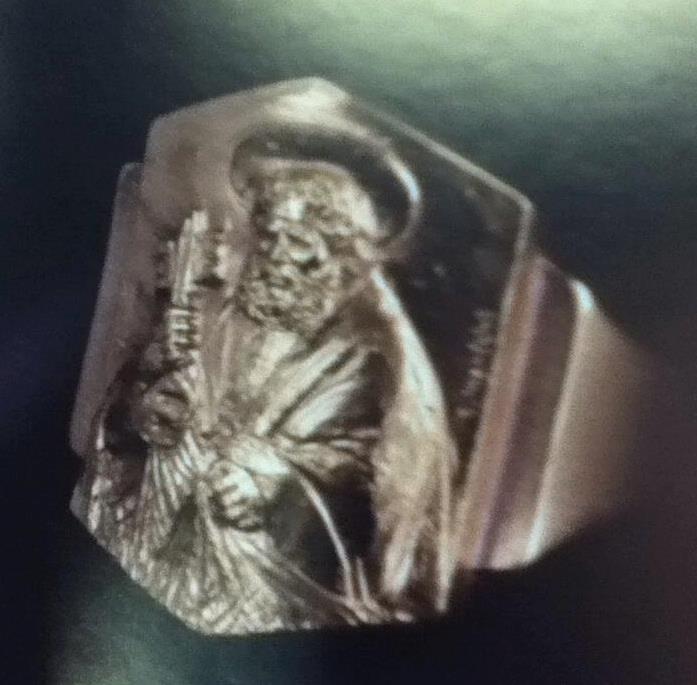
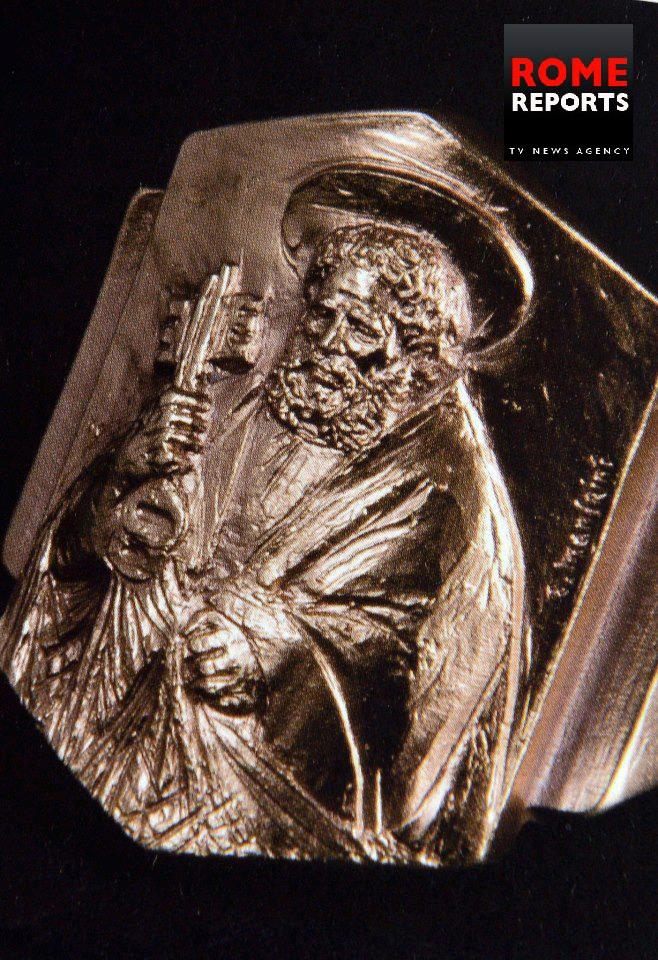
The Ring of the Fisherman will be given after this, which signifies the bond between the Pope and God’s Church, and as the image on the ring depicts, that of St. Peter holding the keys on a boat, while fishing, as a fisher of man, it symbolises the Pope’s role as the successor of St. Peter the Apostle, and also as the current holders of the keys of the kingdom of Heaven, entrusted by Christ to Peter. The ring will be presented to the Pope by the senior Cardinal Deacon, Cardinal Jean-Louis Tauran.

Six Cardinals representing the rest of the Cardinals will pay homage to the Pope, and will give their obedience to him, following the imposition of the pallium and the Ring of the Fisherman.

The Mass follows as usual, and the readings will be done in different languages, English, Spanish, and most notably the Gospel in Greek, to highlight the universal nature of the Church, encasing both the Western and Eastern tradition of Christendom. The whole liturgy of the Mass itself will be conducted in solemn Latin and beautiful Gregorian chants.

The booklet for the Mass is available at the link below, in English, Italian, and Latin :

Click to access 20130319_inizio-ministero-petrino.pdf

Ring of the Fisherman for Pope Francis, 266th Pope, Successor of St. Peter the Apostle, leader of the Universal Church

Image

Another image from Rome Reports

6719_10151417713052928_1657486910_n

Pope Francis’ Ring of the Fisherman, which is one of the symbol of the authority as the Pope, as both a bishop (episcopal ring) and the Successor of St. Peter the Apostle, leader of the entire Universal Church. It will be given to Pope Francis at the celebration of the Papal Inauguration Mass, on the Feast of St. Joseph, Tuesday, 19 March 2013, together with another symbol, that is the pallium.

The ring’s image closely follow that of Pope Benedict XVI’s Ring of the Fisherman, with slight difference in the shape of the ring, and the ring being made of gold-plated silver instead of gold. Depicted on the ring is the image of St. Peter holding onto the keys of the kingdom of heaven, and fishing, as he was a fisherman, but called by God to be a ‘fisher of man’.

My personal thoughts on the election of Pope Francis I and the current state of the Church

I can only hope that Msgr. Guido Marini, the Master of Pontifical Liturgical Celebrations (Papal MC) can indeed stay where he is, as many uttered their concern whether he will still stay as papal MC given the apparent change in this new Pope.

As this is just the first day, I do not know much yet about the direction that our new Pope, Francis I, will bring us all, but I hope that he will not overemphasize inculturation and liberation for the sake of evangelisation, as what was once done under Archbishop Marini, the previous papal MC, but rather focus and renew the spirit of the liturgy as was done by Pope Emeritus Benedict XVI when he was Pope, with the help of Monsignor Marini as the chief liturgical reformer.

There is a need to balance between tradition and innovation, and not to tilt too far to the other side. Already these past few years we had seen a great rebound in the number of seminarians joining the seminary, and also the growing accustomisation among many people all over the world of the use of Latin in the Mass, despite of course emphasis remaining on the vernacular language.

Already, many apparently made comments (as I do) on his choice of not wearing the mozzetta and the stole upon making his first appearance, despite the proper winter papal mozzetta had been prepared for the new Pope. These are little things, but I hope this won’t be a precedent, which if not carefully handled, may undo many of the great things and reforms of the reform of Vatican II that had been painstakingly done in the past few years, and have begun to bear fruit in the Church today.

Balance is important. Already we have seen in many cases after Vatican II, churches and groups going too far towards innovation and liberal thoughts that ended up losing their very Catholic identity. What we need is to preserve our tradition, and yet remain open for innovations that can help new evangelisation, and evangelisation must also be carried in the spirit of the preservation of Apostolic teachings and traditions, and not conform to what the world think, that is relativism.

Social media like twitter, Facebook, blogs, and many others are these great innovations that can help spread the teachings of the Church, and yet let us not be like many Catholics, particularly in the USA, which had been commented as being ‘market Catholics’ where they pick and choose what they want to believe in, as long as it suits them, and reject those that they feel don’t fit with them. No, to be a Catholic means accepting the whole teaching as a whole, and not taking just those parts that you like, and discard the rest.

I need to add that going into extremes into the other direction is also abhorred, as what was made obvious by the SSPX Society, which continued to linger in their ultra-conservatism, and refused to take in several important modifications made by Vatican II.

Just some examples : We no longer blame Jews for the death of Christ, and instead they are our elder brothers in faith, having been chosen and called by God first among all nations.

Then, although indeed I firmly believe in salvation only through the One Church of Christ, but I also believe in the Universal Call to Holiness (by Blessed Pope John Paul II), and there are righteous people outside the Church, who do God’s will, but lacking only the necessary faith in Christ, but that doesn’t mean that they are immediately condemned to hell for that. It is our task to bring the Good News and salvation to them, which can be done through new evangelisation, rooted firmly in tradition and prayer.

However, one wish that I want to make is that, I hope Pope Francis I can thoroughly reform the Roman Curia, to purge from it all ties to corruptions and evil, and to purify our Holy Church that it will once again be immaculate and pure as it should always be, as the One, and only Church God had established in this world, through Peter the Apostle.

And I am touched by his selection of name, Francis, which honoured both St. Francis of Assisi, whom I held in high regard, and St. Francis Xavier, the great missionary and co-founder of the Jesuits (with St. Ignatius Loyola) whom Pope Francis I is a member of. St. Francis Xavier is close to my heart as he is also the patron saint of my early education, and which helped me to learn about the faith, and eventually welcomed into the Church.

I am also deeply touched by his humility, especially when he asked that the people pray for him, and even bowed down to show his humility, which does remind me to another Pope, John Paul I, whose motto is Humilitas, but as history went, he did not have the time to accomplish much. Therefore I hope, the legacy of Pope John Paul I can be continued in Pope Francis I, who had the same quality and personality as Pope John Paul I.

However, humility and simplicity must not lead to the simplification of our faith, but rather let these be tools to further deepen our ties to our faith, and understand more about it.

I noted that Pope Francis I is deeply devoted to the Virgin Mary, whose name is part of his personal name, Jorge Maria Bergoglio. He will be another Marian Pope in the likelihood of Blessed Pope John Paul II. It is important for us to have a strong devotion to the Virgin Mary, as she is the best helper that we can have, in guiding our way towards the Lord, and ensuring that we do not go astray from our path.

May God bless our new Pope Francis I, and at this important juncture at the beginning of the new Pontificate, I hope that the Holy Spirit that has elected him to carry this task, will also guide him, that he will make correct choices that will continue the good works that began with Blessed Pope John Paul II, and was accelerated by Pope Benedict XVI, now Pope Emeritus.

Press briefing on the conclusion of the General Congregations of the College of Cardinals

The Ninth General Congregation of the College of Cardinals have been concluded this Saturday morning, 9 March 2013, and as the date of the beginning of the Conclave came closer (Tuesday, 12 March 2013), Fr. Federico Lombardi, head of the Holy See Press Office clarifies certain matters involving the sede vacante period and the upcoming Conclave.

The Conclave will be preceded by a Solemn Mass for the Election of the Roman Pontiff or the Missa pro Eligendo Pontifice/Papa on Tuesday morning, 12 March 2013 in St. Peter’s Basilica, and then on the same day, Tuesday, in the afternoon, the Cardinals will proceed into the Sistine Chapel to officially begin the Conclave.

The famous chimney which will release the signal whether a new Pope had been elected, had been installed on the roof of the Sistine Chapel on Friday morning, after long work by the technicians in the installing the two stoves where the ballots will be burned after the ballots, and the chimney itself, linked directly to the stoves inside the Sistine Chapel.

The Ring of Fisherman, two papal stamps bearing the image of the Ring of the Fisherman, and the master lead seal, also bearing the Ring’s image, which is used for major documents, have been decommissioned by defacement of the Ring’s image, and therefore while the Ring of the Fisherman has not been completely destroyed,

A commission has been created to ensure that the Conclave has indeed been sealed entirely from the outside world, with no external portal of entry and ensuring that no one tampers with the seal of the Conclave until a new Pope had been elected. Strong frequency and signal jammers had also been installed to prevent any wiretapping and bugging of the Sistine Chapel and the areas where the Cardinals will reside throughout the Conclave.

It is noted that if the Conclave has not been successful to elect a new Pope after three full days (a new Pope can only be elected if he receives more than two-thirds of all the votes of the Cardinal-electors, or 77 votes), the voting sessions will be adjourned for a day of prayer and reflection, so that in the event of the upcoming voting sessions, the Cardinals can gain a new inspiration of the Holy Spirit and therefore hopefully elect a new Pope as soon as possible.

The Motu Proprio released earlier by Pope Benedict XVI in 2007 has modified the rules of the election as written in the Apostolic Constitution Universi Dominici Gregis, as it no longer allows the Cardinal-electors to revert to an absolute majority system once a certain number of days have passed (many days), and the Motu Proprio once again made the election of the new Pope by two-thirds majority alone.

The bells of St. Peter’s Basilica and also the other bells of the churches throughout Rome will also be rung once the new Pope had been elected, just as they were in 2005 conclave, to reinforce and affirm the white smoke signal released through the chimney of the Sistine Chapel.

About 45 minutes or more may pass between the election of the new Pope and his appearance on the Loggia or the balcony of the St. Peter’s Basilica, as there are rites that the new Pope had to go through in the time between, beginning with the acceptance of the election, the entry into the Room of Tears where the Pope will change into his new white Papal cassock, and then homage from all the Cardinals, and of course the announcement of the Habemus Papam by the Cardinal Protodeacon, Jean-Louis Tauran himself, before the new Pope will make his appearance on the balcony.

Friday, 1 March 2013 : 2nd Week of Lent (Scripture Reflection)

We are urged today, not to have evil thoughts on our brothers and sisters today, as illustrated earlier in the story of Joseph in the first reading and the psalm, and how he was sold off in slavery to Egypt due to his brothers’ jealousy, which caused them to initially harbour evil thought of killing him. The same evil intent and plot also happened in the Gospel when the tenants disposed of the servants and the son of the landowner, in the intention of gaining the lands they have been lent with, and disobeying the owner’s wish.

We should not harbour such evil intent, but instead look upon our brothers and sisters with love. Especially, just as Christ has taught us, we should even also look upon our enemies and our persecutors with love! and pray for them too!

And then indeed, the story of the Gospel today, as many of you would know, is a parable on the life of Christ Himself, with the Pharisees and the chief priests being labeled as the evil tenants, as obviously stated in the Scripture. Jesus is the Son of the owner, who is God the Father, who sent Jesus to us, down to earth, just like the owner sent his son in the hope that he will be able to bring the tenants into line and pay up what they are supposed to pay.

But yet, the rejected ones, as we had seen, in both Jesus and Joseph, had become a great instrument of the Lord through their rejection by the people, represented by the brothers of Joseph and the tenants in the Gospel. For Joseph became the regent of Egypt through the gift of prophecy through dreams granted to him by God, which saved thousands if not many more souls from death, by the wise and ample preparation before famine ravaged Egypt for seven years. All these would not have happened without Joseph and his dreams.

Even greater is therefore the role of Christ, for in being rejected by the people, the ‘tenants’ particularly the chief priests, teachers of the Law, and the Pharisees, He has become the very instrument of salvation of all mankind. This rejection was represented by the arrest of Jesus, His trial by the Sanhedrin, leaders of the priests of Israel, and finally His condemnation to death, and His death on the cross. In this He, as the rejected stone by the builder, had become the cornerstone, the very vital part of God’s plan of salvation.

What is a cornerstone? While we do not often use the terms in daily life, architects and those dealing with infrastructure and buildings will know it very well. For cornerstone is named so, since, at the time of the Roman Empire, there is a passion for building commemorative and triumphal arches. Some of these arches can still be seen even today, and some remained in the city of Rome itself. Why are these arches so strong and so solid to be able to stand for centuries and even millenia? It is because of its structure, which is so wonderfully constructed even without modern technology to keep them intact, all just because of one single stone at the peak of the arch, which is called the cornerstone.

This cornerstone is the focal point and the most important point of the arch. For if the cornerstone is removed, the arch will immediately crumble. As long as the cornerstone remained in place, removing other stones from the arch would have minimum impact on the arch’s integrity. Similarly, cornerstone can also be found in other buildings, also known more as the foundation stone. This stone holds up the integrity of the whole building by just being there, and as long as the stone stands, the building will too.

Christ therefore, has become our cornerstone through His death and sacrifice on the cross, and later His glorious resurrection and triumph over death and evil. Why is He our cornerstone? That is because if we keep our anchor on Him, keeping faith in Him, and ensuring that our faith is anchored deeply and securely in Christ, no amount of worldly temptations, and no amount of attacks and persuasions by evil can sway us and make us to fall away from the grace of God.

Through Christ who is our cornerstone, we then can act out His love and compassion on all mankind, for only if we anchor ourselves in Christ, that we can act with love and kindness, out of our faith in God who also loves us dearly that He did not even hold back His Son to be given to us for sacrifice to liberate us from eternal damnation.

Then Christ too established His Church, our Church, as the living and concrete presence that represents Him and His mission in this world, and there was none other than Peter the Apostle, upon whom, as the Rock, Christ chose to build up His Church, making Peter the cornerstone of His Church, the Body of Christ, which is made up of all of us the faithful in Christ.

Now, that our Pope, Benedict XVI, who was the 264th successor of St. Peter, had stepped down from his position as our Pope effective today, our Church, God’s Church, has been left without that cornerstone of faith, which has been passed down since the day of Peter, the first cornerstone of the Universal Church. We still have Christ of course as our Cornerstone, on whom all hearts and minds must be directed to, but it is through the Apostle Peter and his successors, the Popes, that this is made manifest, by them being the cornerstone of God’s living presence in this world, that is the One, Holy, Catholic, and Apostolic Church.

Therefore, today, and through the sede vacante period, and beyond that, let us pray, brothers and sisters in Christ, that first, we all will remain ever faithful, and that our anchor of faith will ever be solidly planted in the cornerstone that is Christ our Lord, always remembering His rejection and sacrifice on the cross that made Him the cornerstone of our life, the cornerstone of salvation, that enabled mankind to return and be reunited with God.

And then, we also pray in particular for our Church, that God will guide the Cardinal-electors who will elect a new Pope to succeed our beloved Pope Benedict XVI, with the guidance of the Holy Spirit sent by God upon all of them. That the world will again have a tangible cornerstone that is the successor of St. Peter, who made the Cornerstone of Christ manifest and real in this world, as the cornerstone of God’s most Holy Church, and as the cornerstone and head of the Body of Christ, the Church, leading all the faithful in Christ in unity with Christ their Saviour.

In the end, the cornerstone, although important, still requires the presence of all of us, the stones surrounding the cornerstone, for the cornerstone by itself will not make a building. Therefore, brothers and sisters in Christ, let us support the new Pope, whoever he will be, as all the people who believe in Christ, that the new Pope, the future cornerstone of the Church, will together build up a solid and strong Church, that is able to project God’s love and work into this world, that more and more people will be saved.

May God bless all of us, bless His Church, bless our retired Pope Emeritus Benedict XVI, and his soon-to-be elected successor. Amen!