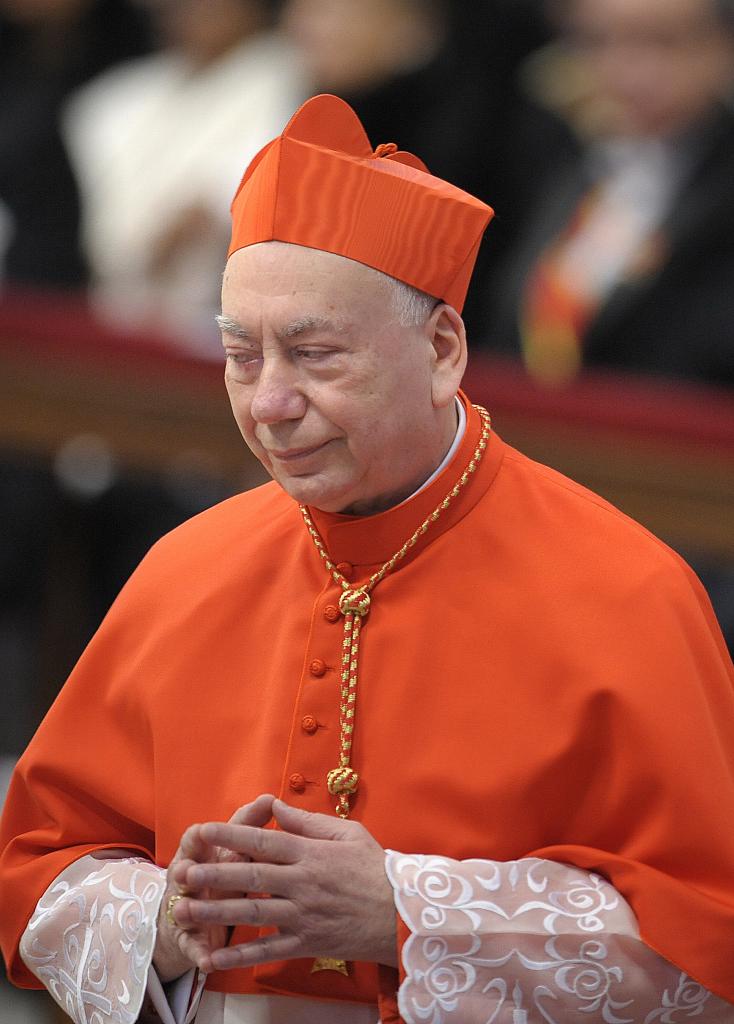
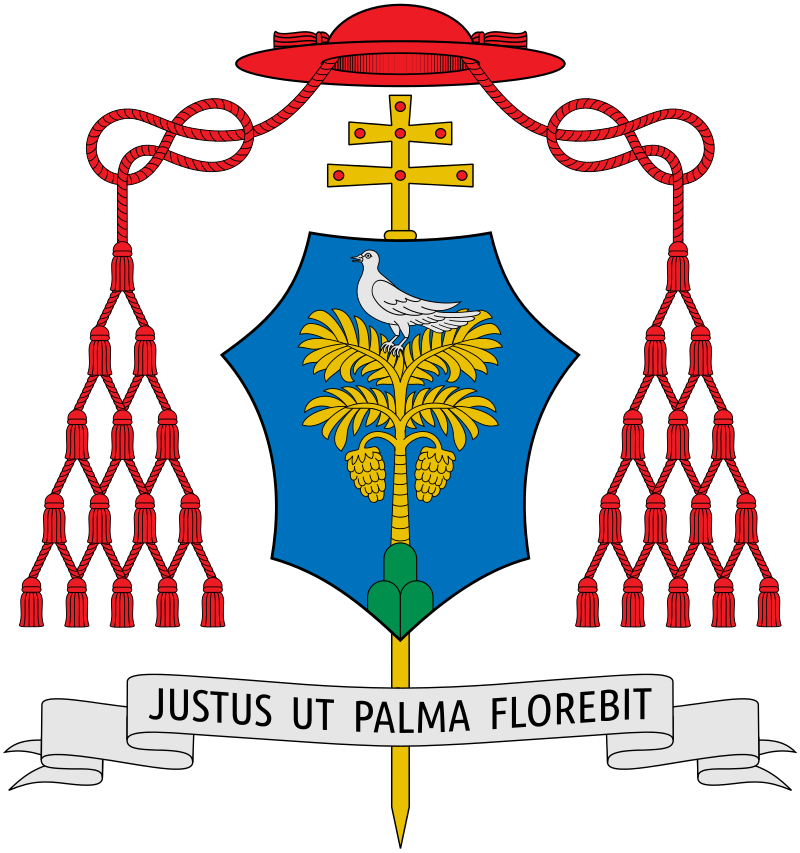
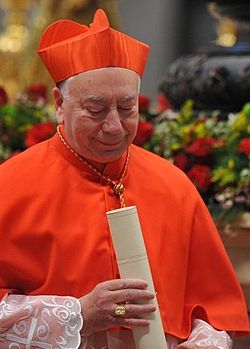
(College of Cardinals Update) Cardinal Francesco Coccopalmerio (Italy), President of the Pontifical Council for Legislative Texts turned 80 and becomes ineligible to participate in a future Papal Conclave

Cardinal Francesco Coccopalmerio, Cardinal Deacon of San Giuseppe dei Falegnami, President of the Pontifical Council for Legislative Texts has turned 80 on Tuesday, 6 March 2018. Therefore, in accordance to the Apostolic Constitution Universi Dominici Gregis, he can no longer vote in a future Papal Conclave.

Cardinal Francesco Coccopalmerio was the Auxiliary Bishop of Milan from 1993 to 2007. In 2007, he was appointed as the President of the Pontifical Council for Legislative Texts, a position he held until the present day.

He was made a Prince of the Church, as the Cardinal Deacon of San Giuseppe dei Falegnami at the Consistory of 18 February 2012 by Pope Benedict XVI, the Vicar of Christ.

We pray for Cardinal Francesco Coccopalmerio, that even in his retirement years, he may continue to inspire the faithful and the Church, and keep strongly the teachings of the Church. May he have a good health and be blessed all the days of his life. Ad multos annos!

Currently, there are 117 Cardinal-electors in the College of Cardinals, which means that there are 3 vacancies for Cardinal-electors available at the moment. The next Cardinal to age out will be Cardinal Manuel Monteiro de Castro, Major Penitentiary Emeritus of the Apostolic Penitentiary (Italy) on 29 March 2018.

Monday, 29 December 2014 : Fifth Day within the Octave of Christmas, Memorial of St. Thomas Becket, Bishop and Martyr (Homily and Scripture Reflections)

Liturgical Colour : White

Dear brothers and sisters in Christ, today we hear about listening to God and obeying His laws, and fulfilling the commandments which He had given to us. It is highlighted in the first reading today from the first letter of St. John the Apostle, that as the servants and disciples of God, that we have to live out our faith and be concrete in that faith, showing it in our actions, words and deeds, and not doing what is contrary to the teachings of our Lord Jesus.

If we call ourselves as the children of God and as the members of His Church, then we have to behave as one. We cannot profess to be the children of God, and yet our actions prove to be completely otherwise. The very reason why it has been so difficult for many to believe in Christ and indeed why many of them refused to believe in Him is because we who are the disciples of Christ preached about Him but we did not practice what we preached.

How can they believe in us and in what we preached to them if we ourselves did not embody what we have preached. Instead, we become an embarrassment of the Faith, and our Lord will not be pleased at us. Not only that we have failed to observe His laws and commandments, but we have also made others to lack the faith in Him because of our own wicked actions and deeds, not in line with what we preached.

Therefore, we have to mean what we say, and we have to act on what we believe in. Otherwise, our faith in God is empty and meaningless, and instead of salvation we will gain condemnation from God and eternal punishment. St. James in his epistle, the letter of St. James, highlighted in it that faith without works is essentially the same as dead. That means faith without action based on that faith is a useless one and indeed, as I have elaborated, this kind of faith is harmful to us.

Yes, and that is the same faith which the hypocrites committed. The Pharisees and the scribes of the Law whom the Lord condemned as hypocrites were externally and outwardly seeming to be pious and good servants of the Lord, but in reality, they have no God in them, for whom they spared no place in their hearts. They preached faith and devotion to God and trumpeted their devotion loud for others to see, and yet they did these for themselves and to satisfy their own vanity.

Jesus condemned them precisely because they have no regards for the Lord and did not obey His laws and commandments as they should have. They have besmirched the Name of the Lord and spat on His precepts. They cared not for the Lord nor for His people but for their own self-aggrandisement. They were the ones who should have recognised the Christ when He came, and yet they doubted Him, rejected Him and laid difficulties along His works and His paths.

Our actions must not be like that of theirs, and instead we have to do as we believed, and we have to act in the way not contradicting the very Creed we profess. And this is what we can learn from the saint whose feast we are celebrating today, namely St. Thomas of Canterbury, also known by his name, St. Thomas Becket, the Archbishop of Canterbury during the high Medieval age of the twelfth century, during the reign of King Henry II of England.

St. Thomas Becket was a devoted man of God, who followed the will of God wholeheartedly and who took the laws and commandments of God seriously in his heart. He was particularly staunch at the enforcement of the law of God and the Church. He was once a servant of the king entrusted with many matters because of his skills in management, appointed to chancellorship by the king.

The king had hoped that if he appointed St. Thomas Becket to the position of the Archbishop of Canterbury, the primate of England and the chief of the religious officer of the state, he would continue to show preference to serve the king and the state as he had been before. But St. Thomas Becket would prove him to be wrong. He was a faithful and pious servant of the Church, who did not mince his words and who was sorrowed by the great corruption in the lives of the king and his servants.

St. Thomas Becket practiced his faith faithfully to the core of its foundations, fulfilling the teachings of Christ. He showed mercy and love to sinners who sought God’s help, but to those who were wicked and unrepentant, and to those who persisted in their love for the world, he had no love for them. He excommunicated and expelled many from the Church those who had followed the path of the Pharisees, getting themselves rich at the cost of others and those who have caused untold sufferings for many.

He gained the enmity and hatred of many in the king’s court and circles, and this eventually led to a group of knights who plotted to assassinate him as he celebrated the solemn prayers. He was assassinated in cold blood at the holy places, while he surrendered himself completely to God. Those who were involved in the assassination including the king were punished severely by the Church, excommunicated and asked to do serious and long series of penance for their murder of the holy man of God, who was canonised as a martyr and saint soon after his murder.

Brothers and sisters in Christ, the example of St. Thomas Becket should inspire us all to walk and practice our faith with genuine intention and devotion to our God. If only that all the faithful would emulate his upright life and devotion to his Faith, then the whole world would have been converted upon seeing our brilliant examples and dedication to the way of the Lord.

It is therefore necessary that we mean what we say, and if we are to preach the Word of God, then we have to mean what we preach and practice it ourselves, so that others who see us may know that we truly belongs to Christ, and not following our own selfish way. May St. Thomas of Canterbury, St. Thomas Becket pray for us and intercede for us sinners. Amen.

First Reading :

Monday, 29 December 2014 : Fifth Day within the Octave of Christmas, Memorial of St. Thomas Becket, Bishop and Martyr (First Reading)


Psalm :

Monday, 29 December 2014 : Fifth Day within the Octave of Christmas, Memorial of St. Thomas Becket, Bishop and Martyr (Psalm)


Gospel Reading :
https://petercanisiusmichaeldavidkang.com/2014/12/28/monday-29-december-2014-fifth-day-within-the-octave-of-christmas-memorial-of-st-thomas-becket-bishop-and-martyr-gospel-reading/

Monday, 29 December 2014 : Fifth Day within the Octave of Christmas, Memorial of St. Thomas Becket, Bishop and Martyr (Gospel Reading)

Liturgical Colour : White

Luke 2 : 22-35

When the day came for the purification according to the Law of Moses, they brought the Baby up to Jerusalem, to present Him to the Lord, as it is written in the Law of the Lord : ‘Every firstborn male shall be consecrated to God.’ And they offered a sacrifice, as ordered in the Law of the Lord : a pair of turtledoves or two young pigeons.

There lived in Jerusalem at this time a very upright and devout man named Simeon; the Holy Spirit was in him. He looked forward to the time when the Lord would comfort Israel, and he had been assured, by the Holy Spirit, that he would not die before seeing the Messiah of the Lord.

So he was led into the Temple by the Holy Spirit at the time the parents brought the Child Jesus, to do for Him according to the custom of the Law. Simeon took the Child in his arms, and blessed God, saying, “Now, o Lord, You can dismiss Your servant in peace, for You have fulfilled Your word and my eyes have seen Your salvation, which You display for all the people to see. Here is the Light You will reveal to the nations, and the glory of Your people Israel.”

His father and mother wondered at what was said about the Child. Simeon blessed them, and said to Mary, His mother, “Know this : your Son is a sign, a sign established for the falling and rising of many in Israel, a sign of contradiction; and a sword will pierce your own soul, so that, out of many hearts, thoughts may be revealed.”

Homily and Reflection :
https://petercanisiusmichaeldavidkang.com/2014/12/28/monday-29-december-2014-fifth-day-within-the-octave-of-christmas-memorial-of-st-thomas-becket-bishop-and-martyr-homily-and-scripture-reflections/

Monday, 29 December 2014 : Fifth Day within the Octave of Christmas, Memorial of St. Thomas Becket, Bishop and Martyr (Psalm)

Liturgical Colour : White

Psalm 95 : 1-2a, 2b-3, 5b-6

Sing to the Lord a new song, sing to the Lord, all the earth! Sing to the Lord, bless His Name.

Proclaim His salvation day after day. Recall His glory among the nations, tell all the peoples His wonderful deeds.

But YHVH is the One who made the heavens. Splendour and majesty go before Him; power and glory fill His sanctuary.

Homily and Reflection :
https://petercanisiusmichaeldavidkang.com/2014/12/28/monday-29-december-2014-fifth-day-within-the-octave-of-christmas-memorial-of-st-thomas-becket-bishop-and-martyr-homily-and-scripture-reflections/

Monday, 29 December 2014 : Fifth Day within the Octave of Christmas, Memorial of St. Thomas Becket, Bishop and Martyr (First Reading)

Liturgical Colour : White

1 John 2 : 3-11

How can we know that we know Him? If we fulfill His commands. If you say, “I know Him,” but do not fulfill His commands, you are a liar and the truth is not in you. But if you keep His word, God’s love is made complete in you. This is how we know that we are in Him : he who claims to live in Him must live as He lived.

My dear friends, I am not writing you a new commandment, but reminding you of an old one, one you had from the beginning. This old commandment is the word you have heard. But, in a way, I give it as a new commandment that is true in Him and in you, because the darkness is passing away and the true Light already shines.

If you claim to be in the Light but hate your brother, you are still in darkness. If you love your brothers and sisters, you remain in the Light and nothing in you will make you fall. But if you hate your brother, you are in the dark and walk in darkness without knowing where you go, for the darkness has blinded you.

Homily and Reflection :
https://petercanisiusmichaeldavidkang.com/2014/12/28/monday-29-december-2014-fifth-day-within-the-octave-of-christmas-memorial-of-st-thomas-becket-bishop-and-martyr-homily-and-scripture-reflections/

1st Anniversary of my Blog! (16-17 January 2013 – present) Thank you for your support! Deo Gratias!

As of tonight, the time between 16 and 17 January 2014, my blog reaches its 1 year mark. It was begun with an inspiration exactly a year ago, just a month after I created my twitter account, inspired by the example of our dear Pope Benedict XVI who made the @Pontifex papal twitter account in early December 2012.

I thank all of those who had chanced upon my blog, and for my regular readers. I apologise for any mistakes I have made or any delay in my postings. The Lord had been kind to me throughout this past year, and He continues to encourage me to write despite some difficulties and challenges I have met along the way.

May this coming new year for my blog bring it to even greater heights, as I will soon write more about the Faith, the Church, and many catechesis of the Faith, from various official sources such as the Catechism of the Catholic Church, the Canon Law, and many others. Thank you once again for your support, and may God bless you all!

May our faith continue to strengthen and grow in God!


Yours in Christ,


+Peter Canisius Michael David Kang

Ut Omnes Unum Sint, ad Maiorem Dei Gloriam

(That they all may be One, for the greater glory of God)

Monday, 6 January 2014 : Monday after the Epiphany (Scripture Reflections)

Liturgical Colour : White

Only those spirits who acknowledge that Jesus is Lord and God, that truly belong to the Lord. Not all spirits and apparitions belong to the Lord, for some does belong to the devil and the falsehoods that he brings to us. Yes, brothers and sisters in Christ, it is important for us to take note of this fact, so that we will not fall into deception and disobey the Lord and His will, even without us knowing it.

Prophets, seers, and visionaries appeared throughout the ages, even up to today, my brethren. We have those who received visions and apparitions of various origins, some of which are truly genuine and have been approved by the Church, but some others of more dubious origins and may even be an attention-seeking or popularity movement, if not immediately devil-inspired.

My dear friends, indeed we have much to gain from good visions and apparitions, through which the Lord continues to speak to us, either directly or through the intermediary of His saints, particularly that of His mother Mary. Through these the Lord had made His will known, and that particularly and often includes the call for mankind to return to Him and repent from their sins.

Remember brethren, that we ought to adhere strongly to the teachings of the faith through the Church, what the Church had taught us in our faith, which is the result of millennia of refinement and richness of God’s revelations made through the ages via His innumerable saints. Quite a few of the saints recognised by the Church were known to be mystics and visionaries, who often received messages from the divine. And our faith can only get richer because of them.

But we have to be careful lest we fall into the lies and falsehoods of Satan. Remember that our first ancestors, Adam and Eve, was deceived by Satan wearing the then noble form of the animal snake, posing to them as the good and benevolent being with good intent, but in fact having malice and evil deep inside. The devil, the prince and father of lies, deceit, and trickery certainly have no problem to deceive us by posing as a holy angel of God or the apparition of saints.

Hence, brothers and sisters in Christ, it is absolutely important for all of us to be properly educated on the faith we have in Christ, that we all will all have a solid foundation of faith, that not even the devil will be able to disturb. And the catechesis of our faith must be complete, that we leave no loophole which the evil one will be able to exploit to his advantage.

Thus, it is important for all of us to seek to always understand more about our faith, by putting our trust in reliable sources especially in the teaching authority of the Church, and trusting only in visions and apparitions approved and proven to be true by the authority of the Church. For the Church had been the great deposit of faith, defending the true and orthodox faith ever since the days of the Apostles until today.

Popular apparition or vision, or popular and influential individuals do not make up our faith brothers and sisters in Christ. If what they revealed to us is not in line or even contrary to our faith and the teachings of the faith in the Church, we can be almost certain that those visions, apparitions, and individuals did not come from God, but rather from men, or worse still, from the evil one.

The popular alleged apparition of the Blessed Virgin Mary at Medjugorje in Serbia for example, had not been approved as a legitimate apparition of the faith and yet it remained very popular, drawing many pilgrims and believers. In the Medjugorje ‘apparition’, the Blessed Virgin apparently appeared daily and gave her messages in daily manner, almost as if she is responding to the prayers of the pilgrims, and as a result, drawing even more people to come and believe in the alleged apparition.

This is what we have to exactly be on guard for, to avoid putting too much emphasis on unverified visions of the spirits, so that we will not easily fall prey to the attempts of the evil one to deceive us, just as he had once deceived Eve, and many other people who had passed away before us. Be always on guard, and strengthen our faith. Read the Scriptures with understanding and deepen our knowledge of the faith through understanding the teachings of the Church.

May our Lord Jesus Christ strengthen our faith, and grant us the strength and courage to say no to the deceptions of evil, and that we may seek the Lord and. Him only, following what He truly desires of us. God be with us all. Amen.

Wednesday, 12 June 2013 : 10th Week of Ordinary Time (Scripture Reflection)

Dear brothers and sisters in Christ, Christ is our Lord and Messiah. His coming was told in the numerous prophecies by the prophets as written throughout the Old Testament of the Scripture. His coming was indeed not to destroy the Law as written in the Scripture, and not to abolish the teachings of the prophets and the Law and commandments that God has given to Moses, but to fulfill and complete all the prophecies made about Him.

In the first reading today, we also heard about how the ‘text’ of the Law brings death, while the Spirit brings life, and it also seemingly criticise those who minister to the Law. In this we can clearly see, that in his letter to the faithful in Corinth, he was referring to the chief priests and the Pharisees, whom Christ repeatedly called hypocrites, and whom repeatedly had caused troubles during the Lord’s earthly ministry.

Therefore, brothers and sisters, today we are called to live out the Law of God, the Law which God had given to Moses, and then perfected and completely fulfilled by Christ, His Son, that we do not become slaves to the Law, but become alive due to that Law, which is, according to Christ, is all about love, for God Himself is love.

The chief priests and the Pharisees had grown so accustomed and so attached to the Law, that they had entirely forgotten the Spirit of the Law, that is love, and they had entirely misunderstood the meaning of the Law, and its purpose, becoming instead mindless slaves to their own human traditions, which their ancestors established in rituals and traditions to worship the Lord, but over time, becoming corrupted with worldly desires and impurities.

Rituals and observations of the Law had become empty, and prayers had become stale, and lacking the freshness of the Spirit of the Lord. That was what Christ had criticised, when the Pharisees went praying in the public places, showcasing their piety for all to see. That they love human glory instead of seeking heavenly glory of God and praising God, and instead of using the Law as it is intended, they had abused it to their own purposes.

That is why Christ came into our world, not just to be our Saviour, but also to perfect the Law of God, and to explain them clearly to the people of God, that they would no longer misinterpret the Law and therefore sin in the eyes of the Lord. He revealed to those whom He had chosen and those who were willing to listen to His word.

The same too, brothers and sisters in Christ, applies to our Church today. We have our own Law in the Church, that is the Canon Law, to regulate matters pertaining to the Church and the faithful in God, and also the liturgical laws to regulate the way we worship the Law with its rituals and observations, much like that observed by the priests of Israel of old, and during Jesus’ time.

We have to obey these laws and norms, my brothers and sisters in Christ, particularly regarding the Mass and the liturgy, because in the Mass we worship the Lord Himself, and we have to do it worthily. Sadly, there are many today who simply do not care about the liturgy and the proper worship of the Mass as written in the Law of the Church, as are evident in the numerous liturgical abuses in the Masses all around the world.

What is important is, not that we should not obey these laws, nor should we disregard them, but to understand them, by proper preparation and explanations, just as Christ Himself once had done regarding the Laws of Moses, which were given by God. A proper understanding of our Church laws and the liturgical norms in the Mass is a must, brothers and sisters, for improper understanding will certainly lead us astray from God.

But on the other hand, neither should we be so fixated on the rules and the Law that we end up doing everything just for the sake of obeying the Law. Then in that case we are no better than the Pharisees and the chief priest of Jesus’ time. We should not follow the rules simply for the sake of obeying the rules and looking good in the eyes of others.

A simple example would indeed be, the obligation for all of us to attend the Sunday Mass. While it may seem to be trivial, but how many of us actually come to the Mass because we want to come to the Mass and worship the Lord, as all of us should be? I am certain that many of us came to the Mass because we feel that it is an obligation to do so, and being good Catholics, we ‘obeyed’. But, this is not good, because if we do it this way, our heart will not be fully in the Mass, not fully attuned to the worship of the Lord, because our mind and our heart are elsewhere, in our businesses, our other occupations, and not focused towards the Lord.

No, when we come for the Mass, my brothers and sisters in Christ, let us make sure that we truly come to be with God, to love our God, and to praise Him and give thanks to Him for all the good graces and blessings that He had given us. Seek to understand more about our faith and about the Mass from those who have the knowledge and are qualified to teach about the faith to others. Remember, obey the Law because we love the Law and understand it, not just for the sake of obedience, or worse, as a symbol of self-gratification and self-glorification. Amen.