Monday, 25 November 2013 : 34th Week of Ordinary Time, Memorial of St. Catherine of Alexandria, Virgin and Martyr (Gospel Reading)

Liturgical Colour : Green or White (Virgins) or Red (Martyrs)

Luke 21 : 1-4

Jesus looked up and saw rich people putting their gifts into the treasury of the Temple. He also saw a poor widow, who dropped in two small coins.

And He said, “Truly, I tell you, this poor widow put in more than all of them. For all of them gave an offering from their plenty; but she, out of her poverty, gave all she had to live on.”

Tuesday, 24 September 2013 : 25th Week of Ordinary Time (First Reading)

Liturgical Colour : Green

Ezra 6 : 7-8, 12b, 14-20

Let the governor of the Jews together with their leaders build the House of God on its former site. This is the command I give as to what you should do to help those Jewish leaders rebuild the House of God : pay the expenses in full and without delay, with the income from taxes of the province at the other side of the River which is allotted to the king. I, Darius, give this command. Let it be carried out at once.

And the leaders of the Jews continued to make progress in building, encouraged by what Haggai, the prophet, and Zechariah, the son of Iddo, had said; and they finished the work according to the command of the God of Israel and the decrees of Cyrus and Darius. The House was finished on the third day of the month of Adar in the sixth year of the reign of Darius.

The children of Israel, the priests and the Levites, and the rest of those who had returned from exile celebrated the consecration of this House of God with rejoicing, offering on this solemnity one hundred young bulls, two hundred rams, and four hundred lambs; and twelve he-goats as a sin offering for all Israel, according to the number of the tribes of Israel.

Then they installed the priests according to their ranks, and the Levites according to their classes, for the service of the House of God in Jerusalem, as it is written in the book of Moses. Those who had returned from exile celebrated the Passover on the fourteenth day of the first month, for the priests and the Levites had purified themselves together, and all of them were clean.

So, they slaughtered the Passover lamb for all who had returned from exile, for their fellow-priests and for themselves.

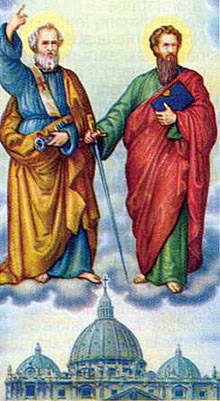
Friday, 28 June 2013 : Vigil Mass of the Solemnity of Saints Peter and Paul, Apostles, Great Feast Day of the Church of Rome (First Reading)

Acts 3 : 1-10

Once when Peter and John were going up to the Temple at three in the afternoon, the hour for prayer, a man crippled from birth was being carried in. Every day they would bring him and put him at the temple gate called “Beautiful”; there he begged from those who entered the Temple.

When he saw Peter and John on their way into the Temple, he asked for alms. Then Peter with John at his side looked straight at him and said, “Look at us.” So he looked at them, expecting to receive something from them. But Peter said, “I have neither silver nor gold, but what I have I give you : In the Name of Jesus of Nazareth, the Messiah, walk!”

Then he took the beggar by his right hand and helped him up. At once his feet and ankles became firm, and jumping up he stood on his feet and began to walk. And he went with them into the Temple walking and leaping and praising God.

All the people saw him walking and praising God; they recognised him as the one who used to sit begging at the Beautiful Gate of the Temple, and they were all astonished and amazed at what had happened to him.

Peter’s Pence Collection, Solemnity of Saints Peter and Paul, Apostles

Peters Pence

In case any of you are wondering what is Peter’s Pence, which is collected every Sunday nearest to the Solemnity of Saints Peter and Paul, Apostles, which falls on 29 June every year (Therefore this year Peter’s Pence is collected on Sunday, 30 June 2013, 13th Sunday of Ordinary Time), Peter’s Pence is a special collection in which the collection will not go into the local church or parish fund, but gathered from all over the world and sent to Rome, to the Holy See. Thus, the collection made during the offertory this Sunday will go directly to Rome.

What is the purpose of the Peter’s Pence collection? Exactly to support the numerous charitable activities and organisations managed by the Holy See, by our Church, all over the world. There are thousands, tens of thousands of charity under the supervision of the Church, and to be able to continue with the action, funds are definitely necessary to provide a solid backing. That is why, Peter’s Pence is done once every year, on the Sunday nearest to the Solemnity of Saints Peter and Paul.

1045213_354782624625355_1349576998_n

Why Solemnity of Saints Peter and Paul? That is because on that day lie the great celebration of the two great saints and apostles that defined our Church, because they met their martyrdom in Rome. St. Peter, the Prince and leader of all the Apostles, whom the Pope is the successor of today, met his martyrdom in what is now Vatican City, through crucifixion, and St. Paul, the Apostle to the Gentiles, and author of the Epistles in the New Testament, met his martyrdom in Rome, through beheading.

Peter’s Pence itself had its origins in the late dark ages and early medieval period, particularly from England, where it got the name Peter’s ‘Pence’. Pence is the unit of money still in use until today in the United Kingdom and the related monetary units. ‘Peter’ simply point to the fact that the collection or ‘pence’ is intended to be sent to Rome, to the Pope, in order to support various Church activities.

Tuesday, 4 June 2013 : 9th Week of Ordinary Time (First Reading)

Tobit 2 : 9-14

That same night, after I had buried the body, I returned home. I washed myself and went out into the courtyard to sleep against the wall; my face was uncovered because of the heat. I did not see that there were sparrows on the wall of the courtyard and, as my eyes were open, the hot droppings from the sparrows fell into my eyes and formed a white film on my eyes.

I went to find doctors to attend to me for medical treatment but the more ointments they smeared on my eyes, the more blind I became because of the film. Finally I became totally blind. I suffered from blindness for four years. All my brothers were burdened because of me. Ahikar kept me for two years before he departed for Elymiade.

My wife Anna worked hard at a woman’s task, weaving. On the seventh day of the month of March she cut the cloth and delivered it to her employers. They paid her wages and gave her, over and above, a young goat for food. When she returned home the kid began to cry. I said to her, “Where does the little kid come from? Did you steal it? Return it to its owners for we are not allowed to eat anything that is stolen.”

But she said, “It is a gift which has been given to me in addition to my wages.” But I said, “I don’t believe it. I tell you to return it to its owners.” I was ashamed of her. She replied, “What about your own almsgiving and your good deeds? I have to put up with all this from you.”

Monday, 27 May 2013 : 8th Week of Ordinary Time, Memorial of St. Augustine of Canterbury, Bishop (Scripture Reflection)

Brothers and sisters in Christ, God is our Lord, and He is our Creator. He is everything to us, for without Him, we cannot live, and we cannot survive. Only by being with God can we be saved, and only by staying in His presence and favour, we can gain eternal life, which He rewards to all those who remain faithful in Him and who prove that they love Him with all their hearts, their minds, and their souls, with their entire beings.

If we want to follow the Lord, and become His disciples, we cannot be half-hearted, and we cannot be hesitant. Instead, we must be very certain in our hearts, and be very conscious that we choose the Lord over everything else in this world. We have to put God foremost in our hearts and in all our daily dealings, before other things that may corrupt our hearts and sway our attention away from the Lord.

Wealth and worldly material possessions are some of such things that most easily turn the hearts of mankind away from God who loves them. Countless people across the different ages had spurned the love of God, and the salvation which He had offered freely to all, all just for the sake of money and possessions.

But be careful brothers and sisters, because we cannot misinterpret the Lord’s true intention and desire for us. The Lord is not hostile against wealth or His children having worldly possessions and material goods, but what He warned us all against is the danger of excessive wealth and the corrupting influence such things can have on us, that it turn us away from the Lord and bring us damnation in the end.

Wealth itself is not evil, brothers and sisters in Christ, and when wealth is used correctly, it can be indeed a great tool for love and for the advancement of the cause of Christ in this world. For wealth can feed many who hunger for basic nutrition and food, and those who lack basic needs required for survival. Wealth also can sponsor many of our Church’s charitable actions spread throughout the world, dedicated to the service of the poor, the ones who hunger, both physically and spiritually.

The true evil itself lies in our weakness, ever since the day of our rebellion against God’s will and our disobedience since the day of Adam. We had been exposed to sin ever since in our hearts. Greed in particular is our weakness, and desire to have more goods, more money had caused mankind to do much evil in the history of mankind, even within the Church.

That is why brothers and sisters in Christ, do not shun wealth! and do not hate the rich! but instead do our own part to help those who are less fortunate, especially those among us who have more, in terms of goods, money, or even if we have particular skills or even love, which we can indeed share to those around us who need them more. Indeed, this world has many people who does not just need the food for our stomach, but also food for the heart, that is love. For there remains many who are unloved in this world.

Today, we commemorate the feast of a great saint, Saint Augustine of Canterbury, who first established the Church hierarchy in the chaotic England of the Dark Ages. He established the first diocese in that country, what is to be known as the Archdiocese of Canterbury, and Saint Augustine was its first bishop

Saint Augustine converted many of the Anglo-Saxons who ruled England and much of the rest of Britannia at the time, in the region we know now as the United Kingdom. He established the Church in England. He served the Lord with zeal and strong faith, and through dedicated service, especially to the weak and to the poor. He convinced the rich and the powerful to follow Christ and abandon their old pagan and sinful ways, including even the king, whom he converted to Christianity.

Sadly, now the Church in England had been divided, by irresponsible act of men throughout history, which had brought division in the One, Holy, Catholic, and Apostolic Church. I am certain that Saint Augustine is sad that his successors have not kept the faith of the Apostles. Let us pray that the Church in England will be reunited once more, and be one with the Universal Church, keeping alive the faith of the Apostles, and fall not into the evils of the world.

Then for all of us, brothers and sisters in Christ, let us all strive to do our own best in giving our all to our less fortunate brethren, be it through material donations, skill donations, and even more importantly, by donating the love that is within us. Not that it will lessen the love that is within us. On the contrary, if we share our love to others who lack them and long for love, our own love will grow and strengthen us. May God be with us, in all our deeds, and strengthen our resolve, to do good for the sake of all mankind. Amen.