Saturday, 13 January 2018 : 1st Week of Ordinary Time, Memorial of St. Hilary, Bishop and Doctor of the Church (First Reading)

Liturgical Colour : Green or White (Bishops or Saturday Mass of Our Lady)

1 Samuel 9 : 1-4, 17-19 and 1 Samuel 10 : 1a

There was a man from the tribe of Benjamin whose name was Kish. He was the son of Abiel, son of Zeror, son of Becorath, son of Aphiah, a valiant Benjaminite. Kish had a son named Saul, a handsome young man who had no equal among the Israelites, for he was a head taller than any of them.

It happened that the asses of Kish were lost. So he said to his son Saul, “Take one of the boys with you and go look for the asses.” They went all over the hill country of Ephraim and the land of Shalishah but did not find them. They passed through the land of Shaalim and the land of Benjamin, but the asses were nowhere to be found.

So, when Samuel saw Saul, YHVH told him, “Here is the man I spoke to you about! He shall rule over My people.” Saul approached Samuel in the gateway and said, “Tell me, where is the house of the seer?” Samuel answered Saul, “I am the seer. Go up ahead of me to the high place, for today you shall eat with me. In the morning, before you leave, I will tell you all that is in your heart.”

Then Samuel took a vial of oil and poured it on Saul’s head.

Saturday, 23 December 2017 : 3rd Week of Advent, Memorial of St. John of Kanty, Priest (Homily and Scripture Reflections)

Liturgical Colour : Purple/Violet

Dear brothers and sisters in Christ, on this day we listened to the words of the Scriptures telling us about the prophecy regarding the coming of a messenger who would prepare the way for the coming of the Lord’s glorious salvation as well as the fulfilment of that prophecy. In the first reading, we heard the prophecy made by the prophet Malachi, the last of the prophets recorded in the Old Testament regarding the servant of God.

In that prophecy, he spoke of someone who would come to straighten the path for the Lord, preparing the people for the coming of the day of restoration and reconciliation between them and the Lord. His prophecy was among the many prophecies and messages which the Lord has given to His people throughout time, and it spoke about St. John the Baptist, the messenger of God and Herald of the Messiah.

As we prepare ourselves to welcome the joy of the Christmas season, it is indeed a good time for us to reflect on the life and works of St. John the Baptist. His birth is the theme of today’s Gospel passage, as God’s long promised salvation was finally at hand. He was the one to prepare the way for the Lord, to make His paths straight, by his works among the people, through his baptisms at the Jordan, where he called the people to repent from their sins.

Now, let us ask ourselves, are we doing what St. John the Baptist has called on the people of his time to do? Yet, if we look at how we normally celebrate Christmas, we will see that many of us worry about many other things during Christmas, and not about what we really need to do with our lives. Many of us worry about how we will celebrate Christmas, what kind of food and gifts we are going to have, instead of remembering the true purpose of this celebration in Christmas.

When we celebrate Christmas, we are joyful not because it is just another holiday or day off from work, and also not because it is a time for us to go for holidays and have merrymaking and parties. Christmas is not just another festive season when we exchange gifts and enjoy ourselves with our families and friends. In truth, it is much, much more than all of those.

In Christmas, we remember the historical birth of the Lord and Saviour of the world, through Whom God has revealed His grace and love, and by Whose sacrifice on the cross, He has redeemed all those who believed in Him and brought them to reconciliation with Him. But it is not just an annual remembrance of the time that has passed and has no significance to us.

That is because as the Lord Himself promised to us, just before He ascended in glory to heaven, that He will come again at the time of His choosing, when He will judge all the peoples, and those who are caught unprepared and living in a state of sin, and not being repentant, will be thrown into hell with Satan and his fellow fallen angels, where we will have eternal regret.

Each and every one of us as Christians need to internalise that call which St. John the Baptist made, and which the prophet Malachi prophesied about. ‘Repent, for the kingdom of God is about to come!’ is the message we need to listen to, and which we need to reflect upon. And we need to ask ourselves, what is it that we are doing or we have been doing to prepare ourselves for the coming of the Lord, if that is going to happen suddenly, for example, tomorrow. Are we ready for Him? More importantly, are we worthy of Him?

Let us all heed the examples and the piety of St. John of Kanty, a holy and devout servant of God whose feast day we celebrate today. St. John of Kanty or St. John Cantius was a Polish priest, philosopher and theologian who was renowned for his many works and writings, but even more so for his deep devotion to the Lord, his charitable life and almsgiving to the poor.

He lived humbly and showed generosity towards his neighbours. He cared for those who are in need, and as a teacher and scholar, he also cared for the students who were in need of assistance, in the university where he was also working at as a professor and academic. His dedication to the Lord and to his fellow men and women inspired many others down the centuries even until this very day.

All of us should follow in his footsteps, and especially in our Christmas celebrations this year and henceforth. Let us not give in to the culture of excess, materialism and hedonistic attitudes, by celebrating Christmas with much glamour and fanciness, and yet without compassion, love and generosity. Instead, we should share our joys and blessings with others, especially those who are poor and in need.

Let us strive towards a more meaningful Christmas celebration, one that is centred on Christ, and not on ourselves. And rather than worrying on the wrong things, on superficial matters of Christmas celebrations, we should spend our time giving our love, care and attention for those who are in need, being more charitable and generous upon one another.

May the Lord continue to guide us on our path, that we may grow ever deeper in faith, and will be able to devote ourselves more wholeheartedly following the footsteps of our holy predecessors, St. John the Baptist, St. John of Kanty and many others, that we will be ready and be worthy when the Lord comes again, even if He does so suddenly, and we will be worthy of receiving His eternal glory and inheritance. May God bless us always, now and forevermore. Amen.

Saturday, 23 December 2017 : 3rd Week of Advent, Memorial of St. John of Kanty, Priest (Gospel Reading)

Liturgical Colour : Purple/Violet

Luke 1 : 57-66

When the time came for Elizabeth, she gave birth to a son. Her neighbours and relatives heard that the merciful Lord had done a wonderful thing for her, and they rejoiced with her. When, on the eighth day, they came to attend the circumcision of the child, they wanted to name him Zechariah after his father. But his mother said, “Not so; he shall be called John.”

They said to her, “But no one in your family has that name!” and they asked the father, by means of signs, for the name he wanted to give him. Zechariah asked for a writing tablet, and wrote on it, “His name is John,” and they were very surprised. Immediately Zechariah could speak again, and his first words were in praise of God.

A holy fear came on all in the neighbourhood, and throughout the hill country of Judea the people talked about these events. All who heard of it pondered in their minds, and wondered, “What will this child be?” For they understood that the hand of the Lord was with him.

Saturday, 23 December 2017 : 3rd Week of Advent, Memorial of St. John of Kanty, Priest (Psalm)

Liturgical Colour : Purple/Violet

Psalm 24 : 4-5ab, 8-9, 10 and 14

Teach me Your ways, o Lord; make known to me Your paths. Guide me in Your truth and instruct me, for You are my God, my Saviour.

Good and upright, the Lord teaches sinners His way. He teaches the humble of heart and guides them in what is right.

The ways of the Lord are love and faithfulness for those who keep His covenant and precepts. The Lord gives advice to those who revere Him and makes His covenant known to them.

Saturday, 23 December 2017 : 3rd Week of Advent, Memorial of St. John of Kanty, Priest (First Reading)

Liturgical Colour : Purple/Violet

Malachi 3 : 1-4, 23-24

Now I am sending My messenger ahead of Me to clear the way; then suddenly the Lord for Whom you long will enter the sanctuary. The Envoy of the covenant which you so greatly desire already comes, says YHVH of hosts. Who can bear the day of His coming and remain standing when He appears? For He will be like fire in the foundry and like the lye used for bleaching.

He will be as a refiner or a fuller. He will purify the sons of Levi and refine them like gold and silver. So YHVH will have priests who will present the offering as it should be. Then YHVH will accept with pleasure the offering of Judah and Jerusalem, as in former days.

I am going to send you the prophet Elijah before the day of YHVH comes, for it will be a great and terrible day. He will reconcile parents with their children, and the children with their parents, so that I may not have to curse this land when I come.

Wednesday, 6 December 2017 : 1st Week of Advent, Memorial of St. Nicholas, Bishop (Homily and Scripture Reflections)

Liturgical Colour : Purple/Violet or White (Bishops)

Dear brothers and sisters in Christ, on this day we listened to the readings of the Holy Scriptures telling us all about the love which the Lord, Our God, has shown us all His people, and the coming of the time when He will bring us into an eternity of joy and grace, no more sorrows and tears, at the time of His own choosing. We believe that this time will come in the future just as He has promised us.

And we see God as a loving and caring God as He is, for He is Our Shepherd, Our Loving Father, Our Master and Creator. God did not create us mankind for no reason or purpose, or just for fun. God created each and every one of us in His image, because He loves us, and He wants to share the love that is in Him, for He is love, with all of us.

God has no need for our love in the first place, because He is already perfect in love. In the Most Holy Trinity He has been united with perfect love, Father, Son and the Holy Spirit. Yet, He wants to love us, and thus He created us and the whole world. But unfortunately, we mankind chose to follow the devil’s advice and temptation instead, and fell into disobedience and therefore, sin.

Yet, He still loves each and every one of us without exception. Sin is an obstacle that had to be overcome before we can be reconciled with Him, for sin brings about death, and also separation from Him, Who is the Lord and Master of life. And that is why, as the Lord Himself made it clear in the famous verse from the Gospel of St. John, chapter 3, ‘God so loved the world that He sent us His Most Beloved Son, that all who believe in Him will not perish but enter into eternal life.’

Thus, it is why a centre tenet of our faith is that God Himself has come down upon us and dwelled with us, as He has prophesied through the prophet Isaiah, that a Son would be born of the Virgin, and His Name will be Emmanuel, or ‘God is with us’. Jesus Christ, Our Lord, is the fulfilment of that prophecy, the Son of God, the Divine Word Who is God, with God since time immemorial, incarnate through His mother, the Blessed Virgin Mary, to be the Son of Man.

And through Jesus, God showed His extraordinary love to us, His people, all of mankind. In the Gospel passage today, when the people who followed Jesus were hungry, four thousand men and many thousands more of women and children, He showed compassion and love for them, and wanted to feed them Himself. With seven loaves of bread and some fishes He blessed and multiplied, all the multitudes of them received food and were filled to satisfaction, with much excess to spare.

This, and another occasion of feeding of the five thousand men with five loaves of bread and two fishes, and the many other miracles, healing wonders and all that the Lord had done among His people, showed His tender love and compassion for us, as our Shepherd, Who has been saddened by our waywardness, and in fact, He was angry also, at our stubbornness and refusal to believe in Him, as what He showed to the Pharisees and the teachers of the Law who persistently opposed Him and His works.

God wants us to be reconciled with Him so much, and He desires to love us so much to the point that, as we know, He was willing to lay down His life for us. He Himself said, that there is no greater love than for one to lay down his life for his friends, and that was exactly what the Lord Jesus had done. He accepted death willingly, death on the cross, to suffer torture, whips and lashes, the heavy burden of the cross, bearing all of our sins, and die on that cross, so that all of us may be saved through Him and in Him.

And this, brothers and sisters in Christ, is why we celebrate Christmas. Christmas is the celebration of the birthday of Our Lord Jesus, but it will have no greater meaning should it not be linked to the very reason why Christmas existed in the first place. Why did God choose to be born as a Man? No other gods in other pantheons and traditions, false as they are, chose to humble themselves in this manner. No, only God, the Lord and Master of the universe, Our God, chose to do so. And that is because of His pure love for each one of us as I mentioned.

But sadly, as we have been discussing in the past few days of Advent, in our celebrations and preparations for the celebrations of Christmas, God Himself has often been forgotten and put aside, replaced by the commercial and worldly ways of Christmas celebrations and revelries. We all know of the dramatic commercialisation, materialism and secularism that surround much of our Christmas celebrations today, throughout the world.

That said, there are of course still places where we can see the true meaning of Christmas being celebrated, as there are still those who truly place Christ at the centre of their Christmas celebrations. Yet, the temptations can be truly great for us to conform with the ways of the world, and all the excesses of partying and celebrations, the desires for Christmas gifts, joys and pleasures, forgetting about Christ, the true focus of our celebrations.

Take for example, the extensive commercialisation of the figure now known as identical and symbolic of our modern day Christmas celebrations, namely Santa Claus, whose origins in fact came about from the saint of the Church whose feast day we celebrate today. We always remember Santa Claus as the old man with big belly and dressed in red and white thick sweater, with a matching pointy hat, and a thick white moustache and beard, which is now ubiquitous throughout the world and immediately identifiable with Christmas.

And we see Santa Claus as a figure who delivers presents and gifts for people, especially children, riding on a magical carriage pulled by flying reindeers through the sky, entering through the chimneys of houses to put the gifts discreetly through the fireplaces. But do we all know, that Santa Claus is a horrible misrepresentation of a real person, and one who is a faithful and zealous defender of the faith, St. Nicholas (San Nicolaus – the origin of the name of Santa Claus) of Myra?

St. Nicholas of Myra was a bishop of the church in Myra, in what is now modern day Asian portion of Turkey, and he was known to be a loving and devout old man, always caring for his flock, and also known for his gifts to young children, through which the tradition of Santa Claus eventually came about through folklore and traditions twisted to suit what the world needs. But they choose what they want to see and believe, and not representing wholly who St. Nicholas of Myra truly was.

First and foremost, St. Nicholas of Myra is a staunch defender of the faith, who is a contemporary of the famous heretic, Arius. Arius was a very popular and charismatic preacher, who preached the heresy of Arianism, named after him, which basically stated the belief that Jesus Christ Our Lord, is not equal to God the Father, but was begotten and created by God. He denied the equality between each members of the Holy Trinity, a clear breach and break from the true teachings of the Church.

And unfortunately, many people were swayed to the teachings of Arius, and even quite a few priests and bishops as well. So much so that the heresy of Arianism lasted quite a few hundred years before it was finally defeated completely. And at the time of the inception of this heresy, the Church wanted to settle this issue once and for all, at the first Ecumenical Council of Nicaea, where the bishops of the Church, including St. Nicholas of Myra gathered to discuss about the many matters of the faith, including the teachings of Arius.

It was told that, when Arius spoke about his teachings and defended his ideas before the Ecumenical Council, St. Nicholas of Myra was so inflamed with zeal and righteous anger, that he went forward and punched the heretic Arius in the face for his blasphemy and false teachings of the faith, which had subverted and caused the loss of so many of the souls of the faithful.

Through what we have seen in the examples of St. Nicholas of Myra, we can see the real Santa Claus, and who he should have been, not the false image projected by the world as ‘Father Christmas’, engineered to further the materialistic attitude and distractions to keep us from finding the true focus and purpose of our Christmas joy and celebrations, that is Our Lord Jesus Christ.

Following in the footsteps of St. Nicholas of Myra, all of us as Christians should rediscover the purpose of our rejoicing and celebration this Christmas and from now on. We should indeed be happy and rejoice, together with our families and friends, but shall we now rejoice with the right purpose and intention, that is to remember just how much God has loved us, that He was willing to give us His only beloved Son, to be our Saviour and Redeemer?

Let us go through this season of Advent with a renewed faith and zeal, and prepare ourselves wholeheartedly, in our hearts, minds, souls, bodies, and indeed our whole beings, that we may appreciate much better from now on, the significance of Christmas to our salvation. For it was at Christmas, that God, Who had willingly made Himself to be like one of us, entered the world, and then later on, offered Himself as a perfect sacrifice on Calvary, on the cross, that through His loving sacrifice, all of us are saved through Him.

May the Lord bless each and every one of us, and may He empower all of us to live in accordance with His ways, so that in everything we do, we may always strive to bring glory to God and His Name. And may He also bless our Advent season, that for each one of us, this time will be fruitful and meaningful, for us to prepare ourselves physically, mentally and spiritually, to have a very wonderful and blessed Christmas in a few weeks time. St. Nicholas of Myra, the true Santa Claus, pray for all of us. Amen.
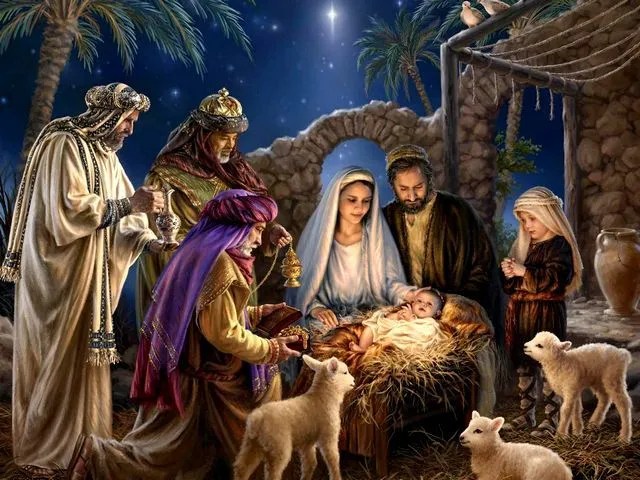
Wednesday, 6 December 2017 : 1st Week of Advent, Memorial of St. Nicholas, Bishop (Gospel Reading)

Liturgical Colour : Purple/Violet or White (Bishops)

Matthew 15 : 29-37

At that time, from the place where Jesus healed the daughter of a Canaanite woman, He went to the shore of Lake Galilee, and then went up into hills, where He sat down. Great crowds came to Him, bringing the dumb, the blind, the lame, the crippled, and many with other infirmities. People carried them to the feet of Jesus, and He healed them.

All were astonished when they saw the dumb speaking, the lame walking, the crippled healed, and the blind able to see; and they glorified the God of Israel. Jesus called His disciples and said to them, “I am filled with compassion for these people; they have already followed Me for three days and now have nothing to eat. I do not want to send them away fasting, or they may faint on the way.”

His disciples said to Him, “And where shall we find enough bread in this wilderness to feed such a crowd?” Jesus said to them, “How many loaves do you have?” They answered, “Seven, and a few small fish.”

Jesus ordered the people to sit on the ground. Then, He took the seven loaves and the small fish, and gave thanks to God. He broke them and gave them to His disciples, who distributed them to the people. They all ate and were satisfied, and the leftover pieces filled seven wicker baskets.

Wednesday, 6 December 2017 : 1st Week of Advent, Memorial of St. Nicholas, Bishop (Psalm)

Liturgical Colour : Purple/Violet or White (Bishops)

Psalm 22 : 1-3a, 3b-4, 5, 6

The Lord is my Shepherd, I shall not want. He makes me lie down in green pastures. He leads me beside the still waters. He restores my soul.

He guides me through the right paths for His Name’s sake. Although I walk through the valley of the shadow of death, I fear no evil, for You are beside me : Your rod and Your staff comfort me.

You spread a table before me in the presence of my foes. You anoint my head with oil; my cup is overflowing.

Goodness and kindness will follow me all the days of my life. I shall dwell in the house of the Lord as long as I live.

Wednesday, 6 December 2017 : 1st Week of Advent, Memorial of St. Nicholas, Bishop (First Reading)

Liturgical Colour : Purple/Violet or White (Bishops)

Isaiah 25 : 6-10a

On this mountain YHVH Sabaoth will prepare for all peoples a feast of rich food and choice wines, meat full of marrow, fine wine strained. On this mountain He will destroy the pall cast over all peoples, this very shroud spread over all nations, and death will be no more. The Lord YHVH will wipe away the tears from all cheeks and eyes; He will take away the humiliation of His people all over the world : for YHVH has spoken.

On that day you will say : This is our God. We have waited for Him to save us, let us be glad and rejoice in His salvation. For on this mountain the hand of YHVH rests.

Monday, 4 December 2017 : 1st Week of Advent, Memorial of St. John Damascene, Priest and Doctor of the Church (Homily and Scripture Reflections)

Liturgical Colour : Purple/Violet or White (Priests)

Dear brothers and sisters in Christ, on this day we heard that story from the Gospel passage, relating to us the moment when the Lord Jesus healed the sick servant of an army centurion, and the Lord was impressed at the faith he has in Him. In order to appreciate this story better, let us all understand the context and situation in which the interaction between Our Lord and the centurion took place.

At that time, the land of Judea, as well as Galilee and Samaria, the places where the Lord ministered to the people, were all under the dominion of the Roman Empire. It was likely that this army captain or centurion is part of the Roman legion or army stationed in the region for peacekeeping and garrison purpose. As such, the army centurion mentioned in the Gospel today might not even be a Jew.

The Jewish people living in Judea were not happy living under the Roman rule, as they had to pay taxes and obey other obligations, although the Romans did respect the Jewish customs and faith, allowing them to carry on with their lives as normal. This was why if we read through the Gospels, the Jews despised the tax collectors and even called them sinners and traitors to their people, as these people collected the taxes for the Romans.

Therefore, the Jews despised all interactions with the Romans, as well as with the pagans, Greeks and all those who do not believe in God or obey the laws of Moses. A Jewish person should not enter the house of a pagan, or else he or she will be considered unclean and unworthy. As such, if Jesus entered into the house of the army centurion, He would be considered unclean, and His enemies would have a reason with which to attack Him, for conspiring with the pagans.

The army centurion must have been aware of this fact, and that was probably the reason why he uttered the now famous words to the Lord Jesus, “I am not worthy that You should enter under my roof. Just say the word, and my servant shall be healed.” This is what each and every one of us utter at every celebration of the Holy Mass at the Agnus Dei, when the Lord is His Most Precious Body and Blood is presented to us sinners.

Knowing that we are sinners, we utter the same words as the centurion had mentioned. The army centurion knew that Jesus is the Lord, and recognising that fact and truth, and how he, as a pagan, did not deserve Jesus, a Jew, and all the more, as the Lord and Master of all, from coming into his house. Thus, he believes that, because Jesus is the Lord and God, He needed only to just utter the words, and His will would be done, and the servants would be healed.

This faith should be contrasted with the lack of faith among those whom the Lord Jesus had performed His miracles and wonders, even among His disciples and followers. The Pharisees and the teachers of the Law even demanded Jesus to show them heavenly and miraculous signs that they might believe in Him. Those people had seen the signs performed and yet still did not believe, because they have consciously chosen not to believe in God and harden their hearts against Him.

This is a reminder to all of us as Christians, that each and every one of us must learn from the faith of the army centurion. We need to be inspired by the pure faith and commitment that the army centurion showed to the Lord, believing wholeheartedly in Him rather than making excuses and doubting Him in what He is capable of doing. Many of us, unfortunately, often did not show the Lord the same faith that the centurion had shown.

Therefore, it is important that in this season of Advent, we should prepare ourselves well, heart, body, mind and soul, in our entire being, to welcome the Lord Jesus, not just merely celebrating His birth into the world, but instead, welcoming Him completely into ourselves, into our whole being. We have received the Lord in the Eucharist at the Holy Mass, but do we truly reflect on what we have received, that is nothing less than the Lord Himself?

Today we celebrate the feast of St. John of Damascus, a renowned saint who lived in Syria more than a millennia ago. St. John of Damascus was a priest who wrote extensively about the faith and whose devotion to God was truly remarkable. Despite the challenges he often encountered in his life, work and mission, he continued to devote himself day after day, to a life of prayer and charitable works, which encouraged many of the Christians in his area, living under difficult conditions.

Brothers and sisters in Christ, let us today make a renewed effort to live faithfully in accordance with our faith, following in the footsteps of the army centurion and our holy predecessors, the saints and blesseds of the Church. Let us all be true disciples of Our Lord in actions and deeds, and be genuine in our love for Him. After all, He has endeavoured to come to us, in the flesh, and even then, to suffer and die on the cross for the sake of our salvation.

May the Lord be with us always, and may He continue to guide us on our path, so that eventually we may be faithful in the same manner as the army centurion, whose faith in Him is so great that he placed his complete trust in His words alone, and also in the footsteps of all the saints, particularly St. John of Damascus, whose feast we celebrate this day. May God bless us forevermore. Amen.