(Easter Vigil) Saturday, 26 March 2016 : Easter Vigil of the Resurrection of the Lord, Holy Week (Second Reading)

Liturgical Colour : White

Genesis 22 : 1-18

Some time later God tested Abraham and said to him, “Abraham!” And he answered, “Here I am.” Then God said, “Take your son, your only son, Isaac, whom you love, and go to the land of Moriah and offer him there as a burnt offering on one of the mountains I shall point out to you.”

Abraham rose early next morning and saddled his donkey and took with him two of his young men and his son Isaac. He chopped wood for the burnt offering and set out for the place to which God had directed him.

On the third day, Abraham looked up and saw the place in the distance, and he said to the young men, “Stay here with the donkey. The boy and I will go over there to worship and then we will come back to you.”

Abraham took the wood for the burnt offering and laid it on Isaac his son. He carried in his hand the fire and the knife. As the two of them went on together, Isaac spoke to Abraham, his father, “Father!” And Abraham replied, “Yes, my son?” Isaac said, “The fire and the wood are here, but where is the lamb for the sacrifice?” Abraham replied, “God Himself will provide the lamb for the sacrifice.”

They went on, the two of them together, until they came to the place to which God had directed them. When Abraham had built the altar and set the wood on it, he bound his son Isaac and laid him on the wood placed on the altar. He then stretched out his hand to seize the knife and slay his son. But the Angel of YHVH called to him from heaven, “Abraham! Abraham!”

And he said, “Here I am.” “Do not lay your hand on the boy; do not harm him, for now I know that you fear God, and you have not held back from Me your only son.”

Abraham looked around and saw behind him a ram caught by its horns in a bush. He offered it as a burnt offering in place of his son. Abraham named the place ‘The Lord will provide.’ And the saying has lasted to this day.

And the Angel of YHVH called from heaven a second time, “By Myself I have sworn, it is YHVH who speaks, because you have done this and not held back your son, your only son. I will surely bless you and make your descendants as numerous as the stars in the sky and the sand on the seashore.

“Your descendants will take possession of the lands of their enemies. All the nations of the earth will be blessed through your descendants because you have obeyed Me.”


Alternative reading (Shorter version)

Genesis 22 : 1-2, 9a, 10-13, 15-18

Some time later God tested Abraham and said to him, “Abraham!” And he answered, “Here I am.” Then God said, “Take your son, your only son, Isaac, whom you love, and go to the land of Moriah and offer him there as a burnt offering on one of the mountains I shall point out to you.”

They came to the place to which God had directed them. He then stretched out his hand to seize the knife and slay his son. But the Angel of YHVH called to him from heaven, “Abraham! Abraham!”

And he said, “Here I am.” “Do not lay your hand on the boy; do not harm him, for now I know that you fear God, and you have not held back from Me your only son.”

Abraham looked around and saw behind him a ram caught by its horns in a bush. He offered it as a burnt offering in place of his son.

And the Angel of YHVH called from heaven a second time, “By Myself I have sworn, it is YHVH who speaks, because you have done this and not held back your son, your only son. I will surely bless you and make your descendants as numerous as the stars in the sky and the sand on the seashore.

“Your descendants will take possession of the lands of their enemies. All the nations of the earth will be blessed through your descendants because you have obeyed Me.”

Thursday, 3 October 2013 : 26th Week of Ordinary Time (Gospel Reading)

Liturgical Colour : Green

Luke 10 : 1-12

After this, the Lord appointed seventy-two other disciples, and sent them two by two ahead of Him to every town and place, where He Himself was to go. And He said to them, “The harvest is plentiful, but the workers are few. So you must ask the Lord of the harvest to send workers to His harvest. Courage! I am sending you like lambs among wolves. Set off without purse or bag or sandals; and do not stop at the homes of those you know.”

“Whatever house you enter, first bless them, saying, ‘Peace to this house!’ If a friend of peace lives there, the peace shall rest upon that person. But if not, the blessing will return to you. Stay in that house, eating and drinking at their table, for the worker deserves to be paid. Do not move from house to house.”

“When they welcome you to any town, eat what they offer you. Heal the sick who are there, and say to them : ‘The kingdom of God has drawn near to you.’ But in any town where you are not welcome, go to the marketplace and proclaim : ‘Even the dust of your town that clings to our feet, we wipe off and leave with you. But know for a certainty that the kingdom of God has drawn near to you.’ I tell you, that on the Day of Judgment, it will be better for Sodom than for this town.”

Tuesday, 24 September 2013 : 25th Week of Ordinary Time (First Reading)

Liturgical Colour : Green

Ezra 6 : 7-8, 12b, 14-20

Let the governor of the Jews together with their leaders build the House of God on its former site. This is the command I give as to what you should do to help those Jewish leaders rebuild the House of God : pay the expenses in full and without delay, with the income from taxes of the province at the other side of the River which is allotted to the king. I, Darius, give this command. Let it be carried out at once.

And the leaders of the Jews continued to make progress in building, encouraged by what Haggai, the prophet, and Zechariah, the son of Iddo, had said; and they finished the work according to the command of the God of Israel and the decrees of Cyrus and Darius. The House was finished on the third day of the month of Adar in the sixth year of the reign of Darius.

The children of Israel, the priests and the Levites, and the rest of those who had returned from exile celebrated the consecration of this House of God with rejoicing, offering on this solemnity one hundred young bulls, two hundred rams, and four hundred lambs; and twelve he-goats as a sin offering for all Israel, according to the number of the tribes of Israel.

Then they installed the priests according to their ranks, and the Levites according to their classes, for the service of the House of God in Jerusalem, as it is written in the book of Moses. Those who had returned from exile celebrated the Passover on the fourteenth day of the first month, for the priests and the Levites had purified themselves together, and all of them were clean.

So, they slaughtered the Passover lamb for all who had returned from exile, for their fellow-priests and for themselves.

Friday, 19 July 2013 : 15th Week of Ordinary Time (First Reading)

Exodus 11 : 10 – Exodus 12 : 14

Moses and Aaron had worked all these marvels in the presence of Pharaoh, but YHVH had made Pharaoh obstinate and he would not let the people of Israel leave his country.

YHVH spoke to Moses and Aaron in the land of Egypt and said, “This month is to be the beginning of all months, the first month of your year. Speak to the community of Israel and say to them : On the tenth day of this month let each family take a lamb, a lamb for each house. If the family is too small for a lamb, they must join with a neighbour, the nearest to the house, according to the number of persons and to what each one can eat.”

“You will select a perfect lamb without blemish, a male born during the present year, taken from the sheep or goats. Then you will keep it until the fourteenth day of the month. On that evening all the people will slaughter their lambs and take some of the blood to put on the doorposts and on top of the doorframes of the houses where you eat.”

“That night you will eat the flesh roasted at the fire with unleavened bread and bitter herbs. Do not eat the meat lightly cooked or boiled in water but roasted entirely over the fire – the head, the legs, and the inner parts. Do not leave any of it until the morning. If any is left till morning, burn it in the fire.”

“And this is how you will eat : with a belt round your waist, sandals on your feet and a staff in your hand. You shall eat hastily for it is a passover in honour of YHVH. On that night I shall go through Egypt and strike every firstborn in Egypt, men and animals; and I will even bring judgment on all the gods of Egypt, I, YHVH!”

“The blood on your houses will be the sign that you are there. I will see the blood and pass over you; and you will escape the mortal plague when I strike Egypt. This is a day you are to remember and celebrate in honour of YHVH. It is to be kept as a festival day for all generations forever.”

Thursday, 4 July 2013 : 13th Week of Ordinary Time, Memorial of St. Elizabeth of Portugal (First Reading)

Genesis 22 : 1-19

Some time later God tested Abraham and said to him, “Abraham!” And he answered, “Here I am.” Then God said, “Take your son, your only son, Isaac, whom you love, and go to the land of Moriah and offer him there as a burnt offering on one of the mountains I shall point out to you.”

Abraham rose early next morning and saddled his donkey and took with him two of his young men and his son Isaac. He chopped wood for the burnt offering and set out for the place to which God had directed him. On the third day, Abraham looked up and saw the place in the distance, and he said to the young men, “Stay here with the donkey. The boy and I will go over there to worship and then we will come back to you.”0

Abraham took the wood for the burnt offering and laid it on Isaac his son. He carried in his hand the fire and the knife. As the two of them went on together, Isaac spoke to Abraham, his father, “Father!” And Abraham replied, “Yes, my son?” Isaac said, “The fire and the wood are here, but where is the lamb for the sacrifice?” Abraham replied, “God Himself will provide the lamb for the sacrifice.”

They went on, the two of them together, until they came to the place to which God had directed them. When Abraham had built the altar and set the wood on it, he bound his son Isaac and laid him on the wood placed on the altar. He then stretched out his hand to seize the knife and slay his son. But the angel of YHVH called to him from heaven, “Abraham! Abraham!”

And he said, “Here I am.” “Do not lay your hand on the boy; do not harm him, for now I know that you fear God, and you have not held back from Me your only son.”

Abraham looked around and saw behind him a ram caught by its horns in a bush. He offered it as a burnt offering in place of his son. Abraham named the place, ‘The Lord will provide.’ And the saying has lasted to this day.

And the angel of YHVH called from heaven a second time, “By myself I have sworn, it is YHVH who speaks, because you have done this and not held back your son, your only son, I will surely bless you and make your descendants as numerous as the stars in the sky and the sand on the seashore. Your descendants will take possession of the lands of their enemies. All the nations of the earth will be blessed through your descendants because you have obeyed Me.”

So Abraham returned to his servants, and they set off together for Beersheba and it was there that Abraham stayed.

Imposition of the pallium on the new Metropolitan Archbishops by Pope Francis

On the great Feast day and Solemnity of Saints Peter and Paul, Apostles, the feast day of the Church of Rome, on Saturday, 29 June 2013, 34 new Metropolitan Archbishops will receive the pallium, the symbol of their metropolitan office from Pope Francis, in a Mass at St. Peter’s Basilica.
Pallium (Pallium)
1_0_674753 (Papal Pallium)
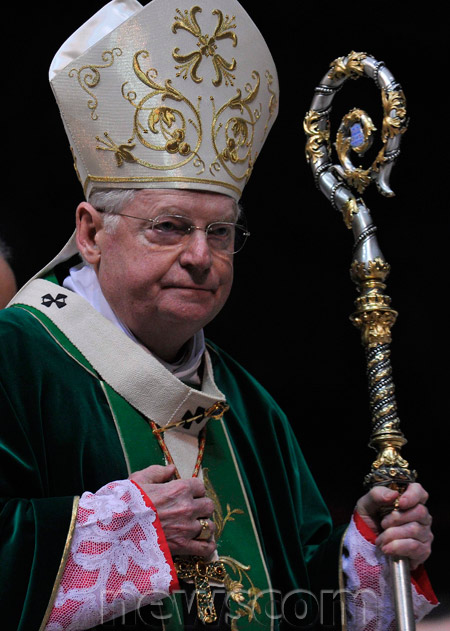
Pallium is a woolen band, worn around the shoulders, as a symbol of office, representation of the Good Shepherd, with Jesus carrying the lamb on His shoulder, which is reminiscent of the authority entrusted upon the Metropolitan Archbishops over their flocks. Pallium therefore is a symbol of authority. It is about three fingers wide, and has six black crosses, out of which three are pierced with a golden pin, representing the wounds of Christ pierced by the holy nails on the cross.
angelo-scola
(Above : image of Cardinal Angelo Scola, wearing the pallium, as the Metropolitan Archbishop of Milan, who received the pallium personally from Pope Benedict XVI in 2011)
Papal pallium from 2005 is different, in order to distinguish the nature of the Papal office, as the Pope is not just any bishop or Metropolitan Archbishop, but is Metropolitan over the entire world, the entire Church, as the Vicar of Christ.
Pope-Benedict-XVI
(Above : Pope Benedict XVI with the Papal pallium in 2012)

The list of the new Metropolitan Archbishops who will receive the pallium below.

1. Patriarch Manuel Jose Macario do Nascimento Clemente, Patriarch of Lisbon (Portugal)
2. Archbishop Dieudonne Nzapalainga, C.S.Sp., Metropolitan Archbishop of Bangui (Central African Republic)
3. Archbishop Carlo Roberto Maria Redaelli, Metropolitan Archbishop of Gorizia (Italy)
4. Archbishop Claudio Dalla Zuanna, S.C.I., Metropolitan Archbishop of Beira (Mozambique)
5. Archbishop Prakash Mallavarapu, Metropolitan Archbishop of Visakhapatnam (India)
6. Archbishop Antonio Carlos Altieri, S.D.B., Metropolitan Archbishop of Passo Fundo (Brazil)
7. Archbishop Marek Jedraszewski, Metropolitan Archbishop of Lodz (Poland)
8. Archbishop Philip Tartaglia, Metropolitan Archbishop of Glasgow (Great Britain)
9. Archbishop Salvatore Joseph Cordileone, Metropolitan Archbishop of San Francisco (USA)
10. Archbishop Rolando Joven Tria Tirona, O.C.D., Metropolitan Archbishop of Caceres (Philippines)
11. Archbishop Rogelio Cabrera Lopez, Metropolitan Archbishop of Monterrey (Mexico)
12. Archbishop Joseph William Tobin, C.Ss.R., Metropolitan Archbishop of Indianapolis (USA)
13. Archbishop Carlos Maria Franzini, Metropolitan Archbishop of Mendoza (Argentina)
14. Archbishop Lorenzo Ghizzoni, Metropolitan Archbishop of Ravenna-Cervia (Italy)
15. Archbishop George Antonysamy, Metropolitan Archbishop of Madras and Mylapore (India)
16. Archbishop Anil Joseph Thomas Couto, Metropolitan Archbishop of Delhi (India)
17. Archbishop John Wong Soo Kau, Metropolitan Archbishop of Kota Kinabalu (Malaysia)
18. Archbishop Murray Chatlain, Metropolitan Archbishop of Keewatin-Le Pas (Canada)
19. Archbishop Sérgio Eduardo Castriani, C.S.Sp., Metropolitan Archbishop of Manaus (Brazil)
20. Archbishop Peter Loy Chong, Metropolitan Archbishop of Suva, (Fiji)
21. Archbishop Alfonso Cortes Contreras, Metropolitan Archbishop of Leon (Mexico)
22. Archbishop Alexander King Sample, Metropolitan Archbishop of Portland in Oregon (USA)
23. Archbishop Joseph Effiong Ekuwem, Metropolitan Archbishop of Calabar (Nigeria)
24. Archbishop Jesus Juarez Parraga, S.D.B., Metropolitan Archbishop of Sucre (Bolivia)
25. Archbishop Fabio Martinez Castilla, Metropolitan Archbishop of Tuxtla Gutierrez (Mexico)
26. Archbishop Ramon Alfredo Dus, Metropolitan Archbishop of Resistencia (Argentina)
27. Archbishop Mario Aurelio Poli, Metropolitan Archbishop of Buenos Aires (Argentina)
28. Archbishop Gintaras Linas Grusas, Metropolitan Archbishop of Vilnius (Lithuania)
29. Archbishop Michael Owen Jackels, Metropolitan Archbishop of Dubuque (USA)
30. Archbishop Duro Hranic, Metropolitan Archbishop of Dakovo-Osijek (Croatia)
31. Archbishop Moacir Silva, Metropolitan Archbishop of Ribeirao Preto (Brazil)
32. Archbishop Jozef Piotr Kupny, Metropolitan Archbishop of Wroclaw (Poland)
33. Archbishop Sergio Alfredo Gualberti Calandrina, Metropolitan Archbishop of Santa Cruz de la Sierra (Bolivia)
34. Archbishop Giuseppe Petrocchi, Metropolitan Archbishop of L’Aquila (Italy)
In addition, the Metropolitan Archbishop of Hue, Archbishop Francois Xavier Le Van Hong, will not receive the pallium directly from the Pope in Rome, but in his home diocese of Hue, through the papal representative. Therefore, in addition to the 34 Metropolitan Archbishops mentioned above, 35 Metropolitan Archbishops will receive the pallium in this year.
35. Archbishop Francois Xavier Le Van Hong, Metropolitan Archbishop of Hue (Vietnam)

Metropolitan Archbishop differs from normal Archbishops in that, they have jurisdiction over other dioceses that are placed under their supervision, in a group called Ecclesiastical Province of the Church. Archbishops of Archdioceses without Metropolitan character has no jurisdiction over any dioceses under them, and they are usually directly subject to the Holy See.

(Easter Vigil) Saturday, 30 March 2013 : Easter Vigil of the Resurrection of the Lord, Holy Week (Second Reading)

Genesis 22 : 1-18

Some time later God tested Abraham and said to him, “Abraham!” And he answered, “Here I am.” Then God said, “Take your son, your only son, Isaac, whom you love, and go to the land of Moriah and offer him there as a burnt offering on one of the mountains I shall point out to you.”

Abraham rose early next morning and saddled his donkey and took with him two of his young men and his son Isaac. He chopped wood for the burnt offering and set out for the place to which God had directed him.

On the third day, Abraham looked up and saw the place in the distance, and he said to the young men, “Stay here with the donkey. The boy and I will go over there to worship and then we will come back to you.”

Abraham took the wood for the burnt offering and laid it on Isaac his son. He carried in his hand the fire and the knife. As the two of them went on together, Isaac spoke to Abraham, his father, “Father!” And Abraham replied, “Yes, my son?” Isaac said, “The fire and the wood are here, but where is the lamb for the sacrifice?” Abraham replied, “God Himself will provide the lamb for the sacrifice.”

They went on, the two of them together, until they came to the place to which God had directed them. When Abraham had built the altar and set the wood on it, he bound his son Isaac and laid him on the wood placed on the altar. He then stretched out his hand to seize the knife and slay his son. But the Angel of YHVH called to him from heaven, “Abraham! Abraham!”

And he said, “Here I am.” “Do not lay your hand on the boy; do not harm him, for now I know that you fear God, and you have not held back from Me your only son.”

Abraham looked around and saw behind him a ram caught by its horns in a bush. He offered it as a burnt offering in place of his son. Abraham named the place ‘The Lord will provide.’ And the saying has lasted to this day.

And the Angel of YHVH called from heaven a second time, “By Myself I have sworn, it is YHVH who speaks, because you have done this and not held back your son, your only son. I will surely bless you and make your descendants as numerous as the stars in the sky and the sand on the seashore.

“Your descendants will take possession of the lands of their enemies. All the nations of the earth will be blessed through your descendants because you have obeyed Me.”


Alternative reading (Shorter version)


Genesis 22 : 1-2, 9a, 10-13, 15-18

Some time later God tested Abraham and said to him, “Abraham!” And he answered, “Here I am.” Then God said, “Take your son, your only son, Isaac, whom you love, and go to the land of Moriah and offer him there as a burnt offering on one of the mountains I shall point out to you.”

They came to the place to which God had directed them. He then stretched out his hand to seize the knife and slay his son. But the Angel of YHVH called to him from heaven, “Abraham! Abraham!”

And he said, “Here I am.” “Do not lay your hand on the boy; do not harm him, for now I know that you fear God, and you have not held back from Me your only son.”

Abraham looked around and saw behind him a ram caught by its horns in a bush. He offered it as a burnt offering in place of his son.

And the Angel of YHVH called from heaven a second time, “By Myself I have sworn, it is YHVH who speaks, because you have done this and not held back your son, your only son. I will surely bless you and make your descendants as numerous as the stars in the sky and the sand on the seashore.

“Your descendants will take possession of the lands of their enemies. All the nations of the earth will be blessed through your descendants because you have obeyed Me.”

(Good Friday) Friday, 29 March 2013 : Passion of our Lord Jesus Christ, Holy Week (First Reading)

Isaiah 52 : 13 – Isaiah 53 : 12

It is now when My servant will succeed; He will be exalted and highly praised. Just as many have been horrified at His disfigured appearance : “Is this a man? He does not look like one,” so will nations be astounded, kings will stand speechless, for they will see something never told, they will witness something never heard of.

Who could believe what we have heard, and to whom has YHVH revealed His feat? Like a root out of dry ground, like a sapling He grew up before us, with nothing attractive in His appearance, no beauty, no majesty.

He was despised and rejected, a Man of sorrows familiar with grief, a Man from whom people hide their face, spurned and considered of no account. Yet ours were the sorrows He bore, ours were the sufferings He endured, although we considered Him as one punished by God, stricken and brought low.

Destroyed because of our sins, He was crushed for our wickedness. Through His punishment, we are made whole; by His wounds we are healed. Like sheep we had all gone astray, each following His own way; but YHVH laid upon Him all our guilt.

He was harshly treated, but unresisting and silent, He humbly submitted. Like a lamb led to the slaughter or a sheep before the shearer, He did not open His mouth. He was taken away to detention and judgment – what an unthinkable fate! He was cut off from the land of the living, stricken for His people’s sin.

They made His tomb with the wicked, they put Him in the graveyard of the oppressors, though He had done no violence nor spoken in deceit. Yet it was the will of YHVH to crush Him with grief. When He makes Himself an offering for sin, He will have a long life and see His descendants. Through Him the will of YHVH is done.

For the anguish He suffered, He will see the light and obtain perfect knowledge. My just Servant will justify the multitude; He will bear and take away their guilt.

Therefore I will give Him His portion among the great, and He will divide the spoils with the strong. For He surrendered Himself to death and was even counted among the wicked, bearing the sins of the multitude and interceding for sinners.

(Holy Thursday) Thursday, 28 March 2013 : Mass of the Lord’s Supper – Cena Domini, Holy Week (First Reading)

Exodus 12 : 1-8, 11-14

YHVH spoke to Moses and Aaron in the land of Egypt and said, “This month is to be the beginning of all months, the first month of your year. Speak to the community of Israel and say to them :

“On the tenth day of this month let each family take a lamb, a lamb for each house. If the family is too small for a lamb, they must join with a neighbour, the nearest to the house, according to the number of persons and to what each one can eat.”

“You will select a perfect lamb without blemish, a male born during the present year, taken from the sheep or goats. Then you will keep it until the fourteenth day of the month. On that evening all the people will slaughter their lambs, and take some of the blood to put on the doorposts and on top of the doorframes of the houses where you eat.”

“That night you will eat the flesh roasted at the fire with unleavened bread and bitter herbs. And this is how you will eat : with a belt round your waist, sandals on your feet and a staff in your hand. You shall eat hastily for it is a passover in honour of YHVH.”

“On that night I shall go through Egypt and strike every firstborn in Egypt, men and animals; and I will even bring judgment on all the gods of Egypt, I, YHVH! The blood on your houses will be the sign that you are there. I will see the blood and pass over you; and you will escape the mortal plague when I strike Egypt.”

“This is a day you are to remember and celebrate in honour of YHVH. It is to be kept as a festival day for all generations forever.”

Sunday, 10 March 2013 : 4th Sunday of Lent, Laetare Sunday, 2nd Scrutiny for Baptism (Gospel Reading)

Luke 15 : 1-3, 11-32

Meanwhile tax collectors and sinners were seeking the company of Jesus, all of the eager to hear what He had to say. But the Pharisees and the scribes frowned at this, muttering, “This Man welcomes sinners and eats with them.” So Jesus told them this parable.

Jesus continued, “There was a man with two sons. The younger said to his father, ‘Give me my share of the estate.’ So the father divided his property between them. Some days later, the younger son gathered all his belongings, and started off for a distant land, where he squandered his wealth in loose living.”

“Having spent everything, he was hard pressed when a severe famine broke out in that land. So he hired himself out to a well-to-do citizen of that place, and was sent to work on a pig farm. So famished was he, that he longed to fill his stomach even with the food given to the pigs, but no one offered him anything.”

“Finally coming to his senses, he said, ‘How many of my father’s hired workers have food to spare, and here I am starving to death! I will get up and go back to my father, and say to him, Father, I have sinned against God, and before you. I no longer deserve to be called your son. Treat me then as one of your hired servants.’ With that thought in mind, he set off for his father’s house.”

“He was still a long way off, when his father caught sight of him. His father was so deeply moved with compassion that he ran out to meet him, threw his arms around his neck and kissed him. The son said, ‘Father, I have sinned against Heaven and before you. I no longer deserve to be called your son.'”

“But the father turned to his servants : ‘Quick!’ he said, ‘Bring out the finest robe and put it on him! Put a ring on his finger and sandals on his feet! Take the fattened calf and kill it! We shall celebrate and have a feast, for this son of min was dead, and has come back to life; he was lost and is found!’ And the celebration began.”

“Meanwhile, the elder son had been working in the fields. As he returned and approached the house, he heard the sound of music and dancing. He called one of the servants and asked what it was all about. The servant answered, ‘Your brother has come home safe and sound, and your father is so happy about it that he has ordered this celebration, and killed the fattened calf.'”

The elder son became angry and refused to go in. His father came out and pleaded with him. The son, very indignant, said, ‘Look, I have slaved for you all these years. Never have I disobeyed your orders. Yet you have never given me even a young goat to celebrate with my friends. Then when this son of yours returns, after squandering your property with loose women, you kill the fattened calf for him.'”

“The father said, ‘My son, you are always with me, and everything I have is yours. But this brother of yours was dead, and has come back to life; he was lost, and is found. And for that we had to rejoice and be glad.'”


Alternative reading (from Year A)

John 9 : 1-41

As Jesus walked along, He saw a man who had been blind from birth. His disciples asked Him, “Master, was he born blind because of a sin of his, or of his parents?” Jesus answered, “Neither was it for his own sin nor for his parents’ sin. He was born blind so that God’s power might be shown in him. While it is day we must do the work of the One who sent Me; for the night will come when no one can work. As long as I am in the world, I am the light of the world.”

As Jesus said this, He made paste with spittle and clay, and rubbed it on the eyes of the blind man. Then He said, “Go and wash in the Pool of Siloam.” (Siloam means sent.) So the blind man went and washed and came back able to see. His neighbours, and all the people who used to see him begging, wondered. They said, “Isn’t this the beggar who used to sit here?” Some said, “He’s the one.” Others said, “No, but he looks like him.” But the man himself said, “I am he.”

Then they asked him, “How is it that your eyes were opened?” And he answered, “The Man called Jesus made a mud paste, put it on my eyes abd said to me, ‘Go to Siloam and wash.’ So I went, and washed, and I could see.” They asked, “Where is He?” and the man answered, “I don’t know.”

The people brought the man who had been blind to the Pharisees. Now it was a sabbath day when Jesus made mud paste and opened his eyes. The Pharisees asked him again, “How did you recover your sight?” And he said, “He put paste on my eyes, and I washed, and now I see.” Some of the Pharisees said, “That Man is not from God, for He works on the sabbath”; but others wondered, “How can a sinner perform such miraculous signs?” They were divided, and they questioned the blind man again, “What do you think of this Man who opened your eyes?” And he answered, “He is a prophet!”

After all this, the Jews refused to believe that the man had been blind and had recovered his sight; so they called his parents and asked them, “Is this your son? You say that he was born blind, how is it that he now sees?” The parents answered, “He really is our son and he was born blind; but how it is that he now sees, we don’t know, neither do we know who opened his eyes. Ask him, he is old enough. Let him speak for himself.”

The parents said this because they feared the Jews, who had already agreed that whoever confessed Jesus to be the Christ was to be expelled from the synagogue. Because of that his parents said, “He is old enough, ask him.”

So a second time the Pharisees called the man who had been blind, and they said to him, “Tell us the truth; we know that this Man is a sinner.” He replied, “I don’t know whether He is a sinner or not; I only know that I was blind and now I see.” They said to him, “What did He do to you? How did He open your eyes?” He replied, “I have told you already and you would not listen. Why do you want to hear it again? Do you also want to become His disciples?”

Then they started to insult him. “Become His disciple yourself! We are disciples of Moses. We know that God spoke to Moses; but as for this Man, we don’t know where He comes from.” The man replied, “It is amazing that you don’t know where the Man comes from, and yet He opened my eyes! We know God doesn’t listen to sinners, but if anyone honours God and does His will, God listens to him. Never, since the world began, has it been heard that anyone opened the eyes of a person who was born blind. If this Man were not from God, He could do nothing.”

They answered him, “You were born a sinner and now you teach us!” And they expelled him. Jesus heard that they had expelled him. He found him and said, “Do you believe in the Son of Man?” He answered, “Who is He, that I may believe in Him?” Jesus said, “You have seen Him and He is speaking to you.” He said, “Lord, I believe”; and he worshiped Him. Jesus said, “I came into this world to carry out a judgment : Those who do not see shall see, and those who see shall become blind.”

Some Pharisees stood by and asked Him, “So we are blind?” And Jesus answered, “If you were blind, you would not be guilty. But you say, ‘We see’; this is the proof of your sin.”


Shorter version (John 9 : 1, 6-9, 13-17, 34-38)

As Jesus walked along, He saw a man who had been blind from birth.

As Jesus said this, He made paste with spittle and clay, and rubbed it on the eyes of the blind man. Then He said, “Go and wash in the Pool of Siloam.” (Siloam means sent.) So the blind man went and washed and came back able to see. His neighbours, and all the people who used to see him begging, wondered. They said, “Isn’t this the beggar who used to sit here?” Some said, “He’s the one.” Others said, “No, but he looks like him.” But the man himself said, “I am he.”

The people brought the man who had been blind to the Pharisees. Now it was a sabbath day when Jesus made mud paste and opened his eyes. The Pharisees asked him again, “How did you recover your sight?” And he said, “He put paste on my eyes, and I washed, and now I see.” Some of the Pharisees said, “That Man is not from God, for He works on the sabbath”; but others wondered, “How can a sinner perform such miraculous signs?” They were divided, and they questioned the blind man again, “What do you think of this Man who opened your eyes?” And he answered, “He is a prophet!”

They answered him, “You were born a sinner and now you teach us!” And they expelled him. Jesus heard that they had expelled him. He found him and said, “Do you believe in the Son of Man?” He answered, “Who is He, that I may believe in Him?” Jesus said, “You have seen Him and He is speaking to you.” He said, “Lord, I believe”; and he worshiped Him.