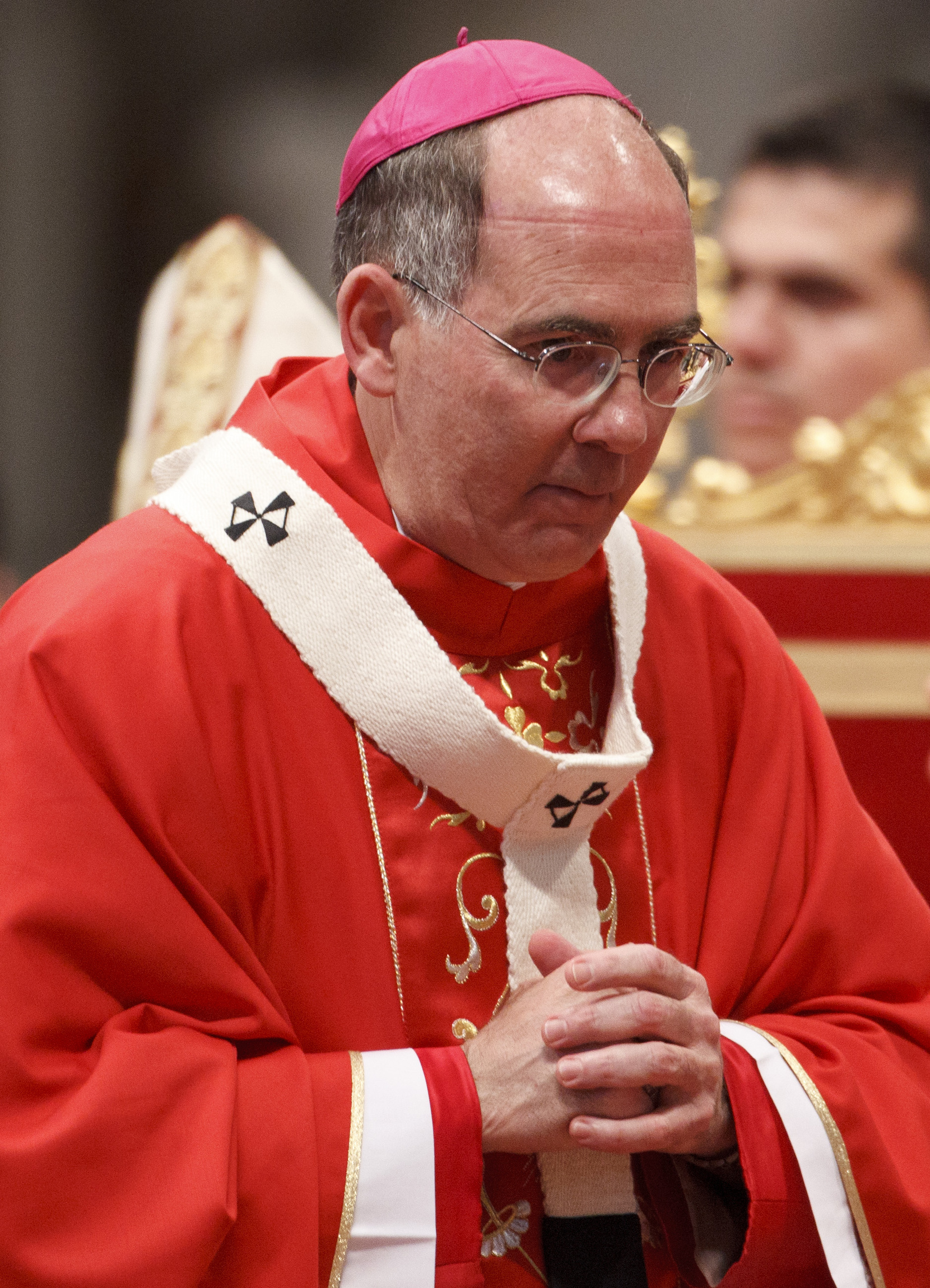
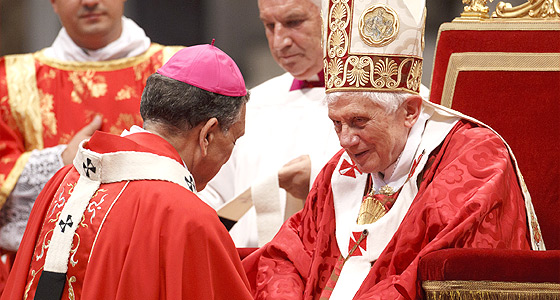
Official Schedule of Papal Apostolic Journey to Korea (14-18 August 2014)

index

Wednesday, Aug. 13, 2014
4:00 p.m. Leave by plane from Rome’s Fiumicino International Airport for Seoul

Thursday, Aug. 14, 2014
10:30 a.m. Arrival at the Seoul Air Base
12:00 p.m. Private Mass at the Apostolic Nunciature to Korea
3:45 p.m. Welcoming ceremony in the garden of the Blue House (Presidential Palace) in Seoul and courtesy visit to the president of the Republic in the Blue House
4:30 p.m. Meeting with the authorities and government officials in the Chungmu Hall of the Blue House of Seoul
5:30 p.m. Meeting with Korean bishops in the conference headquarters of the Episcopal Conference of Korea

Friday, Aug. 15, 2014
8:45 a.m. Transfer by helicopter to Daejeon (Metropolitan Archdiocese of Daejeon)
10:30 a.m. Holy Mass on the Solemnity of the Annunciation in the World Cup stadium of Daejeon and praying of the Angelus
1:30 p.m. Lunch with the youth of the Major Seminary of Daejeon
4:30 p.m. Transfer by helicopter to the Solmoe shrine
5:30 p.m. Meeting with the Asian youths at the Solmoe shrine (As part of Sixth Asian Youth Day – 2014)
7:15 p.m. Transfer by helicopter to Seoul

Saturday, Aug. 16, 2014
8:55 a.m. Visit to the Shrine of the Martyrs of Seosomun
10:00 a.m. Holy Mass and Beatification Paul Yun Ji-Chung and his 123 companions (Korean Martyrs) at the Door of Gwanghwamun in Seoul
3:30 p.m. Transfer by helicopter to Kkottongnae
4:30 p.m. Visit to the Rehabilitation Center for the Disabled in the House of Hope in Kkottongnae
5:15 p.m. Meeting with the religious communities of Korea in the School of Love training center of Kkottongnae
6:30 p.m. Meeting with the leaders of the Lay Apostolate at the Spirituality Center of Kkottongnae
7:00 p.m. Transfer by helicopter to Seoul

Sunday, Aug. 17, 2014
10:00 a.m. Transfer by helicopter to Haemi
11:00 a.m. Meeting with the Asian bishops in the Haemi shrine
1:00 p.m. Lunch with the bishops of Asia in the refectory of Haemi shrine
4:30 p.m. Holy Mass concluding the Sixth Asian Youth Day in the castle of Haemi
7:00 p.m. Transfer by helicopter to Seoul

Monday, Aug. 18, 2014
9:00 a.m. Encounter with religious leaders in the palace of the old Curia of the Metropolitan Archdiocese of Seoul
9:45 a.m. Holy Mass for peace and reconciliation in the Myeongdong Cathedral of the Metropolitan Archdiocese of Seoul
12:45 p.m. Farewell ceremony from the Republic of Korea at the Air Base of Seoul
1:00 p.m. Departure by plane from the Air Base of Seoul to Rome’s Ciampino International Airport
5:45 p.m. Arrival at Rome’s Ciampino International Airport

19 Cardinals to be created at the Consistory of 22 February 2014

On Sunday, 12 January 2014, at the Angelus of the Feast of the Baptism of the Lord, Pope Francis announced that 19 new Cardinals will be created at the consistory planned to be held on the Feast of the Chair of St. Peter, 22 February 2014.


Here are the names of the new Cardinals or Cardinal-elects, and some short explanation on them :

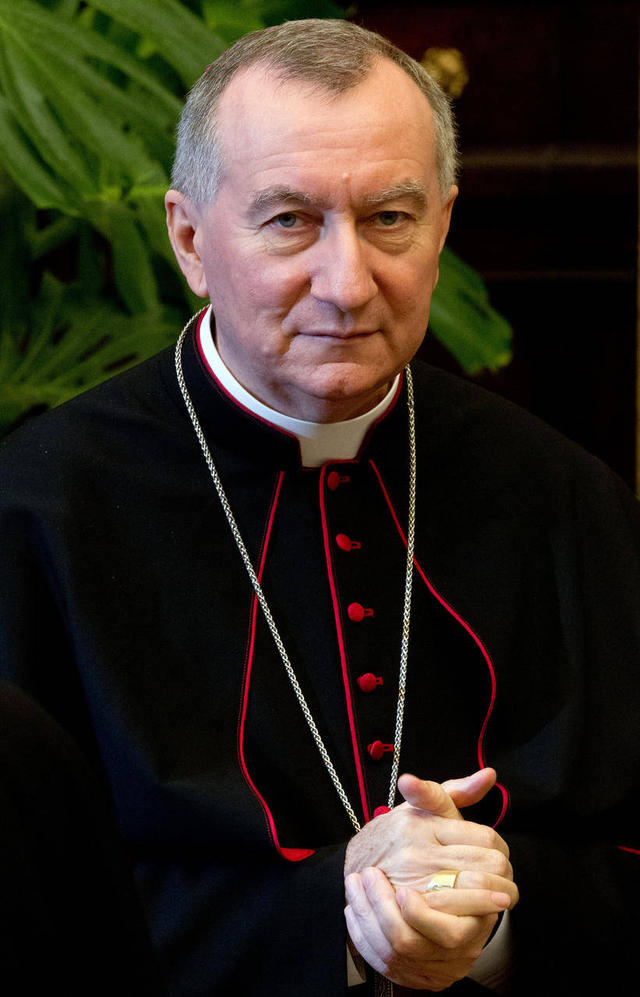
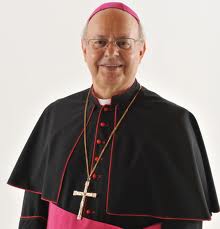
1. Archbishop Pietro Parolin, Secretary of the Secretariat of State – 58 (Age)

1272287

Being the highest position in the Church just below that of the Pope himself, Archbishop Parolin as the Secretariat of State is a certain candidate for the Cardinalate to be made at this consistory, and the position itself is explicitly stated to have to be held by a Cardinal (As Cardinal Secretary of State)


2. Archbishop Lorenzo Baldisseri, Secretary General of the Synod of Bishops – 73

images

Archbishop Lorenzo Baldisseri is also the Secretary of the College of Cardinals and therefore was the Secretary of the Conclave that elected Pope Francis on 13 March 2013.

It was reported and confirmed by sighting that the Pope had placed his own red zucchetto (skullcap) on the head of Archbishop Baldisseri, which by ancient custom (last used by Blessed Pope John XXIII on the Secretary of that time, Monsignor Alberto di Jorio in 1958) mark that the new Pope wants to bestow the red hat on the prelate. Hence, the elevation of Archbishop Baldisseri is pretty much certain.


3. Archbishop Gerhard Ludwig Muller, Prefect of the Congregation for the Doctrine of the Faith – 66

Muller

As the Prefect of a Congregation, and one as important as the Congregation for the Doctrine of the Faith once held by Cardinal Joseph Ratzinger before he was elected Pope Benedict XVI in 2005, Archbishop Gerhard Ludwig Muller is a certain candidate for the Cardinalate, and sure enough, he is one of the 19 appointed.


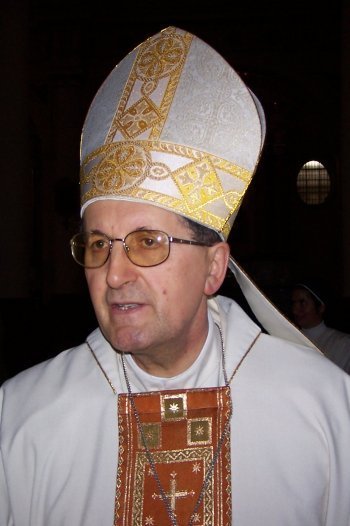
4. Archbishop Beniamino Stella, Prefect of the Congregation for Clergy – 72

Stella

Similar with Archbishop Muller, as the Prefect of an important Roman Curia Congregation, Archbishop Stella is a certain candidate for the Cardinalate, and as a recent appointee by Pope Francis, this made his elevation very certain indeed.


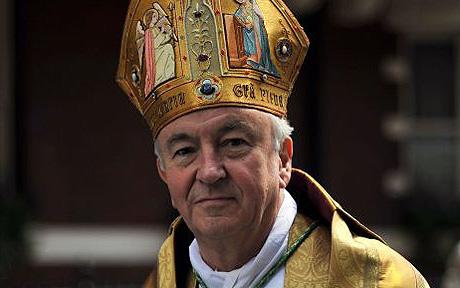
5. Archbishop Vincent Nichols, Metropolitan Archbishop of Westminster (United Kingdom) – 68

BRITAIN-RELIGION-ARCHISHOP-WESTMINSTER

With the problems that affected Cardinal Keith O’Brien early of last year and his retirement, the United Kingdom has no leading figure, which Archbishop Vincent Nichols, as the Archbishop of Westminster, the Primatial See of the United Kingdom as the obvious choice for the Cardinalate.


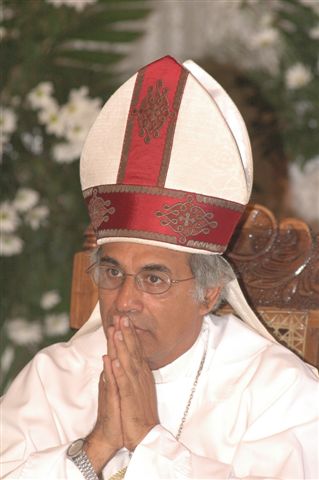
6. Archbishop Leopoldo Jose Brenes Solorzano, Metropolitan Archbishop of Managua (Nicaragua) – 64

Solorzano

As his predecessor was made Cardinal in 1985, and had been 7 years as a non-elector, it was natural that Archbishop Solorzano is made a Cardinal, representing the Central American region.


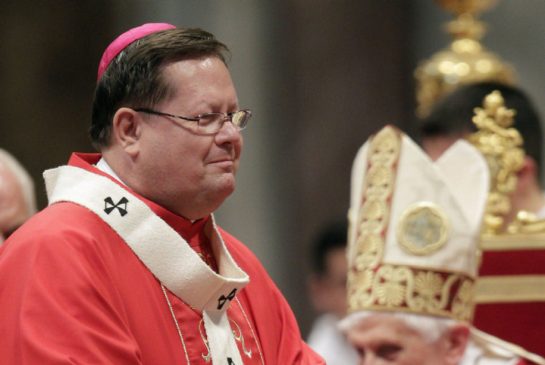
7. Archbishop Gerald Cyprien Lacroix, I.S.P.X., Metropolitan Archbishop of Quebec (Canada) – 56

gerald_cyprien_lacroix.jpg.size.xxlarge.promo

The second youngest of the newly appointed Cardinals, as the Primate of Canada by virtue of being the Prelate of Quebec, it is natural for Archbishop Lacroix to be appointed Cardinal. His predecessor, Cardinal Marc Ouellet, is the current Prefect of the Congregation for Bishops and was a leading papabili of the 2013 Papal Conclave.


8. Archbishop Jean-Pierre Kutwa, Metropolitan Archbishop of Abidjan (Cote d’Ivoire / Ivory Coast) – 68

Jean-Pierre Kutwa

With two of his immediate predecessors made Cardinals in 1983 and 2001 respectively, Archbishop Kutwa had a high chance of being appointed Cardinal. His appointment is a nod to the Church in Africa, a growing community of the faithful, one with the Universal Church.


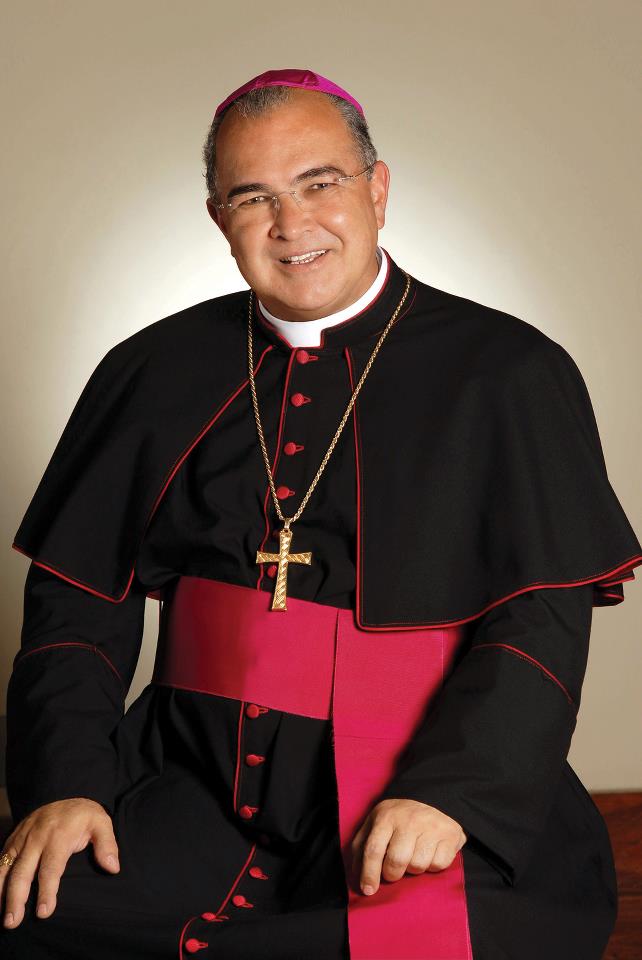
9. Archbishop Orani Joao Tempesta, O. Cist., Metropolitan Archbishop of Sao Sebastiao do Rio de Janeiro (Brazil) – 63

Dom Orani João Tempesta

As the head of a Cardinalatial see, with all five of his immediate predecessors made Cardinals, and with the limelight gained from the 2013 World Youth Day in Rio de Janeiro, Archbishop Tempesta is a certain candidate for the Cardinalate.


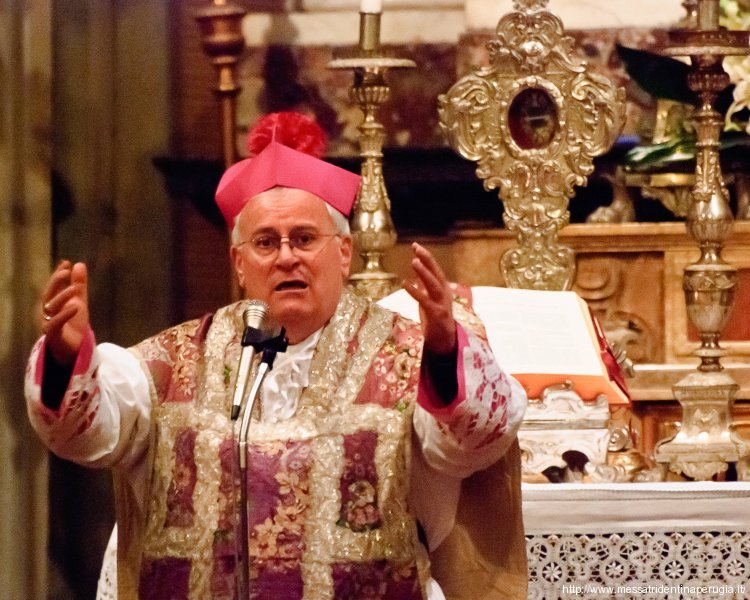
10. Archbishop Gualtiero Bassetti, Metropolitan Archbishop of Perugia-Citta della Pieve (Italy) – 71

Bassetti

His long ago predecessor, Cardinal Vincenzo Gioacchino Pecci was elected Pope Leo XIII in 1878. Since then Perugia had had no Cardinal. This elevation of Archbishop Bassetti to the Cardinalate would honour the memory of Pope Leo XIII and give chance to other Italian Archdioceses to get the red hat besides the major, Cardinalate ones. Archbishop Bassetti is also known for his pastoral nature and hard work for his Archdiocese.


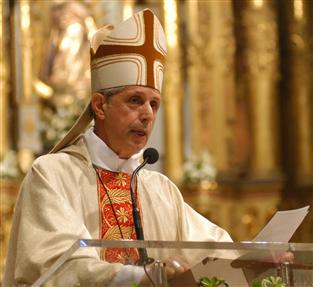
11. Archbishop Mario Aurelio Poli, Metropolitan Archbishop of Buenos Aires (Argentina) – 66

20130327134808

As the successor of Pope Francis as the Metropolitan Archbishop of Buenos Aires, Archbishop Poli is a natural and certain choice for the Cardinalate.


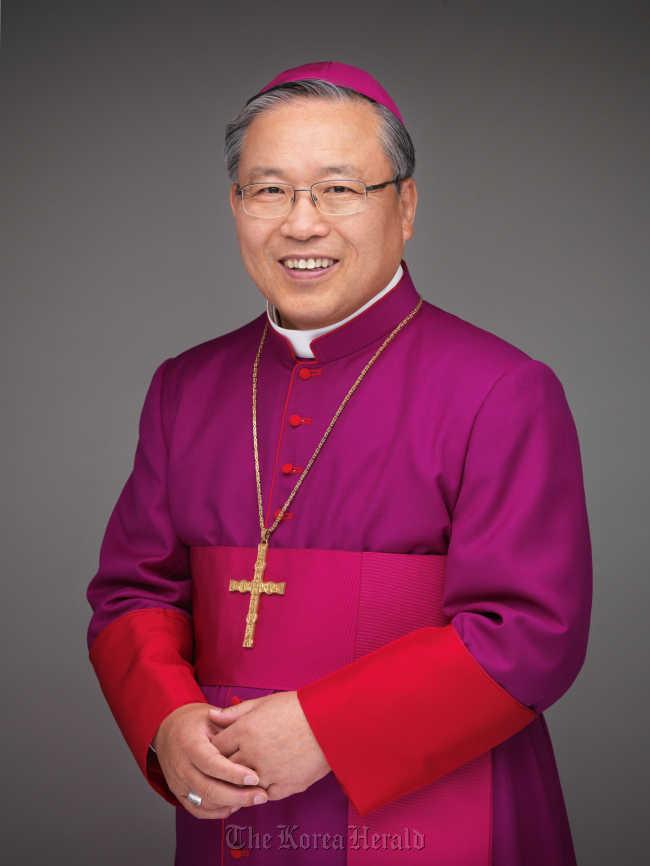
12. Archbishop Andrew Yeom Soo-jung, Metropolitan Archbishop of Seoul (South Korea) – 70

20120625000388_0

Among the three great Asian nations known for their Cardinals, namely Hong Kong (China), South Korea, and the Philippines, only South Korea at the moment has no Cardinal-elector. Hence, Archbishop Andrew Yeom is an almost confirmed choice for the Cardinalate, and indeed, he was chosen.


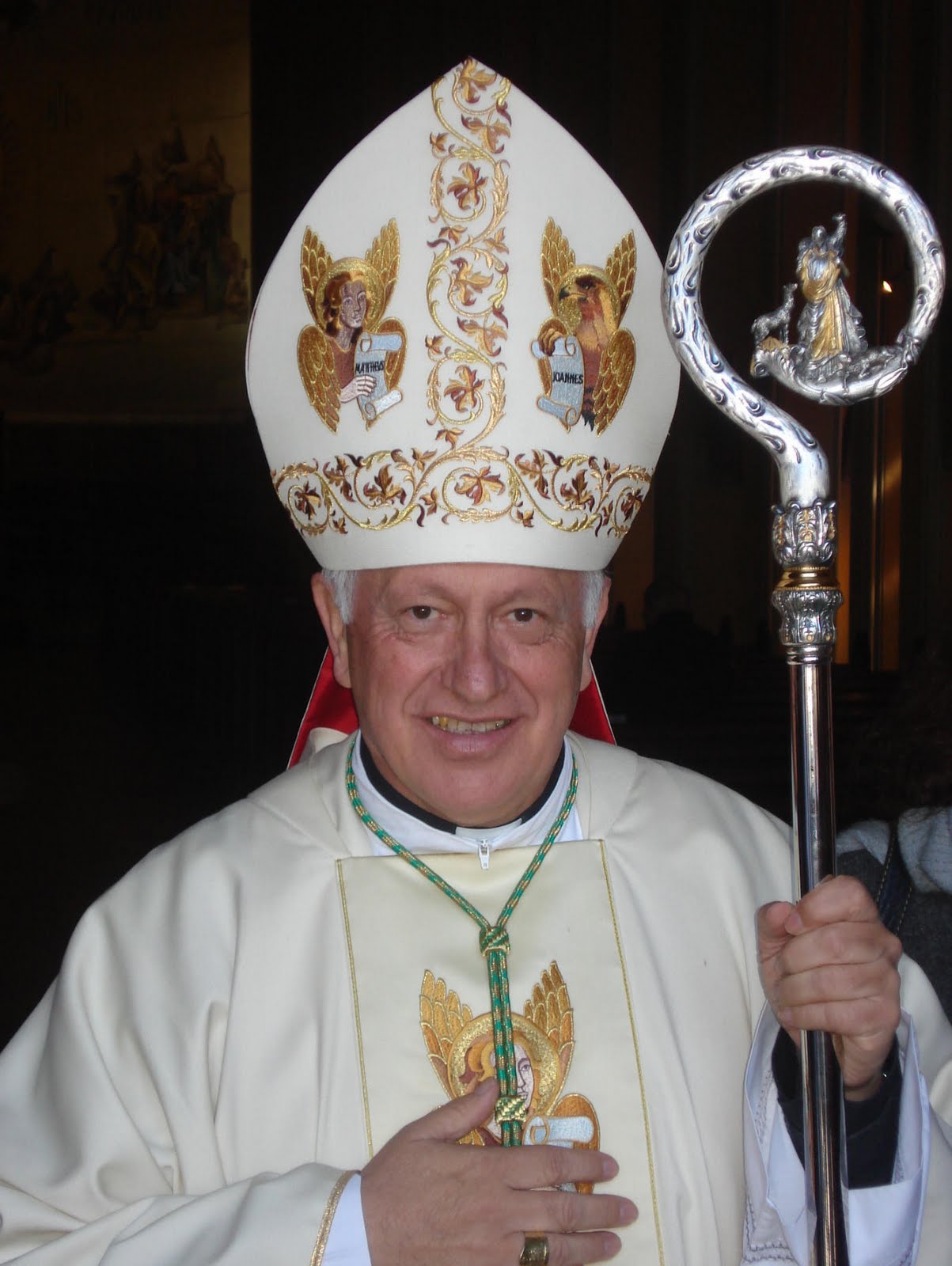
13. Archbishop Ricardo Ezzati Andrello, S.D.B., Metropolitan Archbishop of Santiago (Chile) – 72

02

Another Cardinalatial see in the Latin Americas, and therefore, Archbishop Ezzati Andrello is one of the few possible choices for the Cardinalate. Another Cardinal to increase the proportion of Latin America in the Sacred College of Cardinals.


14. Archbishop Philippe Nakellentuba Ouedraogo, Metropolitan Archbishop of Ouagadougou (Burkina Faso) – 68

Oua

One of his predecessor was made Cardinal by Pope Paul VI in 1965, and therefore Archbishop Ouedraogo was a potential candidate for the Cardinalate for Africa region.


15. Archbishop Orlando Beltran Quevedo, O.M.I., Metropolitan Archbishop of Cotabato (Philippines) – 74

Quevedo

A rather suprising choice because Archbishop Quevedo is already 74 and therefore is just one year from the mandatory retirement age, although this may be extended towards 80, as was quite common in recent years among Asian Cardinals.

Geographically the choice made sense because the Philippines does deserve more Cardinals, and so far the Cardinalatial sees only cover the north (Manila) and central (Cebu) portions of the country. A Cardinal from the southern island of Mindanao is a good sign indeed.


16. Bishop Chibly Langlois, Bishop of Les Cayes (Haiti) – 55

chibly_langlois

The youngest of the newly appointed Cardinals, from a relatively less important diocese in the Caribbean region. This choice is a nod both to the plight of the people of Haiti after the earthquake that happened a few years earlier, as well as the rising importance of the region to the Universal Church.


There are three Cardinal non-electors (over the age of 80) appointed in this Consistory, usually for their great and long contribution and dedication to the Church :


17. Archbishop Loris Francesco Capovilla, Archbishop-Prelate Emeritus of Loreto (Italy) – 98

Capovilla

The oldest of the newly appointed Cardinals at 98, likely the oldest person ever appointed a Cardinal. Archbishop Capovilla was renowned for being the long-time private secretary to Blessed Pope John XXIII.

As the aforementioned Pope will be canonised this coming April, it is an obvious nod to his memory that Archbishop Capovilla, coupled with his long and dedicated service, that he is made a Cardinal.


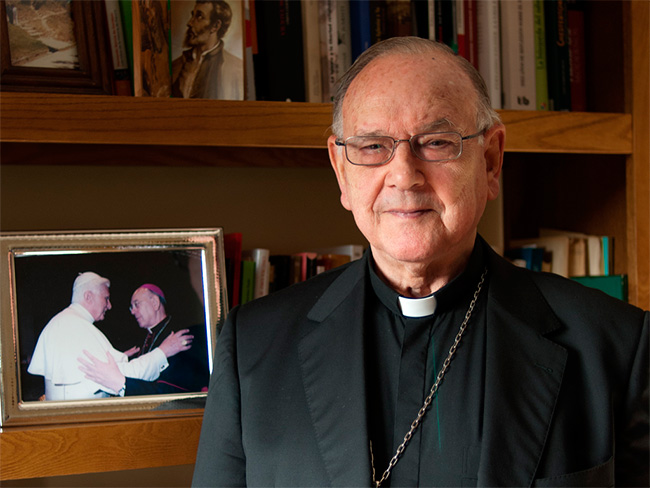
18. Archbishop Fernando Sebastian Aguilar, C.M.F., Metropolitan Archbishop Emeritus of Pamplona y Tudela (Spain) – 84

fernando-sebastian


19. Archbishop Kelvin Edward Felix, Metropolitan Archbishop Emeritus of Castries (Saint Lucia) – 80

rev_felix

Another appointee for the Caribbean region, even though being over 80, it was rather honorary in nature, but nevertheless it was to highlight the importance of the New World in the Universal Church.

Cardinabili List for the Cardinal Consistory of 22 February 2014

Here is my own list of the potential candidates for the Cardinalate, to receive the red biretta in the Consistory next month.

The final list is not yet known, and while some in this list may not be chosen, it is possible all of them are chosen, and there may be even names outside this list I have compiled too. Pray for them!


Cardinal Consistory of 22 February 2014 (Feast of the Chair of St. Peter)


Almost Certain


Curia

1. Archbishop Pietro Parolin, Secretary of the Secretariat of State

2. Archbishop Beniamino Stella, Prefect of the Congregation for Clergy

3. Archbishop Gerhard Ludwig Muller, Prefect of the Congregation for the Doctrine of the Faith

4. Archbishop Lorenzo Baldisseri, Secretary General of the Synod of Bishops


Residential

5. Patriarch Francesco Moraglia, Patriarch of Venice (Italy)

6. Archbishop Mario Aurelio Poli, Metropolitan Archbishop of Buenos Aires (Argentina)


Very likely


Residential

6. Patriarch Manuel Jose Macario do Nascimento Clemente, Patriarch of Lisbon (Portugal)

7. Archbishop Vincent Nichols, Metropolitan Archbishop of Westminster (United Kingdom)

8. Archbishop Andre-Joseph Leonard, Metropolitan Archbishop of Mechelen-Brussels (Belgium)

9. Major Archbishop Sviatoslav Shevchuk, Major Archbishop of Kyiv-Halyc (Head of the Ukrainian Greek Catholic Church)

10. Archbishop Jose Serafio Palma, Metropolitan Archbishop of Cebu (Philippines)

11. Archbishop Andrew Yeom Soo-jung, Metropolitan Archbishop of Seoul (South Korea)

12. Archbishop Cyprian Kizito Lwanga, Metropolitan Archbishop of Kampala (Uganda)

13. Archbishop Odon Razanakolona, Metropolitan Archbishop of Antananarivo (Madagascar)

14. Archbishop Orani Joao Tempesta, Metropolitan Archbishop of Rio de Janeiro (Brazil)

15. Archbishop Ricardo Ezzati Andrello, S.D.B., Metropolitan Archbishop of Santiago (Chile)


Possible


Curial

16. Archbishop Jean-Louis Brugues, O.P., Head of the Vatican Secret Archives and the Vatican Apostolic Library

17. Archbishop Salvatore Fisichella, President of the Pontifical Council for the Promotion of the New Evangelisation

18. Archbishop Vincenzo Paglia, President of the Pontifical Council for the Family


Residential

19. Archbishop Charles Joseph Chaput, O.F.M. Cap., Metropolitan Archbishop of Philadelphia (USA)

20. Archbishop Rogelio Cabrera Lopez, Metropolitan Archbishop of Monterrey (Mexico)

21. Archbishop Peter Takeo Okada, Metropolitan Archbishop of Tokyo (Japan)

22. Archbishop Ignatius Suharyo Hardjoatmodjo, Metropolitan Archbishop of Jakarta (Indonesia)

23. Patriarch Ibrahim Isaac Sidrak, Patriarch of Alexandria (Head of the Coptic Catholic Church)

24. Archbishop Francis Xavier Kriengsak Kovithavanij, Metropolitan Archbishop of Bangkok (Thailand)

25. Archbishop Eustaqio Pastor Cuquejo Verga, Metropolitan Archbishop of Asuncion (Paraguay)

26. Archbishop Cesare Nosiglia, Metropolitan Archbishop of Turin (Italy)

Imposition of the pallium on the new Metropolitan Archbishops by Pope Francis

On the great Feast day and Solemnity of Saints Peter and Paul, Apostles, the feast day of the Church of Rome, on Saturday, 29 June 2013, 34 new Metropolitan Archbishops will receive the pallium, the symbol of their metropolitan office from Pope Francis, in a Mass at St. Peter’s Basilica.
Pallium (Pallium)
1_0_674753 (Papal Pallium)
Pallium is a woolen band, worn around the shoulders, as a symbol of office, representation of the Good Shepherd, with Jesus carrying the lamb on His shoulder, which is reminiscent of the authority entrusted upon the Metropolitan Archbishops over their flocks. Pallium therefore is a symbol of authority. It is about three fingers wide, and has six black crosses, out of which three are pierced with a golden pin, representing the wounds of Christ pierced by the holy nails on the cross.
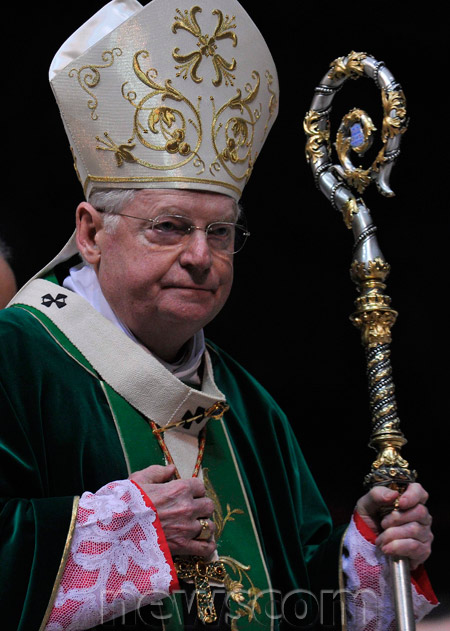
angelo-scola
(Above : image of Cardinal Angelo Scola, wearing the pallium, as the Metropolitan Archbishop of Milan, who received the pallium personally from Pope Benedict XVI in 2011)
Papal pallium from 2005 is different, in order to distinguish the nature of the Papal office, as the Pope is not just any bishop or Metropolitan Archbishop, but is Metropolitan over the entire world, the entire Church, as the Vicar of Christ.
Pope-Benedict-XVI
(Above : Pope Benedict XVI with the Papal pallium in 2012)

The list of the new Metropolitan Archbishops who will receive the pallium below.

1. Patriarch Manuel Jose Macario do Nascimento Clemente, Patriarch of Lisbon (Portugal)
2. Archbishop Dieudonne Nzapalainga, C.S.Sp., Metropolitan Archbishop of Bangui (Central African Republic)
3. Archbishop Carlo Roberto Maria Redaelli, Metropolitan Archbishop of Gorizia (Italy)
4. Archbishop Claudio Dalla Zuanna, S.C.I., Metropolitan Archbishop of Beira (Mozambique)
5. Archbishop Prakash Mallavarapu, Metropolitan Archbishop of Visakhapatnam (India)
6. Archbishop Antonio Carlos Altieri, S.D.B., Metropolitan Archbishop of Passo Fundo (Brazil)
7. Archbishop Marek Jedraszewski, Metropolitan Archbishop of Lodz (Poland)
8. Archbishop Philip Tartaglia, Metropolitan Archbishop of Glasgow (Great Britain)
9. Archbishop Salvatore Joseph Cordileone, Metropolitan Archbishop of San Francisco (USA)
10. Archbishop Rolando Joven Tria Tirona, O.C.D., Metropolitan Archbishop of Caceres (Philippines)
11. Archbishop Rogelio Cabrera Lopez, Metropolitan Archbishop of Monterrey (Mexico)
12. Archbishop Joseph William Tobin, C.Ss.R., Metropolitan Archbishop of Indianapolis (USA)
13. Archbishop Carlos Maria Franzini, Metropolitan Archbishop of Mendoza (Argentina)
14. Archbishop Lorenzo Ghizzoni, Metropolitan Archbishop of Ravenna-Cervia (Italy)
15. Archbishop George Antonysamy, Metropolitan Archbishop of Madras and Mylapore (India)
16. Archbishop Anil Joseph Thomas Couto, Metropolitan Archbishop of Delhi (India)
17. Archbishop John Wong Soo Kau, Metropolitan Archbishop of Kota Kinabalu (Malaysia)
18. Archbishop Murray Chatlain, Metropolitan Archbishop of Keewatin-Le Pas (Canada)
19. Archbishop Sérgio Eduardo Castriani, C.S.Sp., Metropolitan Archbishop of Manaus (Brazil)
20. Archbishop Peter Loy Chong, Metropolitan Archbishop of Suva, (Fiji)
21. Archbishop Alfonso Cortes Contreras, Metropolitan Archbishop of Leon (Mexico)
22. Archbishop Alexander King Sample, Metropolitan Archbishop of Portland in Oregon (USA)
23. Archbishop Joseph Effiong Ekuwem, Metropolitan Archbishop of Calabar (Nigeria)
24. Archbishop Jesus Juarez Parraga, S.D.B., Metropolitan Archbishop of Sucre (Bolivia)
25. Archbishop Fabio Martinez Castilla, Metropolitan Archbishop of Tuxtla Gutierrez (Mexico)
26. Archbishop Ramon Alfredo Dus, Metropolitan Archbishop of Resistencia (Argentina)
27. Archbishop Mario Aurelio Poli, Metropolitan Archbishop of Buenos Aires (Argentina)
28. Archbishop Gintaras Linas Grusas, Metropolitan Archbishop of Vilnius (Lithuania)
29. Archbishop Michael Owen Jackels, Metropolitan Archbishop of Dubuque (USA)
30. Archbishop Duro Hranic, Metropolitan Archbishop of Dakovo-Osijek (Croatia)
31. Archbishop Moacir Silva, Metropolitan Archbishop of Ribeirao Preto (Brazil)
32. Archbishop Jozef Piotr Kupny, Metropolitan Archbishop of Wroclaw (Poland)
33. Archbishop Sergio Alfredo Gualberti Calandrina, Metropolitan Archbishop of Santa Cruz de la Sierra (Bolivia)
34. Archbishop Giuseppe Petrocchi, Metropolitan Archbishop of L’Aquila (Italy)
In addition, the Metropolitan Archbishop of Hue, Archbishop Francois Xavier Le Van Hong, will not receive the pallium directly from the Pope in Rome, but in his home diocese of Hue, through the papal representative. Therefore, in addition to the 34 Metropolitan Archbishops mentioned above, 35 Metropolitan Archbishops will receive the pallium in this year.
35. Archbishop Francois Xavier Le Van Hong, Metropolitan Archbishop of Hue (Vietnam)

Metropolitan Archbishop differs from normal Archbishops in that, they have jurisdiction over other dioceses that are placed under their supervision, in a group called Ecclesiastical Province of the Church. Archbishops of Archdioceses without Metropolitan character has no jurisdiction over any dioceses under them, and they are usually directly subject to the Holy See.

Cardinal Juan Sandoval Iniguez turns 80, ceases to be a Cardinal-elector

Image

Today, Thursday, 28 March 2013, Cardinal Juan Sandoval Iniguez, Cardinal-Priest of Nostra Signora di Guadalupe e S. Filippo Martire, and Metropolitan Archbishop Emeritus of Guadalajara, Mexico, turns 80, and therefore, according to the rules written in the Apostolic Constitution Universi Dominici Gregis, he loses his right to vote in any future conclave.

http://www.gcatholic.org/hierarchy/data/cardJP2-6.htm#144

May God bless His Eminence Cardinal Sandoval Iniguez, with a blessed old age and health. May he remain strong in the faith and hopefully can perhaps still carry out the mission God had given him.

The College of Cardinals now stands at 206 members in total, with 113 Cardinal-electors and 93 Cardinal non-electors. There are now vacancy of 7 Cardinal-electors as compared to the maximum number of electors allowed in the Conclave of 120, although Popes John Paul II and Benedict XVI had sometimes surpassed this limit.

Next Cardinal-elector to age out (80) will be Cardinal Godfried Danneels on 4 June 2013.

Coat of arms of Cardinal Jorge Maria Bergoglio, S.J., now Pope Francis

Image

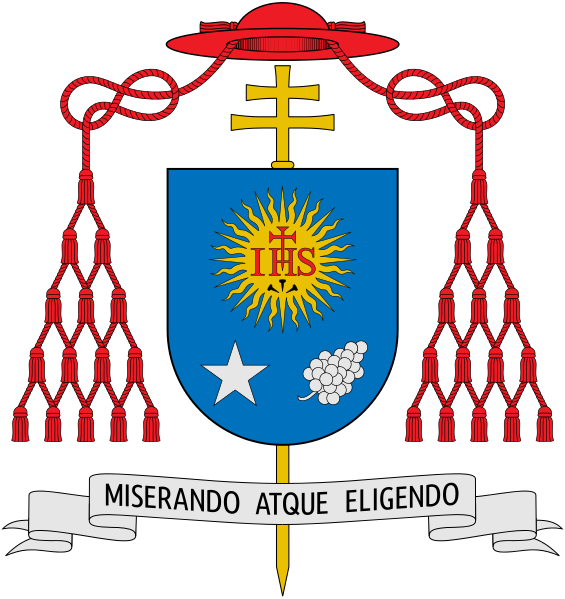
This is the coat of arms of Cardinal Jorge Maria Bergoglio, S.J., Metropolitan Archbishop of Buenos Aires, Argentina, who was elected as the 266th Pope and Bishop of Rome last Wednesday, 13 March 2013 and chosen the name Pope Francis.

Pope Francis used his episcopal motto “Miserando atque Eligendo” which means “Lowly but chosen” in English, in line with his views and outlook on humility.

The Cardinal’s fifteen red tassels and the galero on top of it will be replaced by the papal arms standard including the papal tiara/mitre and the crossed keys of the kingdom of heaven (silver and gold).

The symbols that appeared on the shield are first, the IHS symbol surrounded with a sun-like ray is the symbol of the Jesuit order (S.J.) of which Pope Francis is a member of, and the star on the bottom-left, in conjunction with the blue colouration of the shield represents the Virgin Mary, and the grape on the bottom right represents Jesus Christ, as the grower of the vineyard of the Lord.

(Update) Summary of the Fifth General Congregation of the College of Cardinals : Thursday, 7 March 2013

http://www.news.va/en/news/general-congregations-with-all-electors-present-st

Rumour had mentioned that the St. Peter’s Basilica is booked for the Mass for the Election of the Roman Pontiff (Missa pro Eligendo Pontifice), but has been dismissed as untrue by Fr. Federico Lombardi, head of the Holy See Press Office.

152 Cardinals attended the Fifth General Congregation, with 114 Cardinal-electors attending. The last Cardinal-elector to arrive, Cardinal Jean-Baptiste Pham Minh-Man of Ho Chi Minh, Vietnam will arrive in time to attend the Sixth General Congregation on Thursday evening.

New Particular Congregation leaders are elected to aid the Camerlengo during this period with term of 3 days each cycle. Particular Congregation is only limited to Cardinal-electors and divided into three groups depending on the orders of the Cardinals (Bishops, priests, or deacons), and also scheduled to meet among themselves for discussions.

1. Cardinal Bishops : Cardinal Bechara Rai (Cardinal-Patriarch)

2. Cardinal Priests : Cardinal Laurent Monsengwo Pasinya of Kinshasa, Zaire

3. Cardinal Deacons : Cardinal Velasio de Paolis

Dean of the College of Cardinals, Cardinal Angelo Sodano has also read and sent the letter of condolence to the late Venezuelan leader, Hugo Chavez.

Who to watch for in 2013 papal conclave? Scola, Ouellet, Ravasi, Scherer

Scola, Ouellet, Ravasi, Scherer, who you should watch for in the Conclave.


Scola (Cardinal Angelo Scola, Metropolitan Archbishop of Milan)

Italian, so that even though he’s not in Curia, he did have experience in Rome, and he is already close to Rome, both in distance and relations. Also close to Pope Emeritus Benedict XVI,
and he has also done great job in Venice and then Milan, in which
these two archdioceses alone produced 5 popes in the past century

Only Pope Benedict XV and Pope Pius XII were not from these (excluding Pope John Paul II and Benedict XVI)

Venice : Pius X, John XXIII, John Paul I
Milan : Pius XI, Paul VI

Also at the forefront of communication with Islam through the publications Oasis he created to reach out to Christians in the Muslim world, and involved in interreligious dialogues.

Scola is also more charismatic than Ouellet and also active in the media via youtube, twitter, his site.

Scola is also a well-known author in bioethics, and certainly is a trait needed for a Pope that will lead the Church in its constant battle against the improper use of Science. Yes to an ethical science, but no to unbridled and uncontrolled use of science!

If the conclave proceeds smoothly, he should be the one elected Pope, within 2 or 3 days from the start of the conclave.


Ouellet (Cardinal Marc Ouellet, Prefect of the Congregation for Bishops)

In the Roman Curia and in charge of the bishops, but with the problem is that his archdiocesan experience is not that good, and the story has come out that the very church and parish we was born into, was no longer there, which is shameful considering the rate of secularisation in the west. Formerly he was the Metropolitan Archbishop of Quebec in Canada.

But so far he has done quite a good job, and quite in line with Pope Benedict XVI, by appointing bishops who are not only known to be good administrators, but more importantly, bishops who are holy, and are steadfast in their faith, with individuals like Archbishop Chaput of Philadelphia and Cardinal Tagle of Manila as example.


Ravasi (Cardinal Gianfranco Ravasi, President of Pontifical Council for Culture)

Ravasi is the forefront in how the Church communicates with social issues and the media, and he has been quite active in twitter, more so than Scola, but his administrative skill has been found rather lacking, since he has only five or six years experience as a bishop and never had any experience in handling major archdioceses or dioceses.

At least Cardinal Ravasi will sure make good use of the social media to help evangelise the faith to many, especially youths. But at the moment, we will also need candidate who are more experienced in administration as well, especially considering the troubles that had befallen the Church in recent years due to some inefficiencies in administration.


Scherer (Cardinal Odilo Pedro Scherer, Metropolitan Archbishop of Sao Paulo)

Scherer is rather conservative and as a Latin American, this may boost his chances, but he is quite young and he is not familiar with the curia and with still a relatively short experience as a senior prelate, he needs more experience in managing important archdioceses and other administrative matters.

In addition, the status of Brazil as a country, although having the largest Catholic population in the world, but the rapidly declining number of Catholics in the country as a percentage of the population and the rapidly growing secularisation in the country (also affect the rest of Latin America) may also affect his chances.


In fact, this time round, just as it was with the election of Pope Benedict XVI, now our Pope Emeritus, we does have a clear leading papabili, and the number of papabili is in fact not as many as the media mentioned it.

It will not be like the election of Pope John XXIII when there is no clear preferred papabili present, which resulted in the election of Cardinal Angelo Roncalli, later Pope John XXIII as the compromise choice.

Cardinal Keith O’ Brien of Edinburgh resigned amid controversy, and will not participate in Conclave

http://www.guardian.co.uk/world/2013/feb/25/cardinal-obrien-resigns-full-statements

The resignation of Cardinal Keith O’ Brien, now Metropolitan Archbishop Emeritus of St. Andrews and Edinburgh in Scotland, UK, has been accepted by Pope Benedict XVI, and allegations of improper conduct have also arisen against him. As such, he found it wise not to participate in the Conclave, which will happen sometime in March 2013.

Therefore, at this moment, we will have 115 Cardinal-electors barring any other Cardinals who may also skip the Conclave due to poor health such as Cardinal-Patriarch Antonios Naguib of the Coptic Catholics who is reported to be in ill health.


With regards to Cardinal O’ Brien, it is easy for many within, and especially from outside the Church of Christ to accuse not only him, but the whole Church itself. Many would be very happy to see the Church destroyed, and therefore, crushing the last bastion of truth and light in our struggle against evil. The world does hate Christ and those who believed in Him. We in the Church, and our leaders are human, and we are all sinners. Indeed, to those who have been given the trust and authority, much responsibility is given too.

Whatever bad things Cardinal O’ Brien had done, much good he had also done as well, in the service of our Lord. We thank him for his long service to God and His Church and pray that he will cooperate in all matters necessary, so that our Church, indeed, will be purged from all evil that has encroached into it in recent years. Indeed, Satan has been so busy working against God and His people that not only that he is not satisfied with just turning the world against us, it also corrupts even those inside, to destroy us.

This is why, the Year of Faith is important, because we must remember first and foremost that no matter what Satan throws at us, our faith must ever be impeccable and strong, and we must always centre ourselves in the love of God, through the Church. So, brothers and sisters in Christ, let us pray that the Lord will send His Holy Spirit to cleanse, not only our Church, but also the whole world, from Satan the deceiver. Pray for our Pope Benedict XVI who will be retiring soon, and for his soon-to-be elected successor. God bless the One, Holy, Catholic, and Apostolic Church!

Episcopal Ordination of Coadjutor Archbishop William Goh of Singapore, Part II : The office of Bishop, what they wear, and their significance

Continuing from the first part, in which I elaborated on the Episcopal Ordination ceremony itself, let us now take a look at the office of the Episcopate itself, that is of a bishop. One may ask, who is a bishop? Bishops are ‘overseers’, which came from the Greek word, Episkopos, which means overseers, as in the early Church, there are those appointed to succeed the Apostles and oversee the Christian communities, to care for them like shepherds care for their flocks of sheep.

Such was the origin of the episcopate, with bishops as those appointed in positions of authority and with oversight over the laity and the religious alike, to keep them faithful to God, and united to the successor of the blessed Apostle Peter, who is our Pope.


This development of the early Church eventually become an office on its own, a separate level from the priesthood, as in the episcopate, there is a fulfillment and completion of the holy orders, which is symbolised by the bishop wearing both the deacon’s dalmatic, and the priest’s chasuble over the dalmatic. This symbolises the union of the ministry of the diaconate and the priesthood in the person of the bishop, who represents the completion of holy orders.

Cardinals and Popes are not separate orders on their own, unlike the diaconate, priesthood, and the episcopate, as these are just different types of bishops, with Cardinals usually being bishops from important dioceses/archdioceses in the world, and the officials of the Roman Curia (the body governing the Universal Church), and the Pope, being the Bishop of Rome, is still a bishop, but is preeminent due to him being the successor of the Apostle Peter, to whom Christ entrusted His Church, and thus the Pope becomes the very Vicar of Christ in this world.


There are also many types of bishops, which I will elaborate further below :


1. Diocesan bishops : These are the ordinary bishops, who head a diocese. A diocese is a division of the Church in a certain geographical area consisting of the faithful in Christ, who may share same culture, language, and customs, or may be of diverse linguistic and cultural origins.


2. Archbishops : These are the bishops who head a more important diocese, either by location, or by history, or by some other reasons. These dioceses therefore are also correspondingly named archdioceses. There are two types of archdioceses :

          a. Metropolitan Archdiocese : An archdiocese that has an overseer status over one or more other dioceses (called suffragan dioceses or suffragan sees) which are grouped together into an Ecclesiastical Province (or Province of the Church), and headed by a Metropolitan Archbishop, whose distinguishing feature is that he wears a pallium (a woolen shoulder band with black crosses).

          b. Archdioceses (directly subject) : These Archdioceses are important dioceses which has either been historically a metropolitan see or diocese that were elevated to an archdiocese status, but these are not overseeing any dioceses under them, and therefore stand alone on its own, directly subject to the Holy See, to the Pope, instead of through a Metropolitan. The Archdiocese of Singapore is of this type.


3. Auxiliary bishops : These are ‘helper’ bishops, who are appointed in larger dioceses/archdioceses to help with the administration of the diocese/archdiocese’s large Catholic population. May also succeed the diocesan bishop/archbishop upon retirement if selected by the Pope, but this succession is not automatic (not like that of a coadjutor). They are given titular see (diocese/archdiocese) upon their appointment as auxiliary bishop.


4. Coadjutor Archbishops/Bishops : These are bishops/archbishops appointed to dioceses/archdioceses to succeed the diocesan bishop/archbishop, whose age may be nearing 75 or in ill health. Bishops have to submit their resignation to the Pope upon reaching the age of 75, so the appointment of a coadjutor is a way to ensure that the diocese does not become vacant if the diocesan bishop resigns, and is a good way to prepare the coadjutor for the eventual succession and duty as the new bishop of the diocese. Coadjutors are not given any titular sees since they are bound immediately to the see (diocese/archdiocese) which they are to succeed in the future.


5. Titular dioceses/archdioceses : These are usually ancient dioceses/archdioceses, mostly located in North Africa and the Middle East, which due to historical events, had fallen into seclusion and extinction. Some can also be found in Europe and Italy, where some dioceses and archdiocese had been suppressed in the past, and become titular sees. These are now given to Apostolic Nuncios, Apostolic Delegates, and the auxiliary bishops.


6. Major Archdioceses : These are only found in the Eastern Catholic Churches, namely the main diocese in the Syro-Malankar, Syro-Malabar, Romanian, and Ukrainian Eastern Catholic Churches, whose importance place them into this special type of Archdioceses, but not high enough to be given the title of a Patriarchate itself.


7. Patriarchate (Latin and Eastern Catholic) : These are the special Patriarchal sees headed by a Patriarch, which in the Eastern Catholic Churches are the leaders of their respective Churches, in full communion with the Bishop of Rome. They are the Patriarchs of the ancient Pentarchy, of Alexandria, Jerusalem, and Antioch, and historically of Constantinople (modern-day Istanbul). However, in our approach to our sister Church of the Eastern Orthodox (who is not yet in full communion with Rome), we respect their Ecumenical Patriarch of Constantinople, who is the leader of the Eastern Orthodox faithful. Latin Patriarchates also exist in Lisbon, Venice, and Goa, which are headed by Roman Catholic Archbishops, but with special Patriarchal title, due to their distinctive history in the Church. Rome itself was a Patriarchate (of the West) until 2006, but was abolished by Pope Benedict XVI to better reflect the position of the Pope as the leader of the Universal Church, and not just the Church of the West (the Roman Church).


So, therefore, after talking about bishops, who they are, and what types of bishops are there, let us now look into the vestments and the items particular to bishops, all of which are steeped in the tradition of the faith and filled with deep symbolism.


1. Working dress (worn outside Mass and important events, the daily wear of bishops, and also for Cardinals and Popes)

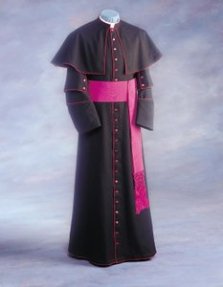
a. Simar            
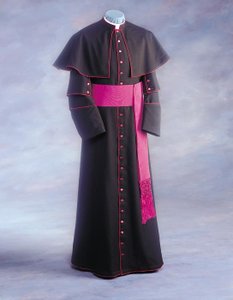
 Image

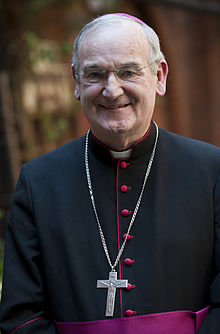
A simar is a special type of cassock worn by the bishops, cardinals, and popes, that is a cassock with a shoulder cape, and a sash (around the waist), which is violet for bishops, scarlet for cardinals, and white for popes. As is well known, the Pope’s simar is white in colour, while bishop’s and cardinal’s simar is black, and with violet lining for bishops, and scarlet lining for cardinals.


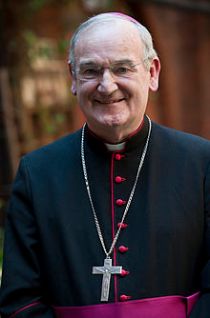
b. Pectoral cross (also part of the pontificalia and the choir dress)
Image


The pectoral cross is worn as its name suggests, on the breast, to represent Christ who protects us from harm, as noted in the prayer of the bishop when he wear the pectoral cross before the Mass, called Munire me dignerisMunire digneris me, Domine Jesu Christe, ab omnibus insidiis inimicorum omnium, signo sanctissimae Crucis tuae: ac concedere digneris mihi indigno servo tuo, ut sicut hanc Crucem, Sanctorum tuorum reliquiis refertam, ante pectus meum teneo, sic semper mente retineam at memoriam passionis, et sanctorum victorias Martyrum. (May You graciously protect me, o Lord Jesus Christ, from all the snares of all my enemies, the sign of the Your most holy Cross: that You would vouch and grant to me and all unworthy of being Your servant, that I may receive the Cross, filled with the remains of Your Saints, in front of my breast, I hold, then it always in mind, but retain the memory of the passion, martyrs and saints victories.). 

This is because pectoral crosses are usually precious and contain the relics of the saints, which therefore be further a reminder that the bishop carries with Him at all times, Christ, and His holy Saints, and a reminder of the Cross, through which the salvation of our Lord comes to us.


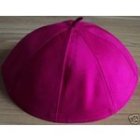
c. Zucchetto (or skullcap)
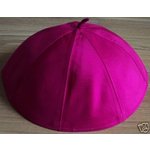
Image


Zucchetto is from the Italian word which means small gourd, because its shape which resembles (half of) a pumpkin. This is a head covering item for the bishops, cardinals, and popes, with the similar pattern of violet for bishops, scarlet for cardinals, and white for popes. This item has a lot in common and may have originated from the Jewish prayer cap, which is somewhat different from the zucchetto in appearance. Originally zucchetto has a practical use in the past, since the clergy in that era were tonsured, that is having their head shaved at the centre, and thus, without the present day heating available, during cold times, the head of the prelate (bishops) would become cold, and the zucchetto came in handy as a covering.

Nowadays, it is a symbol of prayer, and also honor, and therefore, as a sign of humility, it is always removed at the beginning of the Preface of the Eucharistic Prayer and the head of the bishops (including cardinals and Popes) remain bare throughout the Eucharistic Prayer and the Communion.


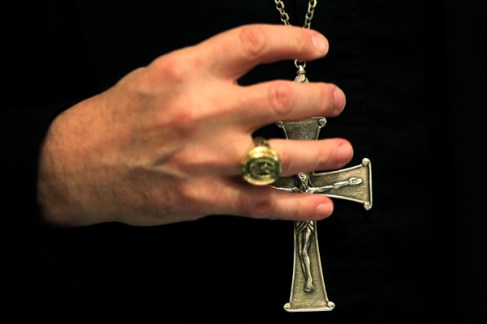
d. Episcopal ring
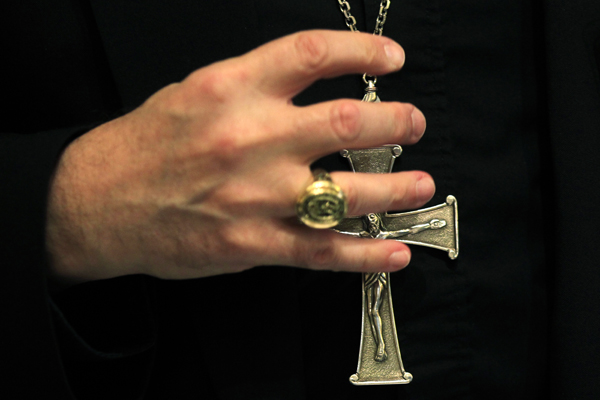
Image


The episcopal ring symbolises the bishop as the shepherd is married to God’s Church, in particular the diocese and the sheep, the faithful in Christ whom he is supposed to guide as the shepherd. The prayer the bishop said when wearing it reflects that this ring is also a symbol of virtue and sanctification, and blessing : Cordis et corporis mei, Domine, digitos virtute decora, et septiformis Spiritus sanctificatione circumda. (With my heart and of my body, O Lord, decorate my fingers with virtue, and sanctify me with the sevenfold blessing of the Holy Spirit around me).


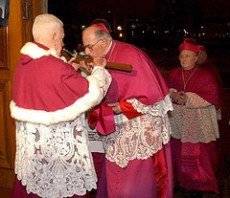
2. Choir dress (worn during the Mass if the bishop is not the celebrant or concelebrant in the Mass, and events like Vespers, and also worn outside for important events)
Image

a. Cassock with fascia/sash

This cassock with sash style is similar to the simar, but is entirely violet for bishops and scarlet for cardinals (as opposed to black with violet or scarlet lining)


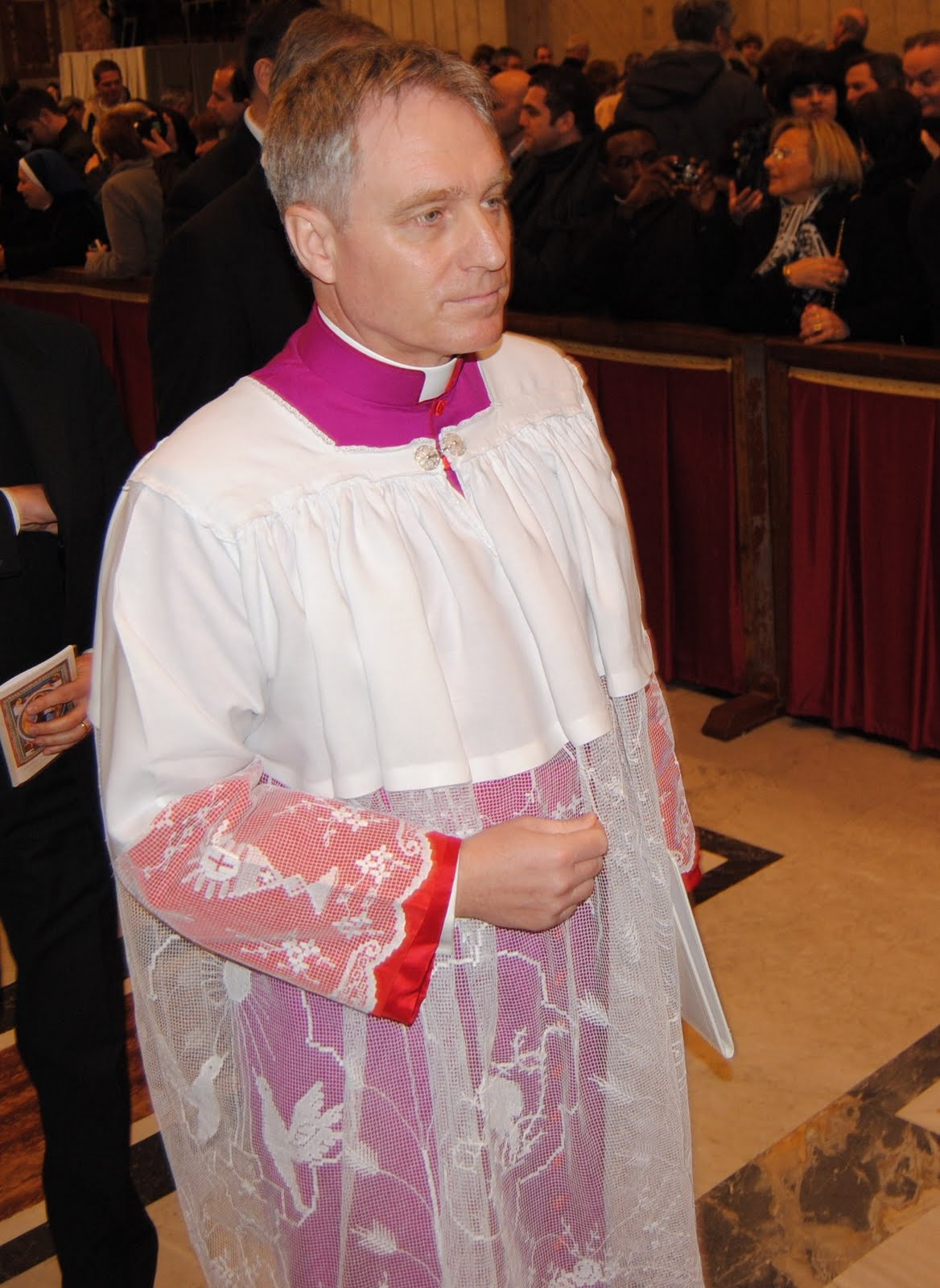
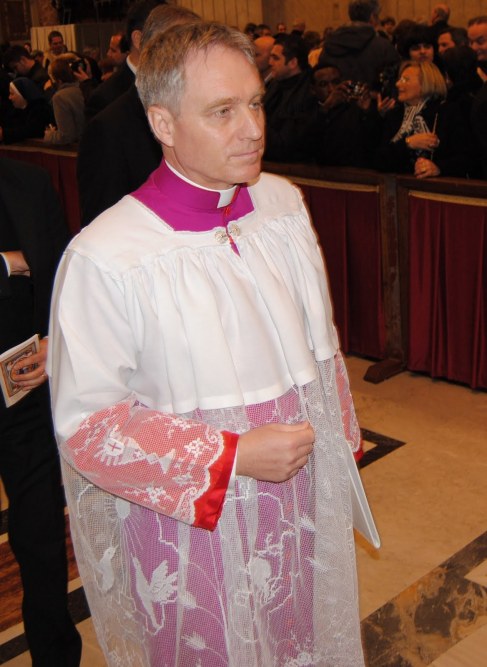
b. Rochet
Image

A beautiful, usually thin, either white or translucent, and laced piece of clothing worn over the cassock and the fascia, as seen worn above by Monsignor Georg Ganswein, now Archbishop Ganswein, Prefect of the Pontifical Household.


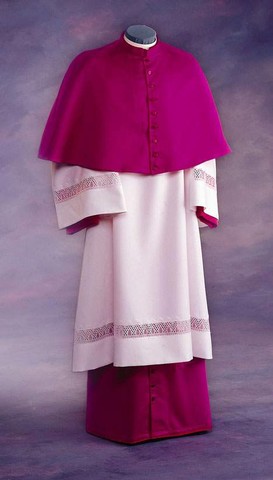
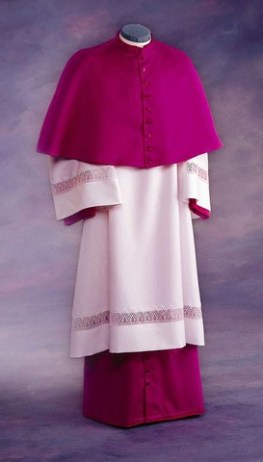
c. Mozzetta
Image


Mozzetta (violet for bishops) is a shoulder cape worn over the rochet and the cassock.


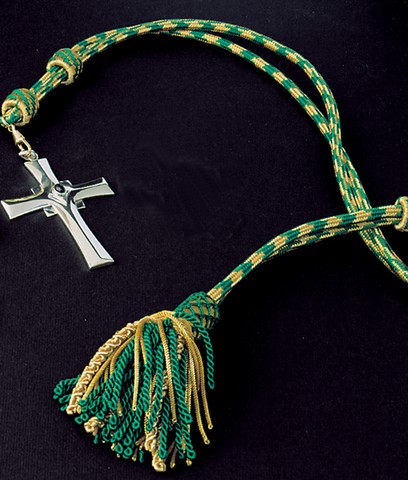
d. Pectoral cross
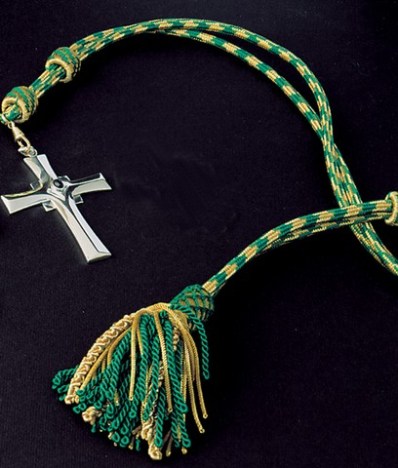
Image

Similar with in working dress, but more often worn with a cord rather than a chain.


e. Zucchetto

Violet for bishops. Similar as in the working dress.


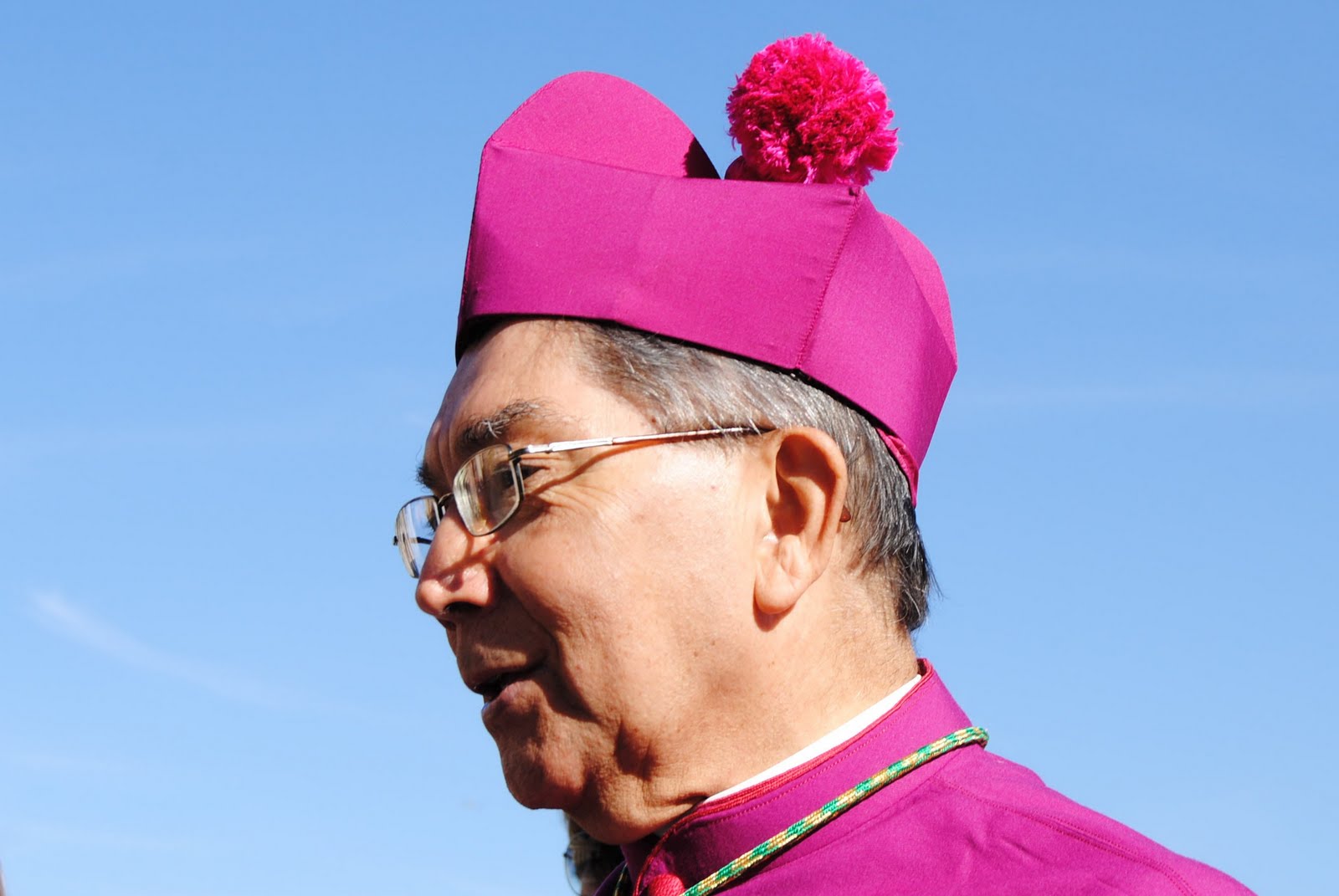
f. Biretta
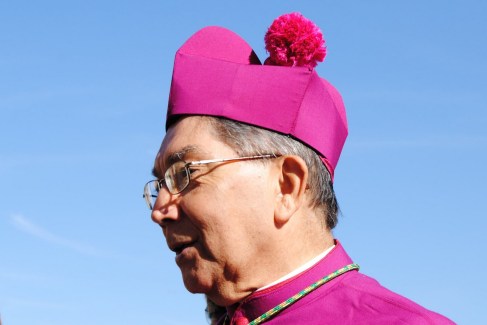
Image


A hat-like item which has the same ancestry as our modern academic mortar board (worn on the graduations in universities), which is violet for bishops and has a pom-pom like object on the top. Only has three peaks, and the unpeaked side is always worn on the left.


3. Bishop’s Pontificalia (worn during the Mass when celebrating)

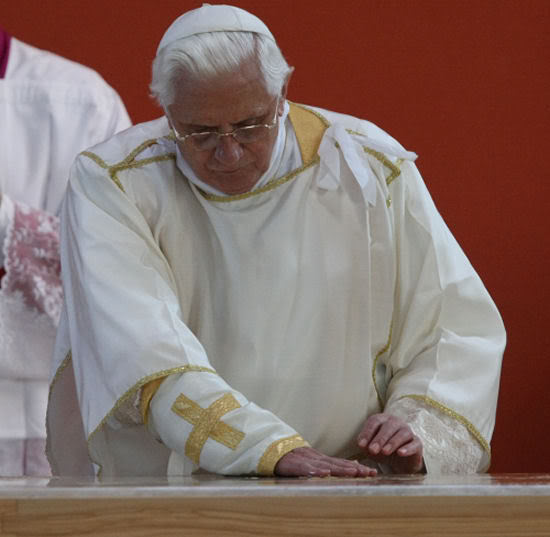
a. Dalmatic

Image


Similar as those worn by deacons, which has squarish-edges as compared to the chasuble (which has more rounded edges), worn over the alb but under the chasuble. Here is the picture of our Pope Benedict XVI wearing the dalmatic during the consecration of a new church in Rome, after he took off his chasuble for the anointing of the altar with holy oils.


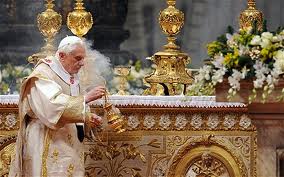
b. Chasuble
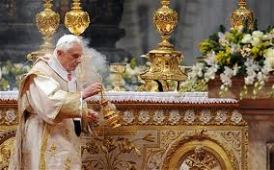
Image


Chasuble as worn by the priests, worn over the dalmatic and the stole, and in this picture, Pope Benedict XVI wore the more traditional Roman-style chasuble, and very visibly underneath the chasuble, is the dalmatic. Only bishops can wear both the chasuble and the dalmatic.


c. Pectoral cross

Worn under the chasuble, not over the chasuble, either the normal chained or corded pectoral cross. Not correctly worn when worn above the chasuble, although many bishops seem to do this. Pope Benedict XVI himself consistently wear the pectoral cross under the chasuble since the beginning of his Pontificate.


d. Episcopal ring

Worn on the finger, which signify his marriage to God and His Church.


e. Mitre
Image


Image


Image


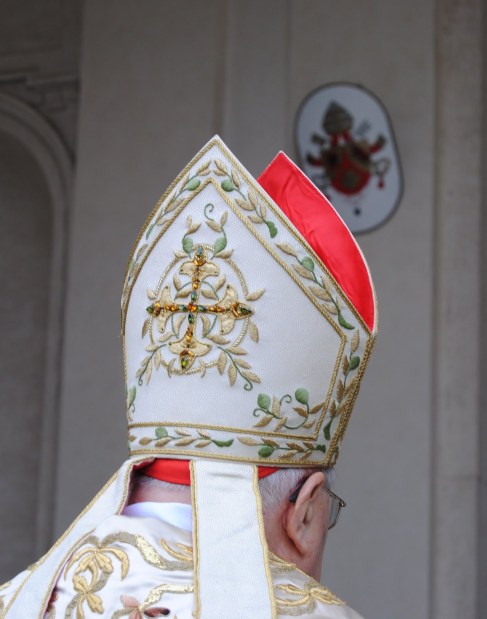
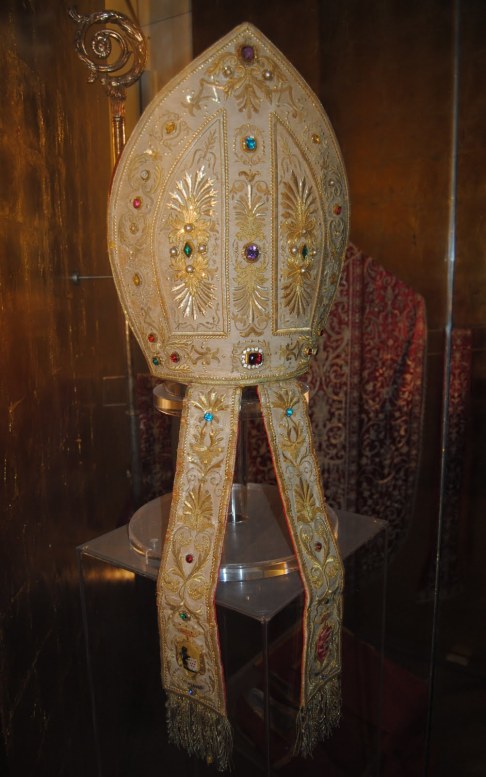
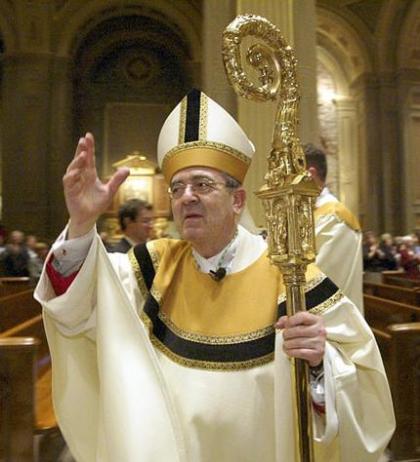
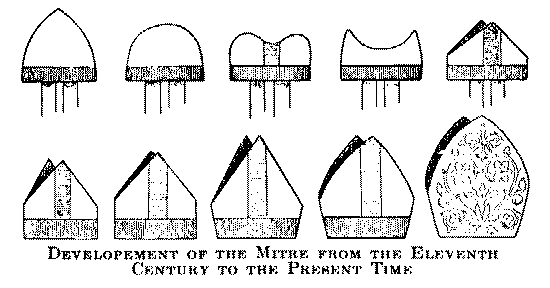
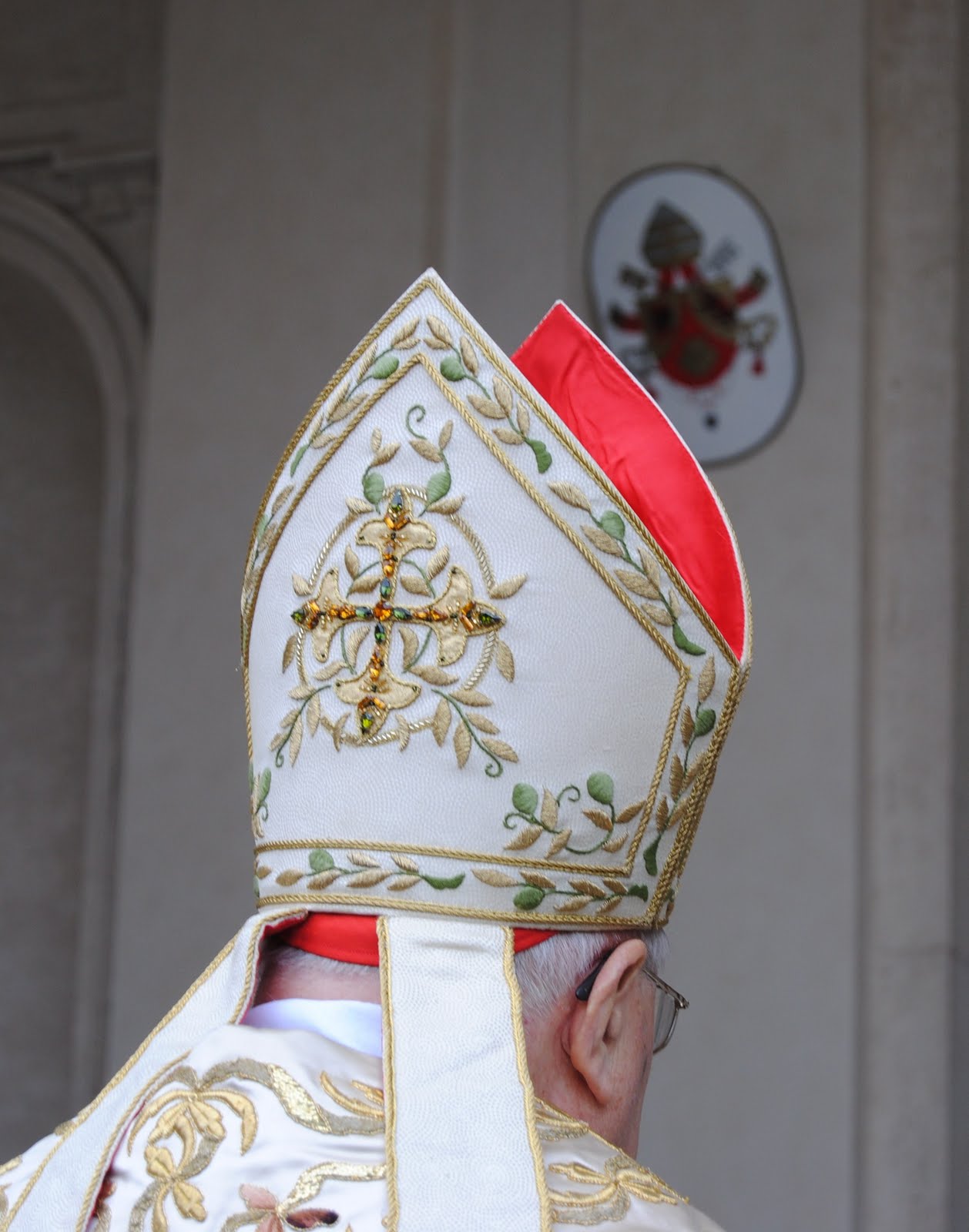
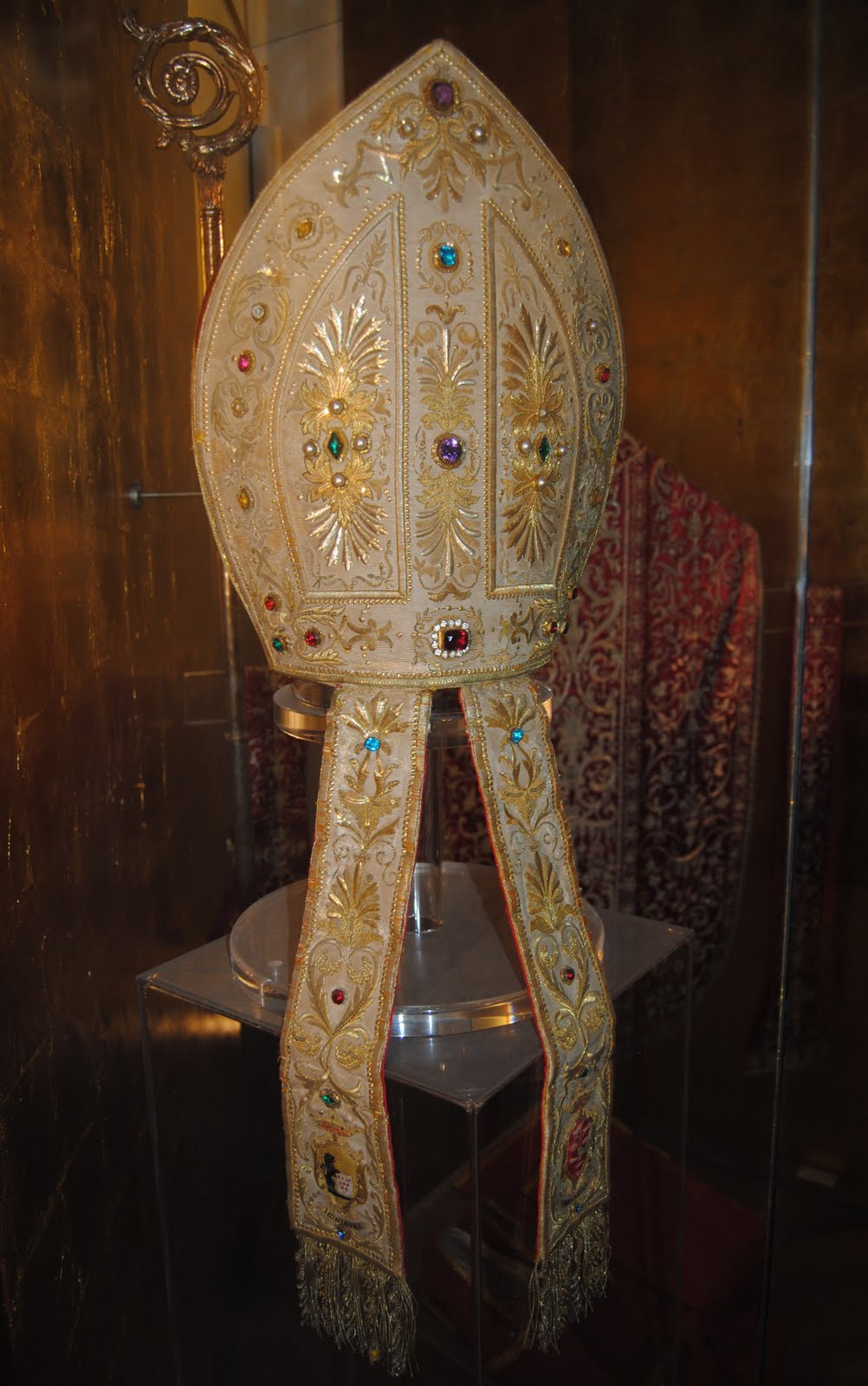
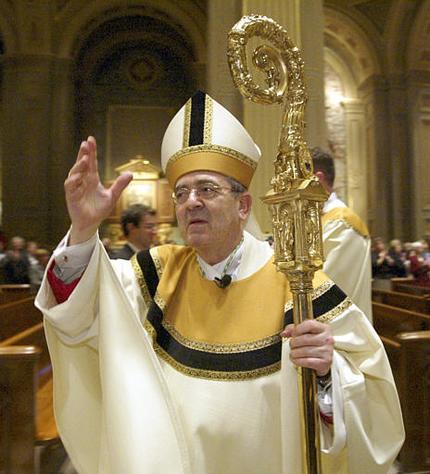
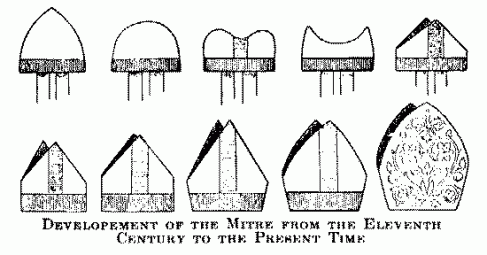
Worn over the zucchetto on the head, and was developed from the camelaucum, or the secular headdress of the late Roman Empire and early Byzantine Empire, where they are also worn by the Popes and the Roman priests, and gradually was restricted only to bishops and abbots.

The mitre symbolises the teaching authority of the bishops, which are symbolised by the two peaks of the mitre, representing the Old and the New Testament, and also recall the flames of the Holy Spirit that inflame the hearts of the Apostles to spread the Good News to all peoples. Therefore, these represents the authority of the bishop to teach the Gospel through the Holy Spirit and based on the Scripture, the Word of God, both the Old and the New Testament. The two lappets behind the mitre themselves also represent the Old and the New Testament, the two sides of the Lord’s Sacred Scripture (which shape looks just like a book marker).


f. Crosier (Pastoral staff)
Image


Image


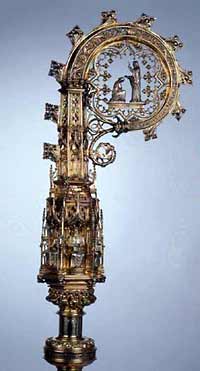
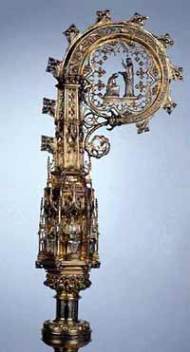
The crosier, or the pastoral staff is the crook-like staff, reminding us on the shepherd’s crook, which they use to shepherd their sheep. Thus, the crosier represents the bishops’ role as the shepherds of the people of God, and guide them in their journey towards the Lord, the Chief Shepherd, the Good Shepherd.


g. Pallium (only for Metropolitan Archbishops and the Pope)
Image

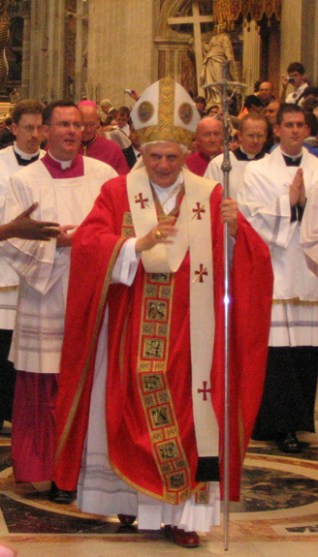
The pallium is a woolen band worn around the shoulder. This represent the metropolitan’s role as the overseer of the faithful, over the sheep of the Lord, that is the faithful people of God, just like Jesus, the Good Shepherd carrying His sheep on His shoulder. Therefore, the pallium represents both the authority of the metropolitan, and the burden presented by his ministry in the service of the Lord.

Image


Image

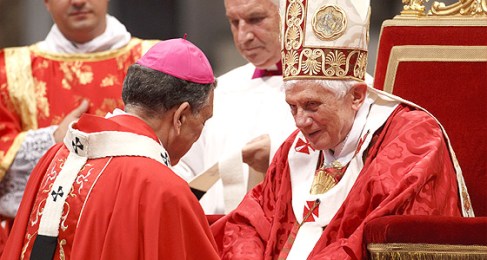
The pallium used to be much wider, as reflected in the earlier pallium that Pope Benedict XVI wore, which used the style not worn since a millenia ago, in the earlier days of the Church. Now the most common form of the pallium is a shorter and narrower woolen band worn around the shoulders, and adorned with three pins that represent the nails that pieced Christ on the cross, and these pins were placed onto the black crosses (red for Pope Benedict XVI’s new, larger pallium and the earlier, much larger pallium), which represent the wounds of Christ.


After all that, and after looking into what a bishop is, what is the nature of the ministry of the bishops, the types of bishops, what they wear and what symbolisms are there in them, let us now take a time to pray, and pray indeed for the soon-to-be ordained Coadjutor Archbishop, William Goh, of the Archdiocese of Singapore.

May God be with him all the days of his new ministry as bishop, and strengthen him at all times, that when his ministry begins this Friday, the Holy Spirit will guide him and keep him faithful to the ministry he has been chosen for, forever and ever. Amen!