Saturday, 27 June 2015 : 12th Week of Ordinary Time, Memorial of St. Cyril of Alexandria, Bishop and Doctor of the Church (Psalm)

Liturgical Colour : Green or White (Bishops or Saturday Mass of our Lady)

Luke 1 : 46-47, 48-49, 50 and 53, 54-55

My soul proclaims the greatness of the Lord, my spirit exults in God my Saviour!

He has looked upon His servant in her lowliness, and people forever will call me blessed. The Mighty One has done great things for me, Holy is His Name!

From age to age His mercy extends to those who live in His presence. He has filled the hungry with good things, but has sent the rich away empty.

He held out His hand to Israel, His servant, for He remembered His mercy, even as He promised to our fathers, to Abraham and his descendants forever.

Saturday, 27 June 2015 : 12th Week of Ordinary Time, Memorial of St. Cyril of Alexandria, Bishop and Doctor of the Church (First Reading)

Liturgical Colour : Green or White (Bishops or Saturday Mass of our Lady)

Genesis 18 : 1-15

YHVH appeared to Abraham near the oak of Mamre. Abraham was sitting at the entrance to his tent, in the heat of the day, when he looked up and saw three men standing nearby. When he saw them he ran from the entrance of the tent to meet them.

He bowed to the ground and said, “My Lord, if I have found favour in Your sight, do not pass Your servant by. Let a little water be brought. Wash Your feet and then rest under the trees. I shall fetch some bread so that You can be refreshed and continue on Your way, since You have come to Your servant.”

They then said, “Do as you say.” Abraham hurried into the tent to Sarah and said to her, “Quick, take three measures of flour, knead it and make cakes.” Abraham then ran to the herd, took a fine, tender calf, gave it to the servant who hurried to prepare it. He took butter and milk and together with the calf he had prepared laid it all before Them.

And while he remained standing, They ate. They then asked, “Where is Sarah, your wife?” Abraham answered, “She is in the tent. And the visitor said, “At this same time next year I will return and Sarah by then will have a son.”

Now Sarah was behind Him, listening at the entrance to the tent. Abraham and Sarah were old, well on in years, and Sarah no longer had her monthly periods. Sarah laughed to herself saying, “Now that I am old and worn and my husband is an old man, am I to have this pleasure?”

YHVH said to Abraham, “Why did Sarah laugh, saying : ‘Am I really going to have a child now that I am old?’ Is there anything that is impossible for God? At this same time next year I will return and Sarah by then will have a son.”

Sarah denied saying, “I did not laugh,” for she was afraid. But He said, “You did laugh.”

Friday, 17 October 2014 : 28th Week of Ordinary Time, Memorial of St. Ignatius of Antioch, Bishop and Martyr (Homily and Scripture Reflections)

Liturgical Colour : Red

Dear brothers and sisters in Christ, today we celebrate together as we heard in the Scriptures being read this day, the love and mercy of our Lord and God, who had delivered us from the power of death, so that we may be freed from the bondage and slavery of sin which leads eventually to death. Through Christ and what He had done in this world in full obedience to the Lord, He had brought us safety and reassurance against the power of death.

That is because by His suffering and death, He willingly took upon Himself the scourge of death, and all the consequences of our sins, so that those who trust in Him and believe in the words of truth and the Good News He brought, may gain the fullness of salvation and new life just as He had promised to the people of God. Christ had broken the power of death and freed mankind from the tyranny of sin by the act of His ultimate love and obedience to God the Father.

As mentioned ll by Jesus, that we have nothing to fear from sin and death if we are faithful to the Lord through our devotion and faith in Jesus, the Lord and Messiah sent by the Father to be our beacon of hope in this darkened world. As long as we keep ourselves strongly attached and faithful to the teachings of God, we will be safe from all evils and difficulties related to sin and death. Yes, Satan will do all in his power to try and wrest us back from the Lord, and bring us back into damnation, but if we are vigilant, we will not easily fall again for his lies and tricks.

That was why Jesus warned the people to be vigilant and careful against the yeast of the Pharisees. What is this yeast of the Pharisees? It is namely the weaknesses and vulnerabilities of the human soul and heart, which infect us all mankind, as the tools and leverages of Satan in trying to subvert us and turn us against the Lord our loving God and Father. It is pride, jealousy, hatred, lack of faith, and many other vulnerabilities that exist in our hearts.

The Pharisees were a group of social elites in the society of the people of God at the time, and they commanded great respect from the people and wielded great teaching authority in teaching the matters of the faith. They took great pride in their position and authority, and were jealous in guarding them against anyone they saw as threats and potential rivals to their power and authority, as well as prestige.

This is what brought them into direct conflict with the group of the Sadducees, the rational thinkers and the powerful nobilities in the society of the people of God, as the Pharisees acted as the extremely orthodox and zealous defenders of the laws of Moses, to the point that they pointed out the extremities in the application of those laws through their own actions, leading the people away from the true intention and meaning of those laws.

They violently rejected Christ, who they saw as a revolutionary preacher and a great threat to their teaching authority and influence. To this end, they always tried to disrupt His teachings and also to test Him wherever He went, asking many questions designed to trap Him, in which they failed, for the Lord knew all that were in their hearts and minds, and their evil desire to bring about His downfall.

This was why Jesus was so adamant in His warning to the people, that they need to guard themselves against the yeast of the Pharisees. Indeed, as I have mentioned, that through His own actions and act of supreme and ultimate love on the cross, Jesus had given us all new hope through our liberation from the tyranny of our sins and from the enslavement of evil, but this does not mean that we can just get this easily without effort.

In order for us to be saved, then in all of our actions we have to guard ourselves from the yeast of the Pharisees, that is hatred, jealousy, prejudice, greed and desire, violence, anger and wrath, pride and arrogance, and many other things which are indeed the main cause for all of us mankind in our committing of sins and evils. The many sins and evils of this world can be traced to these evils, the evils of our hearts, which we should indeed excise and remove from ourselves.

Today we celebrate the feast of St. Ignatius of Antioch, the successor of St. Peter who was the first Bishop of Antioch. He was a martyr of the faith, who was martyred in the defense of the Faith which he held so dearly. St. Ignatius of Antioch was a convert to the Faith in his youth, and he was also told to be among the children whom the Lord had called to His embrace as told in the Gospels.

St. Ignatius of Antioch succeeded St. Peter in the leadership of the faithful in the major city of Antioch, one of the first dioceses in the world, and the place where the faithful were first called by the appelation ‘Christianos’, which eventually became the name we are now known for, the Christians. St. Ignatius of Antioch led the faithful with love, and he devoted himself to them completely, leading them to live their faith truthfully and with zeal.

He wrote extensively, and in his many letters both to the other bishops and to his own faithful, he affirmed the many central teachings of the Faith, and urged all of his people and peers to adhere closely to the teachings of the Lord as revealed in the Good News the Apostles and disciples of Christ preached. And to the end, St. Ignatius of Antioch remained true to his faith, and even in suffering after he was arrested, he continued to attach himself strongly in faith to the Lord.

He suffered martyrdom in the Colosseum, being thrown to lions and other wild beasts, the fate which also awaited many other of his successors and contemporaries in faith, but indeed, he did not fear death nor he had any need to fear death. Why so? That is because he had been faithful in his life, and was completely devoted to the Lord, and in his righteousness, he was justified and made true in faith, and death no longer has any power over him and all the other faithful who kept their faith.

Brothers and sisters in Christ, today let us all also reaffirm our faith in God, following in the footsteps of St. Ignatius of Antioch and the other faithful saints and martyrs. Let us all not just have faith in mere words, but with real and true actions as well, so that our faith may be alive and living well, and so that we may be truly devoted and our Lord who sees our living and genuine faith, will justify us and bring us to His promised eternal life and reward, and free us forever from the threat of death. God bless us all. Amen.

Friday, 17 October 2014 : 28th Week of Ordinary Time, Memorial of St. Ignatius of Antioch, Bishop and Martyr (Gospel Reading)

Liturgical Colour : Red

Luke 12 : 1-7

Meanwhile, such a numerous crowd had gathered that they crushed one another. Then Jesus spoke to His disciples in this way, “Beware of the yeast of the Pharisees, which is hypocrisy. Nothing is covered that will not be uncovered, or hidden that will not be made known. Whatever you have said in darkness will be heard in daylight, and what you have whispered in hidden places, will be proclaimed from housetops.”

“I tell you, my friends, do not fear those who put to death the body and, after that, can do no more. But I will tell you whom to fear : Fear the one who after killing you is able to throw you into hell. This one you must fear.”

“Do you not buy five sparrows for two pennies? Yet not one of them has been forgotten by God. Even the hairs of your head have been numbered. Do not be afraid! Are you less worthy in the eyes of God than many sparrows?”

Friday, 17 October 2014 : 28th Week of Ordinary Time, Memorial of St. Ignatius of Antioch, Bishop and Martyr (Psalm)

Liturgical Colour : Red

Psalm 32 : 1-2, 4-5, 12-13

Rejoice in the Lord, you who are just, praise is fitting for the upright. Give thanks to Him on the harp and lyre, making melody and chanting praises.

For upright is the Lord’s word and worthy of trust is His work. The Lord loves justice and righteousness; the earth is full of His kindness.

Blessed is the nation whose God is the Lord – the people He has chosen for His inheritance. The Lord looks down from heaven and sees the whole race of mortals.

Friday, 17 October 2014 : 28th Week of Ordinary Time, Memorial of St. Ignatius of Antioch, Bishop and Martyr (First Reading)

Liturgical Colour : Red

Ephesians 1 : 11-14

By a decree of Him who disposes all things according to His own plan and decision, we, the Jews, have been chosen and called and we were awaiting the Messiah, for the praise of His glory.

You, on hearing the word of truth, the Gospel that saves you, have believed in Him. And, as promised, you were sealed with the Holy Spirit, the first pledge of what we shall receive, on the way to our deliverance as a people of God, for the praise of His glory.

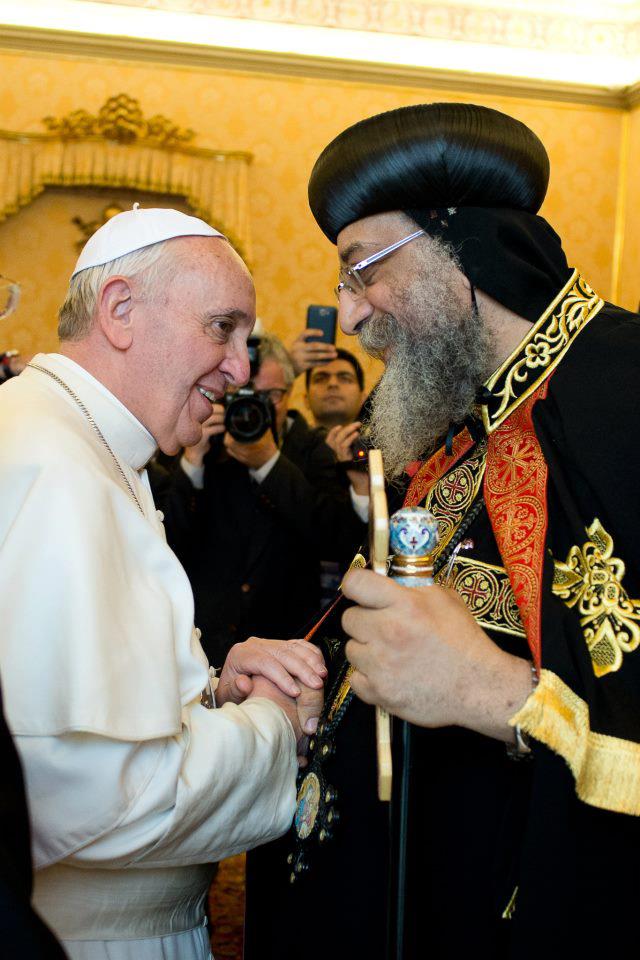
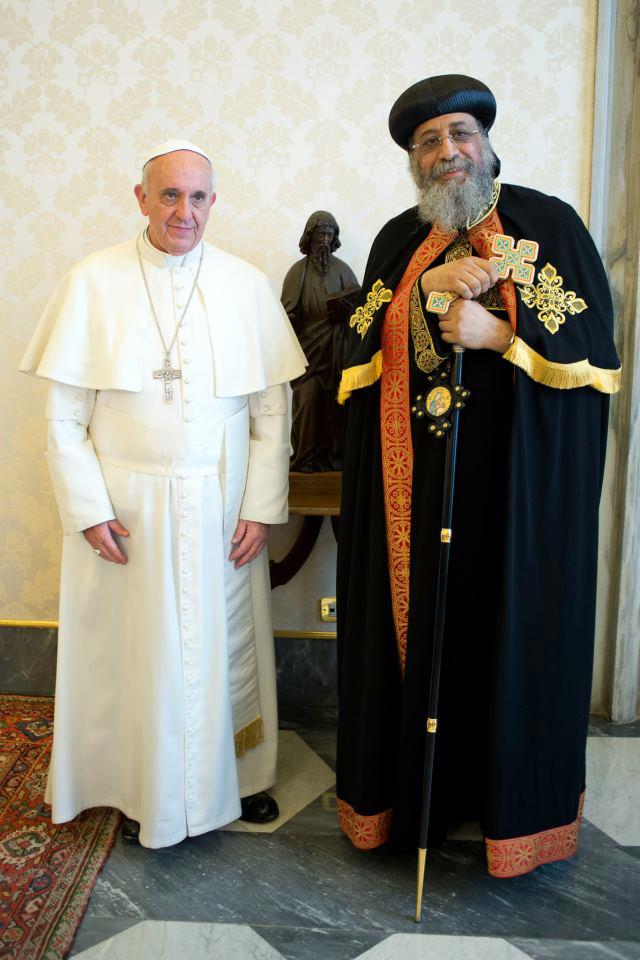
Historic visit by Pope and Patriarch of Alexandria, Pope Tawadros II to the Pope of the Church, Pope Francis

Image

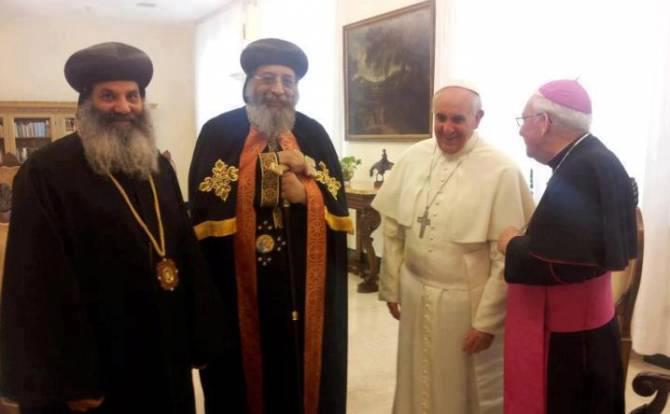
Pope Tawadros II (Theodore II) of Alexandria, the head of the Coptic Church, Successor of St. Mark the Evangelist, first Bishop of Alexandria, is visiting Rome to pay a visit to the Pope and Supreme leader of the Universal Church and Successor of St. Peter the Prince of the Apostles, Pope Francis.

Image

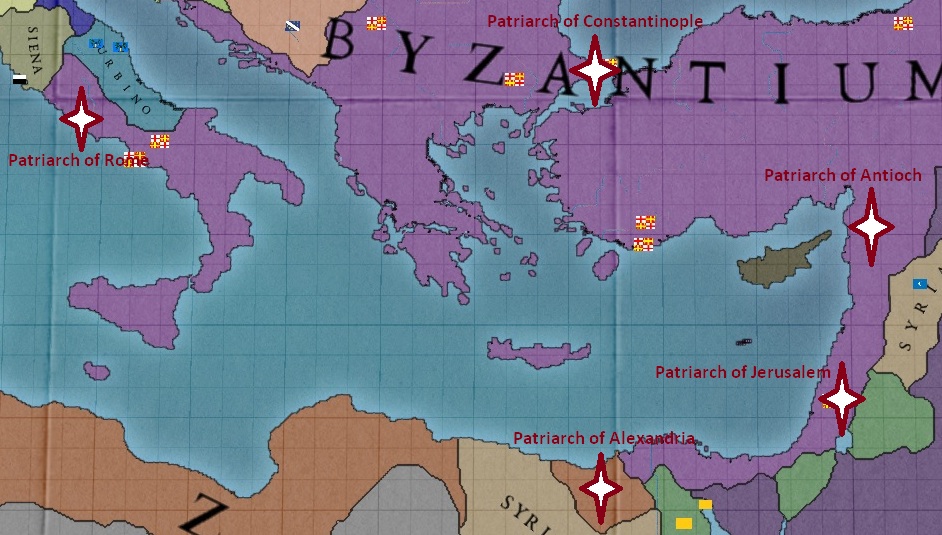
The Coptic Church is the direct descendant of the Patriarchate of Alexandria of the early Christian Pentarchy (Rome, Constantinople, Alexandria, Antioch, and Jerusalem), which broke apart from Rome and the Universal Church due to the disagreement in the Council of Chalcedon of 451, on the true nature of Christ.

Image

This disagreement is more due to misunderstanding in the nature of God, whether Christ’s human and divine persona is distinct or mixed. The initial term for non-Chalcedonians is monophysites, which is a heresy stating that both persona are mixed and indistinguishable. In fact, the Coptics and the other non-Chalcedonians in fact adopt miaphysitism, which while distinguishing the human and divine nature of Christ, but also acknowledge the mystery of the relationship between the two persona.

Image

Pope Tawadros II visits Rome in conjunction with the historic first meeting between the two Popes of Rome and Alexandria in 1973 by Pope Shenouda III, Pope Tawadros II’s predecessor, and Pope Paul VI. During that meeting a historic joint declaration of faith and friendship was announced and declared between the two Churches of God.

Image

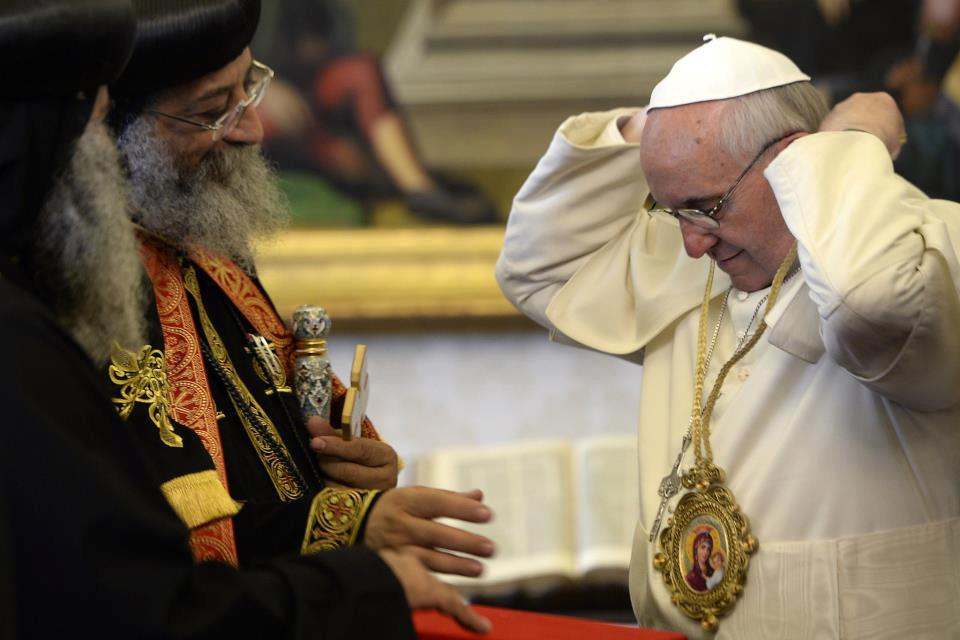
Pope Francis received a gift of an engolpion, which is a form of imagery in medallion, which is worn in the same way as pectoral cross, which are worn by the bishops of the Eastern Rite.

Image

We hope that all Christians, with the Copts and the Orthodox Churches can be reunited once again with the true and only Church, that is the Church of God, as one Body, indivisible by men and worldly ambitions, in the One, Holy, Roman, Catholic, and Apostolic Church.


Pray always for Christian Unity. That we are One, just as Christ our Lord and the Father in heaven are One.


Ut Omnes Unum Sint, ad Maiorem Dei Gloriam

(That they all may be One, for the greater glory of God)