Monday, 11 August 2014 : 19th Week of Ordinary Time, Memorial of St. Clare, Virgin (Gospel Reading)

Liturgical Colour : White

Matthew 17 : 22-27

While Jesus was in Galilee with the Twelve, He said to them, “The Son of Man will be delivered into the hands of men, and they will kill Him. But He will rise on the third day.” The Twelve were deeply grieved.

When they returned to Capernaum, the Temple tax collectors came to Peter and asked him, “Does your Master pay the Temple tax?” He answered, “Certainly.”

Peter then entered the house, and immediately Jesus asked him, “What do you think, Simon? Who pay taxes or tribute to the kings of the earth : their sons or the other people?”

Peter replied, “The other people.” And Jesus told him, “The sons, then, are tax-free. But so as not to offend these people, go to the sea, throw in a hook, and open the mouth of the first fish you catch. You will find a coin in it. Take the coin and let it pay for you and for Me.”

Saturday, 22 February 2014 : Feast of the Chair of St. Peter the Apostle (Gospel Reading)

Liturgical Colour : White

Matthew 16 : 13-19

After that, Jesus came to Caesarea Philippi. He asked His disciples, “Who do people say the Son of Man is?” They said, “For some of them You are John the Baptist, for others Elijah, or Jeremiah, or one of the prophets.”

Jesus asked them, “But you, who do you say I am?” Peter answered, “You are the Messiah, the Son of the living God.” Jesus replied, “It is well for you, Simon Bar-jona (son of Jonah), for it is not flesh or blood that has revealed this to you, but My Father in heaven.”

“And now I say to you : You are Peter, and on this rock I will build My Church; and never will the powers of death overcome it. I will give you the keys of the kingdom of heaven : whatever you bind on earth shall be bound in heaven, and whatever you unbind on earth shall be unbound in heaven.”

Friday, 1 March 2013 : 2nd Week of Lent (Scripture Reflection)

We are urged today, not to have evil thoughts on our brothers and sisters today, as illustrated earlier in the story of Joseph in the first reading and the psalm, and how he was sold off in slavery to Egypt due to his brothers’ jealousy, which caused them to initially harbour evil thought of killing him. The same evil intent and plot also happened in the Gospel when the tenants disposed of the servants and the son of the landowner, in the intention of gaining the lands they have been lent with, and disobeying the owner’s wish.

We should not harbour such evil intent, but instead look upon our brothers and sisters with love. Especially, just as Christ has taught us, we should even also look upon our enemies and our persecutors with love! and pray for them too!

And then indeed, the story of the Gospel today, as many of you would know, is a parable on the life of Christ Himself, with the Pharisees and the chief priests being labeled as the evil tenants, as obviously stated in the Scripture. Jesus is the Son of the owner, who is God the Father, who sent Jesus to us, down to earth, just like the owner sent his son in the hope that he will be able to bring the tenants into line and pay up what they are supposed to pay.

But yet, the rejected ones, as we had seen, in both Jesus and Joseph, had become a great instrument of the Lord through their rejection by the people, represented by the brothers of Joseph and the tenants in the Gospel. For Joseph became the regent of Egypt through the gift of prophecy through dreams granted to him by God, which saved thousands if not many more souls from death, by the wise and ample preparation before famine ravaged Egypt for seven years. All these would not have happened without Joseph and his dreams.

Even greater is therefore the role of Christ, for in being rejected by the people, the ‘tenants’ particularly the chief priests, teachers of the Law, and the Pharisees, He has become the very instrument of salvation of all mankind. This rejection was represented by the arrest of Jesus, His trial by the Sanhedrin, leaders of the priests of Israel, and finally His condemnation to death, and His death on the cross. In this He, as the rejected stone by the builder, had become the cornerstone, the very vital part of God’s plan of salvation.

What is a cornerstone? While we do not often use the terms in daily life, architects and those dealing with infrastructure and buildings will know it very well. For cornerstone is named so, since, at the time of the Roman Empire, there is a passion for building commemorative and triumphal arches. Some of these arches can still be seen even today, and some remained in the city of Rome itself. Why are these arches so strong and so solid to be able to stand for centuries and even millenia? It is because of its structure, which is so wonderfully constructed even without modern technology to keep them intact, all just because of one single stone at the peak of the arch, which is called the cornerstone.

This cornerstone is the focal point and the most important point of the arch. For if the cornerstone is removed, the arch will immediately crumble. As long as the cornerstone remained in place, removing other stones from the arch would have minimum impact on the arch’s integrity. Similarly, cornerstone can also be found in other buildings, also known more as the foundation stone. This stone holds up the integrity of the whole building by just being there, and as long as the stone stands, the building will too.

Christ therefore, has become our cornerstone through His death and sacrifice on the cross, and later His glorious resurrection and triumph over death and evil. Why is He our cornerstone? That is because if we keep our anchor on Him, keeping faith in Him, and ensuring that our faith is anchored deeply and securely in Christ, no amount of worldly temptations, and no amount of attacks and persuasions by evil can sway us and make us to fall away from the grace of God.

Through Christ who is our cornerstone, we then can act out His love and compassion on all mankind, for only if we anchor ourselves in Christ, that we can act with love and kindness, out of our faith in God who also loves us dearly that He did not even hold back His Son to be given to us for sacrifice to liberate us from eternal damnation.

Then Christ too established His Church, our Church, as the living and concrete presence that represents Him and His mission in this world, and there was none other than Peter the Apostle, upon whom, as the Rock, Christ chose to build up His Church, making Peter the cornerstone of His Church, the Body of Christ, which is made up of all of us the faithful in Christ.

Now, that our Pope, Benedict XVI, who was the 264th successor of St. Peter, had stepped down from his position as our Pope effective today, our Church, God’s Church, has been left without that cornerstone of faith, which has been passed down since the day of Peter, the first cornerstone of the Universal Church. We still have Christ of course as our Cornerstone, on whom all hearts and minds must be directed to, but it is through the Apostle Peter and his successors, the Popes, that this is made manifest, by them being the cornerstone of God’s living presence in this world, that is the One, Holy, Catholic, and Apostolic Church.

Therefore, today, and through the sede vacante period, and beyond that, let us pray, brothers and sisters in Christ, that first, we all will remain ever faithful, and that our anchor of faith will ever be solidly planted in the cornerstone that is Christ our Lord, always remembering His rejection and sacrifice on the cross that made Him the cornerstone of our life, the cornerstone of salvation, that enabled mankind to return and be reunited with God.

And then, we also pray in particular for our Church, that God will guide the Cardinal-electors who will elect a new Pope to succeed our beloved Pope Benedict XVI, with the guidance of the Holy Spirit sent by God upon all of them. That the world will again have a tangible cornerstone that is the successor of St. Peter, who made the Cornerstone of Christ manifest and real in this world, as the cornerstone of God’s most Holy Church, and as the cornerstone and head of the Body of Christ, the Church, leading all the faithful in Christ in unity with Christ their Saviour.

In the end, the cornerstone, although important, still requires the presence of all of us, the stones surrounding the cornerstone, for the cornerstone by itself will not make a building. Therefore, brothers and sisters in Christ, let us support the new Pope, whoever he will be, as all the people who believe in Christ, that the new Pope, the future cornerstone of the Church, will together build up a solid and strong Church, that is able to project God’s love and work into this world, that more and more people will be saved.

May God bless all of us, bless His Church, bless our retired Pope Emeritus Benedict XVI, and his soon-to-be elected successor. Amen!

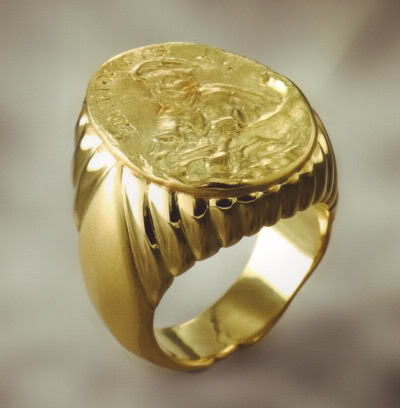
The Ring of the Fisherman or the Fisherman’s Ring (Pope Benedict XVI’s ring as Pope)

Image

What is the Ring of the Fisherman? or also called the Fisherman’s Ring? and why fisherman?

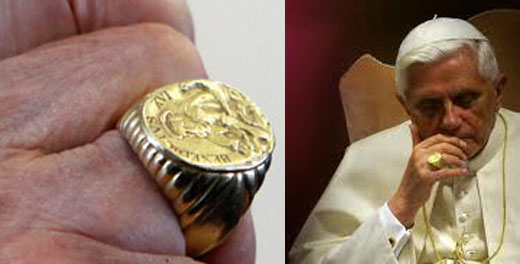
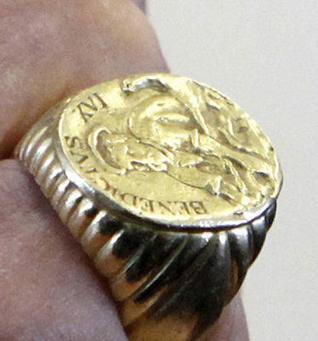
This is because, Peter, the leader of the Apostles, whom our Popes are successors of, including our retiring Pope Benedict XVI, was once a fisherman at Lake Galilee in Israel. Then Jesus, our Lord, came and called him and his brother Andrew, to follow Him, and then He made Peter, a fisher of man, through His Church, which He entrusted to him to lead. This is why, the picture on the Fisherman’s Ring represents Peter as fisherman as seen in the image above. Also engraved is the regnal name of the Pope, Benedictus XVI in Latin.

Image


This ring was used in the past to seal important Papal documents such as letters and most importantly papal bulls. The seal used was wax seal, in which hot wax was poured and the ring is pressed onto the hot wax while it is still hot, and therefore, the image engraved on the ring, will be reflected on the wax seal, signifying the legality of the documents and papal bulls published, with the authority of the Pope, as successor of St. Peter and leader of the Universal Church, one Church of Christ.

Image

This ring, which symbolises the authority of the Pope, given to him at the Installation of the Pope (Papal Installation), is destroyed upon the Pope’s death, and in Pope Benedict XVI’s case, it will be destroyed after the sede vacante starts with a silver hammer in the presence of witnesses, to prevent any misuse of the Ring during the sede vacante to validate documents not released by the Pope.

Monday, 28 January 2013 : 3rd Week of Ordinary Time, Memorial of St. Thomas Aquinas, Priest and Doctor of the Church (Scripture Reflection)

Today, once again we see Jesus in His role as the High Priest and the Messiah sent by God. He is the Son, one of the Trinity, whom the Father sent down to us, for our sake, out of His great love for us. He is filled with the Holy Spirit, unlike the slander of the teachers of the Law as mentioned in the Gospel, who accused and slandered Jesus’ miracle work to be the work of Satan and his evil spirits.

Then why was Jesus so angry with them such that He rebuked them mentioning that sinning against the Holy Spirit cannot be forgiven, although He said that even those who insulted God can be forgiven? The reason is because, we need to differentiate between those who does not know God, but can recognise good works and miracles, which eventually originated in God, and those who claim that they know and love God, but cannot even recognise the very work of the Holy Spirit, which is manifested in the good works and miracles, as Jesus did.

The teachers of the Law belong to that second group of people, who are supposedly very knowledgeable about the Law and thus about God, but failed to see the works of God and the Holy Spirit through Jesus, and instead slanders the Holy Spirit in Jesus by attributing the works to the power of Satan. This is a kind of ultimate hypocrisy on the teachers’ side and Jesus clearly did not tolerate this, for as much as God is indeed forgiving and loving, He also hates sin. These teachers of the Law were the guides of the people, and they set the moral standard of the people of God. If they themselves slander the Lord and His great works through Jesus, then they are not a good guides of the people, since instead of bringing the people to the Lord, they will make people fall into sin instead.

Jesus Himself said : “If anyone cause these little ones (also mean the people, the faithful) who believe in Me to sin, it is better for him to be thrown into the sea with large milestone around his neck.” This is why Jesus was very angry at the teachers of the Law due to their role in deceiving people on the works of the Holy Spirit. The same too should also apply to our priests today, as they too are human, and are subject to temptations as we are. Therefore, let us fervently pray for them, that all of them will remain faithful to their calling, and will commit themselves fully to God and His works, ministering to God’s people to the best of their abilities. Let them not to fall into temptation and thus sin, as what has happened to some of our wayward priests. Pray for these priests too, that they can return to the light, and do their best to atone for whatever evil they have committed. God truly loves all and forgives all, even the worst of sinners.

Then, Jesus also emphasized again on the unity of the Church, the Church He has established and entrusted to St. Peter the Apostle. He said that if Satan is divided against himself and has his followers divided against him in a civil war, he will not be able to stand and be vanquished. The same also applies to our own Church, as how are we going to beat Satan and his evil works, if our own Church is divided against itself?

Many people throughout the centuries, fueled by personal ambitions and selfish desires had led to the fracturing of the unity of the Body of Christ, the Church. As a result, today, although technically there is still only One Church that exist, our own Catholic Church, established by Christ Himself and entrusted to Peter, there now in our world exists thousands of churches, which are the splinters and fragments of this holy Body. Even worse that instead of working together, many of these churches attack one another’s faith, and many of them also even went astray from the true faith in Christ, preferring alternative sources and leaders than Christ and the Holy Scripture itself. Many of the attacks were even directed at the Church itself, and many believed in the falseness that arose out of misunderstanding of the faith, and through centuries of division and enmity, born out of human imperfections.

Today, we celebrate the feast day of St. Thomas Aquinas, a great Doctor of the Church, who was called Doctor Angelicus, or the “Angelic Doctor” out of his great piety, his great faith, and most importantly, out of his great works of the faith and in the field of theology, that helps to define the basis of our modern Church, and also influenced many aspects of our modern world. He is the one person that we look up to, in the matters of the faith, and many aspirants to the priesthood should indeed read his great writings and learn more about the faith, to anchor themselves properly in Christ, that they will not be led astray like those wayward priests, or even worse to be like those teachers of the Law rebuked by Christ. St. Thomas Aquinas also defined many concepts of Christian virtues and ethics, which act as guidelines on how all of us Christians should strive to be. Let us all take some time to try and find the writings of this great Saint, read them, and reflect on them. In doing so, all of us, laity and ordained members of the Church alike, can gain great holiness.

Therefore, today, let us also strive to work for unity of all Christians, of all who believes in Christ. Let us stand up to our faith, and equipped ourselves with the knowledge of our faith and the Holy Scripture, to always be ready with answers, especially when a person who does not yet believe in Christ, or even our separated brethren in Christ came to us with questions about the faith, and about our Church, we are able to give a good answer, and may indeed help to dispel many misconceptions that others have on both the faith, and the Catholic Church, the One Church that God has established, that hopefully, one day, all Christians will be reunited again, and be able to call each other, brothers and sisters in Christ, once again.

Let us work to help fulfill the prayer of Christ to the Father : “That they may be One as we are One; I in them and You in Me. Thus they shall reach perfection in unity; and the world shall know that You have sent Me, and that I have loved them, just as You loved Me.”, and let the world truly know the Lord through our Christian unity, and stand up united against Satan and all his evil angels and supporters. God bless us all, and God bless our priests, and God bless our Pope, Benedict XVI, Amen.

St. Thomas Aquinas, pray for us.


+Ut Omnes Unum Sint, ad Maiorem Dei Gloriam+

(That they all may be One, for the greater glory of God)