On the Future Canonisation of Blessed Pope John XXIII and Blessed Pope John Paul II

Image

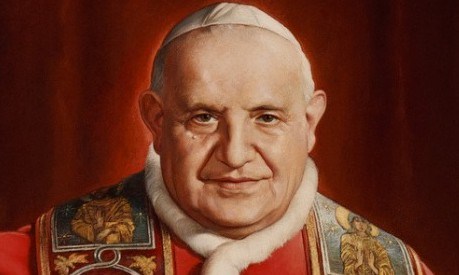
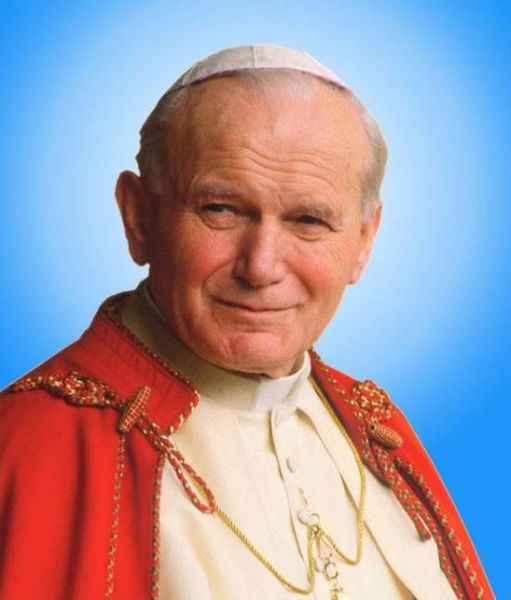
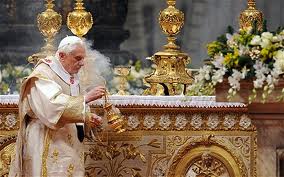
The two great Popes of the last century, both of whom had been recognised as Blessed, through the virtues of their life and miracles attributed to them, will be declared Saints, in a ceremony likely to be scheduled at the end of this year (2013).

Both Blessed Pope John XXIII and Blessed Pope John Paul II, who was made a Blessed just two years ago on 1 May 2011, had each left their incredible and remarkable footprint in the path of history, both in the history of the Church, and in the history of the world and mankind.

Image

Blessed Pope John XXIII was known to be a great man of peace, and above all things seek to embrace peace and cooperation, between mankind, and also begun the process of Ecumenism in order to reunite the divided fragments of God’s Church back into the One, Holy, Catholic, and Apostolic Church that is our Church.

He was also known for his Encyclical Pacem in Terris (Peace on earth), which was released just months after the world was almost engulfed in an all-out nuclear war between the two superpowers, the United States of America (USA) and the Soviet Union (USSR) during the height of the Cold War in the Cuban Missile Crisis. Blessed Pope John XXIII worked hard ceaselessly to promote peace between the parties in conflict, for the good of all mankind, all of whom are the children of the same one God.

Blessed Pope John XXIII also convoked the Second Vatican Council, which brought the Church in line with the developments in the world, and also to make the Church more relevant in the increasingly rapid new developments in our world, and the rise of apathy towards religion in general. He would pass away before the Council was completed, but his legacy continued on until today.

Image

Blessed Pope John Paul II ‘the Great’ was a well-known Pope, a Pope of youths, and a hardworking Pope, who travelled around the world to visit all the flocks of the Lord that had been entrusted to him as the Successor of St. Peter the Apostle, as the Vicar of Christ. He was instrumental in the end of Communism in Eastern Europe, ending persecutions against the people of the faith, and also open boundaries and barriers that had been long in place since the beginning of the Cold War.

Blessed Pope John Paul II has also renewed the zeal for the faith amongst many around the world, and especially in youths, to whom he dedicated a special event, the World Youth Day, in order to commemorate the faith, particularly amongst the youths of the faith, around the globe. He inspired many through his works, his Encyclicals, and especially his perseverance despite being troubled with a worsening Parkinson’s disease condition, that made him to labour until his passing on 2 April 2005.

Both Popes had been very influential, hardworking, and very holy leaders of the One Church of the Lord Jesus Christ, and they had done much to strengthen the faith and the Church, and bring God closer to many, bringing them closer to salvation.

I hope to soon be able to ask for the intercessions of Pope St. John XXIII and Pope St. John Paul II the Great, and I pray that they will intercede for us sinners around the world, and pray for us, till we are greeted by them at the doors of heaven when it is time for us to be with the Lord again. Now we wait for the official announcement on the date of the Canonisation.

Image

Blessed Pope John XXIII, pray for us!

Image

Blessed Pope John Paul II, pray for us!

Tuesday, 9 July 2013 : 14th Week of Ordinary Time, Memorial of Saints Augustine Zhao Rong, Priest and Companions, Martyrs (Scripture Reflection)

Brothers and sisters in Christ, the Lord is driven to compassion for the sake of all of us, because of our poverty, the poverty of our souls, of our sinfulness, and our lack of leadership. That is because we are all like sheep without a shepherd, going in all directions and getting lost. Christ came into this world, and painstakingly taking all of us into His fold, as the Good Shepherd, seeking the lost ones one by one, until all of us are found once again and reunited.

The Lord our God does not wish us to be lost or forever separated from Him. He came down Himself and suffered for our sake, that eventually we can be reunited with Him for eternity. For there is no other option besides salvation, other than eternal damnation. That is why Christ came to us to offer us the other option that is salvation and eternal life. He became our shepherd, the Good Shepherd, so that we will no longer be lost. He became our guide, our leader, the light of our path, and our God.

Today we celebrate the memorial and feast of St. Augustine Zhao Rong and his companions, who are the Catholic martyrs from China, and many of them were martyred during the Boxer Rebellion at the turn of the twentieth century, when a severe persecution against Christians in China occurred. Many Christians, including St. Augustine Zhao Rong and his companions were murdered brutally for their faith, because they refused to renounce their faith and kept holding steadfastly to their faith.

St. Augustine Zhao Rong himself was a Chinese diocesan priest who served in several areas in China before he was arrested, tortured until his death in the defense of his Christian faith. He did not give up on the Lord and remained faithful. The same case had happened for many other martyrs of China, many of whom were repeatedly asked and offered to reject the Lord and reembrace pagan practices, but they refused and were received into heaven with a martyr’s glory.

These martyrs, the local Chinese and the Western missionaries, were joined in death for the sake of their faith in Christ, and they embody to us, the virtues of a faithful life dedicated to the Lord. A life lived with zeal and love for the Lord and His people, and with purpose. Opposition and persecution will naturally come, but they will be able to subvert the faith of the just ones.

Indeed, brothers and sisters in Christ, even today, the Church throughout the world, particularly in China, where St. Augustine Zhao Rong and companions met their martyrdom, where religious freedom, superficial as it is, is very limited and bordering on being non-existent. The Church was forced to serve the atheistic government, who views the Church as a hostile entity, and therefore they tried to destroy it. When the attempts to destroy the Church had not been successful, they resolve to weaken the Church by seizing it out of the Universal Church.

Many people there still suffer today, and Christians in the Church suffer an even greater suffering, being seen as ‘hostile’ by the government, and as a ‘threat’ that needs to be eliminated. Yet, as the saying goes, that the blood of martyrs is the seed of Christians, persecution and opposition brings fervour and zeal to the people of God, that they may not just persevere through the tough times, but indeed prosper and grow.

But seeds cannot grow without proper care and provision, as we need labourers to constantly care and give all their time into the effort. That is why the Lord said that though the harvest is plentiful, but the labourers are few. We need more labourers to harvest the field of the Lord, and these harvests are simply the people who come to know the Lord, and to be saved. The labourers are none other than our priests, supported by all of us, the laity.

All around the world, including in China, there are increasing shortage of priests to serve the people of God. The number of the people in the Church has grown significantly while the number of priests had been stagnating for quite a long time. This makes it increasingly difficult, especially in the areas where the Church is growing, to project itself through love and service, and also to conduct worship in the Mass, in which priests are badly needed.

It is more and more difficult to gain new priests nowadays, brethren, because the world increasingly shut the Lord out of the minds of the young people, many of whom are called by the Lord. Yes, many are called, but few responded, and among those who responded, even fewer followed his calling through to the end in service of the people of the Lord. It is important that we bring the zeal and devotion, and the love for God back to all of us, especially those whom the Lord had called and entrusted with His flock.

Even priests and religious brothers and sisters must also be growing in faith and love. All of us cannot be complacent otherwise we would be caught unprepared by the devil, whose works are many, and whose deceit and trickery threatened to corrupt many people and turn them away from the Lord their God.

Therefore, brothers and sisters, inspired by the devotion and zeal of St. Augustine Zhao Rong, his companions, the martyrs of China, let us persevere against the opposition and the persecution of the faith in any form that is there in this world, in our society, and even in our families. Let us foster a prayerful and loving atmosphere in our homes, in our communities, in our parishes, that we can allow the faith to grow strong in all of us, especially our youths, some of whom may be future priests and servants of God and His people.

Pray, brethren, and pray hard, for the sake of our Church, for God’s people, and especially a special intention for the Church in China, for our brethren in faith unjustly treated and persecuted for their faith and obedience to the Lord rather than to the secular and Godless authority. May the Lord strengthen them in faith, give them courage, and remain with them through their ordeal, and may He also be with us, at all times. Amen.

(Live) Eucharistic Adoration from the Vatican, with Pope Francis (Universal Eucharistic Adoration)

The worldwide Universal Eucharistic Adoration will begin at 5 pm CEST (Rome Time/UTC+2), today, Sunday, 2 June 2013.

Image

Watch the event live from Rome, with Eucharistic Adoration to be led by Pope Francis, so that especially for those who are unable to attend the Adoration near their homes, all of you can still participate, together as One Church, One Body of Christ!

YouTube : http://www.youtube.com/watch?v=8z2b7tw-EPE (Vatican YouTube)
Vatican Player : http://www.vatican.va/video/

Sunday, 12 May 2013 : 7th Sunday of Easter (Scripture Reflection)

Dear brothers and sisters in Christ, today we hear of the glory of God, who is to come, the glory of God who had been risen in glory from the dead and therefore triumphed over death and evil, and broke their hold over all of us for eternity. This God who had been taken up in glory to heaven, in the glorious Ascension, and seated at the right hand of God the Father. This was seen by the first martyr, Stephen the deacon, who saw and proclaim the glory of Christ, that despite knowing that such proclamation would certainly bring about his death at the hands of the chief priests.

God’s promise will become a reality, that He will soon once again come down onto this world, this time not as the humble king born in a manger, which we celebrate now as Christmas, but this time He will descend as a great and almighty king in glory, as the ruler of all creation and the Master of all the Universe. He will come as the great judge who will judge all for their own worth, whether they are worthy or unworthy of heaven that is the reward for those who are faithful, and for those who keep God in their hearts.

Those who knows Christ will know the Father, because Christ was sent by the Father into this world in His first coming to be our Messiah, our Saviour from death and the slavery of sin. If we hold fast onto this faith, Christ too will know us, and make all of us His own, and when the time comes for all of us to be judged, we will be welcomed into His Kingdom, and we will receive our rewards of eternal life.

Christ desires also, first and foremost, that all of those who believe in Him be one and united, as one Body, and therefore one Spirit, in the Church that He established through the Apostles. This is because Christ knows human weaknesses and the extent of human susceptibility to the devil’s influences. The evil one will stop at nothing to prevent his ultimate fate that is total defeat and damnation, but his fate has already been decided. Nevertheless, through his numerous agents and tools in this world, he can indeed make life difficult for those of us who believe and keep the faith.

Christ knows that the Church He had established will be fractured by the agents of Satan, through human pride and arrogance, and self-serving attitudes, that resulted in the breaking of the Body of the faithful. That is why He prayed, and prayed hard to His Father in heaven, that all the faithful ones in Him, His sheep, will remain as one, as indivisible from each other, just as He and the Father, and also the Holy Spirit are together and united in an immeasurably strong bond and unity.

His wish, that they all may be one, that all of us may be one, as one Church, one people, with one Creed, and one belief, had been dashed by the evils of human ambitions and weaknesses throughout the past centuries. Many had succumbed to the temptations of the world and false teachings, through numerous false prophets, aimed by Satan to confuse the Church and the faithful, and broke the unity within the Body of Christ, that is the Church.

False prophets like Arius, Jan Hus, Martin Luther, and many others who even claimed themselves Messiah or the second coming of Christ, had spread seeds of disunity among the faithful, and also spread false teachings that ended up confusing the faithful and snared many into damnation because of them believing in teachings in contrary to the teachings of Christ, as delivered to us through the Apostles and the early Church Fathers.

Many today in our world had claimed that faith must be a personal one, that is to be a personal ‘encounter’ with Christ. But they had forgotten that faith in Christ is impossible to be described in personal terms, or separated from the whole community of the faithful, that is the Church. Humans are inherently weak because of our imperfections, and because of our own sinful nature, since our first rebellion through our ancestors who disobeyed the Lord’s command not to eat the fruits of the tree of knowledge of good and evil.

Since then, many think too high of themselves, thinking that they are capable of great wisdom and possessing great knowledge, and therefore are capable of interpreting the Scripture on their own, and as they like it. This is why, although reading the Scripture is important for the development of the faith, we have to anchor ourselves in the authority and the teaching magisterium of the Church, as only in good guidance of the Church, that we can fully make use and understand the Scripture.

For the Scripture was written by the apostles and disciples of Christ, who were inspired by the Holy Spirit, and also the numerous prophets of the past times, who also received the message of the Lord, many of which are veiled messages that are part of the mystery of our faith. Even someone who is very knowledgeable and experienced in the Scripture, will certainly not be able to claim to fully understand the full and true meaning of God’s words contained in the Scripture.

Many today and in the past interpreted the words of God in the Scripture as they wished, and they ended up establishing new ‘faiths’ that they call churches, which in fact exist in thousands, millions, and maybe more today. There are as many ‘churches’ as there are heads, obviously because no one can agree perfectly with one another and mankind will certainly be influenced by pride and arrogance to shut out other’s own interpretations and keep one’s own interpretations to oneself. Such is the danger of self-faith and faith that does not conform to the will of God in the Church.

Indeed, many of them sinned grievously because they had caused division in the body of the faithful, the Church, the Body of Christ, and also spreading false teachings, and many of these, especially are intertwined with relativism, that is to include secular developments into the faith, which are in fact incompatible, and therefore, the faith, the true faith that we know of, no longer exists in those who had gone astray.

Brothers and sisters in Christ, strengthen your faith and resolve! Do not give up to the temptations of Satan and this world. Read the Scripture and learn the faith through the teachings of the Church, and deafen yourselves to the false allures of the false prophets and agents of the evil one. Be steadfast and be faithful, and the Lord will reward all of you.

Help one another in the faith, and pass the teachings of the Lord in the Church to those, especially those who had gone astray in their path, and those who has had wrong impression and ideas about the true faith in God. Who says that Christians can only evangelise to non-Christians and non-believers? Look into ourselves, and you can see so much division within the Body of Christ that is the Church, that we need to do some internal housecleaning first.

Just as Christ said, that if we are united then the world will believe in the Lord, if we are divided against ourselves, by attacking one another’s faith, how is the Church going to stand and bring then the fight to the devil? Let us strive to fulfill Christ’s wish and indeed, God’s will, that the entire community of the believers in Christ, would be reunited, into one body, one faith, and one belief in Christ our Lord, within His One, Holy, Catholic, and Apostolic Church, our Roman Catholic Church, the one and only true Church that Christ had established in this world, on Peter His Apostle, on whom He entrusted the keys of the Kingdom of heaven.

May God strengthen the unity between Christians and allow all those who believe in Him to be reunited once again within one Church, and one faith, under the authority and jurisdiction of the Pope, the Bishop of Rome, the successor of St. Peter the Apostle, keeper of the keys of the kingdom of heaven, and Vicar of Christ in this world. God bless all of us, Amen.

Episcopal Ordination of Coadjutor Archbishop William Goh of Singapore, Part II : The office of Bishop, what they wear, and their significance

Continuing from the first part, in which I elaborated on the Episcopal Ordination ceremony itself, let us now take a look at the office of the Episcopate itself, that is of a bishop. One may ask, who is a bishop? Bishops are ‘overseers’, which came from the Greek word, Episkopos, which means overseers, as in the early Church, there are those appointed to succeed the Apostles and oversee the Christian communities, to care for them like shepherds care for their flocks of sheep.

Such was the origin of the episcopate, with bishops as those appointed in positions of authority and with oversight over the laity and the religious alike, to keep them faithful to God, and united to the successor of the blessed Apostle Peter, who is our Pope.


This development of the early Church eventually become an office on its own, a separate level from the priesthood, as in the episcopate, there is a fulfillment and completion of the holy orders, which is symbolised by the bishop wearing both the deacon’s dalmatic, and the priest’s chasuble over the dalmatic. This symbolises the union of the ministry of the diaconate and the priesthood in the person of the bishop, who represents the completion of holy orders.

Cardinals and Popes are not separate orders on their own, unlike the diaconate, priesthood, and the episcopate, as these are just different types of bishops, with Cardinals usually being bishops from important dioceses/archdioceses in the world, and the officials of the Roman Curia (the body governing the Universal Church), and the Pope, being the Bishop of Rome, is still a bishop, but is preeminent due to him being the successor of the Apostle Peter, to whom Christ entrusted His Church, and thus the Pope becomes the very Vicar of Christ in this world.


There are also many types of bishops, which I will elaborate further below :


1. Diocesan bishops : These are the ordinary bishops, who head a diocese. A diocese is a division of the Church in a certain geographical area consisting of the faithful in Christ, who may share same culture, language, and customs, or may be of diverse linguistic and cultural origins.


2. Archbishops : These are the bishops who head a more important diocese, either by location, or by history, or by some other reasons. These dioceses therefore are also correspondingly named archdioceses. There are two types of archdioceses :

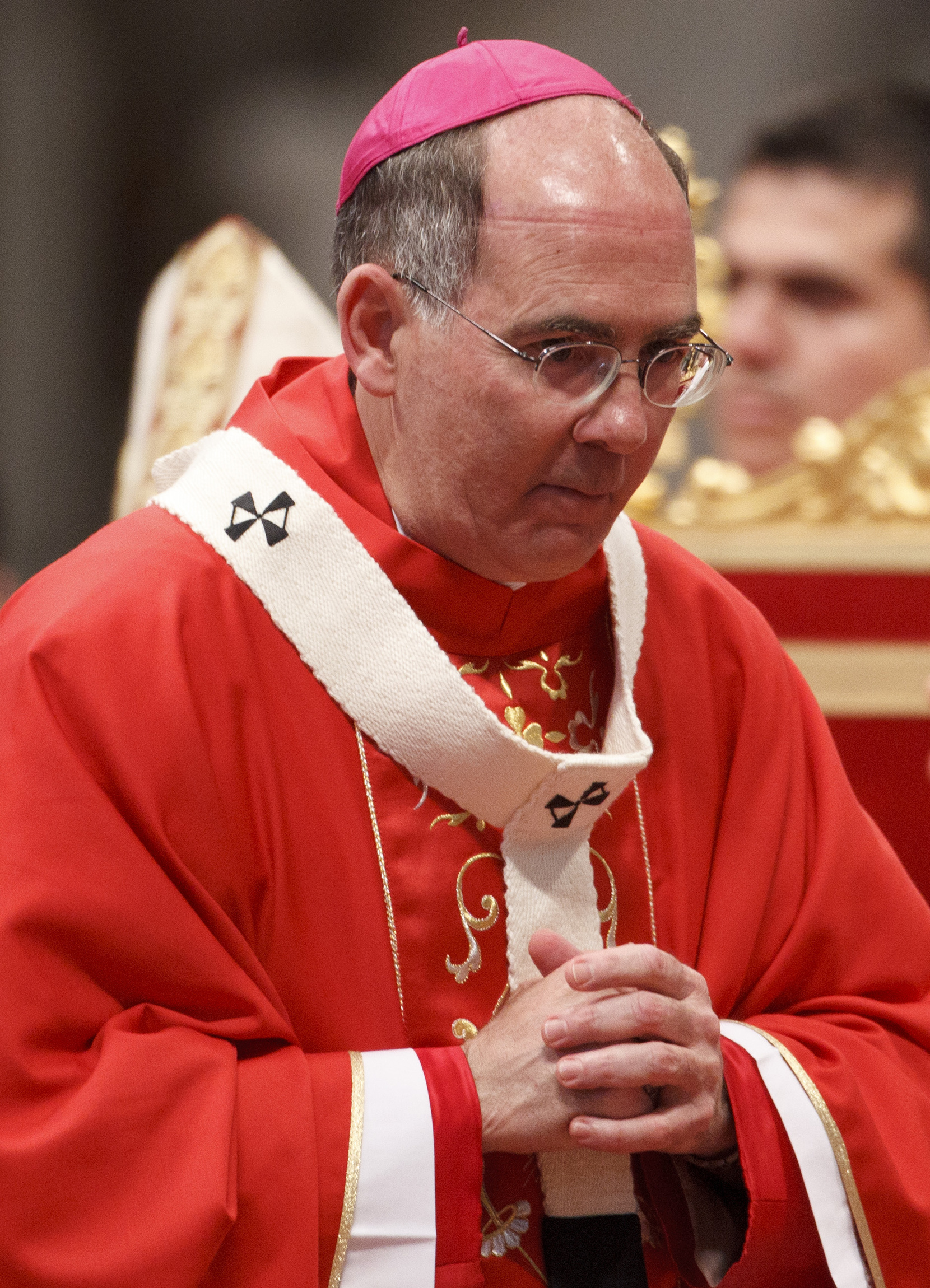
          a. Metropolitan Archdiocese : An archdiocese that has an overseer status over one or more other dioceses (called suffragan dioceses or suffragan sees) which are grouped together into an Ecclesiastical Province (or Province of the Church), and headed by a Metropolitan Archbishop, whose distinguishing feature is that he wears a pallium (a woolen shoulder band with black crosses).

          b. Archdioceses (directly subject) : These Archdioceses are important dioceses which has either been historically a metropolitan see or diocese that were elevated to an archdiocese status, but these are not overseeing any dioceses under them, and therefore stand alone on its own, directly subject to the Holy See, to the Pope, instead of through a Metropolitan. The Archdiocese of Singapore is of this type.


3. Auxiliary bishops : These are ‘helper’ bishops, who are appointed in larger dioceses/archdioceses to help with the administration of the diocese/archdiocese’s large Catholic population. May also succeed the diocesan bishop/archbishop upon retirement if selected by the Pope, but this succession is not automatic (not like that of a coadjutor). They are given titular see (diocese/archdiocese) upon their appointment as auxiliary bishop.


4. Coadjutor Archbishops/Bishops : These are bishops/archbishops appointed to dioceses/archdioceses to succeed the diocesan bishop/archbishop, whose age may be nearing 75 or in ill health. Bishops have to submit their resignation to the Pope upon reaching the age of 75, so the appointment of a coadjutor is a way to ensure that the diocese does not become vacant if the diocesan bishop resigns, and is a good way to prepare the coadjutor for the eventual succession and duty as the new bishop of the diocese. Coadjutors are not given any titular sees since they are bound immediately to the see (diocese/archdiocese) which they are to succeed in the future.


5. Titular dioceses/archdioceses : These are usually ancient dioceses/archdioceses, mostly located in North Africa and the Middle East, which due to historical events, had fallen into seclusion and extinction. Some can also be found in Europe and Italy, where some dioceses and archdiocese had been suppressed in the past, and become titular sees. These are now given to Apostolic Nuncios, Apostolic Delegates, and the auxiliary bishops.


6. Major Archdioceses : These are only found in the Eastern Catholic Churches, namely the main diocese in the Syro-Malankar, Syro-Malabar, Romanian, and Ukrainian Eastern Catholic Churches, whose importance place them into this special type of Archdioceses, but not high enough to be given the title of a Patriarchate itself.


7. Patriarchate (Latin and Eastern Catholic) : These are the special Patriarchal sees headed by a Patriarch, which in the Eastern Catholic Churches are the leaders of their respective Churches, in full communion with the Bishop of Rome. They are the Patriarchs of the ancient Pentarchy, of Alexandria, Jerusalem, and Antioch, and historically of Constantinople (modern-day Istanbul). However, in our approach to our sister Church of the Eastern Orthodox (who is not yet in full communion with Rome), we respect their Ecumenical Patriarch of Constantinople, who is the leader of the Eastern Orthodox faithful. Latin Patriarchates also exist in Lisbon, Venice, and Goa, which are headed by Roman Catholic Archbishops, but with special Patriarchal title, due to their distinctive history in the Church. Rome itself was a Patriarchate (of the West) until 2006, but was abolished by Pope Benedict XVI to better reflect the position of the Pope as the leader of the Universal Church, and not just the Church of the West (the Roman Church).


So, therefore, after talking about bishops, who they are, and what types of bishops are there, let us now look into the vestments and the items particular to bishops, all of which are steeped in the tradition of the faith and filled with deep symbolism.


1. Working dress (worn outside Mass and important events, the daily wear of bishops, and also for Cardinals and Popes)

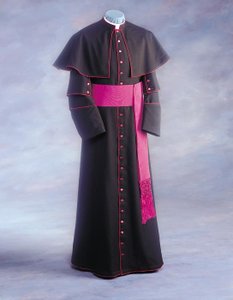
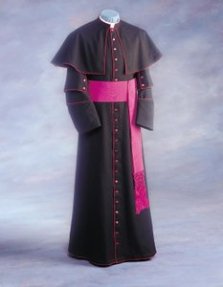
a. Simar            
 Image

A simar is a special type of cassock worn by the bishops, cardinals, and popes, that is a cassock with a shoulder cape, and a sash (around the waist), which is violet for bishops, scarlet for cardinals, and white for popes. As is well known, the Pope’s simar is white in colour, while bishop’s and cardinal’s simar is black, and with violet lining for bishops, and scarlet lining for cardinals.


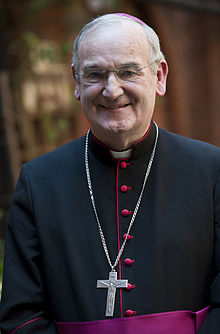
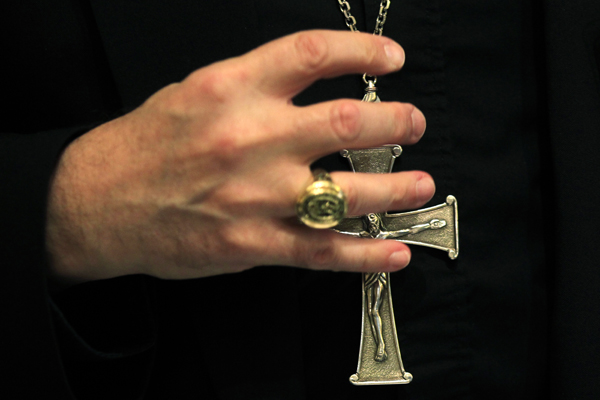
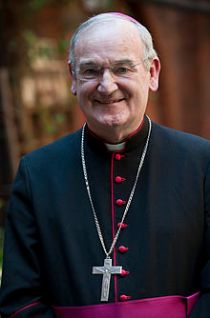
b. Pectoral cross (also part of the pontificalia and the choir dress)
Image


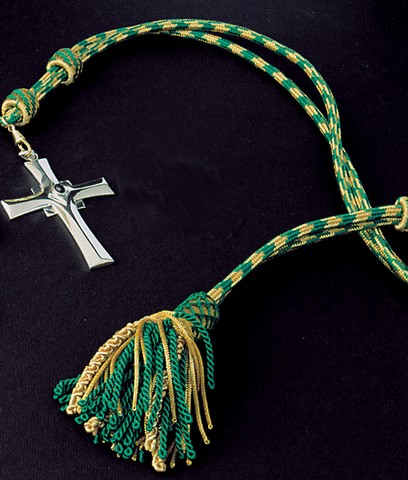
The pectoral cross is worn as its name suggests, on the breast, to represent Christ who protects us from harm, as noted in the prayer of the bishop when he wear the pectoral cross before the Mass, called Munire me digneris : Munire digneris me, Domine Jesu Christe, ab omnibus insidiis inimicorum omnium, signo sanctissimae Crucis tuae: ac concedere digneris mihi indigno servo tuo, ut sicut hanc Crucem, Sanctorum tuorum reliquiis refertam, ante pectus meum teneo, sic semper mente retineam at memoriam passionis, et sanctorum victorias Martyrum. (May You graciously protect me, o Lord Jesus Christ, from all the snares of all my enemies, the sign of the Your most holy Cross: that You would vouch and grant to me and all unworthy of being Your servant, that I may receive the Cross, filled with the remains of Your Saints, in front of my breast, I hold, then it always in mind, but retain the memory of the passion, martyrs and saints victories.). 

This is because pectoral crosses are usually precious and contain the relics of the saints, which therefore be further a reminder that the bishop carries with Him at all times, Christ, and His holy Saints, and a reminder of the Cross, through which the salvation of our Lord comes to us.


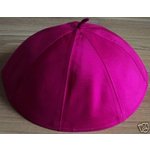
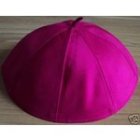
c. Zucchetto (or skullcap)
Image


Zucchetto is from the Italian word which means small gourd, because its shape which resembles (half of) a pumpkin. This is a head covering item for the bishops, cardinals, and popes, with the similar pattern of violet for bishops, scarlet for cardinals, and white for popes. This item has a lot in common and may have originated from the Jewish prayer cap, which is somewhat different from the zucchetto in appearance. Originally zucchetto has a practical use in the past, since the clergy in that era were tonsured, that is having their head shaved at the centre, and thus, without the present day heating available, during cold times, the head of the prelate (bishops) would become cold, and the zucchetto came in handy as a covering.

Nowadays, it is a symbol of prayer, and also honor, and therefore, as a sign of humility, it is always removed at the beginning of the Preface of the Eucharistic Prayer and the head of the bishops (including cardinals and Popes) remain bare throughout the Eucharistic Prayer and the Communion.


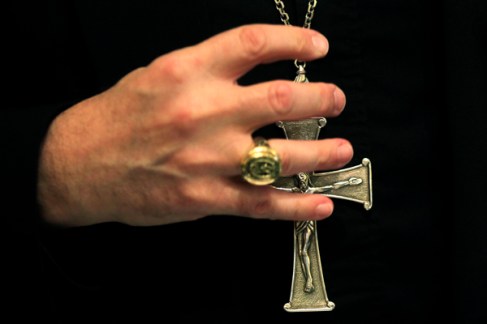
d. Episcopal ring
Image


The episcopal ring symbolises the bishop as the shepherd is married to God’s Church, in particular the diocese and the sheep, the faithful in Christ whom he is supposed to guide as the shepherd. The prayer the bishop said when wearing it reflects that this ring is also a symbol of virtue and sanctification, and blessing : Cordis et corporis mei, Domine, digitos virtute decora, et septiformis Spiritus sanctificatione circumda. (With my heart and of my body, O Lord, decorate my fingers with virtue, and sanctify me with the sevenfold blessing of the Holy Spirit around me).


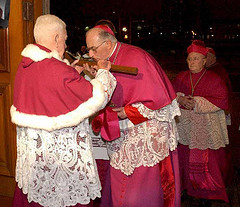
2. Choir dress (worn during the Mass if the bishop is not the celebrant or concelebrant in the Mass, and events like Vespers, and also worn outside for important events)
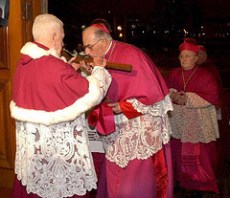
Image

a. Cassock with fascia/sash

This cassock with sash style is similar to the simar, but is entirely violet for bishops and scarlet for cardinals (as opposed to black with violet or scarlet lining)


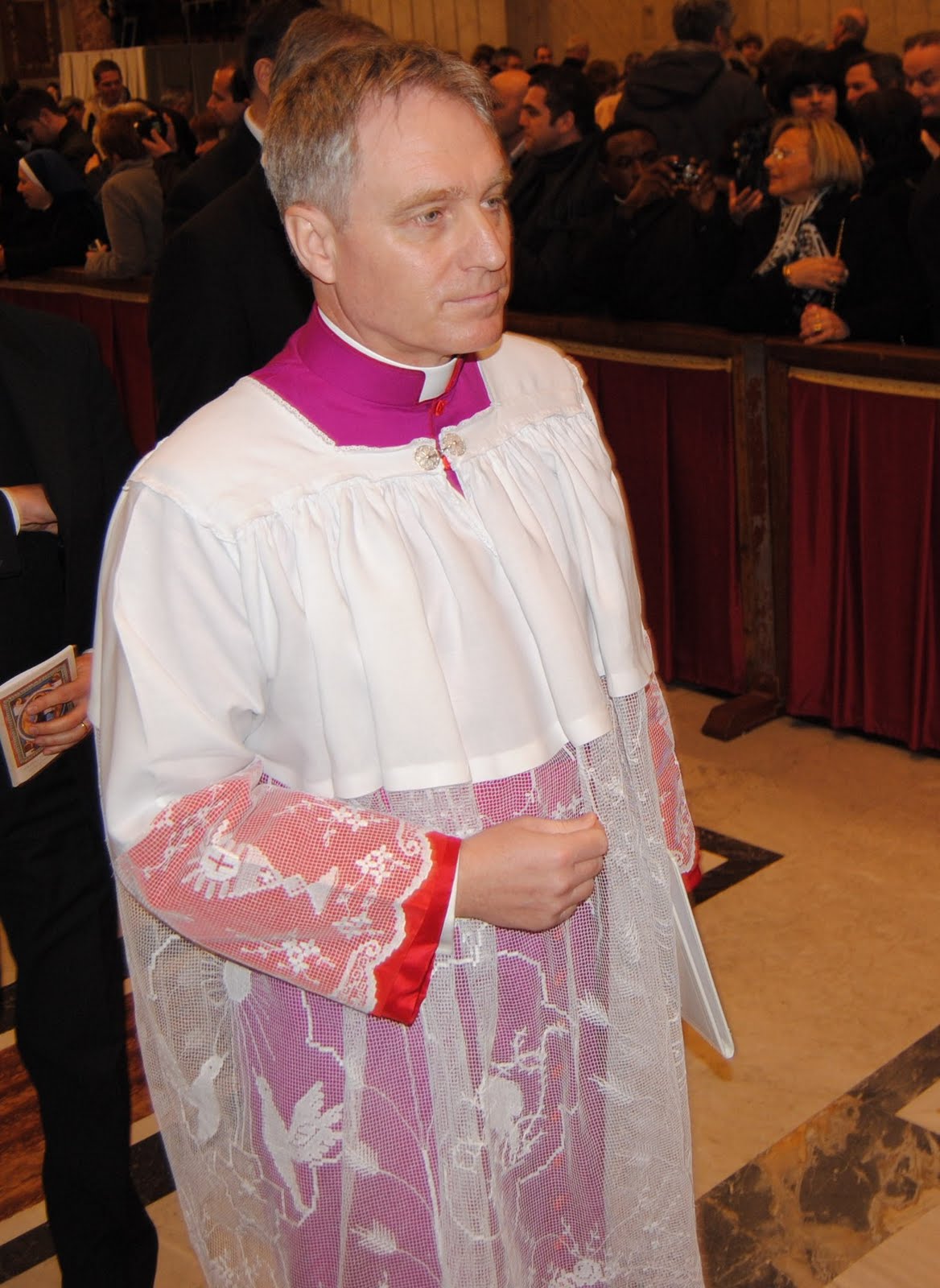
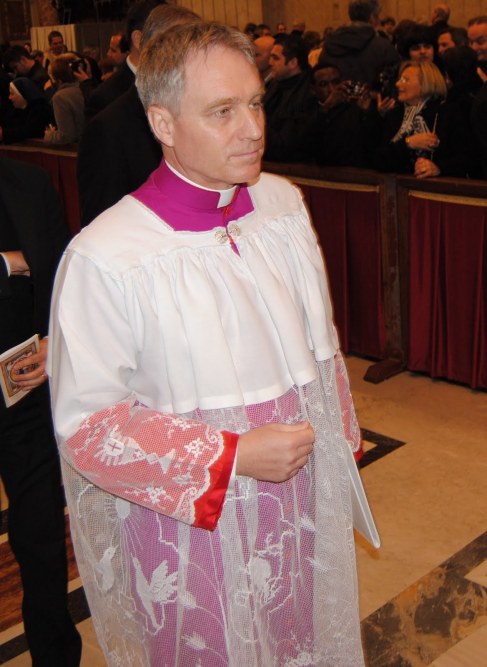
b. Rochet
Image

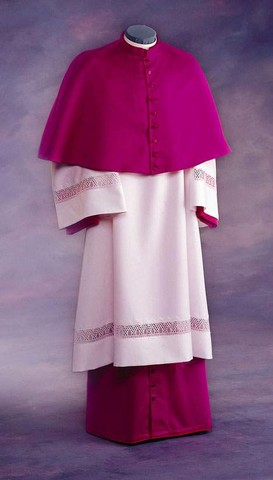
A beautiful, usually thin, either white or translucent, and laced piece of clothing worn over the cassock and the fascia, as seen worn above by Monsignor Georg Ganswein, now Archbishop Ganswein, Prefect of the Pontifical Household.


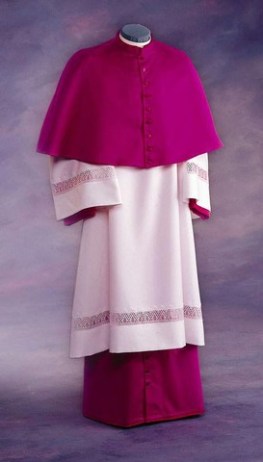
c. Mozzetta
Image


Mozzetta (violet for bishops) is a shoulder cape worn over the rochet and the cassock.


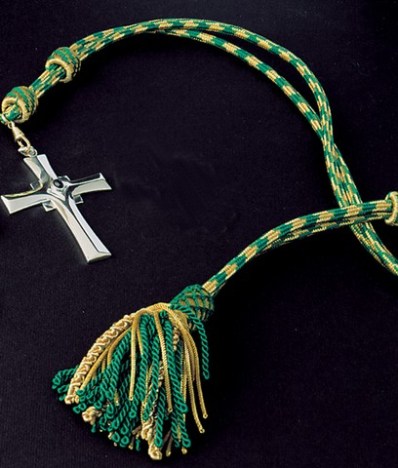
d. Pectoral cross
Image

Similar with in working dress, but more often worn with a cord rather than a chain.


e. Zucchetto

Violet for bishops. Similar as in the working dress.


f. Biretta
Image


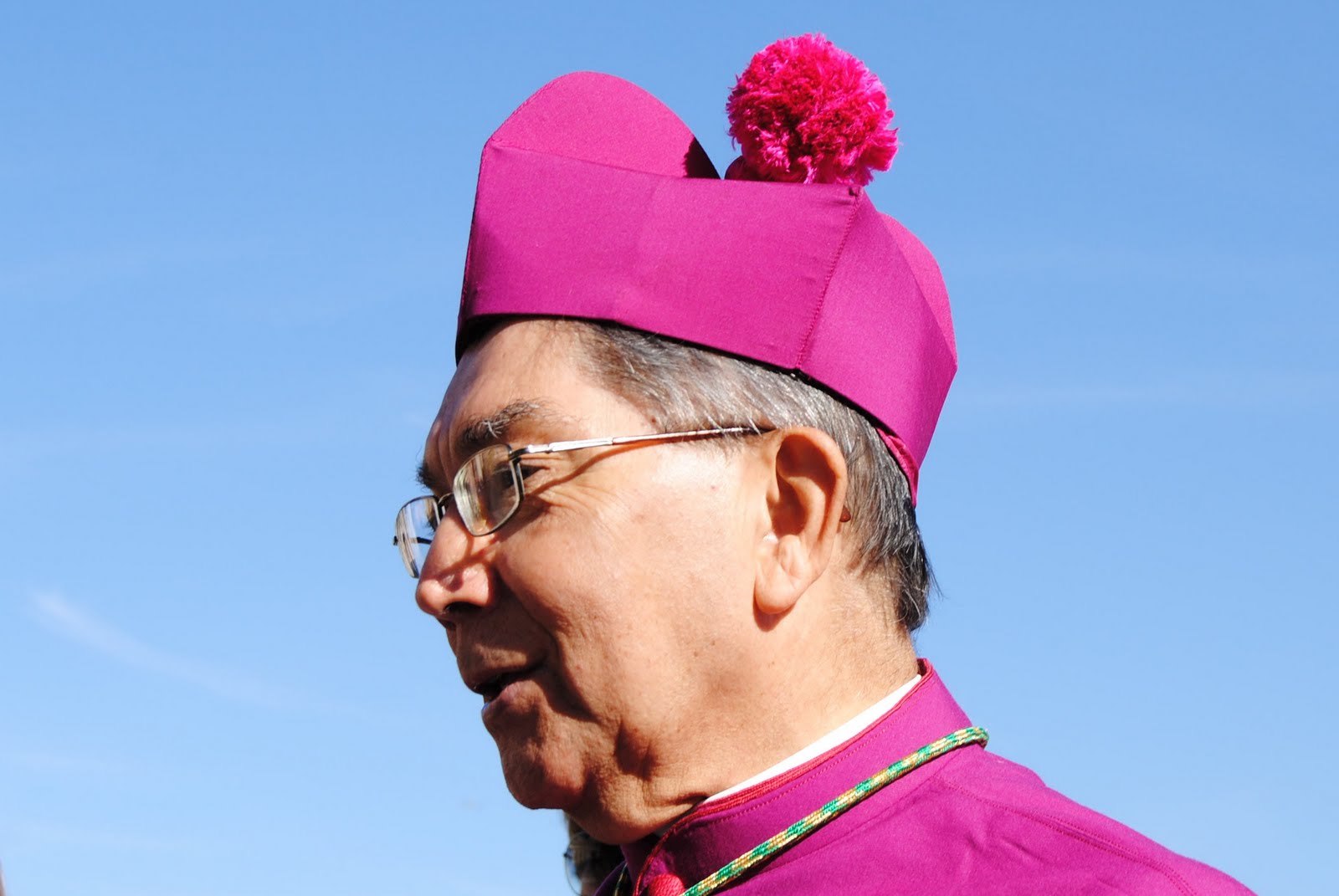
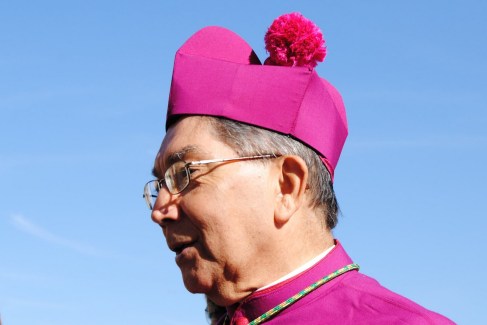
A hat-like item which has the same ancestry as our modern academic mortar board (worn on the graduations in universities), which is violet for bishops and has a pom-pom like object on the top. Only has three peaks, and the unpeaked side is always worn on the left.


3. Bishop’s Pontificalia (worn during the Mass when celebrating)

a. Dalmatic

Image


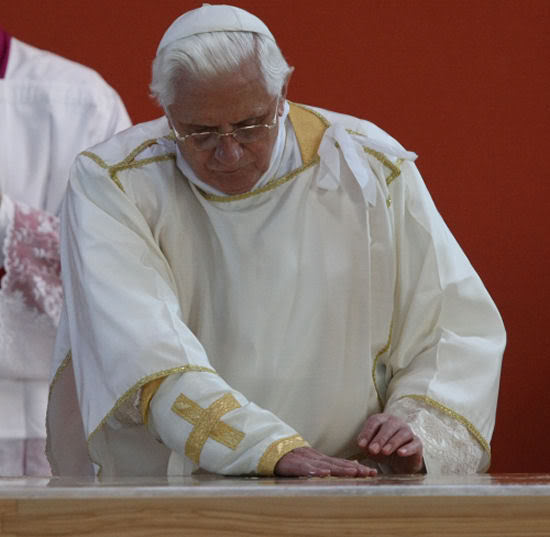
Similar as those worn by deacons, which has squarish-edges as compared to the chasuble (which has more rounded edges), worn over the alb but under the chasuble. Here is the picture of our Pope Benedict XVI wearing the dalmatic during the consecration of a new church in Rome, after he took off his chasuble for the anointing of the altar with holy oils.


b. Chasuble
Image


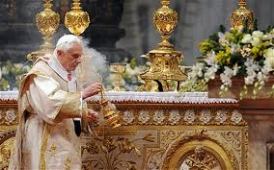
Chasuble as worn by the priests, worn over the dalmatic and the stole, and in this picture, Pope Benedict XVI wore the more traditional Roman-style chasuble, and very visibly underneath the chasuble, is the dalmatic. Only bishops can wear both the chasuble and the dalmatic.


c. Pectoral cross

Worn under the chasuble, not over the chasuble, either the normal chained or corded pectoral cross. Not correctly worn when worn above the chasuble, although many bishops seem to do this. Pope Benedict XVI himself consistently wear the pectoral cross under the chasuble since the beginning of his Pontificate.


d. Episcopal ring

Worn on the finger, which signify his marriage to God and His Church.


e. Mitre
Image


Image


Image


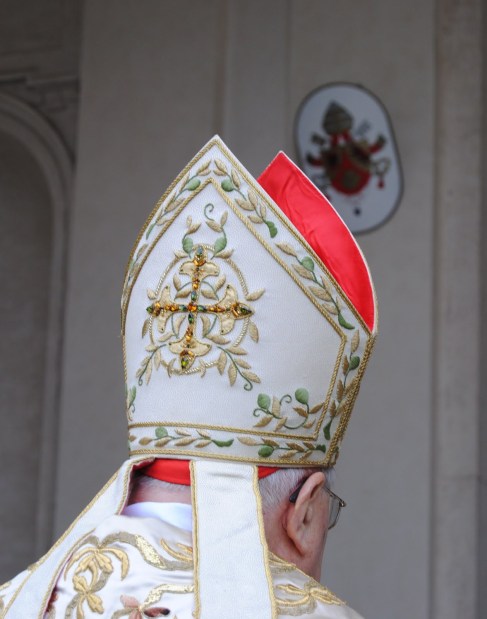
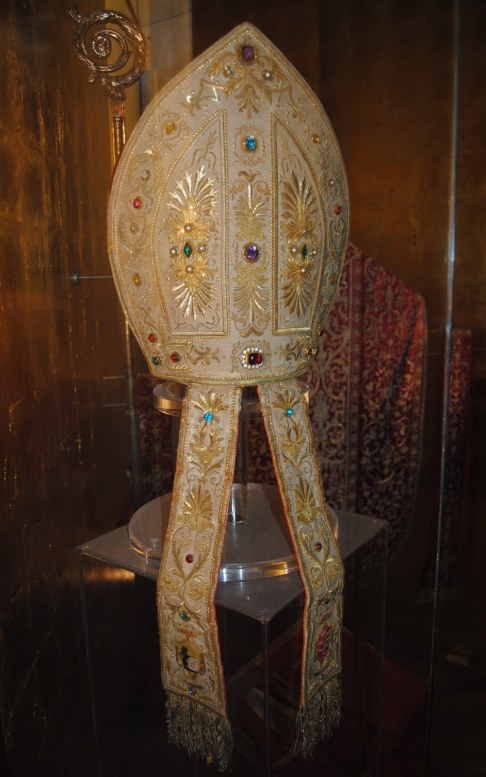
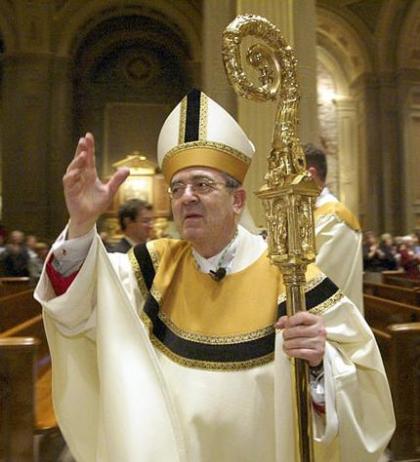
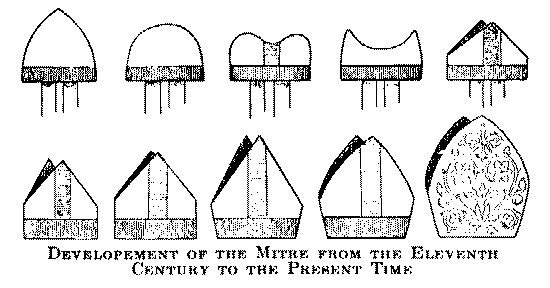
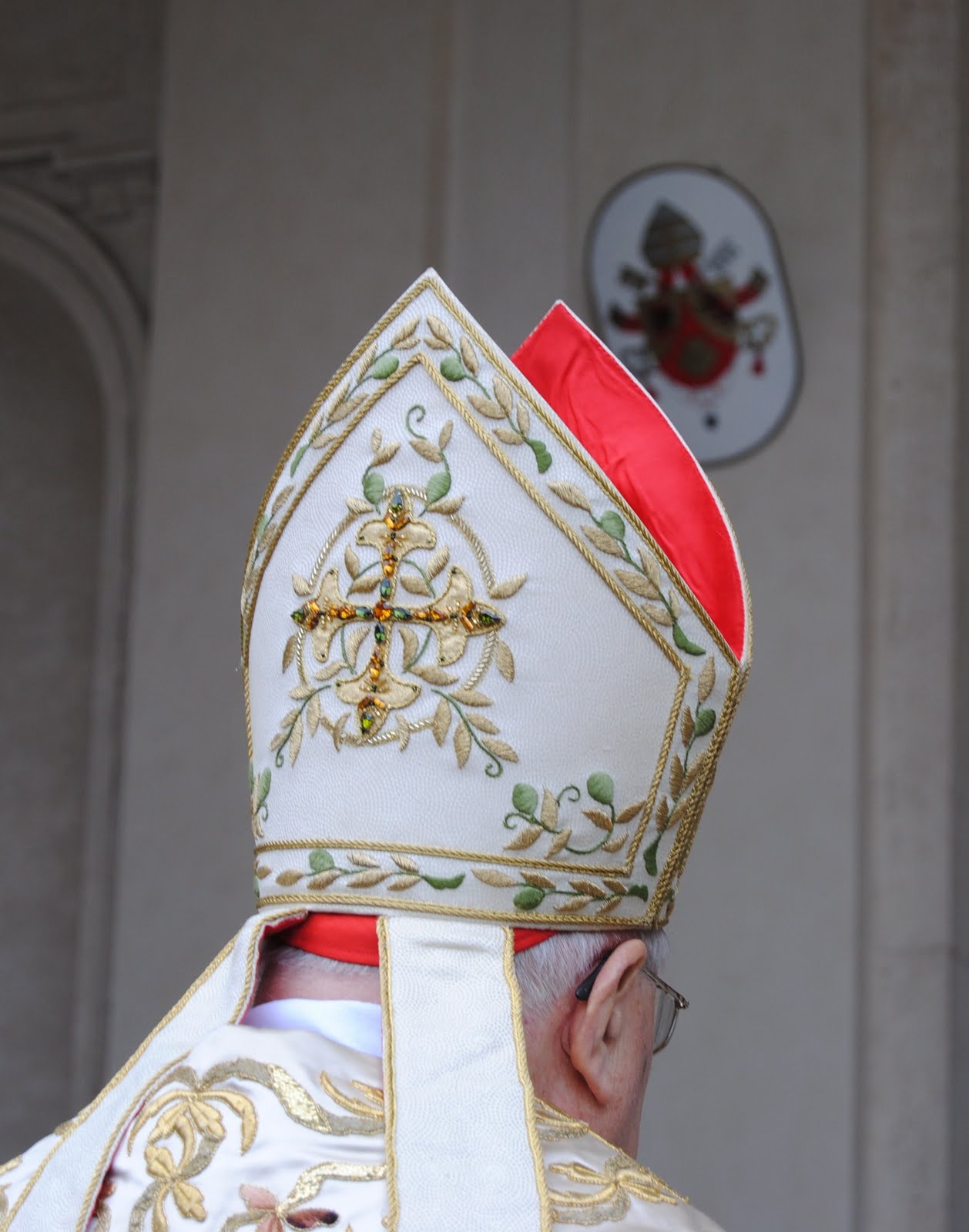
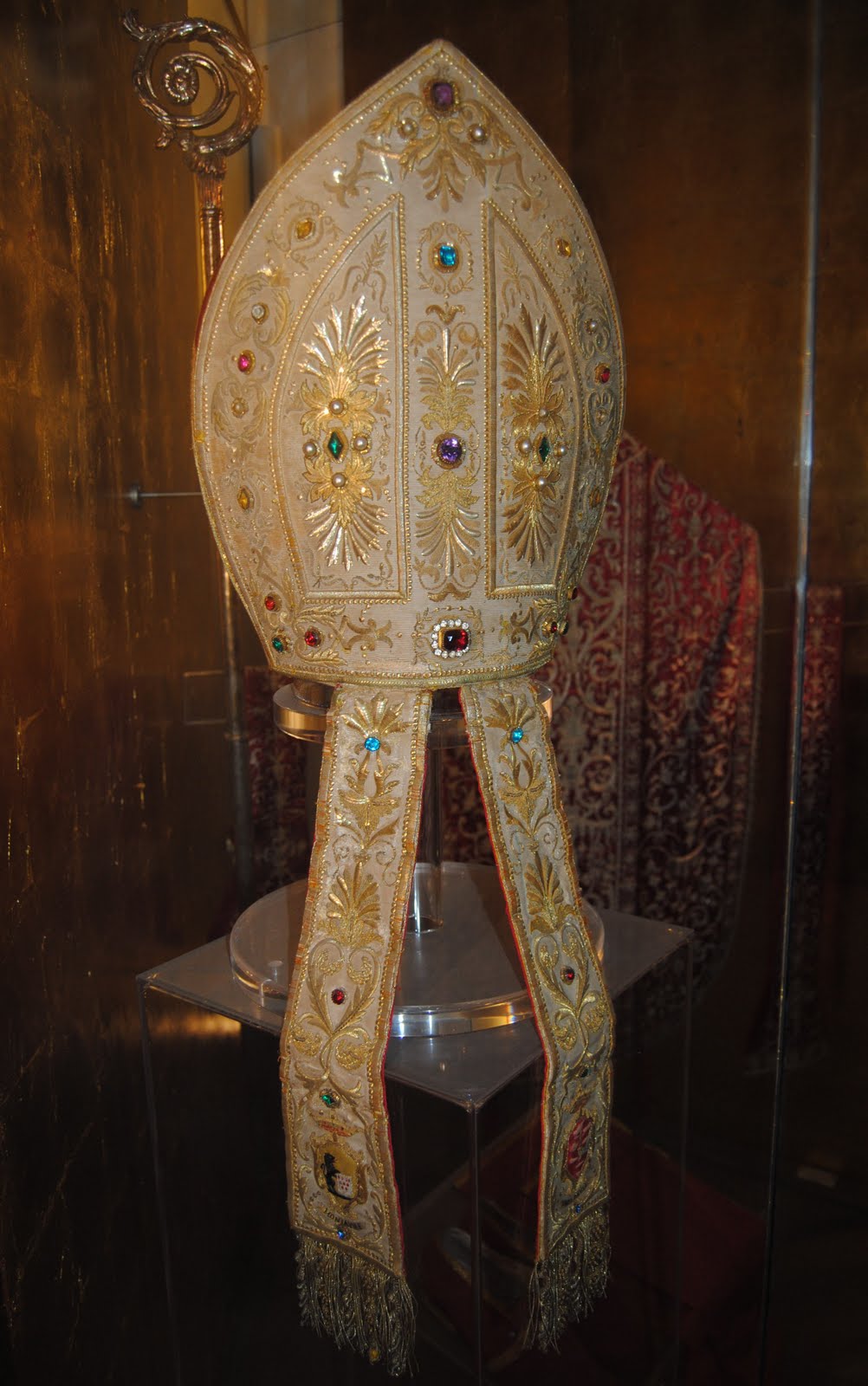
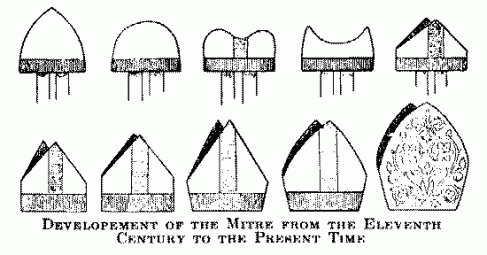
Worn over the zucchetto on the head, and was developed from the camelaucum, or the secular headdress of the late Roman Empire and early Byzantine Empire, where they are also worn by the Popes and the Roman priests, and gradually was restricted only to bishops and abbots.

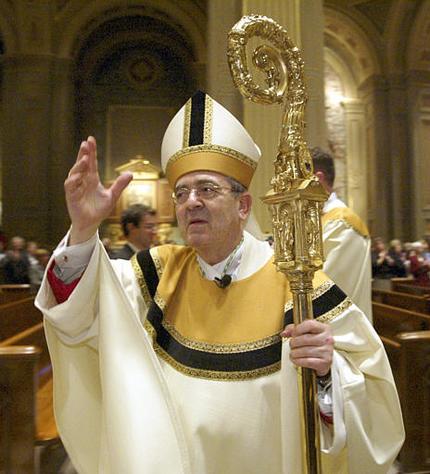
The mitre symbolises the teaching authority of the bishops, which are symbolised by the two peaks of the mitre, representing the Old and the New Testament, and also recall the flames of the Holy Spirit that inflame the hearts of the Apostles to spread the Good News to all peoples. Therefore, these represents the authority of the bishop to teach the Gospel through the Holy Spirit and based on the Scripture, the Word of God, both the Old and the New Testament. The two lappets behind the mitre themselves also represent the Old and the New Testament, the two sides of the Lord’s Sacred Scripture (which shape looks just like a book marker).


f. Crosier (Pastoral staff)
Image


Image


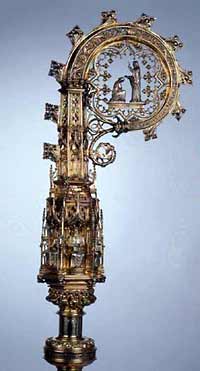
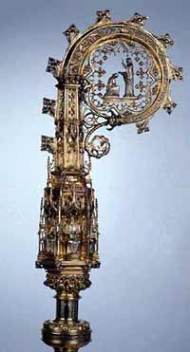
The crosier, or the pastoral staff is the crook-like staff, reminding us on the shepherd’s crook, which they use to shepherd their sheep. Thus, the crosier represents the bishops’ role as the shepherds of the people of God, and guide them in their journey towards the Lord, the Chief Shepherd, the Good Shepherd.


g. Pallium (only for Metropolitan Archbishops and the Pope)
Image

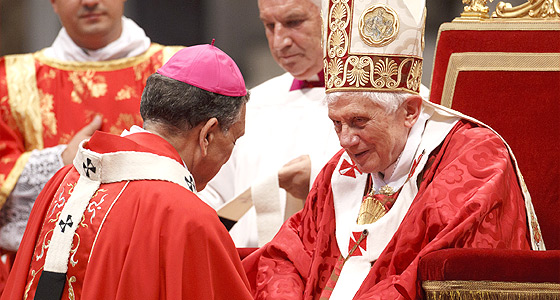
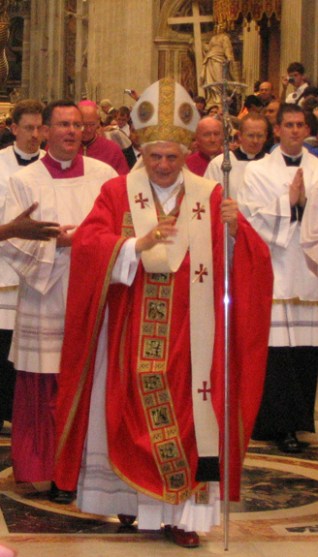
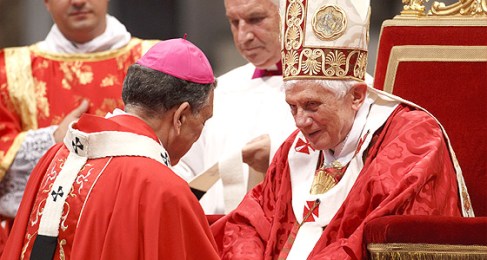
The pallium is a woolen band worn around the shoulder. This represent the metropolitan’s role as the overseer of the faithful, over the sheep of the Lord, that is the faithful people of God, just like Jesus, the Good Shepherd carrying His sheep on His shoulder. Therefore, the pallium represents both the authority of the metropolitan, and the burden presented by his ministry in the service of the Lord.

Image


Image

The pallium used to be much wider, as reflected in the earlier pallium that Pope Benedict XVI wore, which used the style not worn since a millenia ago, in the earlier days of the Church. Now the most common form of the pallium is a shorter and narrower woolen band worn around the shoulders, and adorned with three pins that represent the nails that pieced Christ on the cross, and these pins were placed onto the black crosses (red for Pope Benedict XVI’s new, larger pallium and the earlier, much larger pallium), which represent the wounds of Christ.


After all that, and after looking into what a bishop is, what is the nature of the ministry of the bishops, the types of bishops, what they wear and what symbolisms are there in them, let us now take a time to pray, and pray indeed for the soon-to-be ordained Coadjutor Archbishop, William Goh, of the Archdiocese of Singapore.

May God be with him all the days of his new ministry as bishop, and strengthen him at all times, that when his ministry begins this Friday, the Holy Spirit will guide him and keep him faithful to the ministry he has been chosen for, forever and ever. Amen!