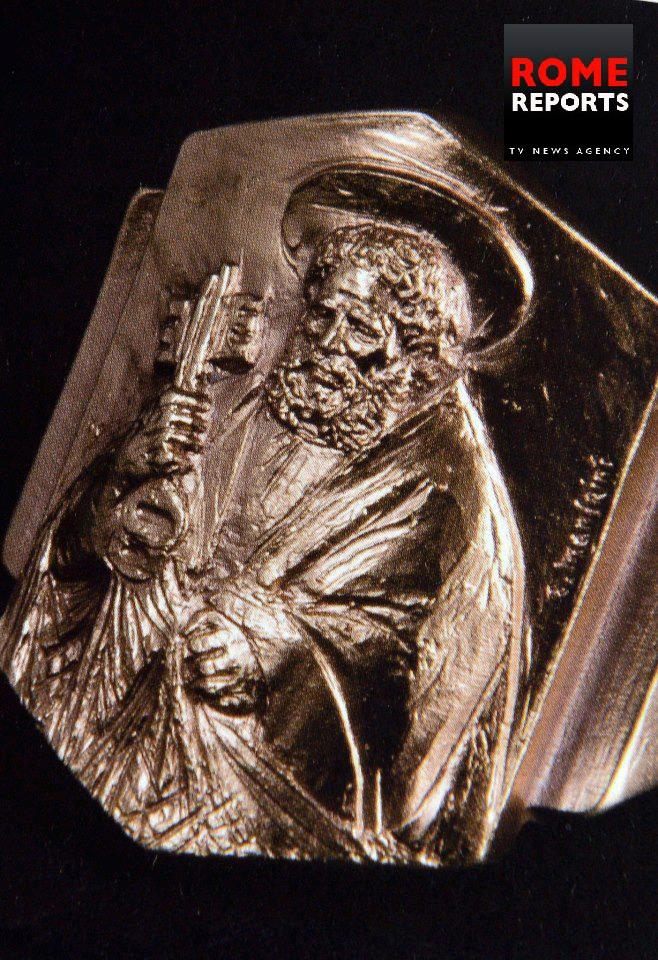
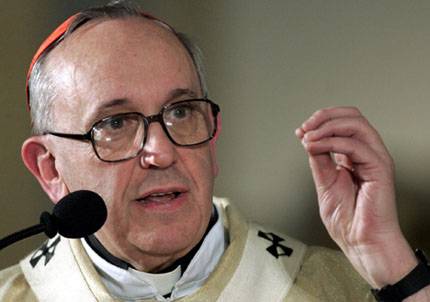
Ring of the Fisherman for Pope Francis, 266th Pope, Successor of St. Peter the Apostle, leader of the Universal Church

Image

Another image from Rome Reports

6719_10151417713052928_1657486910_n

Pope Francis’ Ring of the Fisherman, which is one of the symbol of the authority as the Pope, as both a bishop (episcopal ring) and the Successor of St. Peter the Apostle, leader of the entire Universal Church. It will be given to Pope Francis at the celebration of the Papal Inauguration Mass, on the Feast of St. Joseph, Tuesday, 19 March 2013, together with another symbol, that is the pallium.

The ring’s image closely follow that of Pope Benedict XVI’s Ring of the Fisherman, with slight difference in the shape of the ring, and the ring being made of gold-plated silver instead of gold. Depicted on the ring is the image of St. Peter holding onto the keys of the kingdom of heaven, and fishing, as he was a fisherman, but called by God to be a ‘fisher of man’.

Official Video by the Vatican on the Election of Pope Francis, 266th Pope and Bishop of Rome

The official video released by the Vatican in YouTube, with full coverage of the election of the Metropolitan Archbishop of Buenos Aires, Argentina, Jorge Maria Cardinal Bergoglio as Pope Francis, 266th Pope and Bishop of Rome, and the 265th Successor of St. Peter the Apostle.

Habemus Papam! Our new Pope, Jorge Maria Cardinal Bergoglio as Pope Francis I

Habemus Papam! We have a Pope!

Bergoglio

Jorge Maria Cardinal Bergoglio, Metropolitan Archbishop of Buenos Aires, who is 76 years old, had been elected the 265th Successor of St. Peter the Apostle, the 266th Pope and Bishop of Rome, on March 2013.

He has taken the name of Francis, and shall henceforth reign as Pope Francis I. The first non-European and first South/Latin American Pope.

List of possible regnal names for the new Pope, from Benedict to Peter

These are the list of all the possible regnal names (may not be entirely complete, since I may miss some in the way), that the new Pope can and may take as his own regnal name. In parentheses are how the name will look like if the Pope takes the name.

The ones listed below are the names that Popes had been taking since 1775 till today (2013) :

1. Benedict (Benedict XVII) last Benedict still living as Pope Emeritus

2. John Paul (John Paul III) last John Paul died in 2005

3. Paul (Paul VII) last Paul died in 1978

4. John (John XXIV) last John died in 1963, no John before that since 1334

5. Pius (Pius XIII) last Pius died in 1958

6. Leo (Leo XIV) last Leo died in 1903

7. Gregory (Gregory XVII) last Gregory died in 1846


Below are the names that the Popes had taken before 1775, but this does not rule them out from being picked by the new Pope, but chances are remote, with the above 7 names in use for the past 238 years.

8. Clement (Clement XV) last Clement died in1775

9. Innocent (Innocent XIV) last Innocent died in 1724

10. Alexander (Alexander IX) last Alexander died in 1691

11. Urban (Urban IX) last Urban died in 1644

12. Sixtus (Sixtus VI) last Sixtus died in 1590

13. Marcellus (Marcellus III) last Marcellus died in 1555

14. Julius (Julius IV) last Julius died in 1555

15. Adrian (Adrian VII) last Adrian died in 1523, last non-Italian Pope before 1978

16. Callixtus (Callixtus IV) last Callixtus died in 1458

17. Nicholas (Nicholas VI) last Nicholas died in 1455

18. Eugene (Eugene V) last Eugene died in 1447

19. Martin (Martin VI) last Martin died in 1431

20. Boniface (Boniface X) last Boniface died in 1404

21. Celestine (Celestine VI) last Celestine died in 1294, also a Saint, the famous Pope who resigned

22. Honorius (Honorius V) last Honorius died in 1287

23. Lucius (Lucius IV) last Lucius died in 1185

24. Anastasius (Anastasius V) last Anastasius died in 1154

25. Eugene (Eugene IV) last Eugene died in 1153

26. Gelasius (Gelasius III) last Gelasius died in 1119

27. Paschal (Paschal III) last Paschal died in 1118

28. Victor (Victor IV) last Victor died in 1087

29. Stephen (Stephen X) last Stephen died in 1058

30. Damasus (Damasus III) last Damasus died in 1048

31. Sylvester (Sylvester IV) last Sylvester died in 1045

32. Sergius (Sergius V) last Sergius died in 1012

33. Agapetus (Agapetus III) last Agapetus died in 955

34. Marinus (Marinus III) last Marinus died in 946

35. Lando/Landus (Landus II) only used once, died in 914, last Pope whose name is only used once

36. Theodore (Theodore III) last Theodore died in 897

37. Romanus (Romanus II) only used once, died in 897

38. Formosus (Formosus II) only used once, died in 896

39. Valentine (Valentine II) only used once, died in 827

40. Zachary (Zachary II) only used once, died in 752

41. Constantine (Constantine II) only used once, died in 715

42. Sisinnius (Sisinnius II) only used once, died in 708

43. Conon (Conon II) only used once, died in 687

44. Agatho (Agatho II) only used once, last one is Saint, died in 681

45. Donus (Donus II) only used once, last one died in 678

46. Adeodatus (Adeodatus III) last Adeodatus died in 676

47. Vitalian (Vitalian II) only used once, died in 672

48. Severinus (Severinus II) only used once, died in 640

49. Sabinian (Sabinian II) only used once, died in 606

50. Pelagius (Pelagius III) last Pelagius died in 590

51. Vigilius (Vigilius II) only used once, died in 555

52. Silverius (Silverius II) only used once, last one is Saint, died in 537

53. Felix (Felix V) last Felix died in 530


All the names below have been used only once, ever. Most of them are the early Church Fathers and Saints, and therefore, it is rather extremely unlikely any of these names would be picked.

54. Hormisdas (Hormisdas II) only used once, died in 523

55. Symmachus (Symmachus II) only used once, last one is Saint, died in 514

56. Simplicius (Simplicius II) only used once, last one is Saint, died in 483

57. Hilarius (Hilarius II) only used once, last one is Saint, died in 468

58. Zosimus (Zosimus II) only used once, last one is Saint, died in 418

59. Siricius (Siricius II) only used once, last one is Saint, died in 399

60. Liberius (Liberius II) only used once, died in 366

61. Mark (Mark II) only used once, last one is Saint, died in 336

62. Miltiades (Miltiades II) only used once, last one is Saint, died in 314, First Pope after Edict of Milan

63. Eusebius (Eusebius II) only used once, last one is Saint, died in 310

64. Marcellinus (Marcellinus II) only used once, last one is Saint, died in 304

65. Caius (Caius II) only used once, last one is Saint, died in 296

66. Eutychian (Eutychian II) only used once, last one is Saint, died in 283

67. Dionysius (Dionysius II) only used once, last one is Saint, died in 268

68. Cornelius (Cornelius II) only used once, last one is Saint, died in 253

69. Fabian (Fabian II) only used once, last one is Saint, died in 250

70. Anterus (Anterus II) only used once, last one is Saint, died in 236

71. Pontian (Pontian II) only used once, last one is Saint, died in 235

72. Zephyrinus (Zephyrinus II) only used once, last one is Saint, died in 217

73. Eleuterus (Eleuterus II) only used once, last one is Saint, died in 189

74. Soter (Soter II) only used once, last one is Saint, died in 174 or 175

75. Anicetus (Anicetus II) only used once, last one is Saint, died in 166

76. Hyginus (Hyginus II) only used once, last one is Saint, died in 140 or 142

77. Telesphorus (Telesphorus II) only used once, last one is Saint, died in 136 or 138

78. Evaristus (Evaristus II) only used once, last one is Saint, died in 105 or 107

79. Anacletus (Anacletus II) only used once, last one is Saint, died in 88 or 92

80. Linus (Linus II) only used once, last one is Saint, died in 76 or 79

81. Peter (Peter II) only used once, and he is the founder of the Church, Apostle of Jesus Christ, and it is extremely unlikely any future Pope, or any Pope will ever adopt the name of the Prince of the Apostles.

Cardinal Angelo Scola, Archbishop of Milan, the Papabile

http://www.eitb.com/en/news/world/detail/1282802/candidates-new-pope–profile-cardinal-angelo-scola/

From the article (My commentary at the end) :


Election of new pope

Profile of Cardinal Angelo Scola, Archbishop of Milan

APTN

03/11/2013

A conservative, and theologically close to both Pope Benedict and his predecessor John Paul II, Cardinal Scola is regarded as one of the leading European candidates to become Pope.

Cardinal Angelo Scola, the archbishop of Milan.

Cardinal Angelo Scola, the archbishop of Milan, shot to the top of a list of possible successors to Pope Benedict XVI almost immediately the resignation was announced.

A conservative, and theologically close to both Pope Benedict and his predecessor John Paul II, Cardinal Scola is regarded as one of the leading European candidates to become Pope.

Some observers tipped him to succeed after the death of John Paul II in 2005, but the conclave instead chose Cardinal Joseph Ratzinger who became Benedict XVI, the 265th pope.

But if there was rivalry between the candidates in 2005, it had little effect on their close relationship, and Scola remained a favourite of Pope Benedict’s, who appointed the Cardinal archbishop of the Milan Diocese in June 2011.

In the small town of Malgrate on Lake Como in northern Italy, many of the 5,000 residents are backing their hometown boy to become Pope. Scola was born in Malgrate on 7 November 1941 to a truck driver and a homemaker.

He entered the priesthood in 1970, became a Cardinal in 2003, serving first as Patriarch of Milan until he was elevated to his current post of archbishop.

Scola’s cousin, Angelo Colombo, remembers that during World War II he would spend time at his cousin’s home because Scola’s father was a truck driver and could get access to flour and bread.

Colombo said he would go to Scola’s family home, and his aunt and the future Cardinal would always share their food. When he asked if he thought his cousin would make a good Pope, Colombo laughed and responded: “he was a tough boy”.

Scola spent the early years of his life in a small home on Malgrate’s Salita Sant’Antonio. Alfredo Cagliandi was a classmate of Cardinal Scola and lived in the apartment below him.

“We would invite Angelo to come and play and he would repeatedly respond ‘I am sorry, but I don’t have time.’  He was too busy because was already involved in something religious,” said Cagliandi, who still lives in Malgrate.

Scola spent the first two decades after his 1970 ordination in the lecture halls and libraries of renowned Catholic universities and theological training grounds, notably in Fribourg, Switzerland, and the Lateran Pontifical University in Rome.

While pursuing theological studies, Scola was involved in Communion and Liberation, a conservative Italian Catholic group which blends political activism with faith-based fervour as it seeks to make its weight felt in the country’s decision-making.

Back in Scola’s home town, the local priest Father Andrea Lotterio proudly showed off the baptismal font where he says the town’s babies are still baptised today, noting that Scola was baptised there in 1941.

Father Lotterio said Scola has pleased the residents of Malgrate by never losing his strong ties to his hometown. “He has maintained his relationships with many local citizens, with his friends, with his relatives,” Lotterio said. “So much so that in this town he is called Don Angelo, instead of Cardinal or Patriarch of Venice.”

Pope Benedict resigned as leader of the Catholic Church on Thursday, becoming the first pope in 600 years to resign. For the time being, the governance of the Catholic Church shifts to Cardinal Tarcisio Bertone, the camerlengo, or chamberlain. Bertone, along with the College of Cardinals will guide the church and make plans for the conclave to elect the 266th leader within the next few weeks.


Commentary and additions:

Indeed, Cardinal Angelo Scola has many strengths and characteristics that we need as the new Pope to lead the Roman Catholic Church, the one and Universal Church. He does have his weaknesses, but his strengths more than made up for him. After all, it is human to have weaknesses and to make mistakes.

Cardinal Scola is media-savvy, able to reach out into the hearts of many, including youths and those in the world, who are longing for the Lord to come to them. Being media-savvy, and also internet-savvy, Cardinal Scola is not shy of using modern media tools, such as the internet, twitter, YouTube, his own site, and many other means to evangelise to the world, and to reach out, especially to youths.

Cardinal Scola also has a positive outlook and optimism in the Church, and indeed, instead of being pessimistic on the Church, and instead of looking at a Church in trouble, he dismissed all this, and all the lies that the media had brought about the Church, that the Church instead of being in chaos and trouble, is in fact growing, and filled with vibrant and strong faith and love in God, and Cardinal Scola has the capacity to tap into all these energies.

Cardinal Scola also came from a poorer family background, and he understood the plight of the poor and the less fortunate. His hometown people has often remembered him as someone who not only did not forget about where he came from, and where he was born, but also someone who constantly gives them his care and his love, in imitation of Christ and His care for the poor.

Cardinal Scola speaks Italian, English, French, and Spanish, and although his English is not that good, but he has quite a strong command of these languages, which are essential in the Pope’s ministry as the leader of the Universal Church.

Cardinal Scola’s initiatives to reach out to the Christians in the Holy Land and in other areas where Christians are minorities, and his involvement in interreligious dialogue and cooperation, and even with atheists, had been fruitful and crucial in strengthening Christians in the areas where they had been persecuted, and where persecutions are ongoing.

His experience in the Archdiocese of Milan, Patriarchate of Venice, and Diocese of Grosseto clearly showed that he is a pastoral leader with a humble and yet intellectual mind, that matches that of our beloved Pope Emeritus Benedict XVI. Yet, his experiences in the Roman Curia too were many, with works as leader of Pontifical Institute of Marriage and the Family, which he also took a strong stand with the Church in the sanctity of both marriage and the family.

His intellect, knowledge, and publications especially in topics like bioethics, in the midst of the attacks against Church’s stand on bioethics, cloning, and contraceptions will be essential for the future leader of the Church, and his ability to connect and reach out to people, more than Pope Emeritus Benedict XVI, will be valuable asset to have in the new Pope.

Nevertheless, now that the Conclave will begin soon, we continue to pray that God will pour His Holy Spirit on all the Cardinal-electors, that they can make a wise and inspired decision, to elect someone whom the Lord has chosen, as the best possible person to succeed His Apostle, Peter, and lead the whole Universal Church, that God Himself built in this world, to be the manifestation of His love, justice, and presence.

What is our faith really about? And how to answer questions that directly address our faith (From a comment)

You see how much lies evil had planted in the heart of many in this world to lead them away from the truth in God (From my blog’s comment and my reply). Do not reject them, and do not turn them away.

Especially if they ask you about your faith in God, through the Church, stand up tall, and shielded with our faith and knowledge of that faith that we have gained through the teachings of the Church, answer confidently, in courage, in love, and of course, offer a welcoming hand for them, and teach them the truth, that they too may join us in salvation in Christ.

Let us work together to accomplish the unity of all Christians in the One, Holy, Catholic, and Apostolic Church! Ut Omnes Unum Sint, ad Maiorem Dei Gloriam! That they all may be One, for the greater glory of God!

The comment :

What of the pope Petrus Romanus as described by St. Malachy in 1139 to be the next and final pope? St. Malachy’s final words regarding his full listing of all future popes (which has proven to be correct to the last detail) – “Rome, the seat of the Vatican, will be destroyed and the dreadful Judge will judge the people.”

Please pray to our Lord and Savior, our only Redeemer and mediator with God, Jesus Christ our one true King!
Ephesians 2:8-9; 1599 Geneva Bible (GNV)
8 For by [a]grace are ye saved through faith, and that not of yourselves: it is the gift of God,
9 [b]Not of works, lest any man should boast himself.

It is not through a church, catholic, evangelical, or other that we find our way. It is only with a relationship with Jesus, our Lord and Savior. It is not through saying rote prayers or seeking after a “favor” or “abolition” from any mere human (past or present).

It is only with our Lord Jesus. His mother Mary was highly “favored” which never meant she was to be placed higher than our Lord. Period. Seek after and follow Him and know others by the fruits of their hearts not the fruits of this world (fame or fortunes) as they are always meant to decieve.

Thank you for reading and seeking Him!

My reply :

I have no need to comment on that prophecy, which may after all be false and forgery. Even if that prophecy is true, it only showed that the Church led by the successor of blessed St. Peter the Apostle, remained faithful to the last, with that last Bishop of Rome as shepherd to feed the lambs of our Lord, through time of persecution of the Church, and even likely to suffer death at the hands of Satan and those who hated the Church and wished for its destruction, as it is the last bastion of Christ and His light in this world.

For grace and salvation is indeed through faith, but faith alone does not save one, and neither does work alone. For what you mentioned here of boasting is, work done without faith, but work done in faith serve only to affirm that faith in the Lord, and faith without works is dead. Faith needs to be alive, and nothing better to make it alive and manifest through our actions, in simple acts that we do in our daily lives, through our love for our neighbours and fellow men.

For believing solely in faith, to be frank, how do you even define faith? Faith is not mere words, and not mere ‘personal’ relationship, but it is as communal as it is personal. Nobody can have faith if they never show it through their good works following what Christ had taught us. It is a danger to believe that we are saved simply by faith, and then we can do as we like. Faith is through our love and works for our brethren, the poor, the weak, and the less fortunate, that through this living faith, we are justified by the Lord. Not enough by mere personal relations and personal dedications to God, for if that is the case, then the faith of the Pharisees would have been sufficient.

No! Christ mentioned that we are saved by faith, because this faith is not just once, and not just once and for all, and not through a single moment, but this faith is manifest throughout our entire life, and reflected through our prayers, our actions, and our concrete works for the good of others, and for the sake of God. The Church is the community through which we can make our faith manifest in this world even more.

Mary, the mother of our Lord, is never placed higher than our Lord Jesus Christ Himself. That is a severe misunderstanding of the true faith of our Church, and that is what people outside the Church had been led to believe by the evil one, so that they will too take part in destroying the very one and only Church that God had established.

Mary, as the mother of our Lord, in the faith of the Church, is the mother who brought Christ into this world, and through her perfect obedience of God’s will, by her answers to the Archangel Gabriel, the salvation of this world through Christ is possible. Her faith and love is proven throughout Christ’s life on earth, even to accompany Him on the foot of the Cross.

For Mary is our closest and most direct intercessor to our God, for who else is closer to Christ in this world than His own mother? Remember the wedding at Cana, when Christ apparently refused to perform the necessary miracle because ‘it was not yet His time’, but when Mary interceded for their sake, the Lord did listen and performed the miracle of water, turning into wine.

Therefore, we venerate Mary, not as a goddess, not as equal of God, but as a being so great, and so noble, and as the first and greatest of all the saints in heaven, all of whom pray for us ceaselessly before the Lord, and no one else in ever closer to God than Mary, His mother.

If only we humble ourselves and ask God, through Mary, His mother, in great humility and repentance, our prayers will surely be heard. It is of course up to God’s will, whether He will fulfill our wishes, but that is how great indeed that God works in His own mysterious ways.

Rosary, and all that dedication to Mary? Simply our way of adoring her, who is the greatest saint and the one who made all salvation possible through her acceptance of her mission, that is to bear Christ the Saviour in her, and taking care of our Lord all the way to Calvary.

She is the pillar of support of the Lord’s mission in salvation, and it is in this spirit that we dedicate our prayers through Mary, honouring her, and in honouring Mary, we honour her Son, our God.

Do not listen to the lies of Satan and the world, and learn the truth of God’s love through the Church. The Church is not perfect, and it is led by humble and sinful men, like all of us, but through the Church, and through the authority God has granted it via the Apostles, especially through Peter, God has made His power, His redemption, and His presence manifest in this world.

Our faith is communal as it is personal. It is not enough to just have a personal relationship in Christ, but we must also have a ‘communal relationship’, that is through the Church, that is the One, Holy, Catholic, and Apostolic Church.

God bless you, dear brother, and may God guide you to the truth, and be joined as one, that I, and all my brothers and sisters in Christ and in faith, can soon call you our brethren.

10,000th View : Thanks be to God, and pray for me as always!

Tonight, as of midnight and the beginning of the Fourth Sunday of Lent, Laetare Sunday, 10 March 2013, my blog has been viewed 10,000 times. I thank all the visitors who had visited my humble blog, with all its imperfections and mistakes, and thank you for all your encouragement and prayers.

Do continue to pray for me, and pray too for the Cardinal-electors, who will soon go into the Sistine Chapel for the Conclave, and we hope that by next week, we will already have a new Pope, a new shepherd for our Church, that is God’s Church He built on Peter, the Rock, and the leader of the Apostles.


Statistics (as of the end of Sunday, 10 March 2013)

Total View : 10,526

Total Visitors : 6,895

Days since beginning : 53


Statistics by Country (Total tabulated : 10,341)

1. United States of America (USA) : 3,817

2. Singapore : 2,851

3. Philippines : 632

4. United Kingdom (UK) : 470

5. Canada : 411

6. Italy : 196

7. Australia : 195

8. Malaysia : 163

9. France : 114

10. Ireland : 103

11. Indonesia : 86

12. Germany : 84

13. India : 82

14. Poland : 77

15. Netherlands : 57

16. Brazil : 55

17. Belgium : 44

18. Hong Kong : 40

19. Sweden : 38

20. Mexico : 36

21. Botswana : 35

22. Switzerland : 32

23. Hungary : 32

24. Nigeria : 30

25. Portugal : 30

26. Finland : 29

27. Croatia : 28

28. New Zealand : 27

29. Austria : 24

30. Spain : 22

31. Taiwan : 22

32. Malta : 19

33. Slovakia : 18

34. South Africa : 17

35. United Arab Emirates : 17

36. Slovenia : 16

37. Vietnam : 16

38. Thailand : 15

39. South Korea : 15

40. Egypt : 14

41. Greece : 14

42. Czech Republic : 14

43. Sri Lanka : 14

44. Colombia : 13

45. Japan : 13

46. Trinidad and Tobago : 13

47. Argentina : 13

48. Saudi Arabia : 11

49. Kenya : 11

50. Norway : 10

51. Jordan : 8

52. Cambodia : 8

53. Puerto Rico (USA) : 8

54. Tanzania : 8

55. Romania : 7

56. Russia : 7

57. Bolivia : 6

58. Brunei Darussalam : 6

59. Uganda : 6

60. Lebanon : 6

61. Cameroon : 6

62. Ukraine : 6

63. Israel : 6

64. Vatican City : 6

65. Belarus : 6

66. Bulgaria : 5

67. Ghana : 5

68. Pakistan : 5

69. Cyprus : 5

70. Nepal : 5

71. Serbia : 5

72. Bahamas : 5

73. Namibia : 5

74. Guam (USA) : 4

75. Panama : 4

76. Chile : 4

77. Jamaica : 4

78. Macau : 3

79. Nicaragua : 3

80. Lesotho : 3

81. El Salvador : 3

82. Zimbabwe : 3

83. Venezuela : 3

84. Rwanda : 3

85. Laos : 3

86. Luxembourg : 3

87. Denmark : 3

88. Latvia : 2

89. Kuwait : 2

90. Qatar : 2

91. Bermuda (UK) : 2

92. Grenada : 2

93. Turkey : 2

94. Haiti : 2

95. Guatemala : 2

96. Lithuania : 2

97. Monaco : 2

98. Peru : 2

99. Albania : 2

100. Mozambique : 2

101. Ecuador : 1

102. Papua New Guinea : 1

103. Libya : 1

104. Bangladesh : 1

105. Gibraltar (UK) : 1

106. Bosnia-Herzegovina : 1

107. Timor-Leste : 1

108. Swaziland : 1

109. Togo : 1

110. Uruguay : 1

111. Costa Rica : 1

112. Estonia : 1

113. Honduras : 1

114. Oman : 1


The Church is truly universal, isn’t it?

+Ut Omnes Unum Sint, ad Maiorem Dei gloriam
(That they all may be One, for the greater glory of God)

My Guide to the Papal Conclave : Part III (From the election of the new Pope to the Urbi et Orbi blessing by the new Pope)

Part II here : https://petercanisiusmichaeldavidkang.com/2013/03/09/my-guide-to-the-papal-conclave-part-ii-from-the-beginning-to-the-election-of-the-new-pope/


1. After the new Pope had accepted his election as Pope and leader of the Roman Catholic Church, there are several scenarios :


a. If he is already a bishop : The new Pope will immediately be the Bishop of Rome and leader of the Universal Church, the Successor of St. Peter the Apostle. Then he will immediately accept the homage of the Cardinal-electors gathered in the Conclave, after he changes his cardinal’s robes for the new, white papal robes in the Room of Tears.

b. If he is not yet a bishop : The new Pope will need to be immediately ordained a bishop following the proper order of the Ordination of bishops, and the senior Cardinal Bishop by seniority in the Conclave should be the principal consecrator. The new Pope can only receive homage of the Cardinals after his ordination to the episcopate (after he had been ordained a bishop).


2. The new Pope then leaves the Sistine Chapel main hall where the voting took place, into the special ‘Room of Tears’, where three sets of differently-sized white papal robes had been prepared for him to adjust to his size. The new Pope changes from his cardinal’s red robes into the white papal robes and then return to the main hall of the Sistine Chapel.


3. The new Pope, after dressed in the white papal robes (with the red mozzetta and the large state stole) will then receive the homage of all the Cardinals gathered in the Sistine Chapel.


4. New addition in 2013 Conclave : After the homage, the new Pope will proceed with all the Cardinal-electors from the Sistine Chapel to the Pauline Chapel. The new Pope will enter the Pauline Chapel alone, and pray before the Blessed Sacrament in the Chapel.


5. In the meanwhile, the most senior Cardinal in the order of deacons, that is the Cardinal Protodeacon (Cardinal Jean-Louis Tauran for the 2013 conclave) will then appear at the Loggia or the balcony of St. Peter’s Basilica to deliver the announcement of the election of a new Pope.


The formula :

The Cardinal Protodeacon will first greet the assembled people in St. Peter’s Square and throughout the world (done in 2005 conclave in different languages) :

1. Italian : Fratelli e sorelle carissimi

2. Spanish : Queridísimos hermanos y hermanas

3. French : Bien chers frères et sœurs

4. German : Liebe Brüder und Schwestern

5. English : Dear brothers and sisters


Then he continues :

Annuntio vobis gaudium magnum

I announce to you a great joy


Habemus Papam!

We have a Pope!


Eminentissimum ac Reverendissimum Dominum

The most eminent and reverend Lord


Dominum (New Pope’s first name/baptismal name) Sanctae Romanae Ecclesiae Cardinalem (New Pope’s surname)

Lord (New Pope’s first name/baptismal name) Cardinal (New Pope’s surname) of the Holy Roman Church


Qui sibi nomen imposuit (New Pope’s chosen regnal name and number)

Who takes for himself the name of (New Pope’s chosen regnal name and number)


5. After this, after a moment, the new Pope, led by a processional crucifix, made his appearance at the same balcony of St. Peter’s Basilica. He then may deliver his first address as Pope to the people gathered at the Square, and to the world.


6. After the address, then the new Pope will give his Urbi et Orbi special blessing (For the city of Rome (Urbi) and the world (Orbi)), with which is attached plenary indulgence, that is the forgiveness of all temporal sins, providing the people participates in full faith and repentance.


The text of the Urbi et Orbi blessing (Latin):

Sancti Apostoli Petrus et Paulus: de quorum potestate et auctoritate confidimus ipsi intercedant pro nobis ad Dominum.

(Amen)

Precibus et meritis beatæ Mariae semper Virginis, beati Michaelis Archangeli, beati Ioannis Baptistæ, et sanctorum Apostolorum Petri et Pauli et omnium Sanctorum misereatur vestri omnipotens Deus; et dimissis omnibus peccatis vestris, perducat vos Iesus Christus ad vitam æternam.

(Amen)

Indulgentiam, absolutionem et remissionem omnium peccatorum vestrorum, spatium verae et fructuosae poenitentiæ, cor semper penitens, et emendationem vitae, gratiam et consolationem Sancti Spiritus; et finalem perseverantiam in bonis operibus tribuat vobis omnipotens et misericors Dominus.

(Amen)

Et benedictio Dei omnipotentis, Patris et Filii et Spiritus Sancti descendat super vos et maneat semper.

(Amen)


Text of Urbi et Orbi blessing (English)

May the Holy Apostles Peter and Paul, in whose power and authority we have confidence, intercede on our behalf to the Lord.

(Amen)

Through the prayers and merits of the Blessed Mary ever Virgin, of Blessed Michael the Archangel, of Blessed John the Baptist, and of the Holy Apostles Peter and Paul, and of all the saints, may Almighty God have mercy on you, and with your sins forgiven, may Jesus Christ lead you into everlasting life.

(Amen)

May the Almighty and merciful Lord grant you indulgence, absolution, and remission of all your sins, time for a true and fruitful penance, an always repentant heart and amendment of life, the grace and consolation of the Holy Spirit, and final perseverance in good works.

(Amen)

And may the blessing of Almighty God, the Father, the Son, and the Holy Spirit, descend on you and remain with you always.

(Amen)


7. Then the new Pope takes his leave of the people, and return inside St. Peter’s Basilica. The long process of electing a new Pope is over, and the new Pope is now in charge in leading God’s Church in his given mission as the Successor of St. Peter the Apostle.


8. The Papal Inauguration Mass will take place several days after the election (does not have to be on a Sunday), to allow for the foreign dignitaries invited to the event to be able to arrive, to attend the Papal Inauguration Mass. The new Pope will receive his signs of office in this Inauguration, namely, the pallium and the Ring of the Fisherman. The Papal Inauguration most likely will take place at St. Peter’s Square.


9. The new Pope will take possession of his Cathedral, in an enthronement ceremony at the Cathedral of the Diocese of Rome (The Pope is the Bishop of Rome, and contrary to popular perceptions, St. Peter’s Basilica is not a Cathedral). The Cathedral of Rome is the Archbasilica of St. John Lateran

Complete name (Latin) : Archibasilica Sanctissimi Salvatoris et Sanctorum Ioannes Baptista et Evangelista in Laterano, Omnium urbis et orbis Ecclesiarum Mater et Caput

Complete name (English) : Archbasilica of the Most Holy Saviour, Saint John the Baptist, and Saint John the Evangelist in Lateran, Head and Mother Church of All the City and the Whole World

The Church, the Year of Faith, and Christian Unity : Ut Omnes Unum Sint (That they all may be One)

The Lord never said : “You are Peter, and I will make you the leader amongst thousands of churches and other leaders, and they can have their own customs and choose what they believe in, and we can also do what we like, and what we want.”

He did not say : “Peter, you will be one of the many, in a board of management of My ‘churches’, and that these churches were born from Me.”

No, what He truly said was :

“You are Peter, and on this Rock, I will build My Church (singular), and never will the powers of death overcome it. I will give you the keys of the kingdom of heaven : whatever you bind on earth shall be bound in heaven, and whatever you unbind on earth shall be unbound in heaven.”

For our Church is One, and all are united with the successor of St. Peter the Apostle, to whom God has entrusted to feed all of His sheep, and to whom He has entrusted the authority over all of the earth and mankind, the beloved people of God (‘whatever you bind on earth shall be bound in heaven, and whatever you unbind on earth shall be unbound in heaven’), and that there is only One Body of Christ, all believing in Christ, and obeying the elders God has appointed over them, of which Peter and his successors are the chief shepherds, the chief elders, who then report to the very Chief Shepherd who will come again at the end of time.

For our faith in Christ is communal as it is personal. This is why we have our bishops, and our beloved Pope, Peter’s successor. For if not so, then all of us can just be our own priests, and just by thinking that we are saved by simply say, “Lord, Lord, I believe in you.”, and shutting ourselves from everyone else, caring only about our salvation.

No, not only will we not be saved by that way, we will be condemned by God, who will judge our ignorance and failure to live our faith by helping others around us, who are less fortunate, and need our help.

When a house is divided against itself, how can it stand and survive? When Satan is divided against himself, he will perish and not stand, just as what Christ said to the Pharisees when they accused Him of using the power of Beelzebub, Satan’s liutenant in casting out demons.

So, therefore, how can God’s Church stand if we are divided against ourselves? In order for us to stand the persecution of Satan in this world, we must first unite and gather our strength, that when Satan and his angels come to scourge God’s beloved people, we will be united as one against him, and as one Church, God will make us all righteous when He comes again in glory.

Let us pray therefore, that in this Year of Faith, our faith in God will ever be strengthened, and will never falter, and that most importantly we can live this faith and put in into action that will be pleasing to the Lord, by serving our fellow men, and thus spreading His Gospel, not just by our words, but by our own actions.

Let us also pray that Ut Omnes Unum Sint, God’s great wish, that all of His faithful may be One, will be accomplished, that every Christian, and everyone who believes in Christ, will all return to the One, Holy, Catholic, and Apostolic Church, that is built by God, Christ Himself, on the rock of faith that is Peter. Amen!


+Ut Omnes Unum Sint, ad Maiorem Dei Gloriam+
(That they all may be One, for the greater glory of God)

Friday, 22 February 2013 : Feast of Chair of St. Peter the Apostle (Scripture Reflection)

Today, one might ask, why do we celebrate the feast of a chair? Why the chair of St. Peter? As we all should know, that all dioceses in the world has Cathedrals, one in each diocese, and in the Cathedral, there is a special ‘chair’ that only the ordinary or the bishop of the diocese can sit on. This is because that chair is the Cathedra, the bishop’s throne or seat, which represents his authority, which is given from the Lord Himself.

Where does this authority come from? Right, you all should know indeed, that it came eventually, down the centuries and millenia from the early leaders of the Church, who themselves receievd that power and authority from the Apostles, whose leader is Peter, who was then known as Simon, son of Jonah, or Simon Bar-Jona, the fisherman.

Simon answered out of great courage and speak out the truth sincerely about Christ, who is indeed the Messiah and the Son of the living God, who has come to save the world, although maybe none at that time has yet to understand that He has to do this through His suffering and ultimately death on the cross. But indeed, for the great act of faith that Simon showed, Christ entrusted him with His authority and power, as His vicar on earth, simply through the words that He mentioned, that He will give Simon the keys of the kingdom of heaven, and He will build His Church, that is all the faithful in Him, united as one Body, on him as the foundation.

Hence, that is why Christ renamed Simon as Peter, whose Aramaic (the language spoken at the time of Jesus) origin was Kephas/Kepha, which means rock, that was then translated to Greek as Petros, and then to Latin as Petrus, which all means rock. The Gospel indeed has some pun to the word as Christ did say, “You are Peter and on this Rock…”, which one may interpret as the play on the word Petros/Petrus/Kepha, and there are those, who said that the rock does not refer to Peter at all.

No, this cannot be, since that Rock does refer to Peter, and why? It is because of his great faith in Christ, that is like a great rock, will become the most suitable foundation of His Church on this world, for Peter himself later on, as the leader of the Church, rooted himself firmly in Christ, even to his death in Rome.

It does not mean that Peter did not falter in his faith and dedication to the Lord. As everyone should know, that Peter was well-known for his betrayal of the Lord, even after he said during the Last Supper that he would never leave or abandon the Lord, but when Jesus was tried and mocked, and someone suspected Peter of being Christ’s accomplice, he denied Christ three times, out of fear and uncertainty, seeing that the Lord he has always believed in, has now been judged and soon to be sentenced to death.

Nevertheless, it is not Peter’s failures that we should focus on, but rather, what happens after, as he should indeed be a role model to all of us, that after whenever we fall, we must rise up again and rise up ever stronger than before, even stronger than before we fall. It was Peter who led the Apostles in the days after the Crucifixion and the Resurrection of Christ, and it was to him that Christ asked, “Peter, do you love Me.”, also three times.

Just as we often heard indeed in the Bible that God is merciful and willing to forgive all who had erred but yet willing to fully turn themselves back towards Him again, the same thing was what Christ did to Peter. Peter knew that he had been forgiven, and he gave Christ the promise of undying and eternal love, and that he will never fail Him again as before. Christ then entrusted the care of all His sheep in this world, all those who believe in Him, in Peter, whom He then affirm as the leader of all the faithful, and His representative in this world.

It is at that point that Christ entrusted the keys of the kingdom of heaven, and built His Church, which began on Pentecost, with the coming of the Holy Spirit on the Apostles. It was Peter who defended Christ and gave a fiery speech, asking the people to believe in Christ, and caused many to convert to the cause of God, and therefore, marked the very beginning of the Church.

Through Peter, we have many of his successors, who are the Bishops of Rome. Why the Bishop of Rome? This is because, in the established tradition and the letters following the events of the New Testament, Peter would travel to Rome eventually and settled there, before being martyred by the Emperor Nero of the Roman Empire sometime in 67 AD, not long after the other great Apostle Paul, the Apostle of the Gentiles, who is also associated together with the Bishop of Rome.

St. Peter in his great humility, when he was about to be crucified, through which he will face his martyrdom, refused to be crucified in the same way as the Lord did, and thus chose to be crucified upside down. This is what we know now as the ‘upside-down’ cross, or the cross of St. Peter.

Many had misunderstood this ‘upside-down’ as the symbol of the Antichrist, when the Pope, for example Blessed Pope John Paul II utilised it on his chair during his visit to the Holy Land, which in fact is the symbol of his own authority as the successor of St. Peter, and the symbol of Peter’s humility in being crucified upside-down that he would not die the same way as Christ, as he felt unworthy to do so. Now that all of you know about this, tell those who has yet to know about this, that they too may know and not linger in falsehood, but remain in the truth.

The chair of St. Peter can be seen at the back of the High Altar below the famous Holy Spirit stained glass on the walls of St. Peter’s Basilica in the Vatican, which was built on the spot where St. Peter was buried after his martyrdom. This chair, which is armless, and made of wood and inlaid with precious metals, contains the materials from the original chair that was known to have been used by St. Peter himself when he was in Rome. In a sense, this was St. Peter’s cathedra, and thus, the very first seat of authority that was present in this world.

Many of the Bishops of Rome who succeeded Peter had been great Popes, and many too had been saints and great saints, contributing greatly to the growth of the Church of Christ to whom they are entrusted to, through Peter. Of course there are also some Popes who had been bad Popes, and were great sinners. We condemn what they did, which in one way or another have done bad to the Church of Christ and to the faithful, due to their failure to faithfully carry out the mission that has been entrusted by Christ to them through Peter.

The Popes, who are the Bishops of Rome, are human too, as St. Peter was, and therefore was also prone to sins and errors as other mankind are, but we had indeed gone a long way since St. Peter was entrusted with the keys of kingdom of heaven. After the Council of Trent, and the succeeding councils, the Church has rediscovered itself, and led by the Pope, who is the leader of all the faithful in Christ, we continue in our mission that Christ had given us, that is to spread the Gospel, the Good News to all, and to baptise everyone in the name of the Father, the Son, and the Holy Spirit.

Let us pray for our Pope, the successor of St. Peter the Apostle, that he will continue to carry out his mission entrusted to Him by Christ, and use the authority he was given to unite all the faithful in Christ. Now that our Pope, our beloved Pope Benedict XVI has decided to step down due to ill health, we pray for him that God will continue to watch over him in his retirement, and we pray for whoever his successor as the Bishop of Rome, St. Peter’s successor, will be. It is out  of the same humility that our Pope has decided to step aside, because he felt that someone else can better fulfill the roles and mission entrusted to the Popes since St. Peter, just like Peter himself humbly asked to be crucified upside-down to not die the way Christ died for the salvation of the world.

St. Peter the Apostle, you to whom Christ entrusted the keys of the kingdom of heaven, and upon whom He built His Church, pray for us, pray for our Pope Benedict XVI, your successor, and his successors, and pray for the new Coadjutor Archbishop of Singapore, Msgr. William Goh Seng Chye, who will be ordained today, and who will receive the authority given to him through the endless succession that came from you, and from Christ, who gave you the authority over the Church and the world. Pray for us, St. Peter. Amen.