Sunday, 13 October 2013 : 28th Sunday of Ordinary Time (Psalm)

Liturgical Colour : Green

Psalm 97 : 1, 2-3ab, 3cd-4

Sing to the Lord a new song, for He has done wonders; His right hand, His holy arm, has won victory for Him.

The Lord has shown His salvation, revealing His justice to the nations. He has not forgotten His love nor His faithfulness to Israel.

The farthest ends of the earth all have seen God’s saving power. All you lands, make a joyful noise to the Lord, break into song and sing praise.

Sunday, 13 October 2013 : 28th Sunday of Ordinary Time (First Reading)

Liturgical Colour : Green

2 Kings 5 : 14-17

So Naaman went down to the Jordan where he washed himself seven times as Elisha had ordered. His skin became soft like that of a child and he was cleansed.

Then Naaman returned to the man of God with all his men. He entered and said to him, “Now I know that there is no other God anywhere in the world but in Israel. I ask you to accept these gifts from your servant.”

But Elisha answered, “I swear by YHVH whom I serve, I will accept nothing.” And however much Naaman insisted, Elisha would not accept his gifts. So Naaman told him, “Since you refuse, let me get some sacks of soil from your land – the amount that two mules can carry. I shall use it to build an altar to YHVH, for I shall not offer sacrifices to any other god but Him.”

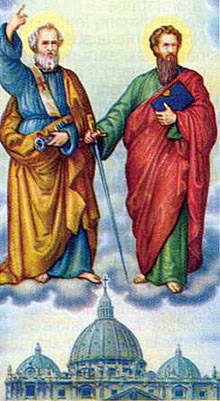
Peter’s Pence Collection, Solemnity of Saints Peter and Paul, Apostles

Peters Pence

In case any of you are wondering what is Peter’s Pence, which is collected every Sunday nearest to the Solemnity of Saints Peter and Paul, Apostles, which falls on 29 June every year (Therefore this year Peter’s Pence is collected on Sunday, 30 June 2013, 13th Sunday of Ordinary Time), Peter’s Pence is a special collection in which the collection will not go into the local church or parish fund, but gathered from all over the world and sent to Rome, to the Holy See. Thus, the collection made during the offertory this Sunday will go directly to Rome.

What is the purpose of the Peter’s Pence collection? Exactly to support the numerous charitable activities and organisations managed by the Holy See, by our Church, all over the world. There are thousands, tens of thousands of charity under the supervision of the Church, and to be able to continue with the action, funds are definitely necessary to provide a solid backing. That is why, Peter’s Pence is done once every year, on the Sunday nearest to the Solemnity of Saints Peter and Paul.

1045213_354782624625355_1349576998_n

Why Solemnity of Saints Peter and Paul? That is because on that day lie the great celebration of the two great saints and apostles that defined our Church, because they met their martyrdom in Rome. St. Peter, the Prince and leader of all the Apostles, whom the Pope is the successor of today, met his martyrdom in what is now Vatican City, through crucifixion, and St. Paul, the Apostle to the Gentiles, and author of the Epistles in the New Testament, met his martyrdom in Rome, through beheading.

Peter’s Pence itself had its origins in the late dark ages and early medieval period, particularly from England, where it got the name Peter’s ‘Pence’. Pence is the unit of money still in use until today in the United Kingdom and the related monetary units. ‘Peter’ simply point to the fact that the collection or ‘pence’ is intended to be sent to Rome, to the Pope, in order to support various Church activities.

Imposition of the pallium on the new Metropolitan Archbishops by Pope Francis

On the great Feast day and Solemnity of Saints Peter and Paul, Apostles, the feast day of the Church of Rome, on Saturday, 29 June 2013, 34 new Metropolitan Archbishops will receive the pallium, the symbol of their metropolitan office from Pope Francis, in a Mass at St. Peter’s Basilica.
Pallium (Pallium)
1_0_674753 (Papal Pallium)
Pallium is a woolen band, worn around the shoulders, as a symbol of office, representation of the Good Shepherd, with Jesus carrying the lamb on His shoulder, which is reminiscent of the authority entrusted upon the Metropolitan Archbishops over their flocks. Pallium therefore is a symbol of authority. It is about three fingers wide, and has six black crosses, out of which three are pierced with a golden pin, representing the wounds of Christ pierced by the holy nails on the cross.
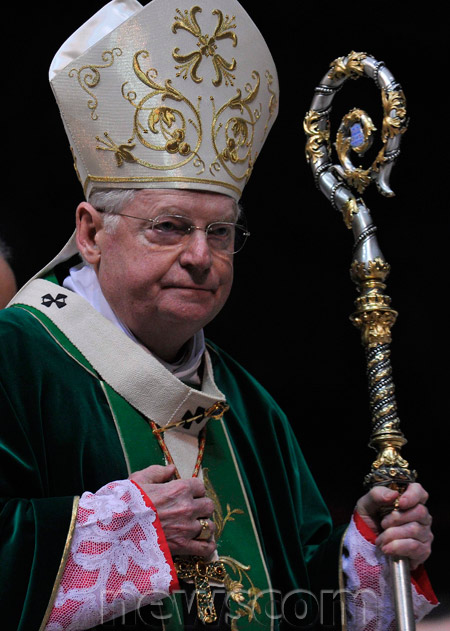
angelo-scola
(Above : image of Cardinal Angelo Scola, wearing the pallium, as the Metropolitan Archbishop of Milan, who received the pallium personally from Pope Benedict XVI in 2011)
Papal pallium from 2005 is different, in order to distinguish the nature of the Papal office, as the Pope is not just any bishop or Metropolitan Archbishop, but is Metropolitan over the entire world, the entire Church, as the Vicar of Christ.
Pope-Benedict-XVI
(Above : Pope Benedict XVI with the Papal pallium in 2012)

The list of the new Metropolitan Archbishops who will receive the pallium below.

1. Patriarch Manuel Jose Macario do Nascimento Clemente, Patriarch of Lisbon (Portugal)
2. Archbishop Dieudonne Nzapalainga, C.S.Sp., Metropolitan Archbishop of Bangui (Central African Republic)
3. Archbishop Carlo Roberto Maria Redaelli, Metropolitan Archbishop of Gorizia (Italy)
4. Archbishop Claudio Dalla Zuanna, S.C.I., Metropolitan Archbishop of Beira (Mozambique)
5. Archbishop Prakash Mallavarapu, Metropolitan Archbishop of Visakhapatnam (India)
6. Archbishop Antonio Carlos Altieri, S.D.B., Metropolitan Archbishop of Passo Fundo (Brazil)
7. Archbishop Marek Jedraszewski, Metropolitan Archbishop of Lodz (Poland)
8. Archbishop Philip Tartaglia, Metropolitan Archbishop of Glasgow (Great Britain)
9. Archbishop Salvatore Joseph Cordileone, Metropolitan Archbishop of San Francisco (USA)
10. Archbishop Rolando Joven Tria Tirona, O.C.D., Metropolitan Archbishop of Caceres (Philippines)
11. Archbishop Rogelio Cabrera Lopez, Metropolitan Archbishop of Monterrey (Mexico)
12. Archbishop Joseph William Tobin, C.Ss.R., Metropolitan Archbishop of Indianapolis (USA)
13. Archbishop Carlos Maria Franzini, Metropolitan Archbishop of Mendoza (Argentina)
14. Archbishop Lorenzo Ghizzoni, Metropolitan Archbishop of Ravenna-Cervia (Italy)
15. Archbishop George Antonysamy, Metropolitan Archbishop of Madras and Mylapore (India)
16. Archbishop Anil Joseph Thomas Couto, Metropolitan Archbishop of Delhi (India)
17. Archbishop John Wong Soo Kau, Metropolitan Archbishop of Kota Kinabalu (Malaysia)
18. Archbishop Murray Chatlain, Metropolitan Archbishop of Keewatin-Le Pas (Canada)
19. Archbishop Sérgio Eduardo Castriani, C.S.Sp., Metropolitan Archbishop of Manaus (Brazil)
20. Archbishop Peter Loy Chong, Metropolitan Archbishop of Suva, (Fiji)
21. Archbishop Alfonso Cortes Contreras, Metropolitan Archbishop of Leon (Mexico)
22. Archbishop Alexander King Sample, Metropolitan Archbishop of Portland in Oregon (USA)
23. Archbishop Joseph Effiong Ekuwem, Metropolitan Archbishop of Calabar (Nigeria)
24. Archbishop Jesus Juarez Parraga, S.D.B., Metropolitan Archbishop of Sucre (Bolivia)
25. Archbishop Fabio Martinez Castilla, Metropolitan Archbishop of Tuxtla Gutierrez (Mexico)
26. Archbishop Ramon Alfredo Dus, Metropolitan Archbishop of Resistencia (Argentina)
27. Archbishop Mario Aurelio Poli, Metropolitan Archbishop of Buenos Aires (Argentina)
28. Archbishop Gintaras Linas Grusas, Metropolitan Archbishop of Vilnius (Lithuania)
29. Archbishop Michael Owen Jackels, Metropolitan Archbishop of Dubuque (USA)
30. Archbishop Duro Hranic, Metropolitan Archbishop of Dakovo-Osijek (Croatia)
31. Archbishop Moacir Silva, Metropolitan Archbishop of Ribeirao Preto (Brazil)
32. Archbishop Jozef Piotr Kupny, Metropolitan Archbishop of Wroclaw (Poland)
33. Archbishop Sergio Alfredo Gualberti Calandrina, Metropolitan Archbishop of Santa Cruz de la Sierra (Bolivia)
34. Archbishop Giuseppe Petrocchi, Metropolitan Archbishop of L’Aquila (Italy)
In addition, the Metropolitan Archbishop of Hue, Archbishop Francois Xavier Le Van Hong, will not receive the pallium directly from the Pope in Rome, but in his home diocese of Hue, through the papal representative. Therefore, in addition to the 34 Metropolitan Archbishops mentioned above, 35 Metropolitan Archbishops will receive the pallium in this year.
35. Archbishop Francois Xavier Le Van Hong, Metropolitan Archbishop of Hue (Vietnam)

Metropolitan Archbishop differs from normal Archbishops in that, they have jurisdiction over other dioceses that are placed under their supervision, in a group called Ecclesiastical Province of the Church. Archbishops of Archdioceses without Metropolitan character has no jurisdiction over any dioceses under them, and they are usually directly subject to the Holy See.

Pope Francis’ Schedule of Celebrations and Events from May to July 2013 (After Pentecost to World Youth Day)

http://attualita.vatican.va/sala-stampa/bollettino/2013/05/17/news/31002.html

Pope Francis’ schedule for the months of May to July 2013 (After Pentecost Sunday to World Youth Day 2013)


May 2013


Thursday, 23 May 2013 at 6 pm in the Basilica of St. Peter, Vatican

Profession of faith with the bishops of the Italian Episcopal Conference (CEI)


Sunday, 26 May 2013 at 9.30 am (Solemnity of the Most Holy Trinity)

Visit to the Parish of St. Elizabeth and Zachary in the Diocese of Rome, followed by Holy Mass


Thursday, 30 May 2013 at 7 pm in the Lateran Square (in front of the Lateran Basilica)

Holy Mass of the Solemnity of the Most Precious Body and Blood of our Lord (Corpus Christi), followed by Eucharistic Adoration and Procession to the Basilica of St. Mary Major.


June 2013


Sunday, 2 June 2013 (9th Ordinary Sunday) at 6 pm in the Basilica of St. Peter, Vatican

Eucharistic Adoration


Sunday, 16 June 2013 (11th Ordinary Sunday)at 10.30 am in the St. Peter’s Square, Vatican

Holy Mass to commemorate the Encyclical (by Blessed Pope John Paul II) Evangelium Vitae, on the Sanctity of Life (Literal : The Gospel of Life)


Saturday, 29 June 2013 at 9.30 am in the Basilica of St. Peter, Vatican

Holy Mass of the great Solemnity of Sts. Peter and Paul, with the imposition of the pallium on the newly appointed Metropolitan Archbishops by the Pope


July 2013


Sunday, 7 July 2013 (14th Ordinary Sunday) at 9.30 am in the Basilica of St. Peter, Vatican

Holy Mass with seminarians and religious novices


Monday, 22 July 2013 – Monday, 29 July 2013

World Youth Day 2013 celebrations in Rio de Janeiro, Brazil

Pope Francis’ Schedule for April and May 2013

http://www.news.va/en/news/liturgical-celebrations-to-be-presided-over-by-p-2


APRIL
7 April, Second Sunday of Easter, or Divine Mercy Sunday: 5:30pm, Mass in the Basilica of St. John Lateran for the Bishop of Rome to take possession of the Roman cathedra.
14 April, Sunday: 5:30pm, Mass in the Basilica of St. Paul Outside-the-Walls
21 April, Sunday: 9:30am, Mass and priestly ordinations in St. Peter’s Basilica.
28 April, Sunday: 10:00am, Mass and confirmations in St. Peter’s Square.
 
MAY
4 May, Saturday: 6:00pm, Recitation of the Rosary in the Basilica of St. Mary Major.
5 May, Sunday: 10:00am, Mass for Confraternities in St. Peter’s Square.
12 May, Sunday: 9:30am, Mass and canonizations of Blesseds Antonio Primaldo and Companions; Laura di Santa Caterina da Siena Montoya y Upegui; and Maria Guadalupe Garcia Zavala.
18 May, Saturday: 6:00pm, Pentecost Vigil in St. Peter’s Square with the participation of ecclesial movements.
19 May, Pentecost Sunday: 10:00am, Mass in St. Peter’s Square with the participation of ecclesial movements.

Holy Week Mass schedule (Live) with Pope Francis in Rome and the Vatican

Here is the schedule for Papal celebrations of Pope Francis for Holy Week in Rome :


(Live from Rome Reports : http://www.romereports.com/palio/modules.php?name=Content3&pa=showpage&newlang=english&pid=47#.UU4b91fTear)

(Live from Vatican Player : http://vatican.va/video/)

(Live from Vatican YouTube : http://youtube.com/vatican/)


1. Palm Sunday (Solemn Entry into Jerusalem) : Sunday, 24 March 2013 at 9.30 am Rome time / CET / UTC+1 (St. Peter’s Square)

2. Chrism Mass (Blessing of the Holy Oils) : Thursday, 28 March 2013 at 9.30 am Rome time / CET / UTC+1 (St. Peter’s Basilica)

3. Cena Domini (Mass of the Lord’s Supper) : Thursday, 28 March 2013 at 5.30 pm Rome time / CET / UTC+1 (Casa del Marmo prison)

4. Good Friday (Passion of our Lord Jesus Christ) : Friday, 29 March 2013 at 5 pm Rome time / CET / UTC+1 (St. Peter’s Basilica)

5. Way of the Cross at Colosseum : Friday, 29 March 2013 at 9 pm Rome time / CET / UTC+1 (Colosseum)

6. Easter Vigil (Resurrection of our Lord Jesus Christ) : Saturday, 30 March 2013 at 9 pm Rome time / CET / UTC+1 (St. Peter’s Basilica)

7. Easter Sunday (Resurrection of our Lord Jesus Christ) : Sunday, 31 March 2013 at 10 am Rome time / CET / UTC+1 (St. Peter’s Square)

8. Urbi et Orbi Blessing of Easter (Blessing to the city of Rome and the world) : Sunday, 31 March 2013 at 12 pm (noon) Rome time / CET / UTC+1 (St. Peter’s Square)

Details on the Papal Inauguration Mass and ceremony of Pope Francis, 266th Pope and Bishop of Rome

Mass appeal: some details of tomorrow’s papal inauguration—UPDATED

Today, Tuesday, 19 March 2013, our new Pope will be solemnly inaugurated to begin his Pontificate. He is already our Pope, ever since he accepted the rightful election in the Conclave, but the Inauguration ceremony affirms and completes that process, with the imposition of the symbols of the authority of the Pope, as the leader of the entire Universal Church.

There will be some changes to the liturgy this year, as the imposition of the Pallium and the Ring of the Fisherman will take place just before the Mass starts, instead of being within the Mass itself, as the impositions are seen as more of an extra-liturgical event.

The Pope will pray with the leaders of the Eastern Catholic Churches, the Patriarchs and Major Archbishops at the Tomb of St. Peter underneath the main altar of St. Peter’s Basilica, where the pallium and the ring had been placed since the night before.

The Pope will then proceed with all the other concelebrating Cardinals and prelates outside to the Altar at St. Peter’s Square, which in the meanwhile the Laudes Regia hymn or ‘Laud to the King (Christ)’, that is a glorious rendition of the Litany of the Saints, with the new innovation of the inclusion of part asking the past Popes who had been canonised as saints for the new Pope, their successor, beginning from Pope St. Linus to Pope St. Pius X.

Following after this is the imposition of the papal pallium, which is different from the pallium worn by the Metropolitan Archbishops. Pope Francis’ pallium will be the same in appearance with that of Pope Benedict XVI’s pallium, with red crosses instead of black ones, representing the wounds of Christ, with three gold pins on three of the crosses, representing the nails that bound both hands and the legs of Christ onto the cross. The pallium symbolises the authority the Pope has over the entire Universal Church. The pallium will be imposed by the senior Cardinal of the order of Priest in the Cardinal-electorate, Cardinal Godfried Danneels.

The Ring of the Fisherman will be given after this, which signifies the bond between the Pope and God’s Church, and as the image on the ring depicts, that of St. Peter holding the keys on a boat, while fishing, as a fisher of man, it symbolises the Pope’s role as the successor of St. Peter the Apostle, and also as the current holders of the keys of the kingdom of Heaven, entrusted by Christ to Peter. The ring will be presented to the Pope by the senior Cardinal Deacon, Cardinal Jean-Louis Tauran.

Six Cardinals representing the rest of the Cardinals will pay homage to the Pope, and will give their obedience to him, following the imposition of the pallium and the Ring of the Fisherman.

The Mass follows as usual, and the readings will be done in different languages, English, Spanish, and most notably the Gospel in Greek, to highlight the universal nature of the Church, encasing both the Western and Eastern tradition of Christendom. The whole liturgy of the Mass itself will be conducted in solemn Latin and beautiful Gregorian chants.

The booklet for the Mass is available at the link below, in English, Italian, and Latin :

Click to access 20130319_inizio-ministero-petrino.pdf

(Special) Mass for the Election of the Roman Pontiff / Missa pro Eligendo Pontifice (Psalm)

Psalm 88 : 4-5, 21-22, 25 and 27

I have made a covenant with David, My chosen one; I have made a pledge to my servant. I establish his descendants forever; I build his throne for all generations.

I have found David My servant, and with My holy oil I have anointed him. My hand will be ever with him and My arm will sustain him.

My faithfulness and love will be with him, and by my help he will be strong. He will call on Me, “You are my Father, my God, my Rock, my Saviour.”

Homily of the Dean of the College of Cardinals, Cardinal Angelo Sodano, at the Mass for the Election of the Roman Pontiff / Missa pro Eligendo Pontifice

http://www.zenit.org/en/articles/cardinal-angelo-sodano-s-homily-at-the-missa-pro-eligendo-pontifice


Homily of Cardinal Angelo Sodano
Dean of the College of Cardinals
Vatican Basilica – March 12, 2013

Dear Concelebrants, Distinct Authorities, Brothers and Sisters in Christ,

“Forever I will sing the mercies of the Lord” is the hymn that resounds once again near the tomb of the Apostle Peter in this important hour of the history of the Holy Church of Christ.

These are the words of Psalm 88 that have flowed from our lips to adore, give thanks and beg the Father who is in heaven. “Misericordias Domini in aeternum cantabo”: is the beautiful Latin text that has introduced us into contemplation of the One who always watches over his Church with love, sustaining her on her journey down through the ages, and giving her life through his Holy Spirit.

Such an interior attitude is ours today as we wish to offer ourselves with Christ to the Father who is in heaven, to thank him for the loving assistance that he always reserves for the Holy Church, and in particular for the brilliant Pontificate that he granted to us through the life and work of the 265th Successor of Peter, the beloved and venerable Pontiff Benedict XVI, to whom we renew in this moment all of our gratitude.

At the same time today, we implore the Lord, that through the pastoral sollicitude of the Cardinal Fathers, He may soon grant another Good Shepherd to his Holy Church. In this hour, faith in the promise of Christ sustains us in the indefectible character of the church. Indeed Jesus said to Peter: “You are Peter and on this rock I will build my Church, and the gates of hell shall not prevail against her.” (Mt. 16:18).

My brothers, the readings of the World of God that we have just heard can help us better understand the mission that Christ has entrusted to Peter and to his successors.

1. The Message of Love

The first reading has offered us once again a well-known oracle from the second part of the book of Isaiah that is known as “the book of consolation” (Isaiah 40-66). It is a prophecy addressed to the people of Israel who are in exile in Babylon. Through this prophecy, God announces that he will send a Messiah full of mercy, a Messiah who would say: “The spirit of the Lord God is upon me… he has sent me to bring good news to the poor, to bind up the wounds of broken hearts, to proclaim liberty to captives, freedom to prisoners, and to announce a year of mercy of the Lord” (Isaiah 61:1-3).

The fulfillment of such a prophecy is fully realized in Jesus, who came into the world to make present the love of the Father for all people. It is a love which is especially felt in contact with suffering, injustice, poverty and all human frailty, both physical and moral. It is especially found in the well known encyclical of Pope John Paul II, “Dives in Misericordia” where we read: “It is precisely the mode and sphere in which love manifests itself that in biblical language is called “mercy” (n. 3).

This mission of mercy has been entrusted by Christ to the pastors of his Church. It is a mission that is entrustedd by every priest and bishop, but is especially entrusted to the Bishop of Rome, Shepherd of the universal Church. It is infact to Peter that Jesus said: “Simon son of John, do you love me more than these?… Feed my lambs (John 21:15). In his commentary on these words, St. Augustine wrote: “May it be therefore the task of love to feed the flock of the Lord” (In Iohannis Evangelium, 123, 5; PL 35, 1967).

It is indeed this love that urges the Pastors of the Church to undertake their mission of service of the people of every age, from immediate charitable work even to the highest form of service, that of offering to every person the light of the Gospel and the strength of grace. This is what Benedict XVI wrote in his Lenten Message for this year (n.3). “Sometimes we tend, in fact, to reduce the term “charity” to solidarity or simply humanitarian aid. It is important, however, to remember that the greatest work of charity is evangelization, which is the “ministry of the word”. There is no action more beneficial – and therefore more charitable – towards one’s neighbor than to break the bread of the word of God, to share with him the Good News of the Gospel, to introduce him to a relationship with God: evangelization thus becomes the highest and the most integral promotion of the human person. As the Servant of God Pope Paul VI wrote in the Encyclical Populorum Progressio, the proclamation of Christ is the first and principal contributor to development (cf. n. 16).”

2. The message of unity

The second reading is taken from the letter to the Ephesians., written by the Apostle Paul in this very city of Rome during his first imprisonment (62-63 A.D.)

It is a sublime letter in which Paul presents the mystery of Christ and his Church. While the first part is doctrinal (ch.1-3), the second part, from which today’s reading is taken, has a much more pastoral tone (ch. 4-6). In this part Paul teaches the practical consequences of the doctrine that was previously presented and begins with a strong appeal for church unity: “As a prisoner for the Lord, then, I urge you to live a life worthy of the calling you have received. Be completely humble and gentle; be patient, bearing with one another in love. Make every effort to keep the unity of the Spirit through the bond of peace.(Eph 4,1-3).

St. Paul then explains that in the unity of the Church, there is a diversity of gifts, according to the manifold grace of Christ, but this diversity is in function of the building up of the one body of Christ. “So Christ himself gave the apostles, the prophets, the evangelists, the pastors and teachers, to equip his people for works of service, so that the body of Christ may be built up (Eph 4:11-12).

It is for the very unity of His mystical body that Christ then has sent His Holy Spirit and, at the same time, He has established His apostles and among them Peter, who takes the lead, as the visible foundation of the unity of the Church.

In our text, St. Paul teaches that each of us must work to build up the unity of the Church, so that “From him the whole body, joined and held together by every supporting ligament, grows and builds itself up in love, as each part does its work (Eph 4:16). Each of us is therefore called to cooperate with the Successor of Peter, the visible foundation of such an ecclesial unity.

3. The Mission of the Pope

Brothers and sisters in Christ today’s Gospel takes us back to the Last Supper, when the Lord said to his Apostles: “This is my commandment: that you love one another as I have loved you” (John 15:12). The text is linked to the first reading from the Messiah’s actions in the first reading from the prophet Isaiah, reminding us that the fundamental attitude of the Pastors of the Church is love. It is this love that urges us to offer our own lives for our brothers and sisters. Jesus himself tells us: “There is no greater love than to lay down one’s life for one’s friends” (John 15:12).

The basic attitude of every good Shepherd is therefore to lay down one’s life for his sheep (John 10:15). This also applies to the Successor of Peter, Pastor of the Universal Church. As high and universal the pastoral office, so much greater must be the charity of the Shepherd. In the heart of every Successor of Peter, the words spoken one day by the Divine Master to the humble fisherman of Galilee have resounded: “Diligis me plus his? Pasce agnos meos… pasce oves meas”; “Do you love me more than these? Feed my lambs… feed my sheep!” (John 21:15-17)

In the wake of this service of love toward the Church and towards all of humanity, the last popes have been builders of so many good initiatives for people and for the international community, tirelessly promoting justice and peace. Let us pray that the future Pope may continue this unceasing work on the world level.

Moreover, this service of charity is part of the intimate nature of the Church. Pope Benedict XVI reminded us of this fact when he said: “The service of charity is also a constitutive element of the Church’s mission and an indispensable expression of her very being; (Apostolic Letter in the form of a Motu Proprio Intima Ecclesiae natura, November 11, 2012, introduction; cf. Deus caritas est, n. 25).

It is this mission of charity that is proper to the Church, and in a particular way is proper to the Church of Rome, that in the beautiful expression of St. Ignatius of Antioch, is the Church that “presides in charity” “praesidet caritati” (cf. Ad Romanos (preface).; Lumen Gentium, n. 13).

My brothers, let us pray that the Lord will grant us a Pontiff who will embrace this noble mission with a generous heart. We ask this of the Lord, through the intercession of Mary most holy, Queen of the Apostles and of all the Martyrs and Saints, who through the course of history, made this Church of Rome glorious through the ages. Amen.